REVIEW 4 major objections 4 minor 1 cited by
Eliminating Gibbs Phenomena: A Non-linear Petrov-Galerkin Method for the Convection-Diffusion-Reaction Equation
T0 review · 4 major / 4 minor · reviewed 2026-08-14 · deepseek-v4-flash
Pith's one-line read A nonlinear Petrov-Galerkin method that minimizes residuals in Lq spaces makes numerical approximations of convection-dominated problems track the Lq-best approximation, so driving q toward 1 removes Gibbs oscillations on suitable meshes.
desk verdict A credible numerical study of an Lq variant of DPG-style residual minimization that shows q→1 suppresses Gibbs oscillations on some meshes, but the theoretical argument for the central claim is incomplete and the title oversells it. read the letter →
The pith
A machine-rendered reading of the paper's core claim, the machinery that carries it, and where it could break.
The reading
What carries the argument
The load-bearing object is the duality mapping JVφ: V → V', the Banach-space replacement for the Riesz map, defined for a weight φ by pairing with norm-bounded functionals. With V = W1,q'0(Ω) and φ(t) = tq'-1, the mixed system—find un ∈ Un and residual r ∈ Vm such that ⟨$JVφ^{{-1}}$(r), vm⟩ + Bε(un, vm) = ℓ(vm) for all vm and Bε(wn, r) = 0 for all wn—turns residual minimization in the dual norm into a finite-dimensional nonlinear saddle-point problem. The parameter q appears only through this mapping, so it directly selects the norm in which quasi-best approximation is measured; q→1 forces the near-L1 behavior that suppresses oscillations, while the unproven Fortin-projector condition is what would guarantee that the discrete solution really is quasi-best.
What would settle it
A direct test: choose the one-dimensional non-uniform mesh for which the paper's companion analysis shows the L1-best approximation of a step keeps a positive overshoot as q→1, run the method with q→1, and compare min(un) with the L1-best interpolant's overshoot; if the undershoot does not approach the same positive limit, the claimed qualitative equivalence fails. Alternatively, search for a pair (Un, Vm) with dim Vm ≥ dim Un for which the Fortin condition fails and show the error bound is violated.
Extended reading notes
Core claim
The paper's central claim is that the numerical solution produced by its nonlinear Petrov-Galerkin method behaves, up to the quasi-best approximation constants, like the Lq(Ω)-best approximation of the exact solution. Consequently, when q is driven toward 1, Gibbs-type over- and undershoots near boundary and interior layers disappear on exactly those meshes where the L1(Ω)-best approximation of the layer is itself oscillation-free. The authors demonstrate this by minimizing the residual in the dual norm of W1,q'0(Ω) with the duality mapping of weight tq'-1, and they show in one- and two-dimensional convection-dominated examples that their computed solutions match the overshoot profile of the true Lq best approximation; on meshes known to produce persistent L1 overshoots, the oscillations persist, and on suitably modified meshes they vanish as q→1.
Load-bearing premise
The conclusion that the computed solution is a quasi-best Lq approximation rests on the existence of a Fortin projector between the discrete test and trial spaces that the paper never proves; it only observes numerically that enriching the test space by two polynomial degrees seems to work.
Editorial extensions
If this is right
- For convection-dominated problems, choosing q close to 1 yields approximations without over- and undershoots on meshes where the L1-best approximation of the layer is oscillation-free; the layer does not need to be fully resolved.
- The method's convergence rate in the convection-dominated regime is roughly O(h^{1/q}), consistent with best approximation of a discontinuity, meaning the oscillation control comes at the expected cost of reduced order near layers.
- Enriching the test space by two polynomial degrees and imposing weak inflow boundary conditions on the residual variable is enough, in the tested cases, to obtain the quasi-optimal behavior; a non-constant weighting function in the test norm is unnecessary.
- The observed match with Lq best approximation gives a practical mesh-design rule: refine elements near the layer and align the closest interior nodes parallel to it; overshoots then vanish as q→1, as in the corner-layer and interior-layer examples.
- On meshes where the L1-best approximation provably keeps overshoots, the method also keeps overshoots as q→1, so the Gibbs phenomenon is not eliminated universally but only where the underlying approximation space allows it.
Reading between the lines
- If the qualitative match with Lq best approximation holds beyond the tested examples, the method could be used as a numerical probe for the Lq-best approximation of discontinuous solutions themselves, giving a PDE-based way to explore mesh-dependent Gibbs phenomena.
- The unproven Fortin condition suggests a concrete research target: deriving sufficient compatibility conditions for the discrete trial and test spaces, or importing an adaptive strategy that bypasses discrete inf-sup conditions, would turn the method from a numerically observed recipe into a guaranteed one.
- Because monotone high-order schemes for nonlinear conservation laws are necessarily nonlinear, this nonlinear framework may extend to shock problems where q→1 acts as a built-in limiter, though the computational cost of solving the nonlinear system with q' large would have to be addressed first.
Signed reviews
Editorial analysis
A structured set of objections, weighed in public.
Referee Report
Summary. The paper develops a nonlinear Petrov-Galerkin method for the convection-diffusion-reaction equation in a W^{1,q}_0(Ω)-W^{1,q'}_0(Ω) Banach space setting, extending the DPG residual-minimization framework via duality mappings. A fully discrete inexact mixed method is derived, several test norms and weak boundary conditions are examined, and extensive one- and two-dimensional numerical experiments are presented. The central claim is that the discrete solution qualitatively behaves like the Lq(Ω)-best approximation, so that taking q→1 eliminates Gibbs phenomena whenever the L1(Ω)-best approximation has no overshoots; the paper demonstrates this on selected meshes, while honestly reporting meshes on which overshoots persist.
Significance. If the central claim were established, the paper would make a significant contribution to non-oscillatory finite element methods, connecting nonlinear Petrov-Galerkin ideas to L1-type best approximation and providing practical mesh-design guidance. The abstract framework with duality mappings is carefully presented, the numerical study is extensive and includes counterexamples (e.g., Mesh 3 in Section 5.3.1), and the comparison with Lq-best approximations in Figure 12 is informative. However, the theoretical route to the Gibbs-elimination claim is incomplete: the quasi-optimality estimate is in a norm that does not control pointwise overshoot, the identification with Lq-best approximation is only established in a zero-diffusion limit, and the fully discrete analysis relies on an unproven Fortin projector. The paper's own statements in Sections 3.3 and 5.2.3 acknowledge the latter difficulty.
major comments (4)
- [Section 1.3, Conclusions, Eq. (3.12)] The central claim that Gibbs phenomena can be eliminated by taking q→1 does not follow from the quasi-optimality estimate (3.12). That estimate controls the W^{1,q}_0(Ω) norm of the error, but for d=2 and q close to 1 the space W^{1,q}_0(Ω) does not embed into L∞(Ω), so a small W^{1,q} error does not control the size of the pointwise over- and undershoots that define the Gibbs phenomenon. Without an additional argument, the qualitative statement in the abstract and conclusions overstates what (3.12) establishes.
- [Section 4.4.2 and Eq. (4.8)] For ε>0, the method (4.8) minimizes the residual in the test norm (4.4), which is not the Lq(Ω) error; the exact identification with the Lq(Ω)-best approximation is only derived in the ε=0, optimal-test-norm case of Section 4.4.2. Therefore, even if a bounded Fortin projector exists, the analysis does not show that the discrete solution is close to the Lq-best approximation for the convection-diffusion-reaction equation with ε>0. The numerical evidence in Figure 12 is suggestive but concerns a single example and does not replace a proof.
- [Eq. (3.11) and Section 5.2.3] The error bound (3.12) requires the existence of a Fortin projector Π: V → V_m satisfying (3.11). The paper correctly states that dim(V_m) ≥ dim(U_n) is only necessary and that finding sufficient conditions is 'highly non-trivial'; the observation that compatibility 'is typically satisfied' for Δp ≥ 2 is numerical, not proven. If no such projector exists, the quasi-best approximation property of the fully discrete method does not follow, so this is a load-bearing gap in the theory.
- [Section 4, intro, and Section 3.2] The inf-sup and continuity constants from the cited work [28] are not parameter-robust, and the paper acknowledges in Section 3.2 that extending robust estimates from Hilbert to Lq spaces remains an open problem. Consequently, even the abstract quasi-optimality route (3.12) does not provide the parameter-independent control that would be needed to justify the robustness claims in the convection-dominated regime; the observed robustness in ε is presently supported only by numerical experiments.
minor comments (4)
- [References, [5]] Reference [5] is cited as an unpublished result, yet it carries a substantial part of the mesh-design predictions used in Section 5.3; it should be marked as 'in preparation' or 'personal communication' and, ideally, the relevant statements should be summarized in an appendix.
- [Figures 7 and 8] The captions of Figures 7 and 8 appear to be identical, both describing variation of ε, while the text of Section 5.2.3 attributes the h-refinement experiment to Figure 7; the captions need to be corrected.
- [Section 5.2.3] The statement that for Δp ≥ 2 the Fortin condition 'is typically satisfied' is vague; specifying the meshes, polynomial degrees, and q-ranges for which this was observed would make the claim reproducible.
- [Section 4.3] The notation Δp is used without a definition; it should be defined as Δp = p_m − p_n when the spaces are introduced.
Circularity Check
Core method is self-contained, but the mesh-design 'prediction' that Gibbs vanishes as q→1 is imported from an unpublished same-author result [5].
-
self citation load bearing
[Section 1.3 (Summary of Results), Section 5.3.2 (Boundary Layer in a Corner of the Domain), Section 6 (Conclusions)]
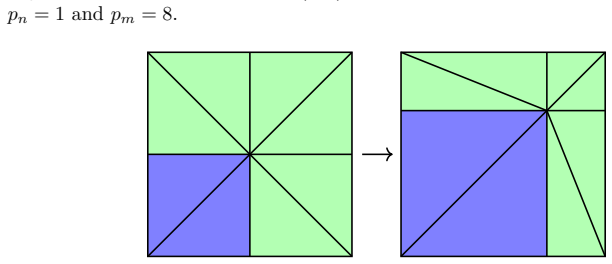
"Thus, the Gibbs phenomenon can be eliminated by taking the limit q→1 provided that the L1(Ω)-best approximation does not exhibit Gibbs phenomena. The results in [5] show that this depends on the mesh that is chosen. [...] From [5] we can infer that the L1-best approximation does not exhibit overshoots if the volume of the green area is smaller or equal to the volume of the blue area."
The paper's conditional Gibbs-elimination claim and its mesh-design rule are both attributed to [5], an unpublished manuscript by the same three authors. The mesh criterion (green area <= blue area) is used to 'predict' and to design meshes on which the method's overshoots vanish, but that criterion is not proved in this paper and no independent external source is supplied. For the specific numerical examples the paper also computes Lq-best approximations directly, so the main method-to-Lq-best comparison retains independent content; however, the general claim and the mesh-design predictions reduce to an unverified same-author citation chain.
full rationale
The paper's own derivation of the nonlinear Petrov-Galerkin method and its quasi-optimality estimate (Sections 3.1-3.3, eqs. (3.10)-(3.12)) is presented with formulas and constants, not by fitting parameters to force a conclusion. The no-overshoot phenomenon is verified against known analytical solutions (Examples 5.1-5.4) and by directly computing Lq-best approximations in Figure 12, so those results are not circular by construction. The main circularity concern is the reliance on [5], an unpublished result by the same authors, for the mesh-dependent behavior of L1-best approximations and for the design of meshes that eliminate Gibbs phenomena. This is a load-bearing same-author citation for the paper's 'prediction' and mesh-design contribution, although it is not a fitted-input or definitional circularity. Hence score 3 rather than a higher score.
Assumptions & free parameters
free parameters (3)
- q (Lq exponent) =
Varied in experiments; focus on q→1 (q=1.01, 1.1)
- α (Lq' norm weighting in test norm (4.4)) =
0 or 1 across experiments
- ω(x) (streamline weighting in test norm) =
0, 1, or x+ε in experiments
assumptions (6)
- standard math Hahn-Banach corollary: the duality map J^φ_V(v) is non-empty for every v (Def. 2.1).
- standard math Asplund's theorem characterizes the duality map as the subdifferential of ψ(‖·‖) (Thm. 2.3).
- standard math Milman-Pettis and uniform convexity imply reflexivity and single-valuedness of duality maps (Prop. 2.2).
- domain assumption Inf-sup condition for Bε on W^{1,q}_0 × W^{1,q'}_0 with robustness constants from [28]; requires c − (1/q)∇·b ≥ c0 > 0 and Poisson regularity.
- ad hoc to paper Existence of Fortin projector Π: V→Vm satisfying (3.11).
- domain assumption Characterization from unpublished [5]: L1-best approximation has no overshoot on certain meshes (e.g., local volume balancing, alignment).
Cite this review
Pith. "Pith review of Eliminating Gibbs Phenomena: A Non-linear Petrov-Galerkin Method for the Convection-Diffusion-Reaction Equation." pith.science (2026). https://pith.science/paper/B6LWNLYH
@misc{pith2026190800996,
  author       = {Pith},
  title        = {Pith review of: Eliminating Gibbs Phenomena: A Non-linear Petrov-Galerkin Method for the Convection-Diffusion-Reaction Equation},
  year         = {2026},
  howpublished = {\url{https://pith.science/paper/B6LWNLYH}},
  note         = {Machine review of arXiv:1908.00996}
}
abstract
In this article we consider the numerical approximation of the convection-diffusion-reaction equation. One of the main challenges of designing a numerical method for this problem is that boundary layers occurring in the convection-dominated case can lead to non-physical oscillations in the numerical approximation, often referred to as Gibbs phenomena. The idea of this article is to consider the approximation problem as a residual minimization in dual norms in Lq-type Sobolev spaces, with 1 < q < $\infty$. We then apply a non-standard, non-linear PetrovGalerkin discretization, that is applicable to reflexive Banach spaces such that the space itself and its dual are strictly convex. Similar to discontinuous Petrov-Galerkin methods, this method is based on minimizing the residual in a dual norm. Replacing the intractable dual norm by a suitable discrete dual norm gives rise to a non-linear inexact mixed method. This generalizes the Petrov-Galerkin framework developed in the context of discontinuous Petrov-Galerkin methods to more general Banach spaces. For the convection-diffusion-reaction equation, this yields a generalization of a similar approach from the L2-setting to the Lq-setting. A key advantage of considering a more general Banach space setting is that, in certain cases, the oscillations in the numerical approximation vanish as q tends to 1, as we will demonstrate using a few simple numerical examples.
Figures


Figures from the paper (13 more)




Forward citations
Cited by 1 Pith paper
-
Gibbs Phenomena for $L^q$-Best Approximation in Finite Element Spaces -- Some Examples
On certain 1D and 2D meshes, the Lq-best approximation of a discontinuity in piecewise-linear finite element spaces has over/undershoots that vanish as q tends to 1, while on other meshes they persist even at q=1.
Reference graph
Works this paper leans on
-
[28]
P. Houston, I. Muga, S. Roggendorf, K. G. van der Zee, The Convection- Diffusion-Reaction Equation in Non-Hilbert Sobolev Spaces: A Direct Proof of the Inf-Sup Condition and Stability of Galerkin’s Method, Comput. Methods Appl. Math. 19 (3) (2019) 503–522
work page 2019
-
[5]
P. Houston, S. Roggendorf, K. G. van der Zee, Gibbs Phenomenon for Lq-Best Approximation of Discontinuities in Finite Element Spaces – Some Examples (Unpublished Result)
-
[1]
J. W. Gibbs, Fourier’s series, Nature 59 (1539) (1899) 606
-
[2]
Wilbraham, On a certain periodic function, Cambridge and Dublin Math
H. Wilbraham, On a certain periodic function, Cambridge and Dublin Math. J 3 (198) (1848) 1848
-
[3]
F. Richards, A Gibbs phenomenon for spline functions, Journal of approximation theory 66 (3) (1991) 334–351
work page 1991
-
[4]
E. B. Saff, S. Tashev, Gibbs phenomenon for bestLp approximation by polygonal lines, East J. Approx. 5 (2) (1999) 235–251. 24
work page 1999
-
[6]
E. Moskona, P. Petrushev, E. Saff, The gibbs phenomenon for best L1- trigonometric polynomial approximation, Constructive Approximation 11 (3) (1995) 391–416
work page 1995
-
[7]
Guermond, A finite element technique for solving first-order PDEs in LP , SIAM J
J.-L. Guermond, A finite element technique for solving first-order PDEs in LP , SIAM J. Numer. Anal. 42 (2) (2004) 714–737
work page 2004
Show all 41 references
-
[8]
J. E. Lavery, Nonoscillatory solution of the steady-state inviscid Burgers’ equa- tion by mathematical programming, J. Comput. Phys. 79 (2) (1988) 436–448
1988
-
[9]
J. E. Lavery, Solution of steady-state one-dimensional conservation laws by math- ematical programming, SIAM J. Numer. Anal. 26 (5) (1989) 1081–1089
1989
-
[10]
J. E. Lavery, Solution of steady-state, two-dimensional conservation laws by mathematical programming, SIAM J. Numer. Anal. 28 (1) (1991) 141–155
1991
-
[11]
B.-N. Jiang, Non-oscillatory and non-diffusive solution of convection problems by the iteratively reweighted least-squares finite element method, Journal of com- putational physics 105 (1) (1993) 108–121
1993
-
[12]
Jiang, The least-squares finite element method: theory and applications in computational fluid dynamics and electromagnetics, Springer Science & Business Media, 1998
B.-N. Jiang, The least-squares finite element method: theory and applications in computational fluid dynamics and electromagnetics, Springer Science & Business Media, 1998
1998
-
[13]
Guermond, B
J.-L. Guermond, B. Popov, Linear advection with ill-posed boundary conditions via L1-minimization, Int. J. Numer. Anal. Model. 4 (1) (2007) 39–47
2007
-
[14]
Guermond, F
J.-L. Guermond, F. Marpeau, B. Popov, A fast algorithm for solving first-order PDEs by L1-minimization, Commun. Math. Sci. 6 (1) (2008) 199–216
2008
-
[15]
Guermond, B
J.-L. Guermond, B. Popov, L1-approximation of stationary Hamilton-Jacobi equations, SIAM J. Numer. Anal. 47 (1) (2008/09) 339–362
2008
-
[16]
Guermond, B
J.-L. Guermond, B. Popov, An optimal L1-minimization algorithm for stationary Hamilton-Jacobi equations, Commun. Math. Sci. 7 (1) (2009) 211–238
2009
-
[18]
L. F. Demkowicz, J. Gopalakrishnan, An overview of the discontinuous Petrov Galerkin method, in: Recent developments in discontinuous Galerkin finite el- ement methods for partial differential equations, Vol. 157 of IMA Vol. Math. Appl., Springer, Cham, 2014, pp. 149–180
2014
-
[19]
J. Chan, J. A. Evans, W. Qiu, A dual Petrov-Galerkin finite element method for the convection-diffusion equation, Comput. Math. Appl. 68 (11) (2014)
2014
-
[20]
Broersen, R
D. Broersen, R. Stevenson, A robust Petrov-Galerkin discretisation of convection- diffusion equations, Comput. Math. Appl. 68 (11) (2014) 1605–1618
2014
-
[21]
Broersen, R
D. Broersen, R. P. Stevenson, A Petrov-Galerkin discretization with optimal test space of a mild-weak formulation of convection-diffusion equations in mixed form, IMA J. Numer. Anal. 35 (1) (2015) 39–73
2015
-
[22]
J. Chan, N. Heuer, T. Bui-Thanh, L. Demkowicz, A robust DPG method for convection-dominated diffusion problems II: adjoint boundary conditions and mesh-dependent test norms, Comput. Math. Appl. 67 (4) (2014) 771–795
2014
-
[23]
Cohen, W
A. Cohen, W. Dahmen, G. Welper, Adaptivity and variational stabilization for convection-diffusion equations, ESAIM Math. Model. Numer. Anal. 46 (5) (2012) 1247–1273. 25
2012
-
[24]
Demkowicz, N
L. Demkowicz, N. Heuer, Robust DPG method for convection-dominated diffu- sion problems, SIAM J. Numer. Anal. 51 (5) (2013) 2514–2537
2013
-
[25]
M. S. Alnæs, J. Blechta, J. Hake, A. Johansson, B. Kehlet, A. Logg, C. Richard- son, J. Ring, M. E. Rognes, G. N. Wells, The FEniCS project version 1.5, Archive of Numerical Software 3 (100) (2015)
2015
-
[26]
Logg, K.-A
A. Logg, K.-A. Mardal, G. N. Wells, et al., Automated Solution of Differential Equations by the Finite Element Method, Springer, 2012
2012
-
[27]
I. Muga, K. G. van der Zee, Discretization of Linear Problems in Banach Spaces: Residual Minimization, Nonlinear Petrov-Galerkin, and Monotone Mixed Meth- ods, arXiv preprint arXiv:1511.04400v1 (2015)
2015 arXiv
-
[29]
Brezis, Functional analysis, Sobolev spaces and partial differential equations, Universitext, Springer, New York, 2011
H. Brezis, Functional analysis, Sobolev spaces and partial differential equations, Universitext, Springer, New York, 2011
2011
-
[30]
Deimling, Nonlinear functional analysis, Springer-Verlag, Berlin, 1985
K. Deimling, Nonlinear functional analysis, Springer-Verlag, Berlin, 1985
1985
-
[31]
Zeidler, Nonlinear functional analysis and its applications
E. Zeidler, Nonlinear functional analysis and its applications. III, Springer- Verlag, New York, 1985, variational methods and optimization, Translated from the German by Leo F. Boron
1985
-
[32]
Cioranescu, Geometry of Banach spaces, duality mappings and nonlinear prob- lems, Vol
I. Cioranescu, Geometry of Banach spaces, duality mappings and nonlinear prob- lems, Vol. 62 of Mathematics and its Applications, Kluwer Academic Publishers Group, Dordrecht, 1990
1990
-
[33]
Chidume, Geometric properties of Banach spaces and nonlinear iterations, Vol
C. Chidume, Geometric properties of Banach spaces and nonlinear iterations, Vol. 1965 of Lecture Notes in Mathematics, Springer-Verlag London, Ltd., Lon- don, 2009
1965
-
[34]
Demkowicz, J
L. Demkowicz, J. Gopalakrishnan, Discontinuous Petrov-Galerkin (DPG) method, ICES Report (15–20) (2015)
2015
-
[35]
Demkowicz, J
L. Demkowicz, J. Gopalakrishnan, A class of discontinuous Petrov-Galerkin methods. II. Optimal test functions, Numer. Methods Partial Differential Equa- tions 27 (1) (2011) 70–105
2011
-
[36]
Stakgold, M
I. Stakgold, M. J. Holst, Green’s functions and boundary value problems, Vol. 99, John Wiley & Sons, 2011
2011
-
[37]
Zitelli, I
J. Zitelli, I. Muga, L. Demkowicz, J. Gopalakrishnan, D. Pardo, V. M. Calo, A class of discontinuous Petrov-Galerkin methods. Part IV: the optimal test norm and time-harmonic wave propagation in 1D, J. Comput. Phys. 230 (7) (2011) 2406–2432
2011
-
[38]
Gopalakrishnan, W
J. Gopalakrishnan, W. Qiu, An analysis of the practical DPG method, Mathe- matics of Computation 83 (286) (2014) 537–552
2014
-
[39]
Gopalakrishnan, Five lectures on DPG methods, arXiv:1306.0557 (2013)
J. Gopalakrishnan, Five lectures on DPG methods, arXiv:1306.0557 (2013)
2013 arXiv
-
[40]
I. Muga, M. J. W. Tyler, K. G. van der Zee, The Discrete-Dual Minimal-Residual Method (DDMRes) for Weak Advection-Reaction Problems in Banach Spaces, Comput. Methods Appl. Math. 19 (3) (2019) 557–579
2019
-
[41]
Solin, L
P. Solin, L. Korous, P. Kus, Hermes2D, a C++ library for rapid development of adaptive hp-FEM and hp-DG solvers, J. Comput. Appl. Math. 270 (2014) 152–165
2014
-
[42]
Demkowicz, T
L. Demkowicz, T. F¨ urer, N. Heuer, X. Tian, The double adaptivity paradigm (how to circumvent the discrete inf-sup conditions of babuÅąka and brezzi), ICES Report (19–07) (2019). 26
2019
Reviewed August 14, 2026 · model on record in the stance chip above.
Discussion (0). Continue with ORCID to comment.