REVIEW 3 major objections 4 minor 40 references
Rational Elliptic Surfaces and the Trigonometry of Tetrahedra
T0 review · 3 major / 4 minor · reviewed 2026-08-14 · deepseek-v4-flash
Pith's one-line read A W(D6)-equivariant bijection maps generic marked tetrahedra to generic marked D6-surfaces, identifying length and angle functions with period maps.
desk verdict A genuinely new dictionary between tetrahedra and elliptic surfaces, but the main correspondence is not yet proved because the surface construction depends on a non-canonical choice the author explicitly does not know how to control. read the letter →
The pith
A machine-rendered reading of the paper's core claim, the machinery that carries it, and where it could break.
The reading
What carries the argument
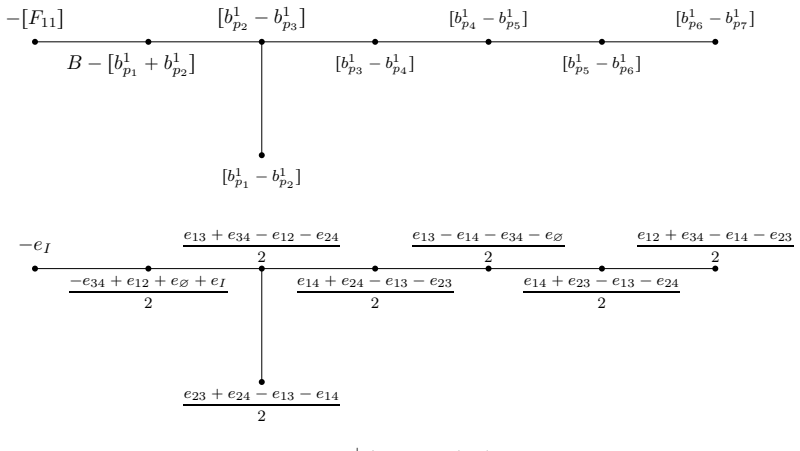
The central object is the pair $(T,X_T)$ linked by the root system $E_8$. The lattice $Q(E_8)$ is built from an affine 3-space over $\mathbb{F}_2$ whose eight points are labelled by the even subsets of $\{1,2,3,4\}$; the roots $e_\emptyset$, $e_I$, and $e_{ij}$ ($i<j$) provide common labels for the tetrahedron and the surface sides. On the tetrahedron side, $L_T$ is a homomorphism from the $E_7^L$ sublattice to $\mathbb{C}^\times$ defined by cross-ratios such as $\langle \tilde{A}_i,E_{ij},\tilde{A}_j,E_{ji}\rangle$; $A_T$ is the same construction on the dual tetrahedron. On the surface side, the two period maps restrict classes to the two $I_2$ fibers. The bridge is an admissible conic bundle $b\colon X_T\to\mathbb{P}^1$: its eight critical values, paired with the chosen components of $F_1$ and $F_2$, produce the configurations $\Pi(T)$ and $\Omega(T)$, and its conic-bundle function is exactly the Cho-Kim function. The proof identifies the two moduli spaces as unramified double covers of the same parameter space, with the period-map equalities established by explicit cross-ratio computations on generating roots.
What would settle it
Take a generic marked tetrahedron, for example a right-angled spherical tetrahedron, and construct $X_T$ using two different choices of the four disjoint curves to shrink. If the resulting surfaces are not isomorphic as marked $D_6$-surfaces, or if their period maps disagree with $L_T$ and $A_T$, then the correspondence is not well-defined.
Extended reading notes
Core claim
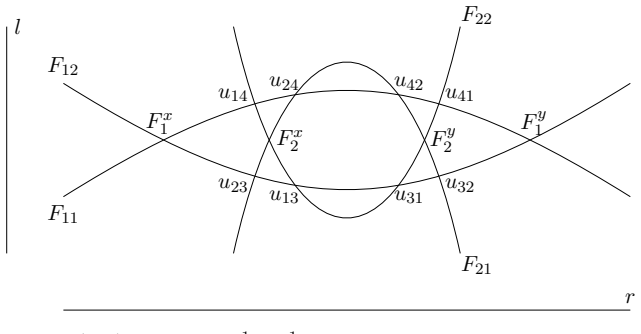
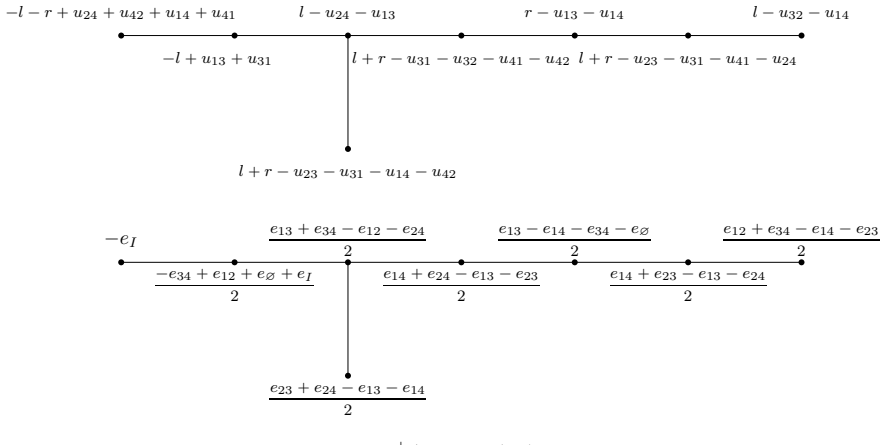
On the paper's own terms, the discovery is a complete translation between two moduli spaces. A marked projective tetrahedron $T=(Q,H_1,H_2,H_3,H_4)$ has a length function $L_T\colon Q(E_7^L)\to\mathbb{C}^\times$ built from cross-ratios of the intersection points $E_{ij}$ of the edge lines with the quadric $Q$, and an angle function $A_T\colon Q(E_7^A)\to\mathbb{C}^\times$ obtained from the dual tetrahedron. A marked $D_6$-surface $X$ has two distinguished $I_2$ fibers $F_1,F_2$ (each a pair of transversally intersecting rational curves), and the period maps $\mathrm{Res}_{F_1}\colon Q(E_7^L)\to\mathbb{C}^\times$ and $\mathrm{Res}_{F_2}\colon Q(E_7^A)\to\mathbb{C}^\times$ record how line bundles restrict to those fibers. Theorem 1.9 asserts a $W(D_6)$-equivariant bijection $T\leftrightarrow (X_T,F_1,F_2)$ with $L_T=\mathrm{Res}_{F_1}$ and $A_T=\mathrm{Res}_{F_2}$. The construction blows up $Q$ at the twelve points $H_i\cap H_j\cap Q$, then shrinks four chosen disjoint curves to obtain $X_T$; the paper argues through Torelli theory that the resulting marked surface does not depend on the choice. The equalities with the two period maps are proved by checking them on two generating roots and using the $W(D_6)$ symmetry.
Load-bearing premise
The construction of the surface $X_T$ from a tetrahedron requires choosing which four disjoint curves to shrink, and the paper assumes, without a complete proof, that every choice gives the same resulting surface.
Editorial extensions
If this is right
- Because the correspondence is one-to-one and equivariant under $W(D_6)$, the length function of a tetrahedron determines its angle function through the period maps of a single surface.
- The Regge symmetries appear as reflections in $W(D_6)$ acting on the Picard lattice, explaining the 23,040-element symmetry group of a tetrahedron.
- The configurations $\Pi(T)$ and $\Omega(T)$ of eight points on $\mathbb{P}^1$ are projectively equivalent, and their cross-ratios agree, because both arise from one admissible conic bundle on $X_T$.
- The Cho-Kim function of a tetrahedron and the dual Cho-Kim function are related by a fractional linear transformation, so the angle data can be computed from the edge data via the principal parameters.
- The paper expects the same correspondence to extend to Euclidean tetrahedra, with the $I_2$ fiber $F_1$ replaced by a type $III$ fiber, so a single dictionary may cover spherical, hyperbolic, and Euclidean trigonometry.
Reading between the lines
- If the unresolved choice in the construction is harmless, the isomorphism between different blowdowns should be constructible from the $E_8$ data, and it would yield an explicit formula for the fractional linear transformation in Theorem 1.7.
- The same dictionary suggests that the volume of a non-Euclidean tetrahedron, for which Cho-Kim type formulas exist, could be expressed through periods or regulators of the associated elliptic surface, linking tetrahedron trigonometry to arithmetic invariants.
- Extending the correspondence to non-generic tetrahedra would map geometric degenerations such as ideal vertices, Euclidean limits, and disphenoids to configurations of singular elliptic fibers, giving a taxonomy of tetrahedron degenerations by surface type.
Signed reviews
Editorial analysis
A structured set of objections, weighed in public.
Referee Report
Summary. The paper develops a correspondence between generic marked projective tetrahedra and rational elliptic surfaces endowed with a pair of I2 fibers, which the author calls D6-surfaces. The central result, Theorem 1.9, asserts a W(D6)-equivariant bijection under which the length function L_T of a tetrahedron equals the period map Res_{F1} of the associated surface and the angle function A_T equals the period map Res_{F2}. The proof strategy is to show that both the moduli space of tetrahedra and the moduli space of D6-surfaces are unramified double covers of the same parameter space T, then to construct a rational map Cor between them, and finally to verify the equality of the period maps on a set of root classes spanning the relevant lattices (Lemmas 4.4, 4.5, 4.7, 4.8). The paper then derives Theorem 1.1 (projective equivalence of the configurations Ω(T) and Π(T)) and Theorem 1.3 (Regge symmetries) as corollaries of the correspondence.
Significance. If the construction is made fully rigorous, the paper provides a striking new dictionary between three-dimensional non-Euclidean trigonometry and the theory of rational elliptic surfaces. The explicit root-basis verification of the period-map equalities is a concrete and useful strength, and the derivation of the known projective-equivalence and Regge-symmetry results from a single geometric framework is conceptually valuable. The paper also points toward deeper connections with mixed Hodge structures and motivic interpretations. However, the main theorem is not yet proven as written because the correspondence is not shown to be well-defined; the construction depends on a non-canonical choice that is explicitly admitted to lack a proof.
major comments (3)
- [§4.2, Theorem 1.9] The construction of the surface X_T from a tetrahedron T is not yet shown to be well-defined. After blowing up the quadric at the twelve points E_ij, the paper blows down a chosen set of four (-1)-curves and states: 'The last step is not canonical. Surprisingly, different choices of four (-1)-curves result in isomorphic rational elliptic surfaces. Unfortunately, we do not have a clear explanation of this fact yet; its proof is based on the Torelli theorem for anti-canonical pairs.' No proof of this independence is supplied. This is load-bearing: if two admissible choices yield non-isomorphic marked D6-surfaces, then the map Cor in §4.1 is not a well-defined map from M_tetr to M_surf, and the bijection in Theorem 1.9 collapses. Moreover, the verification of L_T = Res_{F1} in §4.3 is performed only for the particular model constructed with the four specific curves listed in §4.2, so it cannot establish independence of the choice. A proof of well-definedness, or a canonical construction of X_T, is required before Theorem 1.9 can be accepted.
- [Lemma 4.2] The intersection pairing on Pic(X_T) as printed is internally inconsistent. The statement reads 'uij.ukl = -1 if uij = ukl and -1 if uij ≠ ukl'; the second case must be 0, since exceptional divisors from distinct blow-ups are disjoint. As printed, the lattice relations used throughout §4.3 and §4.4, such as the expressions for the root classes (e.g., (e23+e24+e34+e∅)/2 = π(l - u23 - u42)), do not follow from the stated pairing. This is a critical typo that must be corrected, as the explicit verification of the period-map equalities depends on the intersection form of the Picard lattice.
- [Lemma 4.1] The proof of Lemma 4.1 contains a numerical inconsistency: it states that after blowing down the eight (-1)-curves 'we obtain a del Pezzo surface with Picard number 1' but then concludes that 'the surface is isomorphic to P1 × P1', which has Picard number 2. This appears to be a typo (the intended number is probably 2), but as written the proof is not coherent. In addition, the argument that X_T is a rational elliptic surface with a pair of I2-fibers is presented in a compressed way; the claim that the images of the curves [E_ij] lie on a pair of reducible (2,2)-curves would benefit from a more explicit justification.
minor comments (4)
- [§1.1/Abstract] The abstract states that the paper establishes a bijection between non-Euclidean tetrahedra and certain rational elliptic surfaces, while Theorem 1.9 is stated only for generic marked projective tetrahedra and generic D6-surfaces. The abstract should be adjusted to reflect the generic hypothesis, or the introduction should explain how the non-generic case is handled.
- [Lemma 4.4, equation (4.1)] There is a stray parenthesis in the displayed formula: 'rA2, (A2A4)∩(E23E34), A4, E42)q' should read 'rA2, (A2A4)∩(E23E34), A4, E42]_{(A2A4)}'. This is a minor typesetting error but makes the formula difficult to parse.
- [§4.1] The sentence 'It is easy to see that a rational map U -> V, which commutes with etale maps U -> X and V -> X can be extended to a morphism' is imprecise: the maps from U and V to X are the covering maps, not arbitrary etale maps. The statement is standard for finite etale covers from normal varieties, but the wording should be clarified and a brief justification supplied.
- [§2.4, determinant formula] In the displayed formula for det(L), the notation 'R(E8)/(R(E_L^7) ∪ R(E_A^7))' is used; it would be helpful to remind the reader that this is a quotient by the union of two root sets, not a quotient group, to avoid confusion.
Circularity Check
No circularity: the period-map equalities are verified by direct geometric computation, and no fitted parameter, self-citation chain, or definitional identification is used as the load-bearing step.
full rationale
The central claim, Theorem 1.9, is a correspondence between generic marked projective tetrahedra and generic marked D6-surfaces with LT = ResF1 and AT = ResF2. The length and angle functions LT and AT are defined directly from the projective tetrahedron in Section 2.3, and the period maps ResF1 and ResF2 are defined independently from the constructed rational elliptic surface in Section 3.2. The equality LT = ResF1 is proved in Section 4.3 by checking two generating roots via explicit cross-ratio computations (Lemmas 4.4 and 4.5), and AT = ResF2 is proved in Section 4.4 by analogous direct computations (Lemmas 4.7 and 4.8). The marking of XT only fixes the identification of the root lattice with Q(E8); the period-map values are determined by actual restrictions of line bundles to the fibers, so the equality is not imposed by construction. No parameter is fitted to a data subset and then renamed a prediction; the identities are verified for all generic tetrahedra. Known results, such as Theorem 1.1 and Regge symmetry, are derived as corollaries rather than used as inputs. External citations, chiefly to Looijenga's Torelli theorem, are used for standard moduli facts and do not form a self-citation chain. The paper does state an unresolved issue: in Section 4.2, the choice of four (-1)-curves to blow down is not canonical, and the author writes that different choices give isomorphic surfaces but that no clear explanation is available and the proof is based on the Torelli theorem for anti-canonical pairs. This is an omitted proof and a correctness risk for well-definedness of Cor, not a circular reduction; it does not make the derivation equivalent to its inputs. The apparent inconsistency in Lemma 4.2, where uij.ukl is printed as -1 both when uij = ukl and when uij ≠ ukl, is a typo rather than a circular step. Overall, the derivation chain is self-contained apart from the explicitly acknowledged geometric gap, so the circularity score is 0.
Assumptions & free parameters
assumptions (4)
- standard math Torelli theorem for rational elliptic surfaces with an anti-canonical cycle (Looijenga 1981, Theorem 5.3)
- standard math Surjectivity of the period map for rational elliptic surfaces (Looijenga 1981, Proposition 5.5)
- standard math Classification of singular fibers of conic bundles on rational elliptic surfaces (Garbagnati-Salgado 2019, Proposition 5.1)
- domain assumption Identification of non-Euclidean tetrahedra with projective tetrahedra via the Klein model and polar duality (Goncharov 1999, §1.5)
Cite this review
Pith. "Pith review of Rational Elliptic Surfaces and the Trigonometry of Tetrahedra." pith.science (2026). https://pith.science/paper/6KXRI3BJ
@misc{pith2026190801141,
  author       = {Pith},
  title        = {Pith review of: Rational Elliptic Surfaces and the Trigonometry of Tetrahedra},
  year         = {2026},
  howpublished = {\url{https://pith.science/paper/6KXRI3BJ}},
  note         = {Machine review of arXiv:1908.01141}
}
abstract
We study the trigonometry of non-Euclidean tetrahedra using tools from algebraic geometry. We establish a bijection between non-Euclidean tetrahedra and certain rational elliptic surfaces. We interpret the edge lengths and the dihedral angles of a tetrahedron as values of period maps for the corresponding surface. As a corollary we show that the cross-ratio of the exponents of the solid angles of a tetrahedron is equal to the cross-ratio of the exponents of the perimeters of its faces. The Regge symmetries of a tetrahedron are related to the action of the Weyl group $W(D_6)$ on the Picard lattice of the corresponding surface.
Figures

Figures from the paper (1 more)
Reference graph
Works this paper leans on
-
[1]
The R egge symmetry, confocal conics, and the S chl\" a fli formula
Arseniy Akopyan and Ivan Izmestiev. The R egge symmetry, confocal conics, and the S chl\" a fli formula. Bull. Lond. Math. Soc. , 51(5):765--775, 2019
work page 2019
-
[2]
N. Bourbaki. \' E l\' e ments de math\' e matique. F asc. XXXIV . G roupes et alg\`ebres de L ie. C hapitre IV : G roupes de C oxeter et syst\`emes de T its. C hapitre V : G roupes engendr\' e s par des r\' e flexions. C hapitre VI : syst\`emes de racines . Actualit\' e s Scientifiques et Industrielles, No. 1337. Hermann, Paris, 1968
work page 1968
-
[3]
On the volume formula for hyperbolic tetrahedra
Yunhi Cho and Hyuk Kim. On the volume formula for hyperbolic tetrahedra. Discrete Comput. Geom. , 22(3):347--366, 1999
work page 1999
-
[4]
23040 symmetries of hyperbolic tetrahedra
P. Doyle and G. Leibon. 23040 symmetries on hyperbolic tetrahedra. arXiv:math/0309187, 2003
work page Pith review arXiv 2003
-
[5]
E. B. Dynkin and A. N. Minchenko. Enhanced D ynkin diagrams and W eyl orbits. Transform. Groups , 15(4):813--841, 2010
work page 2010
-
[6]
Construction of linear pencils of cubic curves with M ordell- W eil rank six and seven
Davide Fusi. Construction of linear pencils of cubic curves with M ordell- W eil rank six and seven. Comment. Math. Univ. St. Pauli , 55(2):195--205, 2006
work page 2006
- [7]
-
[8]
Linear systems on rational elliptic surfaces and elliptic fibrations on K 3 surfaces
Alice Garbagnati and Cec\' lia Salgado. Linear systems on rational elliptic surfaces and elliptic fibrations on K 3 surfaces. J. Pure Appl. Algebra , 223(1):277--300, 2019
work page 2019
Show all 40 references
-
[9]
The moduli space of rational elliptic surfaces
Gert Heckman and Eduard Looijenga. The moduli space of rational elliptic surfaces. In Algebraic geometry 2000, A zumino ( H otaka) , volume 36 of Adv. Stud. Pure Math. , pages 185--248. Math. Soc. Japan, Tokyo, 2002
2000
-
[10]
Elementary mathematics from an advanced standpoint , volume 1
Felix Klein. Elementary mathematics from an advanced standpoint , volume 1. Springer-Verlag Berlin Heidelberg, 2016. Arithmetic, algebra, analysis
2016
-
[11]
Rational surfaces with an anticanonical cycle
Eduard Looijenga. Rational surfaces with an anticanonical cycle. Ann. of Math. (2) , 114(2):267--322, 1981
1981
-
[12]
Yu. I. Manin. Cubic forms , volume 4 of North-Holland Mathematical Library . North-Holland Publishing Co., Amsterdam, second edition, 1986. Algebra, geometry, arithmetic, Translated from the Russian by M. Hazewinkel
1986
-
[13]
On extremal rational elliptic surfaces
Rick Miranda and Ulf Persson. On extremal rational elliptic surfaces. Math. Z. , 193(4):537--558, 1986
1986
-
[14]
On the volume of a hyperbolic and spherical tetrahedron
Jun Murakami and Masakazu Yano. On the volume of a hyperbolic and spherical tetrahedron. Comm. Anal. Geom. , 13(2):379--400, 2005
2005
-
[15]
Cross ratios as moduli of del P ezzo surfaces of degree one
Isao Naruki. Cross ratios as moduli of del P ezzo surfaces of degree one. Proc. Japan Acad. Ser. A Math. Sci. , 56(7):328--331, 1980
1980
-
[16]
Cross ratio variety as a moduli space of cubic surfaces
Isao Naruki. Cross ratio variety as a moduli space of cubic surfaces. Proc. London Math. Soc. (3) , 45(1):1--30, 1982. With an appendix by Eduard Looijenga
1982
-
[17]
The M ordell- W eil lattice of a rational elliptic surface
Keiji Oguiso and Tetsuji Shioda. The M ordell- W eil lattice of a rational elliptic surface. Comment. Math. Univ. St. Paul. , 40(1):83--99, 1991
1991
-
[18]
Configurations of K odaira fibers on rational elliptic surfaces
Ulf Persson. Configurations of K odaira fibers on rational elliptic surfaces. Math. Z. , 205(1):1--47, 1990
1990
-
[19]
Ponzano and T
G. Ponzano and T. Regge. Semiclassical limit of racah coefficients. Spectroscopic and group theoretical methods in physics , pages pp. 1--58, 1968
1968
-
[20]
Elliptic surfaces
Matthias Sch\" u tt and Tetsuji Shioda. Elliptic surfaces. In Algebraic geometry in E ast A sia--- S eoul 2008 , volume 60 of Adv. Stud. Pure Math. , pages 51--160. Math. Soc. Japan, Tokyo, 2010
2008
-
[21]
A. N. Tjurin. The intersection of quadrics. Uspehi Mat. Nauk , 30(6(186)):51--99, 1975
1975
-
[22]
V., Izmestiev I
Akopyan A. V., Izmestiev I. V., The Regge symmetry, confocal conics, and the Schl \"a fli formula. ArXiv:math/1903.04929, (2019)
2019 arXiv
-
[23]
Cho Y., Kim H., On the volume formula for hyperbolic tetrahedra
-
[24]
Collected papers I(1889), pp
Cayley A., On the triple tangent planes of surfaces of the third order. Collected papers I(1889), pp. 445-456
-
[25]
Doyle P., Leibon G., 23040 symmetries on hyperbolic tetrahedra
-
[26]
L., Scissor Congruences, Group Homology and Characteristic Classes
Dupont J. L., Scissor Congruences, Group Homology and Characteristic Classes. Nankai Tracts in Mathematics, vol. 1, World Scientific, Singapore, (2001)
2001
-
[27]
A curious relation between angles and lengths of edges of a tetrahedron
Egan G., Answer to the question "A curious relation between angles and lengths of edges of a tetrahedron" , https://mathoverflow.net/q/336464
-
[28]
4th ed., Berlin: Springer 1933 Vol.1, pl.3, Trigonometrie, pp
Klein F., Elementar Mathematik vom h \"o heren Standpunkt aus. 4th ed., Berlin: Springer 1933 Vol.1, pl.3, Trigonometrie, pp. 184-201
1933
-
[29]
I., Pangeometry
Lobachevsky N. I., Pangeometry. (In Russian) Ucheneye zapiski kazanskogo universiteta (1836), Issue I, pp. 3-166
-
[30]
Communications in Analysis and Geometry, 13(2), pp
Murakami J., Yano M., On the volume of a hyperbolic and spherical tetrahedron. Communications in Analysis and Geometry, 13(2), pp. 379-400
-
[31]
Mathematische Zeitschrift, 193(4), pp
Miranda R., Persson U., On Extremal Rational Elliptic Surfaces. Mathematische Zeitschrift, 193(4), pp. 537-558
-
[32]
Looijenga
Naruki I., Cross ratio variety as a moduli space of cubic surfaces, Appendix by E. Looijenga. Proc. Lond. Math. Soc.(1982), pp. 1-30
1982
-
[33]
Spectroscopic and group theoretical methods in physics (1968), pp
Ponzano G., Regge T., Semiclassical limit of Racah coefficients. Spectroscopic and group theoretical methods in physics (1968), pp. 1-58
1968
-
[34]
A curious relation between angles and lengths of edges of a tetrahedron
Petrov F., Answer to the question "A curious relation between angles and lengths of edges of a tetrahedron" , https://mathoverflow.net/q/336464
-
[35]
Il Nuovo Cimento X (1958), pp
Regge T., Symmetry properties of Clebsch-Gordan coefficients. Il Nuovo Cimento X (1958), pp. 544-545
1958
-
[36]
In preparation
Rudenko D., Mixed Hodge structures and non-Euclidean tetrahedra. In preparation
-
[37]
N., On intersection of quadrics
Tyurin, A. N., On intersection of quadrics. Russ. Math. Surv. 30(1975), pp. 51-105
1975
-
[38]
Goncharov A., Volumes of hyperbolic manifolds and mixed Tate motives. J. Amer. Math. Soc. 12 (1999), pp. 569-618
1999
-
[39]
Goncharov A., Polylogarithms, Regulators and Arakelov motivic complexes. J. Amer. Math. Soc. 18 (2005), no. 1, pp. 1-60
2005
-
[40]
Garbagnati A., Salgado C., Linear systems on rational elliptic surfaces and elliptic fibrations on K3 surfaces. J. of Pure and Applied Algebra Vol. 223 (2019), Vol. 223, pp. 277-300
2019
Reviewed August 14, 2026 · model on record in the stance chip above.
Discussion (0). Continue with ORCID to comment.