REVIEW 3 major objections 5 minor 37 references
Improving Resolution of Solid State NMR in Dense Molecular Hydrogen
T0 review · 3 major / 5 minor · reviewed 2026-08-14 · deepseek-v4-flash
Pith's one-line read Lee-Goldburg decoupling narrows the 1H resonance of dense molecular hydrogen 1600-fold, to 3.1 ppm, inside a diamond anvil cell.
desk verdict The reported Lee-Goldburg narrowing is arithmetically inconsistent with the paper's own B1 and offset values; the mechanism needs to be re-examined before the result can stand. read the letter →
The pith
A machine-rendered reading of the paper's core claim, the machinery that carries it, and where it could break.
The reading
What carries the argument
The load-bearing mechanism is the Lee-Goldburg decoupling sequence: a continuous radio-frequency field applied off resonance at an angle Θ = arccos(1/√3) ≈ 54.7° to the static field B0, the 'magic angle,' in the rotating frame. At this angle the average homonuclear dipolar Hamiltonian vanishes, so direct dipole–dipole couplings between proton pairs are truncated and only the isotropic chemical shift survives. The enabling hardware is the two-dimensional Lenz-lens resonator, whose B1 field distribution across the 12 pL sample cavity was computed (FEMM) to have an average of about 17 mT with a standard deviation of 3 mT, placing roughly 80% of the sample within the homogeneous volume Veff = 0.8·V0 needed for efficient decoupling.
What would settle it
Measure the B1 field distribution across the 12 pL sample cavity directly — for example by spatially resolved nutation imaging or by detecting the LG linewidth as a function of RF offset on a sample much smaller than the cavity — and show that more than 20% of the volume lies outside the reported ⟨B1⟩ ± σ range; if so, the claimed uniform decoupling would not be achieved and the 3.1 ppm line would be a fortuitous average.
Extended reading notes
Core claim
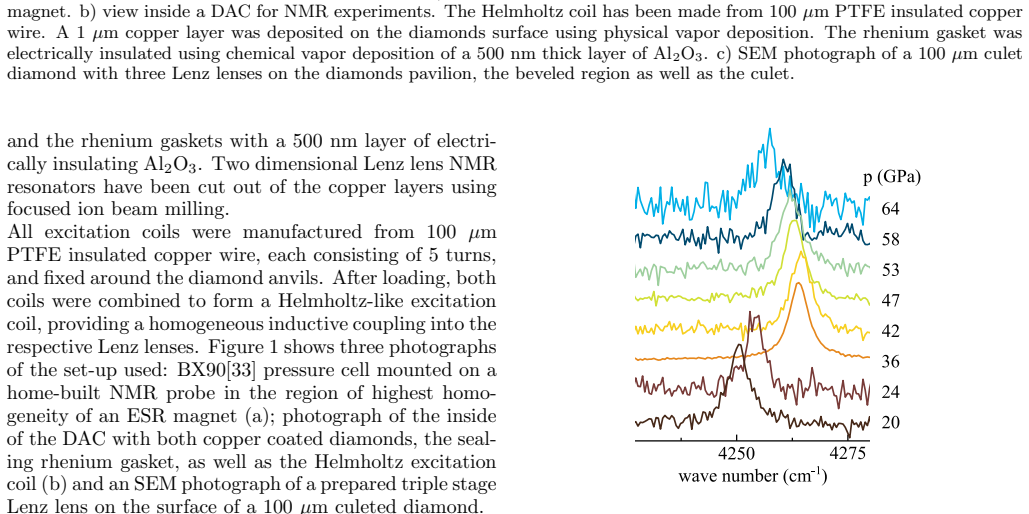
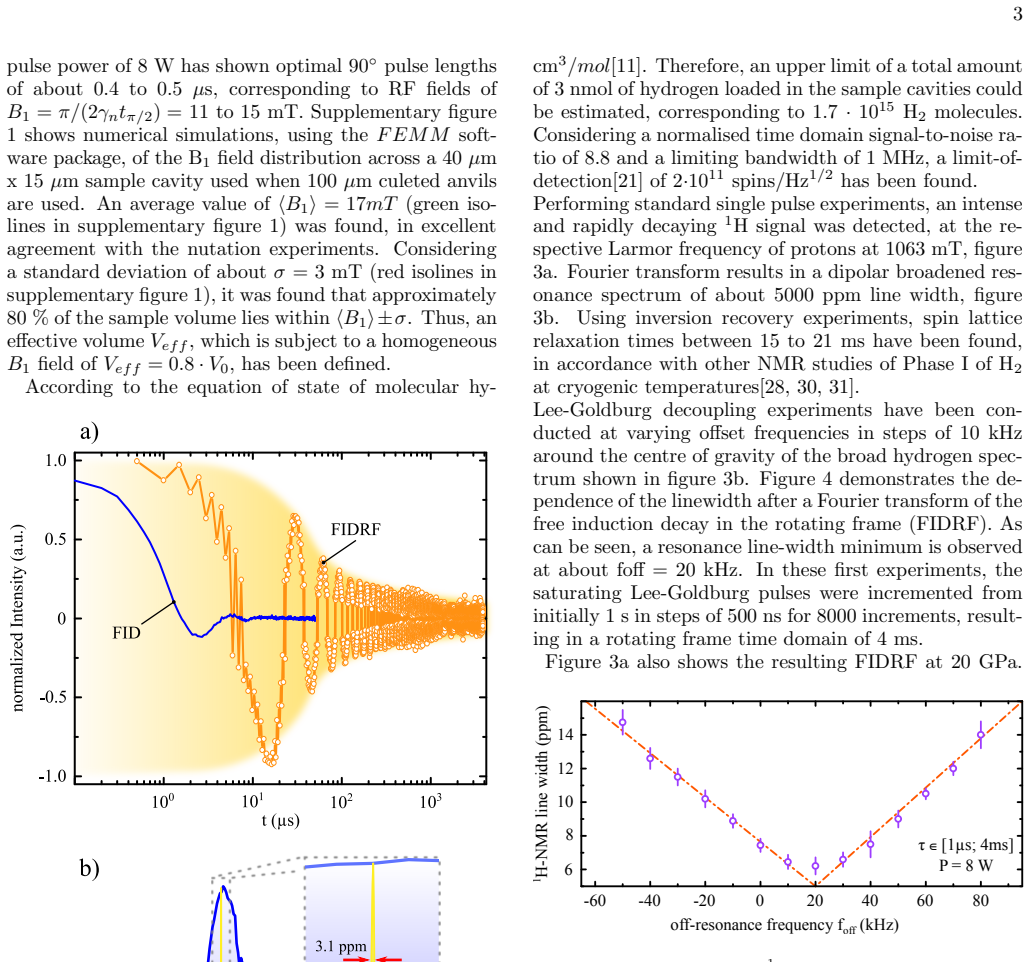
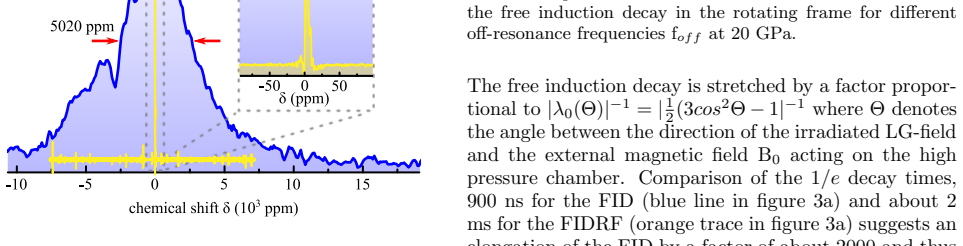
The central discovery is that the Lee-Goldburg decoupling sequence, long a staple of solid-state NMR, can be transplanted into the diamond anvil cell environment and there collapses the enormous homonuclear dipolar broadening that had made 1H NMR of dense hydrogen nearly featureless. At a proton Larmor frequency of 45.26 MHz (1.063 T), continuous off-resonance irradiation at the magic-angle condition Θ = 54.7° stretched the free induction decay from a roughly 900 ns time constant to about 2 ms, and lengthening the LG pulse to 16 ms resolved the resonance to a 3.1 ppm line at 20 GPa. The same experiment performed at pressures from 20 to 64 GPa yielded linewidths of roughly 3–5 ppm with Lorentzian lineshapes and no detectable chemical-shift anisotropy, meaning the isotropic chemical shift of hydrogen becomes experimentally accessible.
Load-bearing premise
The argument relies on the B1 radio-frequency field being homogeneous enough across the 12-picolitre sample cavity that the Lee-Goldburg condition holds for most of the sample, a property inferred from simulations and bulk nutation experiments rather than measured directly.
Editorial extensions
If this is right
- At pressures from 20 to 64 GPa, LG decoupling routinely gives 1H linewidths of 3–5 ppm, so the isotropic chemical shift of dense hydrogen becomes measurable rather than buried under dipolar broadening.
- The method makes 1H solid-state NMR in diamond anvil cells a practical structural probe, allowing future experiments to distinguish between proposed crystal structures of hydrogen phases II and III by their predicted chemical shifts.
- Because LG decoupling acts on homonuclear dipolar couplings, it should apply to other spin-1/2 systems with strong dipole–dipole interactions under extreme conditions, not only H2.
- The observed rotating-frame decay time of about 2 ms (versus 900 ns for the normal FID) implies that resolution can be pushed further by extending the LG pulse duration, approaching the roughly 250 Hz Fourier limit set by the acquisition window.
Reading between the lines
- If the 3.1 ppm resolution carries over to higher pressures, NMR could test the predicted wide dispersion of 1H chemical shifts across the proposed phases of hydrogen, giving a structural probe complementary to Raman and infrared spectroscopy.
- The reported 80% homogeneous effective volume suggests that the remaining 20% of the sample, outside the ⟨B1⟩ ± σ band, may set a practical floor on the attainable linewidth; improving Lenz lens geometry could push resolutions below 3 ppm.
- Since LG decoupling here is applied without magic-angle spinning, the residual linewidth is dominated by B1 inhomogeneity and incomplete averaging; combining LG with other homonuclear decoupling variants might yield sub-ppm resolution in DACs.
Signed reviews
Editorial analysis
A structured set of objections, weighed in public.
Referee Report
Summary. The manuscript reports solid-state 1H NMR experiments on dense molecular hydrogen in diamond anvil cells at 20-64 GPa, using Lenz-lens based resonators. The authors claim the first application of homonuclear Lee-Goldburg (LG) decoupling at extreme conditions, narrowing the broad ortho-hydrogen resonance from about 5000 ppm to 3.1 ppm at 20 GPa. They infer the magic-angle condition from the FID elongation factor and support B1 homogeneity with FEMM simulations and nutation experiments.
Significance. If the demonstrated line narrowing is confirmed and correctly attributed to Lee-Goldburg decoupling, this would be a substantial technical advance for high-pressure NMR, enabling chemical-shift-resolved studies in dense hydrogen and other strongly dipolar solids at megabar pressures. The paper benefits from machine-independent experimental data, a clear presentation of the resonator design, and a quantitative estimate of the effective sample volume under the decoupling field.
major comments (3)
- [Fig. 4 and text near 'Lee-Goldburg decoupling experiments'] The reported Lee-Goldburg offset is inconsistent with the measured B1. From the nutation experiments (90° pulse lengths of 0.4-0.5 µs at 8 W) and the FEMM simulation (⟨B1⟩ = 17 mT), the RF amplitude is ν1 ≈ 470-640 kHz. The LG magic-angle condition requires an offset Δ = ν1/√2 ≈ 330-450 kHz. However, Fig. 4 shows a linewidth minimum at f_off = 20 kHz. With Δ = 20 kHz and ν1 ≈ 550 kHz, the effective-field angle is θ = arctan(ν1/Δ) ≈ 88°, giving a dipolar scaling factor 1/2(3cos²θ - 1) ≈ -0.5, which predicts only a factor-of-two narrowing, not the observed ~2000-fold FID elongation. Unless the LG experiments used a much lower RF power than the nutation experiments, the offset and B1 values are mutually incompatible. This issue must be resolved before the 3.1 ppm linewidth can be attributed to LG decoupling at the magic angle.
- [Figs. 4 and 5] The linewidth data are presented without error bars or repeated experiments. The minimal linewidth of 3.1 ppm is based on a single spectrum, and the pressure series in Fig. 5 shows one measurement per pressure. To support quantitative claims about 3-5 ppm resolution and the pressure dependence, the authors should provide uncertainties, e.g., from repeated measurements or from the signal-to-noise ratio and the FID truncation point.
- [Supplementary Fig. 6 and text on B1 homogeneity] The claim that the Lenz lens provides a homogeneous B1 field across the sample cavity is inferred from FEMM simulation and bulk nutation, not from a direct spatial measurement. The effective volume Veff = 0.8·V0 is used to argue that the LG condition is met for most of the sample, but this is an assumption. A direct measurement of the B1 profile (e.g., by spatially resolved nutation or by measuring the line narrowing as a function of sample position) would strengthen the interpretation.
minor comments (5)
- [Text after Eq. (FID elongation)] The formula for the FID elongation is misprinted: '|1/2(3cos²Θ−1|−1' is missing a closing parenthesis. It should read '|(1/2)(3cos²Θ−1)|⁻¹'.
- [Nutation experiments paragraph] The equation for B1 is garbled: 'B1 =π/(2γntπ/2)' should be B1 = π/(2γ t_90), where t_90 is the 90° pulse length.
- [Fig. 3 caption and text] The term 'Lorenzian' should be 'Lorentzian' in the text.
- [Lee-Goldburg pulse description] The phrase 'incremented from initially 1 s in steps of 500 ns' presumably means 1 µs, not 1 s; please correct the unit.
- [Reference list] Reference [32] has the year '19650' clearly a typo for '1965'.
Circularity Check
No significant circularity: the reported narrowing is a direct experimental observation, and the magic-angle inference is a consistency check rather than a fitted prediction.
full rationale
The paper's central claim is empirical: a Lee-Goldburg irradiation sequence produced a 1600-fold narrowing of the 1H resonance of molecular ortho-hydrogen, from about 5000 ppm to 3.1 ppm. This is presented as a measured free-induction decay in the rotating frame and its Fourier transform (Figures 3 and 5), not as a quantity derived from an assumed model. The magic-angle inference is also not circular: the paper measures the 1/e decay time of the FIDRF, extracts |1/2(3cos²Θ−1)|⁻¹ ≈ 4.5×10⁻⁴, and notes that this corresponds to Θ ≈ 54.7°, close to the magic angle. This is a post-hoc consistency check between the observed decay elongation and the expected decoupling scaling, not a parameter fitted to the final linewidth. The homogeneity of the B1 field is supported by FEMM simulations and nutation experiments reported in the paper, with prior Lenz-lens work cited only as methodological background rather than as the sole justification. No equation in the paper is defined in terms of the quantity it is claimed to predict, and no fitted parameter is renamed as a prediction. The apparent inconsistency between the reported B1 (11–15 mT) and the LG offset (20 kHz) is a potential experimental or interpretational problem, but it is a correctness/consistency concern, not circularity. Under the review rules, concerns about internal consistency or correctness do not by themselves raise the circularity score. The appropriate finding is a low circularity score of 1, reflecting only minor self-citation in the instrumentation context, with the central result standing as an independent experimental observation.
Assumptions & free parameters
free parameters (2)
- LG off-resonance frequency f_off =
20 kHz
- RF field amplitude B1 for LG decoupling =
11-17 mT
assumptions (4)
- standard math Average Hamiltonian theory describes the suppression of dipole-dipole couplings during LG irradiation.
- domain assumption The equation of state of molecular hydrogen from Loubeyre et al. (1996) is accurate for converting sample volume to molar amount.
- domain assumption The FEMM finite-element simulation accurately models the B1 field distribution of the Lenz lens resonators.
- domain assumption The Raman vibron shift reliably determines the pressure in the DAC.
Cite this review
Pith. "Pith review of Improving Resolution of Solid State NMR in Dense Molecular Hydrogen." pith.science (2026). https://pith.science/paper/3OD6TXCM
@misc{pith2026190801150,
  author       = {Pith},
  title        = {Pith review of: Improving Resolution of Solid State NMR in Dense Molecular Hydrogen},
  year         = {2026},
  howpublished = {\url{https://pith.science/paper/3OD6TXCM}},
  note         = {Machine review of arXiv:1908.01150}
}
read the original abstract
Recent advancements in radio-frequency resonator designs have led to the implementation of nuclear magnetic resonance in diamond anvil cells (DACs) at pressures well above 100 GPa. However, a relatively low resolution and the absence of decoupling sequences complicate the analysis of the results of solid state NMR in DACs. Here, we present the first application of homo-nuclear Lee-Goldburg (LG) decoupling at extreme conditions on high density molecular hydrogen. Lenz lens based two-dimensional resonator structures were found to generate a homogeneous B1 field across sample cavities as small as 12 picolitres, a prerequisite for optimal decoupling. At ideal LG conditions, the broad 1H resonance of molecular ortho-hydrogen was narrowed 1600-fold, resulting in line-widths of 3.1 ppm.
Figures

Figures from the paper (3 more)


Reference graph
Works this paper leans on
-
[1]
05K19WC1) for financial support
and the Federal Ministry of Education and Research, Germany (BMBF, grant no. 05K19WC1) for financial support
-
[2]
E. Wigner and H. B. Huntington, ”On the Possibility of a Metallic Modification of Hydrogen”, J. Chem. Phys. , 3, 764–770 (1935)
work page 1935
-
[3]
N W Ashcroft, ”Metallic hydrogen: A high-temperature superconductor?”, Physical Review Letters , 21, 1748– 1749 (1968)
work page 1968
- [4]
-
[5]
R. Dias and I. F. Silvera, ”Observation of the Wigner- Huntington Transition to Solid Metallic Hydrogen”, Sci- ence,355, 715–718 (2017)
work page 2017
-
[6]
M. I. Eremets and A. P. Drozdov, ”Comments on the claimed observation of the Wigner-Huntington Transi- tion to Metallic Hydrogen”, ArXiv:1702.05125, (2017)
arXiv 2017
-
[7]
X.-D. Liu, P. Dalladay-Simpson, R. T. Howie, B. Li, and E. Gregoryanz, ”Comment on Observation of the Wigner-Huntington transition to metallic hydrogen”, Science, 357, eaan2286 (2017)
work page 2017
-
[8]
A. F. Goncharov and V. Struzhkin, ”Comment on Ob- servation of the Wigner-Huntington transition to metallic hydrogen, Science, 357, eaam9736 (2017)
work page 2017
Show all 37 references
-
[9]
Loubeyre, F
P. Loubeyre, F. Occelli, and P. Dumas, ”Observation of a first order phase transition to metal hydrogen near 425 GPa”, arxiv:1906.05634,(2019)
2019 arXiv
-
[10]
Van Kranendonk, ”Solid Hydrogen”
J. Van Kranendonk, ”Solid Hydrogen”. Plenum Press, New York, NY, first edition, (1983)
1983
-
[11]
Stojilovic, ”Why Can’t We See Hydrogen in X-ray Photoelectron Spectroscopy?”, J
N. Stojilovic, ”Why Can’t We See Hydrogen in X-ray Photoelectron Spectroscopy?”, J. of Chem. Edu. , 89, (10), 1331–1332 (2012)
2012
-
[12]
Loubeyre, R
P. Loubeyre, R. LeToullec, D. Hausermann, M. Hanfland, R. J. Hemley, H. K. Mao, and L. W. Finger, ”X-ray diffraction and equation of state of hydrogen at megabar pressures”, Nature, textbf83, 702–704 (1996)
1996
-
[13]
Boehler, M
R. Boehler, M. Guthrie, J. J. Molaison, A. M. dos San- tos, S. Sinogeikin, S. Machida, N. Pradhan, and C. A. Tulk, ”Large-volume diamond cells for neutron diffrac- tion above 90 GPa”, High Pressure Research, 33, 546– 554 (2013)
2013
-
[14]
I. I. Mazin, Russell J. Hemley, A. F. Goncharov, M. Han- fland, and H. K. Mao, ”Quantum and classical orienta- tional ordering in solid hydrogen”, Physical Review Let- ters, 78, 1066–1069 (1997). 5
1997
-
[15]
Brinkmann, ”Introduction to average Hamiltonian theory
A. Brinkmann, ”Introduction to average Hamiltonian theory. I. Basics”, Concepts in Magnetic Resonance Part A: Bridging Education and Research , 45A, (2016)
2016
-
[16]
Mehring and J
M. Mehring and J. S. Waugh, ”Magic-angle NMR ex- periments in solids”, Physical Review B , 5, 3459–3471 (1972)
1972
-
[17]
Vinogradov, P
E. Vinogradov, P. K. Madhu, and S. Vega, ”Phase modu- lated Lee-Goldburg magic angle spinning proton nuclear magnetic resonance experiments in the solid state: A bi- modal Floquet theoretical treatment”. Journal of Chem- ical Physics, 115, 8983–9000 (2001)
2001
-
[18]
I. J. Lowe, ”Free Induction Decays of Rotating Solids”, Physical Review Letters, 2, 285–287 (1959)
1959
-
[19]
E. R. Andrew, A. Bradbury, and R. G. Eades, ”Nuclear Magnetic Resonance Spectra from a Crystal rotated at High Speed”. Nature, 182, 1659–1659 (1958)
1958
-
[20]
J. W. Hennel and J. Klinowski, ”Magic-Angle Spinning: a Historical Perspective”, In Klinowski J. (eds), editor, New Techniques in Solid-State NMR. Topics in Current Chemistry, volume 2, pages 1–14. Springer, Berlin, Hei- delberg, 246 edition, (2005)
2005
-
[21]
Meier, ”At Its Extremes: NMR at Giga-Pascal Pres- sures”, Graham Webb (eds.), Annual Reports on NMR Spectroscopy, chapter 1, pages 1–74
T. Meier, ”At Its Extremes: NMR at Giga-Pascal Pres- sures”, Graham Webb (eds.), Annual Reports on NMR Spectroscopy, chapter 1, pages 1–74. Elsevier, London, 93th edition, (2018)
2018
-
[22]
Meier, N
T. Meier, N. Wang, D. Mager, J. G. Korvink, S. Pe- titgirard, and L. Dubrovinsky, ”Magnetic flux tailoring through Lenz lenses for ultrasmall samples: A new path- way to high-pressure nuclear magnetic resonance”, Sci- ence Advances, 3,eaao5242 (2017)
2017
-
[23]
Meier, S
T. Meier, S. Petitgirard, S. Khandarkhaeva, and L. Dubrovinsky, ”Observation of nuclear quantum effects and hydrogen bond symmetrisation in high pressure ice”. Nature Communications, 9, 2766(2018)
2018
-
[24]
Meier, S
T. Meier, S. Khandarkhaeva, S. Petitgirard, T. K¨ orber, A. Lauerer, E. R¨ ossler, and Leonid Dubrovinsky, ”NMR at pressures up to 90 GPa”, Journal of Magnetic Reso- nance, 292,44–47 (2018)
2018
-
[25]
Meier, F
T. Meier, F. Trybel, S. Khandarkhaeva, G. Steinle- Neumann, S. Chariton, T. Fedotenko, S. Petitgirard, M. Hanfland, K. Glazyrin, N. Dubrovinskaia, and L. Dubrovinsky, ”Pressure-Induced Hydrogen-Hydrogen In- teraction in Metallic FeH Revealed by NMR”. Physical Review X, 9, 031008 (2019)
2019
-
[26]
T. Meier. ”Journey to the centre of the Earth: Jules Vernes’ dream in the laboratory from an NMR perspec- tive”, Progress in Nuclear Magnetic Resonance Spec- troscopy, 106-107, 26–36 (2018)
2018
-
[27]
Spin Dynamics: Basics of Nuclear Magnetic Resonance
M..H Levitt. Spin Dynamics: Basics of Nuclear Magnetic Resonance. (2000), ISBN 9780470511183
2000
-
[28]
Monserrat, S
B. Monserrat, S. E. Ashbrook, and C. J. Pickard, ”Nu- clear Magnetic Resonance Spectroscopy as a Dynami- cal Structural Probe of Hydrogen under High Pressure”, Physical Review Letters, 122, 135501 (2019)
2019
-
[29]
W. N. Hardy and A. J. Berlinsky, ”Anomalous NMR Line Shapes in Solid Ordered Ortho-Hydrogen and Para- Deuterium”, Physical Review B, 8, 4996–5012, (1973)
1973
-
[30]
A. J. Berlinsky and W. N. Hardy, ”Theory of Ortho- Para Conversion and its Effect on the NMR Spectrum of Ordered Solid Ortho-Hydrogen”, Physical Review B , 8, 5013–5027 (1973)
1973
-
[31]
Washburn, M
S. Washburn, M. Calkins, H. Meyer, and A. B. Harris. ”Pulsed NMR studies in solid H2. III. Spin-lattice relax- ation times”, Journal of Low Temperature Physics , 53, 585–617 (1983)
1983
-
[32]
P. L. Pedroni, R. Schweizer, and H. Meyer, ”NMR re- laxation times and line shapes in solid H2 at elevated densities”, Physical Review B, 14, 896–905 (1976)
1976
-
[33]
Lee and W
M. Lee and W. I. Goldburg, ”Nuclear-Magnetic- Resonance Line Narrowing by a Rotating rf Field”,Phys- ical Review, 140, A1261–A1271 (19650
-
[34]
Kantor, V
I. Kantor, V. Prakapenka, A. Kantor, P. Dera, A. Kurnosov, S. Sinogeikin, N. Dubrovinskaia, and L. Dubrovinsky, ”BX90: A new diamond anvil cell design for X-ray diffraction and optical measurements”, Review of Scientific Instruments , 83,125102 (2012)
2012
-
[35]
S. K. Sharma, H. K. Mao, and P. M. Bell, ”Raman Measurements of Hydrogen in the Pressure Range 0.2-630 kbar at Room Temperature”, Physical Review Letters , 44, 886–888 (1980)
1980
-
[36]
R. J. Hemley and H. K. Mao, ”Phase transition in solid molecular hydrogen at ultrahigh pressures”, Physical Re- view Letters, 61, 857–860 (1988)
1988
-
[37]
Y. A. Freiman and Y. Crespo, ”Isotopic and spin-nuclear effects in solid hydrogens”, Low Temperature Physics, 43, 1345–1361 (2017). II. SUPPLEMENT AR Y 6 FIG. 6. Finite element simulation of the RF B 1 field generated by the 3rd stage Lenz lenses across a 12 pl sample cavity. Th...
2017
Reviewed August 14, 2026 · model on record in the stance chip above.
Discussion (0). Continue with ORCID to comment.