REVIEW 4 major objections 7 minor 16 references
Eigenmode beam optimisation for optical micro-manipulation
T0 review · 4 major / 7 minor · reviewed 2026-08-14 · deepseek-v4-flash
Pith's one-line read The paper shows that the optimal optical trap is the largest-eigenvalue eigenvector of a Hermitian momentum-transfer matrix, and that this eigenmode delivers a ten-fold increase in trap stiffness over a Gaussian beam of equal power.
desk verdict The optimal-beam claim rests on an unproven and possibly mistyped momentum-transfer matrix, but the OEi extension to 3D Mie scattering is a genuinely useful idea that deserves a serious revision, not a desk rejection. read the letter →
The pith
A machine-rendered reading of the paper's core claim, the machinery that carries it, and where it could break.
The reading
What carries the argument
The central object is the momentum-transfer matrix \(M_j^k\), a Hermitian matrix—equal to its own conjugate transpose—defined by expressing the \(z\)-component of the optical force as the quadratic form \(F_z = g_k M_j^k g_j\) in the beam-shape coefficients \(g_j\). The beam-shape coefficients come from projecting vector Bessel beams onto vector spherical harmonics, and the Mie scattering coefficients enter through the combinations \(b_k + b_j^* - 2b_k b_j^*\) and \(a_k + a_j^* - 2a_k a_j^*\). The eigenvectors of \(M\) are the optical eigenmodes: orthogonal field profiles that contribute independently to the force, with eigenvalues giving the force at constant incident power. Choosing the largest eigenvalue solves the beam-optimisation problem.
What would settle it
A direct check would be to evaluate \(M_j^k\) for two indices with \(n_j \neq n_k\) and verify conjugate symmetry \(M_j^k = (M_k^j)^*\); the printed matrix elements are not obviously symmetric under \(j \leftrightarrow k\), so this computation would settle whether the eigenmode optimisation is valid.
Extended reading notes
Core claim
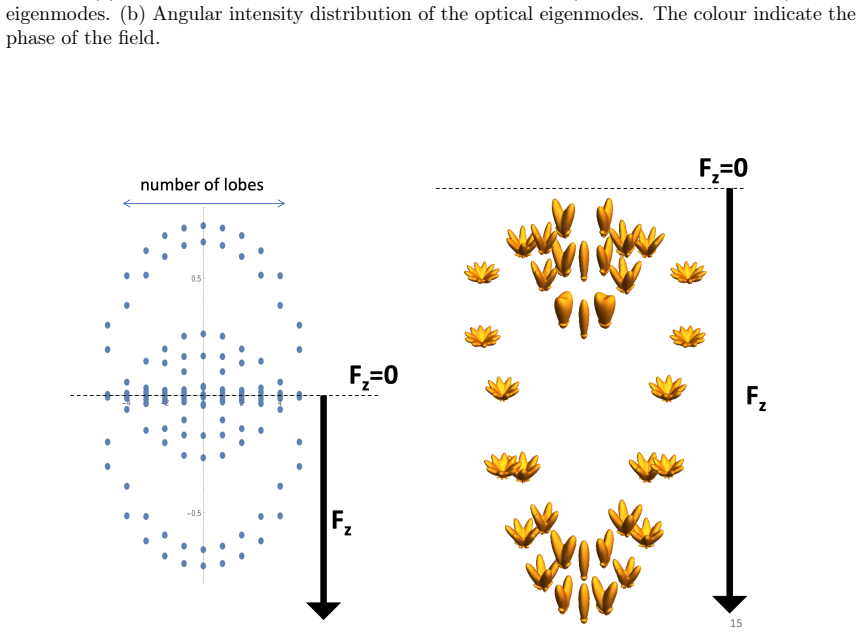
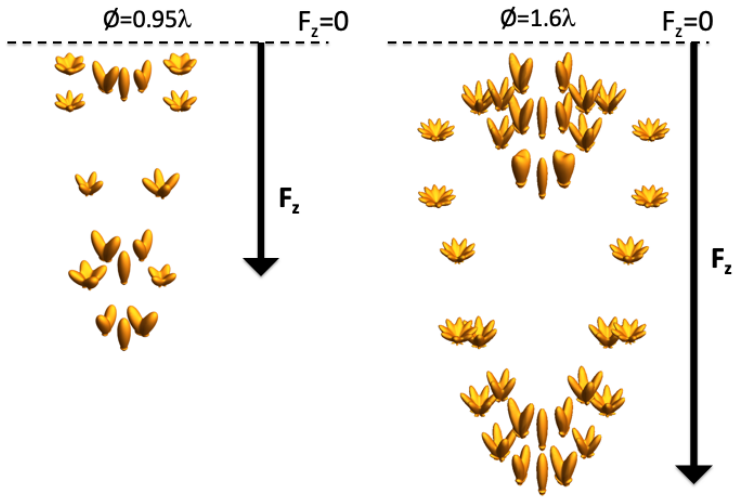
The central discovery is a variational principle for optical trapping: among all incident fields of a given power, the one that maximises the force on a spherical particle is the optical eigenmode with the largest eigenvalue of the momentum-transfer matrix \(M_j^k\) defined in Eq. (2). The matrix is built from beam-shape coefficients and Mie scattering coefficients, and its Hermiticity makes the eigenvalues real and the eigenvectors orthogonal. In the numerical example, a particle of diameter \(1.5\$\lambda$\) and refractive index \(1.5\) displaced in a cylindrically symmetric beam exhibits a transverse trap stiffness roughly ten times larger for the optimal eigenmode than for a Gaussian beam of the same power (Fig. 4). Because the transverse and longitudinal force matrices do not commute, simultaneous optimisation of both directions is impossible; the paper instead optimises the phase between the transverse eigenmode and the longitudinal tractor-beam eigenmode.
Load-bearing premise
The load-bearing premise is that the matrix \(M\) defined in Eq. (2) is Hermitian—conjugate-symmetric, so its eigenvalues are real—as the paper asserts by construction without showing the derivation; if that symmetry fails, the eigenvector ranking that selects the optimal beam is not defined.
Editorial extensions
If this is right
- Given a particle size, refractive index, and numerical aperture, the optimal trapping beam is computable by diagonalising a finite matrix rather than by scanning trial beams.
- The largest-eigenvalue eigenmode provides a benchmark for trap stiffness: any other beam of the same power can be compared against it.
- The eigenmode decomposition gives a reduced basis, so force calculations can keep only the modes with significant eigenvalues instead of the full Hilbert space.
- Because the transverse and longitudinal force operators do not commute, no single beam can simultaneously be the optimal transverse trap and the optimal tractor beam; a phase-optimised superposition is needed.
- The number of significant optical eigenmodes grows with particle size, so larger particles offer more optical degrees of freedom for trapping.
Reading between the lines
- If the method is sound, the same Hermitian-eigenmode construction should also yield optimal beams for other quadratic measures such as angular momentum transfer or torque, extending beyond simple trapping.
- The non-commutativity of transverse and longitudinal force matrices suggests a fundamental trade-off for single-sided optical traps; mapping this Pareto frontier for various particle sizes would be a natural test of the framework.
- Because the eigenmode basis is complete as the Mie order grows, the approach could be transferred to non-spherical particles by replacing Mie coefficients with T-matrix coefficients.
- The predicted ten-fold stiffness enhancement is directly testable: building the optimal eigenmode with a spatial light modulator and comparing its trap stiffness with a Gaussian beam of equal power would confirm or refute the whole chain.
Signed reviews
Editorial analysis
A structured set of objections, weighed in public.
Referee Report
Summary. The paper applies the optical eigenmode (OEi) method to optical trapping of spherical Mie particles. It represents the incident field as a superposition of vector Bessel beams, defines a momentum-transfer matrix M from the Maxwell stress tensor, and claims that the eigenvectors of this Hermitian matrix are orthogonal optical eigenmodes whose eigenvalues give the force in a chosen direction. The mode with the largest eigenvalue is asserted to be the beam delivering the largest momentum transfer at constant incident power. A numerical example reports a ten-fold enhancement of transverse trap stiffness relative to a Gaussian beam, and the paper also discusses longitudinal 'tractor-beam' trapping. The central conceptual idea is promising, but the derivation and numerical support are incomplete as written.
Significance. If the momentum-transfer matrix is correctly derived and the power-normalization issue is resolved, the approach would provide a systematic, basis-set method for beam optimization in optical micromanipulation, extending earlier OEi work to 3D Mie particles and offering potential advantages for high-NA systems and resonant particles. The eigenvalue decomposition is elegant and could enable dimensionality reduction in force calculations. The paper does not provide code, data, or machine-checked derivations, so the credibility rests entirely on the analytic derivation and the numerical example. The central claim is plausible and of interest to the optical trapping community, but the current manuscript does not yet establish it.
major comments (4)
- [Section 2.2, Eq. (2)] The matrix M_j^k is stated to be Hermitian 'by construction,' but no derivation from Eq. (1) is supplied, and the printed expression is not manifestly Hermitian. The nearest-neighbor coupling contains terms such as δ_{n_j+1,n_k}√((1−n_k)^2(n_j^2−m_k^2)/(n_k^2(4n_k^2−1))) and δ_{n_j,n_k+1}√((1−n_j)^2(n_k^2−m_k^2)/(n_j^2(4n_j^2−1))); the first radicand can be negative when |m_k|>n_j, and the second radicand appears to require n_k^2−m_j^2 for conjugate symmetry. In addition, the polarization diagonal term pairs p_k=1 (TM) with the magnetic Mie coefficient b and p_k=2 (TE) with the electric coefficient a, which is the reverse of the usual association. Please derive M_j^k step by step from the Maxwell stress tensor, define all index ranges and summation conventions, and demonstrate explicitly that M_j^k = (M_k^j)^*.
- [Section 2.3] The optimality claim that the optical eigenmode with the largest eigenvalue delivers the largest momentum transfer at constant incident power assumes that the Euclidean norm of the beam-shape coefficient vector g is proportional to the incident power. For vector Bessel beams this is not established: the time-averaged power is a separate quadratic functional of the coefficients, generically with a non-identity Gram matrix. If the Bessel basis is not orthonormal with respect to the power measure, then the eigenvectors of M_j^k need not maximize the force at fixed power. Please define the power normalization explicitly, state the inner product with respect to which M is Hermitian, and show how the eigenvalue ordering relates to the force at constant power (or formulate a generalized eigenvalue problem).
- [Section 3.2, Figure 4] The claimed ten-fold enhancement of transverse trap stiffness is not reproducible from the information given. The manuscript does not specify the maximum multipole order (l_max and n_max) used in the Mie and Bessel expansions, the numerical aperture (cone angle γ), the medium refractive index, the particle displacement at which the transverse force is evaluated, or the normalization procedure applied to the Gaussian and eigenmode beams. Please provide these details and include a convergence check showing that the leading eigenvalue and eigenvector are stable with respect to basis size. Without this, the numerical result remains unverified.
- [Abstract and Section 2.4] The abstract and parts of Section 2.4 state that the method defines 'the optimal trapping beam' without qualification, but the optimization is explicitly restricted to cylindrically symmetric beams. Section 3.2 correctly says 'Within this restricted Hilbert space,' yet the broader language elsewhere overstates the result. Please either qualify the conclusion as optimal only within the cylindrical-symmetric subclass, or provide a symmetry or averaging argument showing that the unrestricted optimum can always be chosen to be cylindrically symmetric.
minor comments (7)
- [Abstract] The sentence 'This relationship defines also a set of orthogonal optical eigenmodes' appears twice in the abstract; the duplicate should be removed.
- [Section 2.2, Eq. (2)] The phrase 'where g_k = g^*_k' is confusing; state explicitly that the quadratic form is F_z = g^† M g with a defined conjugation and index ordering.
- [Section 2.1] In the definition B_l(k_t ρ) = (i)^l J_l(k_t ρ)e^{ilφ}, the missing space before 'with ρ = ...' makes the sentence hard to read, and the symbol J_l should be defined as the Bessel function of the first kind (which is only mentioned later in the text).
- [References] Reference [9] appears to duplicate reference [5] (same title and journal); please combine or delete the duplicate.
- [Figures 1–3] The figure captions do not specify the axes, the sorting order of the eigenvalues, or the color/phase mapping used in the angular intensity distributions; adding these details would improve interpretability.
- [Section 3.2, Figure 4] The label 'arbitrary units' on the vertical axis of the force plot makes the ten-fold enhancement claim less transparent; normalize both curves to the same incident power and report the stiffness ratio with a statement of numerical uncertainty.
- [Introduction] The phrase 'optical eigemodes' in the last paragraph of the Introduction is a typo and should read 'optical eigenmodes'.
Circularity Check
No circularity found: the optimal beam is the dominant eigenvector of an independently defined momentum-transfer matrix, and the reported enhancement is a model output, not a fitted input.
full rationale
The derivation chain is a standard Rayleigh-quotient optimisation. Eq. (2) defines the z-force as the quadratic form g† M g, with M expressed in terms of Mie coefficients and Bessel beam-shape coefficients. The Hermitian matrix M is presented as following from the Maxwell stress tensor and Mie scattering, not as a quantity fitted to the target beam. The claim that the largest-eigenvalue eigenvector delivers maximum momentum transfer at fixed incident power is the textbook spectral theorem for Hermitian matrices; it is a mathematical consequence of the definition of eigenvalue, not an empirical prediction fitted to data. The numerical ten-fold stiffness comparison in Fig. 4 is a simulation output produced by the same model, so no fitted parameter is renamed as a prediction. The heavy self-citation of the OEi framework is noticeable, but the load-bearing object in this paper—the specific matrix M_j^k and its eigen-decomposition for Mie scattering—is not carried by those citations: the citations supply a general quadratic-form viewpoint, while the Hermitian character of M is asserted 'by construction' rather than derived. That omission, and the absence of an explicit power-normalisation Gram matrix, are correctness risks; they do not make the derivation circular because no equation of the paper is equivalent to its own output by construction.
Assumptions & free parameters
assumptions (5)
- domain assumption Mie scattering theory for spherical particles gives the exact scattered field as a function of the incident field.
- domain assumption The optical force is a quadratic Hermitian form in the beam shape coefficients.
- domain assumption The set of vector Bessel beams provides a sufficient basis for the incident field in the optimization.
- ad hoc to paper Restriction to cylindrical symmetric beams is sufficient for optimal transverse trapping.
- ad hoc to paper The matrix M_j^k is Hermitian, so its eigenvalues are real and eigenvectors are orthogonal.
Cite this review
Pith. "Pith review of Eigenmode beam optimisation for optical micro-manipulation." pith.science (2026). https://pith.science/paper/DT3DDMKQ
@misc{pith2026190801179,
  author       = {Pith},
  title        = {Pith review of: Eigenmode beam optimisation for optical micro-manipulation},
  year         = {2026},
  howpublished = {\url{https://pith.science/paper/DT3DDMKQ}},
  note         = {Machine review of arXiv:1908.01179}
}
read the original abstract
Optical micro-manipulation and trapping of micro-particles delivers a mechanical system in direct interaction with a beam of light. In this interaction, the optical properties such as polarisation, beam profile and wavelength of the trapping beam are important. Different beams are associated with different momentum transfer, trap stiffness and stabilisation properties, for example. One method to determine the best beam profile is through the use of the optical eigenmode approach. To use this method, we employ Mie scattering theory which enables the exact determination of the scattered field as a function of the incident field. More precisely, this approach allows us to calculate the Hermitian relationship between the incident field and the optical forces acting on the scattering objects. This Hermitian relationship defines also a set of orthogonal optical eigenmodes which deliver a natural basis to describe momentum transfer in light-matter interactions. This relationship defines also a set of orthogonal optical eigenmodes. Using these modes it is possible to define, for each numerical aperture, particle size or geometry, the optimal trapping beam.
Figures

Figures from the paper (2 more)


Reference graph
Works this paper leans on
-
[1]
Mie scattering eigenmodes for optical trapping
Michael Mazilu. Mie scattering eigenmodes for optical trapping. arXiv e-prints, page arXiv:1704.08779, 2017
work page Pith review arXiv 2017
-
[2]
Optimal trapping beam for spherical micro-particles (conference presen- tation)
Michael Mazilu. Optimal trapping beam for spherical micro-particles (conference presen- tation). Proc. SPIE 10347, Optical Trapping and Optical Micromanipulation XIV, page 103470M, 2017
work page 2017
-
[3]
Michael Mazilu. Nanophotonics generated optimal beam for optical trapping in vacuum.SPIE Nanophotonics Australasia, 10456(143):10456–143, 2017
work page 2017
-
[4]
Optical eigenmode description of single-photon light-matter interactions
Kyle Ballantine and Michael Mazilu. Optical eigenmode description of single-photon light-matter interactions. Proc. SPIE 10935, Complex Light and Optical Forces XIII , 10935:109351B, 2019
work page 2019
- [5]
-
[6]
Spin and angular momentum operators and their conservation.J
Michael Mazilu. Spin and angular momentum operators and their conservation.J. Opt. A, 11(9):094005, 2009. 7
work page 2009
-
[7]
Optical eigenmodes; spin and angular momentum
Michael Mazilu. Optical eigenmodes; spin and angular momentum. J. Opt., 13(6):064009, 2011
work page 2011
-
[8]
Coherent control of plasmonic nanoantennas using optical eigenmodes
Sebastian Kosmeier, Anna Chiara De Luca, Svetlana Zolotovskaya, Andrea Di Falco, Kishan Dholakia, and Michael Mazilu. Coherent control of plasmonic nanoantennas using optical eigenmodes. Scientific Reports, 3:1808 EP –, 2013. Article
work page 2013
Show all 16 references
-
[9]
Optical Eigenmodes; exploiting the quadratic nature of the energy flux and of scattering interactions.Opt
Michael Mazilu, J Baumgartl, S Kosmeier, and K Dholakia. Optical Eigenmodes; exploiting the quadratic nature of the energy flux and of scattering interactions.Opt. Express, 19(2):933– 945, 2011
2011
-
[10]
Joerg Baumgartl, Sebastian Kosmeier, Michael Mazilu, Edward T. F. Rogers, Nikolay I Zhe- ludev, and Kishan Dholakia. Far field subwavelength focusing using optical eigenmodes.Appl. Phys. Lett., 98(18):181109, 2011
2011
-
[11]
Resonance enhanced optical manipulation: the push and pull of light.Proc
Michael Mazilu and Kishan Dholakia. Resonance enhanced optical manipulation: the push and pull of light.Proc. SPIE 8458, Optical Trapping and Optical Micromanipulation IX, page 845809, 2012
2012
-
[12]
Axial optical trapping efficiency through a dielectric interface
Antonio Alvaro Ranha Neves, Adriana Fontes, Carlos Lenz Cesar, Andrea Camposeo, Roberto Cingolani, and Dario Pisignano. Axial optical trapping efficiency through a dielectric interface. Phys. Rev. E, 76:061917, 2007
2007
-
[13]
Optical eigenmode imaging
Anna Chiara De Luca, Sebastian Kosmeier, Kishan Dholakia, and Michael Mazilu. Optical eigenmode imaging. Phys Rev A, 84(2):021803(R), 2011
2011
-
[14]
Enhanced Optical Manipulation of Cells Using Antireflection Coated Mi- croparticles
Derek Craig, Alison McDonald, Michael Mazilu, Helen Rendall, Frank Gunn-Moore, and Kishan Dholakia. Enhanced Optical Manipulation of Cells Using Antireflection Coated Mi- croparticles. ACS Photonics, 2(10):1403–1409, 2015
2015
-
[15]
Orbital-angular-momentum transfer to optically levitated microparticles in vacuum
Michael Mazilu, Yoshihiko Arita, Tom Vettenburg, Juan M Auñón, Ewan M Wright, and Kishan Dholakia. Orbital-angular-momentum transfer to optically levitated microparticles in vacuum. Physical Review A - Atomic, Molecular, and Optical Physics, 94(5):053821, 2016
2016
-
[16]
Is there an optimal basis to maximise optical information transfer?Sci
Mingzhou Chen, Kishan Dholakia, and Michael Mazilu. Is there an optimal basis to maximise optical information transfer?Sci. Rep., 6:22821, 2016. 8
2016
Reviewed August 14, 2026 · model on record in the stance chip above.
Discussion (0). Continue with ORCID to comment.