REVIEW 3 major objections 5 minor 16 references
A Sharp Inequality of Hardy-Littlewood Type Via Derivatives
T0 review · 3 major / 5 minor · reviewed 2026-08-14 · deepseek-v4-flash
Pith's one-line read For two-kernel combinations of reproducing kernels, the generalized Carleman inequality holds, with equality only for a single kernel.
desk verdict A real partial advance on the Hardy–Littlewood contraction conjecture, with a new derivative calculus and a two-kernel theorem—but the main proof's decisive derivative identity is asserted rather than shown, and the paper itself admits a monotonicity step in Theorem 3.6 is numerically false. read the letter →
The pith
A machine-rendered reading of the paper's core claim, the machinery that carries it, and where it could break.
The reading
What carries the argument
The central object is the reproducing kernel $K_{w,\alpha}(z)=(1-\bar w z)^{-\alpha}$ of the weighted Bergman space $A_\alpha^2$, together with the exact derivative formula of Theorem 2.4: when $f^\alpha=\sum_i c_iK_{w_i,\alpha}$, one has $\partial_\alpha N_f(\alpha)=\frac{1}{2\alpha^2}N_f(\alpha)^{1-2\alpha}D_f(\alpha)$, where $D_f(\alpha)$ is a bilinear sum of logarithmic terms involving the values of $f^\alpha$, the points $w_i$, and the norm itself. The proof of the two-kernel theorem rests on an identity for the projected norm, $\frac{d}{d\beta}N_\beta=\frac{1}{\beta^2}N_\beta^{1-\beta}\widehat D_\beta(F^\beta(w),w)$, where $\widehat D_\beta$ is the two-kernel version of $D_f$. The sign of $\widehat D_\beta$ controls monotonicity, and Theorem 3.8 shows it is always non-positive for two points, with equality only when one coefficient vanishes or the two points coincide. The integral computations leading to the derivative formula use Stokes' theorem and residue calculus to evaluate logarithmic integrals over the disc.
What would settle it
Take $\alpha=3/2$, $w_1=0$, $w_2=0.6$, $c_1=1$, $c_2=1+i$, and compute $N_f(\beta)$ numerically on a fine grid of $\beta\in[1,\alpha]$. A single $\beta$ where $N_f(\beta)$ increases, or where the finite-difference derivative disagrees with the paper's formula (2.5)-(2.6), would refute Theorem 4.1.
Extended reading notes
Core claim
The central claim is Theorem 4.1: suppose $f\in H^2$ factors as $f=\eta F$, where $\eta$ is inner and $F$ is zero-free, and suppose that for some $\alpha>1$ the function $F^\alpha$ is a linear combination of two reproducing kernels, $F^\alpha=c_1K_{w_1,\alpha}+c_2K_{w_2,\alpha}$ with $K_{w,\alpha}(z)=(1-\bar w z)^{-\alpha}$. Then for every $1\le \beta\le \alpha$, the norm inequality $\|F\|_{A_\alpha^{2\alpha}}\le \|F\|_{A_\beta^{2\beta}}$ holds, with equality if and only if $F^\alpha$ is a single kernel term. Consequently $\|f\|_{A_\alpha^{2\alpha}}\le\|f\|_{H^2}$, with equality exactly when $f=cK_{w,1}$. The proof differentiates the projected norm $N_\beta=\|P_{w,\beta}F^\beta\|^{1/\beta}_{A_\beta^2}$ and shows that its derivative has the sign of a two-kernel expression $\widehat D_\beta$, which the authors prove is non-positive. This settles the generalized Carleman/Hardy-Littlewood inequality for a non-integer range of $\alpha$, not just integer $\alpha$ as in Burbea's earlier result.
Load-bearing premise
The proof's load-bearing step is an unproved derivative identity, stated as 'by straight-forward computation', for the projected two-kernel norm; if that identity is not exactly right, the norm inequality does not follow.
Editorial extensions
If this is right
- For any $f\in H^2$ whose $\alpha$-th power is a two-kernel combination, Conjecture 2 holds: $\|f\|_{A_\alpha^{2\alpha}}\le\|f\|_{H^2}$ for every $\alpha>1$, with extremals exactly the single reproducing kernels.
- The stronger monotonicity statement $\|F\|_{A_\alpha^{2\alpha}}\le\|F\|_{A_\beta^{2\beta}}$ for $1\le\beta\le\alpha$ holds in this class, so the norm is decreasing in the parameter $\beta$.
- By Corollary 4.4, the conclusion transfers to Conjecture 1 for $p=2/\alpha$, yielding $\|f\|_{A^2_{2/p}}\le\|f\|_{H^p}$ for such functions.
- The derivative formula gives a finite, computable criterion $D_\alpha(c,w)\le 0$ that would imply the full Conjecture 2 if established for all finite kernel sums, as shown in Proposition 3.3.
- The equality cases identify the extremal functions of the inequality as $f(z)=c/(1-\bar w z)$, matching the known extremal for Carleman's inequality.
Reading between the lines
- Because finite linear combinations of reproducing kernels are dense in $A_\alpha^2$, the remaining obstacle to the full conjecture is purely finite-dimensional: prove $D_\alpha(c,w)\le 0$ for all $k$, $c$, and $w$. The numerical examples in the paper suggest the sign is subtle for $k\ge 3$, so a counterexample may exist.
- The same derivative machinery could be adapted to other one-parameter families of norms, such as weighted Bergman norms with different weights, or to Hardy spaces over the infinite-dimensional torus via the Bohr transform, where contractive inequalities imply bounds for Dirichlet polynomials.
- A testable next step is to search numerically for $k=3$ complex coefficients where $D_\alpha(c,w)>0$, since the paper's sufficient conditions (positive coefficients, collinear points) do not cover that case; finding one would delimit exactly how far the monotonicity program can go.
Signed reviews
Editorial analysis
A structured set of objections, weighed in public.
Referee Report
Summary. The paper studies the inequality ||f||_{A_α^{2α}} ≤ ||f||_{H^2} for α>1, which is equivalent to a Hardy-Littlewood/Carleman-type inequality. For zero-free f in H^2, the authors define N_f(α)=||f||_{A_α^{2α}} and observe that if N_f is decreasing in α, then the desired a priori inequality follows. The main technical result is a discrete derivative formula for ∂_α N_f(α) when f^α is a finite linear combination of reproducing kernels of A^2_α (Theorem 2.4), expressed through a quantity D_f(α). Several sufficient conditions for D_f(α)≤0 are given (Theorems 2.7, 3.6, 3.8). The central application is Theorem 4.1: if f=ηF with η inner and F zero-free, and if F^α is a linear combination of exactly two reproducing kernels, then ||F||_{A_α^{2α}} ≤ ||F||_{A_β^{2β}} for every 1≤β≤α, and consequently ||f||_{A_α^{2α}}≤||f||_{H^2}, with equality only for one-kernel functions. Some numerical evidence is presented in Section 5.
Significance. If the main theorem is correct, it gives a nontrivial partial resolution of a long-standing conjecture by proving the inequality for a dense family of two-kernel combinations, and it identifies the extremal functions. The derivative formula for finite kernel combinations is elegant and potentially useful beyond this application. The reduction from an infinite-dimensional norm inequality to a finite-dimensional algebraic sign condition is a promising strategy. The paper also provides explicit equality characterizations and numerical evidence. However, the central proof relies on an unproved derivative identity, and the paper itself reports a numerical failure of a related monotonicity statement; these issues must be resolved before the result can be accepted.
major comments (3)
- [Section 4, proof of Theorem 4.1, case (1), after Definition 4.3] The identity d/dβ N_β = (1/β^2) N_β^{1-β} \hat D_β(F^β(w),w) is asserted as 'by straight-forward computation' but is not derived. This identity is the exact bridge that converts the algebraic inequality \hat D_β≤0 into the monotonicity N_α^{1/2}≤N_β^{1/2}, so it is load-bearing for the main theorem. The computation is not routine: it requires differentiating F^β(w) with respect to β, which involves log F(w), and reconciling the branch of log F^β with the principal branch Log used in \hat D_β. Please provide the complete derivation and state precisely the branch assumptions needed for each β∈[1,α].
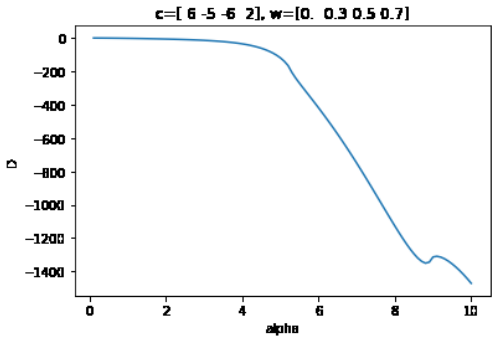
- [Section 5.2(1)] The paper states that 'In the proof of Theorem 3.6, we showed that Dα(c,w) is non-increasing in α under the given conditions. However, Figure 1 shows that this is not always true.' As written, the proof of Theorem 3.6 derives D_α(c,w)≤0 from the monotonicity of D_t along the path t∈[0,α]. If that path monotonicity can fail, the proof is invalid. The authors must clarify exactly which monotonicity statement is false, correct the proof if possible, or else withdraw or restrict Theorem 3.6 and identify which of the paper's claims remain supported.
- [Theorem 3.8 proof] Two assertions in the proof of Theorem 3.8 are also made without derivation: the formula d/dt D_t = |c1|^2 (d/dt a11,t) Log(|f1,t|^2/(a11,t N_t)) and the equality D_1=0. Since Theorem 4.1 relies directly on Theorem 3.8 to conclude \hat D_β≤0, these steps should be expanded. In light of the admitted numerical failure of a similar monotonicity argument in Section 5.2, the 'by direct computation' statements in this proof need independent verification.
minor comments (5)
- [Section 5.1(2)] The word 'Hadmadard' should be 'Hadamard' in the phrase 'Hadmadard product'.
- [Lemma 3.7 proof] The name 'Jenson' should be 'Jensen' in the proof of Lemma 3.7.
- [Equation (1.4)] The notation n_i and m_i in equation (1.4) is introduced without a defining sentence; a brief explanation would improve readability.
- [Remark 2.6] Remark 2.6 attributes a question about monotonicity of N_f(α)^{2α} to reference [4], but the introduction attributes a closely related question to [6, Question 1]; please verify the intended reference.
- [Theorem 3.9] Theorem 3.9 condition (1) should explicitly note that the points w_i are real because (c,w) is assumed to lie in Λ_α∪Γ; otherwise the statement appears to claim the result for arbitrary w∈D^k, which is not proved in the text.
Circularity Check
No significant circularity found; the central derivative identity is unproved but not assumed, so the gap is a correctness issue, not circularity.
full rationale
The derivation chain is not circular. The paper begins from an open conjecture and derives an exact derivative formula for N_f(α) in Theorem 2.4 using Stokes' theorem and residue computations for functions whose α-th power lies in the span of reproducing kernels. The subsequent sign conditions for D_α (Theorems 3.6, 3.8) are proved by independent Jensen-type and matrix arguments; they do not assume the target inequality. In Theorem 4.1, the key step is the asserted identity d/dβ N_β = (1/β^2) N_β^{1−β} \hat D_β(F^β(w),w), described as 'by straight-forward computation.' This is load-bearing and unproved in the paper, and the numerical note in Section 5.2(1) shows that a related monotonicity assertion in the proof of Theorem 3.6 can fail. However, this is an omitted proof or possible error, not circularity: \hat D_β is defined independently in Definition 4.2, and the inequality is not used as an input anywhere. No parameters are fitted, no data subset is used to produce a prediction, and the cited background work [6] is by different authors and is used only for known equivalences. Thus the paper's central claim does not reduce to its own inputs, and any circularity score would be inappropriate.
Assumptions & free parameters
assumptions (5)
- standard math Weighted Bergman spaces A^2_alpha are reproducing kernel Hilbert spaces with kernel K_{w,alpha}(z) = (1 - z \bar w)^{-alpha} (or the paper's real-line convention), and the span of kernel functions at points in an open interval is dense.
- standard math Stokes' theorem and the residue theorem for the unit disc apply to the integrals defining III_ij.
- standard math Jensen's inequality for probability measures applies with equality conditions.
- domain assumption Outer functions have no zeros in the unit disc and can be approximated by functions in O* with the Hardy norm.
- domain assumption For a continuous function on an interval avoiding 0, there is a connected neighborhood and a half-plane containing its image, so a single-valued logarithm exists on that neighborhood.
Cite this review
Pith. "Pith review of A Sharp Inequality of Hardy-Littlewood Type Via Derivatives." pith.science (2026). https://pith.science/paper/AZCGXTVL
@misc{pith2026190801320,
  author       = {Pith},
  title        = {Pith review of: A Sharp Inequality of Hardy-Littlewood Type Via Derivatives},
  year         = {2026},
  howpublished = {\url{https://pith.science/paper/AZCGXTVL}},
  note         = {Machine review of arXiv:1908.01320}
}
abstract
In this paper we consider a generalized version of Carleman's inequality. An equivalent version of it states that $\|f\|_{A_\alpha^{2\alpha}}\leq\|f\|_{H^2}$, where $f$ is a holomorphic function and $\alpha>1$. If the norms $\|f\|_{A_\alpha^{2\alpha}}$ are decreasing in $\alpha$, then the inequality holds for $f$. For a dense set of functions, we calculate the derivative of the norms $\|f\|_{A_\alpha^{2\alpha}}$ in $\alpha$ and give sufficient conditions for this derivative to be non-positive. As an application, we prove the inequality for linear combinations of two reproducing kernels. Some numerical evidences are also provided.
Figures
Figures from the paper (1 more)
Reference graph
Works this paper leans on
-
[1]
Aronszajn, Theory of reproducing kernels, Trans
N. Aronszajn, Theory of reproducing kernels, Trans. Amer. Math. Soc. , 68(1950), 337-404
work page 1950
-
[2]
Bayart, Hardy spaces of Dirichlet series and their composition operators
F. Bayart, Hardy spaces of Dirichlet series and their composition operators. Monatsh. Math. 136 (2002), no. 3, 203-236
work page 2002
- [3]
-
[4]
A. Bondarenko, O. Brevig, E. Saksman, K. Seip, J. Zhao, Pseudomoments of the Riemann zeta function. Bull. Lond. Math. Soc. 50 (2018), no. 4, 709-724
work page 2018
-
[5]
A. Bondarenko, W. Heap, K. Seip, An inequality of Hardy-Littlewood type for Dirichlet polynomials. J. Number Theory 150 (2015), 191-205. 22
work page 2015
- [6]
-
[7]
Burbea, Inequalities for reproducing kernel spaces
J. Burbea, Inequalities for reproducing kernel spaces. Illinois J. Math. 27 (1983), no. 1, 130-137
work page 1983
-
[8]
Burbea, Inequalities for holomorphic functions of several complex variables
J. Burbea, Inequalities for holomorphic functions of several complex variables. Trans. Amer. Math. Soc. 276 (1983), no. 1, 247-266
work page 1983
Show all 16 references
-
[9]
Burbea, Sharp inequalitites for holomorphic functions
J. Burbea, Sharp inequalitites for holomorphic functions. Illinois J. Math. 31 (1987), 248-264
1987
-
[10]
Carleman, Zur theorie der minimal߬ achen,Math
T. Carleman, Zur theorie der minimal߬ achen,Math. Zeit., 9(1921) 154-160
1921
-
[11]
G. H. Hardy, J. E. Littlewood, Some properties of fractional integrals. II. Math. Zeit. 34 (1932), no. 1, 403-439
1932
-
[12]
Helson, Hankel forms and sums of random variables.Studia Math
H. Helson, Hankel forms and sums of random variables.Studia Math. 176 (2006), no. 1, 85-92
2006
-
[13]
Mateljevi´ c and M
M. Mateljevi´ c and M. Pavlovi´ c, New proofs of the isoperimetric inequality and some generalizations, J. Math. Anal. Appl. 98(1984) 25-30
1984
-
[14]
Vukoti´ c, The isoperimetric inequality and a theorem of Hardy and Littlewood
D. Vukoti´ c, The isoperimetric inequality and a theorem of Hardy and Littlewood. Amer. Math. Monthly 110 (2003), no. 6, 532-536
2003
-
[15]
S. E. Warschawski, On the differentiability at the boundary in conformal map- ping. Proc. Amer. Math. Soc. 12 (1961), 614-620
1961
-
[16]
Zhu, Translating inequalities between Hardy and Bergman spaces
K. Zhu, Translating inequalities between Hardy and Bergman spaces. Amer. Math. Monthly 111 (2004), no. 6, 520-525. Hui Dan, School of Mathematical Sciences, Fudan University, Shanghai, 200433, China, E- mail: hdan@fudan.edu.cn Kunyu Guo, School of Mathematical Sciences, Fudan ...
2004
Reviewed August 14, 2026 · model on record in the stance chip above.
Discussion (0). Continue with ORCID to comment.