REVIEW 3 major objections 5 minor 18 references
Energy Efficiency Optimization for UAV-assisted Backscatter Communications
T0 review · 3 major / 5 minor · reviewed 2026-08-14 · deepseek-v4-flash
Pith's one-line read A UAV collecting data from backscatter tags has a unique hover point that maximizes energy efficiency, and that point moves closer to the tags when the UAV transmits at lower power.
desk verdict A fresh UAV-backscatter system model, but the main outage derivation multiplies two events that share the same channel gain, overestimating outage and shifting the claimed optimal hover location. read the letter →
The pith
A machine-rendered reading of the paper's core claim, the machinery that carries it, and where it could break.
The reading
What carries the argument
The load-bearing object is the closed-form average outage probability in Eq. (10), built by writing the joint successful-delivery probability as a product of three terms: the complementary CDF of the tag-to-UAV SNR, the complementary CDF of the UAV-to-BS SNR, and the complementary energy-outage probability. Each term is evaluated under Nakagami-m fading with LoS/NLoS probabilities from Eq. (2). The optimization mechanism is the Golden Section method, a one-dimensional line search, applied to the energy efficiency objective in Eq. (12); it supplies the unique $x_1^*$ without computing derivatives of the complicated outage expression.
What would settle it
Run a Monte Carlo simulation with fixed parameters from the paper, drawing the tag-to-UAV channel and using it simultaneously for the backscattered signal and the energy-harvest outage, then compare the measured joint outage probability with Eq. (10); a systematic gap that grows with channel correlation would show the factorization in Eq. (8) does not hold.
Extended reading notes
Core claim
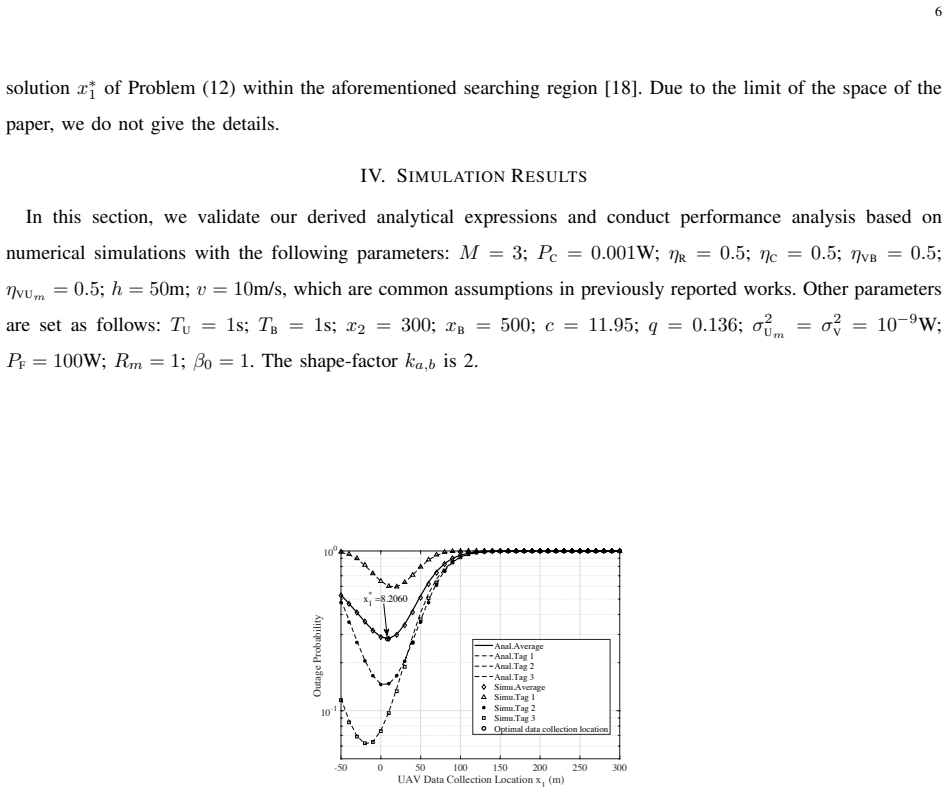
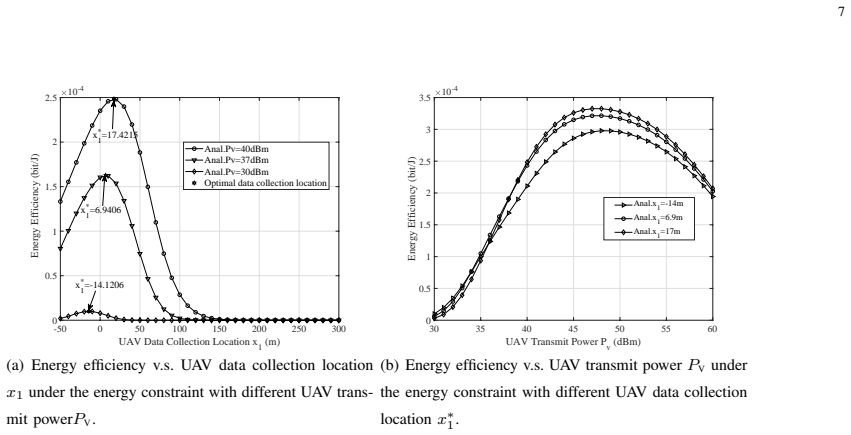
The paper's central claim is that the system average outage probability in Eq. (10) accurately captures the behavior of the proposed UAV-assisted backscatter system, and that maximizing the energy efficiency in Eq. (12) yields a unique optimal data collection location $x_1^*$. The outage model combines three events: the tag fails to harvest enough energy, the backscattered tag-to-UAV signal falls below threshold, or the UAV-to-BS upload falls below threshold. Using Golden Section search on the one-dimensional feasible region, the paper shows that the optimal hover point moves closer to the tags for lower UAV transmit power, because weaker excitation requires shorter backscatter links to keep outage low; higher transmit power instead lets the UAV hover closer to the base station and spend less energy on flight. The paper verifies the analytical expression with Monte Carlo simulation over the full range of hover locations and finds the optimal transmit power for maximum energy efficiency.
Load-bearing premise
The whole outage calculation in Eq. (8) multiplies together the probabilities of three separate outage events as if they were independent; the tag-to-UAV signal quality and the tag's energy harvest both depend on the same random channel, so if that dependence is strong the predicted outage probability and optimal hover location will be off.
Editorial extensions
If this is right
- The optimal hover location can be computed directly from closed-form expressions, so system designers can avoid exhaustive simulation when positioning a collector UAV.
- Lower UAV transmit power forces the collector closer to the tags; higher power relaxes that requirement and lets the UAV hover nearer the base station, saving flight energy.
- For any fixed hover location, there is an optimal UAV transmit power that maximizes bits per joule, so power and position should be chosen together.
- Per-tag outage grows with the horizontal distance between tag and UAV, so the scheme implicitly treats tags near the center of the collection zone more favorably.
Reading between the lines
- The outage formula multiplies marginal probabilities for tag-to-UAV signal quality and energy harvesting even though both depend on the same tag-to-UAV channel; a joint outage treatment would be a natural extension and could shift the optimal hover point.
- If the UAV operates half-duplex instead of full-duplex, the collection phase doubles or the schedule changes, which would alter the energy-efficiency trade-off in a straightforward way from the same model.
- The same Golden Section optimization can be extended to multiple UAVs or non-uniform tag distributions, though the objective may then lose its unimodal shape.
Signed reviews
Editorial analysis
A structured set of objections, weighed in public.
Referee Report
Summary. The paper proposes a UAV-assisted backscatter communication system in which a UAV hovers at a location x1 to collect data from multiple terrestrial backscattering tags via TDMA, then flies to a location x2 near a base station to upload the collected data. The authors derive an expression for the system average outage probability (Theorem 1) and formulate an energy efficiency maximization problem over the data collection location x1, solved by Golden Section search under a UAV energy constraint. They report that the optimal location x1* moves closer to the tags as the UAV transmit power decreases. Monte Carlo simulations are presented to validate the analytical outage probability.
Significance. The system model is timely and the optimization framework is relevant for IoT applications in remote areas. The paper provides explicit analytical expressions and includes Monte Carlo validation, which is a strength. However, the correctness of the main analytical derivation is undermined by an unjustified independence assumption in Eq. (8), and the optimality claim relies on an unproven unimodality assumption. If the technical issues are resolved, the results would be a useful contribution to UAV-assisted backscatter communications.
major comments (3)
- [Section II-C, Eq. (8)] Eq. (8) factorizes the joint event of tag energy sufficiency and tag-to-UAV SNR success as the product of the marginal probabilities. However, both events depend on the same channel power |g_VUm|^2: the energy event is |g_VUm|^2 >= A_m (from Eq. (6)), and the SNR event, conditioned on |g_VUm|^2 = y, is |g'_VUm|^2 >= gamma^m_th (y sigma^2_Um + sigma^2_V) / (eta_R P_V y). Since |g_VUm|^2 and |g'_VUm|^2 are independent, the exact joint success probability is a single integral over y >= A_m. The product form is not equal to this integral in general, and because the conditional survival probability is increasing in y, the product systematically underestimates the joint success probability and overestimates Pin,m. This error propagates into the closed-form expression in Eq. (10) and into the energy efficiency objective in Eq. (12). The Monte Carlo match in Fig. 2 does not resolve the issue unless the simulator explicitly generates the joint event; the paper does not state the simulation procedure.
- [Section III, feasible region] The feasible region for x1 is derived incorrectly. From the constraint (x2 - x1) P_F / v + (T_B + T_U) P_V <= E_total, the correct lower bound is x1 >= x2 - v (E_total - (T_B + T_U) P_V) / P_F, not x1 >= v (E_total - (T_B + T_U) P_V) / P_F as written in the text. This changes the search interval for the Golden Section method and may lead to infeasible or overly restrictive optimization results.
- [Section III, unimodality and convexity] The optimization uses the Golden Section method, which requires the objective function to be unimodal over the search interval. The paper asserts that Pin(x1) is 'obviously convex' based on a single simulation figure, but no proof is provided, and convexity of Pin(x1) does not imply unimodality of eta_en(x1), which also has a location-dependent denominator. The claimed global optimum x1* is therefore not rigorously established. The authors should either provide a proof of unimodality for the considered parameter regimes or explicitly restrict the claim to the numerical examples.
minor comments (5)
- [Theorem 1, Eq. (10)] The expression in Eq. (10) is called 'closed-form' in the abstract and Theorem 1, but it still contains an integral; please rephrase as an analytical expression with a single integral.
- [Section II-A, system model] The tags are described as 'randomly scattered with uniform distribution within a range of 20 meters,' but Eq. (9) treats the tag locations as fixed without averaging over the spatial distribution; clarify whether the analysis is for a given realization or averages over the tag positions.
- [Section IV, simulation parameters] The simulation parameters do not specify the UAV total energy E_total; adding this value would improve reproducibility.
- [Section III, text near Eq. (12)] The text says 'the problem in Eq. (10) is convex,' but Eq. (10) is an expression, not an optimization problem; please rephrase.
- [Section III, feasible-region formula] The formula for the feasible region is ambiguous because of missing parentheses; write it as x1 >= x2 - v(E_total - (T_B + T_U) P_V) / P_F to avoid confusion.
Circularity Check
No circularity: outage and energy-efficiency results are derived from stated channel/energy models without fitted inputs or load-bearing self-citations.
full rationale
The derivation chain is self-contained and non-circular. The outage expression in Eq. (8) and Theorem 1, Eq. (10), are obtained from the stated channel and energy models (Nakagami-m fading, LoS/NLoS probabilities, backscatter SNR in Eq. (4), and tag energy in Eq. (6)) using standard probability calculations; no parameter is fitted to the outage or energy-efficiency results being reported. The optimal data-collection location x1* in Section III is produced by a Golden Section search over the objective in Eq. (12), whose ingredients are the same derived outage formulas and the flight/energy constraint; the observation that x1* moves closer to the tags at lower UAV transmit power follows from evaluating that objective, not from imposing the conclusion. The paper's references are to prior external work on channels and UAV models, and no load-bearing claim is supported only by a self-citation. The only notable issue, the product factorization in Eq. (8) of events that both depend on |gVUm|^2, is a possible modeling approximation; even if it were inaccurate, it is a correctness concern, not circularity, because the formula is not fitted to the Monte-Carlo points and the simulation validation does not define the analytical result. Therefore the circularity score is 0.
Assumptions & free parameters
free parameters (7)
- LoS probability constants c and q =
c=11.95, q=0.136
- Nakagami shape factor k_{a,b} =
2 for all links
- Reflection coefficient eta_R =
0.5
- Energy conversion efficiency eta_C =
0.5
- NLoS attenuation factors eta_VB and eta_VUm =
0.5
- Path loss exponent alpha =
2
- UAV flight power PF =
100 W
assumptions (5)
- domain assumption All channels follow i.i.d. Nakagami-m fading with shape factor k_{a,b} and mean Omega = omega beta0 d^{-alpha}.
- domain assumption LoS probability follows p_{a,LOS} = 1/(1 + c exp[-q(theta - c)]).
- domain assumption The UAV operates in full-duplex mode with perfect signal separation, so no self-interference remains.
- ad hoc to paper SNR outage, uplink outage, and tag energy outage events factor into independent probabilities in Eq. (8).
- ad hoc to paper The energy efficiency objective is unimodal over the feasible x1 region, so Golden Section search converges to the global optimum.
Cite this review
Pith. "Pith review of Energy Efficiency Optimization for UAV-assisted Backscatter Communications." pith.science (2026). https://pith.science/paper/IA2552HF
@misc{pith2026190801339,
  author       = {Pith},
  title        = {Pith review of: Energy Efficiency Optimization for UAV-assisted Backscatter Communications},
  year         = {2026},
  howpublished = {\url{https://pith.science/paper/IA2552HF}},
  note         = {Machine review of arXiv:1908.01339}
}
read the original abstract
Future Internet-of-Things (IoT) has high demand for energy-saving communications, especially in remote areas and smart cities. To meet this demand, we propose novel Unmanned Aerial Vehicle-assisted backscatter communications, where a UAV first collects data from multiple terrestrial backscattering tags via time division multiple access, and then flies into the coverage region of a terrestrial base station to upload its collected data to its associated base station. To determine the optimal UAV data collection location, we first analyze the system average outage probability, and then optimize the energy efficiency with the optimal backscattering location through Golden Section method under UAV energy constraint. Our analytical and simulation results illustrate that there is a trade-off between UAV data collection location and the outage probability, and the optimal UAV data collection location to achieve maximum energy efficiency needs to be closer to the tags for lower UAV transmit power.
Figures

Reference graph
Works this paper leans on
-
[1]
Wirelessly powered backscatter communication networks: Modeling, coverage, and capacity,
K. Han and K. Huang, “Wirelessly powered backscatter communication networks: Modeling, coverage, and capacity,” IEEE Trans. Wireless Commun., vol. 16, no. 4, pp. 2548–2561, Apr. 2017
work page 2017
-
[2]
X. Lu, H. Jiang, D. Niyato, D. I. Kim, and Z. Han, “Wireless-powered device-to-device communications with ambient backscattering: Performance modeling and analysis,” IEEE Trans. Wireless Commun. , vol. 17, no. 3, pp. 1528–1544, Mar. 2018
work page 2018
-
[3]
Wi-Fi backscatter: Internet connectivity for RF-powered devices,
B. Kellogg, A. Parks, S. Gollakota, J. R. Smith, and D. Wetherall, “Wi-Fi backscatter: Internet connectivity for RF-powered devices,” in Proc. ACM SIGCOMM 2014 , ser. SIGCOMM ’14. New York, NY , USA: ACM, Aug. 2014, pp. 607–618
work page 2014
-
[4]
LoRa backscatter: Enabling the vision of ubiquitous connectivity,
“LoRa backscatter: Enabling the vision of ubiquitous connectivity,” in Proc. ACM Interact. Mob. Wearable Ubiquitous Technol. , vol. 1, no. 3. New York, NY , USA: ACM, Sep. 2017, pp. 105:1–105:24
work page 2017
-
[5]
Wireless charging technologies: Fundamentals, standards, and network applications,
X. Lu, P. Wang, D. Niyato, D. I. Kim, and Z. Han, “Wireless charging technologies: Fundamentals, standards, and network applications,” IEEE Commun. Surveys Tuts. , vol. 18, no. 2, pp. 1413–1452, 2016
work page 2016
-
[6]
LoRea: A backscatter architecture that achieves a long communication range,
A. Varshney, O. Harms, C. Perez-Penichet, C. Rohner, F. Hermans, and T. V oigt, “LoRea: A backscatter architecture that achieves a long communication range,” in ACM SENSYS 2017 , Nov. 2017, pp. 1–14
work page 2017
-
[7]
Survey on unmanned aerial vehicle networks for civil applications: A communications viewpoint,
S. Hayat, E. Yanmaz, and R. Muzaffar, “Survey on unmanned aerial vehicle networks for civil applications: A communications viewpoint,” IEEE Commun. Surveys Tuts. , vol. 18, no. 4, pp. 2624–2661, 2016
work page 2016
-
[8]
Cellular-connected UA V: Potential, challenges, and promising technologies,
Y . Zeng, J. Lyu, and R. Zhang, “Cellular-connected UA V: Potential, challenges, and promising technologies,” IEEE Wireless Commun. , vol. 26, no. 1, pp. 120–127, Feb. 2019
work page 2019
Show all 18 references
-
[9]
A drone-based wireless power transfer anc communications platform,
X. He, J. Bito, and M. M. Tentzeris, “A drone-based wireless power transfer anc communications platform,” in 2017 IEEE WPTC , May 2017, pp. 1–4
2017
-
[10]
Joint trajectory and power optimization for UA V relay networks,
S. Zhang, H. Zhang, Q. He, K. Bian, and L. Song, “Joint trajectory and power optimization for UA V relay networks,” IEEE Commun. Lett., vol. 22, no. 1, pp. 161–164, Jan. 2018
2018
-
[11]
Power-efficient communication in UA V-aided wireless sensor networks,
M. Hua, Y . Wang, Z. Zhang, C. Li, Y . Huang, and L. Yang, “Power-efficient communication in UA V-aided wireless sensor networks,” IEEE Communications Letters , vol. 22, no. 6, pp. 1264–1267, June 2018
2018
-
[12]
Energy-efficient cooperative secure transmission in multi-uav enabled wireless networks,
M. Hua, Y . Wang, Q. Wu, H. Dai, Y . Huang, and L. Yang, “Energy-efficient cooperative secure transmission in multi-uav enabled wireless networks,” IEEE Transactions on Vehicular Technology, pp. 1–1, 2019
2019
-
[13]
Opportunistic relaying for low-altitude UA V swarm secure communications with multiple eavesdroppers,
H. Liu, S. Yoo, and K. S. Kwak, “Opportunistic relaying for low-altitude UA V swarm secure communications with multiple eavesdroppers,” J. Commun. Netw., vol. 20, no. 5, pp. 496–508, Oct 2018
2018
-
[14]
Mobile internet of things: Can UA Vs provide an energy-efficient mobile architecture?
M. Mozaffari, W. Saad, M. Bennis, and M. Debbah, “Mobile internet of things: Can UA Vs provide an energy-efficient mobile architecture?” in 2016 IEEE GLOBECOM , Dec. 2016, pp. 1–6
2016
-
[15]
Optimal LAP altitude for maximum coverage,
A. Al-Hourani, S. Kandeepan, and S. Lardner, “Optimal LAP altitude for maximum coverage,” IEEE Wireless Commun. Lett. , vol. 3, no. 6, pp. 569–572, Dec. 2014
2014
-
[16]
On the physical layer security of backscatter wireless systems,
W. Saad, X. Zhou, Z. Han, and H. V . Poor, “On the physical layer security of backscatter wireless systems,” IEEE Trans. Wireless Commun., vol. 13, no. 6, pp. 3442–3451, June 2014
2014
-
[17]
Full-duplex backscatter interference networks based on time-hopping spread spectrum,
W. Liu, K. Huang, X. Zhou, and S. Durrani, “Full-duplex backscatter interference networks based on time-hopping spread spectrum,” IEEE Trans. Wireless Commun. , vol. 16, no. 7, pp. 4361–4377, Jul. 2017
2017
-
[18]
Section 10.2. golden section search in one dimension,
W. H. Press, S. A. Teukolsky, W. T. Vetterling, and B. P. Flannery, “Section 10.2. golden section search in one dimension,” Numerical recipes: the art of scientific computing , pp. 492–496, 2007
2007
Reviewed August 14, 2026 · model on record in the stance chip above.
Discussion (0). Continue with ORCID to comment.