REVIEW 3 major objections 4 minor 106 references
A multi-wavelength study of a massive, active galaxy at $z\sim 2$: coupling the kinematics of the ionized and molecular gas
T0 review · 3 major / 4 minor · reviewed 2026-08-14 · deepseek-v4-flash
Pith's one-line read GMASS 0953, a massive galaxy at $z\simeq2.2$, is a multi-phase rotating disc: ionized gas rotates at $203$ km/s at 13 kpc, molecular gas rotates faster in the centre, and the baryonic mass sits within the local Tully-Fisher scatter.
desk verdict A careful, transparent single-object study; the two-phase comparison is real, but the rotation-curve-peak and Tully-Fisher claims rest on a wind-vs-rotation degeneracy the authors test only qualitatively. read the letter →
The pith
A machine-rendered reading of the paper's core claim, the machinery that carries it, and where it could break.
The reading
What carries the argument
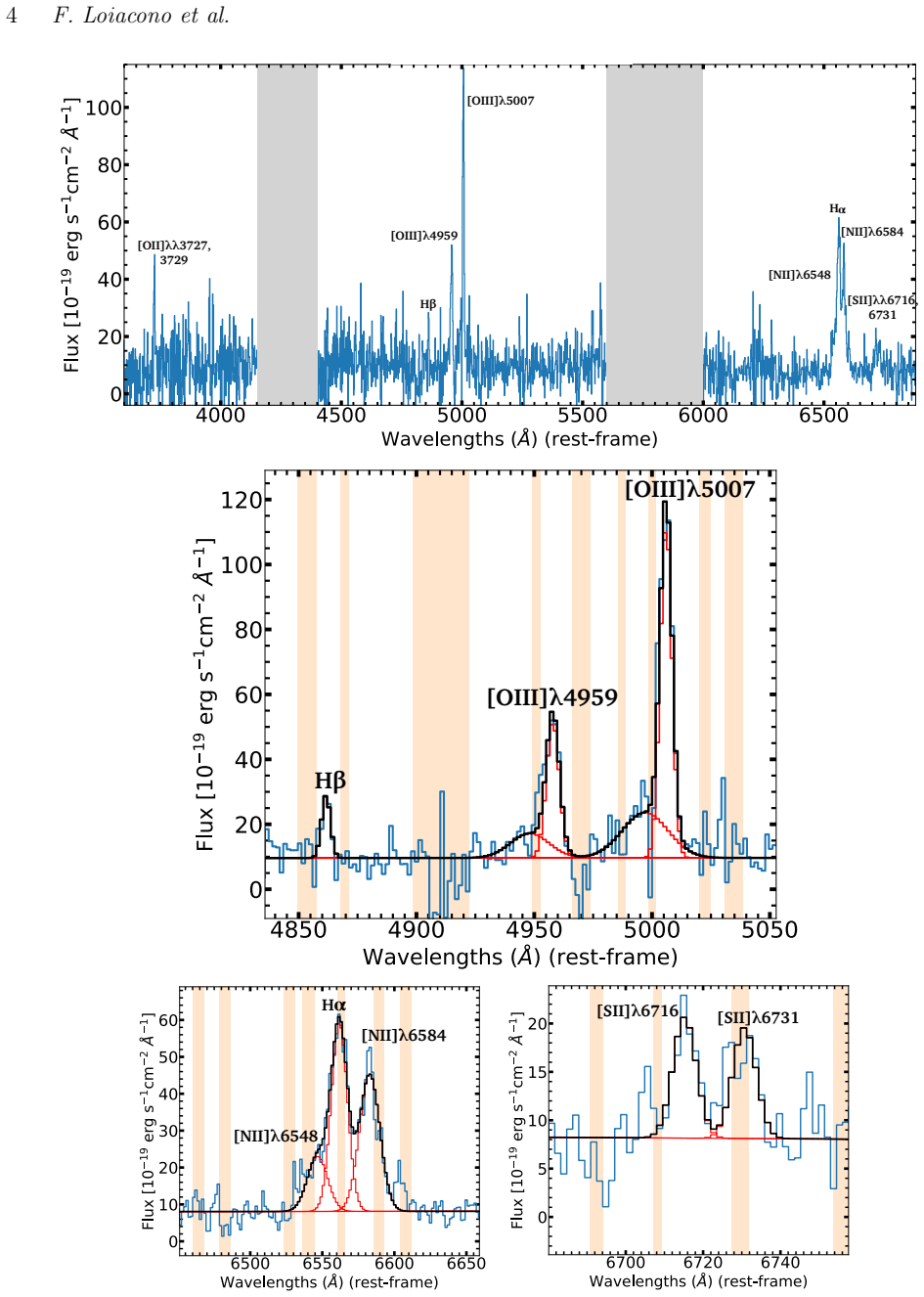
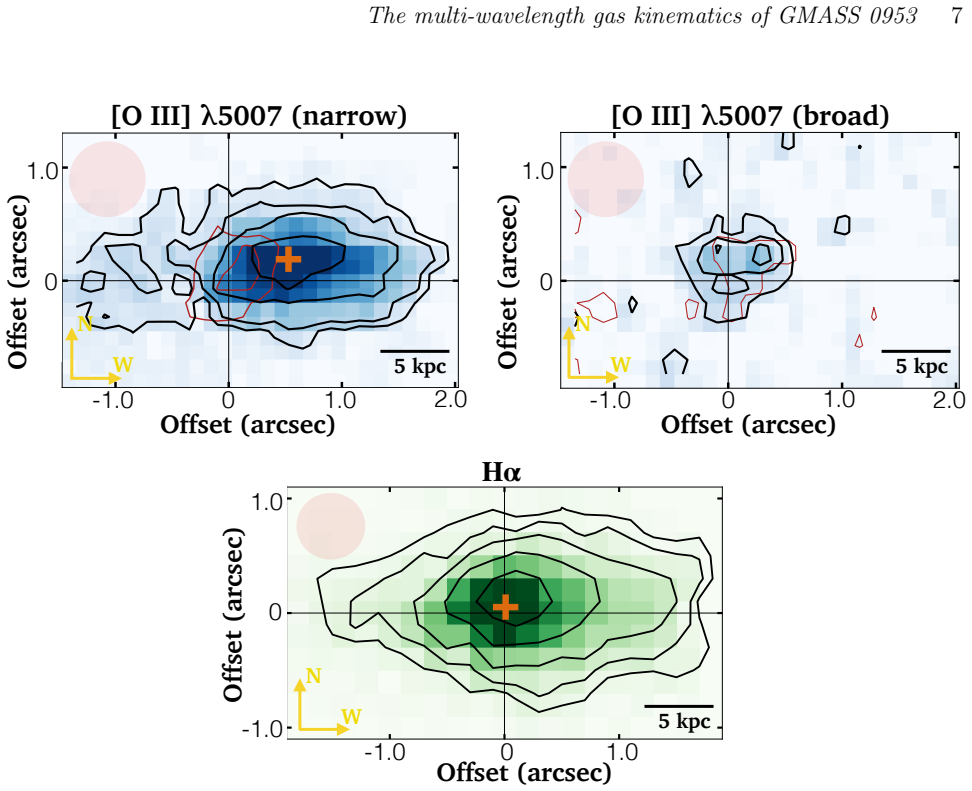
The central machinery is the tilted-ring disc model applied to integral-field data cubes through three-dimensional fitting, which compares an artificial rotating-disc cube with the observed cube and thereby corrects for beam smearing. Its kinematic backbone is the comparison of three emission-line tracers: [O III] $\lambda5007$ and H$\alpha$ trace the outer ionized disc out to 13 kpc, while CO(J=6-5) traces the unresolved molecular disc near 1 kpc, with all three gradients sharing a position angle aligned with the stellar major axis. The outflow-rate estimate rests on a simple conical-wind model that converts the luminosity of the blueshifted [O III] component into an expelled ionized-gas mass and divides it by a flow timescale set by the outflow radius and velocity.
What would settle it
A concrete test would be sub-kpc-resolution integral-field or ALMA observations of the inner few kiloparsecs: a rotating disc should show the classic spider-diagram velocity field, with line-of-sight velocities following $V_{\rm rot}\,\sin i\,\cos\theta$ around the fixed major axis, whereas an outflow cone should show a biconical pattern with the highest velocities along the minor axis and no matching high-velocity signature in the CO disc.
Extended reading notes
Core claim
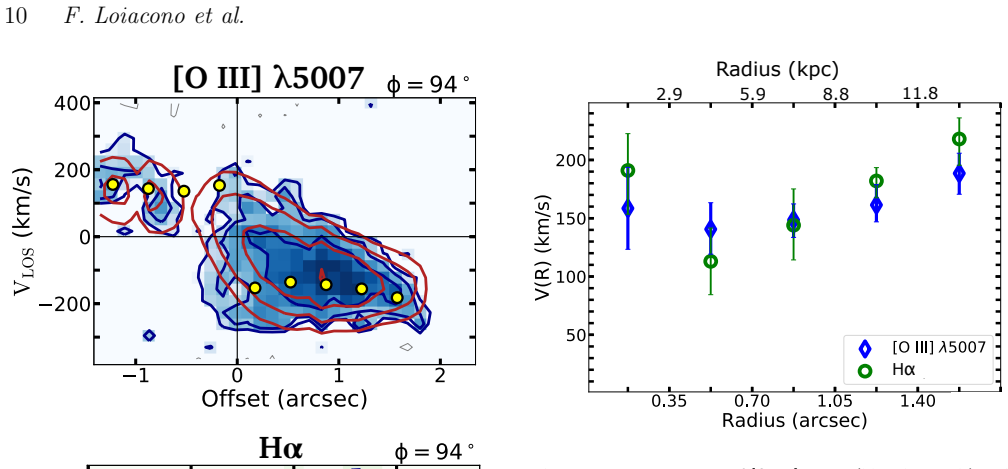
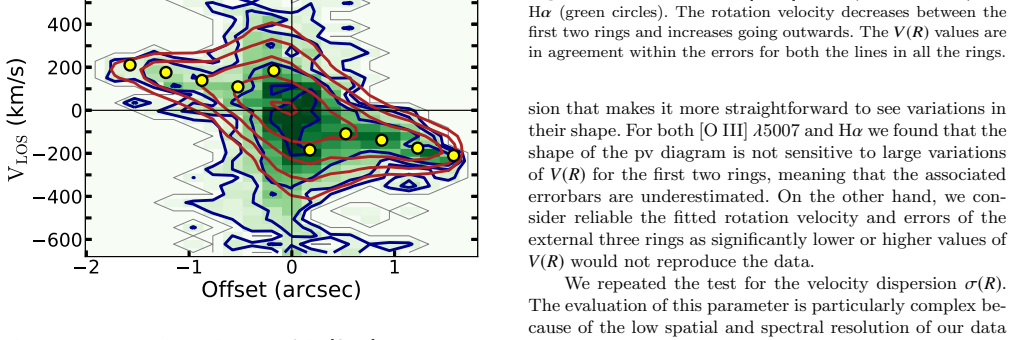
The central claim is that GMASS 0953 hosts a multi-phase rotating disc whose rotation curve rises toward the centre. The ionized gas, traced independently by [O III] $\lambda5007$ and H$\alpha$, shows a large-scale velocity gradient aligned with the stellar major axis; tilted-ring modelling gives a representative rotation velocity of $V_{\rm ion}=203^{+17}_{-20}\,{\rm km\,s}^{-1}$ at $R\simeq13$ kpc. The molecular gas, traced by CO(J=6-5), shows the same spatial orientation but on a scale of $R\simeq1$ kpc, with a higher central velocity $V_{\rm CO}=320^{+92}_{-53}\,{\rm km\,s}^{-1}$. The paper interprets this as evidence that the ionized and molecular phases belong to one disc, that the rotation curve peaks in the very central region, and that the dynamical mass within 13 kpc exceeds $1.3\times10^{11}\,M_{\odot}$, consistent with the stellar mass. With baryonic mass $M_{\rm b}\simeq(1.47\pm0.12)\times10^{11}\,M_{\odot}$, the galaxy falls within the 0.11 dex scatter of the local baryonic Tully-Fisher relation, and a broad blueshifted [O III] wing at $\Delta v=-535\pm152$ km/s is presented as evidence of an AGN-driven outflow. The paper explicitly cautions that a galactic-scale wind could mimic the ionized velocity gradients and is not fully separable at the current spatial resolution, but argues that rotation is the more likely reading because the gradient follows the stellar major axis.
Load-bearing premise
The load-bearing premise is that the observed [O III] and H$\alpha$ velocity gradients come from circular rotation in a tilted disc with inclination fixed to 75 degrees and position angle 94 degrees, rather than from a galactic-scale wind; at the available spatial resolution the two interpretations are not fully separable.
Editorial extensions
If this is right
- Massive galaxies at $z\simeq2$ can already be dynamically relaxed rotating discs, so disc settling does not have to wait until low redshift.
- A rotation curve that peaks near 1 kpc and then declines implies a centrally concentrated mass distribution, consistent with the compact stellar structure of GMASS 0953.
- Molecular and ionized gas trace the same disc, so high-resolution CO observations can recover central rotation velocities where seeing-limited ionized-gas measurements are unreliable.
- With a total depletion timescale near $10^8$ yr, the galaxy would rapidly become passive if fresh gas accretion is shut off.
- The kpc-scale blueshifted [O III] feature shows that AGN-driven gas ejection is operating in this source, even though its efficiency relative to star formation remains uncertain.
Reading between the lines
- If the multi-phase disc is real, the combination of a high inner CO velocity and a lower outer ionized velocity implies a steeply falling rotation curve; a higher-resolution CO rotation curve would directly probe the bulge-to-disc transition and test the inferred central mass concentration.
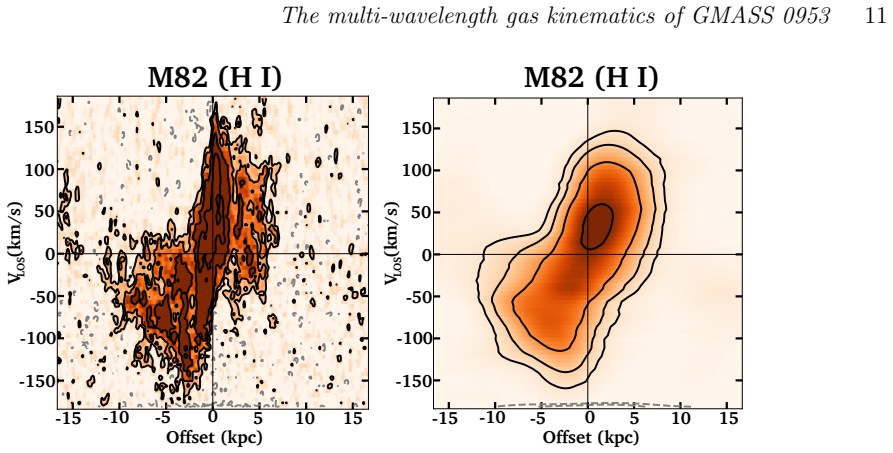
- The M82 comparison suggests that low-resolution, single-tracer kinematics of high-redshift galaxies may systematically misclassify outflow cones as discs, making multi-phase position-angle agreement a cheap discriminator for future surveys.
- Because the outflow rate swings by about an order of magnitude depending on the dust-extinction correction, the prediction that GMASS 0953 quenches within about $10^8$ yr is not strongly tied to AGN feedback; if the unextincted estimate is correct, star formation alone would dominate the gas depletion.
- If confirmed, the position of GMASS 0953 on the local baryonic Tully-Fisher relation would make it a useful benchmark for testing whether high-redshift kinematic samples suffer from selection biases toward the most settled galaxies.
Editorial analysis
A structured set of objections, weighed in public.
Referee Report
Summary. GMASS 0953 is a massive (M* ~ 1.15e11 Msun), z = 2.226 star-forming galaxy with an obscured AGN. The paper combines GNIRS slit spectroscopy, SINFONI and KMOS integral-field data, and published ALMA CO(6-5) measurements to study the kinematics of the ionized and molecular gas. The [O III] and Halpha velocity gradients are modelled as a rotating disc with 3DBarolo, yielding a consistent outer rotation velocity V_ion = 203+17/-20 km/s at R ~ 13 kpc. Combined with V_CO = 320+92/-53 km/s at R ~ 1 kpc from Talia et al. (2018), the authors infer a multi-phase disc with a rotation curve that peaks in the centre, a dynamical mass lower limit of 1.3e11 Msun, and consistency with the z = 0 baryonic Tully-Fisher relation. They also identify an AGN-driven ionized outflow from a broad blueshifted [O III] component and evaluate outflow rates and depletion timescales, concluding that total gas depletion occurs on ~1e8 yr timescales while emphasizing the uncertainties in the AGN's role.
Significance. If the rotation interpretation is correct, this is one of the few multi-phase kinematic studies of a massive z ~ 2 galaxy, and it supports the existence of kinematically settled systems at early epochs. Strengths include independent 3DBarolo fits to two emission lines that give consistent outer rotation curves, a robust outflow detection in two independent datasets, and a generally transparent discussion of limitations, including the wind degeneracy and the unreliable inner rings. The principal weakness is that the strongest conclusions - the central rotation-curve peak, the dynamical mass, and the Tully-Fisher placement - depend on the rotation assumption, which is not uniquely constrained by the data, and on a V_CO-to-V_ion comparison whose significance is not quantified against the authors' own caveats. The paper is therefore a solid measurement and case study, but its headline claims are provisional.
major comments (3)
- [§4.3, §5] The wind-versus-rotation degeneracy is acknowledged but never quantitatively tested. The only test offered is the qualitative M82 comparison in Fig. 8, which the authors state 'appears roughly similar' after smoothing, and the wind interpretation is then rejected because the wind would move perpendicular to the disc. With a PSF of 0.59-0.70 arcsec and a ring width of 0.35 arcsec, the inner few kpc are resolved with less than one PSF element, and wide-angle or inclined biconical outflows can project velocity gradients along the major axis. Because V_ion, the dynamical mass lower limit, and the Tully-Fisher placement in §5 all assume rotation, the authors should add a quantitative test (e.g., mock biconical-wind cubes observed with the same PSF, inclination, and velocity binning) or present the rotation-derived quantities explicitly as conditional on the assumed geometry.
- [§4.2, §5] The claim that the rotation curve peaks in the central regions rests on comparing V_CO = 320+92/-53 km/s (Talia et al. 2018) with V_ion = 203+17/-20 km/s at R ~ 13 kpc, a difference of roughly 1.2-2.1 sigma depending on how the asymmetric error bars are propagated. The authors themselves state in §4.2 that the first two rings of the ionized rotation curve are not constrained by the pv diagrams and that their errors are underestimated. The paper should provide an explicit significance estimate that includes the systematic uncertainties (fixed inclination, unresolved CO core, and ring correlation) and, if the significance remains low, present the centrally peaked rotation curve as tentative rather than a firm result.
- [§5] The baryonic Tully-Fisher placement uses V_ion as the circular velocity without an asymmetric-drift correction, even though the velocity dispersion upper limits from the 3DBarolo fits are large (sigma < 160 km/s for [O III] and sigma < 90 km/s for Halpha; §4.2). If the true circular velocity is higher than V_ion, the galaxy's position on the z = 0 relation would shift substantially. The authors should show how the BTFR conclusion depends on V_c by considering the range of asymmetric-drift corrections allowed by the data, or restrict the claim to the measured rotation velocity.
minor comments (4)
- [Throughout] The manuscript contains several typos that should be corrected: 'hypotesis' (§4), 'phoenomena' (§4.3), 'changelling' and 'blushifted' (Conclusions), and 'espress' and 'abudance' (Appendix D).
- [Fig. 8] Please specify how the M82 data were smoothed to 4.65 kpc (kernel shape and width) and whether the velocity binning was matched to the [O III]/Halpha data, so that the comparison is reproducible.
- [Abstract/Conclusions] The abstract uses 'may host an ionized disc' while the conclusions state 'we found evidence of a multi-phase disc'; the confidence level should be harmonized, especially if the wind degeneracy remains unresolved.
- [§5] In the sentence comparing V_CO with the Halpha inner value, give the radius and uncertainty of the Halpha inner value explicitly, since the reader would otherwise need to reconstruct it from Fig. 7.
Circularity Check
No significant circularity: the ionized-gas rotation curve, CO comparison, and baryonic Tully-Fisher placement are independent measurements combined with published external data.
full rationale
The paper's central kinematic result, Vion=203 km/s at 13 kpc, is derived by fitting the SINFONI/KMOS [O III] and H-alpha data cubes with the 3DBarolo tilted-ring model; it is a measurement from the data, not a prediction obtained from an input. The comparison to VCO=320 km/s from Talia et al. (2018) cites independently published ALMA observations; although a co-author overlaps, the CO rotation curve is not fit in this paper and is externally falsifiable, so the citation is real evidence rather than a circular chain. The dynamical-mass lower limit and the baryonic Tully-Fisher placement follow from measured Vion, Mstar, MH2, and standard scaling relations, with no parameter fitted to make GMASS 0953 land on the relation. The M82 wind comparison is explicitly presented as a degeneracy and caveat, not as a fitted alternative, and the paper does not claim its rotation interpretation as a forced or unique result. Outflow rates and depletion timescales are derived from measured line fluxes and standard assumptions, with the authors acknowledging the strong model-dependence. No derivation in the paper reduces to its own inputs by the paper's equations, so no circular step is present.
Assumptions & free parameters
free parameters (5)
- Disc inclination angle i =
75 degrees
- Position angle of the major axis phi =
94 degrees
- Dynamical center =
HST/H-band emission peak
- Disc scale height z0 =
150 pc (default)
- Gas surface density normalization =
locally averaged flux matching
assumptions (5)
- domain assumption The velocity gradients in [O III] and Hα are produced by a rotating disc with constant inclination and position angle across the tilted rings.
- domain assumption The CO(6-5) line traces a rotating molecular disc with V_CO = 320 km/s at R~1 kpc, as published in Talia et al. (2018).
- domain assumption The baryonic Tully-Fisher relation at z=0 (Lelli et al. 2016b) is valid for testing this z~2 galaxy, i.e., no significant evolution in the relation.
- domain assumption The outflow mass and rate derivations assume a conical geometry, a temperature of 10^4 K, fully ionized oxygen, solar relative abundances scaled by the mass-metallicity relation, and electron density from [S II].
- domain assumption Standard ΛCDM cosmology and Chabrier IMF are adopted.
Cite this review
Pith. "Pith review of A multi-wavelength study of a massive, active galaxy at $z\sim 2$: coupling the kinematics of the ionized and molecular gas." pith.science (2026). https://pith.science/paper/IOIN4XNY
@misc{pith2026190801358,
  author       = {Pith},
  title        = {Pith review of: A multi-wavelength study of a massive, active galaxy at $z\sim 2$: coupling the kinematics of the ionized and molecular gas},
  year         = {2026},
  howpublished = {\url{https://pith.science/paper/IOIN4XNY}},
  note         = {Machine review of arXiv:1908.01358}
}
abstract
We report a multi-wavelength study of the massive ($M_{\star} \gtrsim 10^{11} \rm{M}_{\odot}$), $z\sim 2$ star-forming galaxy GMASS 0953, which hosts an obscured AGN. We combined near-infrared observations of the GNIRS, SINFONI and KMOS spectrographs to study the kinematics of the [O III]$\lambda 5007$ and H$\alpha$ emission lines. Our analysis shows that GMASS 0953 may host an ionized disc extending up to 13 kpc, which rotates at a velocity of $V_{\rm{ion}} = 203^{+17}_{-20} {\ \rm kms}^{-1}$ at the outermost radius. Evidence of rotation on a smaller scale ($R \sim 1$ kpc) arises from the CO(J=6-5) line. The central velocity $V_{\rm{CO}} = 320^{+ 92}_{-53} {\ \rm kms}^{-1}$ traced by the molecular gas is higher than $V_{\rm{ion}}$, suggesting that the galaxy harbors a multi-phase disc with a rotation curve that peaks in the very central regions. The galaxy appears well located on the $z = 0$ baryonic Tully-Fisher relation. We also discuss the possibility that the [O III]$\lambda 5007$ and H$\alpha$ velocity gradients are due to a galactic-scale wind. Besides, we found evidence of an AGN-driven outflow traced by a broad blueshifted wing affecting the [O III]$\lambda 5007$ line, which presents a velocity offset $\Delta v = -535 \pm 152 {\ \rm kms}^{-1}$ from the systemic velocity. Because of the short depletion timescale ($\tau_{\rm{dep}}\sim 10^8$ yr) due to gas ejection and gas consumption by star formation activity, GMASS 0953 may likely evolve into a passive galaxy. However, the role of the AGN in depleting the gas reservoir of the galaxy is quite unclear because of the uncertainties affecting the outflow rate.
Figures

Figures from the paper (7 more)




Reference graph
Works this paper leans on
-
[1]
Asplund M., Grevesse N., Sauval A. J., Scott P., 2009, @doi [ ] 10.1146/annurev.astro.46.060407.145222 , http://adsabs.harvard.edu/abs/2009ARA
arXiv 2009
-
[2]
Barro G., et al., 2017, @doi [ ] 10.3847/2041-8213/aa9f0d , http://adsabs.harvard.edu/abs/2017ApJ...851L..40B 851, L40
-
[3]
G., 1987, PhD thesis, , Kapteyn Institute, (1987)
Begeman K. G., 1987, PhD thesis, , Kapteyn Institute, (1987)
1987
-
[4]
Berta S., et al., 2013, @doi [ ] 10.1051/0004-6361/201220859 , http://adsabs.harvard.edu/abs/2013A
-
[5]
Princeton University Press
Binney J., Tremaine S., 2008, Galactic Dynamics: Second Edition . Princeton University Press
2008
-
[6]
Brusa M., et al., 2015, @doi [ ] 10.1093/mnras/stu2117 , http://adsabs.harvard.edu/abs/2015MNRAS.446.2394B 446, 2394
-
[7]
Brusa M., et al., 2018, @doi [ ] 10.1051/0004-6361/201731641 , https://ui.adsabs.harvard.edu/abs/2018A
-
[8]
Calzetti D., Armus L., Bohlin R. C., Kinney A. L., Koornneef J., Storchi-Bergmann T., 2000, @doi [ ] 10.1086/308692 , http://adsabs.harvard.edu/abs/2000ApJ...533..682C 533, 682
doi:10.1086/308692 2000
Show all 106 references
-
[9]
Cano-D \' az M., Maiolino R., Marconi A., Netzer H., Shemmer O., Cresci G., 2012, @doi [ ] 10.1051/0004-6361/201118358 , http://adsabs.harvard.edu/abs/2012A
2012 doi
-
[10]
Carniani S., et al., 2015, @doi [ ] 10.1051/0004-6361/201526557 , http://adsabs.harvard.edu/abs/2015A
2015 doi
-
[11]
Cassata P., et al., 2008, @doi [ ] 10.1051/0004-6361:200809881 , http://adsabs.harvard.edu/abs/2008A
2008 doi
-
[12]
Chabrier G., 2003, @doi [ ] 10.1086/376392 , http://adsabs.harvard.edu/abs/2003PASP..115..763C 115, 763
2003 doi
-
[13]
Chen C.-C., et al., 2017, @doi [ ] 10.3847/1538-4357/aa863a , http://adsabs.harvard.edu/abs/2017ApJ...846..108C 846, 108
2017 doi
-
[14]
Cicone C., et al., 2014, @doi [ ] 10.1051/0004-6361/201322464 , http://adsabs.harvard.edu/abs/2014A
2014 doi
-
[15]
Cimatti A., et al., 2004, @doi [ ] 10.1038/nature02668 , http://adsabs.harvard.edu/abs/2004Natur.430..184C 430, 184
2004 doi
-
[16]
Cimatti A., et al., 2008, @doi [ ] 10.1051/0004-6361:20078739 , http://adsabs.harvard.edu/abs/2008A
2008 doi
-
[17]
Cimatti A., et al., 2013, @doi [ ] 10.1088/2041-8205/779/1/L13 , http://adsabs.harvard.edu/abs/2013ApJ...779L..13C 779, L13
2013 doi
-
[18]
Cresci G., Maiolino R., 2018, @doi [Nature Astronomy] 10.1038/s41550-018-0404-5 , http://adsabs.harvard.edu/abs/2018NatAs...2..179C 2, 179
2018 doi
-
[19]
Cresci G., et al., 2015, @doi [ ] 10.1088/0004-637X/799/1/82 , http://adsabs.harvard.edu/abs/2015ApJ...799...82C 799, 82
2015 doi
-
[20]
Daddi E., et al., 2004, @doi [ ] 10.1086/381020 , http://adsabs.harvard.edu/abs/2004ApJ...600L.127D 600, L127
2004 doi
-
[21]
Daddi E., et al., 2007, @doi [ ] 10.1086/521818 , http://adsabs.harvard.edu/abs/2007ApJ...670..156D 670, 156
2007 doi
-
[22]
Dekel A., et al., 2009, @doi [ ] 10.1038/nature07648 , http://adsabs.harvard.edu/abs/2009Natur.457..451D 457, 451
2009 doi
-
[23]
Delvecchio I., et al., 2014, @doi [ ] 10.1093/mnras/stu130 , http://adsabs.harvard.edu/abs/2014MNRAS.439.2736D 439, 2736
2014 doi
-
[24]
Di Matteo T., Springel V., Hernquist L., 2005, @doi [ ] 10.1038/nature03335 , http://adsabs.harvard.edu/abs/2005Natur.433..604D 433, 604
2005 doi
-
[25]
M., Fraternali F., 2015, @doi [ ] 10.1093/mnras/stv1213 , http://adsabs.harvard.edu/abs/2015MNRAS.451.3021D 451, 3021
Di Teodoro E. M., Fraternali F., 2015, @doi [ ] 10.1093/mnras/stv1213 , http://adsabs.harvard.edu/abs/2015MNRAS.451.3021D 451, 3021
2015 doi
-
[26]
M., Fraternali F., Miller S
Di Teodoro E. M., Fraternali F., Miller S. H., 2016, @doi [ ] 10.1051/0004-6361/201628315 , https://ui.adsabs.harvard.edu/abs/2016A
2016 doi
-
[27]
S., et al., 2017, @doi [ ] 10.1093/mnras/stw3088 , http://adsabs.harvard.edu/abs/2017MNRAS.466..861D 466, 861
Dunlop J. S., et al., 2017, @doi [ ] 10.1093/mnras/stw3088 , http://adsabs.harvard.edu/abs/2017MNRAS.466..861D 466, 861
2017 doi
-
[28]
Eisenhauer F., et al., 2003, in Iye M., Moorwood A. F. M., eds, Vol. 4841, Instrument Design and Performance for Optical/Infrared Ground-based Telescopes. pp 1548--1561 ( @eprint astro-ph/0306191 ), @doi 10.1117/12.459468
2003 arXiv
-
[29]
H., Joyce R
Elias J. H., Joyce R. R., Liang M., Muller G. P., Hileman E. A., George J. R., 2006, in Society of Photo-Optical Instrumentation Engineers (SPIE) Conference Series. p. 62694C, @doi 10.1117/12.671817
2006 doi
-
[30]
C., 2012, @doi [ ] 10.1146/annurev-astro-081811-125521 , http://adsabs.harvard.edu/abs/2012ARA
Fabian A. C., 2012, @doi [ ] 10.1146/annurev-astro-081811-125521 , http://adsabs.harvard.edu/abs/2012ARA
2012 doi
-
[31]
Feltre A., Charlot S., Gutkin J., 2016, @doi [ ] 10.1093/mnras/stv2794 , http://adsabs.harvard.edu/abs/2016MNRAS.456.3354F 456, 3354
2016 doi
-
[32]
Ferrero I., et al., 2017, @doi [ ] 10.1093/mnras/stw2691 , http://adsabs.harvard.edu/abs/2017MNRAS.464.4736F 464, 4736
2017 doi
-
[33]
Fiore F., et al., 2017, @doi [ ] 10.1051/0004-6361/201629478 , http://adsabs.harvard.edu/abs/2017A
2017 doi
-
[34]
M., et al., 2009, @doi [ ] 10.1088/0004-637X/706/2/1364 , http://adsabs.harvard.edu/abs/2009ApJ...706.1364F 706, 1364
F \"o rster Schreiber N. M., et al., 2009, @doi [ ] 10.1088/0004-637X/706/2/1364 , http://adsabs.harvard.edu/abs/2009ApJ...706.1364F 706, 1364
2009 doi
-
[35]
M., et al., 2014, @doi [ ] 10.1088/0004-637X/787/1/38 , http://adsabs.harvard.edu/abs/2014ApJ...787...38F 787, 38
F \"o rster Schreiber N. M., et al., 2014, @doi [ ] 10.1088/0004-637X/787/1/38 , http://adsabs.harvard.edu/abs/2014ApJ...787...38F 787, 38
2014 doi
-
[36]
Franco M., et al., 2018, @doi [ ] 10.1051/0004-6361/201832928 , https://ui.adsabs.harvard.edu/abs/2018A
2018 doi
-
[37]
Genzel R., et al., 2013, @doi [ ] 10.1088/0004-637X/773/1/68 , http://adsabs.harvard.edu/abs/2013ApJ...773...68G 773, 68
2013 doi
-
[38]
Genzel R., et al., 2014, @doi [ ] 10.1088/0004-637X/796/1/7 , http://adsabs.harvard.edu/abs/2014ApJ...796....7G 796, 7
2014 doi
-
[39]
Genzel R., et al., 2017, @doi [ ] 10.1038/nature21685 , http://adsabs.harvard.edu/abs/2017Natur.543..397G 543, 397
2017 doi
-
[40]
Giacconi R., et al., 2002, @doi [ ] 10.1086/338927 , https://ui.adsabs.harvard.edu/abs/2002ApJS..139..369G 139, 369
2002 doi
-
[41]
Glazebrook K., et al., 2004, @doi [ ] 10.1038/nature02667 , http://adsabs.harvard.edu/abs/2004Natur.430..181G 430, 181
2004 doi
-
[42]
Grazian A., et al., 2006, @doi [ ] 10.1051/0004-6361:20053979 , http://adsabs.harvard.edu/abs/2006A
2006 doi
-
[43]
M., et al., 2012, @doi [ ] 10.1111/j.1365-2966.2012.21723.x , http://adsabs.harvard.edu/abs/2012MNRAS.426.1073H 426, 1073
Harrison C. M., et al., 2012, @doi [ ] 10.1111/j.1365-2966.2012.21723.x , http://adsabs.harvard.edu/abs/2012MNRAS.426.1073H 426, 1073
2012
-
[44]
M., Alexander D
Harrison C. M., Alexander D. M., Mullaney J. R., Swinbank A. M., 2014, @doi [ ] 10.1093/mnras/stu515 , http://adsabs.harvard.edu/abs/2014MNRAS.441.3306H 441, 3306
2014 doi
-
[45]
M., Costa T., Tadhunter C
Harrison C. M., Costa T., Tadhunter C. N., Fl \"u tsch A., Kakkad D., Perna M., Vietri G., 2018, @doi [Nature Astronomy] 10.1038/s41550-018-0403-6 , http://adsabs.harvard.edu/abs/2018NatAs...2..198H 2, 198
2018 doi
-
[46]
M., Thompson T
Heckman T. M., Thompson T. A., 2017, arXiv e-prints, https://ui.adsabs.harvard.edu/abs/2017arXiv170109062H
2017
-
[47]
M., Armus L., Miley G
Heckman T. M., Armus L., Miley G. K., 1990, @doi [ ] 10.1086/191522 , http://adsabs.harvard.edu/abs/1990ApJS...74..833H 74, 833
1990 doi
-
[48]
Herrera-Camus R., et al., 2019, @doi [ ] 10.3847/1538-4357/aaf6a7 , https://ui.adsabs.harvard.edu/abs/2019ApJ...871...37H 871, 37
2019 doi
-
[49]
F., Torrey P., Faucher-Gigu \`e re C.-A., Quataert E., Murray N., 2016, @doi [ ] 10.1093/mnras/stw289 , http://adsabs.harvard.edu/abs/2016MNRAS.458..816H 458, 816
Hopkins P. F., Torrey P., Faucher-Gigu \`e re C.-A., Quataert E., Murray N., 2016, @doi [ ] 10.1093/mnras/stw289 , http://adsabs.harvard.edu/abs/2016MNRAS.458..816H 458, 816
2016 doi
-
[50]
I., Battaglia G., 2017, @doi [ ] 10.1093/mnras/stw3285 , http://adsabs.harvard.edu/abs/2017MNRAS.466.4159I 466, 4159
Iorio G., Fraternali F., Nipoti C., Di Teodoro E., Read J. I., Battaglia G., 2017, @doi [ ] 10.1093/mnras/stw3285 , http://adsabs.harvard.edu/abs/2017MNRAS.466.4159I 466, 4159
2017 doi
-
[51]
Kennicutt Jr. R. C., 1998, @doi [ ] 10.1146/annurev.astro.36.1.189 , http://adsabs.harvard.edu/abs/1998ARA
1998 doi
-
[52]
H., Dav \'e R., 2005, @doi [ ] 10.1111/j.1365-2966.2005.09451.x , http://adsabs.harvard.edu/abs/2005MNRAS.363....2K 363, 2
Kere s D., Katz N., Weinberg D. H., Dav \'e R., 2005, @doi [ ] 10.1111/j.1365-2966.2005.09451.x , http://adsabs.harvard.edu/abs/2005MNRAS.363....2K 363, 2
2005
-
[53]
King A., 2005, @doi [ ] 10.1086/499430 , http://adsabs.harvard.edu/abs/2005ApJ...635L.121K 635, L121
2005 doi
-
[54]
Kriek M., et al., 2008, @doi [ ] 10.1086/528945 , http://adsabs.harvard.edu/abs/2008ApJ...677..219K 677, 219
2008 doi
-
[55]
R., Hanisch R
Kriss G., 1994, in Crabtree D. R., Hanisch R. J., Barnes J., eds, Astronomical Society of the Pacific Conference Series Vol. 61, Astronomical Data Analysis Software and Systems III. p. 437
1994
-
[56]
Kurk J., et al., 2013, @doi [ ] 10.1051/0004-6361/201117847 , http://adsabs.harvard.edu/abs/2013A
2013 doi
-
[57]
S., Schombert J
Lelli F., McGaugh S. S., Schombert J. M., 2016a, @doi [ ] 10.3847/0004-6256/152/6/157 , http://adsabs.harvard.edu/abs/2016AJ....152..157L 152, 157
-
[58]
S., Schombert J
Lelli F., McGaugh S. S., Schombert J. M., 2016b, @doi [ ] 10.3847/2041-8205/816/1/L14 , http://adsabs.harvard.edu/abs/2016ApJ...816L..14L 816, L14
-
[59]
Lelli F., De Breuck C., Falkendal T., Fraternali F., Man A. W. S., Nesvadba N. P. H., Lehnert M. D., 2018, @doi [ ] 10.1093/mnras/sty1795 , http://adsabs.harvard.edu/abs/2018MNRAS.tmp.1721L
2018 doi
-
[60]
K., et al., 2015, @doi [ ] 10.1088/0004-637X/814/2/83 , http://adsabs.harvard.edu/abs/2015ApJ...814...83L 814, 83
Leroy A. K., et al., 2015, @doi [ ] 10.1088/0004-637X/814/2/83 , http://adsabs.harvard.edu/abs/2015ApJ...814...83L 814, 83
2015 doi
-
[61]
Luo B., et al., 2017, @doi [ ] 10.3847/1538-4365/228/1/2 , http://adsabs.harvard.edu/abs/2017ApJS..228....2L 228, 2
2017 doi
-
[62]
Madau P., Dickinson M., 2014, @doi [ ] 10.1146/annurev-astro-081811-125615 , http://adsabs.harvard.edu/abs/2014ARA
2014 doi
-
[63]
R., Dickinson M., Le Borgne D., Frayer D
Magnelli B., Elbaz D., Chary R. R., Dickinson M., Le Borgne D., Frayer D. T., Willmer C. N. A., 2011, @doi [ ] 10.1051/0004-6361/200913941 , http://adsabs.harvard.edu/abs/2011A
2011 doi
-
[64]
Magnelli B., et al., 2013, @doi [ ] 10.1051/0004-6361/201321371 , http://adsabs.harvard.edu/abs/2013A
2013 doi
-
[65]
Maiolino R., et al., 2015, @doi [ ] 10.1093/mnras/stv1194 , http://adsabs.harvard.edu/abs/2015MNRAS.452...54M 452, 54
2015 doi
-
[66]
K., Mangum J
Martini P., Leroy A. K., Mangum J. G., Bolatto A., Keating K. M., Sandstrom K., Walter F., 2018, @doi [ ] 10.3847/1538-4357/aab08e , http://adsabs.harvard.edu/abs/2018ApJ...856...61M 856, 61
2018 doi
-
[67]
S., Schombert J
McGaugh S. S., Schombert J. M., Bothun G. D., de Blok W. J. G., 2000, @doi [ ] 10.1086/312628 , http://adsabs.harvard.edu/abs/2000ApJ...533L..99M 533, L99
2000 doi
-
[68]
Nelson D., et al., 2018, @doi [ ] 10.1093/mnras/stx3040 , http://adsabs.harvard.edu/abs/2018MNRAS.475..624N 475, 624
2018 doi
-
[69]
F., et al., 2014, @doi [ ] 10.1088/0004-637X/781/1/21 , http://adsabs.harvard.edu/abs/2014ApJ...781...21N 781, 21
Newman S. F., et al., 2014, @doi [ ] 10.1088/0004-637X/781/1/21 , http://adsabs.harvard.edu/abs/2014ApJ...781...21N 781, 21
2014 doi
-
[70]
M., Sancisi R., Swaters R
Noordermeer E., van der Hulst J. M., Sancisi R., Swaters R. S., van Albada T. S., 2007, @doi [ ] 10.1111/j.1365-2966.2007.11533.x , http://adsabs.harvard.edu/abs/2007MNRAS.376.1513N 376, 1513
2007
-
[71]
Norman C., et al., 2004, @doi [ ] 10.1086/383487 , http://adsabs.harvard.edu/abs/2004ApJ...607..721N 607, 721
2004 doi
-
[72]
Onodera M., et al., 2015, @doi [ ] 10.1088/0004-637X/808/2/161 , http://adsabs.harvard.edu/abs/2015ApJ...808..161O 808, 161
2015 doi
-
[73]
E., Ferland G
Osterbrock D. E., Ferland G. J., 2006, Astrophysics of gaseous nebulae and active galactic nuclei
2006
-
[74]
Popping G., et al., 2017, @doi [ ] 10.1051/0004-6361/201730391 , http://adsabs.harvard.edu/abs/2017A
2017 doi
-
[75]
H., Lockhart I
Rogstad D. H., Lockhart I. A., Wright M. C. H., 1974, @doi [ ] 10.1086/153164 , http://adsabs.harvard.edu/abs/1974ApJ...193..309R 193, 309
1974 doi
-
[76]
G., et al., 2010, @doi [ ] 10.1111/j.1365-2966.2010.17634.x , http://adsabs.harvard.edu/abs/2010MNRAS.409...48R 409, 48
Roseboom I. G., et al., 2010, @doi [ ] 10.1111/j.1365-2966.2010.17634.x , http://adsabs.harvard.edu/abs/2010MNRAS.409...48R 409, 48
2010
-
[77]
Rupke D. S. N., Veilleux S., 2011, @doi [ ] 10.1088/2041-8205/729/2/L27 , http://adsabs.harvard.edu/abs/2011ApJ...729L..27R 729, L27
2011 doi
-
[78]
S., Veilleux S., Sanders D
Rupke D. S., Veilleux S., Sanders D. B., 2005, @doi [ ] 10.1086/444451 , http://adsabs.harvard.edu/abs/2005ApJ...632..751R 632, 751
2005 doi
-
[79]
L., Kronberg P
Schaaf R., Pietsch W., Biermann P. L., Kronberg P. P., Schmutzler T., 1989, @doi [ ] 10.1086/167045 , http://adsabs.harvard.edu/abs/1989ApJ...336..722S 336, 722
1989 doi
-
[80]
Scoville N., et al., 2016, @doi [ ] 10.3847/0004-637X/820/2/83 , http://adsabs.harvard.edu/abs/2016ApJ...820...83S 820, 83
2016 doi
-
[81]
E., Steidel C
Shapley A. E., Steidel C. C., Pettini M., Adelberger K. L., 2003, @doi [ ] 10.1086/373922 , http://adsabs.harvard.edu/abs/2003ApJ...588...65S 588, 65
2003 doi
-
[82]
Sharples R., et al., 2013, The Messenger, http://adsabs.harvard.edu/abs/2013Msngr.151...21S 151, 21
2013
-
[83]
L., Bland-Hawthorn J., 1998, @doi [ ] 10.1086/305108 , http://adsabs.harvard.edu/abs/1998ApJ...493..129S 493, 129
Shopbell P. L., Bland-Hawthorn J., 1998, @doi [ ] 10.1086/305108 , http://adsabs.harvard.edu/abs/1998ApJ...493..129S 493, 129
1998 doi
-
[84]
Spekkens K., Giovanelli R., 2006, @doi [ ] 10.1086/506177 , http://adsabs.harvard.edu/abs/2006AJ....132.1426S 132, 1426
2006 doi
-
[85]
S., Bezanson R., Marrone D
Spilker J. S., Bezanson R., Marrone D. P., Weiner B. J., Whitaker K. E., Williams C. C., 2016, @doi [ ] 10.3847/0004-637X/832/1/19 , http://adsabs.harvard.edu/abs/2016ApJ...832...19S 832, 19
2016 doi
-
[86]
Springel V., Di Matteo T., Hernquist L., 2005, @doi [ ] 10.1086/428772 , http://adsabs.harvard.edu/abs/2005ApJ...620L..79S 620, L79
2005 doi
-
[87]
C., Erb D
Steidel C. C., Erb D. K., Shapley A. E., Pettini M., Reddy N., Bogosavljevi \'c M., Rudie G. C., Rakic O., 2010, @doi [ ] 10.1088/0004-637X/717/1/289 , http://adsabs.harvard.edu/abs/2010ApJ...717..289S 717, 289
2010 doi
-
[88]
A., Sancisi R., van Albada T
Swaters R. A., Sancisi R., van Albada T. S., van der Hulst J. M., 2009, @doi [ ] 10.1051/0004-6361:200810516 , http://adsabs.harvard.edu/abs/2009A
2009 doi
-
[89]
J., et al., 2018, @doi [ ] 10.3847/1538-4357/aaa4b4 , http://adsabs.harvard.edu/abs/2018ApJ...853..179T 853, 179
Tacconi L. J., et al., 2018, @doi [ ] 10.3847/1538-4357/aaa4b4 , http://adsabs.harvard.edu/abs/2018ApJ...853..179T 853, 179
2018 doi
-
[90]
Tadaki K.-i., et al., 2017, @doi [ ] 10.3847/2041-8213/aa7338 , http://adsabs.harvard.edu/abs/2017ApJ...841L..25T 841, L25
2017 doi
-
[91]
Talia M., et al., 2012, @doi [ ] 10.1051/0004-6361/201117683 , http://adsabs.harvard.edu/abs/2012A
2012 doi
-
[92]
Talia M., et al., 2018, @doi [ ] 10.1093/mnras/sty481 , http://adsabs.harvard.edu/abs/2018MNRAS.476.3956T 476, 3956
2018 doi
-
[93]
B., Fisher J
Tully R. B., Fisher J. R., 1977, , http://adsabs.harvard.edu/abs/1977A
1977
-
[94]
\"U bler H., et al., 2018, @doi [ ] 10.3847/2041-8213/aaacfa , http://adsabs.harvard.edu/abs/2018ApJ...854L..24U 854, L24
2018 doi
-
[95]
Ueda Y., et al., 2018, @doi [ ] 10.3847/1538-4357/aa9f10 , http://adsabs.harvard.edu/abs/2018ApJ...853...24U 853, 24
2018 doi
-
[96]
Weinberger R., et al., 2017, @doi [ ] 10.1093/mnras/stw2944 , http://adsabs.harvard.edu/abs/2017MNRAS.465.3291W 465, 3291
2017 doi
-
[97]
Wisnioski E., et al., 2015, @doi [ ] 10.1088/0004-637X/799/2/209 , http://adsabs.harvard.edu/abs/2015ApJ...799..209W 799, 209
2015 doi
-
[98]
Wisnioski E., et al., 2018, @doi [ ] 10.3847/1538-4357/aab097 , http://adsabs.harvard.edu/abs/2018ApJ...855...97W 855, 97
2018 doi
-
[99]
Wuyts E., et al., 2016, @doi [ ] 10.3847/0004-637X/827/1/74 , http://adsabs.harvard.edu/abs/2016ApJ...827...74W 827, 74
2016 doi
-
[100]
da Cunha E., Charlot S., Elbaz D., 2008, @doi [ ] 10.1111/j.1365-2966.2008.13535.x , http://adsabs.harvard.edu/abs/2008MNRAS.388.1595D 388, 1595
2008
-
[101]
de Blok W. J. G., Walter F., Brinks E., Trachternach C., Oh S.-H., Kennicutt Jr. R. C., 2008, @doi [ ] 10.1088/0004-6256/136/6/2648 , http://adsabs.harvard.edu/abs/2008AJ....136.2648D 136, 2648
2008 doi
-
[102]
G., Kriek M., Rodgers B., Franx M., Puxley P., 2005, @doi [ ] 10.1086/429376 , http://adsabs.harvard.edu/abs/2005ApJ...622L..13V 622, L13
van Dokkum P. G., Kriek M., Rodgers B., Franx M., Puxley P., 2005, @doi [ ] 10.1086/429376 , http://adsabs.harvard.edu/abs/2005ApJ...622L..13V 622, L13
2005 doi
-
[103]
G., et al., 2015, @doi [ ] 10.1088/0004-637X/813/1/23 , http://adsabs.harvard.edu/abs/2015ApJ...813...23V 813, 23
van Dokkum P. G., et al., 2015, @doi [ ] 10.1088/0004-637X/813/1/23 , http://adsabs.harvard.edu/abs/2015ApJ...813...23V 813, 23
2015 doi
-
[104]
M., Terlouw J
van der Hulst J. M., Terlouw J. P., Begeman K. G., Zwitser W., Roelfsema P. R., 1992, in Worrall D. M., Biemesderfer C., Barnes J., eds, Astronomical Society of the Pacific Conference Series Vol. 25, Astronomical Data Analysis Software and Systems I. p. 131
1992
-
[105]
van der Wel A., et al., 2014, @doi [ ] 10.1088/0004-637X/788/1/28 , http://adsabs.harvard.edu/abs/2014ApJ...788...28V 788, 28
2014 doi
-
[106]
write newline
" write newline "" before.all 'output.state := FUNCTION fin.entry write newline FUNCTION new.block output.state before.all = 'skip after.block 'output.state := if FUNCTION new.sentence output.state after.block = 'skip output.state before.all = 'skip after.sentence 'output.stat...
Reviewed August 14, 2026 · model on record in the stance chip above.
Discussion (0). Continue with ORCID to comment.