REVIEW 2 major objections 5 minor 68 references
Effects of quantum fluctuations on the dynamics of dipolar Bose polarons
T0 review · 2 major / 5 minor · reviewed 2026-08-14 · deepseek-v4-flash
Pith's one-line read Including anomalous quantum fluctuations changes dipolar Bose polaron density profiles, widths, and breathing frequencies, making dipole-dipole interaction matter for impurity oscillations.
desk verdict The paper's qualitative message about anomalous fluctuations is plausible, but the TF derivation behind the central breathing-mode claim is internally inconsistent, so the main quantitative result is not reliable as written. read the letter →
The pith
A machine-rendered reading of the paper's core claim, the machinery that carries it, and where it could break.
The reading
What carries the argument
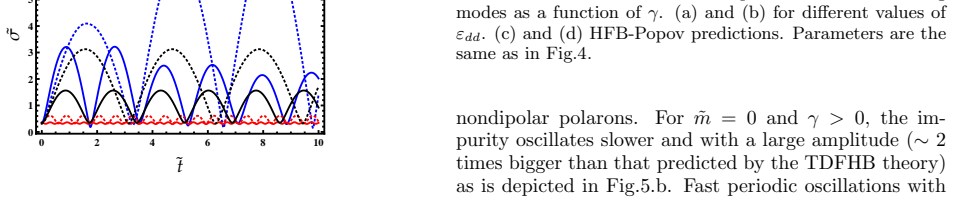
The object that carries the argument is the time-dependent Hartree-Fock-Bogoliubov (TDHFB) set of equations for the condensate wavefunction $\Phi_B$, the anomalous density $\tilde m$, and the impurity wavefunction $\Phi_I$, closed at zero temperature by the relation $\tilde n(\tilde n+1)=|\tilde m|^2$ and by the renormalized coupling $\bar g_B = g_B(1+\tilde m/\Phi_B^2)$. The closure makes the anomalous density larger than the noncondensed density and must be solved self-consistently with the condensate profile. A Gaussian variational ansatz for the impurity, with radial and axial widths as variational parameters, then turns the generalized nonlinear Schrödinger equation into width equations, and linearisation of those equations yields the breathing-mode frequencies $w_\rho$ and $w_z$ as functions of dipole-dipole interaction strength, interspecies coupling, and anomalous correlations.
What would settle it
Measure the radial breathing frequency of an impurity in an oblate dipolar BEC of $^{166}$Er or $^{164}$Dy as a function of $\varepsilon_{dd}$ and $\gamma$, and compare with the TDHFB and HFB-Popov curves in the paper's Fig. 6. A match with the HFB-Popov curves, which show almost no dipole-dipole dependence, would falsify the anomalous-density contribution, as would a quantum Monte Carlo estimate finding $|\tilde m|$ far smaller than $\sqrt{\tilde n(\tilde n+1)}$.
Extended reading notes
Core claim
The central claim is that normal and anomalous fluctuations, in combination with dipole-dipole interactions and impurity-boson contact interactions, alter both equilibrium and dynamical properties of dipolar Bose polarons. Starting from the TDHFB equations, the paper derives Thomas-Fermi density profiles and radii for the condensate and the anomalous component, an extended self-focusing nonlinear Schrödinger equation for the impurity, and variational equations for the impurity widths. Solving them numerically, the authors find that the impurity distorts the condensate and the anomalous component for both repulsive and attractive impurity-boson coupling, and that trap anisotropy combined with the dipole-dipole interaction modulates the amplitude of the width and center-of-mass oscillations. Comparing with HFB-Popov ($\tilde m=0$), the predictions for radial and axial breathing frequencies as functions of $\gamma$ differ considerably; in particular, without the anomalous density the impact of the dipole-dipole interaction on the breathing modes is not important.
Load-bearing premise
The load-bearing premise is that the strength of the pairing correlations is fixed by the zero-temperature relation between the normal and anomalous densities; if that relation is not quantitatively accurate, the claimed effects on breathing frequencies and the differences from HFB-Popov would be wrong.
Editorial extensions
If this is right
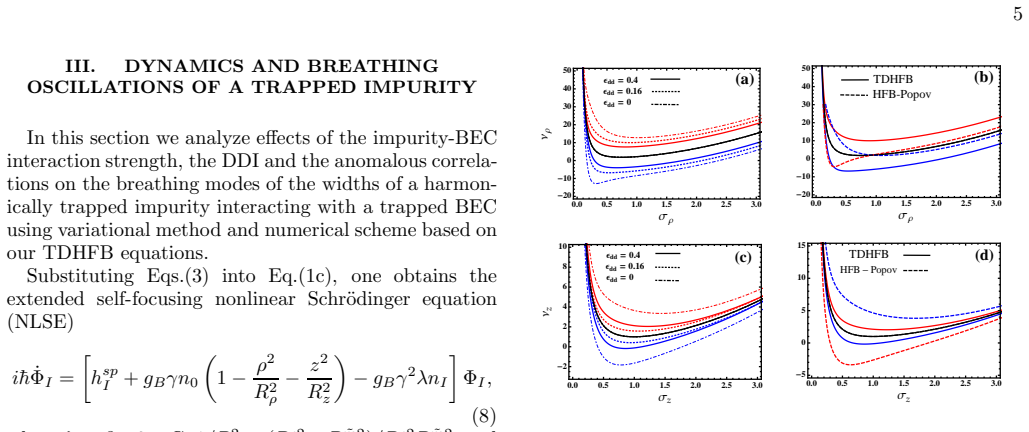
- With anomalous fluctuations included, the impurity's radial breathing frequency rises with interspecies coupling over the whole studied range, while HFB-Popov predicts a peak at $\gamma=0$ followed by a decrease.
- The dipole-dipole interaction shifts the radial and axial breathing frequencies in opposite directions because of the anisotropy, giving a measurable signature of the dipole-dipole interaction in impurity oscillations.
- The depth of the density dip carved by a repulsive impurity grows with $\varepsilon_{dd}$, while attractive impurity-boson coupling increases the condensate density and modifies the anomalous component's shape.
- Thomas-Fermi radii and chemical potentials of both the condensate and the anomalous component acquire explicit dependence on condensed and anomalous fractions, which can be compared with experimental profiles in the weakly coupled regime.
Reading between the lines
- If the anomalous-density effect is real, spectroscopy of dipolar polarons should show systematic deviations from mean-field or Fröhlich-model predictions, for example in the polaron energy or effective mass extracted from radio-frequency spectra.
- The finite-temperature version the authors outline suggests a concrete probe: heating the dipolar BEC should shift the breathing frequencies most near intermediate temperatures, where pairing correlations are largest.
- The single-Gaussian variational ansatz may underestimate the anisotropic deformation of the impurity induced by the dipole-dipole interaction; solving the full width equations without the Gaussian restriction could sharpen the predicted frequencies.
- The same TDHFB machinery is a candidate tool for impurities in dipolar quantum droplets, where the anomalous density is expected to be non-negligible.
Signed reviews
Editorial analysis
A structured set of objections, weighed in public.
Referee Report
Summary. The manuscript studies the static and dynamical properties of dipolar Bose polarons using a time-dependent Hartree-Fock-Bogoliubov (TDHFB) theory that includes both normal and anomalous (pairing) fluctuations. The authors numerically solve the TDHFB equations for the condensate, anomalous, and impurity densities, analyze the time evolution of their widths and center-of-mass oscillations, and derive Thomas-Fermi (TF) expressions for the chemical potential and TF radii of the condensate and the anomalous component in the weak-coupling regime. For the impurity, they introduce a variational Gaussian ansatz, obtain effective radial and axial potentials, and calculate breathing-mode frequencies as functions of the impurity-boson coupling, the dipole-dipole interaction strength, and the anomalous density. The central claim is that the anomalous density significantly modifies the effective potentials and breathing frequencies, and that the HFB-Popov approximation, which ignores the anomalous density, is insufficient for quantitative predictions: specifically, the paper states that without the anomalous density, the effect of the DDI on the breathing modes is not important.
Significance. If the central claim were established, the paper would provide a useful extension of polaron theory to dipolar condensates by quantifying the role of pairing fluctuations in the dynamics. The manuscript contains several valuable ingredients: a consistent numerical implementation of TDHFB, explicit analytic TF formulas that generalize known nondipolar results, a variational treatment of the impurity dynamics, and a clear comparison with the HFB-Popov baseline. The paper also makes a falsifiable prediction that the DDI dependence of breathing modes is controlled by the anomalous density. However, the central quantitative comparison is undermined by an internal inconsistency in the TF reduction, and the magnitude of the anomalous-density effect relies on a closure relation that is asserted rather than independently benchmarked. These issues prevent the main claim from being accepted as stated.
major comments (2)
- [Section II.B, Eqs. (3a)-(3b)] The TF equations are internally inconsistent for generic values of the parameter beta. The paper defines beta = \bar g_B/g_B and \bar g_B = g_B(1 + \tilde m/\Phi_B^2), which gives \tilde m = (\beta - 1)n_c. Substituting Eq. (3a) into this identity yields \tilde m = \tilde m_0 - \gamma G(\beta - 1)n_I, which must coincide with Eq. (3b), \tilde m = \tilde m_0 - \gamma(\beta - 2)n_I. Consistency therefore requires G(\beta - 1) = \beta - 2. With the stated G = \beta/[4(\beta - 1)], this condition holds only for \beta = 8/3, a value that is never mentioned and is far from the dilute limit \beta \to 1 emphasized in the text. Consequently, the coefficient \lambda = \beta - 2 + G entering Eq. (8), and through it the effective potentials (13)-(14) and the breathing frequencies (15)-(16), are not justified by the displayed definitions. The central comparison between TDHFB and HFB-Popov therefore rests on an internally inconsistent derivation and must be reworked.
- [Section II, Eq. (2) and Eq. (8)] The central role of the anomalous density is determined by the zero-temperature closure relation \tilde n(\tilde n + 1) = |\tilde m|^2 together with the renormalized coupling \bar g_B = g_B(1 + \tilde m/\Phi_B^2). This closure is asserted from prior work and is not derived, checked against quantum Monte Carlo data, or compared with any independent many-body calculation in this manuscript. Since the paper's key claim is that TDHFB and HFB-Popov breathing frequencies differ substantially and that the DDI dependence enters only through the anomalous density, the quantitative size of that difference is fully controlled by an unverified assumption. A benchmark against an external method (e.g., quantum Monte Carlo or an experimentally measured dipolar polaron spectrum) would be needed to support the claimed magnitude of the anomalous-density effect.
minor comments (5)
- [Abstract/Conclusion] The statement that 'in the absence of the anomalous density, the impact of the DDI on the breathing modes is not important' is made without a quantitative threshold; please specify how 'not important' is measured (e.g., relative frequency shift) and give the corresponding numbers.
- [Throughout] There are several typographical errors: 'adressed' in the Introduction, 'interations' in the Conclusion, 'envirement' in Section III, 'anisotroy' in Section III, and 'Soild lines' in the caption of Fig. 3.
- [Acknowledgments] The names 'Stefano Giogini' and 'Georg Brunn' should read 'Stefano Giorgini' and 'Georg Bruun'.
- [Eq. (5)] The statement that a1 = a2 = 1 for \tilde m/\Phi^2 \ll 1 should be made more explicit, since a1 and a2 depend on \beta and G through the definitions a1 = (\beta + G\beta - 2)/G and a2 = (G+1)/G; the limiting procedure is not shown.
- [Section III, Eqs. (15)-(16)] The breathing frequencies w_rho and w_z mix barred and unbarred quantities: Eqs. (15)-(16) use sigma_rho0 and sigma_z0, while the potentials in Eqs. (13)-(14) use dimensionless tilde quantities; please clarify the notational correspondence so the reader can reproduce the linearization.
Circularity Check
Partially circular: the TF/NLSE chain forces β = 8/3 by hidden consistency, so the breathing-frequency comparison is not an independent prediction.
-
self definitional
[Section II.B, Eqs. (3a,b) and definitions of β, G; propagated to Eq. (8) and Sec. III]
"nc =nc0 −γGnI, (3a) \tilde m = \tilde m0 −γ(β − 2)nI, (3b) ... with β = \bar g_B/g_B, and G =β/4(β − 1) being effective interaction strengths. One should stress that for large β, the system becomes strongly correlated. Therefore, the diluteness of the gas requires the condition: \tilde m/Φ^2 ≪ 1 or β → 1 [29,30,47]."
By the paper's earlier definition \bar g_B = g_B(1+\tilde m/\Phi_B^2) and β = \bar g_B/g_B, one has β = 1+\tilde m/n_c, i.e. \tilde m = (β−1)n_c. Substituting Eq. (3a) into this identity gives \tilde m = (β−1)n_c0 − γG(β−1)n_I, which must equal Eq. (3b). Consistency for all n_I requires G(β−1) = β−2. With the stated G = β/[4(β−1)], this holds only at β = 8/3, not in the dilute limit β→1 that the paper invokes. Hence the coefficient λ = β−2+G entering Eq. (8), and through it the variational potentials and breathing frequencies (13)–(16), is fixed by a hidden definitional consistency condition rather than by an independent TF solution. The central TDHFB-vs-HFB-Popov comparison therefore reduces to this self-referential/underived step.
full rationale
The one concrete circularity-like defect is the TF/NLSE chain above: the paper treats β as an effective interaction parameter while also defining it via \tilde m, and the resulting consistency condition is satisfied only at an unmentioned special value. This makes the central breathing-mode claim partially definitional rather than independently derived. The rest of the paper is not circular on the same standard: the TDHFB equations are a legitimate framework; Eq. (2) is a standard zero-temperature closure relation (a squeezed-state identity) and its citation to the authors' prior book does not, by itself, make the result circular; the HFB-Popov comparison is a model comparison rather than a fitted-back prediction; and the variational calculation is self-contained once Eq. (8) is granted. The internal inconsistency of the TF equations is primarily a correctness risk, but because it directly controls the claimed DDI/anomalous-density dependence of the breathing frequencies, the circularity score is raised to 6 rather than 0–2.
Assumptions & free parameters
free parameters (1)
- beta = \bar g_B / g_B =
not specified
assumptions (6)
- domain assumption The TDHFB equations (1a)-(1c) govern the dipolar Bose polaron system.
- domain assumption The zero-temperature closure relation \tilde n(\tilde n + 1) = |\tilde m|^2 (Eq. 2).
- ad hoc to paper Renormalized coupling \bar g_B = g_B(1 + \tilde m/\Phi_B^2) removes the unphysical gap.
- domain assumption Neglect of long-range exchange terms \tilde n(r,r') = \tilde m(r,r') = 0 for r not equal to r'.
- domain assumption Thomas-Fermi approximation neglecting kinetic terms in Eqs. (1a) and (1b).
- domain assumption Gaussian variational ansatz for the impurity wavefunction (Eq. 9).
Cite this review
Pith. "Pith review of Effects of quantum fluctuations on the dynamics of dipolar Bose polarons." pith.science (2026). https://pith.science/paper/DZLQHFB4
@misc{pith2026190801412,
  author       = {Pith},
  title        = {Pith review of: Effects of quantum fluctuations on the dynamics of dipolar Bose polarons},
  year         = {2026},
  howpublished = {\url{https://pith.science/paper/DZLQHFB4}},
  note         = {Machine review of arXiv:1908.01412}
}
read the original abstract
We study the dynamics of dipolar Bose polarons in the presence of the normal and anomalous fluctuations using the time-dependent Hartree-Fock-Bogoliubov theory. The density profiles of the condensate, the anomalous component and the impurity are deeply analyzed. The time evolution of the width and the center-of-mass oscillation of such quantities is also highlighted. We calculate corrections due to quantum fluctuations and impurity to the chemical potential and the radius of the condensate and of the anomalous component in the weak coupling regime using the Thomas-Fermi approximation. Effects of the dipole-dipole interaction, impurity-host interaction and the anomalous fluctuation on the width and on the breathing frequencies of the impurity are discussed by variational and numerical means.
Figures


Figures from the paper (2 more)

Reference graph
Works this paper leans on
-
[1]
Blue lines: γ = 2. (a) and (c) Effects of DDI. (b) and (d) Comparison between HFB-Popov approximation ( ˜m = 0) and the TDHFB predictions for εdd = 0 .4. Parameters are: N = 10 3, aB = 100 a0 with a0 being the Bohr radius, ωBρ = 2π × 500 Hz, λB = λI = 5, α = 2, and Ω ρ = 0.2. where the radial Vρ and axial Vz effective potentials are given, respectively as V...
-
[2]
Catani, G
J. Catani, G. Lamporesi, D. Naik, M. Gring, M. Inguscio, F. Minardi, A. Kantian, and T. Giamarchi, Phys. Rev. A 85, 023623 (2012)
2012
-
[3]
M. Guang Hu, M. J. Van de Graaff, D. Kedar, J. P. Corson, E. A. Cornell, and D. S. Jin, Phys. Rev. Lett., 117, 055301 (2016)
work page 2016
-
[4]
N. B. Jrgensen, L. Wacker, K. T. Skalm- stang, M. M. Parish, J. Levinsen, R. S. Christensen, G.M. Bruun, and J. J. Arlt, Phys. Rev. Lett., 117, 055302 (2016)
work page 2016
-
[5]
(see for review) J. T. Devreese, arXiv, 1012.4576v5, (2013)
arXiv 2013
-
[6]
(see for review) F. Grusdt and E. A. Demler, Proceed- ings of the International School of Physics Enrico Fermi, arXiv:1510.04934, (2015)
arXiv 2015
-
[7]
M.Bruderer, A.Klein, S.R. Clark, and D. Jaksch, Phys. Rev. A, 76, 011605 (2007)
work page 2007
-
[8]
J. Tempere, W. Casteels, M. K. Oberthaler, S. Knoop, E. Timmermans, and J. T. Devreese, Phys. Rev. B 80, 184504 (2009)
work page 2009
Show all 68 references
-
[9]
Casteels, J
W. Casteels, J. Tempere, and J. T. Devreese, Phys. Rev. A, 86, 043614 (2012)
2012
-
[10]
Casteels and M
W. Casteels and M. Wouters, Phys. Rev. A 90, 043602 (2014)
2014
-
[11]
Shashi, F
A. Shashi, F. Grusdt, D. A. Abanin, and E. Demler, Phys. Rev. A 89, 053617 (2014)
2014
-
[12]
Grusdt, Y
F. Grusdt, Y. E. Shchadilova, A. N. Rubtsov, and E. Demler, Sci. Rep. 5, 12124 (2015)
2015
-
[13]
Vlietinck, W
J. Vlietinck, W. Casteels, K. Van Houcke, J. Tempere, J. Ryckebusch, and J. T. Devreese, New J. Phys. 17 033023 (2015)
2015
-
[14]
Y. E. Shchadilova, F. Grusdt, A.N. Rubtsov, and E. Demler, Phys. Rev. A, 93, 043606 (2016)
2016
-
[15]
Kain, and H
B. Kain, and H. Y. Ling, Phys. Rev. A, 94, 013621 (2016)
2016
-
[16]
G. E. Astrakharchik and L. P. Pitaevskii, Phys. Rev. A 70, 013608 (2004)
2004
-
[17]
F. M. Cucchietti and E. Timmermans, Phys. Rev. Lett, 96 210401 (2006)
2006
-
[18]
Sacha and E
K. Sacha and E. Timmermans, Phys. Rev. A 73, 063604 (2006)
2006
-
[19]
R. M. Kalas and D. Blume, Phys. Rev. A 73, 043608 (2006). 8
2006
-
[20]
Bruderer, W
M. Bruderer, W. Bao, and D. Jaksch, EPL 82, 30004 (2008)
2008
-
[21]
J. Li, J. An and C. S. Ting, Sci. Rep. 3, 3147 (2013)
2013
-
[22]
A. G. Volosniev, H.-W. Hammer, and N. T. Zinner, Phys. Rev. A 92, 023623 (2015)
2015
-
[23]
S.Christensen, J
R. S.Christensen, J. Levinsen, G. M. Bruun, Phys. Rev. Lett. 115, 160401 (2015)
2015
-
[24]
Levinsen, M
J. Levinsen, M. M. Parish, G. M. Bruun, Phys. Rev. Lett. 115, 125302 (2015)
2015
-
[25]
S. P. Rath and R. Schmidt, Phys. Rev. A, 88, 053632(2013)
2013
-
[26]
L. A. Pen a Ardila and S. Giorgini, Phys. Rev. A, 92, 033612 (2015)
2015
-
[27]
Parisi and S
L. Parisi and S. Giorgini, Phys. Rev. A, 95, 023619 (2017)
2017
-
[28]
Grusdt, G
F. Grusdt, G. Astrakharchik, E. A. Demler, New. J. Phys, 19, 103035, (2017)
2017
-
[29]
Yoshida, Shimpei Endo, Jesper Levinsen, Meera M
Shuhei M. Yoshida, Shimpei Endo, Jesper Levinsen, Meera M. Parish, Phys. Rev. X 8, 011024 (2018)
2018
-
[30]
Boudjemˆ aa, Phys
A. Boudjemˆ aa, Phys. Rev. A 90, 013628 (2014)
2014
-
[31]
Boudjemˆ aa, J
A. Boudjemˆ aa, J. Phys. A: Math. Theor. 48 045002 (2015)
2015
-
[32]
Boudjemˆ aa, Commun
A. Boudjemˆ aa, Commun. Nonlinear Sci. Numer. Simul. 33, 85 (2016)
2016
-
[33]
Boudjemˆ aa, Commun
A. Boudjemˆ aa, Commun. Nonlinear Sci. Numer. Simul. 48, 376 (2017)
2017
-
[34]
M. Sun, H. Zhai, and X. Cui, Phys. Rev. Lett. 119, 013401 (2017)
2017
-
[35]
Levinsen, M
J. Levinsen, M. M. Parish, R. S. Christensen, J. J. Arlt, G. M. Bruun, Phys. Rev. A 96, 063622 (2017)
2017
-
[36]
Guenther, P
N-E. Guenther, P. Massignan, M. Lewenstein, G. M. Bruun, Phys. Rev. Lett. 120, 050405 (2018)
2018
-
[37]
Schmidt, H
R. Schmidt, H. R. Sadeghpour, and E. Demler, Phys. Rev. Lett. 116, 105302 (2016)
2016
-
[38]
Pastukhov, J
V. Pastukhov, J. Phys. B 51, 155203 (2018)
2018
-
[39]
See for review: M. A. Baranov, Physics Reports 464, 71 (2008)
2008
-
[40]
Lahaye et al., Rep
See for review: T. Lahaye et al., Rep. Prog. Phys. 72, 126401 (2009)
2009
-
[41]
Kain and H
B. Kain and H. Y. Ling, Phys. Rev. A 89, 023612 (2014)
2014
-
[42]
L. A. Pena Ardila, T. Pohl, J. Phys. B: At. Mol. Opt. Phys. 52, 015004 (2018)
2018
-
[43]
Hu and J-K
F-Q. Hu and J-K. Xue, Modern Physics Letters B 28, 1450185 (2014)
2014
-
[44]
S. M. Moniri, H. Yavaria, and E. Darsheshdar, Eur. Phys. J. 131, 363 (2016)
2016
-
[45]
Griffin and H
A. Griffin and H. Shi, Phys. Rep. 304, 1 (1998)
1998
-
[46]
D. A. W. Hutchinson, R. J. Dodd, K. Burnett, S. A. Mor- gan, M. Rush, E. Zaremba, N. P. Proukakis, M. Edwards, and C. W. Clark, J. Phys. B 33, 3825 (2000)
2000
-
[47]
V. I. Yukalov, Ann. Phys. 323, 461 (2008); Phys. Part. Nucl. 42, 460 (2011)
2008
-
[48]
Boudjemˆ aa, Degenerate Bose Gas at Finite Tempera- tures, LAP LAMBERT Academic Publishing (2017)
A. Boudjemˆ aa, Degenerate Bose Gas at Finite Tempera- tures, LAP LAMBERT Academic Publishing (2017)
2017
-
[49]
Boudjemˆ aa and M
A. Boudjemˆ aa and M. Benarous, Eur. Phys. J. D 59, 427 (2010)
2010
-
[50]
Boudjemˆ aa and M
A. Boudjemˆ aa and M. Benarous, Phys. Rev. A 84, 043633 (2011)
2011
-
[51]
Boudjemˆ aa, Phys
A. Boudjemˆ aa, Phys. Rev. A 86, 043608 (2012)
2012
-
[52]
Boudjemˆ aa, Phys
A. Boudjemˆ aa, Phys. Rev. A 88, 023619 (2013)
2013
-
[53]
Boudjemˆ aa, Phys
A. Boudjemˆ aa, Phys. Rev. A 91, 063633 (2015)
2015
-
[54]
Boudjemˆ aa, Phys
A. Boudjemˆ aa, Phys. Rev. A 94, 053629 (2016)
2016
-
[55]
Boudjemˆ aa and N
A. Boudjemˆ aa and N. Guebli, J. Phys. A: Math. Theor. 50, 425004 (2017)
2017
-
[56]
Boudjemˆ aa, Phys
A. Boudjemˆ aa, Phys. Rev. A 97, 033627 (2018)
2018
-
[57]
Boudjemˆ aa, Phys
A. Boudjemˆ aa, Phys. Rev. A 98, 033612 (2018)
2018
-
[58]
Balian and M
R. Balian and M. V´ en´ eroni, Ann. Phys. (NY) 187, 29 (1988); 195, 324 (1989); 362, 838 (2015)
1988
-
[59]
Ronen, D
S. Ronen, D. C. E. Bortolotti, and J. L. Bohn, Phys. Rev. A 74, 013623 (2006)
2006
-
[60]
Ronen, D
S. Ronen, D. C. E. Bortolotti, and J. L. Bohn, Phys. Rev. A. 76, 043607 (2007)
2007
-
[61]
He, J.-N
L. He, J.-N. Zhang, Y. Zhang, and S. Yi, Phys. Rev. A 77, 031605 (2008)
2008
-
[62]
Zhang and S
J.-N. Zhang and S. Yi, Phys. Rev. A 81, 033617 (2010)
2010
-
[63]
Baillie and P
D. Baillie and P. B. Blakie, Phys. Rev. A 82, 033605 (2010)
2010
-
[64]
R. N. Bisset, D. Baillie, and P. B. Blakie, Phys. Rev. A 86, 033609 (2012)
2012
-
[65]
Ticknor, Phys
C. Ticknor, Phys. Rev. A 85, 033629 (2012)
2012
-
[66]
T. H. Johnson, M. Bruderer, Y. Cai, S. R. Clark, W. Bao, D. Jaksch, Europhys. Lett. 98, 26001 (2012)
2012
-
[67]
D. H. J. ODell, S. Giovanazzi and C. Eberlein, Phys. Rev. Lett. 92, 250401 (2004)
2004
-
[68]
Eberlein, S
C. Eberlein, S. Giovanazzi and D. H. J. ODell, Phys. Rev. A 71, 033618 (2005)
2005
Reviewed August 14, 2026 · model on record in the stance chip above.
Discussion (0). Continue with ORCID to comment.