REVIEW 3 major objections 4 minor 14 references
Graph Drawing with Morphing Partial Edges
T0 review · 3 major / 4 minor · reviewed 2026-08-14 · deepseek-v4-flash
Pith's one-line read This paper proposes that animating the stubs of partial edge drawings—morphing them between partial and complete—can shorten the time readers need to confirm adjacency in a graph, and presents a scheduling algorithm plus a user study…
desk verdict A small, honest paper that adds time-dependence to partial edge drawing; the main speedup is credible on one task but the general conclusion outruns the single-speed experiment. read the letter →
The pith
A machine-rendered reading of the paper's core claim, the machinery that carries it, and where it could break.
The reading
What carries the argument
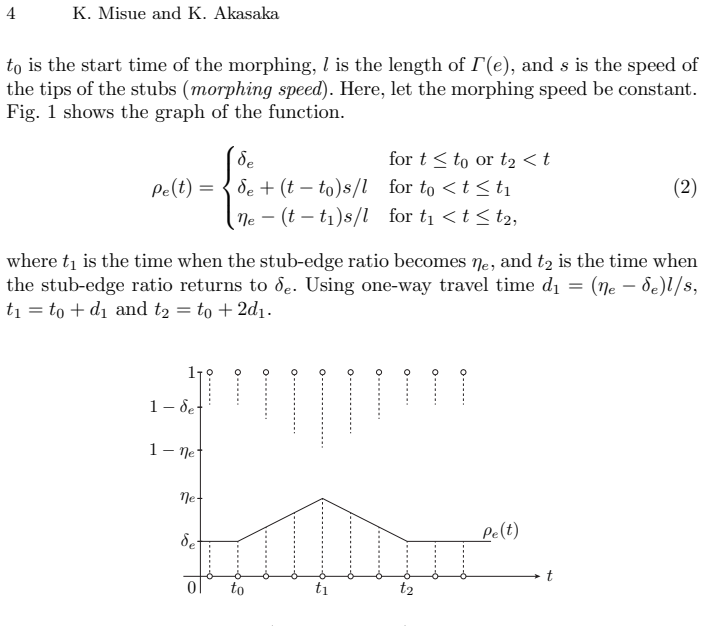
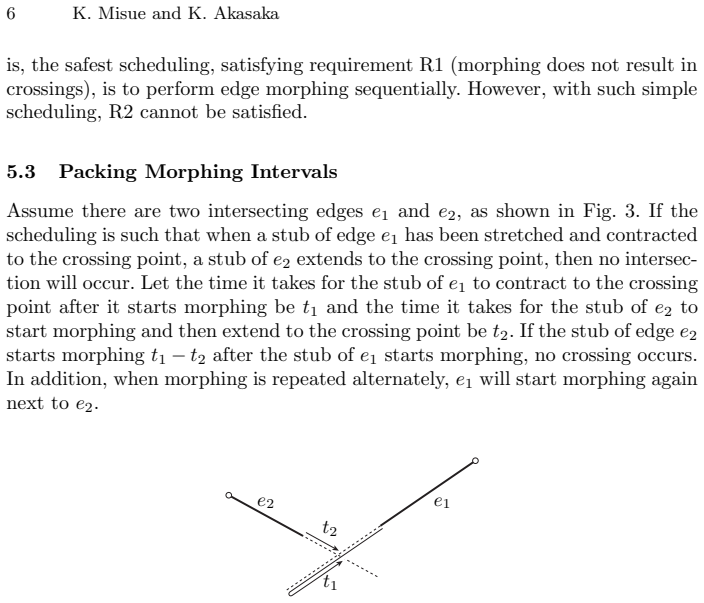
The central object is the morphing function: for each edge $e$, a map $\mu_e$ from time to a partial drawing of $e$, written $\mu_e(t) = \gamma_e(\rho_e(t))$, where $\gamma_e$ is the stub-drawing function and $\rho_e$ is a ratio function selecting the two stub parameters $\alpha, \beta$ at time $t$. In a symmetric homogeneous MED with parameters $(\delta, \eta)$, every edge uses the same ratio function that moves the stub ratio from $\delta$ to $\eta$ and back; when $\eta = 1/2$ the stubs meet and the edge momentarily becomes complete. The scheduling mechanism is a morphing group: a connected component in the intersection graph of edges whose blank areas overlap. Start times are assigned in descending edge length; for each edge, forbidden start intervals are computed from the first and second times its stubs would pass crossing points of already scheduled intersecting edges, and the earliest allowed time is chosen. This packing of one-way travel times prevents dynamic stubs from crossing in the blank areas while shortening the total morphing cycle.
What would settle it
Run the same T1 adjacency task with morphing speed varied below and above 10 degrees per second (for example 5, 7, and 13 degrees per second) and with the 300 ms minimum removed; if the response-time advantage of 1/4-SHMED over 1/4-SHPED disappears or reverses at slower settings, the claim that morphing itself shortens reading time would be refuted. A second check is to record eye-tracking fixations on stub tips while two highlighted nodes are connected: if viewers do not track the moving tips, the proposed mechanism is not the cause of the measured benefit.
Extended reading notes
Core claim
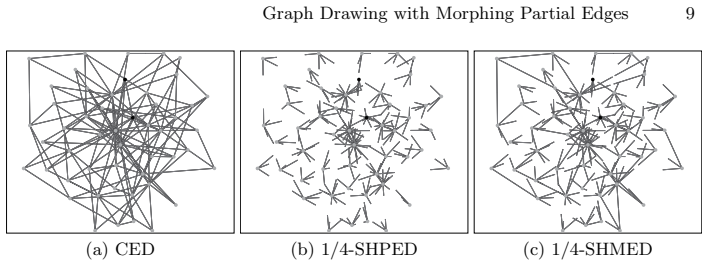
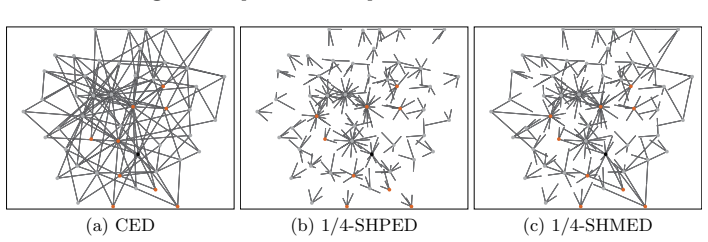
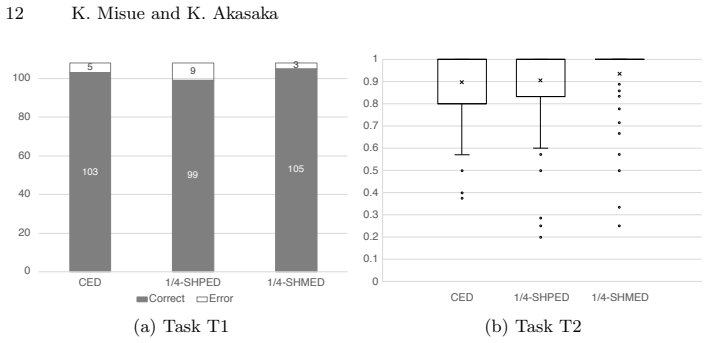
The central claim is that animating partial edges—letting each stub grow to the full edge and shrink back—recovers some of the reading speed lost when a graph is drawn as a partial edge drawing, without sacrificing accuracy. More exactly, in an experiment with three displays (complete edges, 1/4-SHPED, and 1/4-SHMED) on a 50-node, 144-edge graph, the morphing version had a significantly shorter mean response time than the static partial version for the adjacency-confirmation task T1, placing it between the complete drawing and the static partial drawing. For the node-selection task T2 no significant response-time differences appeared, and no significant accuracy differences appeared in either task, so the hypothesis that MED is more accurate than CED was not supported. The paper interprets the result as evidence that morphing helps viewers connect stubs without requiring them to estimate the hidden middle.
Load-bearing premise
The experiment's chosen stub speed—10 degrees per second of visual angle, with a 300 ms minimum one-way travel time—is assumed to be fast enough to make morphing useful but slow enough for human smooth-pursuit eye movements to track the moving stub tips; participant comments that the stubs 'change too fast' suggest this assumption is near its limit.
Editorial extensions
If this is right
- For the adjacency-check task T1, 1/4-SHMED achieved significantly shorter response times than 1/4-SHPED, with CED still fastest.
- For the larger neighborhood-selection task T2, no significant response-time differences were found, so the morphing benefit did not generalize to all reading tasks in this experiment.
- No significant accuracy differences appeared across CED, 1/4-SHPED, and 1/4-SHMED, so the paper's hypothesis H2 (MED more accurate than CED) is not supported.
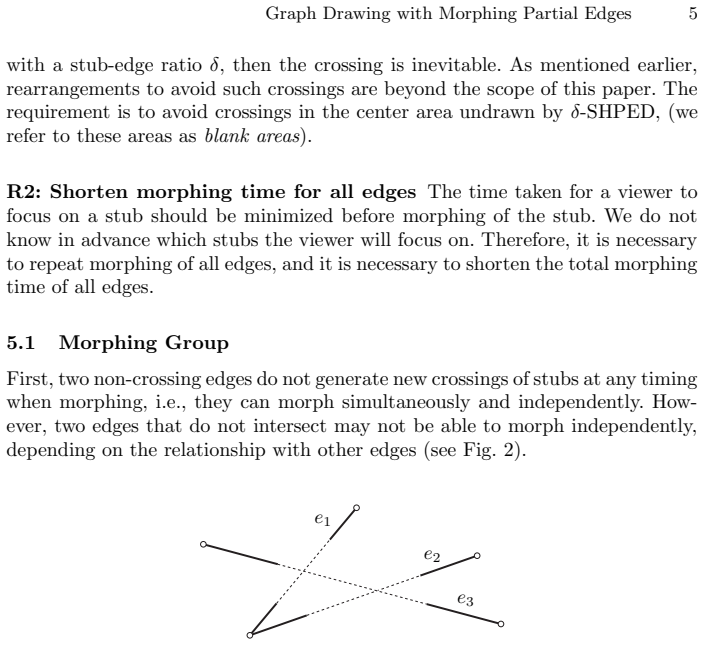
- The scheduling algorithm assigns start times so that dynamic stubs do not enter a blank area while another stub is there, avoiding new crossings, and packs the morphing intervals of non-intersecting edges to shorten total morphing time.
- Taken together, the results support the paper's conclusion that MED can serve as a countermeasure to the extra time required to read a graph drawn with PED.
Reading between the lines
- An implication the authors leave implicit: because the speed choice came from smooth-pursuit limits, the time benefit is likely tied to the 10 degrees per second setting; at slower speeds the advantage may shrink, and several participants already reported the stubs moved too fast.
- The study used one graph with 50 nodes and 144 edges and 12 participants, so the point estimate is thin; a replication across densities, stub ratios, and participant pools would show whether the adjacency-time advantage is stable.
- A practical extension, not examined here, is selective morphing: animate only edges near the viewer's attention or only edges whose blank areas contain crossings, which could keep most of the benefit while reducing the visual clutter that participants complained about.
Signed reviews
Editorial analysis
A structured set of objections, weighed in public.
Referee Report
Summary. The paper introduces morphing edge drawing (MED), a time-varying variant of partial edge drawing (PED), with a formalization of PED/MED, two scheduling requirements (R1: avoid new crossings in blank areas; R2: shorten total morphing time), a greedy scheduling algorithm (Algorithm 1), and a user study comparing CED, 1/4-SHPED, and 1/4-SHMED on two tasks. The main empirical claim is that 1/4-SHMED significantly shortens response time for adjacency verification (T1) compared with 1/4-SHPED (p=0.0011 after Holm correction), although no significant advantage is found for neighbor enumeration (T2) or accuracy. The paper concludes that MED can function as a countermeasure against the reading time incurred by PED.
Significance. The formalization in Sections 2 and 4 is a clean extension of Bruckdorfer et al.'s PED model and is a useful conceptual contribution. The scheduling requirements R1/R2 are sensible, and the experiment uses an appropriate nonparametric framework (Friedman test with Holm correction). If the T1 result is robust across morphing speeds, the paper would demonstrate a practical way to recover reading speed lost by PED. The main limitations—unproven schedule correctness, a single morphing speed, and a small n with only one significant task—currently prevent the broader conclusion from being fully supported.
major comments (3)
- [Section 5.5, Algorithm 1] The algorithm has no correctness proof. The manuscript asserts that the schedule satisfies R1 and R2, but it does not prove that respecting the pairwise prohibited intervals from Expressions (3)-(4) prevents stub crossings throughout an entire morphing cycle, nor does it account for periodic repetition of morphing. It also does not define a measure for R2 or prove any optimality or approximation property. Because the scheduling algorithm is part of the contribution and is used in the experiment, this gap is load-bearing.
- [Sections 6.4 and 6.9] The experiment fixes morphing speed at 10 deg/s with a 300 ms minimum one-way travel time. Participant feedback in Section 6.9 explicitly states "The stubs change too fast. The time for stubs to connect is too short," and the authors acknowledge that "the morphing speed is too fast." Thus H1 is supported at a single speed that is at the usability boundary, and the conclusion in Section 7 extrapolates to MED in general. A speed sweep (for example, 5 and 15 deg/s or different minimum travel times) is needed to establish that the T1 advantage is a property of MED rather than an artifact of this speed.
- [Sections 6.5 and 7, Tables 1-3] With 12 participants, only the T1 response-time comparison shows a significant effect; T2 response time and accuracy show no significant differences. The concluding sentence in Section 7, "MED can function as a countermeasure against the time to read a graph by PED," is broader than the evidence, which supports only a speed advantage for the adjacency-verification task at one morphing speed. The conclusion should be restricted accordingly or supported by additional tasks and speeds.
minor comments (4)
- [Section 2] 'asymmetric PED (SPED)' should be 'symmetric PED (SPED)'; the condition alpha_e = 1 - beta_e gives equal-length stubs, and the same abbreviation is used in Section 4.1.
- [Section 6.9] 'morphing of two stabs works simultaneously' should read 'two stubs'.
- [Tables 1-3] State explicitly whether the reported p-values are raw or Holm-adjusted, and provide the Friedman test statistics.
- [Section 5] Define 'blank area' formally at the point where R1 is introduced, since the algorithm and morphing groups rely on it.
Circularity Check
No significant circularity: the MED formalism and scheduling are derived from graph geometry, and the user study is an independent external test.
full rationale
The paper contains no derivation step in which a predicted quantity is equivalent by construction to an input parameter. The morphing ratio function (Exp. 2) is defined from the chosen delta, eta, edge length l, constant speed s, and times t0/t1/t2; these parameters are set before the experiment, and no response-time or accuracy data are used to refit them. The scheduling algorithm (Algorithm 1 and Exps. 3-5) computes start times from geometric crossing intervals only. The central empirical claim (H1, Table 1) is assessed by a controlled comparison of CED, 1/4-SHPED, and 1/4-SHMED on independent participants, so the outcome is externally falsifiable rather than forced by the formalization. The morphing-speed choice and participant feedback about speed are external-validity concerns, not circularity. There are no load-bearing self-citations or imported uniqueness theorems. Score 0.
Assumptions & free parameters
free parameters (3)
- stub morphing speed =
10 degrees/s
- minimum one-way travel time =
300 ms
- stub-edge ratio delta =
1/4
assumptions (5)
- domain assumption The straight-line layout Gamma(G) is fixed in advance and stub crossings are allowed.
- domain assumption All stubs morph at the same constant speed.
- standard math Two edges that do not cross cannot create new stub crossings during morphing.
- ad hoc to paper Algorithm 1's greedy earliest-start-time packing yields a schedule satisfying R1 and R2.
- domain assumption A morphing speed of 10 degrees/s is trackable by human smooth pursuit based on Robinson [12].
Cite this review
Pith. "Pith review of Graph Drawing with Morphing Partial Edges." pith.science (2026). https://pith.science/paper/5DZDKVDC
@misc{pith2026190801441,
  author       = {Pith},
  title        = {Pith review of: Graph Drawing with Morphing Partial Edges},
  year         = {2026},
  howpublished = {\url{https://pith.science/paper/5DZDKVDC}},
  note         = {Machine review of arXiv:1908.01441}
}
read the original abstract
A partial edge drawing (PED) of a graph is a variation of a node-link diagram. PED draws a link, which is a partial visual representation of an edge, and reduces visual clutter of the node-link diagram. However, more time is required to read a PED to infer undrawn parts. The authors propose a morphing edge drawing (MED), which is a PED that changes with time. In MED, links morph between partial and complete drawings; thus, a reduced load for estimation of undrawn parts in a PED is expected. Herein, a formalization of MED is shown based on a formalization of PED. Then, requirements for the scheduling of morphing are specified. The requirements inhibit morphing from crossing and shorten the overall time for morphing the edges. Moreover, an algorithm for a scheduling method implemented by the authors is illustrated and the effectiveness of PED from a reading time viewpoint is shown through an experimental evaluation.
Figures
Figures from the paper (4 more)

Reference graph
Works this paper leans on
-
[1]
Science 286(5439), 509–512 (1999)
Barab´ asi, A.L., Albert, R.: Emergence of scaling in random networks. Science 286(5439), 509–512 (1999). https://doi.org/10.1126/science.286.5439.509 Graph Drawing with Morphing Partial Edges 13
-
[2]
IEEE Trans- actions on Visualization and Computer Graphics 1(1), 16–28 (March 1995)
Becker, R.A., Eick, S.G., Wilks, A.R.: Visualizing network data. IEEE Trans- actions on Visualization and Computer Graphics 1(1), 16–28 (March 1995). https://doi.org/10.1109/2945.468391
arXiv 1995
-
[3]
In: 2016 7th International Con- ference on Information, Intelligence, Systems Applications (IISA)
Binucci, C., Liotta, G., Montecchiani, F., Tappini, A.: Partial edge drawing: Homo- geneity is more important than crossings and ink. In: 2016 7th International Con- ference on Information, Intelligence, Systems Applications (IISA). pp. 1–6 (July 2016). https://doi.org/10.1109/IISA.2016.7785427
arXiv 2016
-
[4]
IEEE Trans- actions on Visualization and Computer Graphics 15(6), 969–976 (Nov 2009)
Blaas, J., Botha, C., Grundy, E., Jones, M., Laramee, R., Post, F.: Smooth graphs for visual exploration of higher-order state transitions. IEEE Trans- actions on Visualization and Computer Graphics 15(6), 969–976 (Nov 2009). https://doi.org/10.1109/TVCG.2009.181
-
[5]
Bruckdorfer, T., Kaufmann, M.: Mad at edge crossings? break the edges! In: Kranakis, E., Krizanc, D., Luccio, F. (eds.) Fun with Algorithms. pp. 40–50. Springer Berlin Heidelberg, Berlin, Heidelberg (2012)
work page 2012
-
[6]
Bruckdorfer, T., Kaufmann, M., Leibßle, S.: PED user study. In: Di Giacomo, E., Lubiw, A. (eds.) Graph Drawing and Network Visualization. pp. 551–553. Springer International Publishing, Cham (2015)
work page 2015
-
[7]
In: 2017 21st International Conference Information Visualisation (iV)
Burch, M.: A user study on judging the target node in partial link drawings. In: 2017 21st International Conference Information Visualisation (iV). pp. 199–204 (July 2017). https://doi.org/10.1109/iV.2017.43
-
[8]
In: van Kreveld, M., Speckmann, B
Burch, M., Vehlow, C., Konevtsova, N., Weiskopf, D.: Evaluating partially drawn links for directed graph edges. In: van Kreveld, M., Speckmann, B. (eds.) Graph Drawing. pp. 226–237. Springer Berlin Heidelberg, Berlin, Heidelberg (2012)
work page 2012
Show all 14 references
-
[9]
In: 2009 IEEE Symposium on Visual Analytics Science and Technology
Collins, C., Vi´ egas, F.B., Wattenberg, M.: Parallel tag clouds to ex- plore and analyze faceted text corpora. In: 2009 IEEE Symposium on Visual Analytics Science and Technology. pp. 91–98 (Oct 2009). https://doi.org/10.1109/VAST.2009.5333443
2009
-
[10]
Software: Practice and Experience 21(11), 1129–1164 (1991)
Fruchterman, T.M.J., Reingold, E.M.: Graph drawing by force-directed placement. Software: Practice and Experience 21(11), 1129–1164 (1991). https://doi.org/10.1002/spe.4380211102
1991 doi
-
[11]
In: 2011 IEEE Pacific Visualization Symposium
Holten, D., Isenberg, P., van Wijk, J.J., Fekete, J.: An extended evaluation of the readability of tapered, animated, and textured directed-edge representations in node-link graphs. In: 2011 IEEE Pacific Visualization Symposium. pp. 195–202 (March 2011). https://doi.org/10.1109...
2011
-
[12]
The Journal of Physiology 180(3), 569–591 (1965)
Robinson, D.A.: The mechanics of human smooth pursuit eye movement. The Journal of Physiology 180(3), 569–591 (1965). https://doi.org/10.1113/jphysiol.1965.sp007718
1965 doi
-
[13]
In: Proceedings of the 2018 CHI Conference on Human Factors in Com- puting Systems
Romat, H., Appert, C., Bach, B., Henry-Riche, N., Pietriga, E.: Animated edge textures in node-link diagrams: A design space and initial evaluation. In: Proceedings of the 2018 CHI Conference on Human Factors in Com- puting Systems. pp. 187:1–187:13. CHI ’18, ACM, New York, NY...
2018
-
[14]
In: Proceedings of 6th International Conference on Information Visualization Theory and Applications (IVAPP)
Schmauder, H., Burch, M., Weiskopf, D.: Visualizing dynamic weighted digraphs with partial links. In: Proceedings of 6th International Conference on Information Visualization Theory and Applications (IVAPP). pp. 123–130 (2015)
2015
Reviewed August 14, 2026 · model on record in the stance chip above.
Discussion (0). Continue with ORCID to comment.