REVIEW 3 major objections 4 minor 13 references
Fractional Newton-Raphson Method and Some Variants for the Solution of Non-linear Systems
T0 review · 3 major / 4 minor · reviewed 2026-08-14 · deepseek-v4-flash
Pith's one-line read Varying the fractional derivative order lets Newton-type iterations leave the real line and land on complex roots.
desk verdict Interesting new fractional Newton variants, but the numerical tables rest on an undefined complex extension of the fractional derivative, so the central evidence is not yet reproducible. read the letter →
The pith
A machine-rendered reading of the paper's core claim, the machinery that carries it, and where it could break.
The reading
What carries the argument
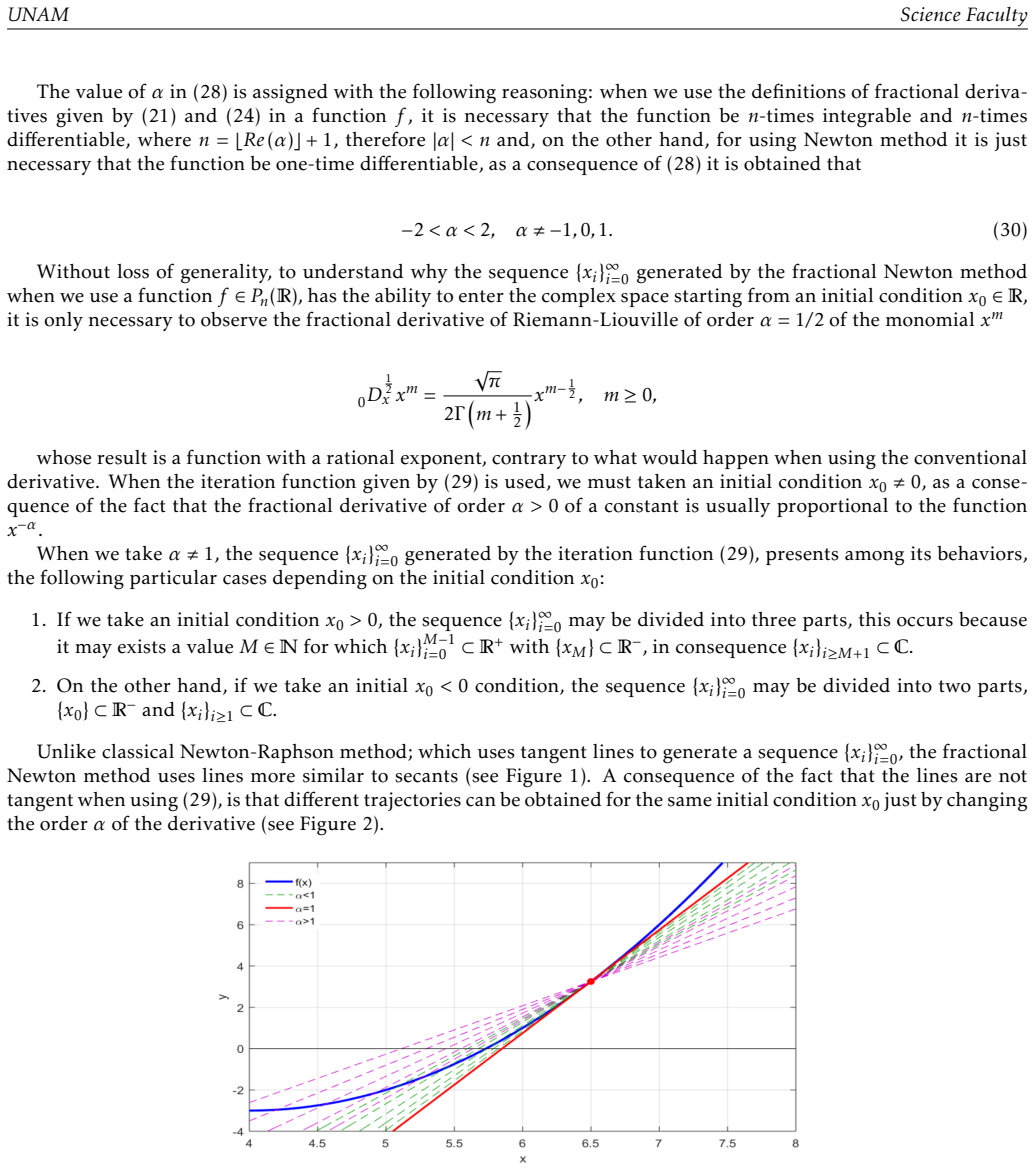
The carrying object is the fractional Jacobian matrix $f^{(\alpha)}(x)=\left(\partial_j^\alpha f_k(x)\right)$, where $\partial_j^\alpha$ is a Riemann-Liouville or Caputo-type derivative acting only on $x_j$ and continuous in $\alpha$ at $\alpha=1$. The fractional Newton method is $x_{i+1}=x_i-\left(f^{(\alpha_f(x_i))}(x_i)\right)^{-1}f(x_i)$, with $\alpha_f$ as in (28); the variants exchange $f^{(\alpha)}$ for $Q_{g,\beta}$ (built from a linearization) or $P_{\epsilon,\beta}$ (a diagonal matrix). The variable order is what lets the iteration leave the real line: for a monomial $x^m$, a fractional Riemann-Liouville derivative produces $x^{m-\alpha}$ with a rational exponent, so real inputs can become complex, while switching the order to 1 near the root recovers the quadratic convergence condition.
What would settle it
Recompute the iteration (29) for f(x)=sin(x)-3/(2x) with x0=0.26 and the $\alpha$ values of Table 2, recording residuals under the principal branch of the Riemann-Liouville formula; if the reported residuals appear only after silently using an analytic continuation, the real-domain formulation is incomplete. Separately, near a simple root compute the ratios $|x_{k+1}-\xi|/|x_k-\xi|^2$ for the fractional Newton method; if these ratios do not remain bounded, the claimed quadratic order fails.
Extended reading notes
Core claim
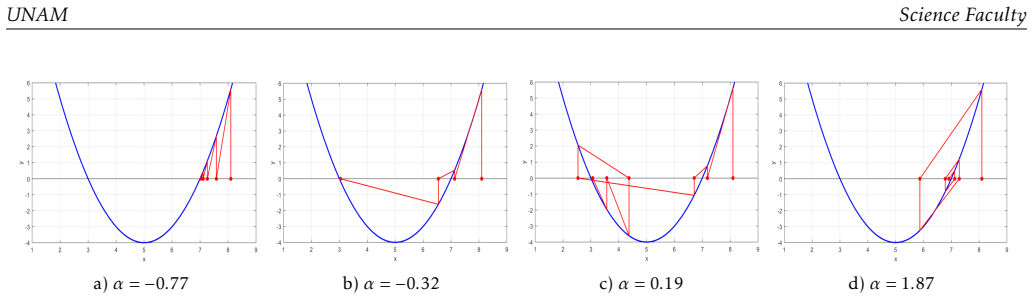
The central claim is that replacing the fixed integer order 1 in Newton-Raphson by a variable fractional order gives iterations whose trajectories can enter the complex plane even when $x_0$ is real. In the fractional Newton method (29), the order is $\alpha_f(x)$, which equals a chosen non-integer $\alpha$ while $\|f(x)\|\ge\delta$ and switches to 1 near a root; the paper concludes that near a simple root the iteration behaves like classical Newton and has order at least quadratic. The quasi-Newton method (39) applies fractional derivatives to a fixed linearization $g$ rather than to $f$, and the pseudo-Newton method (47) replaces the inverse Jacobian by a diagonal fractional-derivative matrix, with $\beta(\alpha,(x_i)_j)$ set to 1 at zero components to avoid the nonzero fractional derivative of a constant; both are claimed to have order at most linear. The reported tables show complex roots of a degree-16 polynomial and of several transcendental and multivariate systems obtained from real starting points.
Load-bearing premise
The methods rely on functions introduced on real space being evaluated at the complex iterates the algorithm produces, and the paper never specifies which complex extension or branch convention is used for transcendental functions in Examples 3.2 through 3.7.
Editorial extensions
If this is right
- From a single real seed, sweeping the derivative orders $\alpha_m$ over $(-2,2)$ can recover multiple real and complex zeros; the degree-16 polynomial example in Table 1 shows this explicitly.
- The fractional Newton method requires only a few iterations per $\alpha$, so the order sweep is affordable when the fractional Jacobian can be computed and inverted.
- The fractional quasi-Newton method uses a cheaper derivative matrix and behaves like fractional Newton when the initial guess is close to a solution, but its linear order demands more iterations.
- The fractional pseudo-Newton method avoids inverting any matrix, at the cost of slower linear convergence and more $\alpha$ values.
- None of the methods claims to find all solutions: they return subsets of the solution set, and more zeros require changing $x_0$, refining the $\alpha_m$ partition, or raising the iteration limit.
Reading between the lines
- Editorial inference: The same order-switching idea could turn other iterative solvers into parameter-swept root finders, treating the derivative order as a continuation parameter rather than a fixed convergence accelerator.
- Editorial inference: For transcendental functions with branch ambiguity, the method's complex trajectory depends on the chosen analytic continuation; specifying that continuation gives a direct way to compare the fractional Newton iterations against classical Newton with complex initial conditions.
- Editorial inference: The convergence claims depend on the threshold $\delta$ in $\alpha_f(x)$, and the paper does not quantify how $\delta$ trades off between basin coverage and convergence speed; this is a testable extension.
Signed reviews
Editorial analysis
A structured set of objections, weighed in public.
Referee Report
Summary. The paper defines a fractional Newton method (27) built on a fractional Jacobian (25), then introduces a switching function alpha_f(x) in (28) so that the iteration (29) reduces to ordinary Newton-Raphson near a root, aiming at quadratic convergence. It also proposes a fractional quasi-Newton method (39), based on a linearized function g, and a fractional pseudo-Newton method (47), with a diagonal matrix, and claims for these variants at most linear convergence. Examples 3.1 through 3.7 apply the methods to a polynomial, scalar transcendental equations, and several nonlinear systems, reporting both real and complex roots obtained from real initial conditions, together with residual norms for the computed roots.
Significance. The proposed iteration schemes are genuine algorithmic variants of fractional Newton-Raphson, and the idea of switching the fractional order to recover classical quadratic convergence near a simple root is attractive. The paper reports residual norms in all tables and does not fit parameters to data, which strengthens the empirical claims. If the complex-domain definition of the fractional derivative is supplied and the convergence-order statements are proved, the methods could be a useful tool for finding multiple real and complex roots of nonlinear systems from real starting values. As it stands, however, the manuscript does not provide the analytical foundation needed to validate the tables or the stated orders of convergence.
major comments (3)
- [Section 3 and Examples 3.2–3.7] Equations (21), (22), and (25) define fractional derivatives for real-valued functions on real intervals, but the tables report iterates m_xi in C for non-polynomial functions such as f(x)=sin(x)-3/(2x) in Example 3.2 and the exponential/trigonometric systems in Examples 3.5–3.7. No analytic continuation, branch cut, or contour prescription is given for the Riemann-Liouville operator aD^x at complex x, nor for the power x^(mu-alpha) in (22). Consequently the values f^(alpha)(m_xi) and the residuals ||f(m_xi)|| in Tables 2–7 are not mathematically defined as written, and the numerical experiments are not reproducible. The same ambiguity already affects Example 3.1, because the monomial formula (22) is multi-valued for complex x unless a branch is specified.
- [Section 3, Eqs. (28)–(29)] The claim that the fractional Newton method (29) has order of convergence at least quadratic is not proved as a theorem. The argument that alpha_f(x)=1 near a root and the iteration reduces to Newton-Raphson is plausible for a simple root, but the usual assumptions (f continuously differentiable, f^(1)(xi) invertible) and a proof that all sufficiently close iterates satisfy ||f(x_i)||<delta should be stated explicitly. For the quasi-Newton and pseudo-Newton methods, the statement that failure of (12) implies "at most an order of convergence (at least) linear" is not logically valid: not satisfying a sufficient condition for quadratic convergence does not exclude superlinear convergence, so a formal statement and proof are needed.
- [Section 3.1, Eq. (39)] The function g(x)=f(x0)+f^(1)(x0)x is a linearization at the initial point, not at the current iterate, so Q_g,beta is a fixed-affine slope rather than a standard quasi-Newton update. If this is intentional, the method should be described as a chord method and its convergence properties need separate analysis. If the intent was to linearize at the current iterate x_i, the formula should instead read f(x_i)+f^(1)(x_i)(x-x_i).
minor comments (4)
- [Section 3.2, Eq. (48)] The definition of P_epsilon,beta(x_i) is ambiguous: applying the fractional derivative to the Kronecker delta delta_kj is not meaningful as written. The matrix should be defined componentwise, for example by specifying the action of d^beta_j on the components of the identity map and on the constant term separately.
- [Table 6, Example 3.6] The parameter line reads "M = +6" where the other tables use "M = e+6"; this appears to be a typographical error and should be corrected.
- [Section 1.2, p. 4] The text contains several language errors, including "the competent k-th" for "the component k-th" and "sil" for "if"; these should be corrected throughout.
- [Section 3 and Tables 1–7] The selection rule for the alpha_m values is not specified beyond a partition of [-2,2], but the tabulated values appear irregular. To make the experiments reproducible, the exact partition or a deterministic rule for generating the alpha_m grid should be stated.
Circularity Check
No circularity: the quadratic-order switch is an explicit construction, and the new variants stand on their own definitions.
full rationale
No circular step is present. The quadratic-convergence claim for method (29) follows by explicit construction: α_f(x) in Eq. (28) is set to 1 whenever ‖f(x)‖ < δ, so once the iterates enter that neighborhood the iteration becomes the classical Newton method whose local quadratic convergence is already established in Section 1.2. This is a design choice, not a hidden fit, and no fitted constant is later renamed as a prediction. The fractional quasi-Newton and pseudo-Newton methods are newly defined iteration functions in Eqs. (39)-(41) and (47)-(48), with their claimed at-most-linear behavior explained from the same classical convergence framework rather than from a parameter fitted to the tabulated roots. The paper does cite the authors' own prior work [1,2] for the baseline fractional Newton-Raphson iteration (27), but that reference merely supplies a starting point; the load-bearing definitions and convergence statements for the new methods are restated in this manuscript and do not reduce to an unverified self-citation. The under-specified evaluation of fractional derivatives at complex iterates in Examples 3.2-3.7 is a reproducibility and correctness concern, not a circularity: it does not make any equation equivalent to its own input. Therefore the derivation chain is self-contained with respect to the circularity criteria.
Assumptions & free parameters
free parameters (4)
- Switching threshold delta =
0.5 in all examples
- Partition of alpha values =
not specified; a partition of (-2,2) is assumed
- Stopping and clustering parameters TOL, LIT, M, epsilon =
TOL=e-4, LIT=40 or 200, delta=0.5, M=e+6 or e+17, epsilon used in (31)
- Initial condition x0 =
per example, e.g., 0.74, 0.26, (0.88,0.88), (4.35,4.35,4.35)
assumptions (4)
- domain assumption An n-dimensional version of Theorem 1.5 is assumed, under which an iteration function with zero first derivative at the fixed point has at least quadratic convergence.
- domain assumption Fractional derivatives satisfy the continuity condition (26), lim_{alpha->1} f^(alpha)(x)=f^(1)(x), for the functions considered.
- domain assumption The fractional Jacobian matrices in (29) and (39) are invertible at every iteration.
- ad hoc to paper Real-valued functions in the examples are extended to complex arguments by analytic continuation.
Cite this review
Pith. "Pith review of Fractional Newton-Raphson Method and Some Variants for the Solution of Non-linear Systems." pith.science (2026). https://pith.science/paper/43STF3VI
@misc{pith2026190801453,
  author       = {Pith},
  title        = {Pith review of: Fractional Newton-Raphson Method and Some Variants for the Solution of Non-linear Systems},
  year         = {2026},
  howpublished = {\url{https://pith.science/paper/43STF3VI}},
  note         = {Machine review of arXiv:1908.01453}
}
read the original abstract
The following document presents some novel numerical methods valid for one and several variables, which using the fractional derivative, allow to find solutions for some non-linear systems in the complex space using real initial conditions. The origin of these methods is the fractional Newton-Raphson method but unlike the latter, the orders of fractional derivatives proposed here are functions. In the first method, a function is used to guarantee an order of convergence (at least) quadratic, and in the others, a function is used to avoid the discontinuity that is generated when the fractional derivative of the constants is used, and with this, it is possible that the methods have at most an order of convergence (at least) linear.
Figures
Reference graph
Works this paper leans on
-
[2]
Fractional Newton-Raphson Method Accelerated with Aitken's Method
F. Brambila-Paz, A. Torres-Hernandez, U. Iturrar´an-Viveros, and R. Caballero-Cruz. Fractional newton-raphson method accelerated with aitken’s method. arXiv preprint arXiv:1804.08445 , 2018. https://arxiv.org/pdf/ 1804.08445.pdf
work page Pith review arXiv 2018
-
[3]
Introduction to numerical analysis , volume 12
Josef Stoer and Roland Bulirsch. Introduction to numerical analysis , volume 12. Springer Science & Business Media, 2013
work page 2013
-
[4]
Robert Plato. Concise numerical mathematics. Number 57. American Mathematical Soc., 2003
work page 2003
-
[5]
Numerical analysis: a second course
James M Ortega. Numerical analysis: a second course. SIAM, 1990
work page 1990
-
[6]
Richard L Burden and J Douglas Faires. An´alisis num´erico. Thomson Learning,, 2002
work page 2002
-
[7]
Iterative solution of nonlinear equations in several variables, volume 30
James M Ortega and Werner C Rheinboldt. Iterative solution of nonlinear equations in several variables, volume 30. Siam, 1970
work page 1970
-
[8]
Applications of fractional calculus in physics
Rudolf Hilfer. Applications of fractional calculus in physics. World Scientific, 2000
work page 2000
-
[9]
Theory and Applications of Fractional Differential Equations
AA Kilbas, HM Srivastava, and JJ Trujillo. Theory and Applications of Fractional Differential Equations. Elsevier, 2006
work page 2006
Show all 13 references
-
[10]
Proposal to use the fractional derivative of radial functions in interpolation problems
F Brambila-Paz, A Torres-Hernandez, and C Torres-Mart´ınez. Proposal to use the fractional derivative of radial functions in interpolation problems. arXiv preprint arXiv:1906.03760, 2019. https://arxiv.org/pdf/1906. 03760.pdf
1906 arXiv
-
[11]
Applications of radial basis function schemes to fractional partial differential equations
Carlos Alberto Torres Mart ´ınez and Carlos Fuentes. Applications of radial basis function schemes to fractional partial differential equations. Fractal Analysis: Applications in Physics, Engineering and Technology, 2017. https: //www.intechopen.com/books/fractal-analysis-appli...
2017
-
[12]
Appli- cation of fractional calculus to oil industry
Benito F Mart ´ınez-Salgado, Rolando Rosas-Sampayo, Anthony Torres-Hern´andez, and Carlos Fuentes. Appli- cation of fractional calculus to oil industry. Fractal Analysis: Applications in Physics, Engineering and Technology,
-
[14]
https://www.intechopen.com/books/fractal-analysis-applications-in-physics -engineering-and-technology . 16
-
[2017]
https://arxiv.org/pdf/1710.07634.pdf
Reviewed August 14, 2026 · model on record in the stance chip above.
Discussion (0). Continue with ORCID to comment.