REVIEW 4 major objections 4 minor 57 references
Free surface lump wave dynamics of a saturated superfluid Helium film with nontrivial boundary condition at the substrate surface
T0 review · 4 major / 4 minor · reviewed 2026-08-14 · deepseek-v4-flash
Pith's one-line read A weak superfluid leak into the substrate forces the film's free surface waves into the forced Kadomtsev–Petviashvili I equation, with lump waves that can stop, reverse, and oscillate.
desk verdict Novel fKP derivation for leaky superfluid films is undone by algebraic errors in the lump dynamics sections; the derivation may survive, the advertised physics does not. read the letter →
The pith
A machine-rendered reading of the paper's core claim, the machinery that carries it, and where it could break.
The reading
What carries the argument
The load-bearing object is the bottom boundary condition $\partial\varphi/\partial z|_{z=0} = C(x,y,t)$, expanded at order $\epsilon^{5/2}$, together with the recursive solution of Laplace's equation in the film. That recursion produces a velocity potential whose second series is driven by $C$; feeding it into the kinematic and dynamic free-surface conditions under the scalings $\bar x = \epsilon^{1/2}\xi$, $\bar y = \epsilon y$, $\bar t = \epsilon^{3/2}t$ yields the forced KP-I equation. The exact time-only solution works through the shift $\bar U = U + \int f\,dT$ with $d^2 a/dT^2 = 6f(T)$; the space-time solution works through a fast-time perturbation series in $\epsilon_1$ that separates an unforced KP-I part $V_0$ from leak-driven corrections $G_1, G_2$.
What would settle it
Measure or compute the actual downward superflow $C(x,y,t)$ for a saturated film on a porous substrate from pore size, pore pressure, and the film's chemical potential gradient, and check whether $C/\epsilon^{5/2}$ stays finite and bounded as $\epsilon\to 0$; if the leakage scales differently, the forced KP-I equation is not the governing equation. Alternatively, in a constant-leak experiment the model predicts a lump that reverses at $T_c = 1/C_k$ and a linearly decaying background, so observing no reversal or a non-linear background decay at the predicted time would falsify the central claim.
Extended reading notes
Core claim
Starting from incompressible, irrotational superfluid hydrodynamics with surface tension and van der Waals forces, and replacing the usual impermeable bottom boundary condition by $\partial\varphi/\partial z = C(x,y,t)$ at $z=0$, the paper derives, through reductive perturbation theory, that the first-order surface displacement $a_1$ (rescaled to $U$) satisfies $\partial U/\partial T + 6U\,\partial U/\partial X + \partial^3 U/\partial X^3 - 3\,\partial^2/\partial Y^2 \int U\, dX = -f$, with $f$ proportional to the first-order downward superfluid velocity $C^{(1)}$. For a saturated film thicker than the critical thickness $d_c = \sqrt{\rho\alpha/\sigma}$, the coefficients make this a forced KP-I equation. The paper then shows that when $f$ depends only on time, a shift $U \mapsto U + \int f\,dT$ and a time-dependent translation turn the forced equation into the unforced KP-I equation, so the exact one-lump solution is inherited with a modified trajectory; in particular a constant leak gives a lump that decelerates, halts at $T_c = 1/C_k$, reverses, and rides on a secularly decaying background. For space-time dependent leaks that vary rapidly compared with the lump evolution, a two-time-scale perturbation expansion yields $U = V_0 + \epsilon_1 V_{0X}(1+\cos\Gamma\tau) + \tfrac{1}{2}\epsilon_1^2 V_{0XX} + O(\epsilon_1^3)$, with the forcing tied self-consistently to the initial data.
Load-bearing premise
The derivation requires that the downward superfluid velocity into the substrate be weak in the precise sense $C = \epsilon^{5/2}C^{(1)}$ — small enough that the film depth stays essentially constant, yet large enough to appear as a forcing term at the KP order — and the paper gives no independent physical estimate from pore geometry or pressure to justify that ordering.
Editorial extensions
If this is right
- A constant downward superflow of strength $C_k$ predicts a lump that turns around at $T_c = 1/C_k$, so the leak's magnitude can be read off from the reversal time.
- The secular background term $-T C_k$ means a persistent leak slowly lowers the film height, so at long times the lump rides on a falling baseline.
- A sinusoidal leak $f = \sin(\Omega T)$ makes the lump's velocity along $X$ oscillate and its height at the origin oscillate with $\Omega$, imprinting the forcing function on the wave trajectory.
- For rapidly varying space-time leaks, the first-order correction is $V_{0X}(1+\cos\Gamma\tau)$, so the leak's effect appears as a periodic distortion of the lump's spatial derivative rather than a change of its core profile.
- Because the unforced part $V_0$ satisfies KP-I, the stability of lump solutions carries over to the forced problem whenever the leak is weak and satisfies the assumed ordering.
Reading between the lines
- The ordering $C = \epsilon^{5/2} C^{(1)}$ is a postulate with no independent physical estimate; if a realistic porous-substrate calculation gave a different power of $\epsilon$, the same boundary condition would lead to a different forced equation, so the specific form of the forced KP-I equation is a prediction to be checked against pore-scale parameters.
- The exact time-only solution suggests a testable diagnostic: measuring the turning time $T_c$ for a film on a porous substrate would directly measure the scaled leak strength, and observing whether the background decays linearly in $T$ would discriminate this model from a simple damping term.
- The same reductive scheme could be applied to thin films below the critical thickness, where surface tension is negligible; there one would expect a forced KdV equation with a leak-induced phase shift, connecting this analysis to the (1+1)-dimensional shallow-water leak results the paper cites.
- The paper's admitted neglect of pore size, pore pressure, and time-dependent van der Waals coefficients means the forcing function $f$ is effective rather than derived; calibrating $f$ from substrate properties would turn the reversal and shaking predictions into quantitative ones.
Signed reviews
Editorial analysis
A structured set of objections, weighed in public.
Referee Report
Summary. The paper considers a saturated superfluid 4He film of thickness d on a substrate with a weak downward superfluid leakage velocity C(x,y,t) at z=0. Using a reductive perturbation expansion with C=O(ε^{5/2}), it derives a forced Kadomtsev–Petviashvili-I equation for the free-surface disturbance, Eq. (23), with forcing f derived from C. For time-dependent forcing f=f(T), it obtains an exact lump solution through a shift-and-translation transformation of the unforced KP-I lump. For constant and sinusoidal f, it analyzes the lump's motion and claims direction reversal. For space-time dependent forcing, it presents a two-time-scale perturbative solution with the forcing chosen self-consistently from the unforced lump, and it plots the resulting profiles. The paper concludes that the leakage velocity changes the lump wave speed and can reverse its direction of motion.
Significance. If the results were correct, the paper would provide a new exactly solvable and perturbative description of lump dynamics in a superfluid film with a porous substrate, extending earlier KP models for 4He films. The reduction in Sec. II follows a standard reductive-perturbation pattern and is plausibly correct, and the exact-solution transform for f=f(T) is a legitimate technique. The paper also cites relevant prior work on perturbed KP equations. However, the central solution analysis contains algebraic errors that invalidate the reported reversal dynamics and the displayed perturbative solution. In addition, the paper does not justify the physical ordering that makes the leakage appear at KP order. Despite the interesting setup and a reasonable formal derivation, the main claims about lump dynamics are not currently supported.
major comments (4)
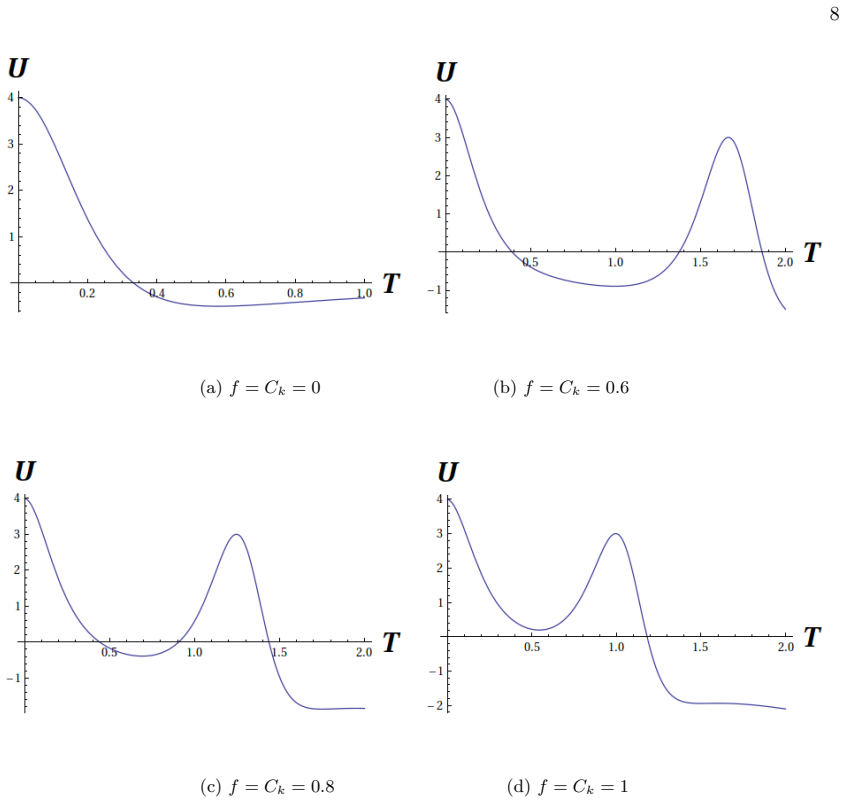
- [III.A, Eq. (28) and items 1–3] For f=Ck, Eqs. (24) and (28) give the lump center X_c=3T(1−CkT). Its time derivative is 3(1−2CkT), not the stated V(T)=3(CkT−1). The reversal therefore occurs at T=1/(2Ck), not at the reported Tc=1/Ck. The claims about the time of stopping, the direction reversal, and the interpretation of Fig. 4 are quantitatively incorrect.
- [III.A.2, f=sin(ΩT)] For f=sin(ΩT), a(T)=−(6/Ω²)sin(ΩT), so the lump center is X_c=(6/Ω²)sin(ΩT)+3T and its velocity is 3+(6/Ω)cos(ΩT). For Ω=2 this velocity is nonnegative and for Ω=4 it is strictly positive; hence the claimed continuous reversal of direction (text near Fig. 5 and Fig. 6) is not realized by the solution. The sinusoidal forcing produces an oscillatory velocity modulation, not a directional reversal.
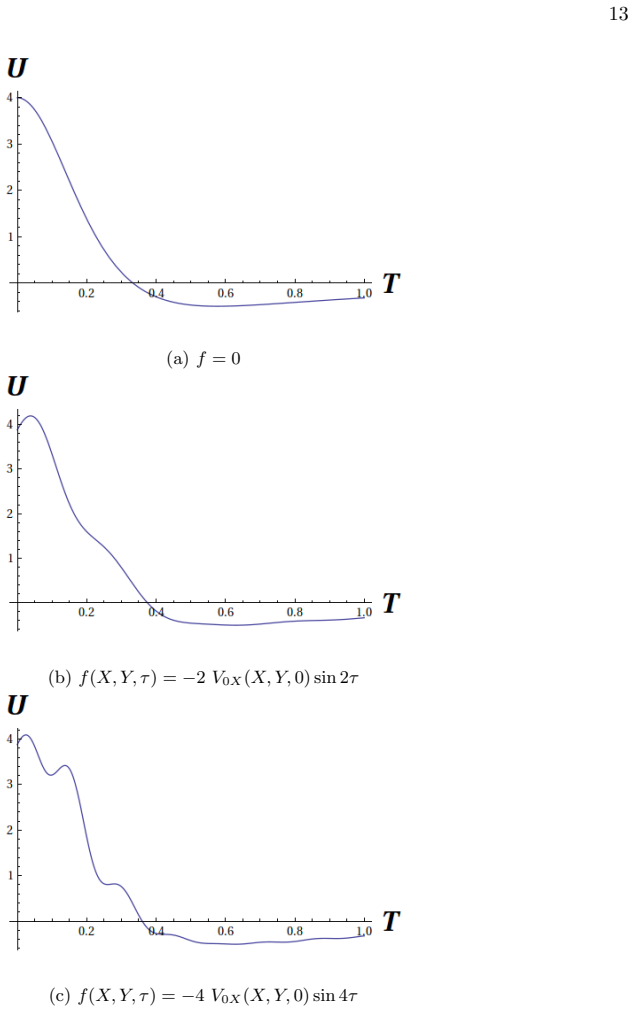
- [III.B, Eqs. (50)–(52)] With F=−Γ V0XX sin(Γτ), the definition G1=−∫∫F dX dτ gives G1=−V0X cos(Γτ), not +V0X cos(Γτ) as in Eq. (51). Consequently U1=V1+G1=V0X(1−cos(Γτ)), and the displayed perturbative solution (52) with the factor (1+cos(Γτ)) does not satisfy Eq. (23) with forcing (50) at O(ϵ1). The perturbative lump profile and the plots in Fig. 7 are therefore not solutions of the stated forced equation.
- [II, item 5 and Eq. (11)] The ordering C=O(ε^{5/2}) and the assumption that the film height d remains constant are postulates. No estimate from material parameters of porous substrates is given to show that the leakage velocity lies in this window. Since the forcing term in the final fKP equation arises only at this order, the derivation establishes a mathematical model but not its physical applicability to the claimed experimental situations.
minor comments (4)
- [II, Sec. III] The phrases 'in-compressible' and 'pertubative' should be corrected to 'incompressible' and 'perturbative', and the spelling of 'Helium' should be made consistent.
- [Fig. 3(a) caption] The caption contains 'at at T=1'; the duplicate word should be removed.
- [III.B, Eq. (48)] The derivation of Eq. (48) is not shown; the way the initial condition fixes ∫R dX should be explained explicitly, since this relation is used to determine the forcing function.
- [III.A, III.B] The term 'Damping Function' is used for a velocity that, in the sinusoidal case, can accelerate the wave; a more descriptive name would avoid confusion.
Circularity Check
No significant circularity: the fKP derivation is a self-contained multiple-scale expansion, and no prediction reduces by construction to a fitted input or self-citation.
full rationale
The derivation is a self-contained multiple-scale expansion from the incompressible irrotational superfluid equations (1) with the modified bottom boundary condition (2), following the standard recursion (7) and reductive perturbation (9)-(13); no parameter is fitted to data and no external result is renamed as an input. The fKP equation (23) follows algebraically from (14)-(19) with the ordering C = ε^{5/2} C^(1) (Eq. 11), which is an explicit smallness postulate rather than a circular input. The exact f(T) solution (27) is obtained by a legitimate variable shift satisfying a''(T) = 6f(T) in (24), mapping the forced equation to the unforced KP-I equation; this is a standard equivalence transformation, not a circular redefinition. The Appendix's exact solution follows the cited non-self method of Yong-Ma-Huang [34] with the nonholonomic constraint (53), and the perturbative construction in Sec. III.B determines the forcing self-consistently from the initial data via Eq. (48), a recognized self-consistent-source technique rather than a fitted prediction. The author's self-citations [19,20,25,26] are contextual and not load-bearing for the central derivation. Suspected algebraic errors in the lump-center reversal time (Sec. III.A) and in the sign of G1 in Eqs. (50)-(52) are correctness concerns, not circularity; the paper's own admissions of crudeness and missing microscopic details (Sec. IV) are acknowledged limitations, not circular reductions. Therefore no circular step is exhibited.
Assumptions & free parameters
free parameters (1)
- lump parameters k1 and m1 =
k1=0, m1=1 in plots
assumptions (6)
- standard math Superfluid is incompressible and irrotational, so the velocity potential satisfies Laplace's equation (Eq. 1).
- domain assumption Free-surface boundary conditions (Eqs. 3 and 4) use linearized surface tension and a truncated van der Waals expansion g1 a - (g2/(2d)) a^2.
- ad hoc to paper The bottom boundary condition is replaced by a prescribed vertical velocity C(x,y,t) at z=0 (Eq. 2), representing a weak downward superflow into the substrate.
- ad hoc to paper The reductive perturbation ordering assumes C = O(epsilon^{5/2}) (Eq. 11), with the film height d treated as constant on the wave-dynamics timescale.
- domain assumption The film is saturated with thickness d larger than the critical thickness dc = sqrt(rho alpha / sigma), so surface tension dominates the dispersion.
- standard math The known one-lump solution of the unforced KP-I equation (Eq. 26) and the transformation (Eq. 24) for time-dependent forcing are used without re-derivation.
Cite this review
Pith. "Pith review of Free surface lump wave dynamics of a saturated superfluid Helium film with nontrivial boundary condition at the substrate surface." pith.science (2026). https://pith.science/paper/VFQMZG44
@misc{pith2026190801512,
  author       = {Pith},
  title        = {Pith review of: Free surface lump wave dynamics of a saturated superfluid Helium film with nontrivial boundary condition at the substrate surface},
  year         = {2026},
  howpublished = {\url{https://pith.science/paper/VFQMZG44}},
  note         = {Machine review of arXiv:1908.01512}
}
read the original abstract
In this article, the free surface wave dynamics of a saturated superfluid Helium film is considered under the condition that there exists a very weak downward localized superfluid flow into the substrate. For saturated film, the effect of surface tension plays a decisive role in the surface wave evolution dynamics of the system. The free surface evolution is shown to be governed by forced Kadomtsev Petviashvili-I equation, with the forcing function depending on downward superfluid velocity at the substrate surface. Exact as well as perturbative free surface lump wave solutions of the (2+1) dimensional nonlinear evolution equation are obtained and the effect of the leakage velocity function on the lump wave solutions are shown.
Figures


Figures from the paper (4 more)


Reference graph
Works this paper leans on
-
[15]
4 for different constant values of Ck
Now if we concentrate on the wave fluctuations at the origin i.e at X = Y = 0, we can get the plots of FIG. 4 for different constant values of Ck. We can see that, whenT increases the amplitude decreases at origin (X =Y = 0) because the wave moves away from origin towards positiveX axis. After T =Tc as we have discussed, the wave reverses it’s motion and st...
-
[34]
A.Gopakumar and J.Sreekumar, Phys.Rev.B, 49 (1994) 4323
work page 1994
-
[1]
The acceleration of the superfluid film due to finite temperature gradient gives a small cor- rection factor [8], hence it is neglected
-
[2]
Since, we have considered saturated film (∼ 10−7 cm), the effect of surface tension is not neglected
Van der Waals force is the nonlinear force acting on the superfluid film [15]. Since, we have considered saturated film (∼ 10−7 cm), the effect of surface tension is not neglected
-
[3]
The superfluid is assumed to be in-compressible and it’s motion to be irrotational. 3
-
[4]
The free surface disturbance a and the equilibrium height d of the film is such that a/d≪ 1
Reductive perturbation technique is used following [15] with the nontrivial bottom boundary condition (2) to derive the nonlinear dynamical equation. The free surface disturbance a and the equilibrium height d of the film is such that a/d≪ 1
-
[5]
We consider that the vertical superfluid velocity at the bottom boundary is very weak so that the interesting surface wave dynamics appear much earlier time, hence the height of the film d does not change significantly
-
[6]
We consider that the leakage of the superfluid into the substrate is localized in space i.e, it vanishes at space infinities (x,y−→±∞)
Show all 57 references
-
[7]
For the fast surface wave dynamics, the other physical parameters like the Van der Waals coefficients are also taken to be constant. Since we consider irrotational superflow and in-compressible superfluid hence from continuity equation we get, ▽2φ(x,y,z,t ) = 0, (1) where φ(x,y,z,...
-
[8]
Hence in case of a very thin film consisting of a few atomic layers [5], the surface tension effect is completely neglected
(21) The sign of ˜B, depends on the size of the thickness d, and changes sign at the critical thickness dc = √ρα σ , which in this case is of the order of 10−7 cm. Hence in case of a very thin film consisting of a few atomic layers [5], the surface tension effect is completely n...
-
[9]
˜T}2 +m2 1( ˜Y + 6k1 ˜T )2 + 1 m2 1 {{ ˜X +k1 ˜Y + 3(k2 1−m2
-
[10]
˜T}2 +m2 1( ˜Y + 6k1 ˜T )2 + 1 m2 1 }2, (26) where k1,m 1 are real parameters. Now moving to the old variables we get, U = 4 [−{X +a(T ) +k1Y + 3(k2 1−m2 1)T}2 +m2 1(Y + 6k1T )2 + 1 m2 1 ] [{X +a(T ) +k1Y + 3(k2 1−m2 1)T}2 +m2 1(Y + 6k1T )2 + 1 m2 1 ]2 − ∫ f(T )dT, (27) where ...
-
[11]
For unforced KP-I equation (when f = 0), the 3D plot of the lump solution (27) in the X−Y plane at a given time is shown in FIG
f = Constant As the simplest case we consider f = constant, which means there is a constant downward superfluid velocity at the bottom surface. For unforced KP-I equation (when f = 0), the 3D plot of the lump solution (27) in the X−Y plane at a given time is shown in FIG. 2. We...
-
[12]
We can see an interesting feature of the lump wave dynamics from Eq. (28). We see that the velocity of the wave is time dependent i.e, V (T ) = 3(CkT− 1). When T increases from zero, the lump wave propagates along positive direction of X axis
-
[13]
For Tc = 1 Ck (for the given choice of parameters), the velocity becomes zero and the wave stops instantaneously
-
[14]
For further increase of time, the wave moves towards opposite direction i.e, towards negative X axis and continues its motion
-
[16]
A decaying background term (−TCk) appears in (28) which comes from the second term of Eq. (27). It is not interesting because it does not propagate with time. It can be explained as, the wave heightU continuously decreases due to a constant leakage (f =Ck) of superfluid into th...
-
[17]
Depending on the real physical condition, the functional form of f may be different
f = sin (ΩT ) where Ω is constant parameter Now as an extension to the previous study, we consider a time dependent sDF. Depending on the real physical condition, the functional form of f may be different. As an example we consider a sinusoidal term as f = sin (ΩT ) where Ω is ...
-
[18]
Following [32], we introduce a fast time scale, τ = T/ϵ1 in the calculation where ϵ1 is a small parameter
Perturbation method for rapidly varying superfluid velocity function, F We assume that the function, F (which is the space derivative of sDF into the substrate i.e, fX) is a rapidly varying function i.e, F = F(X,Y,T/ϵ1), where 0 < ϵ1 << 1. Following [32], we introduce a fast ti...
-
[19]
O(1/ϵ1) : U0Xτ = 0
(30) Transforming (29) accordingly and equating coefficients of different powers of ϵ1 to zero we get the following evolution equations for perturbation quantities. O(1/ϵ1) : U0Xτ = 0. (31) O(1) : U0XT + 6(U0U0X)X +U0XXXX− 3U0YY +U1Xτ =−F. (32) O(ϵ1) : U1XT + 6(U0U1X)X + 6(U1U0X)...
-
[20]
(29) is to be solved with an initial condition (IC) : U(X,Y, 0, 0) = g(X,Y )
Role of initial conditions Let us consider that Eq. (29) is to be solved with an initial condition (IC) : U(X,Y, 0, 0) = g(X,Y ). In [33], authors have discussed in detail how the initial conditions and the system functions must be self consistently related to each other. In t...
-
[21]
Full perturbative solution Finally we can write the full perturbative solution up to O(ϵ2
-
[22]
third sound
as U(X,Y,T,τ ) = [V0(X,Y,T ) +ϵ1{V0X(1 + cos Γτ)} +ϵ2 1{1 2V0XX (X,Y,T )} +O(ϵ3 1)], (52) where V0(X,Y,T ) is the solution of unforced KP-I equation. Similarly the downward leakage velocity function under consideration i.e, F orf as defined in (23) is given in Eq. (50). Similar...
-
[23]
, b1 =kc1, b2 =kc2, b4 =b3, (56) 15 c0 =−kb0,c 1 =− 4a2 1a2b3 (a4 1 +a2 2), c2 = 4a4 1b3 (a4 1 +a2 2), c3 =−kb3, c4 =c3, (57) where c1,c 2,c 3,b 0,b 3,k are arbitrary parameters with b2 3(1 +k2) = 1. VI. ACKNOWLEDGEMENT The work has been carried out with partial financial suppo...
2018
-
[24]
R.S.Johnson, A Modern Introduction to the Mathematical Theory of Water Waves, Cambridge Uni- versity Press,Cambridge, 1997
1997
-
[25]
Rajasekar, Nonlinear Dynamics: Integrability, Chaos and Patterns, Springer, Berlin,2003
M.Lakshmanan, S. Rajasekar, Nonlinear Dynamics: Integrability, Chaos and Patterns, Springer, Berlin,2003
2003
-
[26]
41 (1978) 1389
B.A Huberman, Phys.Rev.Lett. 41 (1978) 1389
1978
-
[27]
Korteweg, G
D.J. Korteweg, G. de Vries, Philos. Mag. 39 (1895) 422
-
[28]
Tohdoh, J
S.Nakajima, S.Kurihara, K. Tohdoh, J. Low. Temp. Physics, 39 (1980) 465
1980
-
[29]
Tohdoh, S.Kurihara, J
S.Nakajima, K. Tohdoh, S.Kurihara, J. Low. Temp. Physics, 41 (1980) 521
1980
-
[30]
A.C Biswas, C.S Warke, Phys.Rev.B, 22 (1980) 2581
1980
-
[31]
J.E Rutledge, W.L McMillan, J.M Mochell and T.E Washburn, Phys.Rev.B, 18 (1978) 2155
1978
-
[32]
C.A Condat and R.A Guyer, Phys.Rev.B, 25 (1982) 3117
1982
-
[33]
R.S Johnson, J.Austral.Math.Soc.Ser.B 25 (1984) 311
1984
-
[35]
A.C Biswas and C.S Warke, Phys.Rev.B, 28 (1983) 6539
1983
-
[36]
J.Sreekumar and V.M Nandakumaran, Phys.Lett, 112 (1985) 168
1985
-
[37]
Phys.Lett B, 4 (1990) 47
J.Sreekumar and V.M Nandakumaran, Mod. Phys.Lett B, 4 (1990) 47
1990
-
[38]
J.Sreekumar and V.M Nandakumaran, Pramana J.Phys, 33 (1989) 697
1989
-
[39]
Ancilotto et.al, Phys.Rev.Lett
F. Ancilotto et.al, Phys.Rev.Lett. 120 (2018) 035302
2018
-
[40]
74 (2006) 024512
R.J Lazarowich, P.Toborek, Phys.Rev.B. 74 (2006) 024512
2006
-
[41]
Guyon, I
E. Guyon, I. Rudnick, J. de Physique 29 (1968) 1081
1968
-
[42]
Mukherjee, M
A. Mukherjee, M. S. Janaki , Phys. Rev. E 89, (2014) 062903
2014
-
[43]
Mukherjee, M.S Janaki, A
A. Mukherjee, M.S Janaki, A. Kundu, Physica Scripta 92,(2017) 035201
2017
-
[44]
Satsuma, M.J
J. Satsuma, M.J. Ablowitz, J. Math. Phys. 20 (1979) 1496
1979
-
[45]
D.J. Kaup, J. Math. Phys. 22 (1981) 1176
1981
-
[46]
Gilson, J.J.C
R. Gilson, J.J.C. Nimmo, Phys. Lett. A 147 (1990) 472
1990
-
[47]
Imai, Prog
K. Imai, Prog. Theor. Phys. 98 (1997) 1013
1997
-
[48]
A.Kundu, A.Mukherjee, T.Naskar, Proc. R. Soc. A 470 (2014) 20130576
2014
-
[49]
Plasmas 22 (2015) 072302
A.Mukherjee, M.S Janaki and A.Kundu, Phys. Plasmas 22 (2015) 072302
2015
-
[50]
Yildirim, Optik 184(2019) 121
Y. Yildirim, Optik 184(2019) 121
2019
-
[51]
Ekici, A
M. Ekici, A. Sonmezoglu, A. Biswas, M. R. Belic, Chin J Phys 57 (2019) 72
2019
-
[52]
N. A. Kudryashov, Optik 186 (2019) 22
2019
-
[53]
Wen, Proc Romanian Acad A, 18 (2017) 191
X. Wen, Proc Romanian Acad A, 18 (2017) 191
2017
-
[54]
Moroz and P
I.M. Moroz and P. K. Newton, J. Math. Phys. 36 (1995) 4923
1995
-
[55]
P. K. Newton, SIAM J. Appl. Math. 53 (1993) 1331
1993
-
[56]
Moroz, J
I.M. Moroz, J. Math. Phys. 38 (1997) 3110
1997
-
[57]
X. Yong, W. Ma, Y. Huang, Computers and Mathematics with Applications. 75 (2018) 3414
2018
Reviewed August 14, 2026 · model on record in the stance chip above.
Discussion (0). Continue with ORCID to comment.