REVIEW 4 major objections 6 minor 49 references
The Pantelides algorithm for delay differential-algebraic equations
T0 review · 4 major / 6 minor · reviewed 2026-08-14 · deepseek-v4-flash
Pith's one-line read This paper extends the Pantelides algorithm to delay differential-algebraic equations and characterizes its termination by a structural nonsingularity condition.
desk verdict A promising Pantelides extension for DDAEs, but the load-bearing 'max over LP solutions' assertion needs proof before the termination theorem can be trusted. read the letter →
The pith
A machine-rendered reading of the paper's core claim, the machinery that carries it, and where it could break.
The reading
What carries the argument
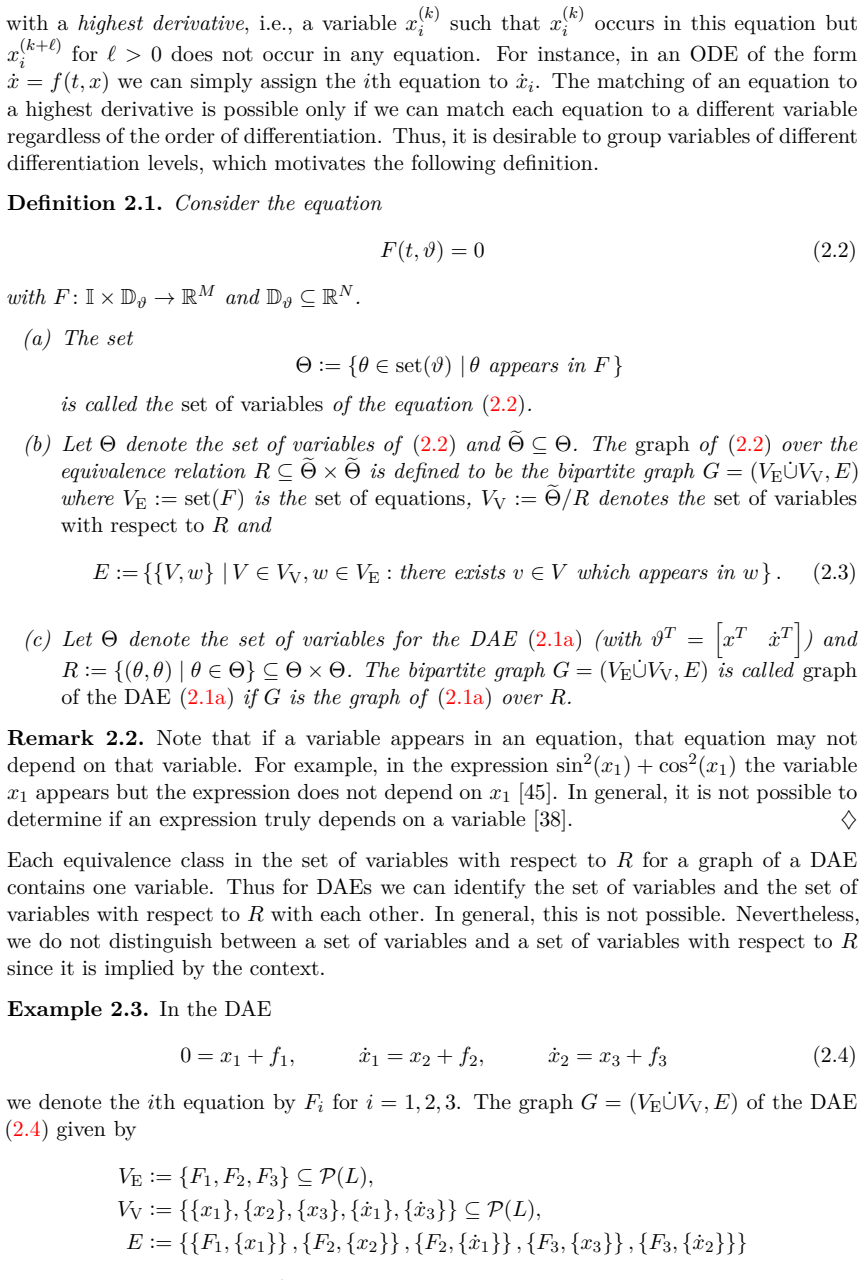
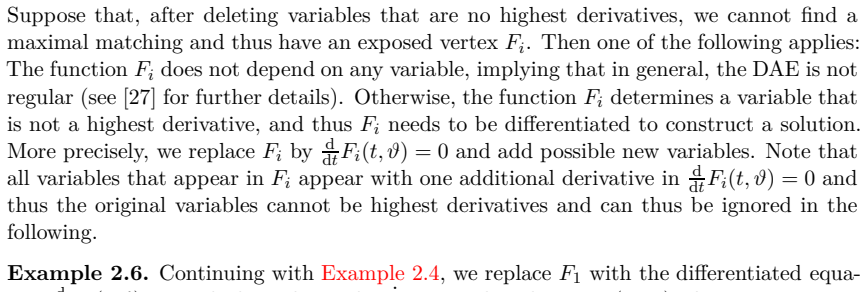
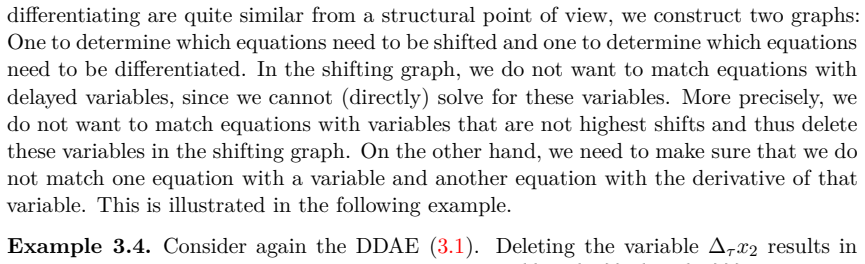
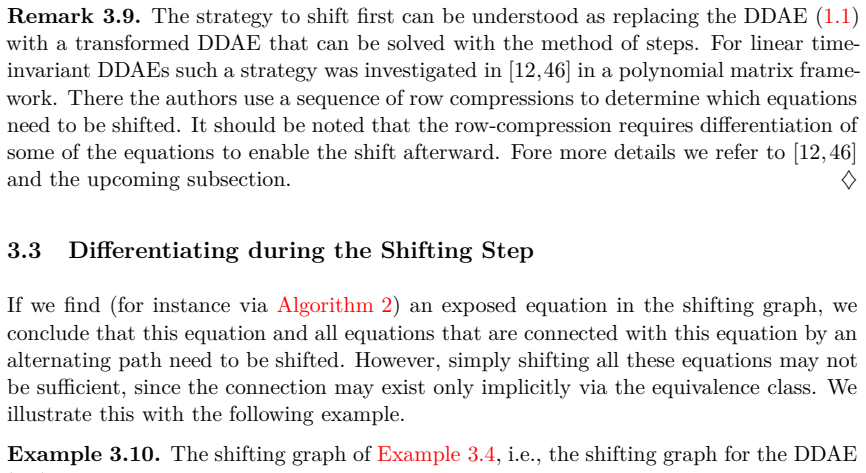
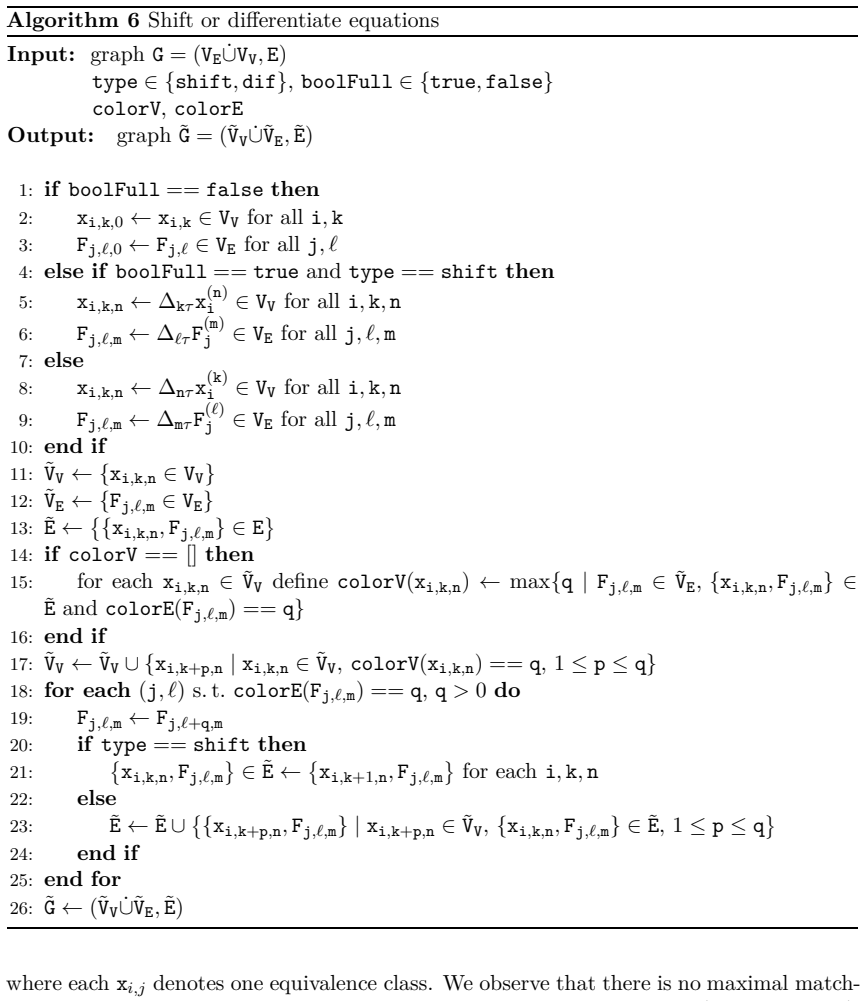
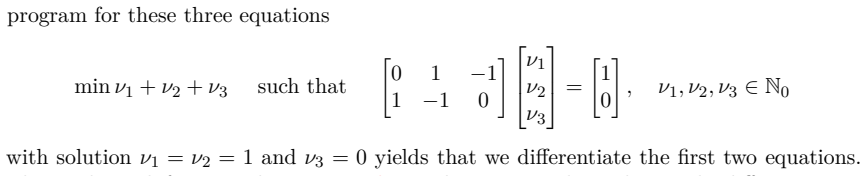
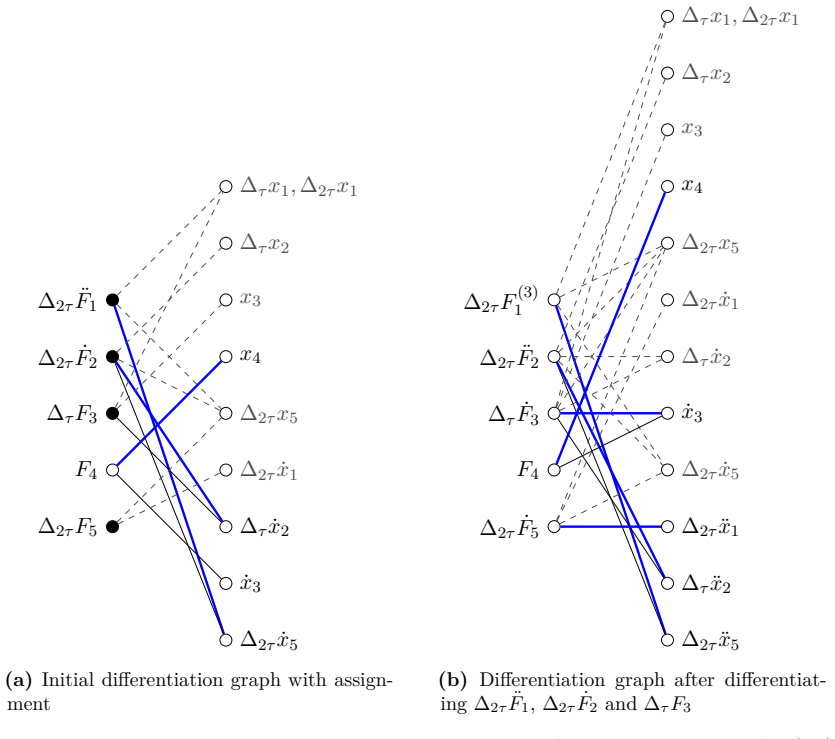
The machinery is a bipartite equation-variable graph equipped with two equivalence relations. In the shifting graph, variables $\Delta_\tau^k x_i^{(p)}$ and $\Delta_\tau^k x_i^{(q)}$ are merged into one vertex if they differ only in differentiation order, so one equation cannot be matched to both $x_i$ and $\dot x_i$. In the differentiation graph, variables differing only in shift level are merged instead. Algorithm 5 repeatedly matches equations to highest-shift variables; when an equation cannot be matched, it shifts the equations reachable by alternating paths and solves the linear system $A\nu=b$ for each implicit connection to decide how many times equations must be differentiated to make the connection direct. Trimmed linearization then rewrites higher derivatives with new variables while preserving the matching property.
What would settle it
Construct a DDAE whose shifting step yields two implicit connections with incompatible linear systems, for example one connection requiring $\nu_1-\nu_2=1$ and another requiring $\nu_2-\nu_1=1$; if no nonnegative integer vector satisfies both, Algorithm 3's componentwise-max rule cannot resolve all connections simultaneously, and running Algorithm 5 on that example would settle whether the paper's claim holds.
Extended reading notes
Core claim
The paper's central claim is that shifting and differentiation are structurally the same operation, so one graph-based algorithm can determine a valid combination of shifts and differentiations for an equation of the form $F(t,x(t),\dot x(t),x(t-\tau))=0$. To make this precise, the authors introduce equivalence classes of variables that differ only in differentiation order or only in shift level, forming a shifting graph and a differentiation graph. Because differentiation does not change the shifting graph, the algorithm shifts first; during that step, implicit connections inside an equivalence class are resolved by solving linear integer programs that prescribe how many times each connected equation must be differentiated. The termination criterion is that the equation set is structurally nonsingular with respect to the equivalence relation $R_{\mathrm{equal}}$ on the full variable set, meaning no subset contains more equations than equivalence classes of variables. Theorem 5.1 states that Algorithm 5 terminates if and only if this structural nonsingularity holds.
Load-bearing premise
The load-bearing premise is that the componentwise maximum of the differentiation counts found for each implicit connection separately always satisfies the linear systems of all connections simultaneously, so a single differentiation count can realize every required direct path.
Editorial extensions
If this is right
- For any DDAE satisfying the structural nonsingularity criterion, Algorithm 5 produces a reformulation in which each equation can be matched to a highest-shift, highest-derivative variable, making the method of steps applicable on successive intervals.
- Because differentiation never changes the shifting graph, shifting before differentiating is the correct structural order, which justifies the two-phase design of the algorithm.
- When no shifts are needed, the DDAE algorithm reduces to the standard Pantelides algorithm with delayed variables treated as parameters, so DAE and DDAE structural analysis coincide in that case.
- The approach uses only the sparsity pattern and matching computations, so it avoids numerical rank decisions and is feasible for large sparse systems.
- Termination alone does not certify the resulting shift and differentiation counts; the paper leaves the construction of a DDAE success check as open work.
Reading between the lines
- Editorial inference: the connection-wise linear programs could be combined into a single integer program over all connections; if that combined program is infeasible, the componentwise-max rule would be provably inadequate, giving a sharper test than the paper's separate solutions.
- Editorial inference: because the method is purely combinatorial, it will inherit the classical Pantelides sensitivity to equation transformations, so preprocessing choices such as adding one equation to another can change the reported shifts and differentiations.
- Editorial inference: if a DDAE success check is developed, this algorithm would become a practical preprocessor for dummy-derivative or least-squares time integration of nonlinear DDAEs.
Signed reviews
Editorial analysis
A structured set of objections, weighed in public.
Referee Report
Summary. This paper extends the classical Pantelides structural-analysis algorithm for differential-algebraic equations to delay differential-algebraic equations of the form F(t,x(t),ẋ(t),x(t−τ))=0. The authors introduce equivalence relations Rshift and Rdiff on the variables of the DDAE, grouping variables that differ only in differentiation order or only in shift, and construct two quotient graphs: a shifting graph and a differentiation graph. The proposed Algorithm 5 first runs a shifting step, during which some equations may need to be differentiated; the required differentiation counts are obtained by solving one small linear integer program per connection and then taking componentwise maxima. After a trimmed linearization step that reduces higher-order derivatives, a differentiation step applies the original Pantelides logic to the shifted system. The main result, Theorem 5.1, states that Algorithm 5 terminates if and only if the DDAE is structurally nonsingular with respect to the equivalence relation Requal that groups all derivatives and shifts of the same variable. Theorem 5.4 identifies a subcase in which no equation is shifted and the algorithm coincides with ordinary Pantelides applied to the DDAE with the delayed argument replaced by a parameter.
Significance. If the main theorem and the algorithmic construction are correct, the paper provides a useful and nontrivial generalization of a widely used structural-analysis tool to a class of systems for which no graph-theoretic analogue existed. The reformulation target is well chosen: it produces a method-of-steps-compatible first-order DDAE in which each equation can be matched to a highest-shift and highest-derivative variable. The termination criterion in terms of structural nonsingularity is clean, falsifiable, and directly parallels Pantelides' DAE criterion. The authors are also explicit about limitations: the algorithm, like the original, may determine incorrect numbers of shifts and differentiations and lacks a success check; this honesty is a strength. The main caveat is that several load-bearing proof steps are compressed, and one key assertion about componentwise maxima of connection-wise LP solutions is stated without proof, so the correctness of the termination theorem is not fully established as written.
major comments (4)
- [Section 3.3, text after Theorem 3.14 and Algorithm 3, step 5] The assertion that taking the componentwise maximum over all connection-wise LP solutions resolves all implicit connections is not proved. The systems A_l ν = b_l in (3.9) differ across connections, and a componentwise maximum of individually feasible vectors is not in general feasible for any one of those systems. What is needed is a proof that the graph update in Algorithm 6 is monotone in the differentiation counts, i.e., that old edges persist and only new edges are added when an equation is differentiated, so that every connection that is direct at the per-connection solution remains direct at the componentwise maximum. Without such a lemma, Example 3.15 only confirms the claim for one instance, and the proof of Lemma 5.2 and Theorem 5.1, which relies on the output of the shifting step, is incomplete.
- [Lemma 5.2 and Theorem 5.1] The proof of Lemma 5.2 conflates the MSS subsets produced by Proposition 2.10, which are minimal structurally singular with respect to the restricted highest-shift variable set, with MSS with respect to Θ/Rs over all variables. The inequalities in the chain following equation (5.2) are therefore not justified as written; the variable sets entering each quotient must be stated precisely at every step. In addition, the sentence 'this argument is easily extended to subsets of the general equation (3.5)' is not a proof of the preservation of structural nonsingularity for subsets disjoint from the shifted MSS subset, nor of the termination argument for the whole shifting phase. Since Lemma 5.2 is the core of Theorem 5.1, this proof needs to be rewritten with full detail.
- [Theorem 3.18 and Step 2 of Algorithm 5] The construction of the first-order reformulation is only partially demonstrated. The proof asserts that if the equation previously matched to Δ^ℓ x_i can no longer be matched after the replacement, then at least one newly introduced variable must appear in F_j and the matching can be reassigned to the associated equivalence class. It is not shown that the proposed assignment is a matching in all cases, nor that all right-hand-side variables are simultaneously highest shifts when several variables x_i with q_i ≥ 2 are linearized at once. This theorem supports Step 2 of Algorithm 5 and Lemma 5.3, so a complete proof is required.
- [Theorem 3.14 and the definition of a connection] The proof of Theorem 3.14(a) relies on the facts J = K−1 and rank(A) = K−1, justified by the statement that 'the equations F_ik form a connected graph.' The definition of a connection in Section 3.3 is informal, and it is not proved that the union of alternating paths defining a connection is always a tree with exactly one more equation vertex than path edges. Since the uniqueness and integrality of the LP solution in Theorem 3.14 are used by Algorithm 3, the definition of a connection should be made precise enough to guarantee these structural properties, or a separate proof should be supplied.
minor comments (6)
- [Definition 3.5] In the definition of differential similarity, the phrase 'there exists x∈Θ' should read 'there exists ξ∈set(x)', consistent with the earlier part of the definition and with the surrounding notation.
- [Lemma 5.2, equation (5.2)] The notation in (5.2) is confusing: the displayed equation uses variables ˜x, ˙x, and ∆−τ ˆx, while the following sentence says set(˜x,x,ˆx)⊆set(x). Please clarify what x denotes and how it relates to ˜x and ˆx.
- [Algorithm 5, Step 2] The instruction 'Add equations to graph G according to Theorem 3.18' does not explicitly state that the newly added equations must themselves be shifted by the corresponding ℓ_p values; this is done in Example 4.1 and should be part of the algorithm statement.
- [Example 4.1 and Example 4.3] The trimmed linearization in Example 4.1 renames y_10 to x_5 and G_10 to F_5, which clashes notationally with the physical variable x_5 introduced in the first-order reformulation of Example 4.3. Please rename one of these (for instance, use z_5 in Example 4.1) to avoid confusion.
- [Lemma 5.2 proof] There is a typo in the proof: 'does not effect the structural nonsingularity' should read 'does not affect the structural nonsingularity.' A similar typo appears in the proof of Theorem 2.11 ('structrually nonsingular').
- [Section 3.3, sentence after Theorem 3.14] The sentence 'If we take of all solutions, the maximal number of differentiations for each equation' is missing an object and should read 'If we take, over all solutions, the componentwise maximum of the number of differentiations for each equation...'.
Circularity Check
No significant circularity: Theorem 5.1 is justified by graph-theoretic lemmas and an external benchmark (Pantelides 1988), not by fitted inputs or self-citation chains.
full rationale
The paper's central claim (Theorem 5.1) is that Algorithm 5 terminates if and only if the DDAE is structurally nonsingular with respect to Θ/Requal. The proof is built from Lemma 5.2 (shifting step) and Lemma 5.3 (differentiation step), which reduce to Proposition 2.10 and to the externally established termination argument of Pantelides [33]. No parameter is fitted to data and then renamed as a prediction, and the equivalence relations Rshift, Rdiff, and Requal are mathematical constructions rather than entities calibrated against the theorem's conclusion. Self-citations such as [12, 46] for the shift-first strategy and [47, 48] for motivation are contextual; the load-bearing justification for shifting before differentiating is Proposition 3.8, which is proven in the paper by an explicit graph isomorphism. Theorem 5.4 also provides an external consistency check by showing agreement with the original Pantelides algorithm when no shifts are needed. The componentwise-max step in Algorithm 3 is asserted without a full proof and is a correctness risk, but it is not circular: the maximum of per-connection LP solutions does not make the termination criterion identical to its input by construction. Overall, the derivation chain is self-contained relative to its stated graph-theoretic framework.
Assumptions & free parameters
assumptions (6)
- domain assumption The sparsity pattern, i.e., which variable appears in which equation, is a valid basis for deciding shifts and differentiations; an appearing variable is treated as functionally relevant.
- domain assumption A DDAE solution can be sought by the method of steps, i.e., by solving a DAE on each interval [i*tau, (i+1)*tau), so the reformulation target is a regular low-index DAE per interval.
- domain assumption Structural nonsingularity with respect to Requal is taken as the termination and well-posedness criterion; actual solvability can differ.
- standard math Differentiating an equation increases the derivative order of every appearing variable in the structural graph, and the shift operator has no chain rule.
- standard math The connection graph in Section 3.3 has incidence matrix A with rank K-1 and nullspace spanned by e, because the equations F_ik form a connected graph.
- ad hoc to paper Taking the componentwise maximum of the solutions of all connection-wise linear programs resolves all implicit connections in the shifting graph.
Cite this review
Pith. "Pith review of The Pantelides algorithm for delay differential-algebraic equations." pith.science (2026). https://pith.science/paper/SJT5VJ4L
@misc{pith2026190801514,
  author       = {Pith},
  title        = {Pith review of: The Pantelides algorithm for delay differential-algebraic equations},
  year         = {2026},
  howpublished = {\url{https://pith.science/paper/SJT5VJ4L}},
  note         = {Machine review of arXiv:1908.01514}
}
read the original abstract
We present a graph-theoretical approach that can detect which equations of a delay differential-algebraic equation (DDAE) need to be differentiated or shifted to construct a solution of the DDAE. Our approach exploits the observation that differentiation and shifting are very similar from a structural point of view, which allows us to generalize the Pantelides algorithm for differential-algebraic equations to the DDAE setting. The primary tool for the extension is the introduction of equivalence classes in the graph of the DDAE, which also allows us to derive a necessary and sufficient criterion for the termination of the new algorithm.
Figures

Figures from the paper (11 more)






Reference graph
Works this paper leans on
-
[1]
Semi-explicit discretization schemes for weakly-coupled elliptic-parabolic problems
R. Altmann, R. Maier, and B. Unger. Semi-explicit discre tization schemes for weakly-coupled elliptic-parabolic problems. ArXiv e-print 1909.03497 , Sep 2019
work page Pith review arXiv 1909
-
[2]
U. M. Ascher and L. R. Petzold. The numerical solution of d elay-differential-algebraic equa- tions of retarded and neutral type. SIAM J. Numer. Anal. , 32(5):1635–1657, 1995
work page 1995
- [3]
- [4]
-
[5]
A. Bellen and M. Zennaro. Numerical methods for delay differential equations . Clarendon Press, 2003
work page 2003
-
[6]
R. Bellman and K. Cooke. Differential-difference equations . Academic Press, New York, 1963. 32
work page 1963
-
[7]
R. Borsche, D. Kocoglu, and S. Trenn. A distributional so lution framework for linear hyper- bolic PDEs coupled to switched DAEs. Technical report, Bern oulli Institute for Mathematics, CS and AI, University of Groningen, 2019
work page 2019
-
[8]
K.E Brenan, S.L. Campbell, and L.R. Petzold. Numerical Solution of Initial-Value Problems in Differential-Algebraic Equations . SIAM, 1996
work page 1996
Show all 49 references
-
[9]
Bursi and D
O.S. Bursi and D. Wagg, editors. Modern Testing Techniques for Structural Systems . Springer, Vienna, 2008
2008
-
[10]
S. L. Campbell. Singular linear systems of differential equations with delays. Appl. Anal. , 11(2):129–136, 1980
1980
-
[11]
S. L. Campbell. A general form for solvable linear time v arying singular systems of differential equations. SIAM J. Math. Anal. , 18(4):1101–1115, 1987
1987
-
[12]
S. L. Campbell. Nonregular 2D descriptor delay systems . IMA Journal of Mathematical Control and Information , 12(1):57–67, 1995
1995
-
[13]
I. S. Duff. On algorithms for obtaining a maximum transve rsal. ACM Trans. Math. Softw. , 7(3):315–330, 1981
1981
-
[14]
T. Erneux. Applied Delay Differential Equations , volume 4. Springer-Verlag, New York, 2009
2009
-
[15]
Fosong, P
E. Fosong, P. Schulze, and B. Unger. From time-domain da ta to low-dimensional structured models. ArXiv e-print 1902.05112 , Feb 2019
1902 arXiv
-
[16]
F. R. Gantmacher. The Theory of Matrices , volume 2. Chelsea Publishing Company, New York, NY, USA, 1959
1959
-
[17]
Gluesing-Luerssen
H. Gluesing-Luerssen. Linear Delay-Differential Systems with Commensurate Delay s: An Algebraic Approach. Springer, Berlin, Berlin, 2002
2002
-
[18]
P. Ha. Analysis and Numerical solutions of Delay Differential-Alg ebraic Equations . Disserta- tion, Technische Universität Berlin, 2015
2015
-
[19]
P. Ha. Spectral Characterizations of Solvability and S tability for Delay Differential-Algebraic Equations. Acta Math. Vietnamica , 43(4):715–735, 2018
2018
-
[20]
Ha and V
P. Ha and V. Mehrmann. Analysis and reformulation of lin ear delay differential-algebraic equations. Electron. J. Linear Algebr. , 23:703–730, 2012
2012
-
[21]
Ha and V
P. Ha and V. Mehrmann. Analysis and numerical solution o f linear delay differential-algebraic equations. BIT Numer Math , 56(2):633–657, 2016
2016
-
[22]
P. Ha, V. Mehrmann, and A. Steinbrecher. Analysis of lin ear variable coefficient delay differential-algebraic equations. J. Dynam. Differential Equations , 26(4):889–914, 2014
2014
-
[23]
J. K. Hale and S. M. Verduyn Lunel. Introduction to Functional Differrential Equations . Springer-Verlag, New York, 1993
1993
-
[24]
Horiuchi, M
T. Horiuchi, M. Inoue, T. Konno, and Y. Namita. Real-tim e hybrid experimental system with actuator delay compensation and its application to a piping system with energy absorber. Earthquake Engineering and Structural Dynamics , 28:1121–1141, 1999
1999
-
[25]
Jungnickel
D. Jungnickel. Graphs, networks and algorithms . Springer, Berlin, 4 edition, 2013
2013
-
[26]
Karmarkar
N. Karmarkar. A new polynomial-time algorithm for line ar programming. Combinatorica, 4(4):373–395, 1984
1984
-
[27]
Kunkel and V
P. Kunkel and V. Mehrmann. Regular solutions of nonline ar differential-algebraic equations and their numerical determination. Numer. Math. , 79(4):581–600, 1998
1998
-
[28]
Kunkel and V
P. Kunkel and V. Mehrmann. Differential-Algebraic Equations. Analysis and Numerical So- lution. European Mathematical Society, Zürich, Switzerland, 200 6
-
[29]
Y. N. Kyrychko, K. B. Blyuss, A. Gonzalez-Buelga, S. J. H ogan, and D. J. Wagg. Real- time dynamic substructuring in a coupled oscillator – pendu lum system. Proc. R. Soc. A , 462:1271–1294, 2006
2006
-
[30]
S. E. Mattsson and G. Söderlind. Index reduction in diffe rential-algebraic equations using dummy derivatives. SIAM J. Sci. Comput. , 14(3):677–692, 1993
1993
-
[31]
Mehrmann and C
V. Mehrmann and C. Shi. Transformation of high order lin ear differential-algebraic systems to first order. Numer. Algorithms , 42:281–307, 2006. 33
2006
-
[32]
J. A. Nelder and R. L. Mead. A simplex method for function minimization. Comput. J. , 7:308–313, 1965
1965
-
[33]
C. C. Pantelides. The consistent initialization of diff erential-algebraic systems. SIAM J. ScI. STAT. Comput., 9(2):213–231, 1988
1988
-
[34]
L. Petzold. Differential/algebraic equations are not O DE’s. SIAM J. ScI. STAT. Comput. , 3(3):367–384, 1982
1982
-
[35]
J. D. Pryce. A simple structural analysis method for DAE s. BIT Numer. Math. , 41(2):364–394, 2001
2001
-
[36]
J. D. Pryce, N. S. Nedialkov, and G. Tan. DAESA—a matlab t ool for structural analysis of differential-algebraic equations: Theory. ACM Transactions on Mathematical Software , 41(2):9:1–9:20, 2015
2015
-
[37]
Reissig, W
G. Reissig, W. S. Martinson, and P. I. Barton. Differenti al–Algebraic Equations of Index 1 May Have an Arbitrarily High Structural Index. SIAM J. Sci. Comput. , 21(6):1987–1990, 2000
1987
-
[38]
Richardson
D. Richardson. Some undecidable problems involving el ementary functions of a real variable. J. Symb. Log. , 33(4):514–520, 1968
1968
-
[39]
L. Scholz. A derivative array approach for linear secon d order differential-algebraic systems. Electron. J. Linear Algebra , 22(1):310–347, 2011
2011
-
[40]
Scholz and A
L. Scholz and A. Steinbrecher. Regularization of DAEs b ased on the signature method. BIT Numerical Mathematics, 56:319–340, 2016
2016
-
[41]
Scholz and A
L. Scholz and A. Steinbrecher. Structural-algebraic r egularization for coupled systems of DAEs. BIT Numerical Mathematics , 56(2):777–804, 2016
2016
-
[42]
Schulze and B
P. Schulze and B. Unger. Data-driven interpolation of d ynamical systems with delay. Systems Control Lett., 97:125–131, 2016
2016
-
[43]
Schulze, B
P. Schulze, B. Unger, C. Beattie, and S. Gugercin. Data- driven structured realization. Linear Algebra Appl., 537:250 – 286, 2018
2018
-
[44]
Steinbrecher
A. Steinbrecher. Numerical Solution of Quasi-Linear Differential-Algebrai c Equations and Industrial Simulation of Multibody Systems . PhD thesis, Institut für Mathematik, Technische Universität Berlin, 2006
2006
-
[45]
G. Tan, N. S. Nedialkov, and J. D. Pryce. Conversion meth ods for improving structural analysis of differential-algebraic systems. BIT Numer. Math. , 57(3):845–865, 2017
2017
-
[46]
Trenn and B
S. Trenn and B. Unger. Delay regularity of differential- algebraic equations. In Proc. 58th IEEE Conf. Decision Control (CDC) 2019, Nice, France , pages 989–994, 2019
2019
-
[47]
B. Unger. Discontinuity propagation in delay different ial-algebraic equations. Electron. J. Linear Algebr., 34:582–601, 2018
2018
-
[48]
B. Unger. Delay differential-algebraic equations in re al-time dynamic substructuring. ArXiv e-print 2003.10195 , Mar 2020
2003 arXiv
-
[49]
D. B. West. Introduction to Graph Theory . Prentice Hall, Upper Saddle River, 2 edition, 2001. 34
2001
Reviewed August 14, 2026 · model on record in the stance chip above.
Discussion (0). Continue with ORCID to comment.