REVIEW 2 major objections 4 minor 55 references
Photon statistics and dynamics of nanolasers subject to intensity feedback
T0 review · 2 major / 4 minor · reviewed 2026-08-14 · deepseek-v4-flash
Pith's one-line read For a β=0.1 nanolaser, incoherent intensity feedback lowers the lasing threshold, compresses the transition region, and at 30% feedback produces irregular spiking with a growing continuous component.
desk verdict A useful but limited stochastic simulation study of incoherent feedback in a beta=0.1 nanolaser; the central caveat about model validity is stated but not fully delimited. read the letter →
The pith
A machine-rendered reading of the paper's core claim, the machinery that carries it, and where it could break.
The reading
What carries the argument
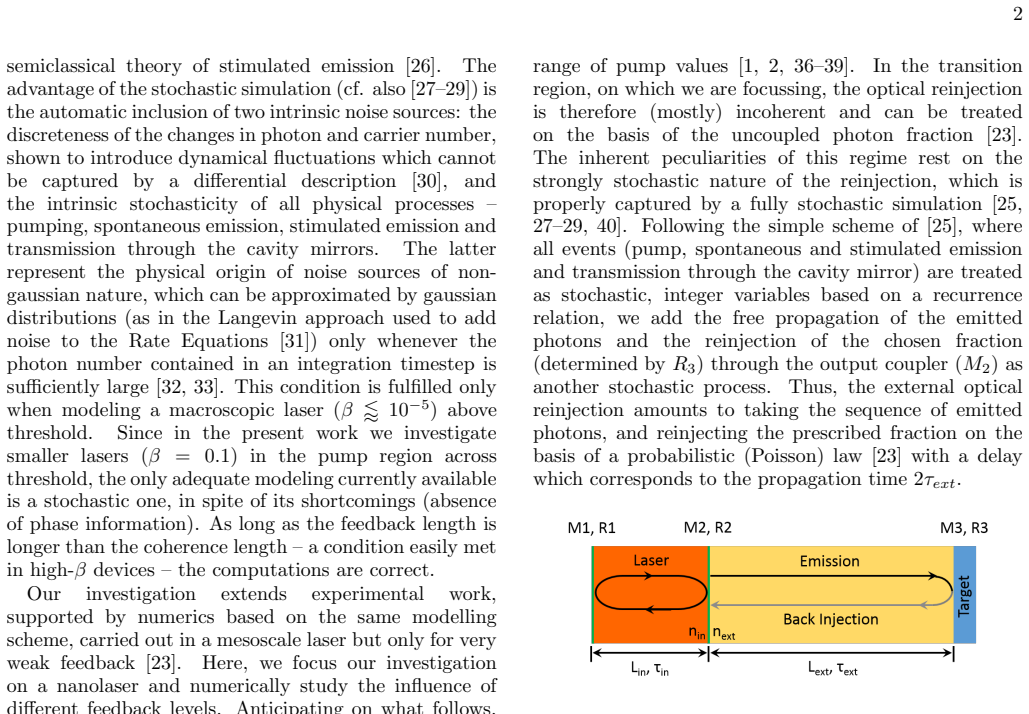
The engine is a recursive, fully stochastic photon-number simulator in which every process (pumping, spontaneous and stimulated emission, mirror losses) is drawn as a Poisson count, extended by a feedback term that reinjects a Poisson-selected fraction of the photons emitted one round-trip earlier. This is the central object because it keeps the intrinsic shot noise and non-Gaussian fluctuations that the paper argues are essential in the β=0.1 transition region. The second key diagnostic is the second-order autocorrelation function g(2)(τ), computed from the simulated time traces and used to judge the onset of coherence, the presence of external-cavity periodicity, and the emergence of a continuous component in the output.
What would settle it
Simulate the same β=0.1 parameters with a phase-resolved (coherent) feedback model: if the input-output curves or g(2)(0) differ by more than the statistical error of the stochastic runs at fext=0.3 and P/Pth≤2.5, then the incoherent assumption is load-bearing and the paper's central claim applies only inside that regime. Alternatively, shorten the external cavity until the round-trip time becomes comparable to the measured coherence time and look for coherent-feedback signatures such as a narrow spectral line or regular pulsing.
Extended reading notes
Core claim
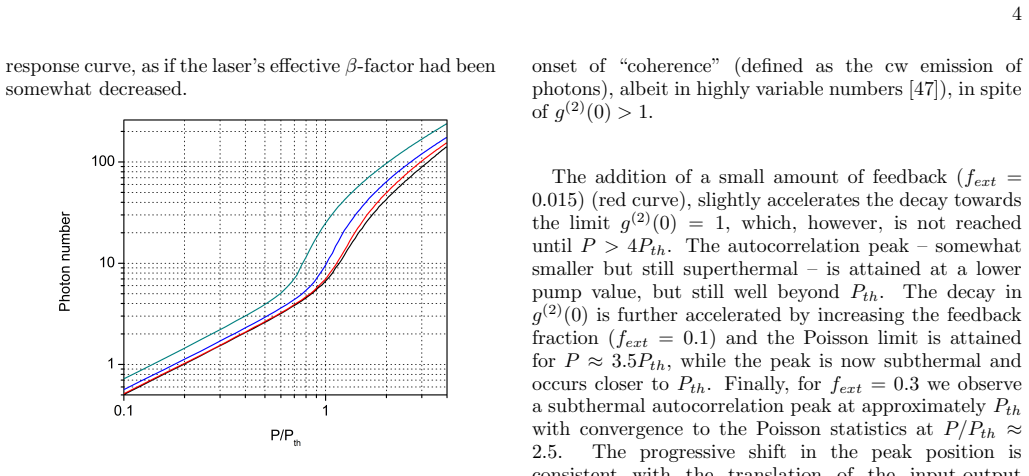
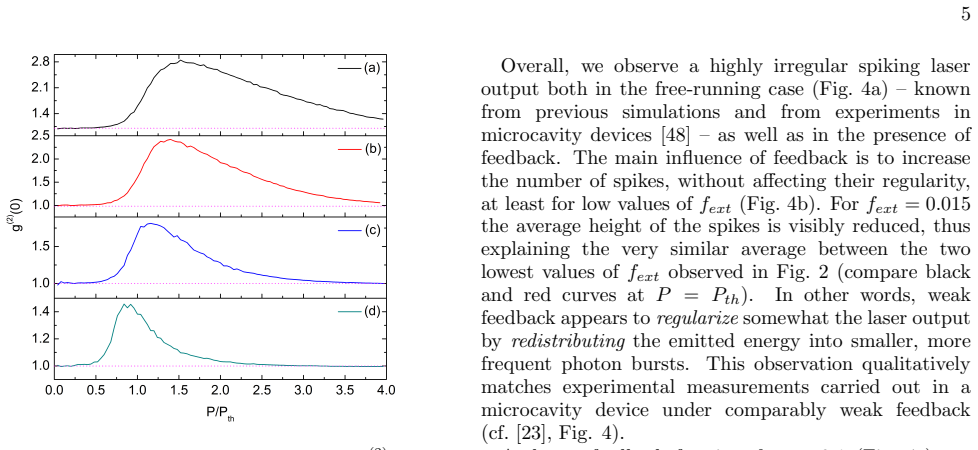
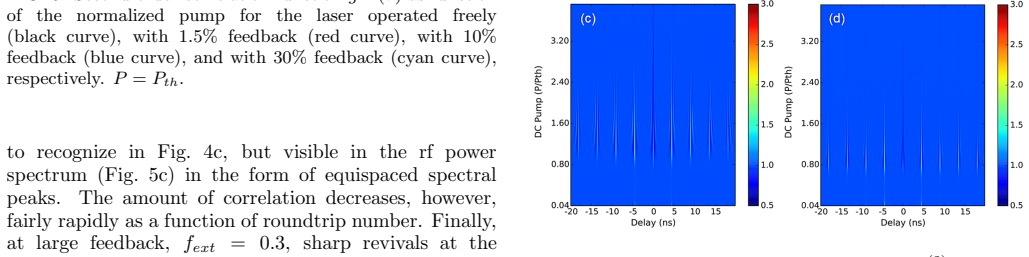
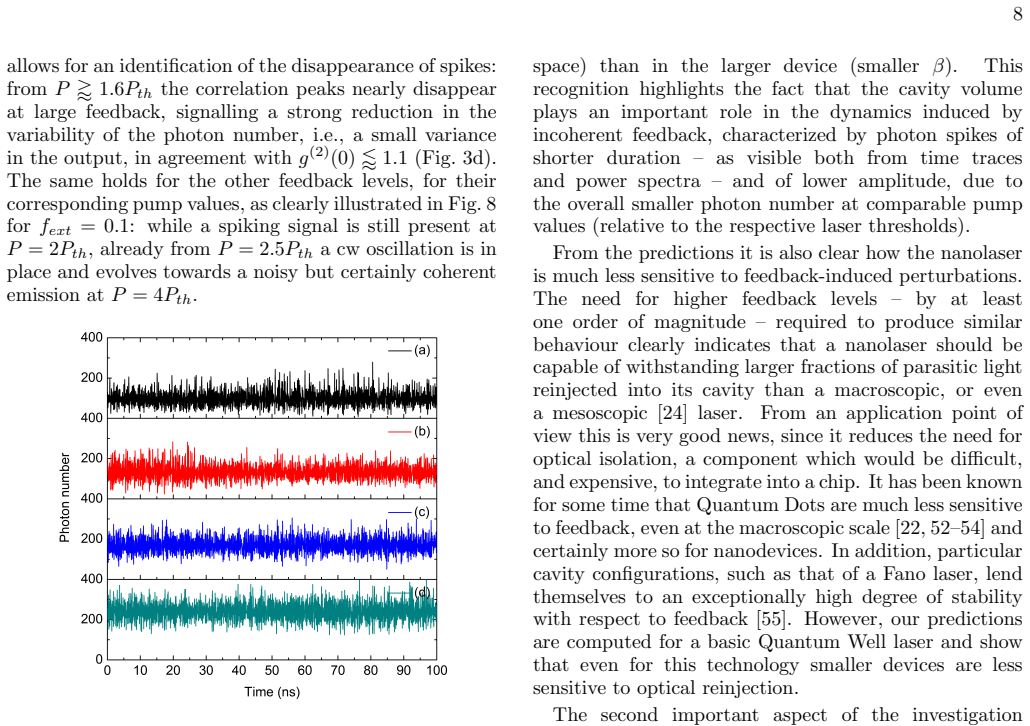
The central claim is that, for a β=0.1 nanolaser pumped through the lasing transition, incoherent optical feedback acts as an effective reduction of the lasing threshold and a narrowing of the transition region: as fext grows from 0 to 0.3, the input-output response shifts to lower pump values, the differential gain above threshold increases, and the pump value where g(2)(0) reaches the Poissonian limit moves from above 4 Pth to about 2.5 Pth. At the largest feedback studied, the temporal output develops a strongly spiking, irregular dynamics with a nonzero continuous background, and the delayed autocorrelation develops sharp revivals at the external-cavity round trip with internal structure at the relaxation-oscillation frequency. The paper further claims that these signatures are enough to identify the dynamics: the delayed g(2)(τ) reproduces, in a simpler way, the information contained in the rf power spectrum.
Load-bearing premise
The whole picture rests on the assumption that the reflected light is reinjected as pure noise-like photon counts with no phase or wave interference, which the paper says is valid only when the external-cavity round trip is longer than the coherence length and the emission is not yet coherent; if that condition fails, the predicted threshold shift and correlation revivals could cease to apply.
Editorial extensions
If this is right
- In a β=0.1 nanolaser, raising the incoherent feedback fraction to 0.3 lowers the pump at which the autocorrelation reaches the Poissonian limit from above 4Pth to about 2.5Pth.
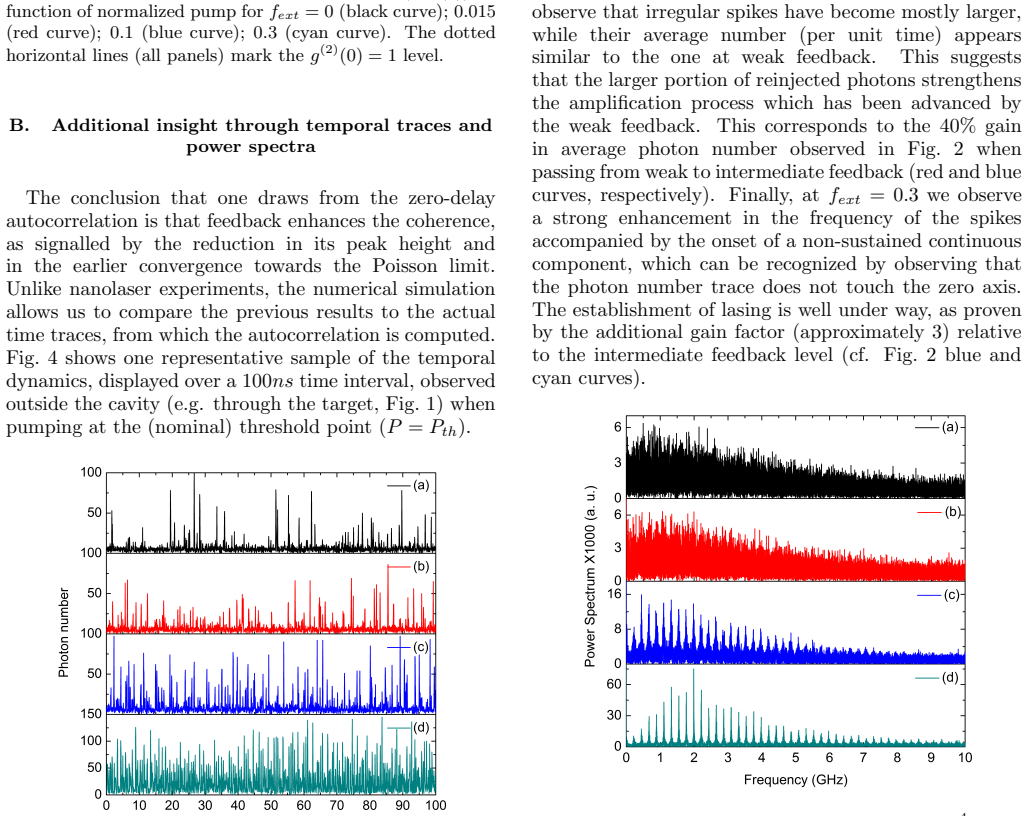
- Large feedback (fext=0.3) changes the output at threshold from rare large spikes to frequent irregular spikes sitting on a continuous, low-coherence background.
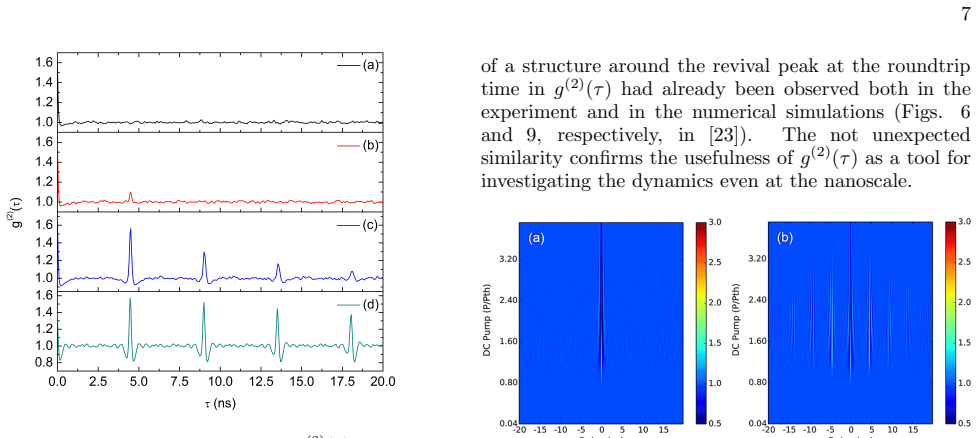
- The delayed autocorrelation g(2)(τ) shows external-cavity revivals with relaxation-oscillation side structure, matching the rf spectrum, so g(2)(τ) is a sufficient experimental diagnostic.
- Compared with a mesoscale laser, the β=0.1 nanolaser needs a feedback level at least an order of magnitude larger to produce qualitatively similar dynamics, implying nanolasers tolerate more parasitic optical feedback without requiring optical isolation.
Reading between the lines
- If the incoherent-feedback picture holds, the threshold shift seen here should also appear as a lowered pump for the onset of stimulated-emission bunching in measured g(2)(0) of any high-β device with a long external cavity; this is a direct consequence but not tested here.
- A natural next step is to scan fext between 0.3 and 1: the model suggests a boundary where the continuous component becomes quasi-cw while spike statistics persist, and this boundary should appear as a qualitative change in the rf spectral slope.
- The model's stated breakdown at coherence implies that at pump values below the current 4Pth but with strong feedback, one might observe a crossover to coherent-feedback effects (linewidth collapse, deterministic chaos) that the current photon-number recurrence cannot describe; identifying that crossover experimentally would delineate the validity domain.
- Because g(2)(τ) cannot distinguish regular from irregular spike sequences, a practical extension is to combine g(2)(τ) with a spike-interval histogram in experiments; the histogram would provide the regularity information that autocorrelation misses.
Signed reviews
Editorial analysis
A structured set of objections, weighed in public.
Referee Report
Summary. The paper presents a fully stochastic simulation of a β=0.1 nanolaser subject to incoherent intensity feedback, modeled by reinjecting a delayed fraction of the emitted photons into the cavity as a Poisson process. Using a photon-number recurrence scheme (Eqs. 1-4), the authors compute input-output curves, zero-delay and time-delayed second-order autocorrelations, temporal traces, and radiofrequency power spectra for feedback fractions fext = 0, 0.015, 0.1, and 0.3. They report that feedback shifts the input-output transition to lower pump values, shrinks the transition region, and at the largest feedback produces irregular spiking with a growing continuous, low-coherence component. They also show that external-cavity revival peaks in g(2)(τ) match periodic features in the rf spectra, and interpret this as validating the use of second-order autocorrelation as a sufficient diagnostic for nanolaser dynamics. The paper emphasizes the low-coherence transition regime and explicitly notes that the incoherent-feedback treatment is valid only while the external round-trip time exceeds the field coherence length, with breakdown expected once Poisson statistics are attained.
Significance. If the results hold, the paper provides a useful extension of stochastic laser modeling to nanolasers with feedback and offers practical guidance for experiments, namely that g(2)(τ) can serve as a simpler diagnostic than rf spectroscopy for identifying feedback-induced dynamics. The work is valuable for its explicit stochastic treatment of low-photon-number dynamics in the transition region and for comparing several observables from the same simulated output, which avoids any parameter fitting to a target result. The authors are also commendably explicit about the model's limitations, including the finite-sampling artifact below threshold and the expected breakdown in the Poissonian regime. The main strength is the internal consistency demonstrated among time traces, autocorrelations, and power spectra, which supports the qualitative interpretation of the simulations. The paper does not, however, provide an independent validation of g(2) as a universally sufficient tool, and its central conclusions partly rely on a parameter region where the model's own validity condition is questionable.
major comments (2)
- [Sec. IV A, Figs. 3 and 8] The paper states that 'when the Poisson regime is attained, the model is expected to break down' and that for the upper values of the pump range 'for sufficiently strong feedback, the predictions may break down,' but it does not delimit which results are affected. For fext=0.3, Fig. 3(d) shows g(2)(0) converging to 1 near P/Pth≈2.5, and Fig. 8 displays fext=0.1 dynamics up to P/Pth=4, where g(2)(0) has also reached the Poisson limit (Fig. 3(c)). Since several conclusions—threshold reduction, the appearance of a continuous component, and the 'noisy but certainly coherent emission at P=4Pth'—are drawn from these high-pump points, the authors should either restrict the analysis and claims to the region where the incoherent-reinjection assumption is justified (e.g., g(2)(0)>1) or provide a quantitative estimate of the emitted-field coherence time and verify that it remains longer than the external round-trip time across the full parameter range. As written, the presentation includes results in a region the authors themselves flag as invalid, which is load-bearing for the validity of the central claims.
- [Abstract and Sec. V] The claim that the paper 'validates the use of the second order autocorrelation as a sufficient tool for the interpretation of the dynamics' is stronger than what the evidence supports. The comparison between g(2)(τ), time traces, and rf spectra is performed on the same simulated photon-number output, so it demonstrates internal consistency of the stochastic model rather than an independent validation of g(2) as a diagnostic. The authors also concede in Sec. IV B that g(2) 'cannot distinguish between regular and irregular sequences,' which further weakens the word 'sufficient.' I recommend softening the abstract and conclusion to state that the results are 'consistent with' the usefulness of g(2) for capturing principal dynamical features, or providing an independent test (e.g., using an analytic relation or a different simulation method).
minor comments (4)
- [Sec. III] The sentence 'Sinj,q−d and Rinj,q−d is the fraction of back propagating photons which have probability 3×10⁻³ of being reinjected into the cavity' is unclear and appears inconsistent with the feedback fractions fext up to 0.3 used later. Please clarify how the feedback fraction defined in Eq. (6) is implemented in the stochastic algorithm.
- [Sec. IV C] When describing the delayed autocorrelation revivals at fext=0.3, the text refers to 'Fig. 5d' but the sharp revivals are shown in Fig. 6(d); the rf spectrum with strong peaks is Fig. 5(d). Please correct the cross-reference.
- [Sec. IV A / Fig. 3 caption] The below-threshold values of g(2)(0) are artificially close to 1 because of the finite-sampling artifact described in the text. The figure captions for Figs. 3 and 7 should explicitly note that below-threshold g(2)(0) values are not physically meaningful, so readers do not misinterpret them as indicating coherent statistics.
- [Sec. III] For reproducibility, the paper should state the simulation time step, the number of stochastic realizations, and the averaging time used for the steady-state and correlation estimates, rather than only citing Ref. [25].
Circularity Check
Central simulation results are self-contained; the claimed validation of g(2) is an internal consistency check on the same simulated time series.
-
other
[Sec. IV C and Sec. V (Conclusion)]
"An additional indicator currently available in experiments on nanolasers is the time-delayed second-order autocorrelation, which in our simulations can be computed directly from the temporal laser output (eq. (5)). ... Interestingly, this also implies that g(2)(τ) can provide equivalent information to that contained in the rf power spectrum ... Through comparison between the autocorrelation predictions (without and with delay) with power spectra and temporal signals, we have shown that the principal features could be well captured, thereby validating the usefulness of the technique."
The rf power spectra and temporal traces are not independent data: they are computed from the same simulated photon-number sequence M(t)=S(t)+R_L(t) used to evaluate g(2)(τ) in Eq. (5). The equivalence between g(2)(τ) and the rf spectrum is a mathematical property of the intensity autocorrelation (Wiener-Khinchin), so the agreement is built into the shared input rather than experimentally or externally confirmed. Presenting this internal consistency check as a 'validation' of g(2) as a sufficient tool is therefore self-referential. This step is secondary: the dynamical predictions (threshold shift, spiking, revival peaks) follow directly from the stochastic model with fext swept, not from this comparison.
full rationale
The central physical results are direct outputs of the fully specified stochastic recurrence model (Eqs. 1-4) with fext varied as an input parameter. No quantity is fitted to a target result, and no prediction is defined in terms of the quantity it claims to predict. Although the model builds on prior work by the same authors ([25], [23]), the equations are reproduced in the paper and the simulation is self-contained, so the self-citation is not load-bearing in a circular way. The only step resembling circularity is the claimed validation of g(2)(τ) as a sufficient diagnostic: g(2), time traces, and rf spectra are all computed from the same simulated intensity output, so their agreement confirms a mathematical consistency rather than providing independent experimental validation. This does not undermine the dynamical predictions, which stand on the stochastic simulation itself. The paper's caveat about model breakdown near the Poisson regime for high pump and strong feedback is a correctness/validity concern, not a circularity of the derivation.
Assumptions & free parameters
free parameters (3)
- β =
0.1
- fext =
0, 0.015, 0.1, 0.3
- reinjection probability per returning photon =
3×10^-3
assumptions (3)
- domain assumption The reinjected light is incoherent and can be treated as an uncorrelated Poissonian photon fraction added to the on-axis modes (S_inj and R_inj terms in Eqs. 2-3).
- domain assumption The stochastic photon-number simulator of ref. [25] correctly captures the low-coherence transition dynamics for β=0.1 without phase information.
- domain assumption The threshold pump is defined as P_th = Γc/β (ref. [43]) and is used to normalize all pump values.
Cite this review
Pith. "Pith review of Photon statistics and dynamics of nanolasers subject to intensity feedback." pith.science (2026). https://pith.science/paper/R54CMKBS
@misc{pith2026190801521,
  author       = {Pith},
  title        = {Pith review of: Photon statistics and dynamics of nanolasers subject to intensity feedback},
  year         = {2026},
  howpublished = {\url{https://pith.science/paper/R54CMKBS}},
  note         = {Machine review of arXiv:1908.01521}
}
read the original abstract
Using a fully stochastic numerical scheme, we investigate the behaviour of a nanolaser in the low-coherence regime at the transition between spontaneous emission and lasing under the influence of intensity feedback. Studying the input-output curves as well as the second order correlations for different feedback fractions, we obtain an insight on the role played by the fraction of photons reinjected into the cavity. The interpretation of the observation is strengthened through the comparison with the temporal traces of the emitted photons and with the radiofrequency power spectra. The results give insight into the physics of nanolasers as well as validate the use of the second order autocorrelation as a sufficient tool for the interpretation of the dynamics. This confirmation offers a solid basis for the reliance on autocorrelations in experiments studying the effects of feedback in nanodevices.
Figures
Figures from the paper (4 more)
Reference graph
Works this paper leans on
-
[23]
Dynamics of a micro-VCSEL operated in the threshold region under low-level optical feedback,
T. Wang , X. Wang, Z. Deng, J. Sun, G.P. Puccioni, G. Wang, and G.L. Lippi, “Dynamics of a micro-VCSEL operated in the threshold region under low-level optical feedback,” IEEE J. Sel. Top. Quantum Electron., 25, 1700308 (2019)
work page 2019
-
[1]
Direct observation of correlations between individual photon emission events of a microcavity laser,
J. Wiersig, C. Gies, F. Jahnke, M. A βmann, T. Berstermann, M. Bayer, C. Kistner, S. Reitzenstein, C. Schneider, S. H¨ ofling, A. Forchel, C. Kruse, J. Kalden and D. Hommel, “Direct observation of correlations between individual photon emission events of a microcavity laser,” Nature 460, 245–250 (2009)
work page 2009
-
[2]
Demonstration of coherent emission from high- β photonic crystal nanolasers at room temperature,
R. Hostein, R. Braive, L. Le Gratiet, A. Talneau, G. Beaudoin, I. Robert-Philip, I. Sagnes, and A. Beveratos, “Demonstration of coherent emission from high- β photonic crystal nanolasers at room temperature,” Opt. Letters 35, 1154-1156 (2010)
work page 2010
-
[3]
M.K. Smit, J. van der Tol, and M.T. Hill, “Moore’s law in photonics,” Laser & Photon. Rev. 6, 1-13 (2012)
work page 2012
-
[4]
Hybrid indium phosphide-on-silicon nanolaser diode,
G. Crosnier, D. Sanchez, S. Bouchoule, P. Monnier, G. Beaudoin, I. Sagnes, R. Raj, and F. Raineri, “Hybrid indium phosphide-on-silicon nanolaser diode,” Nat. Photon. 11, 1-5 (2017)
work page 2017
-
[5]
M.T. Hill and M.C. Gather, “Advances in small lasers,” Nat. Photon. 8, 908-918, (2014)
work page 2014
-
[6]
Tunable nanowire nonlinear optical probe,
Y. Nakayama, P. J. Pauzauskie, A. Radenovic, R. M. Onorato, R. J. Saykally, J. Liphardt and P. Yang, “Tunable nanowire nonlinear optical probe,” Nature447, 1098-1101 (2007)
work page 2007
-
[7]
C. Deeb, Z. Guo, A. Yang, L. Huang, and T.W. Odom, “Correlating nanoscopic energy transfer and far- field emission to unravel lasing dynamics in plasmonic nanocavity arrays,” Nano Lett. 18, 1454-1459, (2018)
work page 2018
Show all 55 references
-
[8]
Single-cell photonic nanocavity probes,
G. Shambat, S. R. Kothapalli, J. Provine, T. Sarmiento, J. Harris, S. Sam Gambhir, and J. Vuˇckovi´ c, “Single-cell photonic nanocavity probes,” Nano Lett. 13, 4999-5005 (2013)
2013
-
[9]
Absorption sensor based on graphene plasmon quantum amplifier,
I. A. Nechepurenko, E.S. Andrianov, A.A. Zyablovsky, A. V. Dorofeenko, A. A. Pukhov, and Y. E. Lozovik, “Absorption sensor based on graphene plasmon quantum amplifier,” Phys. Rev. B 98, 075411, (2018)
2018
-
[10]
Nanolasers: second-order intensity correlation, direct modulation and electromagnetic isolation in array architectures,
S.H. Pan, S.S. Deka, A. El Amili, Q. Gu, and Y. Fainman, “Nanolasers: second-order intensity correlation, direct modulation and electromagnetic isolation in array architectures,” Progress in Quantum Electronics59, 1-18 (2018)
2018
-
[11]
Modulation bandwidth and energy efficiency of metallic cavity semiconductor nanolasers with inclusion of noise effects,
K. Ding, J. O. Diaz, D. Bimberg, and C. Z. Ning, “Modulation bandwidth and energy efficiency of metallic cavity semiconductor nanolasers with inclusion of noise effects,” Laser & Photon. Rev. 9, 1-10 (2015)
2015
-
[12]
Exploration of VCSEL ultra-low biasing scheme for pulse generation,
T. Wang, G. Wang, G.P. Puccioni, and G.L. Lippi, “Exploration of VCSEL ultra-low biasing scheme for pulse generation,” J. Opt. Soc. Am. B36, 799-804 (2019)
2019
-
[13]
Delayed Transition to Coherent Emission in Nanolasers with Extended Gain Media,
F. Lohof, R. Barzel, P. Gartner, and C. Gies, “Delayed Transition to Coherent Emission in Nanolasers with Extended Gain Media,” Phys. Rev. Appl. 10, 054055 (2018)
2018
-
[14]
Lasing threshold of thresholdless and non-thresholdless metal-semiconductor nanolasers,
A.A. Vyshnevyy and D.Yu. Fedyanin, “Lasing threshold of thresholdless and non-thresholdless metal-semiconductor nanolasers,” Opt. Express 26, 33473-33483 (2018)
2018
-
[15]
Lasing thresholds and photon statistics in high-β buried multiple quantum well photonic crystal nanocavity lasers,
N. Takemura, M. Takiguchi, E. Kuramochi, A. Shinya, T. Sato, K. Takeda, S. Matsuo, and M. Notomi, “Lasing thresholds and photon statistics in high-β buried multiple quantum well photonic crystal nanocavity lasers,” Phys. Rev. A 99, 053820 (2019)
2019
-
[16]
Nonlinear dynamics and stochastic behavior of semiconductor lasers with optical feedback,
J. Mørk, “Nonlinear dynamics and stochastic behavior of semiconductor lasers with optical feedback,” Ph.D. thesis, Laboratory for Applied Mathematical Physics, Tech. Univ. Denmark, (1988)
1988
-
[17]
Noise, chaos, and coherence collapse in semiconductor lasers,
J.S. Cohen and D . Lenstra, “Noise, chaos, and coherence collapse in semiconductor lasers,” Philips J. Res. 44, 43 (1989)
1989
-
[18]
Low-frequency fluctuations in vertical cavity lasers: Experiments versus Lang-Kobayashi dynamics,
A. Torcini, S. Barland, G. Giacomelli, and F. Marin, “Low-frequency fluctuations in vertical cavity lasers: Experiments versus Lang-Kobayashi dynamics,” Phys. Rev. A 74, 063801 (2006)
2006
-
[19]
Observing chaos for quantum-dot microlasers with external feedback,
F. Albert, C. Hopfmann, S. Reitzenstein, C. Schneider, S. H¨ ofling, L. Worschech, M. Kamp, W. Kinze, A. Forche & I. Kanter, “Observing chaos for quantum-dot microlasers with external feedback,” Nat. Communications, 2, 1-5 (2011)
2011
-
[20]
Tailoring the mode- switching dynamics in quantum-dot micropillar lasers via time-delayed optical feedback,
S. Holzinger, C. Redlich, B. Lingnau, M. Schmidt, M. von Helversen, J. Beyer, C. Schneider, M. Kamp, S. H¨ ofling, K. L¨ udge, X. Porte, S. Reitzenstein, “Tailoring the mode- switching dynamics in quantum-dot micropillar lasers via time-delayed optical feedback,” Opt. Express, ...
2018
-
[21]
Determining the linewidth enhancement factor via optical feedback in quantum dot micropillar lasers,
S. Holzinger, S. Kreinberg, B.H. Hokr, C. Schneider, S. H¨ ofling, W.W. Chow, X. Porte, S. Reitzenstein, “Determining the linewidth enhancement factor via optical feedback in quantum dot micropillar lasers,” Opt. Express, 26, 31363-31371 (2018)
2018
-
[22]
Nonlinear emission characteristics of quantum dot- micropillar lasers in the presence of polarizedoptical feedback,
C. Hopfmann, F. Albert, C. Schneider, S. H¨ ofling, M. Kamp, A. Forchel, I. Kanter and S. Reitzenstein, “Nonlinear emission characteristics of quantum dot- micropillar lasers in the presence of polarizedoptical feedback,” New J. Phys., 15, 025030 (2013)
2013
-
[24]
Nonlinear dynamics at the meso-and nanoscale: Stochasticity meets determinism,
T. Wang, G.P. Puccioni, and G.L. Lippi, “Nonlinear dynamics at the meso-and nanoscale: Stochasticity meets determinism,” In 2018 IEEE Workshop on Complexity in Engineering (COMPENG), 1-5. IEEE, 2018
2018
-
[25]
Stochastic simulator for modelling the transition to lasing,
G.P. Puccioni and G.L. Lippi, “Stochastic simulator for modelling the transition to lasing,” Opt. Express 23, 2369-2374 (2015)
2015
-
[26]
Zur Quantentheorie der Strahlung,
A. Einstein, “Zur Quantentheorie der Strahlung,” Physik. Zeitschr. 18, 121-128 (1917)
1917
-
[27]
Quantum fluctuations in small lasers,
K. Roy-Choudhury, S. Haas, A. Levi, “Quantum fluctuations in small lasers,” Phys. Rev. Lett. 102, 053902 (2009)
2009
-
[28]
Quantum fluctuations in very small laser diodes,
K. Roy-Choudhury, A.F.J. Levi, “Quantum fluctuations in very small laser diodes,” Phys. Rev. A 81, 013827 (2010)
2010
-
[29]
Markov model of quantum fluctuations at the transition to lasing of semiconductor nanolasers,
A. Vallet, L. Chusseau, F. Philippe, A. Jean-Marie, “Markov model of quantum fluctuations at the transition to lasing of semiconductor nanolasers,” Physica E 105, 97–104 (2019)
2019
-
[30]
Stochastically sustained population oscillations in high-β nanolasers,
A. Lebreton, I. Abram, N. Takemura, M. Kuwata- Gonokami, I. Robert-Philip, and A. Beveratos, “Stochastically sustained population oscillations in high-β nanolasers,” New J. Phys. 15, 033039 (2013)
2013
-
[31]
Coldren and S.W
L.A. Coldren and S.W. Corzine, Diode Lasers and Photonic Integrated Circuits, (Wiley New York, 1995). 10
1995
-
[32]
Numerical solutions to the Laser Rate Equations with noise: technical issues, implementation and pitfalls,
G.L. Lippi, J. Mørk, and G.P. Puccioni, “Numerical solutions to the Laser Rate Equations with noise: technical issues, implementation and pitfalls,” Proc. SPIE 10672, 106722B (2018). Freely available from https://sites.google.com/site/gianlucalippi
2018
-
[33]
Analytical vs. numerical langevin description of noise in small lasers,
G.L. Lippi, J. Mrk, and G.P. Puccioni, “Analytical vs. numerical langevin description of noise in small lasers,” arXiv:1903.08859 (2019)
2019 arXiv
-
[34]
Coherence collapse in single-mode semiconductor lasers due to optical feedback,
D. Lenstra, B. H . Verbeek, and A. J . den Boef, “Coherence collapse in single-mode semiconductor lasers due to optical feedback,” IEEE J. Quantum Electron. QE-21, 674 (1984)
1984
-
[35]
Intensity noise of laser diodes with optical feedback,
Y. Kitaoka, H. Sato, Q. Mizuuchi, K. Yamamoto, and M. Kato, “Intensity noise of laser diodes with optical feedback,” IEEE J. Quantum Electron. 12, 822-828, (1996)
1996
-
[36]
Emission from quantum-dot high- β microcavities: transition from spontaneous emission to lasing and the effects of superradiant emitter coupling,
S. Kreinberg, W.W. Chow, J. Wolters, C. Schneider, C. Gies, F. Jahnke, S. H¨ ofling, M. Kamp and S. Reitzenstein, “Emission from quantum-dot high- β microcavities: transition from spontaneous emission to lasing and the effects of superradiant emitter coupling,” Light: Science & ...
2017
-
[37]
Thresholdless quantum dot nanolaser,
Y. Ota, M. Kakuda, K. Watanabe, S. Iwamoto, Y. Arakawa, “Thresholdless quantum dot nanolaser,” Opt. Express 25, 19981 (2017)
2017
-
[38]
Thresholdless transition to coherent emission at telecom wavelengths from coaxial nanolasers,
S. Kreinberg, K. Laiho, F. Lohof, W.E. Hayenga, P. Holewa, Ch. Gies, M. Khajavikhan, and S. Reitzenstein, “Thresholdless transition to coherent emission at telecom wavelengths from coaxial nanolasers,” arXiv:1905.09924 (2019)
2019 arXiv
-
[39]
Self-Tuned Quantum Dot Gain in Photonic Crystal Lasers,
S. Strauf, K. Hennessy, M. T. Rakher, Y.-S. Choi, A. Badolato, L. C. Andreani, E. L. Hu, P. M. Petroff, and D. Bouwmeester, “Self-Tuned Quantum Dot Gain in Photonic Crystal Lasers,” Phys. Rev. Lett. 96, 127404 (2006)
2006
-
[40]
Monte Carlo modeling of the dual-mode regime in a quantum well and quantum dot semiconductor lasers,
L. Chusseau, F. Philippe, F. Disanto, “Monte Carlo modeling of the dual-mode regime in a quantum well and quantum dot semiconductor lasers,” Opt. Express 22, 5312–5324 (2014)
2014
-
[41]
Analysis of semiconductor microcavity lasers using rate equations,
G. Bj¨ ork and Y. Yamamoto, “Analysis of semiconductor microcavity lasers using rate equations,” IEEE J. Quantum Electron. QE-27, 2386 (1991)
1991
-
[42]
Delayed formation of coherence in the emission dynamics of high- Q nanolasers ,
G. Moody, M. Segnon, I. Sagnes, R. Braive, A. Beveratos, I. Robert-Philip, N. Belabas, F. Jahnke, K.L. Silverman, R.P. Mirin, M.J. Stevens, and C. Gies, “Delayed formation of coherence in the emission dynamics of high- Q nanolasers ,” Optica 5, 395-401 (2018)
2018
-
[43]
Photon statistics of a cavity-QED laser: a comment on the laser-phase- transition analogy,
P.R. Rice and H.J. Carmichael, “Photon statistics of a cavity-QED laser: a comment on the laser-phase- transition analogy,” Phys. Rev. A 50, 4318-4329 (1994)
1994
-
[44]
Low- frequency fluctuations and polarization dynamics in vertical-cavity surface-emitting lasers with isotropic feedback,
M. Sondermann, H. Bohnet, and T. Ackemann, “Low- frequency fluctuations and polarization dynamics in vertical-cavity surface-emitting lasers with isotropic feedback,” Phys. Rev. A 67, 021802(R) (2003)
2003
-
[45]
Giant photon bunching, superradiat pulse emission and excitation trapping in quantum-dot nanolasers,
F. Jahnke, Ch. Gies, M. A βman, M. Bayer, H.A.M. Leymann, A. Foerster, J. Wiersig, Ch. Schneider, M. Kamp, and S. H¨ ofling, “Giant photon bunching, superradiat pulse emission and excitation trapping in quantum-dot nanolasers,” Nat. Commun. 7, 11540 (2016)
2016
-
[46]
Nontrivial photon statistics in small scale lasers,
T. Wang, D. Aktas, O. Alibart, E. Picholle, G.P. Puccioni, S. Tanzilli, and G.L. Lippi, “Nontrivial photon statistics in small scale lasers,” arXiv:1710.02052, (2017)
2017 arXiv
-
[47]
Onset of lasing in small devices: the identification of the first threshold through autocorrelation resonance,
T. Wang, G.P. Puccioni, G.L. Lippi, “Onset of lasing in small devices: the identification of the first threshold through autocorrelation resonance,” Ann. Phys., 530, 1800086, (2018)
2018
-
[48]
Dynamical Buildup of Lasing in Mesoscale Devices,
T. Wang, G.P. Puccioni, and G.L. Lippi, “Dynamical Buildup of Lasing in Mesoscale Devices,” Sci. Rep. 5, 15858 (2015)
2015
-
[49]
Stochastic switching in delay-coupled oscillators,
O. D’Huys, T. Jngling, and W. Kinzel, “Stochastic switching in delay-coupled oscillators,” Phys. Rev. E 90, 032918 (2014)
2014
-
[50]
How mesoscale lasers can answer fundamental questions related to nanolasers,
T. Wang, G.P. Puccioni, and G.L. Lippi, “How mesoscale lasers can answer fundamental questions related to nanolasers,” SPIE Proc. 9884, 98840B (2016). A copy can be obtained from: https://sites.google.com/site/gianlucalippi
2016
-
[51]
Strong and weak chaos in networks of semiconductor lasers with time-delayed couplings,
S. Heiligenthal, T. J¨ ungling, O. DHuys, D.A. Arroyo- Almanza, M.C. Soriano, I. Fischer, I. Kanter, and W. Kinzel, “Strong and weak chaos in networks of semiconductor lasers with time-delayed couplings,” Phys. Rev. E 88, 012902 (2013)
2013
-
[52]
OBrien, S.P
D. OBrien, S.P. Hegarty, G. Huyet, and A.V. Uskov, Sensitivity of quantum-dot semiconductor lasers to optical feedback,” Opt. Lett 29, 1072 (2004)
2004
-
[53]
Quantum dot semiconductor lasers with optical feedback,
G. Huyet, D. OBrien, S.P. Hegarty, J.G. McInerney, A.V. Uskov, D. Bimberg, C. Ribbat, V.M. Ustinov, A.E. Zhukov, S.S. Mikhrin, A.R. Kovsh, J.K. White, K. Hinzer, and A.J. SpringThorpe, “Quantum dot semiconductor lasers with optical feedback,” Phys. Stat. Sol. (a) 201, 345 (2004)
2004
-
[54]
Modeling quantum dot lasers with optical feedback: Sensitivity of bifurcation scenarios,
Ch. Otto, K. L¨ udge, and E. Sch¨ oll, “Modeling quantum dot lasers with optical feedback: Sensitivity of bifurcation scenarios,” Phys. Stat. Sol. B 247, 829 (2010)
2010
-
[55]
Suppression of coherence collapse in semiconductor Fano lasers,
T.S. Rasmussen, Y. Yu, and J. Mørk, “Suppression of coherence collapse in semiconductor Fano lasers,” Phys. Rev. Lett. 123, 233904 (2019)
2019
Reviewed August 14, 2026 · model on record in the stance chip above.
Discussion (0). Continue with ORCID to comment.