REVIEW 2 major objections 4 minor 38 references
Designing Arbitrary One-dimensional Potentials on an Atom Chip
T0 review · 2 major / 4 minor · reviewed 2026-08-14 · deepseek-v4-flash
Pith's one-line read A digital micro-mirror device plus a feedback loop writes arbitrary longitudinal potentials—boxes, barriers, and ramps—onto one-dimensional Bose gases on an atom chip.
desk verdict A genuinely useful methods paper that does what it says with care, but the potential claim rests on density inferred from the same measurement used for optimization. read the letter →
The pith
A machine-rendered reading of the paper's core claim, the machinery that carries it, and where it could break.
The reading
What carries the argument
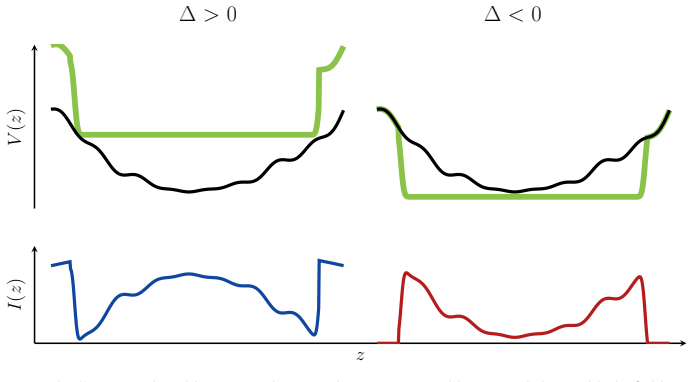
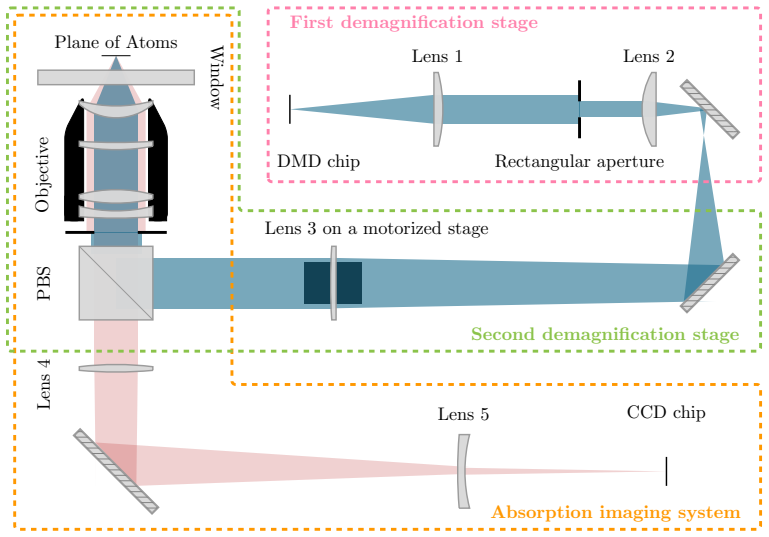
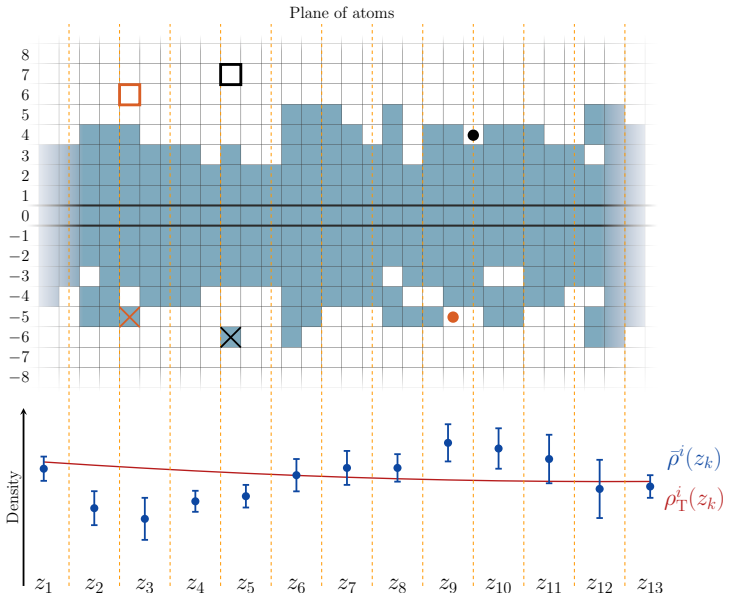
The load-bearing mechanism is the DMD as a binary intensity modulator imaged onto the atoms with spatial averaging and spatial filtering. Because many micro-mirror pixels contribute to each diffraction-limited spot, switching individual pixels in a column changes the local optical potential in small steps, giving quasi-gray-scale one-dimensional potentials. The optimization loop then uses the Thomas–Fermi relation between the one-dimensional density and the total potential, $V(z)=\mu-\frac{g}{2\pi a_\perp^2}\frac{\rho(z)}{\sqrt{1+2a_s\rho(z)}}-\frac{\hbar\omega_\perp}{2}\left(\sqrt{1+2a_s\rho(z)}+\frac{1}{\sqrt{1+2a_s\rho(z)}}\right)$ (Eq. 2), to translate density deviations into pixel updates: where density is too high, pixels are switched on to raise the potential; where too low, outer pixels are shifted away to lower it. The target density itself comes from the non-polynomial Schrödinger equation for each candidate potential.
What would settle it
Toggle on a single DMD super-pixel column and image the density: if the induced density dip appears at more than one longitudinal position, or if toggling pixels in one region shifts density in a distant region by a comparable amount, the local update rule on which the optimization rests is empirically false.
Extended reading notes
Core claim
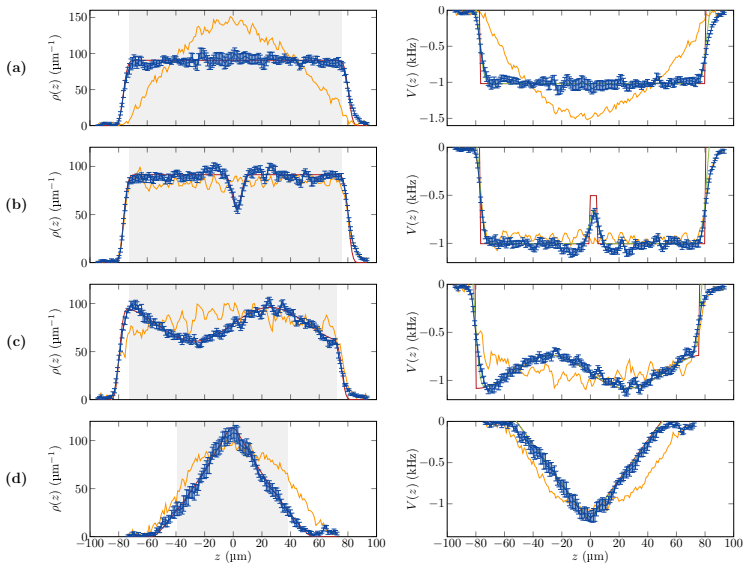
The central claim is that superposing an optical dipole potential, locally shaped by a DMD, on the magnetic confinement of an atom chip yields a robust and versatile method to engineer the longitudinal potential of a one-dimensional Bose gas while preserving the chip's transverse trapping and evaporative cooling. The paper shows that an iterative pattern optimization—comparing the measured one-dimensional density with a target density obtained by solving the one-dimensional non-polynomial Schrödinger equation—converges to target potentials without requiring a precise model of the optical setup. In the demonstrated examples, the final density profiles agree with the target to 4.2–5.9% normalized root-mean-square deviation in the target region, and the achieved patterns stay stable for over six hours. The measured potentials match the target potentials once those targets are broadened by the DMD imaging system.
Load-bearing premise
The update rule assumes that turning DMD pixels on or off changes the potential locally and monotonically lowers or raises the local density, per the Thomas–Fermi relation, with negligible coupling to neighbouring positions.
Editorial extensions
If this is right
- Homogeneous box-like one-dimensional gases remove density inhomogeneity that otherwise masks intrinsic many-body dynamics, enabling cleaner studies of recurrence, thermalization, and transport.
- Barriers inside a box allow longitudinal splitting and tunable tunneling between homogeneous segments, extending the double-well physics already available via radio-frequency dressed states.
- Because DMD patterns can be changed faster than the axial dynamics, the same setup can implement time-dependent potentials and quenches, for example exciting a chosen mode by imprinting its density modulation.
- The autonomous optimization means no detailed optical model is needed: any target potential can be reached from a black screen or from a previous pattern, limited mainly by imaging noise and resolution.
Reading between the lines
- Possible extension: the same density-feedback loop could be ported to other atomic species or to two-dimensional optical potentials, but the Thomas–Fermi locality assumption would degrade and would need stronger spatial filtering or a more global update rule.
- Possible extension: because the DMD refresh rate (17–50 kHz) is far above the axial trap frequencies, stroboscopic or time-averaged patterns could synthesize effective Floquet potentials on the same chip; fast switching is mentioned in the paper but no Floquet experiment is reported.
- Possible consequence: pushing the measurement noise down, for example with higher-resolution imaging, should drive the converged density residuals below the 4–6% level, since the paper's own termination criterion is set by the standard error of the mean density.
Signed reviews
Editorial analysis
A structured set of objections, weighed in public.
Referee Report
Summary. The paper reports an experimental method for shaping the longitudinal potential of a 1D Bose gas on an atom chip by superposing a DMD-shaped, blue-detuned optical dipole potential on the magnetic chip trap. The central technical contribution is an iterative feedback procedure: starting from a measured density profile, the DMD pattern is updated locally so that the measured longitudinal density approaches the NPSE ground-state density of a desired target potential. The authors demonstrate four potentials—a 160 µm box, a double box with a barrier, a box with sinusoidal modulation, and a V-shaped potential—with final density residuals between 4.2% and 5.9%, and they report stability of a box potential for more than six hours. They argue that the method provides flexible and autonomous control of longitudinal confinement for experiments in quantum thermodynamics and quantum simulation.
Significance. If the central claim holds, this is a useful technical advance: it combines the advantages of atom-chip magnetic trapping (fast evaporative cooling, RF dressed-state capabilities) with the flexibility of DMD-shaped optical potentials, and the optimization loop is described in sufficient detail to be reproduced. The paper is honest in reporting convergence curves, error bars, and a stability measurement, and it explicitly describes the calibration and update rules. However, the verification of the central claim is weakened by a circularity: the optimization acts on the density, and the reported potentials are reconstructed from that same density via the Thomas-Fermi relation. The demonstrated density control is convincing, but the claim of arbitrary potential control would be strengthened by an independent cross-check of the realized potential.
major comments (2)
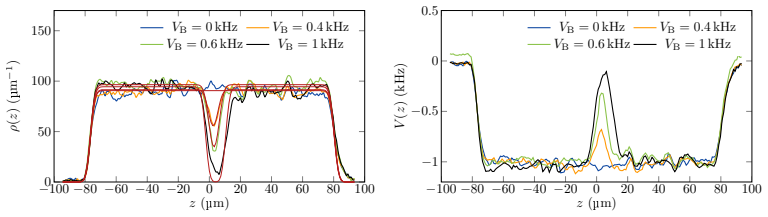
- [§5, Eq. (2), Fig. 7] The reported potential fidelity is not independently verified. The optimization observable is the longitudinal density ρ(z), and the "measured potentials" in Fig. 7 are reconstructed from the same measured density using the Thomas-Fermi relation, Eq. (2). A density match therefore produces an apparent potential match by construction, up to the accuracy of the TF approximation and the assumed chemical potential. The 4.2–5.9% density residuals do not by themselves establish that the realized V(z) equals the target potential, because a pattern that reproduces the target density at the calibration atom number can in principle produce a different potential at other densities. The green "broadened target potentials" in Fig. 7 are a useful consistency check but are not an independent measurement. I recommend adding a cross-check that does not reuse the optimization density: for example, measure the density for the same final DMD pattern at a substantially different atom number and compare with the NPSE ground state of the target potential; a genuine potential match should reproduce the density at both atom numbers. The text should also state explicitly that the plotted potentials are inferred from density, not directly measured.
- [§4, update rule and Fig. 6] The local update rule assumes a monotonic, local relationship between switching DMD pixels and changes in the local density—effectively a diagonally dominant Jacobian with negligible coupling between neighboring 1.05 µm grid points. Given that the imaging PSF has an Airy diameter of 4 µm, neighboring grid points are coupled, and near steep barriers and box edges the local Thomas-Fermi relation itself becomes questionable. The paper shows empirical convergence for four examples, but it does not discuss conditions under which the loop could stall or converge to a density-matching pattern that is not the intended potential. I ask for a brief analysis of this limitation or an additional experimental test: rerun the optimization for the same target starting from different initial patterns and compare the final DMD patterns and density residuals, and comment explicitly on the role of the finite PSF in the update procedure.
minor comments (4)
- [Abstract and §6] The word "arbitrary" overstates the demonstrated capability: the experiment uses only blue-detuned repulsive light, so the optical potential can only add repulsive corrections on top of the magnetic potential. Please qualify the claim (e.g., "shaped repulsive potentials" or "a wide class of one-dimensional potentials") in the abstract and conclusion.
- [Eq. (1)] The normalization factor in Eq. (1) is written as 1/(j−l), but the sum runs from k=j to k=l, so the number of terms is l−j+1. Please check and correct the notation.
- [§3, scattering-rate estimate] The sentence "This leads to only one spontaneous scattering per second for an ensemble of 10^4 atoms" appears inconsistent with the quoted rate of ~2π×0.1 mHz: for 10^4 atoms, this would be on the order of several scattering events per second. Please recheck the numerical estimate.
- [Fig. 10] The text says the stability check exceeds six hours, while the horizontal axis of Fig. 10(a) extends to 500 minutes (about 8.3 hours). Please align the stated time span with the plotted data or adjust the axis.
Circularity Check
Measured potentials are reconstructed from the same density used for optimization, so potential agreement is partly self-referential; overall feedback-control demonstration remains largely self-contained.
-
self definitional
[Sec. 5, Eq. (2) and Fig. 7 (cf. Sec. 4 optimization target, Eq. (1))]
"The initial and final potentials, plotted in Fig. 7, are obtained using the NPSE for 1D condensates. In the limit where the kinetic energy of motion in z-direction is neglected (Thomas-Fermi approximation), the solution for the stationary state reads: ... (2). Here, ρ(z) is the measured 1D density ... Although this measured potential is not used in the optimization process, a qualitative comparison between the measured potential and the target potential is instructive."
The optimization cost function (Eq. 1) and the DMD update rule in Sec. 4 operate on the longitudinal density ρ(z_k), driving the measured density to the NPSE target density of the desired potential. The 'measured potentials' shown in Fig. 7 are then obtained by applying Eq. (2) to that same measured density, with the chemical potential only an offset. Hence the potential curves are not an independent measurement of the optical potential; they are a deterministic re-expression of the same density that was already optimized. Up to the validity of the Thomas-Fermi relation, any density match automatically yields an apparent potential match, so the quoted 4.2-5.9% density residuals cannot by themselves certify that the actual optical potential equals the target.
full rationale
The paper is primarily an experimental feedback-control demonstration: a DMD pattern is iteratively updated until the measured 1D density matches the NPSE ground-state density of a desired potential. That loop is self-contained and uses fresh experimental data at each iteration, so the density residuals (4.2-5.9%) are a meaningful demonstration of density control. The principal circular strand is the potential verification: the "measured potentials" in Fig. 7 are obtained from Eq. (2), which inverts the very density that the optimization was designed to match. Consequently, the apparent agreement between measured and target potentials is partly built into the density agreement and does not independently confirm that the optical potential itself equals the target. The paper explicitly notes that this reconstructed potential is not used in the optimization and calls the comparison qualitative, which mitigates the issue but does not remove it. There is no load-bearing self-citation: references to the authors' prior work concern atom-chip apparatus, absorption imaging, and recurrence experiments, all background techniques rather than premises that force the conclusion. No uniqueness theorem is imported, and no ansatz is smuggled in via citation. The weakness is an independent-validation gap: a quantitative cross-check that does not reuse the optimization density (e.g., atom-number scaling or a direct potential probe) would settle whether the potential claim is fully verified. This warrants a moderate-low circularity score of 2, not a higher score, because the central control demonstration has independent content and the circular element is confined to the potential-reconstruction evidence.
Assumptions & free parameters
assumptions (6)
- domain assumption V_dip(r) proportional to sgn(omega - omega_0) I(r) for a far-detuned optical field.
- domain assumption The 1D Bose gas is described by the non-polynomial Schrödinger equation; Eq. (2) inverts the Thomas-Fermi density to obtain the longitudinal potential.
- domain assumption Local monotonic Thomas-Fermi relation: increasing the local potential decreases the local 1D density.
- domain assumption DMD time averaging faster than atomic dynamics creates an effective time-averaged potential.
- domain assumption The longitudinal density profile is preserved during 1-3 ms time-of-flight imaging.
- domain assumption The DMD imaging system acts as a linear, shift-invariant system with a 4 micron Airy diameter point-spread function.
Cite this review
Pith. "Pith review of Designing Arbitrary One-dimensional Potentials on an Atom Chip." pith.science (2026). https://pith.science/paper/DLEEOOCK
@misc{pith2026190801563,
  author       = {Pith},
  title        = {Pith review of: Designing Arbitrary One-dimensional Potentials on an Atom Chip},
  year         = {2026},
  howpublished = {\url{https://pith.science/paper/DLEEOOCK}},
  note         = {Machine review of arXiv:1908.01563}
}
abstract
We use laser light shaped by a digital micro-mirror device to realize arbitrary optical dipole potentials for one-dimensional (1D) degenerate Bose gases of 87Rb trapped on an atom chip. Superposing optical and magnetic potentials combines the high flexibility of optical dipole traps with the advantages of magnetic trapping, such as effective evaporative cooling and the application of radio-frequency dressed state potentials. As applications, we present a 160 ${\mu}$m long box-like potential with a central tuneable barrier, a box-like potential with a sinusoidally modulated bottom and a linear confining potential. These potentials provide new tools to investigate the dynamics of 1D quantum systems and will allow us to address exciting questions in quantum thermodynamics and quantum simulations.
Figures


Figures from the paper (7 more)



Reference graph
Works this paper leans on
-
[1]
Many-body physics with ultracold gases,
I. Bloch, J. Dalibard, and W. Zwerger, “Many-body physics with ultracold gases,” Rev. Mod. Phys.80, 885–964 (2008)
2008
-
[2]
Ultracold atoms out of equilibrium,
T. Langen, R. Geiger, and J. Schmiedmayer, “Ultracold atoms out of equilibrium,” Annu. Rev. Condens. Matter Phys. 6, 201–217 (2015)
work page 2015
-
[3]
Bose-einstein condensation of atoms in a uniform potential,
A. L. Gaunt, T. F. Schmidutz, I. Gotlibovych, R. P. Smith, and Z. Hadzibabic, “Bose-einstein condensation of atoms in a uniform potential,” Phys. Rev. Lett.110, 200406 (2013)
2013
-
[4]
Two-Dimensional Homogeneous Fermi Gases,
K. Hueck, N. Luick, L. Sobirey, J. Siegl, T. Lompe, and H. Moritz, “Two-Dimensional Homogeneous Fermi Gases,” Phys. Rev. Lett.120, 060402 (2018)
work page 2018
-
[5]
Homogeneous Atomic Fermi Gases,
B. Mukherjee, Z. Yan, P. B. Patel, Z. Hadzibabic, T. Yefsah, J. Struck, and M. W. Zwierlein, “Homogeneous Atomic Fermi Gases,” Phys. Rev. Lett.118, 123401 (2017)
work page 2017
-
[6]
Recurrences in an isolated quantum many-body system,
B. Rauer, S. Erne, T. Schweigler, F. Cataldini, M. Tajik, and J. Schmiedmayer, “Recurrences in an isolated quantum many-body system,” Science360, 307 (2018)
work page 2018
-
[7]
Sound Propagation in a Uniform Superfluid Two-Dimensional Bose Gas,
J. L. Ville, R. Saint-Jalm, É. Le Cerf, M. Aidelsburger, S. Nascimbène, J. Dalibard, and J. Beugnon, “Sound Propagation in a Uniform Superfluid Two-Dimensional Bose Gas,” Phys. Rev. Lett.121, 145301 (2018)
work page 2018
-
[8]
Realization of a Sonic Black Hole Analog in a Bose-Einstein Condensate,
O. Lahav, A. Itah, A. Blumkin, C. Gordon, S. Rinott, A. Zayats, and J. Steinhauer, “Realization of a Sonic Black Hole Analog in a Bose-Einstein Condensate,” Phys. Rev. Lett.105, 240401 (2010)
work page 2010
Show all 38 references
-
[9]
Observation of quantum Hawking radiation and its entanglement in an analogue black hole,
J. Steinhauer, “Observation of quantum Hawking radiation and its entanglement in an analogue black hole,” Nat. Phys. 12, 959–965 (2016)
2016
-
[10]
Microscopy of the interacting harper-hofstadter model in the two-body limit,
M. E. Tai, A. Lukin, M. Rispoli, R. Schittko, T. Menke, D. Borgnia, P. M. Preiss, F. Grusdt, A. M. Kaufman, and M. Greiner, “Microscopy of the interacting harper-hofstadter model in the two-body limit,” Nature546, 519 EP – (2017)
2017
-
[11]
Opticaldipoletrapsforneutralatoms,
R.Grimm,M.WeidemÃijller,andY.B.Ovchinnikov,“Opticaldipoletrapsforneutralatoms,”in Advances In Atomic, Molecular, and Optical Physics, vol. 42 B. Bederson and H. Walther, eds. (Academic Press, 2000), pp. 95 – 170
2000
-
[12]
Direct imaging of a digital-micromirror device for configurable microscopic optical potentials,
G. Gauthier, I. Lenton, N. M. Parry, M. Baker, M. J. Davis, H. Rubinsztein-Dunlop, and T. W. Neely, “Direct imaging of a digital-micromirror device for configurable microscopic optical potentials,” Optica3, 1136–1143 (2016)
2016
-
[13]
Roton-maxon excitation spectrum of bose condensates in a shaken optical lattice,
L.-C. Ha, L. W. Clark, C. V. Parker, B. M. Anderson, and C. Chin, “Roton-maxon excitation spectrum of bose condensates in a shaken optical lattice,” Phys. Rev. Lett.114, 055301 (2015)
2015
-
[15]
Relaxation dynamics in the merging ofn independent condensates,
M. Aidelsburger, J. L. Ville, R. Saint-Jalm, S. Nascimbène, J. Dalibard, and J. Beugnon, “Relaxation dynamics in the merging ofn independent condensates,” Phys. Rev. Lett.119, 190403 (2017)
2017
-
[16]
Microscopic atom optics: From wires to an atom chip,
R. Folman, P. Krüger, J. Schmiedmayer, J. Denschlag, and C. Henkel, “Microscopic atom optics: From wires to an atom chip,” inAdvances In Atomic, Molecular, and Optical Physics, vol. 48 B. Bederson and H. Walther, eds. (Academic Press, 2002), pp. 263 – 356
2002
-
[17]
Trapping and manipulating atoms on chips,
J. Reichel, “Trapping and manipulating atoms on chips,” inAtom Chips, J. Reichel and V. Vuletić, eds. (Wiley-VCH Verlag GmbH & Co. KGaA, 2011), chap. 2, pp. 33–60
2011
-
[18]
Atomic Micromanipulation with Magnetic Surface Traps,
J. Reichel, W. Hänsel, and T. W. Hänsch, “Atomic Micromanipulation with Magnetic Surface Traps,” Phys. Rev. Lett. 83, 3398–3401 (1999)
1999
-
[19]
Controlling cold atoms using nanofabricated surfaces: Atom chips,
R. Folman, P. Krüger, D. Cassettari, B. Hessmo, T. Maier, and J. Schmiedmayer, “Controlling cold atoms using nanofabricated surfaces: Atom chips,” Phys. Rev. Lett.84, 4749–4752 (2000)
2000
-
[20]
Trapping and manipulating neutral atoms with electrostatic fields,
P. Kruger, X. Luo, M. Klein, K. Brugger, A. Haase, S. Wildermuth, S. Groth, I. Bar-Joseph, R. Folman, and J. Schmiedmayer, “Trapping and manipulating neutral atoms with electrostatic fields,” Phys. Rev. Lett.91 (2003)
2003
-
[21]
Optical lattice on an atom chip,
D. Gallego, S. Hofferberth, T. Schumm, P. Krüger, and J. Schmiedmayer, “Optical lattice on an atom chip,” Opt. Lett. 34, 3463 (2009)
2009
-
[22]
Radiofrequency-dressed-state potentials for neutral atoms,
S. Hofferberth, I. Lesanovsky, B. Fischer, J. Verdu, and J. Schmiedmayer, “Radiofrequency-dressed-state potentials for neutral atoms,” Nat Phys2, 710–716 (2006)
2006
-
[23]
Potential roughness near lithographically fabricated atom chips,
P. Krüger, L. M. Andersson, S. Wildermuth, S. Hofferberth, E. Haller, S. Aigner, S. Groth, I. Bar-Joseph, and J. Schmiedmayer, “Potential roughness near lithographically fabricated atom chips,” Phys. Rev. A76, 063621 (2007)
2007
-
[24]
Bose-Einstein condensates - Microscopic magnetic-field imaging,
S. Wildermuth, S. Hofferberth, I. Lesanovsky, E. Haller, L. Andersson, S. Groth, I. Bar-Joseph, P. Kruger, and J. Schmiedmayer, “Bose-Einstein condensates - Microscopic magnetic-field imaging,” Nature435, 440 (2005)
2005
-
[25]
Sensing electric and magnetic fields with bose-einstein condensates,
S. Wildermuth, S. Hofferberth, I. Lesanovsky, S. Groth, P. KrÃijger, J. Schmiedmayer, and I. Bar-Joseph, “Sensing electric and magnetic fields with bose-einstein condensates,” Appl. Phys. Lett.88, 264103 (2006)
2006
-
[26]
Long-range order in electronic transport through disordered metal films,
S. Aigner, L. Della Pietra, Y. Japha, O. Entin-Wohlman, T. David, R. Salem, R. Folman, and J. Schmiedmayer, “Long-range order in electronic transport through disordered metal films,” Science319, 1226–1229 (2008)
2008
-
[27]
Scanning Quantum Cryogenic Atom Microscope,
F. Yang, A. J. Kollár, S. F. Taylor, R. W. Turner, and B. L. Lev, “Scanning Quantum Cryogenic Atom Microscope,” Phys. Rev. Appl.7, 034026 (2017)
2017
-
[28]
Motion in rapidly oscillating field, pp
L.D.LandauandE.M.Lifshitz, Mechanics(Butterworth-Heinemann, 1976),vol.1of Courses of theoretical physics, chap. Motion in rapidly oscillating field, pp. 93–95
1976
-
[29]
Bose–einstein condensation in large time-averaged optical ring potentials,
T. A. Bell, J. A. P. Glidden, L. Humbert, M. W. J. Bromley, S. A. Haine, M. J. Davis, T. W. Neely, M. A. Baker, and H. Rubinsztein-Dunlop, “Bose–einstein condensation in large time-averaged optical ring potentials,” New J. Phys.18, 035003 (2016)
2016
-
[30]
Ultra-preciseholographic beam shaping for microscopic quantum control,
P.Zupancic,P.M.Preiss,R.Ma,A.Lukin,M.E.Tai,M.Rispoli,R.Islam,andM.Greiner,“Ultra-preciseholographic beam shaping for microscopic quantum control,” Opt. Express24, 13881–13893 (2016)
2016
-
[31]
Prethermalizationinanisolatedmanybodysystem,
M.Gring,“Prethermalizationinanisolatedmanybodysystem,”Ph.D.thesis,TechnicalUniversityofVienna,Faculty of Physics (2012)
2012
-
[32]
Absorption imaging of ultracold atoms on atom chips,
D.A.Smith,S.Aigner,S.Hofferberth,M.Gring,M.Andersson,S.Wildermuth,P.Krüger,S.Schneider,T.Schumm, and J. Schmiedmayer, “Absorption imaging of ultracold atoms on atom chips,” Opt. Express19, 8471–8485 (2011)
2011
-
[33]
Correlations and dynamics of tunnel-coupled one-dimensional bose gases,
T. Schweigler, “Correlations and dynamics of tunnel-coupled one-dimensional bose gases,” Ph.D. thesis, Techniche Universität Wien, Fakultät für Physik (2019)
2019
-
[34]
Density ripples in expanding low-dimensional gases as a probe of correlations,
A. Imambekov, I. E. Mazets, D. S. Petrov, V. Gritsev, S. Manz, S. Hofferberth, T. Schumm, E. Demler, and J. Schmiedmayer, “Density ripples in expanding low-dimensional gases as a probe of correlations,” Phys. Rev. A80, 033604 (2009)
2009
-
[35]
Two-point density correlations of quasicondensates in free expansion,
S. Manz, R. Bücker, T. Betz, C. Koller, S. Hofferberth, I. E. Mazets, A. Imambekov, E. Demler, A. Perrin, J. Schmiedmayer, and T. Schumm, “Two-point density correlations of quasicondensates in free expansion,” Phys. Rev. A 81, 031610 (2010)
2010
-
[36]
Projective phase measurements in one-dimensional Bose gases,
Y. D. van Nieuwkerk, J. Schmiedmayer, and F. H. L. Essler, “Projective phase measurements in one-dimensional Bose gases,” SciPost Phys.5, 46 (2018)
2018
-
[37]
Roughness suppression via rapid current modulation on an atom chip,
J.-B. Trebbia, C. L. Garrido Alzar, R. Cornelussen, C. I. Westbrook, and I. Bouchoule, “Roughness suppression via rapid current modulation on an atom chip,” Phys. Rev. Lett.98, 263201 (2007)
2007
-
[38]
Effective wave equations for the dynamics of cigar-shaped and disk-shaped bose condensates,
L. Salasnich, A. Parola, and L. Reatto, “Effective wave equations for the dynamics of cigar-shaped and disk-shaped bose condensates,” Phys. Rev. A65, 043614 (2002)
2002
-
[39]
One-dimensional atomic superfluids as a model system for quantum thermodynamics,
J. Schmiedmayer, “One-dimensional atomic superfluids as a model system for quantum thermodynamics,” in Thermodynamics in the Quantum Regime: Fundamental Aspects and New Directions, F. Binder, L. A. Correa, C. Gogolin, J. Anders, and G. Adesso, eds. (Springer International Publi...
2018
Reviewed August 14, 2026 · model on record in the stance chip above.
Discussion (0). Continue with ORCID to comment.