REVIEW 4 major objections 5 minor 44 references
Blind SAR Image Despeckling Using Self-Supervised Dense Dilated Convolutional Neural Network
T0 review · 4 major / 5 minor · reviewed 2026-08-14 · deepseek-v4-flash
Pith's one-line read Training a SAR despeckling network on pairs of independent speckled images, with no clean ground truth, reaches the same L2 optimum as supervised training because speckle has unit mean.
desk verdict A mostly sound Noise2Noise-for-SAR paper with strong synthetic results, but the blind-despeckling claim hinges on the unstated intensity-vs-amplitude data type. read the letter →
The pith
A machine-rendered reading of the paper's core claim, the machinery that carries it, and where it could break.
The reading
What carries the argument
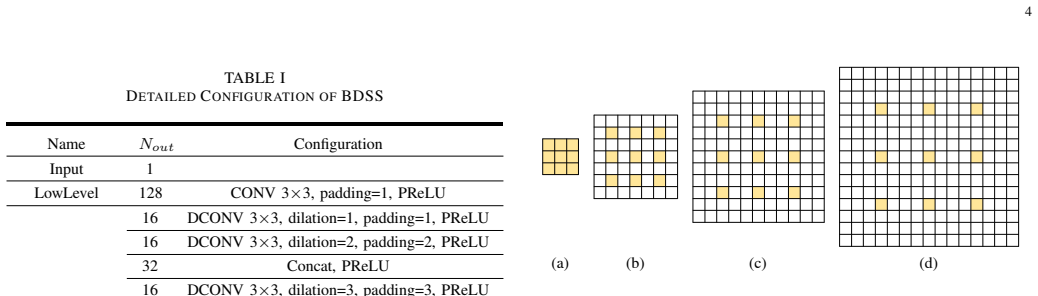
The load-bearing identity is the unit-mean property of SAR speckle: for $y'=n'x$ with $\mathbb{E}\{n'\}=1$, we get $\mathbb{E}\{y'\}=x$. This converts a noisy target into a clean target in expectation under L2 loss. The carrying architecture is BDSS, a fully convolutional network of three enhanced dense blocks in which each layer's feature maps are concatenated with all preceding layers and 3x3 dilated convolutions with dilation factors 1, 2, 3, and 4 enlarge the field of view without adding parameters; batch normalization is removed and PReLU replaces ReLU. The dense connectivity propagates gradients and reuses features while the dilated kernels supply context for reconstructing pixels, and the network is trained on pairs of independently corrupted SAR-like images with no clean reference.
What would settle it
Take a static scene imaged twice with independent speckle, train BDSS on pairs of these two looks, then apply it to a third look and compare the output with the sample average of many looks; a systematic bias or residual speckle variance much larger than $1/L$ would show that the unit-mean independence premise fails.
Extended reading notes
Core claim
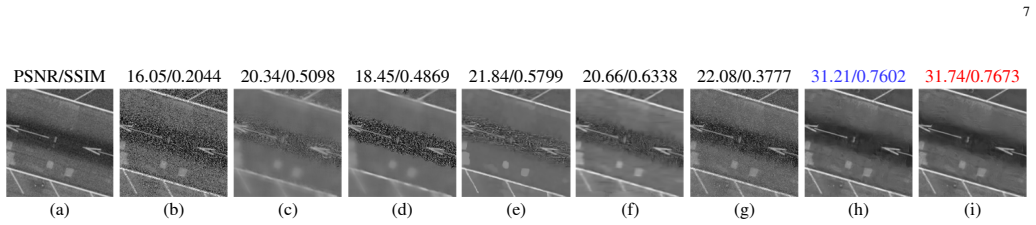
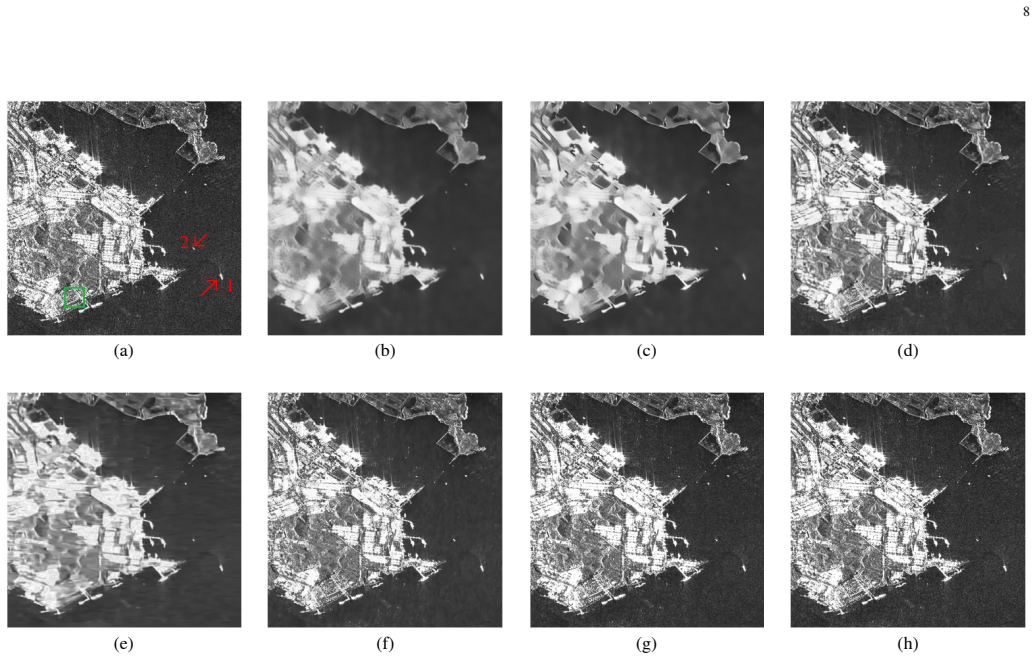
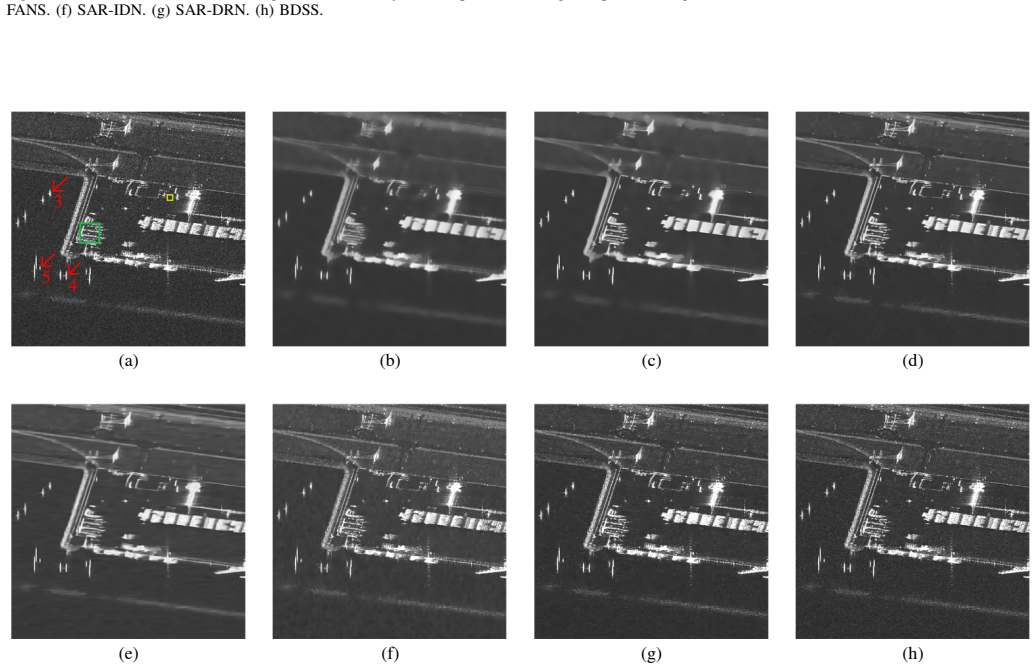
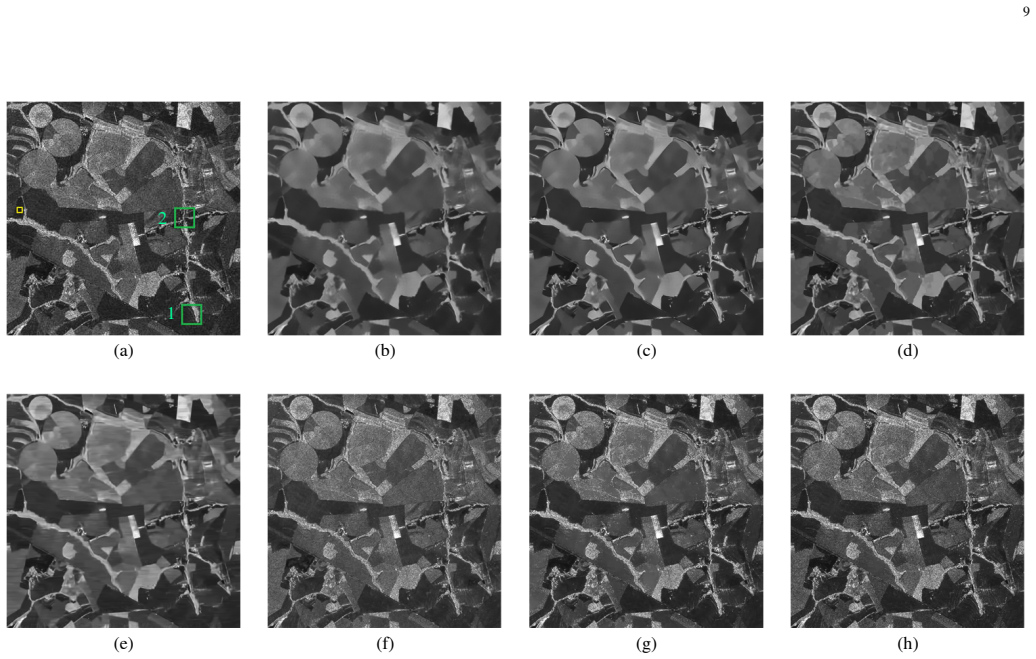
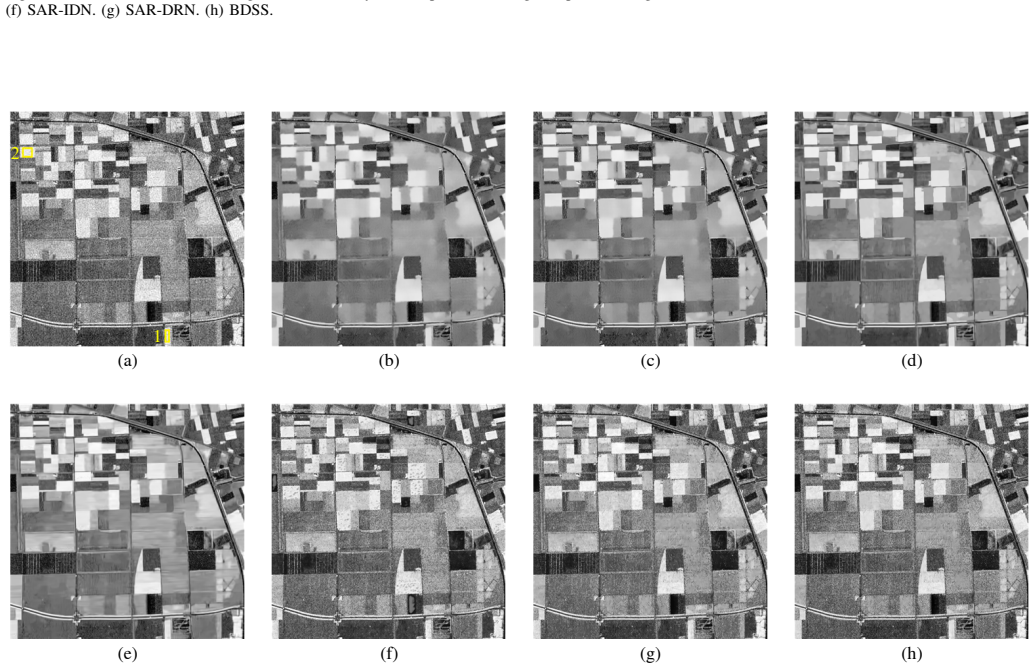
The paper's central claim is that the self-supervised objective $\arg\min_\theta \mathbb{E}_{(y,y')}\{(f_\theta(y)-y')^2\}$ has the same minimizer as the supervised objective $\arg\min_\theta \mathbb{E}_{(y,x)}\{(f_\theta(y)-x)^2\}$, provided the speckle measurements $y$ and $y'$ are independent draws conditioned on the same underlying scene $x$ and the speckle noise has unit mean. Under the standard multiplicative model $y=nx$ with Gamma-distributed $n$, the conditional mean satisfies $\mathbb{E}\{y'\}=x$, making equations (4) and (6) equivalent. The paper reports that the resulting network, BDSS, trained only on pairs of SAR-like noisy images, attains the best PSNR and SSIM on synthetic speckled test images among the compared methods, including the supervised SAR-DRN, and on real SAR images from four sensors it best preserves edges, point targets, and radiometric mean while suppressing speckle. Blindness follows from construction: the network is trained across a range of looks, so the number of looks of the input need not be known in advance.
Load-bearing premise
The argument assumes that the two speckled images used as input and target are independent speckle realizations of the same underlying scene, so that their pixelwise average equals the clean scene; if real speckle is correlated between looks, the scenes differ between looks, or the synthetic SAR-like training images do not represent real SAR statistics, the learned output need not be the clean image.
Editorial extensions
If this is right
- Training data for SAR despeckling no longer needs clean ground truth; paired speckled images of static scenes can serve directly as training pairs.
- The number of looks does not need to be estimated or supplied, so the method applies to images from sensors with unknown or variable looks.
- A network trained this way can outperform a supervised network trained on the same inputs with clean optical targets, according to the reported PSNR and SSIM comparisons.
- Feature preservation is improved relative to classical filters: edges, point targets, and radiometric mean are retained better than with PPB, SAR-BM3D, or FANS in the reported real-image indexes.
- Because the L2 optimum depends only on the conditional mean, the learned mapping is independent of the particular look value used to corrupt the training targets.
Reading between the lines
- If the unit-mean independence assumption holds, the same training recipe should transfer to other multiplicative noise settings, such as ultrasound or optical coherence tomography, wherever paired noisy observations of a static scene can be obtained.
- A direct stress test would train BDSS on two truly independent looks of the same real scene and compare the output with the multi-look average; systematic bias would reveal correlated speckle or scene change between looks.
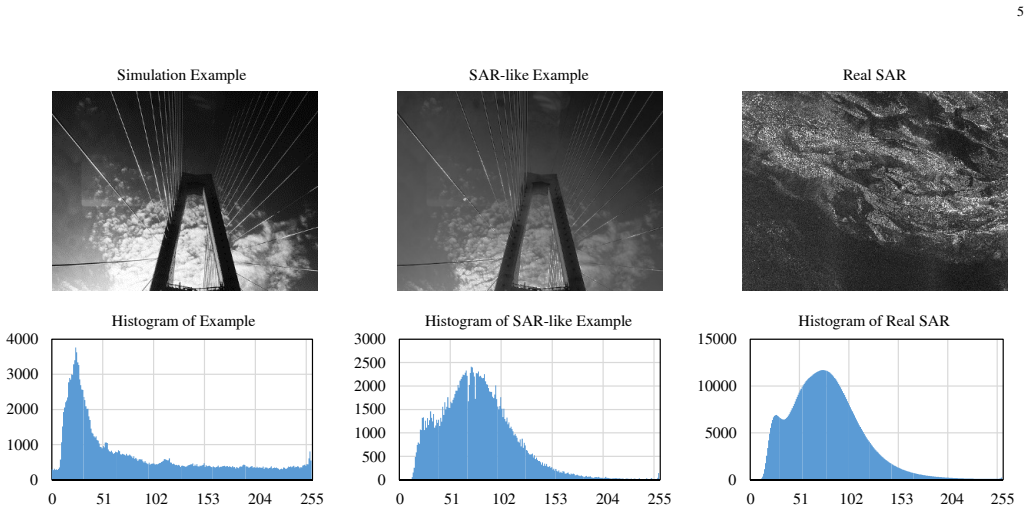
- The paper's synthetic training set is built by a histogram-shaped transform of optical images; if that transform misses higher-order speckle statistics or texture-dependent noise, real-data performance could degrade in regimes not covered by the reported examples.
- Blindness here is blindness to the number of looks, not to scene content; applying the approach to non-stationary scenes or moving targets would require the independence assumption to be checked locally.
Signed reviews
Editorial analysis
A structured set of objections, weighed in public.
Referee Report
Summary. The paper proposes BDSS, a self-supervised convolutional network for blind SAR image despeckling. Following the Noise2Noise principle, the network is trained on pairs of independent speckled realizations (y, y') of the same scene using L2 loss, so that no clean ground truth is needed. The authors argue that because SAR speckle has unit mean, the conditional expectation of the noisy target equals the clean image, making the self-supervised objective equivalent to the supervised one. The network architecture uses three enhanced dense blocks with dilated convolutions. Experiments are conducted on synthetic speckled images (with PSNR/SSIM metrics) and on real SAR images from four sensors (with ENL, EPD-ROA, TCR, and MOR metrics), and the results are compared with classical and CNN-based despeckling methods. The paper also reports a blind-despeckling experiment with random looks.
Significance. The paper addresses a relevant problem, since clean SAR data are rarely available for supervised training. The proposed self-supervised formulation is theoretically sound under the intensity-speckle model with unit-mean Gamma noise, and it is not circular: it relies on independent noisy targets and the unit-mean property, which are external statistical facts. The synthetic experiments support the main claim and show competitive PSNR/SSIM values, and the real-data results are promising. If the identified assumptions are clarified and the experimental comparisons are made more rigorous, this could be a useful contribution to SAR despeckling. However, the load-bearing derivation relies on assumptions that are not verified for the real data, and several experimental claims are not yet fully supported.
major comments (4)
- [II-B, III-C] The minimizer of the L2 loss in Eq. (5) is the conditional expectation E[y' | y], not the unconditional E{y'} printed in Eq. (6). Consequently, Eq. (7) is only justified when E[n' | y] = 1, i.e., when the target speckle has conditional unit mean given the input. This holds for intensity SAR with independent unit-mean Gamma speckle, but not for amplitude SAR: an L-look amplitude image has mean Gamma(L+1/2)/(Gamma(L) sqrt(L)) (e.g., about 0.886 for L=1), approaching 1 only as L grows. The paper never states whether the real SAR images in Section III-C (Sentinel-1, TerraSAR, ALOS-2, AIRSAR) are intensity or amplitude. The synthetic experiments are intensity-consistent, so they cannot reveal a systematic bias. The authors must either confirm the intensity format of the real test images or adapt the derivation and loss to the appropriate data type.
- [III-B, Tables II and VII] The comparison with supervised SAR-DRN is confounded by architecture differences, since BDSS and SAR-DRN differ in network structure (dense blocks with dilated convolutions vs. dilated residual network), depth, and objective. The observed PSNR/SSIM improvements of BDSS over SAR-DRN (e.g., 28.45 vs. 27.91 at L=1 in Table II) cannot be attributed to the self-supervised training strategy alone. To support the claim that self-supervised learning equals or surpasses supervised learning, the authors should train the same architecture with clean targets as a supervised control, or otherwise isolate the effect of the training objective.
- [III-B, Table VII] The experimental results are reported as averages over test images, but no standard deviations, error bars, or significance tests are provided. The differences between BDSS and SAR-DRN are small (e.g., 0.4 dB PSNR at L=1 and 0.0112 SSIM in Table VII), so it is unclear whether they are statistically meaningful. Since the paper claims state-of-the-art performance, the authors should report the variability across the test set and, ideally, a paired significance test over the 360 images.
- [III-A1] The SAR-like training dataset is generated from ImageNet images using a histogram transformation that is described only as 'mainly referring to histograms of SAR images.' This is too vague to reproduce the dataset or to assess its statistical representativeness of real SAR data. Because the real-data despeckling performance depends entirely on this synthetic training distribution, the paper should specify the transformation (e.g., histogram matching with a chosen reference SAR distribution) and provide quantitative similarity measures between the transformed images and real SAR images.
minor comments (5)
- [II-C2, Eq. (12)] The receptive field formula in Eq. (12) is incorrect. For a kernel of size r with dilation factor l, the receptive field is ((r-1)l + 1) x ((r-1)l + 1), i.e., 5x5, 7x7, and 9x9 for 3x3 kernels with dilations 2, 3, and 4, respectively, not 7x7, 11x11, and 15x15 as stated in the text around Fig. 4.
- [III-A2] The description 'L = rand [1, +∞)' is ambiguous and not implementable; the authors should specify how the number of looks is sampled during training (e.g., uniform over a finite range, log-uniform, etc.).
- [II-B] The sentence 'both the inputs y and the targets y\' are drawn from a corrupted distribution (not the same) conditioned on the underlying' is unclear; it should state that y and y\' are conditionally independent given x, with the same conditional distribution.
- [II-B, Eq. (6)] Equation (6) should write f_theta(y) = E[y' | y] rather than E{y'}, since the right-hand side otherwise appears independent of y.
- [III-A2] The claim that removing batch normalization improves despeckling ability is presented without an ablation study or citation to a controlled comparison; adding an ablation would strengthen the architecture section.
Circularity Check
No circularity: the self-supervised equivalence is an externally cited Noise2Noise result applied under stated Gamma unit-mean speckle assumptions.
full rationale
The paper's core derivation in Section II-B is not circular. The claim is that, for L2 loss, training with a second speckled observation y' as target has the same optimum as training with clean x, because multiplicative speckle has unit mean. This is exactly the external Noise2Noise theorem of Lehtinen et al. [25], which the paper explicitly cites, instantiated for the stated Gamma unit-mean multiplicative model of Eqs. (1)-(2). No parameter is fitted to the data and then renamed a prediction: the network is trained on pairs of independently corrupted versions of the same underlying image, and the unit-mean property supplies the external statistical justification. The SAR-like training set is constructed from ImageNet plus simulated speckle, not from the test outputs. There are no self-citations carrying a load-bearing argument, and no equation in the paper reduces by construction to its own input. The manuscript's weak points concern correctness of the conditional-expectation step and intensity versus amplitude speckle statistics, which are assumption violations rather than circularity. Under the stated intensity/Gamma model, the self-supervised objective is an independent application of a known external result.
Assumptions & free parameters
free parameters (2)
- SAR-like intensity transformation parameters
- Dilation schedule and number of dense blocks =
dilations 1,2,3,4,4,3,2,1; 3 blocks
assumptions (4)
- domain assumption Multiplicative speckle model y = nx with n Gamma distributed with unit mean and variance 1/L (Eqs. 1-2).
- domain assumption The two noisy observations y and y' are conditionally independent given the underlying scene x.
- standard math For L2 loss, the optimal predictor is the conditional expectation E[y'|y].
- ad hoc to paper The synthetic SAR-like training distribution is representative of real SAR statistics.
Cite this review
Pith. "Pith review of Blind SAR Image Despeckling Using Self-Supervised Dense Dilated Convolutional Neural Network." pith.science (2026). https://pith.science/paper/6GJER43Z
@misc{pith2026190801608,
  author       = {Pith},
  title        = {Pith review of: Blind SAR Image Despeckling Using Self-Supervised Dense Dilated Convolutional Neural Network},
  year         = {2026},
  howpublished = {\url{https://pith.science/paper/6GJER43Z}},
  note         = {Machine review of arXiv:1908.01608}
}
read the original abstract
Despeckling is a key and indispensable step in SAR image preprocessing, existing deep learning-based methods achieve SAR despeckling by learning some mappings between speckled (different looks) and clean images. However, there exist no clean SAR image in the real world. To this end, in this paper, we propose a self-supervised dense dilated convolutional neural network (BDSS) for blind SAR image despeckling. Proposed BDSS can still learn to suppress speckle noise without clean ground truth by optimized for L2 loss. Besides, three enhanced dense blocks with dilated convolution are employed to improve network performance. The synthetic and real-data experiments demonstrate that proposed BDSS can achieve despeckling effectively while maintaining well features such as edges, point targets, and radiometric. At last, we demonstrate that our proposed BDSS can achieve blind despeckling excellently, i.e., do not need to care about the number of looks.
Figures



Figures from the paper (10 more)



Reference graph
Works this paper leans on
-
[1]
Sea ice type maps from alaska synthetic aperture radar facility imagery: An assessment,
F. M. Fetterer, D. Gineris, and R. Kwok, “Sea ice type maps from alaska synthetic aperture radar facility imagery: An assessment,” J. Geophys. Res. Oceans , vol. 99, no. C11, pp. 22 443–22 458, 1994
work page 1994
-
[2]
F. Bovolo, C. Marin, and L. Bruzzone, “A hierarchical approach to change detection in very high resolution SAR images for surveillance applications,” IEEE Trans. Geosci. Remote Sens. , vol. 51, no. 4, pp. 2042–2054, Apr. 2013
work page 2013
-
[3]
A review of speckle filtering in the context of estimation theory,
R. Touzi, “A review of speckle filtering in the context of estimation theory,” IEEE Trans. Geosci. Remote Sens. , vol. 40, no. 11, pp. 2392– 2404, Nov. 2002
work page 2002
-
[4]
Statistical modeling of SAR images: A survey,
G. Gao, “Statistical modeling of SAR images: A survey,” Sensors, vol. 10, no. 1, pp. 775–795, Jan. 2010
work page 2010
-
[5]
A tutorial on speckle reduction in synthetic aperture radar images,
F. Argenti, A. Lapini, T. Bianchi, and L. Alparone, “A tutorial on speckle reduction in synthetic aperture radar images,” IEEE Geosci. Remote Sens. Mag. , vol. 1, no. 3, pp. 6–35, Sep. 2013
work page 2013
-
[6]
Digital image enhancement and noise filtering by use of local statistics,
J.-S. Lee, “Digital image enhancement and noise filtering by use of local statistics,” IEEE Trans. Pattern Anal. Mach. Intell. , vol. PAMI-2, no. 2, pp. 165–168, Mar. 1980. 12
work page 1980
-
[7]
Scattering-model-based speckle filtering of polarimetric SAR data,
Jong-Sen L, M. Grunes, D. Schuler, E. Pottier, and L. Ferro-Famil, “Scattering-model-based speckle filtering of polarimetric SAR data,” IEEE Trans. Geosci. Remote Sens. , vol. 44, no. 1, pp. 176–187, Jan. 2006
work page 2006
-
[8]
A model for radar images and its application to adaptive digital filtering of multiplicative noise,
V . S. Frost, J. A. Stiles, K. S. Shanmugan, and J. C. Holtzman, “A model for radar images and its application to adaptive digital filtering of multiplicative noise,” IEEE Trans. Pattern Anal. Mach. Intell. , vol. PAMI-4, no. 2, pp. 157–166, Mar. 1982
work page 1982
Show all 44 references
-
[9]
Adaptive restoration of images with speckle,
D. Kuan, A. Sawchuk, T. Strand, and P. Chavel, “Adaptive restoration of images with speckle,” IEEE Trans. Acoust. , vol. 35, no. 3, pp. 373–383, Mar. 1987
1987
-
[10]
Structure detection and statistical adaptive speckle filtering in SAR images,
A. Lopes, E. Nezry, R. Touzi, and H. Laur, “Structure detection and statistical adaptive speckle filtering in SAR images,”Int. J. Remote Sens., vol. 14, no. 9, pp. 1735–1758, Jun. 1993
1993
-
[11]
Nonlocal filtering for polarimetric SAR data: A pretest approach,
J. Chen, Y . Chen, W. An, Y . Cui, and J. Yang, “Nonlocal filtering for polarimetric SAR data: A pretest approach,” IEEE Trans. Geosci. Remote Sensing , vol. 49, no. 5, pp. 1744–1754, May 2011
2011
-
[12]
Robust polarimetric SAR despeckling based on nonlocal means and distributed lee filter,
Hua Zhong, Jingjing Zhang, and Ganchao Liu, “Robust polarimetric SAR despeckling based on nonlocal means and distributed lee filter,” IEEE Trans. Geosci. Remote Sensing , vol. 52, no. 7, pp. 4198–4210, Jul. 2014
2014
-
[13]
Nonlocal means filter for polarimetric SAR data despeckling based on discriminative similarity measure,
G. Liu and H. Zhong, “Nonlocal means filter for polarimetric SAR data despeckling based on discriminative similarity measure,” IEEE Geosci. Remote Sens. Lett. , vol. 11, no. 2, pp. 514–518, Feb. 2014
2014
-
[14]
NL- SAR: A unified nonlocal framework for resolution-preserving PolInSAR denoising,
C.-A. Deledalle, L. Denis, F. Tupin, A. Reigber, and M. Jager, “NL- SAR: A unified nonlocal framework for resolution-preserving PolInSAR denoising,” IEEE Trans. Geosci. Remote Sens. , vol. 53, no. 4, pp. 2021– 2038, Apr. 2015
2021
-
[15]
Image denoising by sparse 3-D transform-domain collaborative filtering,
K. Dabov, A. Foi, V . Katkovnik, and K. Egiazarian, “Image denoising by sparse 3-D transform-domain collaborative filtering,” IEEE Trans. on Image Process., vol. 16, no. 8, pp. 2080–2095, Aug. 2007
2007
-
[16]
A nonlocal SAR image denoising algorithm based on LLMMSE wavelet shrinkage,
S. Parrilli, M. Poderico, C. V . Angelino, and L. Verdoliva, “A nonlocal SAR image denoising algorithm based on LLMMSE wavelet shrinkage,” IEEE Trans. Geosci. Remote Sens. , vol. 50, no. 2, pp. 606–616, Feb. 2012
2012
-
[17]
Deep learning,
Y . LeCun, Y . Bengio, and G. Hinton, “Deep learning,” Nature, vol. 521, no. 7553, pp. 436–444, May 2015
2015
-
[18]
SAR image despeckling using a convolutional neural network,
P. Wang, H. Zhang, and V . M. Patel, “SAR image despeckling using a convolutional neural network,” IEEE Signal Process. Lett. , vol. 24, no. 12, pp. 1763–1767, Dec. 2017
2017
-
[19]
Residual encoder-decoder network introduced for multisource SAR image despeckling,
F. Gu, H. Zhang, C. Wang, and B. Zhang, “Residual encoder-decoder network introduced for multisource SAR image despeckling,” in Proc. IEEE SAR Big Data Era, Models, Methods Appl. (BIGSARDATA) , Beijing, China, Nov. 2017, pp. 1–5
2017
-
[20]
SAR image despeckling through convolutional neural networks,
G. Chierchia, D. Cozzolino, G. Poggi, and L. Verdoliva, “SAR image despeckling through convolutional neural networks,” in Proc. IEEE Int. Geosci. Remote Sens. Symp. (IGARSS) , Fort Worth, TX, Jul. 2017, pp. 5438–5441
2017
-
[21]
A despeckling method using stationary wavelet transform and convolutional neural network,
M. Kim, J. Lee, and J. Jeong, “A despeckling method using stationary wavelet transform and convolutional neural network,” in Proc. IEEE Int. Work. Adv. Image Technol. (IWAIT) , Chiang Mai, Jan. 2018, pp. 1–4
2018
-
[22]
Learning a dilated residual network for SAR image despeckling,
Q. Zhang, Q. Yuan, J. Li, Z. Yang, and X. Ma, “Learning a dilated residual network for SAR image despeckling,” Remote Sens. , vol. 10, no. 2, p. 196, Jan. 2018
2018
-
[23]
SAR image despeckling with a multilayer perceptron neural network,
X. Tang, L. Zhang, and X. Ding, “SAR image despeckling with a multilayer perceptron neural network,” Int. J. Digit. Earth , pp. 1–21, Mar. 2018
2018
-
[24]
SAR image despeckling using a dilated densely connected network,
Y . Gui, L. Xue, and X. Li, “SAR image despeckling using a dilated densely connected network,” Remote Sens. Lett. , vol. 9, no. 9, pp. 857– 866, Sep. 2018
2018
-
[25]
Noise2Noise: Learning image restoration without clean data,
J. Lehtinen, J. Munkberg, J. Hasselgren, S. Laine, T. Karras, M. Aittala, and T. Aila, “Noise2Noise: Learning image restoration without clean data,” in Proc. Int. Conf. Mach. Learn. (ICML) , Stockholm, Sweden, Jul. 2018, pp. 2965–2974
2018
-
[26]
Noise modeling and estimation of remotely- sensed images,
J. Lee and K. Hoppel, “Noise modeling and estimation of remotely- sensed images,” in Proc. IEEE Can. Symp. Remote Sens. Geosci. Remote Sens. Symp. , vol. 2, 1989, pp. 1005–1008
1989
-
[27]
Delving deep into rectifiers: Surpassing human-level performance on ImageNet classification,
K. He, X. Zhang, S. Ren, and J. Sun, “Delving deep into rectifiers: Surpassing human-level performance on ImageNet classification,” in Proc. IEEE Int. Conf. Comput. Vis. (ICCV) Workshop , Santiago, Chile, Dec. 2015, pp. 1026–1034
2015
-
[28]
Densely connected convolutional networks,
G. Huang, Z. Liu, L. v. d. Maaten, and K. Q. Weinberger, “Densely connected convolutional networks,” in Proc. IEEE Int. Conf. Comput. Vis. Pattern Recognit. (CVPR), Honolulu, HI, Jul. 2017, pp. 2261–2269
2017
-
[29]
Deep residual learning for image recognition,
K. He, X. Zhang, S. Ren, and J. Sun, “Deep residual learning for image recognition,” in Proc. IEEE Int. Conf. Comput. Vis. Pattern Recognit. (CVPR), Las Vegas, NV , USA, Jun. 2016, pp. 770–778
2016
-
[30]
Batch normalization: Accelerating deep network training by reducing internal covariate shift,
S. Ioffe and C. Szegedy, “Batch normalization: Accelerating deep network training by reducing internal covariate shift,” in Proc. Int. Conf. Mach. Learn. (ICML) , Lille, France, Jul. 2015, pp. 448–456
2015
-
[31]
Enhanced deep residual networks for single image super-resolution,
B. Lim, S. Son, H. Kim, S. Nah, and K. M. Lee, “Enhanced deep residual networks for single image super-resolution,” in Proc. IEEE Int. Conf. Comput. Vis. Pattern Recognit. (CVPR) Workshop , Honolulu, HI, USA, Jul. 2017, pp. 1132–1140
2017
-
[32]
Deep multi-scale convolutional neural network for dynamic scene deblurring,
S. Nah, T. H. Kim, and K. M. Lee, “Deep multi-scale convolutional neural network for dynamic scene deblurring,” in Proc. IEEE Int. Conf. Comput. Vis. Pattern Recognit. (CVPR) Workshop , Honolulu, HI, Jul. 2017, pp. 257–265
2017
-
[33]
Multi-scale context aggregation by dilated convolutions,
F. Yu and V . Koltun, “Multi-scale context aggregation by dilated convolutions,” arXiv:1511.07122, Nov. 2015
2015 arXiv
-
[34]
ImageNet Large Scale Visual Recognition Challenge,
O. Russakovsky, J. Deng, H. Su, J. Krause, S. Satheesh, S. Ma, Z. Huang, A. Karpathy, A. Khosla, M. Bernstein, A. C. Berg, and L. Fei-Fei, “ImageNet Large Scale Visual Recognition Challenge,” Int. J. Comput. Vis. , vol. 115, no. 3, pp. 211–252, 2015
2015
-
[35]
Adam: A method for stochastic optimization,
D. P. Kingma and J. Ba, “Adam: A method for stochastic optimization,” arXiv:1412.6980, Dec. 2014
2014 arXiv
-
[36]
Automatic differentiation in pytorch,
A. Paszke, S. Gross, S. Chintala, G. Chanan, E. Yang, Z. DeVito, Z. Lin, A. Desmaison, L. Antiga, and A. Lerer, “Automatic differentiation in pytorch,” in Proc. Adv. Neural Inf. Process. Syst. (NeurIPS) Workshop , Long Beach, CA, USA, Oct. 2017
2017
-
[37]
Image quality assessment: From error visibility to structural similarity,
Z. Wang, A. Bovik, H. Sheikh, and E. Simoncelli, “Image quality assessment: From error visibility to structural similarity,” IEEE Trans. on Image Process. , vol. 13, no. 4, pp. 600–612, Apr. 2004
2004
-
[38]
Benchmarking framework for SAR despeckling,
G. Di Martino, M. Poderico, G. Poggi, D. Riccio, and L. Verdoliva, “Benchmarking framework for SAR despeckling,” IEEE Trans. Geosci. Remote Sens. , vol. 52, no. 3, pp. 1596–1615, Mar. 2014
2014
-
[39]
A review on recent developments in fully polarimetric SAR image despeckling,
X. Ma, P. Wu, Y . Wu, and H. Shen, “A review on recent developments in fully polarimetric SAR image despeckling,” IEEE J. Sel. Top. Appl. Earth Obs. Remote Sens. , vol. 11, no. 3, pp. 743–758, Mar. 2018
2018
-
[40]
Oliver and S
C. Oliver and S. Quegan, Understanding synthetic aperture radar images. Raleigh, NC, USA: SciTech, 2004
2004
-
[41]
A variational model for PolSAR data speckle reduction based on the wishart distribution,
X. Nie, H. Qiao, and B. Zhang, “A variational model for PolSAR data speckle reduction based on the wishart distribution,” IEEE Trans. on Image Process., vol. 24, no. 4, pp. 1209–1222, Apr. 2015
2015
-
[42]
Iterative weighted maximum likelihood denoising with probabilistic patch-based weights,
C.-A. Deledalle, L. Denis, and F. Tupin, “Iterative weighted maximum likelihood denoising with probabilistic patch-based weights,” IEEE Geosci. Remote Sens. Lett. , vol. 18, no. 12, pp. 2661–2672, Dec. 2009
2009
-
[43]
Fast adaptive nonlocal SAR despeckling,
D. Cozzolino, S. Parrilli, G. Scarpa, G. Poggi, and L. Verdoliva, “Fast adaptive nonlocal SAR despeckling,” IEEE Geosci. Remote Sens. Lett. , vol. 11, no. 2, pp. 524–528, Feb. 2014
2014
-
[44]
Bag-of-visual-words and spatial extensions for land-use classification,
Y . Yang and S. Newsam, “Bag-of-visual-words and spatial extensions for land-use classification,” in Proc. ACM SIGSPATIAL Int. Conf. Adv. Inf. (ACM GIS) , San Jose, California, Nov. 2010, p. 270
2010
Reviewed August 14, 2026 · model on record in the stance chip above.
Discussion (0). Continue with ORCID to comment.