REVIEW 4 major objections 6 minor 114 references
The first spectroscopic dust reverberation programme on active galactic nuclei: the torus in NGC 5548
T0 review · 4 major / 6 minor · reviewed 2026-08-14 · deepseek-v4-flash
Pith's one-line read NGC 5548's near-infrared dust reverberation campaign shows the hot torus dust at ~1450 K — several hundred kelvin below carbon sublimation — implying the inner dust-free region is an enlarged, luminosity-invariant 'dusty wall' rather than…
desk verdict First spectroscopic dust reverberation data are genuinely new, but the central 'dusty wall' claim hinges on a poorly justified choice of lag driver and a post hoc X-ray adjustment. read the letter →
The pith
A machine-rendered reading of the paper's core claim, the machinery that carries it, and where it could break.
The reading
What carries the argument
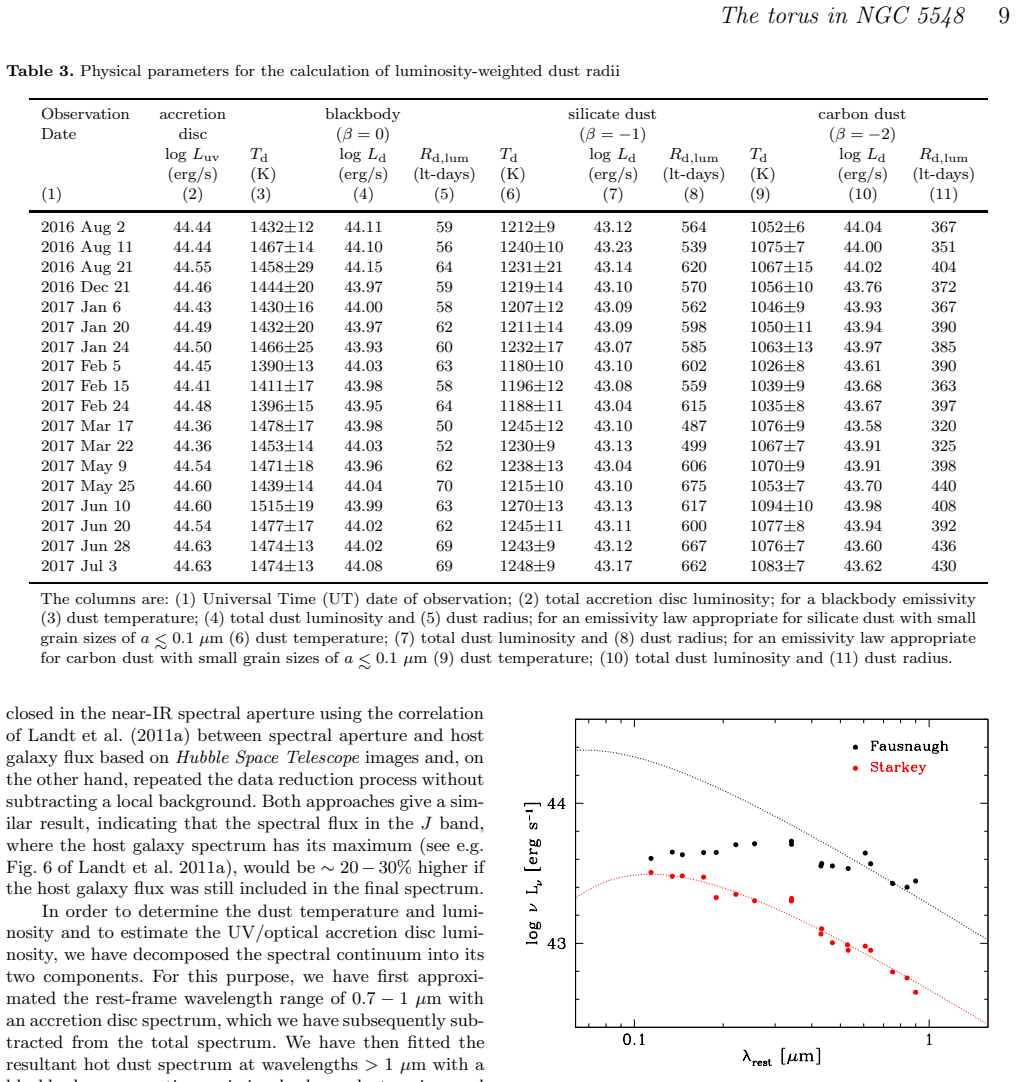
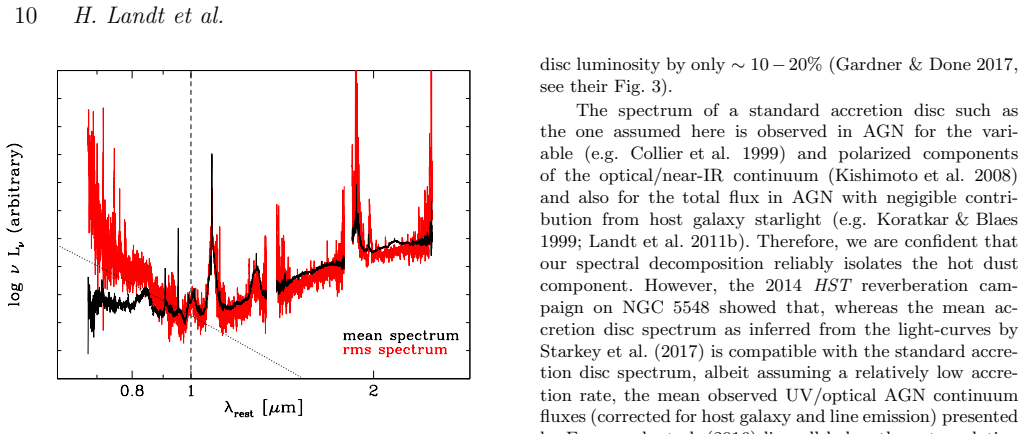
The argument is carried by comparing two independent routes to the dust radius. The response-weighted radius, $R_{\rm rev}=c\tau$, comes from echo mapping the near-infrared dust light curves (H and K bands) against the driving optical light curve; both the maximum-entropy and Markov-chain Monte Carlo formalisms give about 70 light-days when the V-band light curve drives. The luminosity-weighted radius, $R_{\rm d,lum}$, comes from radiative equilibrium, $L_{\rm uv}/(4\pi R_{\rm d,lum}^2)=4\sigma T^4\langle Q_{\rm em}\rangle$, with temperature and dust luminosity from fitting the near-infrared SED with an emissivity law $Q_\lambda(a)\propto\lambda^\beta$. A wavelength-independent emissivity ($\beta=0$, a blackbody, appropriate for grains of a few microns) is the only case in which $R_{\rm d,lum}$ agrees with $R_{\rm rev}$; small-grain carbon and silicate laws fail by factors of about six and eight. The same radiative-equilibrium relation, with the measured temperature and assumed irradiating luminosity, yields $T\simeq1450$ K and predicts that temperature variations should track the driving flux, which is observed. The similarity of the mean and rms spectra at rest wavelengths longer than 1 micron is the additional constraint that a single dust component, rather than a wide temperature range, is responsible. The 'dusty wall' conclusion—an inner edge kept dust-free by ongoing destruction, so its radius is luminosity-invariant—is the interpretation of these two agreements.
What would settle it
Carry out a multi-wavelength reverberation campaign that catches a factor-of-two or larger change in NGC 5548's UV/optical luminosity lasting several months, while measuring the near-infrared lag. The dusty-wall picture predicts the lag stays near 70 light-days and the temperature rises with the heating flux; the sublimation picture predicts the lag shifts by roughly the square root of the luminosity change and the temperature stays pinned near the sublimation value. A second, independent check is to measure the lag with a bluer driver (e.g. a UV light curve) and with the V-band driver; if the ~40-45 day lag from the spectroscopic driver is the true response, the claimed 70-day wall radius is not robust.
Extended reading notes
Core claim
The paper establishes that in NGC 5548 the hot dust producing the near-infrared bump has an average temperature of about 1450 K, and that this dust is the same single component that dominates both the mean and the variable emission: the mean and rms spectra are similar at rest wavelengths longer than 1 micron. Using the V-band light curve as the driving signal, the dust responds with a lag of about 70 light-days, and the luminosity-based radius computed from radiative equilibrium agrees with this response-weighted radius only if the dust emissivity is wavelength-independent (a blackbody), appropriate for grains of a few microns. Small-grain carbon or silicate emissivity laws give luminosity radii about six to eight times larger and are rejected. The 1450 K temperature is near the sublimation point of silicates but several hundred kelvin below that of carbon, so the authors conclude the hot dust is carbon-dominated and, crucially, is not sitting at its sublimation temperature. Temperature variations track the irradiating flux in the way expected for simple heating and cooling, and the dust mass shows two episodes of destruction, each losing about 40 percent, with reformation on timescales of five to six months. The paper's central claim follows: the inner edge of the torus is not set by sublimation but is an enlarged, luminosity-invariant 'dusty wall' kept dust-free by ongoing in-situ dust destruction.
Load-bearing premise
The load-bearing premise is that the assumed total luminosity heating the dust is correct: if the true irradiating luminosity is much lower than estimated (the paper allows the optical/UV estimate to be too high by up to a factor of about ten, with an assumed X-ray contribution making up only part of the gap), the large-grain blackbody solution no longer matches the measured reverberation radius, and the derived 1450 K temperature and the 'not at sublimation' conclusion collapse.
Editorial extensions
If this is right
- The inner edge of the dusty torus is expected to be nearly independent of AGN luminosity, so the standard 'receding torus' radius-luminosity relation would overpredict how much the near-IR radius changes as the source brightens or fades.
- Near-IR dust emission in NGC 5548 should be dominated by large carbonaceous grains of a few microns, not sub-micron silicates, so fitting AGN dust SEDs with small-grain emissivity laws will misestimate dust temperatures by hundreds of kelvin.
- Dust mass destruction and reformation on timescales of roughly five to six months means torus models must treat grain destruction and growth as time-dependent even when the luminosity is roughly constant.
- Since X-ray heating appears to contribute tens of percent of the irradiating luminosity for large grains, bolometric dust-heating estimates based on UV/optical light alone are incomplete.
Reading between the lines
- Beyond the paper's claims: if the inner edge is truly luminosity-invariant, archival photometric reverberation samples should show a much flatter lag-luminosity relation than currently assumed; re-fitting published lags with a luminosity-independent inner edge is a test that needs no new data.
- Beyond the paper's claims: the enlarged dust-free region may coincide with the coronal-line region seen in AGN spectra, so coronal-line variability should track the dust-mass destruction events documented here.
- Beyond the paper's claims: monitoring another AGN at a very different luminosity would test the 'dusty wall' prediction directly, since the lag should not scale as $L^{1/2}$ and the temperature should stay near 1450 K.
- Beyond the paper's claims: simultaneous X-ray and near-infrared reverberation on the same source could measure the X-ray heating fraction directly, breaking the degeneracy between grain size and irradiating luminosity.
Signed reviews
Editorial analysis
A structured set of objections, weighed in public.
Referee Report
Summary. The paper reports the first near-infrared spectroscopic dust reverberation campaign on an AGN, targeting NGC 5548 over one year with IRTF/SpeX and supporting GROND and LCOGT photometry. The authors decompose the continuum into an accretion disc component and a hot dust component, measure dust temperatures for three emissivity laws (blackbody, silicate, carbon), and derive luminosity-based dust radii from radiative equilibrium. They compare these to response-weighted radii obtained with MEMEcho and MCMCRev, claiming a reverberation lag of ~70 light-days, a blackbody-like dust SED with T~1450 K, and large carbon grains. On this basis they conclude that the hot dust is not near its sublimation temperature and that the inner torus edge is a luminosity-invariant 'dusty wall'. The manuscript also reports a cyclical dust mass decrease with an implied reformation timescale of ~5-6 months.
Significance. If the conclusions hold, this is a valuable step: simultaneous spectroscopic measurement of dust temperature, luminosity-based radius, and reverberation radius is a genuine observational advance over photometric campaigns, and the mean/rms spectral comparison is an important diagnostic. The calibration effort is careful, including the use of [S III] for photometric alignment and cross-checks against GROND photometry. However, the central physical conclusions are not yet robust because they depend on a specific choice of driving light-curve and on luminosity adjustments that are partly tuned to the reverberation radius. The core data set should be published, but the interpretive claims need to be re-derived under the full range of admissible lags and luminosities before the 'dusty wall' scenario can be accepted.
major comments (4)
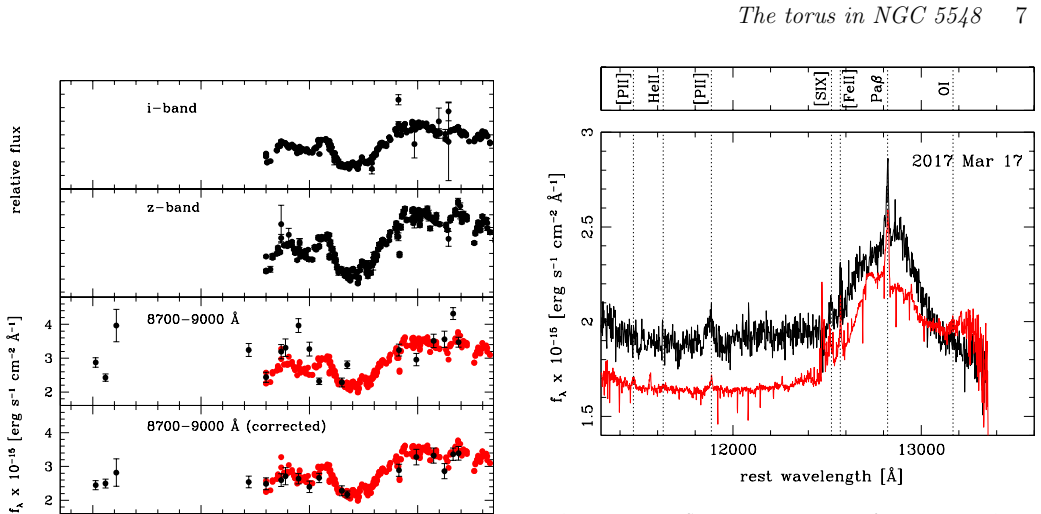
- [Section 4.3 (and Figure 9)] The quoted response-weighted radius of ~70 light-days is driver-dependent. MEMEcho with the 8700-9000 Å spectroscopic light-curve as driver peaks at ~40-45 days in both H and K, whereas the V-band photometric driver gives ~70-80 days. Because the Section 5.1 comparison between Rd,rev and Rd,lum uses the V-band value, and no cross-calibration or inter-band lag test is provided, the central radius comparison is not uniquely determined. Please report both drivers on identical MEMEcho/MCMCRev runs, including the width and peak diagnostics that justify calling the spectroscopic driver 'too smooth', and show the Section 5.1 comparison for the 40-45 day value.
- [Section 5.1 (Eq. 3)] The X-ray heating correction is introduced after the fact. The paper finds that the blackbody luminosity radius (61±1 lt-days) is ~15% smaller than the adopted reverberation radius, and then adds an X-ray contribution of ~40-70% that raises the luminosity-based radius to ~70-80 lt-days. Since this normalization is tuned to the same reverberation radius it is meant to explain, the resulting agreement cannot be used as independent evidence for either X-ray heating or for the large-grain blackbody emissivity law. Please present the X-ray luminosity from the Mehdipour et al. (2015) SED with its uncertainty and compute the radius without adjusting the normalization.
- [Sections 3.4.1 and 5.1] The manuscript states that the accretion disc luminosity may be overestimated by up to a factor of ~10 and the dust radius by a factor of ~3 because of a possible 'constant red component'. This uncertainty is in the opposite direction from the X-ray correction and is not propagated into the final agreement. If Luv were overestimated by a factor of 10, the blackbody Rd,lum would be ~19 lt-days, far from either the 40-45 or 70 day response radius. The authors need to justify why the constant red component does not heat the dust, or include it in the luminosity, and quantify the resulting range of Rd,lum.
- [Section 5.2] The statement 'the hot dust is not close to its sublimation temperature' is only meaningful relative to a specific grain species. The measured T~1450 K lies inside the silicate sublimation range (1300-1500 K) quoted by the authors, so the conclusion depends on the prior conclusion that the dust is carbon-dominated, which in turn relies on the blackbody/large-grain radius match from Section 5.1. The text should decouple these steps and state explicitly that 'not close to sublimation' refers to carbon, not to dust in general.
minor comments (6)
- [General] There are several typographical and LaTeX errors: 'intrigueing' in Section 5.1, 'corrsponding' in the Table 4 header, and 'greaterorequalslant' in Section 5.3.
- [Figure 9] The caption states that the vertical lines in the delay maps indicate the mean and its error, but the H and K log-normal maps peak at ~20 and 35 days while the text quotes mean values of 73±7 and 79±8 days. Please label the peak and centroid separately in the figure or caption to avoid confusion.
- [Table 6] Table 6 lists MCMCRev results for the accretion-disc response function but not for the log-normal model; adding a column with the log-normal centroids and peaks for the same bands would allow readers to compare the two drivers directly.
- [Section 3.4.2 (Eq. 3)] For the blackbody case (β=0), the Planck-averaged emissivity is ⟨Qem⟩=1; it would be helpful to state this explicitly so that Eq. (3) reduces to Luv/(4πR²)=4σT⁴ in that case.
- [Section 4.3] The sentence 'The width of the MEMEcho delay map is much narrower in the former case, most likely due to the spectroscopic light-curve being too smooth' needs a supporting statistic or figure reference, since the peak location is the load-bearing quantity in the subsequent analysis.
- [Abstract and Section 5.2] The phrase 'the dusty torus rather a "dusty wall"' is ungrammatical; suggested wording: 'the dusty torus is rather a "dusty wall".'
Circularity Check
No circularity by construction: the reverberation lag and the dust temperature are independently measured, and the emissivity-law choice is a data-driven model selection rather than a fitted input.
full rationale
The paper's central chain is: fit blackbody and modified blackbody emissivity laws to the near-IR dust SED to obtain T and L_d; compute a luminosity-based radius from Eq. (3) using L_uv from an accretion-disc model; independently measure a response-weighted radius from the reverberation lag; and compare the two radii to select the emissivity law. No step defines the output in terms of the target result. The lag (~70 light-days with the V-band driver) and the temperature (~1450 K for the blackbody case) come from separate data sets: light-curve reverberation versus spectral decomposition of the mean/rms spectra. The X-ray heating contribution is estimated by scaling the independent Mehdipour et al. (2015) SED to the observed 8700-9000 A continuum flux; it is not a free parameter adjusted to force agreement. The choice to use the V-band rather than the spectroscopic light-curve as the driver is a data-selection and robustness concern, not a circular reduction, and the paper explicitly reports both lags (~40-45 d versus ~70-80 d). Self-citations to Landt et al. support the spectral decomposition and earlier temperature measurements, but they are not load-bearing: the GROND photometry, the similarity of mean and rms spectra, and the comparison with the observed light curves provide independent support. The acknowledged uncertainties, including the possible factor-of-10 overestimate of L_uv and the sparse time sampling, are limitations rather than evidence that the derivation is equivalent to its inputs. No equation in the paper reduces to another by construction, and no fitted parameter is renamed as a prediction.
Assumptions & free parameters
free parameters (2)
- Accretion disc luminosity L_uv =
log L_uv ~ 44.36-44.63 erg/s per epoch
- X-ray heating normalization =
Scaling of Mehdipour et al. (2015) SED to observed continuum, increasing irradiating luminosity by ~40-70%
assumptions (6)
- domain assumption Dust is optically thick to incident UV/optical but optically thin to its own IR radiation
- domain assumption Absorption efficiency Q_abs = 1 for UV/optical
- domain assumption Single grain size approximation
- domain assumption The narrow emission line [S III] lambda 9531 is constant and can be used for photometric correction, with its spatial morphology inferred from [Fe II] IFU observations from 2012
- domain assumption Standard geometrically thin, optically thick accretion disc model with Schwarzschild metric, face-on viewing, and outer radius 10^4 r_g
- domain assumption Sublimation temperatures of carbon (1800-2000 K) and silicates (1300-1500 K) from literature
Cite this review
Pith. "Pith review of The first spectroscopic dust reverberation programme on active galactic nuclei: the torus in NGC 5548." pith.science (2026). https://pith.science/paper/6HL6ZZ4K
@misc{pith2026190801627,
  author       = {Pith},
  title        = {Pith review of: The first spectroscopic dust reverberation programme on active galactic nuclei: the torus in NGC 5548},
  year         = {2026},
  howpublished = {\url{https://pith.science/paper/6HL6ZZ4K}},
  note         = {Machine review of arXiv:1908.01627}
}
read the original abstract
We have recently initiated the first spectroscopic dust reverberation programme on active galactic nuclei (AGN) in the near-infrared. Spectroscopy enables measurement of dust properties, such as flux, temperature and covering factor, with higher precision than photometry. In particular, it enables measurement of both luminosity-based dust radii and dust response times. Here we report results from a one-year campaign on NGC 5548. The hot dust responds to changes in the irradiating flux with a lag time of ~70 light-days, similar to what was previously found in photometric reverberation campaigns. The mean and rms spectra are similar, implying that the same dust component dominates both the emission and the variations. The dust lag time is consistent with the luminosity-based dust radius only if we assume a wavelength-independent dust emissivity-law, i.e. a blackbody, which is appropriate for grains of large sizes (of a few microns). For such grains the dust temperature is ~1450 K. Therefore, silicate grains have most likely evaporated and carbon is the main chemical component. But the hot dust is not close to its sublimation temperature, contrary to popular belief. This is further supported by our observation of temperature variations largely consistent with a heating/cooling process. Therefore, the inner dust-free region is enlarged and the dusty torus rather a "dusty wall", whose inner radius is expected to be luminosity-invariant. The dust-destruction mechanism that enlarges the dust-free region seems to partly affect also the dusty region. We observe a cyclical decrease in dust mass with implied dust reformation times of ~5-6 months.
Figures


Figures from the paper (8 more)



Reference graph
Works this paper leans on
-
[1]
N., et al
Abazajian, K. N., et al. 2009, ApJS, 182, 543
2009
-
[2]
1993, ARA&A, 31, 473
Antonucci, R. 1993, ARA&A, 31, 473
1993
-
[3]
Antonucci, R., & Miller, J. S. 1985, ApJ, 297, 621
1985
-
[4]
1992, ApJ, 400, 502
Barvainis, R. 1992, ApJ, 400, 502
1992
-
[5]
2018, MNRAS, 474, 1970
Baskin, A., & Laor, A. 2018, MNRAS, 474, 1970
2018
-
[6]
C., & Katz, S
Bentz, M. C., & Katz, S. 2015, PASP, 127, 67 c© 2019 RAS, MNRAS 000, 1–22 The torus in NGC 5548 21
2015
-
[7]
C., Peterson, B
Bentz, M. C., Peterson, B. M., Netzer, H., Pogge, R. W., & Vestergaard, M. 2009, ApJ, 697, 160
2009
-
[8]
C., et al
Bentz, M. C., et al. 2008, ApJ, 689, L21
2008
Show all 114 references
-
[9]
D., & McKee, C
Blandford, R. D., & McKee, C. F. 1982, ApJ, 255, 419
1982
-
[10]
M., et al
Brown, T. M., et al. 2013, PASP, 125, 1031
2013
-
[11]
2013, A&A, 558, A149
Burtscher, L., et al. 2013, A&A, 558, A149
2013
-
[12]
Clavel, J., Wamsteker, W., & Glass, I. S. 1989, ApJ, 337, 236
1989
-
[13]
H., Ogle, P
Cohen, M. H., Ogle, P. M., Tran, H. D., Goodrich, R. W., & Miller, J. S. 1999, AJ, 118, 1963
1999
-
[14]
Collier, S., Horne, K., Wanders, I., & Peterson, B. M. 1999, MNRAS, 302, L24
1999
-
[15]
A., Kielkopf, J
Collins, K. A., Kielkopf, J. F., Stassun, K. G., & Hessman, F. V. 2017, AJ, 153, 77
2017
-
[16]
C., Vacca, W
Cushing, M. C., Vacca, W. D., & Rayner, J. T. 2004, PASP, 116, 362
2004
-
[17]
2016, ApJ, 832, 15
Czerny, B., Du, P., Wang, J.-M., & Karas, V. 2016, ApJ, 832, 15
2016
-
[18]
2011, A&A, 525, L8
Czerny, B., & Hryniewicz, K. 2011, A&A, 525, L8
2011
-
[19]
2017, ApJ, 846, 154 De Rosa, G., et al
Czerny, B., et al. 2017, ApJ, 846, 154 De Rosa, G., et al. 2015, ApJ, 806, 128
2017
-
[20]
D., et al
Denney, K. D., et al. 2010, ApJ, 721, 715
2010
-
[21]
M., & Lockman, F
Dickey, J. M., & Lockman, F. J. 1990, ARA&A, 28, 215
1990
-
[22]
Draine, B. T. 2016, ApJ, 831, 109
2016
-
[23]
T., & Hensley, B
Draine, B. T., & Hensley, B. S. 2017, arXiv e-prints
2017
-
[24]
2015, ApJ, 806, 129
Edelson, R., et al. 2015, ApJ, 806, 129
2015
-
[25]
2006, ApJ, 648, L101
Elitzur, M., & Shlosman, I. 2006, ApJ, 648, L101
2006
-
[26]
Fausnaugh, M. M. 2017, PASP, 129, 024007
2017
-
[27]
M., et al
Fausnaugh, M. M., et al. 2016, ApJ, 821, 56
2016
-
[28]
W., Korista, K
Ferguson, J. W., Korista, K. T., & Ferland, G. J. 1997, ApJS, 110, 287
1997
-
[29]
2002, Accretion Power in Astrophysics (Cambridge University Press)
Frank, J., King, A., & Raine, D. 2002, Accretion Power in Astrophysics (Cambridge University Press)
2002
-
[30]
2019, MNRAS, 483, 3404 Garc ´ ıa-Burillo, S., et al
Fuller, L., et al. 2019, MNRAS, 483, 3404 Garc ´ ıa-Burillo, S., et al. 2016, ApJ, 823, L12
2019
-
[31]
2017, MNRAS, 470, 3591
Gardner, E., & Done, C. 2017, MNRAS, 470, 3591
2017
-
[32]
M., & Peterson, B
Gaskell, C. M., & Peterson, B. M. 1987, ApJS, 65, 1
1987
-
[33]
Glass, I. S. 2004, MNRAS, 350, 1049
2004
-
[34]
R., et al
Goad, M. R., et al. 2016, ApJ, 824, 11
2016
-
[35]
R., Korista, K
Goad, M. R., Korista, K. T., & Ruff, A. J. 2012, MNRAS, 426, 3086
2012
-
[36]
2008, PASP, 120, 405
Greiner, J., et al. 2008, PASP, 120, 405
2008
-
[37]
J., et al
Grier, C. J., et al. 2013, ApJ, 773, 90 H¨ onig, S. F., et al. 2013, ApJ, 771, 87
2013
-
[38]
1994, in Astronomical Society of the Pacific Conference Series, Vol
Horne, K. 1994, in Astronomical Society of the Pacific Conference Series, Vol. 69, Reverberation Mapping of the Broad-Line Region in Active Galactic Nuclei, ed. P. M
1994
-
[39]
F., & Peterson, B
Horne, K., Welsh, W. F., & Peterson, B. M. 1991, ApJ, 367, L5
1991
-
[40]
Hubeny, I., Agol, E., Blaes, O., & Krolik, J. H. 2000, ApJ, 533, 710
2000
-
[41]
2018, ApJ, 853, L25
Imanishi, M., Nakanishi, K., Izumi, T., & Wada, K. 2018, ApJ, 853, L25
2018
-
[42]
Jones, A. P. 2004, in Astronomical Society of the Pacific Conference Series, Vol. 309, Astrophysics of Dust, ed. A. N. Witt, G. C. Clayton, & B. T. Draine, 347
2004
-
[43]
S., et al
Kaastra, J. S., et al. 2014, Science, 345, 64
2014
-
[44]
2010, ApJ, 724, L183
Kawaguchi, T., & Mori, M. 2010, ApJ, 724, L183
2010
-
[45]
2011, ApJ, 737, 105
Kawaguchi, T., & Mori, M. 2011, ApJ, 737, 105
2011
-
[46]
K., Everett, J
Keating, S. K., Everett, J. E., Gallagher, S. C., & Deo, R. P. 2012, ApJ, 749, 32
2012
-
[47]
2008, Nature, 454, 492
Boisson, C., Albrecht, M., & Leipski, C. 2008, Nature, 454, 492
2008
-
[48]
Kotani, T., Tristram, K. R. W., Weigelt, G., & Levin, K. 2011, A&A, 527, A121
2011
-
[49]
Barvainis, R., Tristram, K. R. W., & Weigelt, G. 2009, A&A, 507, L57
2009
-
[50]
2013, ApJ, 775, L36
Kishimoto, M., et al. 2013, ApJ, 775, L36
2013
-
[51]
F., Beckert, T., & Weigelt, G
Kishimoto, M., H¨ onig, S. F., Beckert, T., & Weigelt, G. 2007, A&A, 476, 713 K¨ onigl, A., & Kartje, J. F. 1994, ApJ, 434, 446
2007
-
[52]
1999, PASP, 111, 1
Koratkar, A., & Blaes, O. 1999, PASP, 111, 1
1999
-
[53]
2014, ApJ, 788, 159
Koshida, S., et al. 2014, ApJ, 788, 159
2014
-
[54]
2009, ApJ, 700, L109
Koshida, S., et al. 2009, ApJ, 700, L109
2009
-
[55]
Peterson, B. M. 1998, ApJ, 499, 719
1998
-
[56]
Krolik, J. H. 2007, ApJ, 661, 52
2007
-
[57]
H., & Begelman, M
Krolik, J. H., & Begelman, M. C. 1986, ApJ, 308, L55
1986
-
[58]
H., & Begelman, M
Krolik, J. H., & Begelman, M. C. 1988, ApJ, 329, 702
1988
-
[59]
C., Ward, M
Landt, H., Bentz, M. C., Ward, M. J., Elvis, M., Peterson, B. M., Korista, K. T., & Karovska, M. 2008, ApJS, 174, 282
2008
-
[60]
L., & Barmby, P
Landt, H., Buchanan, C. L., & Barmby, P. 2010, MNRAS, 408, 1982
2010
-
[61]
J., Elvis, M., & Karovska, M
Landt, H., Ward, M. J., Elvis, M., & Karovska, M. 2014, MNRAS, 439, 1051
2014
-
[62]
J., Steenbrugge, K
Landt, H., Ward, M. J., Steenbrugge, K. C., & Ferland, G. J. 2015, MNRAS, 454, 3688
2015
-
[63]
Laor, A., & Draine, B. T. 1993, ApJ, 402, 441
1993
-
[64]
1987, PASP, 99, 309
Lawrence, A. 1987, PASP, 99, 309
1987
-
[65]
1991, MNRAS, 252, 586
Lawrence, A. 1991, MNRAS, 252, 586
1991
-
[66]
2003, ApJ, 591, 1220
Lodders, K. 2003, ApJ, 591, 1220
2003
-
[67]
2017, MNRAS, 464, 1762
Lopez-Rodriguez, E., et al. 2017, MNRAS, 464, 1762
2017
-
[68]
2013, MNRAS, 431, 2723
Lopez-Rodriguez, E., et al. 2013, MNRAS, 431, 2723
2013
-
[69]
L., Heisler, C
Lumsden, S. L., Heisler, C. A., Bailey, J. A., Hough, J. H., & Young, S. 2001, MNRAS, 327, 459
2001
-
[70]
2001, A&A, 365, 37
Maiolino, R., Marconi, A., & Oliva, E. 2001, A&A, 365, 37
2001
-
[71]
Markwardt, C. B. 2009, in ASP Conference Series, Vol. 411, Astronomical Data Analysis Software and Systems XVIII, ed. D. Bohlender, P. Dowler, & D. Durand (San Francisco: Astronomical Society of the Pacific), arXiv:0902.2850v1
2009 arXiv
-
[72]
2017, ApJ, 846, 55
Mathur, S., et al. 2017, ApJ, 846, 55
2017
-
[73]
J., et al
McGregor, P. J., et al. 2003, in Proc. SPIE, Vol. 4841, Instrument Design and Performance for Optical/Infrared Ground-based Telescopes, ed. M. Iye & A. F. M. Moor- wood, 1581
2003
-
[74]
2015, A&A, 575, A22
Mehdipour, M., et al. 2015, A&A, 575, A22
2015
-
[75]
Minezaki, T., Yoshii, Y., Kobayashi, Y., Enya, K., Sug- anuma, M., Tomita, H., Aoki, T., & Peterson, B. A. 2004, ApJ, 600, L35
2004
-
[76]
2012, MNRAS, 420, 526
Mor, R., & Netzer, H. 2012, MNRAS, 420, 526
2012
-
[77]
2012, AJ, 143, 142
Morganson, E., et al. 2012, AJ, 143, 142
2012
-
[78]
Nelson, B. O. 1996, ApJ, 465, L87 c© 2019 RAS, MNRAS 000, 1–22 22 H. Landt et al
1996
-
[79]
M., Ivezi´ c, Z., & Elitzur, M
Nenkova, M., Sirocky, M. M., Ivezi´ c, Z., & Elitzur, M. 2008, ApJ, 685, 147
2008
-
[80]
1987, MNRAS, 225, 55
Netzer, H. 1987, MNRAS, 225, 55
1987
-
[81]
2015, ARA&A, 53, 365
Netzer, H. 2015, ARA&A, 53, 365
2015
-
[82]
1993, ApJ, 404, L51
Netzer, H., & Laor, A. 1993, ApJ, 404, L51
1993
-
[83]
L., & Horne, K
Oknyanskij, V. L., & Horne, K. 2001, in Astronomical So- ciety of the Pacific Conference Series, Vol. 224, Probing the Physics of Active Galactic Nuclei, ed. B. M. Peterson, R. W. Pogge, & R. S. Polidan, 149
2001
-
[84]
Perlman, E., Alonso-Herrero, A., Colina, L., & Telesco, C. M. 2005, ApJ, 618, L17
2005
-
[85]
J., & Treu, T
Pancoast, A., Brewer, B. J., & Treu, T. 2011, ApJ, 730, 139
2011
-
[86]
J., Treu, T., Park, D., Barth, A
Pancoast, A., Brewer, B. J., Treu, T., Park, D., Barth, A. J., Bentz, M. C., & Woo, J.-H. 2014, MNRAS, 445, 3073
2014
-
[87]
2017, ApJ, 837, 131
Pei, L., et al. 2017, ApJ, 837, 131
2017
-
[88]
Y., Ho, L
Peng, C. Y., Ho, L. C., Impey, C. D., & Rix, H.-W. 2002, AJ, 124, 266
2002
-
[89]
Peterson, B. M. 1993, PASP, 105, 247
1993
-
[90]
Peterson, B. M. 1997, An Introduction to Active Galactic Nuclei (Cambridge University Press)
1997
-
[91]
M., et al
Peterson, B. M., et al. 2013, ApJ, 779, 109
2013
-
[92]
M., et al
Peterson, B. M., et al. 2004, ApJ, 613, 682
2004
-
[93]
A., & Krolik, J
Pier, E. A., & Krolik, J. H. 1992, ApJ, 399, L23
1992
-
[94]
A., & Voit, G
Pier, E. A., & Voit, G. M. 1995, ApJ, 450, 628
1995
-
[95]
M., Sch¨ odel, R., & Woillez, J
Herbst, T. M., Sch¨ odel, R., & Woillez, J. 2010, ApJ, 715, 736 Ramos Almeida, C., et al. 2011, ApJ, 731, 92
2010
-
[96]
T., Toomey, D
Rayner, J. T., Toomey, D. W., Onaka, P. M., Denault, A. J., Stahlberger, W. E., Vacca, W. D., Cushing, M. C., & Wang, S. 2003, PASP, 115, 362
2003
-
[97]
J., Silk, J
Rees, M. J., Silk, J. I., Werner, M. W., & Wickramasinghe, N. C. 1969, Nature, 223, 788
1969
-
[98]
Salpeter, E. E. 1977, ARA&A, 15, 267 Schn¨ ulle, K., Pott, J.-U., Rix, H.-W., Decarli, R., Peterson, B. M., & Vacca, W. 2013, A&A, 557, L13 Schn¨ ulle, K., Pott, J.-U., Rix, H.-W., Peterson, B. M., De
1977
-
[99]
2015, A&A, 578, A57 Sch¨ onell, A
Rosa, G., & Shappee, B. 2015, A&A, 578, A57 Sch¨ onell, A. J., Jr., Storchi-Bergmann, T., Riffel, R. A., & Riffel, R. 2017, MNRAS, 464, 1771
2015
-
[100]
2015, ApJS, 216, 4
Shen, Y., et al. 2015, ApJS, 216, 4
2015
-
[101]
2016, ApJ, 818, 30
Shen, Y., et al. 2016, ApJ, 818, 30
2016
-
[102]
L., Sitko, A
Sitko, M. L., Sitko, A. K., Siemiginowska, A., & Szczerba, R. 1993, ApJ, 409, 139
1993
-
[103]
F., et al
Skrutskie, M. F., et al. 2006, AJ, 131, 1163
2006
-
[104]
2017, ApJ, 835, 65
Starkey, D., et al. 2017, ApJ, 835, 65
2017
-
[105]
A., Horne, K., & Villforth, C
Starkey, D. A., Horne, K., & Villforth, C. 2016, MNRAS, 456, 1960
2016
-
[106]
J., Riffel, R
Storchi-Bergmann, T., McGregor, P. J., Riffel, R. A., Sim˜ oes Lopes, R., Beck, T., & Dopita, M. 2009, MNRAS, 394, 1148
2009
-
[107]
D., Eracleous, M., & Nemmen, R
Elvis, M., Denney, K. D., Eracleous, M., & Nemmen, R. S. 2017, ApJ, 835, 236
2017
-
[108]
2006, ApJ, 639, 46
Suganuma, M., et al. 2006, ApJ, 639, 46
2006
-
[109]
Tran, H. D. 2003, ApJ, 583, 632
2003
-
[110]
Tristram, K. R. W., et al. 2009, A&A, 502, 67
2009
-
[111]
M., & Padovani, P
Urry, C. M., & Padovani, P. 1995, PASP, 107, 803 van Groningen, E., & Wanders, I. 1992, PASP, 104, 700
1995
-
[112]
2015, ApJ, 801, 127
Vazquez, B., et al. 2015, ApJ, 801, 127
2015
-
[113]
J., & Peterson, B
White, R. J., & Peterson, B. M. 1994, PASP, 106, 879
1994
-
[114]
S., & Peterson, B
Zu, Y., Kochanek, C. S., & Peterson, B. M. 2011, ApJ, 735, 80 This paper has been typeset from a T EX/ LATEX file prepared by the author. c© 2019 RAS, MNRAS 000, 1–22
2011
Reviewed August 14, 2026 · model on record in the stance chip above.
Discussion (0). Continue with ORCID to comment.