REVIEW 3 major objections 5 minor 70 references
A young galaxy cluster in the old Universe
T0 review · 3 major / 5 minor · reviewed 2026-08-14 · deepseek-v4-flash
Pith's one-line read A massive local galaxy cluster has a blue star-forming fraction of 0.57, far above what galaxy formation models predict.
desk verdict A plausible, transparent report of an unusual local cluster, but the LCDM tension is overstated by an unvalidated model boundary and an uncorrected significance. read the letter →
The pith
A machine-rendered reading of the paper's core claim, the machinery that carries it, and where it could break.
The reading
What carries the argument
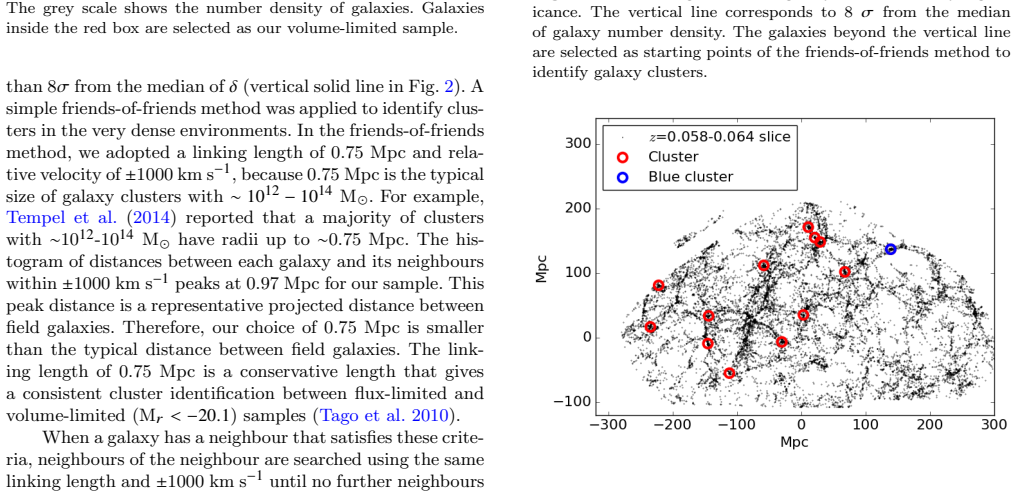
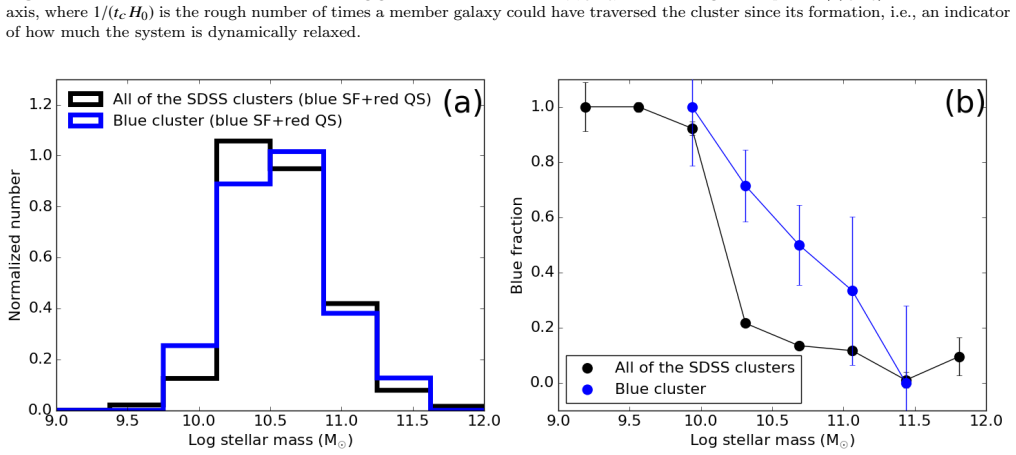
The analysis is carried by a two-part classification machine. First, galaxies are separated into blue star-forming and red quiescent using the stellar mass--star-formation-rate plane: a boundary line is fitted through the local minima of the SFR distribution in five stellar-mass bins of SDSS data, and the same division is applied to the semi-analytic and hydrodynamical model galaxies using a $3\sigma$ offset below the blue main sequence, a choice the authors validate only on SDSS. Second, clusters are identified in a volume-limited, magnitude-limited SDSS sample by a friends-of-friends algorithm with a 0.75 Mpc projected linking length and $\pm1000\ \mathrm{km\,s^{-1}}$ velocity window, starting from galaxies in environments overdense by $8\sigma$, and the same pipeline is run on model galaxy catalogues with matched magnitude and density limits. Halo masses come from the projected velocity dispersion and projected virial radius via a standard virial estimator, calibrated against the true halo masses available in the simulations, and the Dressler--Shectman statistic is used to show the blue cluster is dynamically relaxed.
What would settle it
Re-compute the model blue fractions using the same local-minimum boundary definition applied to the full star-formation-rate distributions of the simulated galaxies rather than a 3-sigma offset below the star-forming relation; if the resulting model blue fractions approach 0.57, the reported >4.7-sigma discrepancy would disappear.
Extended reading notes
Core claim
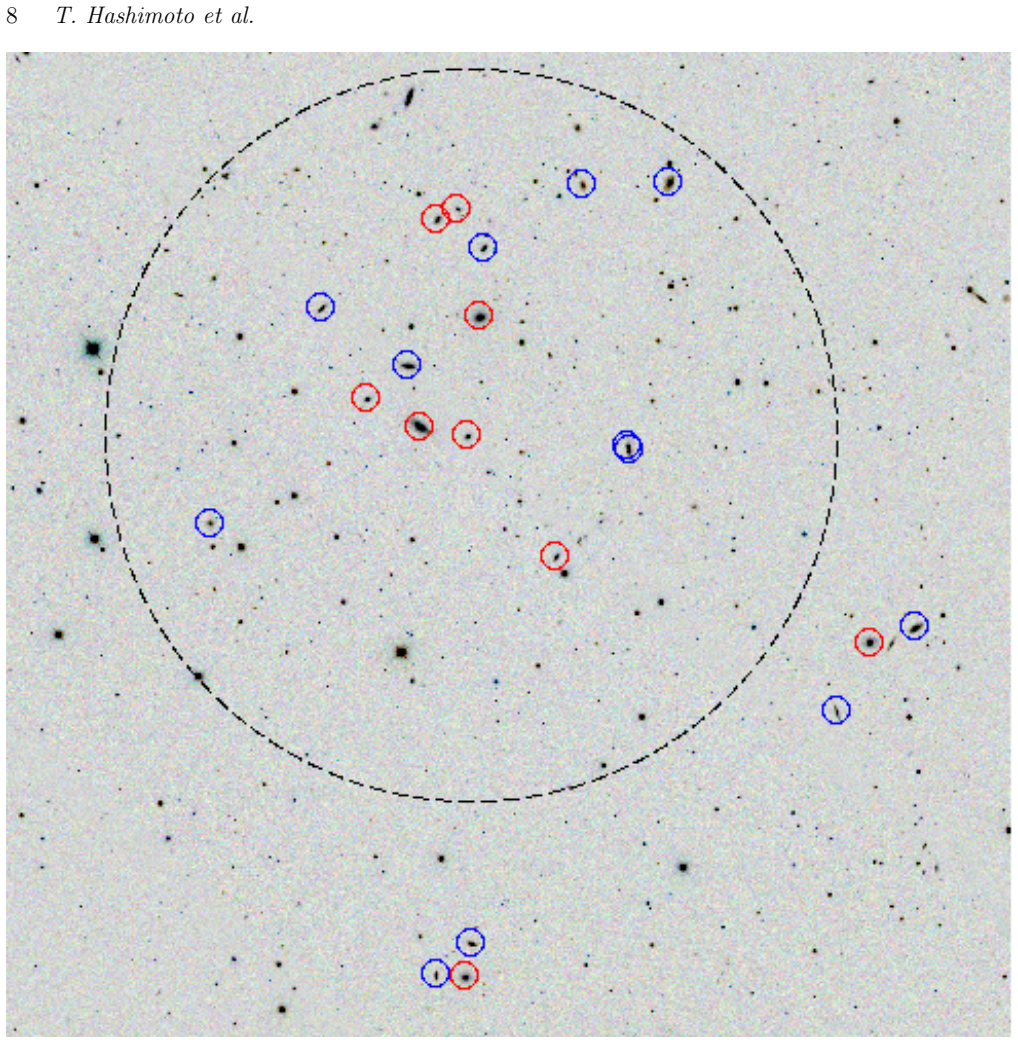
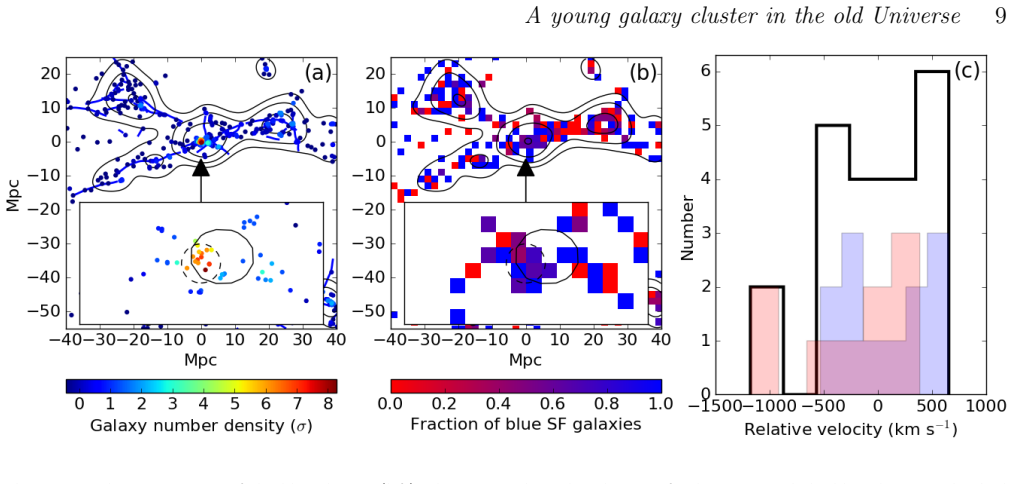
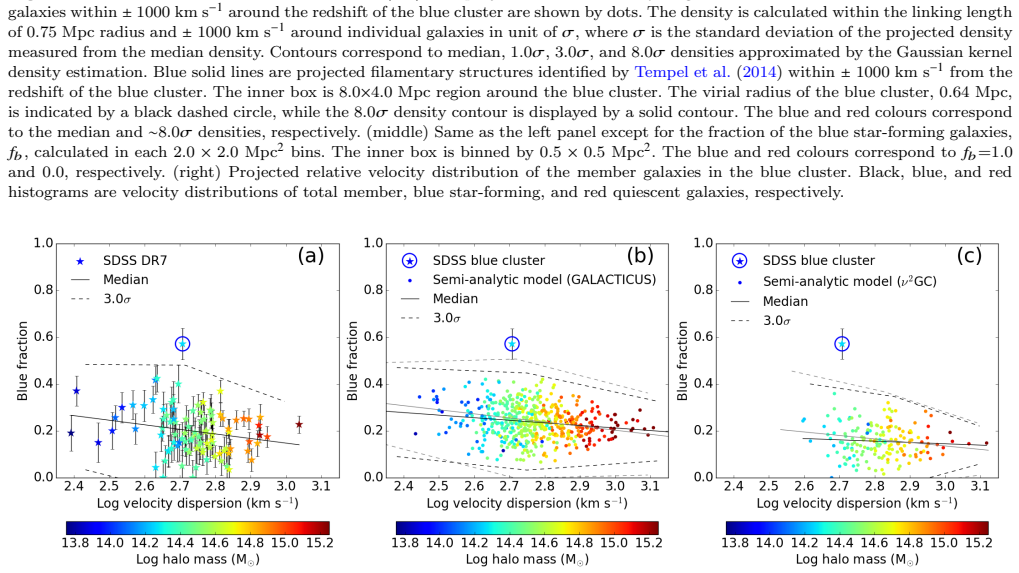
The central discovery is a "blue cluster" at $z=0.061$: SDSS-C4 3028, with 21 spectroscopically confirmed member galaxies, a projected velocity dispersion of $510\ \mathrm{km\,s^{-1}}$, a projected virial radius of $0.64$ Mpc, and an implied halo mass of $2.0^{+1.9}_{-1.0}\times10^{14}\,M_\odot$. Its blue fraction, defined by a boundary between the blue star-forming main sequence and the red quiescent population in the stellar mass--SFR plane, is $0.57\pm0.06$, compared with typical blue fractions below about 0.2 for local massive clusters. The cluster is $4.0\sigma$ above the median of 100 SDSS clusters selected by the same friends-of-friends algorithm, $4.7\sigma$ and $5.7\sigma$ above the median predictions of two semi-analytic models, and above the highest blue fraction found in a hydrodynamical simulation box. A Dressler--Shectman test gives $\Delta/N_{\rm member}=0.89$, indicating a virialised system, and the galaxy stellar mass function of the cluster is statistically indistinguishable from the other SDSS clusters, so the excess star formation is not a consequence of an unusual number of low-mass galaxies. The authors conclude that the cluster is an extreme, rare object whose existence challenges current $\Lambda$CDM-based frameworks of galaxy formation and evolution.
Load-bearing premise
The load-bearing assumption is that the line separating blue from red galaxies used for the SDSS data, placed at the local minimum of the star-formation-rate distribution, matches the line used for the simulations, placed 3 standard deviations below the star-forming relation; this equivalence was checked only on the SDSS data, because the simulated galaxies do not show the same clear two-peaked separation.
Editorial extensions
If this is right
- The Butcher--Oemler pattern is not universal: a massive, dynamically old-looking local halo can host a high blue fraction, so environment alone does not guarantee early quenching.
- Semi-analytic and hydrodynamical models of galaxy formation underproduce the blue fractions of massive clusters at $z\approx0$; reproducing this object would require gas accretion physics that keeps cold streams alive in deep potential wells.
- Such local blue clusters can serve as nearby analogues of the $z\sim0.4$--$0.5$ cluster population, where the global transition from star formation to quiescence is happening, and can be studied in much greater detail than their distant counterparts.
- Mpc-scale filamentary galaxy structures coincident with high blue fractions around the cluster suggest that searches for cold gas streams around other local clusters are a promising observational route.
Reading between the lines
- [Editorial inference] The $4.7\sigma$ gap with models rests on the untested equivalence between the local-minimum boundary in SDSS and the $3\sigma$ main-sequence offset in simulations; if the models' lack of bimodality biases their blue fractions downward, the discrepancy could be smaller than reported.
- [Editorial inference] Deep CO or HI observations of the 12 blue member galaxies would directly test the inferred cold gas reservoirs and the Kennicutt--Schmidt gas mass fractions, which are currently derived indirectly.
- [Editorial inference] If cold streams really feed the cluster, its hot intracluster medium should be underluminous in X-rays and weak in the Sunyaev--Zel'dovich effect relative to the halo-mass scaling relations; shallow existing data are consistent with both, so a deep X-ray observation can discriminate.
- [Editorial inference] Applying the same friends-of-friends pipeline to upcoming wide-area spectroscopic surveys could estimate how many such blue clusters exist, turning a one-object challenge into a statistical one.
Signed reviews
Editorial analysis
A structured set of objections, weighed in public.
Referee Report
Summary. The paper reports the discovery of a galaxy cluster at z=0.061, identified as SDSS-C4 3028, in which 12 of 21 spectroscopically confirmed members are classified as blue star-forming galaxies, giving a blue fraction of 0.57±0.06. The cluster has a velocity dispersion of 510 km/s, implying a halo mass of about 2.0e14 Msun. The authors compare this cluster with 100 clusters selected with the same friends-of-friends algorithm in SDSS DR7 and find the blue fraction to be 4.0 sigma above the median, and 4.7-5.7 sigma above the blue fractions of cluster populations in the GALACTICUS and nu2GC semi-analytic models and in an EAGLE simulation. They report a 0.003% probability of finding such a blue fraction in one cluster, with a corrected probability of 0.32% after accounting for the 100 comparison clusters. The paper proposes that cold gas streams accreted from large-scale filaments may explain the high star-forming fraction, despite theoretical expectations that such streams do not survive in massive local halos.
Significance. If the main claim is robust, this paper identifies a rare and physically interesting outlier that challenges current prescriptions for galaxy quenching in dense environments. The analysis has notable strengths: the cluster member catalog is provided, the same cluster-selection and blue-fraction definitions are applied to the SDSS data and to the model catalogs, magnitude-matched and density-matched model samples are both considered, and a 100,000-iteration shuffle test is used to estimate the chance probability, including a multiple-testing correction. The empirical blue fraction itself, 12/21, is a straightforward and falsifiable measurement. The principal weakness is the calibration of the blue/quiescent boundary in the models and the overstatement of the uncorrected probability in the abstract; both issues are fixable and do not invalidate the observational discovery.
major comments (3)
- [Section 3.5, Figure 5] The claimed >4.7 sigma and >5.7 sigma deviations from the semi-analytic models and EAGLE depend on the assumption that a boundary at 3 sigma below the model main-sequence line is equivalent to the local-minimum boundary used for SDSS. This equivalence is checked only on SDSS (Fig. 4), where the two boundaries are almost identical, and is not tested in the models, whose SFR distributions lack the clear bimodality needed to define a local minimum. If a model main sequence is narrower than the SDSS one, the 3 sigma threshold would fall closer to the ridge and would classify intermediate-SFR galaxies as red, systematically lowering the model blue fraction. Because the central theoretical challenge rests on this model comparison, the authors should provide a sensitivity test, such as varying the sigma threshold or using a fixed absolute SFR cut, to demonstrate that the model discrepancy is not an artifact of the boundary definition.
- [Abstract and Section 4] The abstract and the concluding section quote the uncorrected probability of 0.003% and the 4.0 sigma deviation, while Section 4 itself derives the corrected probability of approximately 0.32% after accounting for the 100 comparison clusters (100 x 0.0032%). The corrected probability corresponds to roughly a 3 sigma effect, not 4 sigma. Using only the uncorrected figure in the abstract overstates the statistical significance of the result. The corrected probability should be quoted in the abstract and the text should be adjusted to reflect that the significance is lower after accounting for the look-elsewhere effect.
- [Section 5.5 and Abstract] The claim that 'filamentary cold gas streams can exist in massive halos even in the local Universe' is presented as a conclusion, but the supporting evidence is only the projected distribution of galaxies around the cluster (Fig. 8a), not a direct detection of cold gas streams. The paper itself notes in Section 5.5 that analytic arguments predict no cold streams in halos of this mass at z=0.061. The high blue fraction is a direct observational result, but the cold-stream interpretation is speculative and should be clearly framed as a hypothesis rather than a conclusion of the paper.
minor comments (5)
- [Section 3.4, Figure 4] The blue/quiescent boundary is fitted over stellar-mass bins from log M*=10.2 to 10.8, but the cluster members in Table B1 include objects at log M* around 9.86 and above 11.1. Please state explicitly how the boundary is extrapolated beyond the fitted range and whether the classification of the most and least massive members is robust to that extrapolation.
- [Figure 3 caption] The caption contains a typo: 'redsfhit' should be 'redshift'.
- [Section 3.6] The text contains a typo: 'tje' should be 'the' in the sentence describing the nu2GC halo mass definition.
- [Section 4, first paragraph] The phrase 'unusually large faction' should be 'unusually large fraction'.
- [Section 5.4] The gas-mass estimates from the Kennicutt-Schmidt and extended Schmidt laws require assumed galaxy radii, but the values of r used in the calculation are not stated in the text or in the figure captions.
Circularity Check
No significant circularity: the blue fraction is a measured quantity and the model comparison relies on external, pre-existing simulation products; the nu2GC self-citation is not load-bearing.
full rationale
The paper's central comparison is to three external, pre-existing theoretical products (GALACTICUS/MULTIDARK, the nu2GC semi-analytic catalogue, and EAGLE), none of which is re-fitted to SDSS-C4 3028 or to the authors' blue-fraction measurement. The observed blue fraction (12/21 member galaxies above a boundary defined by local minima in the SDSS SFR distribution) is a measurement, not a fitted parameter, and the model blue fractions are computed by applying the same cluster-finding pipeline to each model's own galaxy catalogue with each model's boundary set by a 3-sigma offset from that model's own main-sequence line. This rule is an externally stated criterion, not a parameter adjusted to reproduce the target cluster. The only author-overlap citation is the nu2GC catalogue (Makiya et al. 2016, co-authored by R. Makiya), but it is a public, pre-computed simulation product, and the result is corroborated by GALACTICUS and EAGLE, so the self-citation is not load-bearing. The validation that the 3-sigma boundary matches the local-minimum boundary is performed on SDSS only, not within the unimodal model distributions; that is a methodological applicability concern about the model blue fractions, not a circular reduction of the prediction to its inputs. The selection of the cluster as an extreme outlier in the same SDSS sample is a post-selection statistical issue that the paper addresses with a shuffling simulation, not a circular derivation. No equation or fitted value is reused as the claimed prediction, so no circularity step meets the evidentiary bar.
Assumptions & free parameters
free parameters (5)
- FoF linking length and velocity window =
0.75 Mpc, +/-1000 km/s
- Density threshold for cluster seeding =
8 sigma above median projected density
- SDSS blue/quiescent boundary line =
Linear fit to local minima in five stellar mass bins (log M* 10.2-10.8); coefficients not given
- Model blue/quiescent boundary line =
Main-sequence peak fit plus 3 sigma offset in each simulation
- nu2GC halo mass conversion formula =
log(M200c/MFoF)=0.628-0.054 log MFoF (Eq A1)
assumptions (6)
- domain assumption Projected friends-of-friends groups with 0.75 Mpc and +/-1000 km/s trace real galaxy clusters.
- domain assumption MPA-JHU SFR and stellar mass estimates from SDSS DR7 are sufficiently accurate for bimodal classification.
- ad hoc to paper The local minimum of the SFR distribution at fixed stellar mass is the correct SF/quiescent boundary.
- ad hoc to paper The 3 sigma main-sequence boundary in simulations is equivalent to the SDSS local-minimum boundary.
- domain assumption The projected virial mass estimator (Eq 2) gives an unbiased halo mass after simulation calibration.
- domain assumption The Planck15 Lambda CDM cosmology is the correct background for all distances and model comparisons.
Cite this review
Pith. "Pith review of A young galaxy cluster in the old Universe." pith.science (2026). https://pith.science/paper/6SOPUE4T
@misc{pith2026190801666,
  author       = {Pith},
  title        = {Pith review of: A young galaxy cluster in the old Universe},
  year         = {2026},
  howpublished = {\url{https://pith.science/paper/6SOPUE4T}},
  note         = {Machine review of arXiv:1908.01666}
}
abstract
Galaxies evolve from a blue star-forming phase into a red quiescent one by quenching their star formation activity. In high density environments, this galaxy evolution proceeds earlier and more efficiently. Therefore, local galaxy clusters are dominated by well-evolved red, elliptical galaxies. The fraction of blue galaxies in clusters monotonically declines with decreasing redshift, i.e., the Butcher-Oemler effect. In the local Universe, observed blue fractions of massive clusters are as small as $\lesssim$ 0.2. Here we report a discovery of a \lq \lq blue cluster\rq \rq, that is a local galaxy cluster with an unprecedentedly high fraction of blue star-forming galaxies yet hosted by a massive dark matter halo. The blue fraction is 0.57, which is 4.0 $\sigma$ higher than those of the other comparison clusters under the same selection and identification criteria. The velocity dispersion of the member galaxies is 510 km s$^{-1}$, which corresponds to a dark matter halo mass of 2.0$^{+1.9}_{-1.0}\times 10^{14}$ M$_{\odot}$. The blue fraction of the cluster is more than 4.7 $\sigma$ beyond the standard theoretical predictions including semi-analytic models of galaxy formation. The probability to find such a high blue fraction in an individual cluster is only 0.003\%, which challenges the current standard frameworks of the galaxy formation and evolution in the $\Lambda$CDM Universe. The spatial distribution of galaxies around the blue cluster suggests that filamentary cold gas streams can exist in massive halos even in the local Universe. However these cold streams have already disappeared in the theoretically simulated local universes.
Figures


Figures from the paper (9 more)





Reference graph
Works this paper leans on
-
[1]
Abazajian K. N., et al., 2009, @doi [ ] 10.1088/0067-0049/182/2/543 , http://adsabs.harvard.edu/abs/2009ApJS..182..543A 182, 543
-
[2]
Ai M., Zhu M., 2018, @doi [ ] 10.3847/1538-4357/aac9b7 , http://adsabs.harvard.edu/abs/2018ApJ...862...48A 862, 48
-
[3]
Bai L., Rieke G. H., Rieke M. J., Christlein D., Zabludoff A. I., 2009, @doi [ ] 10.1088/0004-637X/693/2/1840 , http://adsabs.harvard.edu/abs/2009ApJ...693.1840B 693, 1840
-
[4]
Barnes J. E., Hernquist L. E., 1991, @doi [ ] 10.1086/185978 , http://adsabs.harvard.edu/abs/1991ApJ...370L..65B 370, L65
doi:10.1086/185978 1991
-
[5]
Benson A. J., 2012, @doi [ ] 10.1016/j.newast.2011.07.004 , http://adsabs.harvard.edu/abs/2012NewA...17..175B 17, 175
-
[6]
A., et al., 2006, @doi [ ] 10.1086/508170 , http://adsabs.harvard.edu/abs/2006ApJS..167....1B 167, 1
Berlind A. A., et al., 2006, @doi [ ] 10.1086/508170 , http://adsabs.harvard.edu/abs/2006ApJS..167....1B 167, 1
doi:10.1086/508170 2006
-
[8]
Blanton M. R., et al., 2001, @doi [ ] 10.1086/320405 , http://adsabs.harvard.edu/abs/2001AJ....121.2358B 121, 2358
doi:10.1086/320405 2001
-
[9]
Boller T., Freyberg M. J., Tr \"u mper J., Haberl F., Voges W., Nandra K., 2016, @doi [ ] 10.1051/0004-6361/201525648 , http://adsabs.harvard.edu/abs/2016A
Show all 70 references
-
[11]
A., 1984, @doi [ ] 10.1086/162519 , http://adsabs.harvard.edu/abs/1984ApJ...285..426B 285, 426
Butcher H., Oemler Jr. A., 1984, @doi [ ] 10.1086/162519 , http://adsabs.harvard.edu/abs/1984ApJ...285..426B 285, 426
1984 doi
-
[12]
E., Marinello G., Clowes R
Campusano L. E., Marinello G., Clowes R. G., Haines C. P., Pereira S., Pizarro D., Hitschfeld-Kahler N., S \"o chting I. K., 2018, @doi [ ] 10.3847/1538-4357/aaeff3 , https://ui.adsabs.harvard.edu/abs/2018ApJ...869..145C 869, 145
2018 doi
-
[13]
X., Hennawi J
Cantalupo S., Arrigoni-Battaia F., Prochaska J. X., Hennawi J. F., Madau P., 2014, @doi [ ] 10.1038/nature12898 , http://adsabs.harvard.edu/abs/2014Natur.506...63C 506, 63
2014 doi
-
[15]
M., 1996, @doi [ ] 10.1086/176827 , https://ui.adsabs.harvard.edu/abs/1996ApJ...458..435C 458, 435
Colless M., Dunn A. M., 1996, @doi [ ] 10.1086/176827 , https://ui.adsabs.harvard.edu/abs/1996ApJ...458..435C 458, 435
1996 doi
-
[16]
Colless M., et al., 2001, @doi [ ] 10.1046/j.1365-8711.2001.04902.x , https://ui.adsabs.harvard.edu/abs/2001MNRAS.328.1039C 328, 1039
2001
-
[17]
A., Schaye J., van de Voort F., Duffy A
Correa C. A., Schaye J., van de Voort F., Duffy A. R., Wyithe J. S. B., 2018, @doi [ ] 10.1093/mnras/sty871 , http://adsabs.harvard.edu/abs/2018MNRAS.478..255C 478, 255
2018 doi
-
[18]
Cortese L., Gavazzi G., Boselli A., Iglesias-Paramo J., Carrasco L., 2004, @doi [ ] 10.1051/0004-6361:20040381 , https://ui.adsabs.harvard.edu/abs/2004A
2004 doi
-
[19]
A., et al., 2015, @doi [ ] 10.1093/mnras/stv725 , http://adsabs.harvard.edu/abs/2015MNRAS.450.1937C 450, 1937
Crain R. A., et al., 2015, @doi [ ] 10.1093/mnras/stv725 , http://adsabs.harvard.edu/abs/2015MNRAS.450.1937C 450, 1937
2015 doi
-
[20]
C., Huchra J
Crook A. C., Huchra J. P., Martimbeau N., Masters K. L., Jarrett T., Macri L. M., 2007, @doi [ ] 10.1086/510201 , http://adsabs.harvard.edu/abs/2007ApJ...655..790C 655, 790
2007 doi
-
[23]
Dekel A., Birnboim Y., 2006, @doi [ ] 10.1111/j.1365-2966.2006.10145.x , http://adsabs.harvard.edu/abs/2006MNRAS.368....2D 368, 2
2006
-
[24]
Dekel A., et al., 2009, @doi [ ] 10.1038/nature07648 , http://adsabs.harvard.edu/abs/2009Natur.457..451D 457, 451
2009 doi
-
[25]
A., 1988, @doi [ ] 10.1086/114694 , http://adsabs.harvard.edu/abs/1988AJ.....95..985D 95, 985
Dressler A., Shectman S. A., 1988, @doi [ ] 10.1086/114694 , http://adsabs.harvard.edu/abs/1988AJ.....95..985D 95, 985
1988 doi
-
[26]
Ettori S., et al., 2019, @doi [ ] 10.1051/0004-6361/201833323 , https://ui.adsabs.harvard.edu/abs/2019A
2019 doi
-
[27]
Faucher-Gigu \`e re C.-A., Kere s D., Ma C.-P., 2011, @doi [ ] 10.1111/j.1365-2966.2011.19457.x , http://adsabs.harvard.edu/abs/2011MNRAS.417.2982F 417, 2982
2011
-
[28]
E., Gott III J
Gunn J. E., Gott III J. R., 1972, @doi [ ] 10.1086/151605 , http://adsabs.harvard.edu/abs/1972ApJ...176....1G 176, 1
1972 doi
-
[29]
P., et al., 2013, @doi [ ] 10.1088/0004-637X/775/2/126 , http://adsabs.harvard.edu/abs/2013ApJ...775..126H 775, 126
Haines C. P., et al., 2013, @doi [ ] 10.1088/0004-637X/775/2/126 , http://adsabs.harvard.edu/abs/2013ApJ...775..126H 775, 126
2013 doi
-
[30]
P., et al., 2015, @doi [ ] 10.1088/0004-637X/806/1/101 , https://ui.adsabs.harvard.edu/abs/2015ApJ...806..101H 806, 101
Haines C. P., et al., 2015, @doi [ ] 10.1088/0004-637X/806/1/101 , https://ui.adsabs.harvard.edu/abs/2015ApJ...806..101H 806, 101
2015 doi
-
[31]
S., Massey R
Hamana T., Miyazaki S., Kashikawa N., Ellis R. S., Massey R. J., Refregier A., Taylor J. E., 2009, @doi [ ] 10.1093/pasj/61.4.833 , http://adsabs.harvard.edu/abs/2009PASJ...61..833H 61, 833
2009 doi
-
[32]
Hayashi M., Kodama T., Tadaki K.-i., Koyama Y., Tanaka I., 2012, @doi [ ] 10.1088/0004-637X/757/1/15 , http://adsabs.harvard.edu/abs/2012ApJ...757...15H 757, 15
2012 doi
-
[33]
Hayashi M., et al., 2018, @doi [ ] 10.1093/pasj/psx088 , http://adsabs.harvard.edu/abs/2018PASJ...70S..17H 70, S17
2018 doi
-
[34]
Ishiyama T., Enoki M., Kobayashi M. A. R., Makiya R., Nagashima M., Oogi T., 2015, @doi [ ] 10.1093/pasj/psv021 , http://adsabs.harvard.edu/abs/2015PASJ...67...61I 67, 61
2015 doi
-
[35]
Kauffmann G., et al., 2003, @doi [ ] 10.1111/j.1365-2966.2003.07154.x , http://adsabs.harvard.edu/abs/2003MNRAS.346.1055K 346, 1055
2003
-
[36]
Kennicutt Jr. R. C., 1998, @doi [ ] 10.1086/305588 , http://adsabs.harvard.edu/abs/1998ApJ...498..541K 498, 541
1998 doi
-
[38]
Knebe A., et al., 2018, @doi [ ] 10.1093/mnras/stx2662 , http://adsabs.harvard.edu/abs/2018MNRAS.474.5206K 474, 5206
2018 doi
-
[39]
Kneib J.-P., et al., 2003, @doi [ ] 10.1086/378633 , http://adsabs.harvard.edu/abs/2003ApJ...598..804K 598, 804
2003 doi
-
[40]
L., Smail I., Bower R
Kodama T., Balogh M. L., Smail I., Bower R. G., Nakata F., 2004, @doi [ ] 10.1111/j.1365-2966.2004.08271.x , http://adsabs.harvard.edu/abs/2004MNRAS.354.1103K 354, 1103
2004
-
[41]
Koyama Y., Kodama T., Shimasaku K., Hayashi M., Okamura S., Tanaka I., Tokoku C., 2010, @doi [ ] 10.1111/j.1365-2966.2009.16226.x , http://adsabs.harvard.edu/abs/2010MNRAS.403.1611K 403, 1611
2010
-
[42]
Kroupa P., 2002, @doi [Science] 10.1126/science.1067524 , http://adsabs.harvard.edu/abs/2002Sci...295...82K 295, 82
2002 doi
-
[43]
Lintott C., et al., 2011, @doi [ ] 10.1111/j.1365-2966.2010.17432.x , https://ui.adsabs.harvard.edu/abs/2011MNRAS.410..166L 410, 166
2011
-
[44]
S., 2003, @doi [ ] 10.1046/j.1365-8711.2003.06033.x , https://ui.adsabs.harvard.edu/abs/2003MNRAS.338..197M 338, 197
Madgwick D. S., 2003, @doi [ ] 10.1046/j.1365-8711.2003.06033.x , https://ui.adsabs.harvard.edu/abs/2003MNRAS.338..197M 338, 197
2003
-
[45]
Makiya R., et al., 2016, @doi [ ] 10.1093/pasj/psw005 , http://adsabs.harvard.edu/abs/2016PASJ...68...25M 68, 25
2016 doi
-
[46]
A., Cava A., Biviano A., Moretti A., Poggianti B., Bettoni D., 2019, arXiv e-prints, https://ui.adsabs.harvard.edu/abs/2019arXiv190106393M
Mamon G. A., Cava A., Biviano A., Moretti A., Poggianti B., Bettoni D., 2019, arXiv e-prints, https://ui.adsabs.harvard.edu/abs/2019arXiv190106393M
2019
-
[47]
L., Shapley A
Martin C. L., Shapley A. E., Coil A. L., Kornei K. A., Bundy K., Weiner B. J., Noeske K. G., Schiminovich D., 2012, @doi [ ] 10.1088/0004-637X/760/2/127 , http://adsabs.harvard.edu/abs/2012ApJ...760..127M 760, 127
2012 doi
-
[48]
C., Matuszewski M., Morrissey P., Neill J
Martin D. C., Matuszewski M., Morrissey P., Neill J. D., Moore A., Cantalupo S., Prochaska J. X., Chang D., 2015, @doi [ ] 10.1038/nature14616 , http://adsabs.harvard.edu/abs/2015Natur.524..192M 524, 192
2015 doi
-
[49]
H., Guo Y., Hertzberg J., Katz N., Mo H
McIntosh D. H., Guo Y., Hertzberg J., Katz N., Mo H. J., van den Bosch F. C., Yang X., 2008, @doi [ ] 10.1111/j.1365-2966.2008.13531.x , http://adsabs.harvard.edu/abs/2008MNRAS.388.1537M 388, 1537
2008
-
[50]
Merritt D., 1987, @doi [ ] 10.1086/164953 , https://ui.adsabs.harvard.edu/abs/1987ApJ...313..121M 313, 121
1987 doi
-
[51]
J., et al., 2005, @doi [ ] 10.1086/431357 , http://adsabs.harvard.edu/abs/2005AJ....130..968M 130, 968
Miller C. J., et al., 2005, @doi [ ] 10.1086/431357 , http://adsabs.harvard.edu/abs/2005AJ....130..968M 130, 968
2005 doi
-
[52]
V., Dalal N., Gottl \"o ber S., 2011, @doi [ ] 10.1088/0067-0049/195/1/4 , https://ui.adsabs.harvard.edu/abs/2011ApJS..195....4M 195, 4
More S., Kravtsov A. V., Dalal N., Gottl \"o ber S., 2011, @doi [ ] 10.1088/0067-0049/195/1/4 , https://ui.adsabs.harvard.edu/abs/2011ApJS..195....4M 195, 4
2011 doi
-
[53]
A., 1974, @doi [ ] 10.1086/153216 , https://ui.adsabs.harvard.edu/abs/1974ApJ...194....1O 194, 1
Oemler Jr. A., 1974, @doi [ ] 10.1086/153216 , https://ui.adsabs.harvard.edu/abs/1974ApJ...194....1O 194, 1
1974 doi
-
[54]
Oguri M., et al., 2018, @doi [Publications of the Astronomical Society of Japan] 10.1093/pasj/psx042 , https://ui.adsabs.harvard.edu/\#abs/2018PASJ...70S..20O 70, S20
2018 doi
-
[55]
Peng Y., Maiolino R., Cochrane R., 2015, @doi [ ] 10.1038/nature14439 , http://adsabs.harvard.edu/abs/2015Natur.521..192P 521, 192
2015 doi
-
[56]
Planck Collaboration et al., 2016a, @doi [ ] 10.1051/0004-6361/201525830 , https://ui.adsabs.harvard.edu/\#abs/2016A&A...594A..13P 594, A13
-
[57]
Planck Collaboration et al., 2016b, @doi [ ] 10.1051/0004-6361/201525823 , http://adsabs.harvard.edu/abs/2016A
-
[58]
Popesso P., et al., 2012, @doi [ ] 10.1051/0004-6361/201117973 , http://adsabs.harvard.edu/abs/2012A
2012 doi
-
[59]
H., Schechter P., 1974, @doi [ ] 10.1086/152650 , http://adsabs.harvard.edu/abs/1974ApJ...187..425P 187, 425
Press W. H., Schechter P., 1974, @doi [ ] 10.1086/152650 , http://adsabs.harvard.edu/abs/1974ApJ...187..425P 187, 425
1974 doi
-
[60]
J., Ostriker J
Rees M. J., Ostriker J. P., 1977, @doi [ ] 10.1093/mnras/179.4.541 , http://adsabs.harvard.edu/abs/1977MNRAS.179..541R 179, 541
1977 doi
-
[61]
Rubin K. H. R., Prochaska J. X., Koo D. C., Phillips A. C., 2012, @doi [ ] 10.1088/2041-8205/747/2/L26 , http://adsabs.harvard.edu/abs/2012ApJ...747L..26R 747, L26
2012 doi
-
[62]
Salim S., et al., 2007, @doi [ ] 10.1086/519218 , http://adsabs.harvard.edu/abs/2007ApJS..173..267S 173, 267
2007 doi
-
[63]
B., Soifer B
Sanders D. B., Soifer B. T., Elias J. H., Madore B. F., Matthews K., Neugebauer G., Scoville N. Z., 1988, @doi [ ] 10.1086/165983 , http://adsabs.harvard.edu/abs/1988ApJ...325...74S 325, 74
1988 doi
-
[64]
Schaye J., et al., 2015, @doi [ ] 10.1093/mnras/stu2058 , http://adsabs.harvard.edu/abs/2015MNRAS.446..521S 446, 521
2015 doi
-
[65]
Shi Y., et al., 2018, @doi [ ] 10.3847/1538-4357/aaa3e6 , http://adsabs.harvard.edu/abs/2018ApJ...853..149S 853, 149
2018 doi
-
[66]
A., Zeldovich Y
Sunyaev R. A., Zeldovich Y. B., 1970, @doi [ ] 10.1007/BF00653471 , https://ui.adsabs.harvard.edu/\#abs/1970Ap&SS...7....3S 7, 3
1970 doi
-
[67]
Tago E., Saar E., Tempel E., Einasto J., Einasto M., Nurmi P., Hein \"a m \"a ki P., 2010, @doi [ ] 10.1051/0004-6361/200913687 , http://adsabs.harvard.edu/abs/2010A
2010 doi
-
[68]
S., Mart \' nez V
Tempel E., Stoica R. S., Mart \' nez V. J., Liivam \"a gi L. J., Castellan G., Saar E., 2014, @doi [ ] 10.1093/mnras/stt2454 , http://adsabs.harvard.edu/abs/2014MNRAS.438.3465T 438, 3465
2014 doi
-
[69]
W., et al., 2015, @doi [ ] 10.1093/mnras/stv1461 , http://adsabs.harvard.edu/abs/2015MNRAS.452.2879T 452, 2879
Trayford J. W., et al., 2015, @doi [ ] 10.1093/mnras/stv1461 , http://adsabs.harvard.edu/abs/2015MNRAS.452.2879T 452, 2879
2015 doi
-
[70]
A., et al., 2004, @doi [ ] 10.1086/423264 , https://ui.adsabs.harvard.edu/abs/2004ApJ...613..898T 613, 898
Tremonti C. A., et al., 2004, @doi [ ] 10.1086/423264 , https://ui.adsabs.harvard.edu/abs/2004ApJ...613..898T 613, 898
2004 doi
-
[71]
M., 2010, @doi [ ] 10.1088/0004-637X/714/2/1470 , http://adsabs.harvard.edu/abs/2010ApJ...714.1470U 714, 1470
Umetsu K., Medezinski E., Broadhurst T., Zitrin A., Okabe N., Hsieh B.-C., Molnar S. M., 2010, @doi [ ] 10.1088/0004-637X/714/2/1470 , http://adsabs.harvard.edu/abs/2010ApJ...714.1470U 714, 1470
2010 doi
-
[72]
Voges W., et al., 1999, , http://adsabs.harvard.edu/abs/1999A
1999
-
[73]
Wang L., et al., 2014, @doi [ ] 10.1093/mnras/stt2481 , http://adsabs.harvard.edu/abs/2014MNRAS.439..611W 439, 611
2014 doi
-
[74]
Webb T. M. A., et al., 2013, @doi [ ] 10.1088/0004-6256/146/4/84 , http://adsabs.harvard.edu/abs/2013AJ....146...84W 146, 84
2013 doi
-
[75]
B., Sunyaev R
Zeldovich Y. B., Sunyaev R. A., 1969, @doi [ ] 10.1007/BF00661821 , https://ui.adsabs.harvard.edu/\#abs/1969Ap&SS...4..301Z 4, 301
1969 doi
-
[76]
G., Franx M., Fabricant D., Kelson D
van Dokkum P. G., Franx M., Fabricant D., Kelson D. D., Illingworth G. D., 1999, @doi [ ] 10.1086/312154 , http://adsabs.harvard.edu/abs/1999ApJ...520L..95V 520, L95
1999 doi
Reviewed August 14, 2026 · model on record in the stance chip above.
Discussion (0). Continue with ORCID to comment.