REVIEW 3 major objections 4 minor 1 cited by
Topological susceptibilty in lattice QCD with exact chiral symmetry -- the index of overlap-Dirac operator versus the clover topological charge in Wilson flow
T0 review · 3 major / 4 minor · reviewed 2026-08-14 · deepseek-v4-flash
Pith's one-line read The rounded clover topological charge in Wilson flow reproduces the overlap-Dirac index susceptibility in lattice QCD.
desk verdict A careful lattice-QCD comparison of two topological charge definitions on a single ensemble; the per-configuration mismatch is openly reported, but the paper claims more about higher moments than the evidence supports. read the letter →
The pith
A machine-rendered reading of the paper's core claim, the machinery that carries it, and where it could break.
The reading
What carries the argument
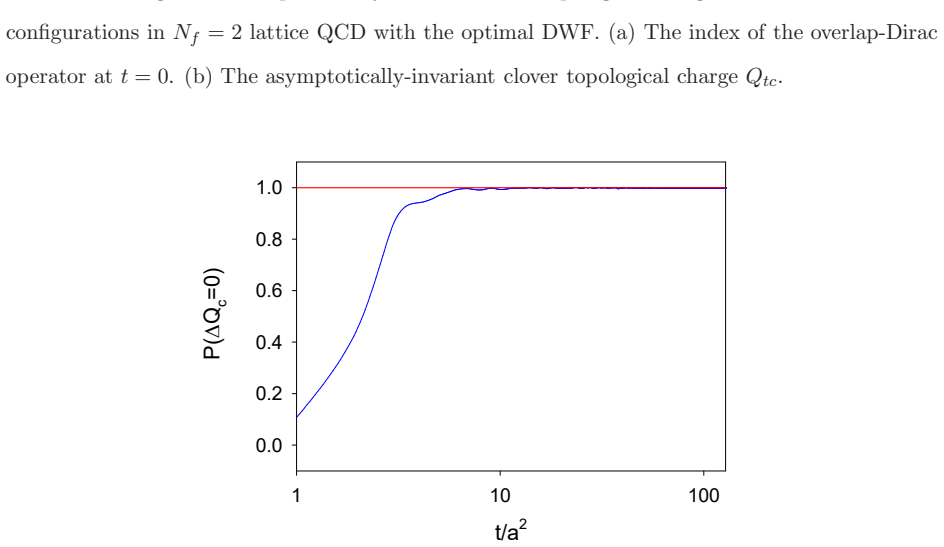
The load-bearing objects are the overlap-Dirac operator index and the Wilson-flowed clover charge. The index, $\mathrm{index}(D_o)=n_+-n_-$, counts exact zero modes of definite chirality and is tied to the index theorem, so it provides a reference 'genuine' topological charge even on rough lattice fields. The Wilson flow smooths the gauge field by evolving it through $dB_\mu/dt=D_\nu G_{\nu\mu}$, averaging over a sphere of radius $\sqrt{8t}$; the clover charge $Q_{\mathrm{clover}}(t)$ is computed from the flowed links via the field-strength tensor. Rounding gives $Q_c(t)$, and the paper's criterion is that $Q_c$ becomes invariant for $t\ge t_c$, meaning the configuration has settled into a topological sector. The argument is carried by comparing the two charges: at $t=0$ they differ per configuration in 31.2% of cases, but at $t\ge t_c$ the index of the flowed configuration equals $Q_c$ exactly, and the ensemble distributions coincide.
What would settle it
On this same ensemble, compute the fourth cumulant $c_4$ of the topological charge distribution from the overlap index and from $Q_{tc}$. If they disagree beyond statistical error, the claim that $Q_{tc}$ captures the full topological fluctuations of the vacuum is false, because $c_4$ is part of the distribution the paper claims to reproduce.
Extended reading notes
Core claim
The paper's central result is that the asymptotic rounded clover charge in the Wilson flow, $Q_{tc}$, is a valid proxy for the topological charge of lattice QCD configurations with exact chiral symmetry. Using 535 configurations at $a\simeq0.06$ fm and $M_\pi\simeq260$ MeV, the authors find that $Q_c(t)=\mathrm{round}[Q_{\mathrm{clover}}(t)]$ becomes invariant for $t\ge t_c$, with $\max\{t_c\}\sim77$, and that for every configuration the overlap-Dirac index computed on the flowed gauge field at $t=77$ equals $Q_{tc}$. Although 167 of the 535 configurations have $Q_{tc}\ne\mathrm{index}(D_o)$ at $t=0$, the probability distributions are nearly identical, and the resulting susceptibilities agree: $\chi_t a^4=6.03(61)\times10^{-7}$ from $Q_{tc}$ versus $7.03(91)\times10^{-7}$ from the overlap index. The paper concludes that Wilson-flow clover charges can replace overlap index computations for determining topological fluctuations in exact-chiral-symmetry lattice QCD.
Load-bearing premise
The argument assumes that the integer value the rounded clover charge settles on at large Wilson-flow time is the true topological charge of the underlying gauge field, even though 31.2% of the configurations change their integer charge during the flow relative to the overlap index at $t=0$.
Editorial extensions
If this is right
- Topological susceptibility in exact-chiral-symmetry lattice QCD can be obtained from Wilson-flowed clover charges, avoiding the cost of projecting overlap zero modes for every configuration.
- The theoretically justified protocol is to flow every configuration until its rounded clover charge is invariant (i.e., up to $t=\max\{t_c\}$), rather than stopping at the susceptibility plateau near $t\sim10$.
- Because the histograms of $Q_{tc}$ and the overlap index are almost identical, the paper asserts that the full topological charge distribution—and higher moments such as $c_4$ and beyond—can also be obtained from $\{Q_{tc}\}$.
- The overlap-Dirac index is almost invariant under the Wilson flow: computing it at $t=t_c$ reproduces $Q_{tc}$, so the exact-chiral-symmetry charge is stable once configurations become smooth.
Reading between the lines
- The 31.2% per-configuration mismatch shows the flow moves individual configurations across topological sector boundaries; the paper's agreement is statistical, not a statement that each configuration's charge is preserved. A natural follow-up is to check whether the fourth cumulant $c_4$ from $Q_{tc}$ matches the overlap-index value, since matching only $\chi_t$ is a weaker test.
- Repeating the comparison on coarser lattices ($a>0.1$ fm) would test whether $Q_{tc}$ remains faithful; the paper itself flags lattice artifacts there as a possible place where the picture could change.
- If the distribution-level agreement persists in larger volumes, Wilson flow could serve as a much cheaper way to map topological fluctuations across the QCD phase diagram, feeding axion-cosmology estimates without fermion zero-mode computations.
Signed reviews
Editorial analysis
A structured set of objections, weighed in public.
Referee Report
Summary. This paper studies the topological charge in N_f=2 lattice QCD with the optimal domain-wall fermion, using 535 configurations on a 24^4 x 48 lattice at a = 0.06 fm and M_pi = 260 MeV. For each configuration, the index of the overlap-Dirac operator is computed at flow time t=0, and the clover topological charge Q_clover(t) is integrated along the Wilson flow from t=0 to t=128 with delta_t=0.01. The authors observe that the rounded charge Q_c(t) = round[Q_clover(t)] becomes invariant for t >= t_c, with max{t_c} ~ 77. Comparing the asymptotically invariant Q_{tc} with the overlap index at t=0, they find disagreement on 31.2% of configurations, but the histograms are reported as 'almost identical,' and the topological susceptibility computed from Q_{tc} is chi_t a^4 = 6.03(61) x 10^-7, consistent with the overlap-index value 7.03(91) x 10^-7. They also verify that at t=77 the overlap index exactly equals Q_{tc} for all configurations. The paper concludes that the topological susceptibility, and by extension higher moments, of lattice QCD with exact chiral symmetry can be obtained from the asymptotically invariant Q_{tc} in the Wilson flow.
Significance. If the central result holds, the paper provides a practical prescription for extracting the topological susceptibility from Wilson-flowed clover charges, benchmarked against the exact chiral symmetry of the overlap-Dirac operator. The numerical work is careful: eigenmodes are computed with residual 10^-12, the sign function error is below 10^-14, and the flow is integrated with a fine step to large t. The explicit cross-check that the overlap index at t=77 equals Q_{tc} for every configuration is a useful consistency test. The agreement of the second moment, chi_t a^4 = 6.03(61) x 10^-7 versus 7.03(91) x 10^-7, is a nontrivial quantitative result. However, the paper's reach exceeds its evidence: the per-configuration mismatch of 31.2% means the claim reduces to an equality of the second moment only, and the extension to higher moments (c4, ...) in the concluding paragraph is not supported by any computation. The single-ensemble, single-lattice-spacing character of the study is also a limitation that the authors themselves partially acknowledge in the final paragraph.
major comments (3)
- [Final paragraph and the paragraph after Fig. 5] The concluding statement that the results imply the topological fluctuations '(χt, c4, ···)' can be obtained from Qtc is not supported by the data presented. The paper computes only the second moment, Eqs. (4) and (6), and shows visually in Fig. 1 that two histograms look similar. Since 167 of 535 configurations have Qtc ≠ index(D_o) at t=0, equality of the second moment does not imply equality of the fourth cumulant or higher moments. To make the claimed inference, the authors should either compute c4 (and ideally a test of distributional equality such as a chi-square or Kolmogorov-Smirnov statistic) from the Qtc and overlap-index histograms, or explicitly restrict the conclusion to χt.
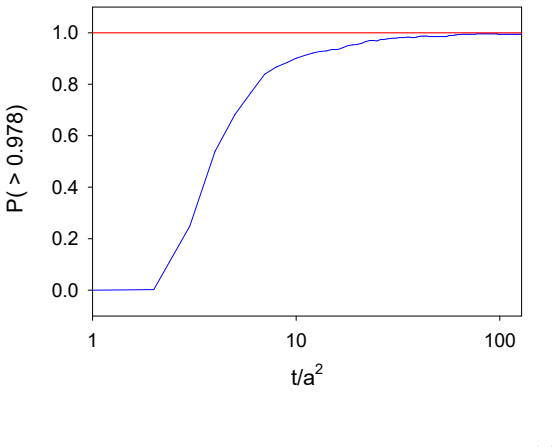
- [Section 4, paragraph after Fig. 3 and before Eq. (6)] The statement that for t ≥ max{t_c} the ensemble 'decomposes into topological sectors, similar to the gauge fields in the continuum theory' is an assumption, not an established fact. The observed per-configuration difference between Qtc and the overlap index at t=0 means that at least one of the two definitions changes under the flow for 31.2% of configurations. The verification that index(D_o) at t=77 equals Qtc shows consistency of the two definitions on the flowed gauge field, but it does not demonstrate that either equals the topological charge of the original configuration at t=0. The paper should state this more carefully: the susceptibility agreement is evidence for a distribution-level match of the second moment, not for per-configuration identification of the topological sector. A quantitative comparison of higher moments would materially strengthen this load-bearing point.
- [Eqs. (4) and (6) and Fig. 5] The agreement between χt a^4 = 6.03(61) × 10^-7 and 7.03(91) × 10^-7 is within about one standard deviation, but no significance level or systematic difference is quoted. Given that the paper's central numerical claim is this agreement, the authors should report the difference and its combined uncertainty, and ideally a p-value, rather than relying only on overlapping error bars and a visual inspection of histograms.
minor comments (4)
- [Title] The title contains a typo: 'susceptibilty' should be 'susceptibility', and the line break in 'cl over' should be removed.
- [Fig. 5 caption / text near Eq. (6)] The text 'agress' should be 'agrees'.
- [Numerical integration section] The Wilson flow is integrated with δt = 0.01, but no estimate of the systematic error from the finite step size is given. A brief test with a smaller step on a few configurations would clarify the robustness of the plateau and of the threshold max{t_c}.
- [Figs. 2 and 3] The vertical axes are labeled 'P(ΔQc=0)' and 'P(>0.978)' without defining what P denotes; the text implies it is a fraction of configurations, but the notation should be made explicit in the figure captions.
Circularity Check
No circular reduction: the susceptibility comparison is against an independent overlap-index benchmark; the flow-time threshold is not fitted to that benchmark.
full rationale
The paper's central quantitative result is a comparison between two independently measured quantities: the overlap-Dirac index at t=0, giving chi_t a^4 = 7.03(91) x 10^-7 (Eq. 4), and the Wilson-flow rounded clover charge Qtc, giving chi_t a^4 = 6.03(61) x 10^-7 (Eq. 6). There is no fitting parameter connecting these values, and the flow-time threshold max{tc} ~ 77 is selected from the observed invariance of Qc, not from the index or from the susceptibility. The later check that Qtc equals index(D_o) at t=77 is a consistency check on the flowed gauge field itself, not an input that forces the t=0 distribution agreement; indeed, the paper explicitly reports that 31.2% of configurations have Qtc != index(D_o) at t=0, so the histogram agreement is an empirical finding rather than a construction. The self-citations ([9], [11], [12]) provide the gauge ensemble and the numerical eigensolver procedures, but they do not supply the susceptibility result or any uniqueness theorem that would make the conclusion automatic. The final limitations—uncertainty for non-chiral fermions, possible artifacts at a > 0.1 fm, and the uncomputed higher moments c4—are correctness/validity concerns, not circularity. No equation in the paper reduces by definition to its own output, and no fitted input is relabeled as a prediction. The derivation chain is therefore self-contained with respect to circularity.
Assumptions & free parameters
free parameters (1)
- Flow-time threshold max{tc} =
~ 77 (largest flow time at which any configuration's round[Qclover(t)] last changes; determined from this ensemble)
assumptions (4)
- standard math The overlap-Dirac operator index on a gauge configuration equals the topological charge Q_t via n_+ - n_- (Atiyah-Singer index theorem).
- domain assumption A sufficiently smooth lattice configuration, with all plaquette values above 44/45, has a well-defined and stable topological sector under continuous deformations (Luscher condition, Eq. (5)).
- domain assumption The clover field strength of the flowed configuration gives an integer charge whose rounding is the true topological charge, with lattice artifacts suppressed by the flow.
- domain assumption The single 535-configuration ensemble at one lattice spacing, one volume, and one pion mass is representative enough to infer the equivalence of the susceptibility and, by implication, higher moments.
Cite this review
Pith. "Pith review of Topological susceptibilty in lattice QCD with exact chiral symmetry -- the index of overlap-Dirac operator versus the clover topological charge in Wilson flow." pith.science (2026). https://pith.science/paper/LFONGCAE
@misc{pith2026190801676,
  author       = {Pith},
  title        = {Pith review of: Topological susceptibilty in lattice QCD with exact chiral symmetry -- the index of overlap-Dirac operator versus the clover topological charge in Wilson flow},
  year         = {2026},
  howpublished = {\url{https://pith.science/paper/LFONGCAE}},
  note         = {Machine review of arXiv:1908.01676}
}
abstract
Using an ensemble of 535 gauge configurations (on the $24^4 \times 48 $ lattice with $ a \simeq 0.06 $~fm and $ M_{\pi} \simeq 260 $~MeV) which are generated by hybrid Monte Carlo (HMC) simulation of $N_f=2$ lattice QCD with the optimal domain-wall quark, we compute the index of the overlap-Dirac operator, and also measure the clover topological charge in the Wilson flow, $Q_{\text{clover}}(t) $, by integrating the flow equation from $ t = 0 $ to $ t = 128 $ with $\delta t = 0.01 $. We observe that $Q_{\text{clover}}(t) $ of each configuration converges to a value close to an integer, and its nearest integer $Q_c(t) = \text{round} [Q_{\text{clover}}(t)] $ becomes invariant for $ t \ge t_c $, with the $ \max\{t_c \} \sim 77 $ for all 535 configurations. For each configuration, we compare the asymptotically-invariant $ Q_c $ with the index of overlap-Dirac operator at $t=0$. It turns out that there are 167 configurations with $Q_c \ne \text{index}(D_{o}) $, amounting to $31.2\%$ of the total 535 configurations. However, the histograms of $ Q_c $ and $ \text{index}(D_o) $ are almost identical. Consequently, the topological susceptibility using the asymptotically-invariant $ Q_c $ agrees with that using the index of overlap-Dirac operator at $ t=0 $. This implies that the topological susceptibility in lattice QCD with exact chiral symmetry can be obtained from the asymptotically-invariant $ Q_c $ in the Wilson flow.
Figures

Figures from the paper (2 more)


Forward citations
Cited by 1 Pith paper
-
Lattice gradient flows (de-)stabilizing topological sectors
Iwasaki and DBW2 gradient flows keep the topological charge of SU(2) gauge configurations stable at long flow times, unlike Wilson and Symanzik flows; DBW2 quantizes the charge already near t=0.5.
Reference graph
Works this paper leans on
-
[1]
The Quantum Theory of Fields. Vol. 2: Moder n Applications,
S. Weinberg, “The Quantum Theory of Fields. Vol. 2: Moder n Applications,” (Cambridge University Press, England, 1996)
work page 1996
-
[2]
M. Srednicki, “Quantum Field Theory,” (Cambridge Unive rsity Press, England, 2007)
work page 2007
- [3]
-
[4]
Luscher, JHEP 1008, 071 (2010), Erratum: [JHEP 1403, 092 (2014)] [arXiv:1006.4518 [hep-lat]]
M. Luscher, JHEP 1008, 071 (2010), Erratum: [JHEP 1403, 092 (2014)] [arXiv:1006.4518 [hep-lat]]
arXiv 2010
-
[5]
D. B. Kaplan, Phys. Lett. B 288, 342 (1992) [hep-lat/9206013]. 10
arXiv 1992
- [6]
-
[7]
R. Narayanan and H. Neuberger, Nucl. Phys. B 443, 305 (1995) [hep-th/9411108]
arXiv 1995
-
[8]
T. W. Chiu, Phys. Rev. Lett. 90, 071601 (2003) [hep-lat/0209153]
arXiv 2003
Show all 14 references
-
[9]
W. P. Chen, Y. C. Chen, T. W. Chiu, H. Y. Chou, T. S. Guu, T. H. Hsieh [TWQCD Collab- oration], Phys. Lett. B 736, 231 (2014) [arXiv:1404.3648 [hep-lat]]
2014 arXiv
-
[10]
Yamazaki, Z
I. Yamazaki, Z. Bai, H. Simon, L.W. Wang, and K. Wu, ACM Tr ansactions on Mathematical Software, Vol. 37, No. 3, Article 27 (2010)
2010
-
[11]
T. W. Chiu, T. H. Hsieh, Y. Y. Mao [TWQCD Collaboration], Phys. Lett. B 702, 131 (2011) [arXiv:1105.4414 [hep-lat]]
2011 arXiv
-
[12]
T. W. Chiu, T. H. Hsieh [TWQCD Collaboration], PoS IWCSE 2013, 058 (2014). [arXiv:1412.2505 [hep-lat]]
2014 arXiv
-
[13]
Luscher, Commun
M. Luscher, Commun. Math. Phys. 85, 39 (1982)
1982
-
[14]
Phillips and D
A. Phillips and D. Stone, Commun. Math. Phys. 103, 599 (1986). 11
1986
Reviewed August 14, 2026 · model on record in the stance chip above.
Discussion (0). Continue with ORCID to comment.