REVIEW 4 major objections 5 minor 27 references
Nonlinear transmission of laser light through coronal plasma due to self-induced incoherence
T0 review · 4 major / 5 minor · reviewed 2026-08-14 · deepseek-v4-flash
Pith's one-line read A dynamic saturation of absolute SRS, driven by self-induced incoherence, restores laser-light transmission through the instability region.
desk verdict Self-induced incoherence is a plausible new saturation route for absolute SRS, cleanly demonstrated in fluid simulations, but the kinetic closure and the leap to NIF observations are the parts to probe in review. read the letter →
The pith
A machine-rendered reading of the paper's core claim, the machinery that carries it, and where it could break.
The reading
What carries the argument
The load-bearing mechanism is self-induced incoherence: the laser drives a primary SRS decay; the resulting electron plasma waves drive a transverse scattering instability that excites a broad spectrum of low-frequency ion-acoustic fluctuations via their ponderomotive force; those fluctuations both detune the primary SRS resonance and seed near-forward stimulated Brillouin scattering, modulating the transmitted light with transverse scale $\sim 2\lambda_0$ and period $\sim 1$ ps. The analysis is carried by a four-wave fluid model (three time-enveloped equations for the laser, Raman, and electron plasma-wave fields plus a non-enveloped equation for the low-frequency density perturbation), closed with collisional and Landau damping, together with the transverse-instability dispersion relation, Eq. (1), whose threshold is exceeded during the growth stage.
What would settle it
A kinetic simulation or a two-region experiment with the same density scale length and temperatures could search for the predicted broadband ion-acoustic fluctuation spectrum near quarter critical; dynamic saturation requires strong low-frequency density perturbations with transverse scale about $5\lambda_0$ and correlation time about $1$ ps, and a transmitted-light spectrum with Stokes/anti-Stokes sidebands near $10^{-3}\omega_0$. If transmission stays near the pump-depletion value while those fluctuations are absent, the mechanism is not the operative saturation path.
Extended reading notes
Core claim
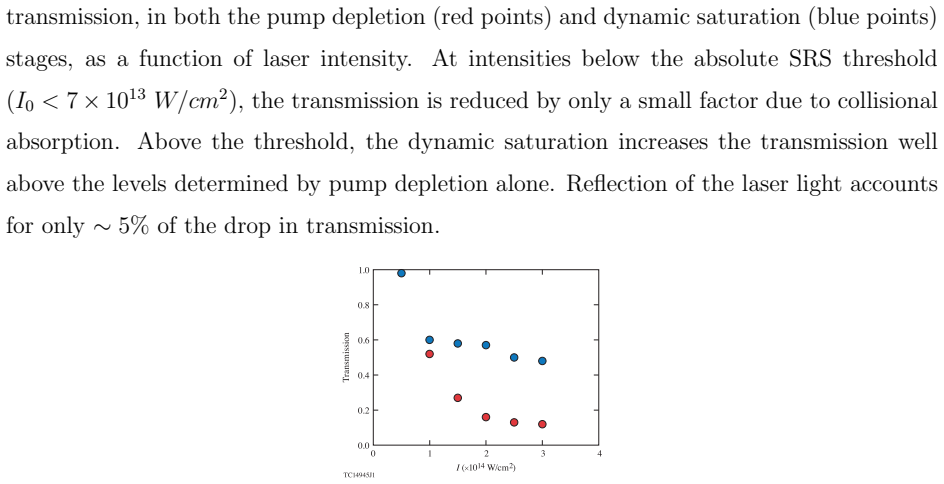
The paper reports a previously undescribed dynamic saturation regime of the absolute stimulated Raman scattering (SRS) instability. In this regime, the electron plasma waves driven by SRS undergo a transverse scattering instability whose ponderomotive force generates a broad spectrum of low-frequency ion-acoustic density fluctuations. These fluctuations detune the primary SRS resonance and seed near-forward Brillouin scattering of the laser light, making both the transmitted light and the scattered light spatiotemporally incoherent. The incoherence arrests the pump depletion that would otherwise stop the light, raising the transmission through the instability region from T=0.16 to T=0.59 at an incident intensity of $2\times10^{14}\,\mathrm{W/cm^2}$ for ignition-relevant parameters. The paper argues this answers how laser energy can penetrate deep into the corona of a direct-drive target.
Load-bearing premise
The load-bearing premise is that the fluid plasma model, closed with Landau damping, captures the nonlinear evolution: if kinetic saturation such as particle trapping, or three-dimensional geometry, changes how the density fluctuations detune the resonance, the predicted transmission increase may not occur.
Editorial extensions
If this is right
- At $I_0=2\times10^{14}\,\mathrm{W/cm^2}$, transmission through the instability region rises from $T=0.16$ in the pump-depletion stage to $T=0.59$ in the dynamic saturation stage, a near-fourfold increase in power reaching deeper corona.
- Above the absolute SRS threshold, dynamic saturation keeps transmission well above the levels set by pump depletion alone for all intensities studied, while reflection accounts for only about 5% of the lost light.
- The transmitted light develops Stokes and anti-Stokes sidebands near $10^{-3}\omega_0$, matching the $\sim1$ ps Poynting-flux oscillations and the ion-acoustic sound speed, and the spectral width grows with incident intensity.
- Coexisting secondary processes, including Langmuir decay instability and a few percent Brillouin backscatter, do not prevent the transmission increase.
- Simulations with wider plasma regions and wider incident beams show similar instability evolution and dynamic saturation, indicating the result is not tied to a particular transverse box size.
Reading between the lines
- Beyond the paper: the same resonance-detuning mechanism could also saturate absolute two-plasmon decay or stimulated Brillouin scattering wherever a narrow resonance is required for absolute growth.
- Beyond the paper: the self-induced incoherence scale ($\sim 2\lambda_0$ transverse, $\sim 1$ ps temporal) suggests that externally imposed laser bandwidth or beam smoothing could either seed or suppress the detuning, an effect testable with controlled intensity histories.
- Beyond the paper: because the model uses a fluid closure with Landau damping at $k_e\lambda_{De}\approx0.15$, kinetic simulations of the same parameters should show whether trapped-particle nonlinearity changes the plasma-wave spectrum before the detuning threshold is reached.
Signed reviews
Editorial analysis
A structured set of objections, weighed in public.
Referee Report
Summary. The manuscript reports a new dynamic saturation regime for the absolute stimulated Raman scattering (SRS) instability in laser-driven ICF coronae. Using two-dimensional LPSE fluid simulations with parameters relevant to NIF direct-drive conditions, the authors show that SRS-generated electron plasma waves undergo a transverse scattering instability, driving broadband, low-frequency ion-acoustic density fluctuations. These fluctuations detune the primary SRS resonance and seed near-forward stimulated Brillouin scattering, converting the initially coherent pump depletion into a spatiotemporally incoherent state. As a result, the transmitted laser power through the instability region increases from T = 0.16 in the pump-depletion stage to T = 0.59 in the dynamic saturation stage. The authors argue that this mechanism explains how laser light can reach high-density regions of direct-drive ICF targets despite absolute SRS, and they provide scaling of transmission with laser intensity, spectral signatures of near-forward SBS, and spatial spectra supporting the proposed chain of instabilities.
Significance. If correct, this result addresses a long-standing puzzle in direct-drive ICF: how laser energy penetrates the quarter-critical density region where absolute SRS would otherwise deplete it. The paper's strengths include a clearly posed mechanistic chain, well-documented simulation diagnostics, a transparent set of parameters, and a falsifiable quantitative claim (the transmission increase from 0.16 to 0.59, with intensity-dependent scaling). The result is not fitted to the experimental coupling; it emerges from the simulation model. However, the central claim rests on the adequacy of a fluid closure for electron plasma waves at k_e\lambda_De \approx 0.15, and this is not quantitatively benchmarked against kinetic effects or against the cited NIF experiment. The proposed mechanism is plausible and internally consistent, but the current evidence is not sufficient to establish it as the explanation for the experimental coupling observations.
major comments (4)
- [LPSE model, Eq. (4) and the 'fluid-like regime' sentence] The assertion that the electron plasma wave dynamics are in a 'fluid-like regime' and that Landau damping is sufficient is not quantitatively justified. At k_e\lambda_De \approx 0.15, the normalized EPW potential is e\phi/T_e = 2\sqrt{I_p}/(k_e\lambda_De) \approx 13\sqrt{I_p}; for I_p at the few-percent level, this is O(1), the regime where trapped-electron nonlinearity and amplitude saturation (refs. 17-21) are known to compete with, and often preempt, fluid-like decay instabilities. The paper provides no comparison of the electron bounce frequency, trapping-induced frequency shift, or saturation level against the SRS growth rate, and no kinetic simulation. Because the proposed detuning chain requires the SRS-generated EPWs to reach amplitudes large enough to drive Eq. (1), this is a load-bearing unverified assumption.
- [Eq. (1) and the discussion of the transverse instability threshold] The statement that the threshold for the transverse instability is 'readily exceeded' is qualitative. Equation (1) defines the growth rate in terms of the normalized plasma wave intensity I_p and the damping rates \gamma_i and \gamma_p, but the manuscript does not report the simulated values of I_p, the relevant k_y, or the threshold margin at the parameters of Figs. 1-4. Since the entire dynamic saturation mechanism depends on this secondary instability growing to sufficient amplitude, the paper should provide a quantitative evaluation of Eq. (1) in the simulation, or a direct measurement of the growth of the transverse ion-acoustic fluctuations.
- [Eq. (3) in the LPSE model] As printed, Eq. (3) for the Raman scattered light has a source term proportional to (\nabla\cdot\hat E_p^*)\hat E_1, which contains the unknown field \hat E_1 on both sides and does not involve the pump field \hat E_0. This is not the standard SRS coupling term and is inconsistent with the three-wave structure of Eqs. (2)-(5). This appears to be a typographical error, but it prevents the model from being reproduced as written and should be corrected, presumably by inserting the pump field in the source term.
- [Abstract and final paragraph, comparison with NIF experiments] The claim that the mechanism 'explains the coupling of laser light to ICF targets at higher plasma densities' goes beyond what the simulations alone demonstrate. The cited NIF experiment (ref. 11) is not directly compared in terms of transmitted power, SRS/SBS spectra, or density-scale-length dependence, and the transmission values are not checked against experimental reflectivity or energy deposition. The paper should either add a quantitative comparison to the relevant experimental observables or temper the explanatory claim to state that the simulations are consistent with the parameter regime of the experiment.
minor comments (5)
- [Fig. 2 and transmission definition] The transmission T is not explicitly defined in the text or figure caption; please specify the spatial and temporal averaging used to obtain the red and blue data points, and indicate whether the same averaging is used for the pump-depletion and dynamic-saturation stages.
- [Simulation robustness paragraph] The statement that 'simulations with a wider plasma and incident laser beam exhibited similar instability evolution and dynamic saturation' is not quantified; please provide the wider dimensions, the resulting transmission values, or a comparison figure.
- [Conclusion paragraph] There is a typo in 'acknowlegde' in the acknowledgments, and 'spectum' in the conclusion should be 'spectrum'.
- [Reference [25]] Please verify the volume and page numbers of reference [25]; the citation as given appears to have an incorrect volume for a 2018 publication in Physics of Plasmas.
- [Table I] The density range is written as '(0.21 to 0.265) nc'; for clarity, please write it as '0.21 n_c to 0.265 n_c' or a similar unambiguous notation.
Circularity Check
No circularity: the transmission values are emergent simulation outputs, not fitted inputs or self-cited conclusions.
full rationale
The paper's central quantitative claims are LPSE simulation outputs: the laser transmission rises from T=0.16 in the pump-depletion stage to T=0.59 in the dynamic-saturation stage, and this increase is reported as a computed result, not as a parameter fitted to any observation. The model equations (2)-(5) evolve the pump, Raman, electron-plasma-wave, and low-frequency ion-density fields self-consistently; the ion-acoustic fluctuations that detune the SRS resonance are generated by the simulation dynamics (Eq. 5), not inserted by hand to produce the desired transmission. No quantity such as the detuning level, the SBS seed, or the final transmission is extracted from the NIF experimental data it is said to explain; instead, the NIF parameters in Table I set the simulation inputs and the transmission is measured from the simulation. The self-citations to LPSE [23-25] are code and method references, and the paper does not invoke them as proof of the new dynamic-saturation mechanism; the mechanism is evidenced by in-paper spectra and Poynting-flux diagnostics (Figs. 1-4). The ke_lambda_De about 0.15 'fluid-like regime' statement is a modeling assumption supported by external references [26,27] and is not a reduction of the conclusion to its own premise; whether kinetic trapping effects would alter the outcome is a correctness and validation concern, not circularity. Therefore no circular step can be exhibited under the required standard.
Assumptions & free parameters
free parameters (2)
- Electron plasma wave collisional damping rate =
1 ps^-1
- Ion-acoustic Landau damping rate coefficient =
0.1 k c_s
assumptions (4)
- domain assumption LPSE fluid model (Eqs. 2-5) accurately models the coupled laser, Raman, electron plasma, and ion-acoustic waves with the stated damping closures.
- domain assumption The SRS-generated electron plasma waves are in a fluid-like regime with ke lambda_De approximately 0.15, so Landau damping closure suffices and kinetic trapping is negligible.
- standard math The transverse plasma wave instability dispersion relation (Eq. 1) applies to the simulated electron plasma waves.
- domain assumption Two-dimensional, s-polarized geometry captures the essential dynamics of the three-dimensional corona.
Cite this review
Pith. "Pith review of Nonlinear transmission of laser light through coronal plasma due to self-induced incoherence." pith.science (2026). https://pith.science/paper/UWRAJVBB
@misc{pith2026190801684,
  author       = {Pith},
  title        = {Pith review of: Nonlinear transmission of laser light through coronal plasma due to self-induced incoherence},
  year         = {2026},
  howpublished = {\url{https://pith.science/paper/UWRAJVBB}},
  note         = {Machine review of arXiv:1908.01684}
}
read the original abstract
The success of direct laser-driven inertial confinement fusion (ICF) relies critically on the efficient coupling of laser light to plasma. At ignition scale, the absolute stimulated Raman scattering (SRS) instability can severely inhibit this coupling by redirecting and strongly depleting laser light. This Letter describes a new dynamic saturation regime of the absolute SRS instability. The saturation occurs when spatiotemporal fluctuations in the ion-acoustic density detune the instability resonance. The dynamic saturation mitigates the strong depletion of laser light and enhances its transmission through the instability region, explaining the coupling of laser light to ICF targets at higher plasma densities.
Figures


Figures from the paper (1 more)

Reference graph
Works this paper leans on
-
[1]
R. S. Craxton, K. S. Anderson, T. R. Boehly, V. N. Goncharov, D. R. Harding, J. P. Knauer, R. L. McCrory, P. W. McKenty, D. D. Meyerhofer, J. F. Myatt et al., Phys. Plasmas 22, 110501 (2015)
work page 2015
-
[2]
V. N. Goncharov, T. C. Sangster, R. Betti, T. R. Boehly, M. J. Bonino, T. J. B. Collins, R. S. Craxton, J. A. Delettrez, D. H. Edgell, R. Epstein et al., Phys. Plasmas 21, 056315 (2014)
work page 2014
-
[3]
W. L. Kruer, The Physics of Laser-Plasma Interactions (Westview Press, Colorado, 2003)
work page 2003
-
[4]
J. F. Myatt, J. Zhang, R. W. Short, A. V. Maximov, W. Seka, D. H. Froula, D. H. Edgell, D. T. Michel, I. V. Igumenshchev, D. E. Hinkel, P. Michel, and J. D. Moody, Phys. Plasmas 21, 055501 (2014)
work page 2014
-
[5]
V. N. Goncharov, T. C. Sangster, P. B. Radha, R. Betti, T. R. Boehly, T. J. B. Collins, R. S. Craxton, J. A. Delettrez, R. Epstein, V. Yu. Glebov et al., Phys. Plasmas 15, 056310 (2008)
work page 2008
-
[6]
J. F. Drake and Y. C. Lee, Phys. Rev. Lett. 31, 1197 (1973)
work page 1973
-
[7]
C. S. Liu, M. N. Rosenbluth, and R. B. White, Phys. Fluids 17, 1211 (1974)
work page 1974
-
[8]
J. L. Kline, D. S. Montgomery, B. Bezzerides, J. A. Cobble, D. F. DuBois, R. P. Johnson, H. A. Rose, L. Yin, and H. X. Vu, Phys. Rev. Lett. 94, 175003 (2005)
work page 2005
Show all 27 references
-
[9]
D. J. Strozzi, D. S. Bailey, P. Michel, L. Divol, S. M. Sepke, G. D. Kerbel, C. A. Thomas, J. E. Ralph, J. D. Moody, and M. B. Schneider, Phys. Rev. Lett. 118, 025002 (2017)
2017
-
[10]
D. S. Montgomery, Phys. Plasmas 23, 055601 (2016)
2016
-
[11]
M. J. Rosenberg, A. A. Solodov, J. F. Myatt, W. Seka, P. Michel, M. Hohenberger, R. W. Short, R. Epstein, S. P. Regan, E. M. Campbell, T. Chapman, C. Goyon, J. E. Ralph, M. A. Barrios, J. D. Moody, and J. W. Bates, Phys. Rev. Lett. 120, 055001 (2018)
2018
-
[12]
D. F. DuBois and M. V. Goldman, Phys. Rev. 164, 207 (1967)
1967
-
[13]
J. A. Heikkinen and S. J. Karttunen, Phys. Fluids 29, 1291 (1986). 10
1986
-
[14]
Kolber, W
T. Kolber, W. Rozmus, and V. T. Tikhonchuk, Phys. Fluids B 5, 138 (1993)
1993
-
[15]
Depierreux, C
S. Depierreux, C. Labaune, J. Fuchs, D. Pesme, V. T. Tikhonchuk, and H. A. Baldis, Phys. Rev. Lett. 89, 045001 (2002)
2002
-
[16]
J. P. Palastro, E. A. Williams, D. E. Hinkel, L. Divol, and D. J. Strozzi, Phys. Plasmas 16, 092304 (2009)
2009
-
[17]
H. X. Vu, D. F. DuBois, and B. Bezzerides, Phys. Rev. Lett. 86, 4306 (2001)
2001
-
[18]
H. X. Vu, L. Yin, D. F. DuBois, B. Bezzerides, and E. S. Dodd, Phys. Rev. Lett. 95, 245003 (2005)
2005
-
[19]
L. Yin, B. J. Albright, K. J. Bowers, W. Daughton, and H. A. Rose, Phys. Rev. Lett. 99, 265004 (2007)
2007
-
[20]
D. J. Strozzi, E. A. Williams, A. B. Langdon, and A. Bers, Phys. Plasmas 14 013104 (2007)
2007
-
[21]
P. E. Masson-Laborde, W. Rozmus, Z. Peng, D. Pesme, S. Huller, M. Casanova, V. Yu. Bychenkov, T. Chapman, and P. Loiseau, Phys. Plasmas 17 092704 (2010)
2010
-
[22]
B. J. Winjum, J. E. Fahlen, F. S. Tsung, and W. B. Mori, Phys. Rev. Lett. 110, 165001 (2013)
2013
-
[23]
J. F. Myatt, R. K. Follett, J. G. Shaw, D. H. Edgell, D. H. Froula, I. V.Igumenshchev, and V. N. Goncharov, Phys. Plasmas 24, 056308 (2017)
2017
-
[24]
R. K. Follett, J. G. Shaw, J. F. Myatt, J. P. Palastro, R. W. Short, and D. H. Froula Phys. Rev. Lett. 120, 135005 (2018)
2018
-
[25]
J. P. Palastro, J. G. Shaw, R. K. Follett, A. Colaitis, D. Turnbull, A. V. Maximov, V. N. Goncharov, and D. H. Froula, Phys. Plasmas 16, 123104 (2018)
2018
-
[26]
L. Yin, B. J. Albright, H. A. Rose, D. S. Montgomery, J. L. Kline, R. K. Kirkwood, J. Milovich, S. M. Finnegan, B. Bergen, and K. J. Bowers, Phys. Plasmas 21, 092707 (2014)
2014
-
[27]
D. T. Michel, S. Depierreux, C. Stenz, V. Tassin, and C. Labaune, Phys. Rev. Lett. 104, 255001 (2010). 11
2010
Reviewed August 14, 2026 · model on record in the stance chip above.
Discussion (0). Continue with ORCID to comment.