REVIEW 3 major objections 4 minor 89 references
Internal Shocks from Variable Outflows in Classical Novae
T0 review · 3 major / 4 minor · reviewed 2026-08-14 · deepseek-v4-flash
Pith's one-line read The paper argues that the multi-peaked light curves, correlated gamma-ray and optical flares, and lagging photosphere expansion seen in classical novae can all be produced by repeated internal radiative shocks from a fast outflow…
desk verdict A professionally executed 1D radiative-hydro study that makes a plausible case for multiple outflow transitions in novae, but several headline agreements are built into the input assumptions rather than independently predicted. read the letter →
The pith
A machine-rendered reading of the paper's core claim, the machinery that carries it, and where it could break.
The reading
What carries the argument
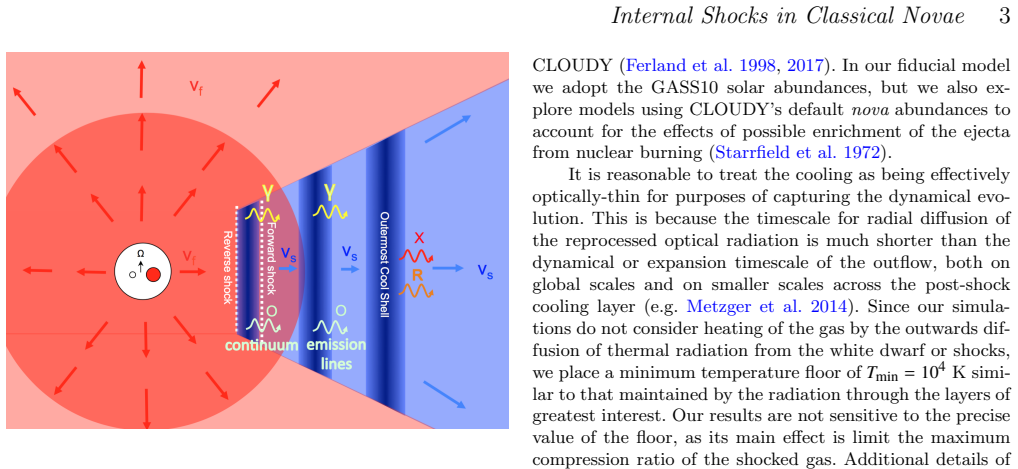
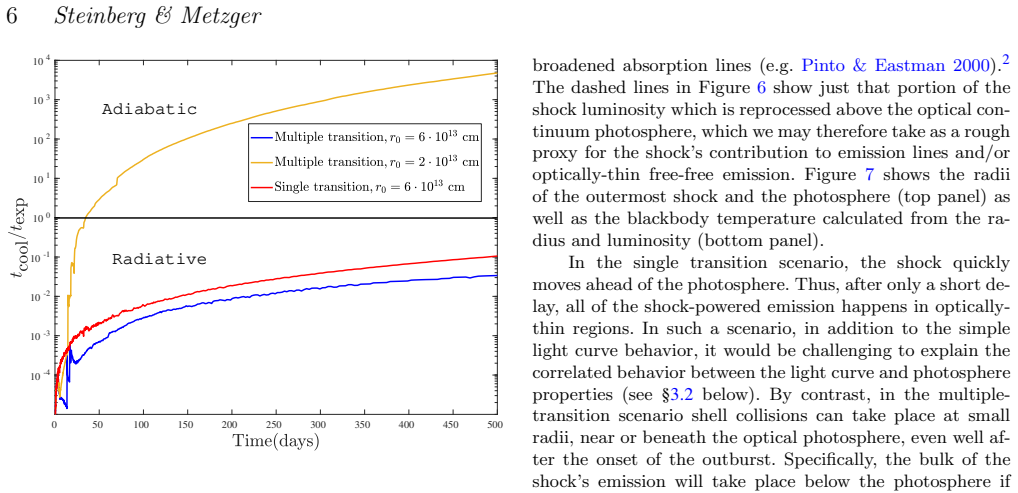
The central object is the internal forward-reverse shock structure formed where the fast outflow catches the slow outflow, with post-shock gas cooling efficiently as a radiative shock to about $10^4$ K and compressing by a factor roughly $\mathcal{M}^2$, where $\mathcal{M}$ is the shock Mach number. The calculations are one-dimensional hydrodynamical simulations with radiative losses, run for a single-transition model, a multiple-transition model, and a bumpy-medium model that varies the mass and homogeneity of the pre-existing slow outflow. The key identity is the thin-shell photosphere-crossing timescale $t_{\rm thin} \approx \dot{M}\kappa_{\rm opt}/(4\pi v_f v_s)$, which determines whether a shock releases most of its energy below or above the optical photosphere, and therefore whether the reprocessed emission appears in the continuum or in emission lines.
What would settle it
Search for a multi-peaked nova whose keV X-ray or 10 GHz radio emission turns on during the same epoch as its gamma-ray and optical flares: the model places those bands behind large absorbing columns for weeks to months, with keV X-rays emerging only when the external column drops below $\tau \simeq 1$, so an early coincident bright radio or keV X-ray flare would rule out the embedded-shock timing.
Extended reading notes
Core claim
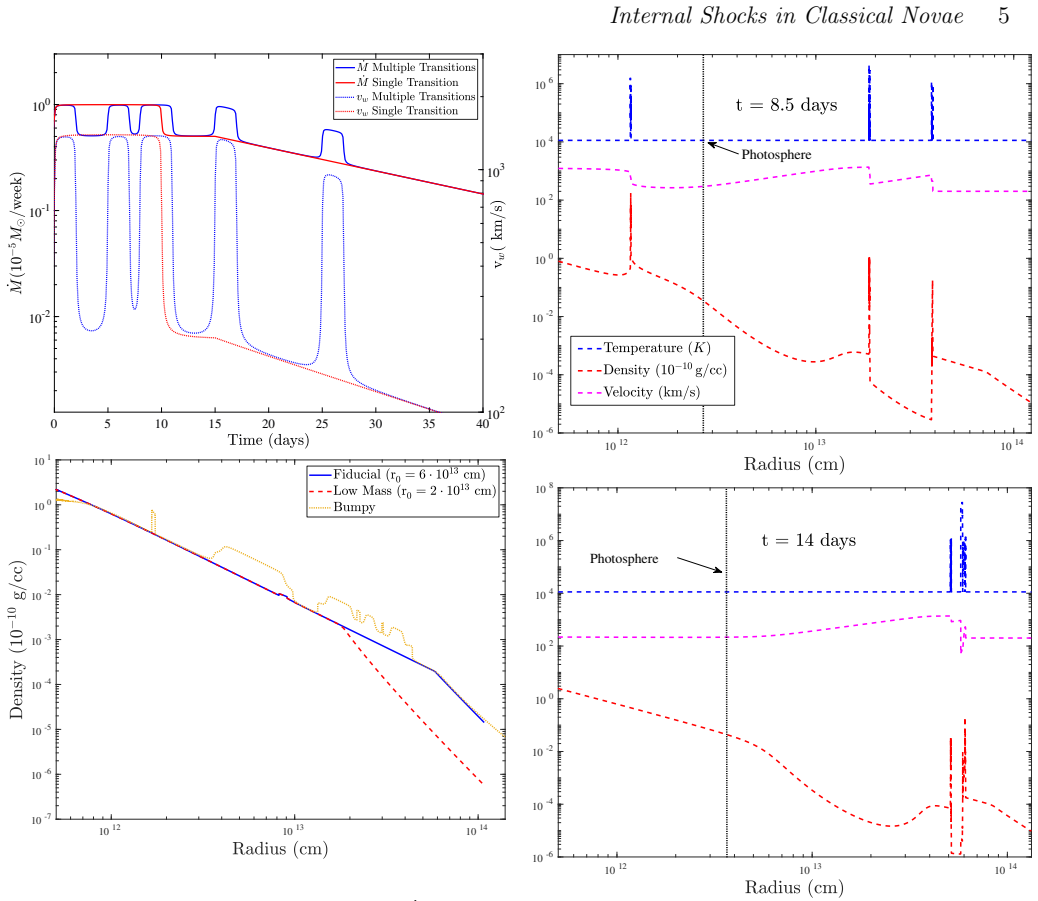
The central claim is that repeated transitions between slow (about 200 km/s) and fast (about 1400 km/s) outflow modes generate internal radiative shocks whose energy, reprocessed by the opaque ejecta, can explain the observed variability of nova optical, gamma-ray, X-ray, and radio emission. In the multiple-transition model, each switch back to the fast flow creates a forward-reverse shock pair bounding a cool, dense shell; these shells later merge pairwise into a monolithic shell whose forward shock eventually breaks through the slow, pre-existing outflow. The paper concludes that the multiple-transition scenario is favored by the gamma-ray and optical variability of novae, while a single monotonic transition predicts smooth light curves and cannot easily reproduce the correlated photospheric behavior.
Load-bearing premise
The central premise is that a slow, equatorially concentrated outflow is already present around the binary when the fast wind starts, with a specific density profile, and that the nova can switch between fast and slow outflow modes repeatedly; if that pre-existing outflow is weaker or the switching does not happen, the predicted flares, delays, and radio and X-ray onsets change.
Editorial extensions
If this is right
- If the central claim is right, multi-peaked nova light curves are not necessarily separate mass ejections but the visible signatures of repeated fast-slow collisions and the later merging of the cold shells they create.
- Gamma-ray and optical flares are predicted to track one another closely, because both follow the instantaneous shock power with little delay, once the shock is above the gamma-ray photosphere.
- Photospheric radius maxima should lag luminosity maxima by roughly the time a shock-bounded shell takes to reach the photosphere, about 0.5 to 2.3 days for the fiducial parameters.
- Spectral line evolution should show accelerating, decelerating, and merging velocity components, with the slow unshocked medium producing narrow absorption features.
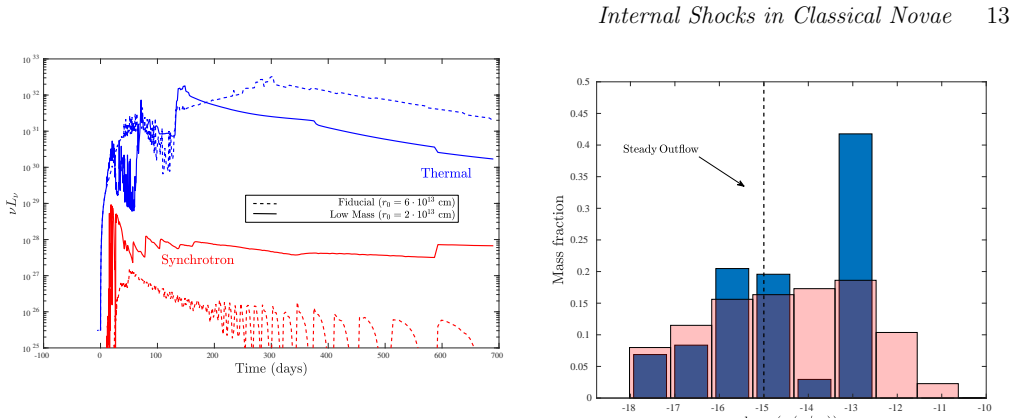
- KeV X-ray and roughly 10 GHz synchrotron radio emission should be delayed for weeks to months, appearing only after the forward shock of the outermost merged shell reaches a sufficiently low external column.
Reading between the lines
- Beyond the paper: if outflow switching timescales are systematically shorter than about a day, most shock energy is deposited beneath the photosphere and flares should appear primarily in the optical continuum, whereas longer switching intervals should push the emission into lines; this yields a testable relation between variability timescale and flare spectrum.
- Beyond the paper: the paper does not identify the mechanism behind fast-slow mode switching, so the predicted variability is only as physical as the assumed switch sequence; coupling the shock hydrodynamics to models of the white-dwarf envelope is a natural next step.
- Beyond the paper: multi-dimensional thin-shell instabilities would broaden the cool shells and likely weaken the bright second-generation collision flares, so the most extreme observed flare amplitudes may require a higher fast/slow velocity contrast than the fiducial 1400/200 km/s values.
Signed reviews
Editorial analysis
A structured set of objections, weighed in public.
Referee Report
Summary. This paper uses one-dimensional moving-mesh hydrodynamical simulations with radiative cooling to model internal shocks in classical nova outflows, comparing a single slow-to-fast transition with a 'multiple transition' scenario in which the outflow alternates between slow and fast modes several times on timescales of hours to days. The authors argue that the multiple-transition model can simultaneously explain observed multi-peaked optical light curves, correlated optical and gamma-ray flares, photospheric expansion that lags the flare maximum, complex accelerating/decelerating/merging spectral line components, and the delayed onset of keV X-ray and radio synchrotron emission from the merged outer shell. They also compute thermal X-ray, gamma-ray, and radio light curves under different assumptions about the pre-existing slow outflow and abundance, and discuss dust formation in the clumpy post-shock gas.
Significance. The paper is a serious and mostly clearly presented exploratory study of a plausible mechanism. Its strengths include a detailed numerical method (RICH moving-mesh hydrodynamics with CLOUDY cooling, an exact Riemann solver, and explicit thin-shell resolution), a systematic comparison of several model variants, and a set of concrete, in principle falsifiable predictions—e.g., the 0.5–2.3 day lag between Ltot and Rph maxima in the multiple-transition model, the early suppression of soft X-rays by the external medium, and the dependence of the radio synchrotron peak on the radius r0 of the initial slow outflow. The paper is also honest about many of its own limitations, including the 1D geometry, the neglect of multidimensional thin-shell instabilities, and the absence of a model for the physical trigger of the fast/slow transitions. However, the evidential weight placed on agreement with the observed gamma-ray/optical variability is overstated because that correlation is in large part built into the model by construction, and several key inputs are chosen to match the very phenomena being explained.
major comments (3)
- [3.3 and 4] The gamma-ray light curves are computed as L_gamma = epsilon_gamma L_sh with a constant epsilon_gamma = 3e-3 (Section 3.3), while the reprocessed optical luminosity shown in Fig. 6 also tracks L_sh by construction. The correlation between optical and gamma-ray flares displayed in Figs. 6 and 10–11 is therefore partly built in, so it cannot independently support the conclusion in Section 4 that the Multiple Transition scenario is 'clearly favored' by the gamma-ray/optical variability. Please either compute gamma-ray emission from a time-dependent particle-acceleration/cooling model that can decorrelate it from L_sh, or explicitly treat this comparison as a consistency check and add a test (e.g., relative flare amplitudes or time lags) that is not predetermined by the common shock-power variable.
- [2 (Fig. 2) and 4] The sequence of fast/slow mode switches is imposed by hand, with transition intervals delta_t chosen on phenomenological grounds to be hours-to-days so that the resulting collisions match observed flare timescales (Section 2). The paper also explicitly states that it does not address the physical origin of the abrupt and frequent transitions (Section 4). Under these conditions, the multi-peaked optical light curves and the accelerating, decelerating, and merging line components in Figs. 6 and 8 follow directly from the injected pulse train and are demonstrations of consistency, not independent predictions. The conclusion should be reworded accordingly, and ideally the authors should identify a diagnostic that can test the prescribed-transition model against alternative mechanisms such as episodic mass ejection or clumpy ejecta.
- [2 (bottom panel) and 3.4–3.5] The predicted delays and luminosities of keV X-rays and radio synchrotron emission depend sensitively on the assumed pre-existing slow outflow, parameterized by r0 and the adopted rho propto r^-2 / r^-4 density profile (Fig. 2). The Fiducial versus Low Mass comparison shows order-of-magnitude changes in the radio synchrotron peak and in the X-ray luminosity, and the paper acknowledges that these predictions depend on the mass, radial distribution, and composition of the external medium. Because these are among the paper's most concrete observational predictions, the authors should either provide a physically motivated derivation of the external density profile or explicitly characterize these predictions as illustrative and state which observations would empirically determine r0.
minor comments (4)
- [Figure 12] The caption assigns 'blue lines' to synchrotron emission and 'red lines' to thermal free-free emission, whereas Section 3.5 describes the blue lines as thermal emission and the red lines as synchrotron emission; please make the text and caption consistent.
- [Abstract and 3.6] There are typos: 'occurence' in the abstract should be 'occurrence', and 'line of site' in Section 3.6 should be 'line of sight'.
- [2 and 3] A table summarizing all input parameters (Mdot_f, v_f, Mdot_s, v_s, r0, delta_t, L_wd, epsilon_gamma, epsilon_B, epsilon_e, p, kappa_opt) and their adopted values would greatly improve reproducibility; the parameters are currently scattered through Sections 2 and 3 and introduced with the phrase 'somewhat arbitrarily'.
- [3.4 and Figs. 10–11] The caveat that the 1D models overestimate the thermal X-ray luminosity because of multidimensional radiative-shock effects is stated in the text, but it would be helpful to print the approximate suppression factor in the figure captions of Figs. 10 and 11 as well.
Circularity Check
Partial circularity: the gamma-ray/optical correlation is built in by definition and the flare timescale is an input boundary condition, so the 'clearly favored' variability verdict is a consistency check; photospheric lag and X-ray/radio delay remain genuine dynamics.
-
fitted input called prediction
[Section 2 'Description of Numerical Model' (boundary condition, near Eqs. 1–3); Section 4 'Conclusions']
"Local maxima (“flares”) are observed in classical nova light curves on timescales ranging from hours to weeks (e.g. Strope et al. 2010; Walter et al. 2012; Henze et al. 2018; Aydi et al. 2019). To generate collisions on approximately this timescale, we impose transitions between the slow to the fast mode on a characteristic time interval δt≈ hours−days and with delays between the transitions of a day to a week."
The flare timescale is not derived from the model; it is inserted as an input boundary condition specifically to match the observed range of nova flare timescales. The multi-peaked optical light curve and the associated variability are the hydrodynamic response to that imposed pulse train, so the agreement with observed variability is a consistency check rather than an independent prediction. The paper's conclusion that 'The Multiple Transition scenario is clearly favored by the gamma-ray/optical variability of novae' therefore rests on an input chosen to produce variability, and the paper itself concedes it 'does not address the physical origin of the abrupt and frequent transitions.'
-
self definitional
[Section 3.3 'Gamma-Ray Emission' (Figs. 10–11); Section 4 'Conclusions']
"we expect the observed gamma-ray emission to approximately track the instantaneous power of the shock, much as with the reprocessed optical emission ... The gamma-ray light curves in Figs. 10, 11 were calculated by multiplying the kinetic power of the shocks from the simulation by a constant value εγ = 3×10⁻³."
The gamma-ray/optical correlation is constructed, not predicted. The plotted optical luminosity is Ltot = Lsh(t) + Lwd with Lwd taken constant, while the gamma-ray luminosity is defined as Lγ = εγ Lsh with constant εγ. Hence Lγ is a fixed linear function of the shock contribution to Lopt, and both outputs 'track the shock power' by definition. Claiming correlated optical and gamma-ray flares as a 'natural prediction' of the model is therefore equivalent to the way the two light curves were computed; it cannot independently test the model. The observed correlations (Li et al. 2017; Aydi et al.) are external evidence, but the model's prediction adds no new constraint beyond the adopted proportionality.
full rationale
Two load-bearing steps are partially circular. First, the outflow variability that produces the flares is an imposed boundary condition: δt ≈ hours–days was chosen specifically to match observed flare timescales, so the resulting multi-peaked light curve and the claim that the multiple-transition scenario is 'clearly favored' by variability are a consistency check, not an independent prediction. Second, the predicted optical/gamma-ray correlation is definitional: the optical light curve includes the shock power Lsh (plus a constant Lwd), and the gamma-ray light curve is defined as Lγ = εγ Lsh with constant εγ, so the two output light curves track the same quantity by construction. The remaining content—photospheric radius lag, shell merging, delayed X-ray and radio emergence—is a genuine hydrodynamical consequence, but it depends on the adopted pre-existing slow outflow profile (r0, ρ ∝ r^-2 inside r0 and r^-4 outside) and on the same imposed δt values. The paper itself explicitly concedes that it 'does not address the physical origin of the abrupt and frequent transitions' and states that self-consistent multi-dimensional models are needed 'to advance to the stage of being truly predictive.' The frequent citations to Steinberg & Metzger (2018) are used for sub-grid corrections and caveats, not as a uniqueness theorem or as the central justification, and so are not treated as load-bearing self-citation. Overall, the variability and gamma-ray/optical correlation claims are partly forced by inputs, giving a circularity score of 6.
Assumptions & free parameters
free parameters (10)
- fast mode mass-loss rate Mdot_f =
1e-5 M_sun/week
- fast mode velocity v_f =
1400 km/s
- slow mode mass-loss rate Mdot_s =
5e-6 M_sun/week
- slow mode velocity v_s =
200 km/s
- initial slow outflow radius r0 =
6e13 cm (Fiducial) or 2e13 cm (Low Mass)
- transition interval delta_t =
hours to days/weeks
- central white dwarf luminosity L_wd =
1e38 erg/s
- gamma-ray efficiency epsilon_gamma =
3e-3
- radio microphysical parameters epsilon_B, epsilon_e, p =
1e-2, 1e-2, 2.5
- optical opacity kappa_opt =
0.03 cm^2/g
assumptions (6)
- domain assumption The outflow is treated as spherically symmetric in 1D, with the slow equatorial component approximated as spherical with an effective solid-angle fraction.
- domain assumption Radiative cooling is optically thin and computed in collisional ionization equilibrium.
- ad hoc to paper The initial slow outflow has density profile rho proportional to r^-2 inside r0 and rho proportional to r^-4 outside.
- domain assumption Thermal reprocessing of shock UV/X-ray luminosity into optical is instantaneous.
- domain assumption A slow outflow pre-exists around the binary before the fast outflow begins.
- standard math Standard hydrodynamics with an ideal gas equation of state and gamma = 5/3.
Cite this review
Pith. "Pith review of Internal Shocks from Variable Outflows in Classical Novae." pith.science (2026). https://pith.science/paper/YCVAIDV4
@misc{pith2026190801700,
  author       = {Pith},
  title        = {Pith review of: Internal Shocks from Variable Outflows in Classical Novae},
  year         = {2026},
  howpublished = {\url{https://pith.science/paper/YCVAIDV4}},
  note         = {Machine review of arXiv:1908.01700}
}
abstract
We present one-dimensional hydrodynamical simulations including radiative losses, of internal shocks in the outflows from classical novae, to explore the role of shocks in powering multi-wavelength emission from radio to gamma-ray wavelengths. Observations support a picture in which the initial phases of some novae generate a slow, equatorially-focused outflow (directly from the outer Lagrange point, or from a circumbinary disk), which then transitions to, or is overtaken by, a faster more isotropic outflow from the white dwarf which collides and shocks the slower flow, powering gamma-ray and optical emission through reprocessing by the ejecta. However, the common occurence of multiple peaks in nova light curves suggests that the outflow's acceleration need not be monotonic, but instead can involve successive transitions between "fast" and "slow" modes. Such a time-fluctuating outflow velocity naturally can reproduce several observed properties of nova, such as correlated gamma-ray and optical flares, expansion of the photosphere coincident with (though lagging slightly) the peak flare luminosity, and complex time-evolution of spectral lines (including accelerating, decelerating, and merging velocity components). While the shocks are still deeply embedded during the gamma-ray emission, the onset of $\sim$ keV X-ray and $\sim 10$ GHz radio synchrotron emission is typically delayed until the forward shock of the outermost monolithic shell (created by merger of multiple internal shock-generated shells) reaches a sufficiently low column through the dense external medium generated by the earliest phase of the outburst.
Figures
Figures from the paper (9 more)



Reference graph
Works this paper leans on
-
[1]
write newline
" write newline "" before.all 'output.state := FUNCTION fin.entry write newline FUNCTION new.block output.state before.all = 'skip after.block 'output.state := if FUNCTION new.sentence output.state after.block = 'skip output.state before.all = 'skip after.sentence 'output.state := if if FUNCTION not #0 #1 if FUNCTION and 'skip pop #0 if FUNCTION or pop #1...
-
[2]
write newline
" write newline "" before.all 'output.state := FUNCTION fin.entry write newline FUNCTION new.block output.state before.all = 'skip after.block 'output.state := if FUNCTION new.sentence output.state after.block = 'skip output.state before.all = 'skip after.sentence 'output.state := if if FUNCTION not #0 #1 if FUNCTION and 'skip pop #0 if FUNCTION or pop #1...
-
[3]
2014, http://dx.doi.org/10.1126/science.1253947 Science , 345, 554
Ackermann , M., et al. 2014, http://dx.doi.org/10.1126/science.1253947 Science , 345, 554
-
[4]
2019, arXiv e-prints , http://arxiv.org/abs/1903.09232 arXiv:1903.09232 [astro-ph.HE]
Aydi , E., Chomiuk , L., Strader , J., et al. 2019, arXiv e-prints , http://arxiv.org/abs/1903.09232 arXiv:1903.09232 [astro-ph.HE]
arXiv 2019
-
[5]
F., & Evans , A
Bode , M. F., & Evans , A. 2008, Classical Novae
2008
-
[6]
2014, http://dx.doi.org/10.1088/0004-637X/783/2/91 , 783, 91
Caprioli , D., & Spitkovsky , A. 2014, http://dx.doi.org/10.1088/0004-637X/783/2/91 , 783, 91
-
[7]
Casanova , J., Jos \'e , J., & Shore , S. N. 2018, http://dx.doi.org/10.1051/0004-6361/201833422 , 619, A121
-
[8]
Cassatella , A., Lamers , H. J. G. L. M., Rossi , C., Altamore , A., & Gonz \'a lez-Riestra , R. 2004, http://dx.doi.org/10.1051/0004-6361:20034102 , 420, 571
Show all 89 references
-
[9]
C., Jean , P., Shore , S
Cheung , C. C., Jean , P., Shore , S. N., et al. 2016, http://dx.doi.org/10.3847/0004-637X/826/2/142 , 826, 142
2016 doi
-
[10]
A., & Imamura , J
Chevalier , R. A., & Imamura , J. N. 1982, http://dx.doi.org/10.1086/160364 , 261, 543
1982 doi
-
[11]
D., Yang , J., et al
Chomiuk , L., Linford , J. D., Yang , J., et al. 2014, http://dx.doi.org/10.1038/nature13773 , 514, 339
2014 doi
-
[12]
L., Retter , A., Jacob , A., & Kaspi , S
Cs \'a k , B., Kiss , L. L., Retter , A., Jacob , A., & Kaspi , S. 2005, http://dx.doi.org/10.1051/0004-6361:20035751 , 429, 599
2005 doi
-
[13]
M., & Bildsten , L
Cunningham , T., Wolf , W. M., & Bildsten , L. 2015, http://dx.doi.org/10.1088/0004-637X/803/2/76 , 803, 76
2015 doi
-
[14]
M., Metzger , B
Derdzinski , A. M., Metzger , B. D., & Lazzati , D. 2017, http://dx.doi.org/10.1093/mnras/stx829 , 469, 1314
2017 doi
-
[15]
H., Smith , O., et al
Evans , A., Tyne , V. H., Smith , O., et al. 2005, http://dx.doi.org/10.1111/j.1365-2966.2005.09146.x , 360, 1483
2005
-
[16]
Evans , A., Banerjee , D. P. K., Gehrz , R. D., et al. 2017, http://dx.doi.org/10.1093/mnras/stw3334 , 466, 4221
2017 doi
-
[17]
J., Korista , K
Ferland , G. J., Korista , K. T., Verner , D. A., et al. 1998, http://dx.doi.org/10.1086/316190 , 110, 761
1998 doi
-
[18]
J., Chatzikos , M., Guzm \'a n , F., et al
Ferland , G. J., Chatzikos , M., Guzm \'a n , F., et al. 2017, Revista Mexicana de Astronomía y Astrofísica , 53, 385
2017
-
[19]
D., et al
Finzell , T., Chomiuk , L., Metzger , B. D., et al. 2018, http://dx.doi.org/10.3847/1538-4357/aaa12a , 852, 108
2018 doi
-
[20]
C., & Buson , S
Franckowiak , A., Jean , P., Wood , M., Cheung , C. C., & Buson , S. 2018, http://dx.doi.org/10.1051/0004-6361/201731516 , 609, A120
2018 doi
-
[21]
S., & Starrfield , S
Gallagher , J. S., & Starrfield , S. 1978, http://dx.doi.org/10.1146/annurev.aa.16.090178.001131 , 16, 171
1978
-
[22]
D., Truran , J
Gehrz , R. D., Truran , J. W., Williams , R. E., & Starrfield , S. 1998, http://dx.doi.org/10.1086/316107 , 110, 3
1998 doi
-
[23]
D., & O'Brien , T
Gill , C. D., & O'Brien , T. J. 2000, http://dx.doi.org/10.1046/j.1365-8711.2000.03342.x , 314, 175
2000
-
[24]
2007, http://dx.doi.org/10.1086/509786 , 168, 213
Gnat , O., & Sternberg , A. 2007, http://dx.doi.org/10.1086/509786 , 168, 213
2007 doi
-
[25]
J., & O'Brien , T
Harman , D. J., & O'Brien , T. J. 2003, http://dx.doi.org/10.1046/j.1365-8711.2003.06906.x , 344, 1219
2003
-
[26]
J., Redman , M
Harvey , E. J., Redman , M. P., Darnley , M. J., et al. 2018, http://dx.doi.org/10.1051/0004-6361/201731741 , 611, A3
2018 doi
-
[27]
J., et al
Henze , M., Ness , J.-U., Darnley , M. J., et al. 2014, http://dx.doi.org/10.1051/0004-6361/201423410 , 563, L8
2014 doi
-
[28]
J., Williams , S
Henze , M., Darnley , M. J., Williams , S. C., et al. 2018, http://dx.doi.org/10.3847/1538-4357/aab6a6 , 857, 68
2018 doi
-
[29]
M., & Neill , J
Hillman , Y., Prialnik , D., Kovetz , A., Shara , M. M., & Neill , J. D. 2014, http://dx.doi.org/10.1093/mnras/stt2027 , 437, 1962
2014 doi
-
[30]
M., Wade , C
Hjellming , R. M., Wade , C. M., Vandenberg , N. R., & Newell , R. T. 1979, http://dx.doi.org/10.1086/112585 , 84, 1619
1979 doi
-
[31]
Jack , D., Robles P \'e rez , J. d. J., De Gennaro Aquino , I., et al. 2017, http://dx.doi.org/10.1002/asna.201613217 Astronomische Nachrichten , 338, 91
2017 doi
-
[32]
1991, http://dx.doi.org/10.1086/170081 , 373, 620
Kato , M., & Hachisu , I. 1991, http://dx.doi.org/10.1086/170081 , 373, 620
1991 doi
-
[33]
1994, http://dx.doi.org/10.1086/175041 , 437, 802
---. 1994, http://dx.doi.org/10.1086/175041 , 437, 802
1994 doi
-
[34]
2009, http://dx.doi.org/10.1088/0004-637X/699/2/1293 , 699, 1293
---. 2009, http://dx.doi.org/10.1088/0004-637X/699/2/1293 , 699, 1293
2009 doi
-
[35]
2011, http://dx.doi.org/10.1088/0004-637X/743/2/157 , 743, 157
---. 2011, http://dx.doi.org/10.1088/0004-637X/743/2/157 , 743, 157
2011 doi
-
[36]
D., Owocki , S., & ud-Doula , A
Kee , N. D., Owocki , S., & ud-Doula , A. 2014, http://dx.doi.org/10.1093/mnras/stt2475 , 438, 3557
2014 doi
-
[37]
I., Chomiuk , L., Rupen , M., et al
Krauss , M. I., Chomiuk , L., Rupen , M., et al. 2011, http://dx.doi.org/10.1088/2041-8205/739/1/L6 , 739, L6
2011 doi
-
[38]
2017, http://dx.doi.org/10.1038/s41550-017-0222-1 Nature Astronomy , 1, 697
Li , K.-L., et al. 2017, http://dx.doi.org/10.1038/s41550-017-0222-1 Nature Astronomy , 1, 697
2017 doi
-
[39]
D., Ribeiro , V
Linford , J. D., Ribeiro , V. A. R. M., Chomiuk , L., et al. 2015, http://dx.doi.org/10.1088/0004-637X/805/2/136 , 805, 136
2015 doi
-
[40]
Livio , M., Shankar , A., Burkert , A., & Truran , J. W. 1990, http://dx.doi.org/10.1086/168836 , 356, 250
1990 doi
-
[41]
M., O'Brien , T
Lloyd , H. M., O'Brien , T. J., & Bode , M. F. 1997, http://dx.doi.org/10.1093/mnras/284.1.137 , 284, 137
1997 doi
-
[42]
2013, http://dx.doi.org/10.1051/0004-6361/201220289 , 551, A37
Martin , P., & Dubus , G. 2013, http://dx.doi.org/10.1051/0004-6361/201220289 , 551, A37
2013 doi
-
[43]
2018, http://dx.doi.org/10.1051/0004-6361/201731692 , 612, A38
Martin , P., Dubus , G., Jean , P., Tatischeff , V., & Dosne , C. 2018, http://dx.doi.org/10.1051/0004-6361/201731692 , 612, A38
2018 doi
-
[44]
N., De Gennaro Aquino , I., et al
Mason , E., Shore , S. N., De Gennaro Aquino , I., et al. 2018, http://dx.doi.org/10.3847/1538-4357/aaa247 , 853, 27
2018 doi
-
[45]
D., Caprioli , D., Vurm , I., et al
Metzger , B. D., Caprioli , D., Vurm , I., et al. 2016, http://dx.doi.org/10.1093/mnras/stw123 , 457, 1786
2016 doi
-
[46]
D., Finzell , T., Vurm , I., et al
Metzger , B. D., Finzell , T., Vurm , I., et al. 2015, http://dx.doi.org/10.1093/mnras/stv742 , 450, 2739
2015 doi
-
[47]
D., Hasco \"e t , R., Vurm , I., et al
Metzger , B. D., Hasco \"e t , R., Vurm , I., et al. 2014, http://dx.doi.org/10.1093/mnras/stu844 , 442, 713
2014 doi
-
[48]
J., & Rupen , M
Mioduszewski , A. J., & Rupen , M. P. 2004, http://dx.doi.org/10.1086/424376 , 615, 432
2004 doi
-
[49]
2001, http://dx.doi.org/10.1086/320220 , 551, 1024
Mukai , K., & Ishida , M. 2001, http://dx.doi.org/10.1086/320220 , 551, 1024
2001 doi
-
[50]
2008, http://dx.doi.org/10.1063/1.2945023 in American Institute of Physics Conference Series, Vol
Mukai , K., Orio , M., & Della Valle , M. 2008, http://dx.doi.org/10.1063/1.2945023 in American Institute of Physics Conference Series, Vol. 1010, A Population Explosion: The Nature & Evolution of X-ray Binaries in Diverse Environments, ed. R. M. Bandyopadhyay , S. Wachter , D...
2008 doi
-
[51]
2019, http://dx.doi.org/10.3847/1538-4357/aafb6d , 872, 86
Nelson , T., Mukai , K., Li , K.-L., et al. 2019, http://dx.doi.org/10.3847/1538-4357/aafb6d , 872, 86
2019 doi
-
[52]
J., Lloyd , H
O'Brien , T. J., Lloyd , H. M., & Bode , M. F. 1994, http://dx.doi.org/10.1093/mnras/271.1.155 , 271, 155
1994 doi
-
[53]
2001 a , http://dx.doi.org/10.1051/0004-6361:20010537 , 373, 542
Orio , M., Covington , J., & \"O gelman , H. 2001 a , http://dx.doi.org/10.1051/0004-6361:20010537 , 373, 542
2001 doi
-
[54]
2001 b , http://dx.doi.org/10.1046/j.1365-8711.2001.04448.x , 326, L13
Orio , M., Parmar , A., Benjamin , R., et al. 2001 b , http://dx.doi.org/10.1046/j.1365-8711.2001.04448.x , 326, L13
2001
-
[55]
E., & Ferland , G
Osterbrock , D. E., & Ferland , G. J. 2006, Astrophysics of gaseous nebulae and active galactic nuclei
2006
-
[56]
D., & Tomida , K
Pejcha , O., Metzger , B. D., & Tomida , K. 2016 a , http://dx.doi.org/10.1093/mnras/stw1481 , 461, 2527
2016 doi
-
[57]
2016 b , http://dx.doi.org/10.1093/mnras/stv2592 , 455, 4351
---. 2016 b , http://dx.doi.org/10.1093/mnras/stv2592 , 455, 4351
2016 doi
-
[58]
A., & Eastman , R
Pinto , P. A., & Eastman , R. G. 2000, http://dx.doi.org/10.1086/308380 , 530, 757
2000 doi
-
[59]
Pontefract , M., & Rawlings , J. M. C. 2004, http://dx.doi.org/10.1111/j.1365-2966.2004.07330.x , 347, 1294
2004
-
[60]
1986, http://dx.doi.org/10.1086/164677 , 310, 222
Prialnik , D. 1986, http://dx.doi.org/10.1086/164677 , 310, 222
1986 doi
-
[61]
2016, http://dx.doi.org/10.1093/mnras/stw365 , 458, 1214
Quataert , E., Fern \'a ndez , R., Kasen , D., Klion , H., & Paxton , B. 2016, http://dx.doi.org/10.1093/mnras/stw365 , 458, 1214
2016 doi
-
[62]
Ribeiro , V. A. R. M., Munari , U., & Valisa , P. 2013, http://dx.doi.org/10.1088/0004-637X/768/1/49 , 768, 49
2013 doi
-
[64]
2014 b , http://dx.doi.org/10.1088/0004-637X/792/1/57 , 792, 57
---. 2014 b , http://dx.doi.org/10.1088/0004-637X/792/1/57 , 792, 57
2014 doi
-
[65]
L., et al
Roy , N., Chomiuk , L., Sokoloski , J. L., et al. 2012, Bulletin of the Astronomical Society of India , 40, 293
2012
-
[66]
B., & Lightman , A
Rybicki , G. B., & Lightman , A. P. 1979, Radiative processes in astrophysics
1979
-
[67]
J., Ness , J.-U., Osborne , J
Schwarz , G. J., Ness , J.-U., Osborne , J. P., et al. 2011, http://dx.doi.org/10.1088/0067-0049/197/2/31 , 197, 31
2011 doi
-
[68]
Shankar , A., Livio , M., & Truran , J. W. 1991, http://dx.doi.org/10.1086/170148 , 374, 623
1991 doi
-
[69]
Shore , S. N. 2013, http://dx.doi.org/10.1051/0004-6361/201322470 , 559, L7
2013 doi
-
[70]
N., De Gennaro Aquino , I., Schwarz , G
Shore , S. N., De Gennaro Aquino , I., Schwarz , G. J., et al. 2013, http://dx.doi.org/10.1051/0004-6361/201321095 , 553, A123
2013 doi
-
[71]
L., Rupen , M
Sokoloski , J. L., Rupen , M. P., & Mioduszewski , A. J. 2008, http://dx.doi.org/10.1086/592602 , 685, L137
2008 doi
-
[72]
Starrfield , S., Iliadis , C., & Hix , W. R. 2016, http://dx.doi.org/10.1088/1538-3873/128/963/051001 , 128, 051001
2016 doi
-
[73]
W., Sparks , W
Starrfield , S., Truran , J. W., Sparks , W. M., & Kutter , G. S. 1972, http://dx.doi.org/10.1086/151619 , 176, 169
1972 doi
-
[74]
Steinberg , E., & Metzger , B. D. 2018, http://dx.doi.org/10.1093/mnras/sty1641 , 479, 687
2018 doi
-
[75]
J., Schaefer , B
Strope , R. J., Schaefer , B. E., & Henden , A. A. 2010, http://dx.doi.org/10.1088/0004-6256/140/1/34 , 140, 34
2010 doi
-
[76]
2011 a , http://dx.doi.org/10.1093/pasj/63.1.159 , 63, 159
Tanaka , J., Nogami , D., Fujii , M., Ayani , K., & Kato , T. 2011 a , http://dx.doi.org/10.1093/pasj/63.1.159 , 63, 159
2011 doi
-
[77]
2011 b , http://dx.doi.org/10.1093/pasj/63.4.911 , 63, 911
Tanaka , J., Nogami , D., Fujii , M., et al. 2011 b , http://dx.doi.org/10.1093/pasj/63.4.911 , 63, 911
2011 doi
-
[78]
Townsend , R. H. D. 2009, http://dx.doi.org/10.1088/0067-0049/181/2/391 , 181, 391
2009 doi
-
[79]
Vishniac , E. T. 1994, http://dx.doi.org/10.1086/174231 , 428, 186
1994 doi
-
[80]
Vlasov , A., Vurm , I., & Metzger , B. D. 2016, http://dx.doi.org/10.1093/mnras/stw1949 , 463, 394
2016 doi
-
[81]
Vurm , I., & Metzger , B. D. 2018, http://dx.doi.org/10.3847/1538-4357/aa9c4a , 852, 62
2018 doi
-
[82]
M., Battisti , A., Towers , S
Walter , F. M., Battisti , A., Towers , S. E., Bond , H. E., & Stringfellow , G. S. 2012, http://dx.doi.org/10.1086/668404 , 124, 1057
2012 doi
-
[83]
Weston , J. H. S., Sokoloski , J. L., Chomiuk , L., et al. 2016, http://dx.doi.org/10.1093/mnras/stw1161 , 460, 2687
2016 doi
-
[84]
2008, http://dx.doi.org/10.1086/590056 , 685, 451
Williams , R., Mason , E., Della Valle , M., & Ederoclite , A. 2008, http://dx.doi.org/10.1086/590056 , 685, 451
2008 doi
-
[85]
M., Bildsten , L., Brooks , J., & Paxton , B
Wolf , W. M., Bildsten , L., Brooks , J., & Paxton , B. 2013, http://dx.doi.org/10.1088/0004-637X/777/2/136 , 777, 136
2013 doi
-
[86]
A., Steeghs , D., Karovska , M., et al
Woudt , P. A., Steeghs , D., Karovska , M., et al. 2009, http://dx.doi.org/10.1088/0004-637X/706/1/738 , 706, 738
2009 doi
-
[87]
2015, http://dx.doi.org/10.1088/0067-0049/216/2/35 , 216, 35
Yalinewich , A., Steinberg , E., & Sari , R. 2015, http://dx.doi.org/10.1088/0067-0049/216/2/35 , 216, 35
2015 doi
-
[88]
M., & Kovetz , A
Yaron , O., Prialnik , D., Shara , M. M., & Kovetz , A. 2005, http://dx.doi.org/10.1086/428435 , 623, 398
2005 doi
-
[89]
A., & Svensson , R
Zdziarski , A. A., & Svensson , R. 1989, http://dx.doi.org/10.1086/167826 , 344, 551
1989 doi
-
[90]
write newline
" write newline "" before.all 'output.state := FUNCTION format.archive archivePrefix empty "" archivePrefix ":" * if FUNCTION format.primaryClass primaryClass empty "" " [" primaryClass * "]" * if FUNCTION format.eprint eprint empty pages empty not booktitle empty not or or ""...
Reviewed August 14, 2026 · model on record in the stance chip above.
Discussion (0). Continue with ORCID to comment.