REVIEW 2 major objections 5 minor 22 references
Thermodynamic conditions governing the optical temperature and chemical potential in nonlinear highly multimoded photonic systems
T0 review · 2 major / 5 minor · reviewed 2026-08-14 · deepseek-v4-flash
Pith's one-line read This paper proves that the optical temperature and chemical potential of a thermalized multimode system are uniquely set by the spectrum, power, and energy.
desk verdict A clean conditional uniqueness theorem with an overbroad universality claim; referee it, but push the authors to either prove or drop the 'any system' language. read the letter →
The pith
A machine-rendered reading of the paper's core claim, the machinery that carries it, and where it could break.
The reading
What carries the argument
The load-bearing object is the rational function $f(x) = \sum_i g_i x/(x-\rho_i) - M$, whose real roots are the candidate temperatures multiplied by $M$. Each pole $\rho_i = U + P\mathcal{E}_i$ combines the internal energy and the $i$-th eigenvalue, and $g_i$ is the degeneracy. The distribution formula $|c_i|^2 = -PT/(\rho_i - x)$ shows that positive modal powers require the root $x$ to stay outside the whole interval $(\rho_1, \rho_N)$. Counting signs across the $N-2$ intervals between poles, then using the asymptotic behavior of $f$ at $\pm\infty$, proves that exactly one physically admissible root exists. A final one-line equation of state, $\mu = (U - MT)/P$, then fixes the chemical potential.
What would settle it
Take a fixed multimode array with known spectrum and launch two different input distributions that have identical total power $P$ and internal energy $U$; if the equilibrium modal occupancies measured after long propagation differ measurably from each other or from the predicted Rayleigh-Jeans form, the uniqueness claim fails. More sharply, in a translationally invariant array, manufacturing initial conditions with the same $P$ and $U$ but different conserved momentum would reveal whether an additional invariant controls the final state.
Extended reading notes
Core claim
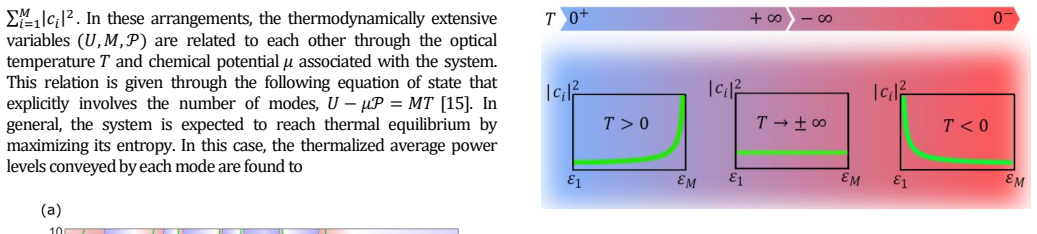
At thermal equilibrium, the modal powers obey a Rayleigh-Jeans distribution, $|c_i|^2 = -T/(\mathcal{E}_i + \mu)$. Substituting the conserved power $P$ and internal energy $U$ turns the normalization condition into an algebraic equation for $x = MT$ whose roots are all real: $f(x) = \sum_i g_i x/(x-\rho_i) - M = 0$, with $\rho_i = U + P\mathcal{E}_i$. Sign changes between consecutive $\rho_i$ give $N-2$ roots by Bolzano's theorem, and the asymptotic sign of $f$ at $\pm\infty$ supplies one more root in one of the two outer intervals. Only one root lies outside $(\rho_1, \rho_N)$, and only that root keeps every modal occupancy positive; hence the temperature is unique. The corresponding chemical potential follows from the equation of state $U - \mu P = MT$. The paper states the threshold explicitly: $T > 0$ when $-U/P > \bar{\mathcal{E}}$ and $T < 0$ when $-U/P < \bar{\mathcal{E}}$, with the domains $T > (U + P\mathcal{E}_N)/M$ and $T < (U + P\mathcal{E}_1)/M$ respectively.
Load-bearing premise
The derivation assumes that the modal occupancies at equilibrium are exactly the Rayleigh-Jeans distribution obtained by maximizing entropy with only total power and total energy conserved; if a real system has extra conserved quantities or nonlinear corrections change the distribution, the uniqueness proof no longer applies.
Editorial extensions
If this is right
- For any multimode structure whose spectrum is known, an experimentalist can predict the equilibrium temperature and chemical potential directly from the input power and the energy set by the launch condition.
- The beam self-cleaning effect, where power settles into the low-order modes, corresponds to positive optical temperatures; negative temperatures instead concentrate power in high-order modes.
- At $-U/P = \bar{\mathcal{E}}$ the temperature diverges and all modes become equally populated; approaching the spectral edges makes $T$ tend to $0^+$ or $0^-$, the condensate limits.
- Since negative temperatures lie above infinite temperature on the thermodynamic scale, energy flows from a negative-temperature system to a positive-temperature one, which determines the direction of mode redistribution.
- The results apply to continuous and discrete multimode systems alike, including multimode fibers, cavities, waveguide arrays, and coupled-resonator structures.
Reading between the lines
- An implication left implicit is that the uniqueness proof would break down in systems with additional conserved quantities (for example transverse momentum in a translationally invariant array): the equilibrium would then be set by a generalized Gibbs distribution, and the argument would need more constraints than just $P$ and $U$.
- A testable extension would be to launch multiple input realizations that share the same $P$ and $U$ but differ in random phases; the paper's numerical ensembles already do this, so a natural experiment is to check whether the fitted $T$ is identical up to fluctuations for every such ensemble.
- If the nonlinearity is increased until the linear Hamiltonian no longer dominates, the conserved quantity $U$ is no longer fixed and the Rayleigh-Jeans form is expected to be replaced by a different equilibrium; the uniqueness statement should be read as restricted to the weakly nonlinear regime.
Signed reviews
Editorial analysis
A structured set of objections, weighed in public.
Referee Report
Summary. The paper considers weakly nonlinear multimode optical systems with M modes, a linear spectrum E_i, and two conserved quantities: total power P and linear internal energy U. Assuming the equilibrium modal occupancies are exactly the Rayleigh-Jeans distribution |c_i|^2 = -T/(E_i + mu), the authors rewrite the power constraint as a rational equation f(x)=0 in the variable x = M T (Eq. (2)). They prove that f(x) is equivalent to a degree N-1 polynomial, that it has N-2 real roots in the intervals between distinct eigenvalue levels, and that exactly one additional real root lies outside the interval (rho_1, rho_N); this exterior root is the only one giving positive modal occupancies and hence uniquely determines the temperature T and chemical potential mu for fixed (P, U, spectrum). Table 1 gives explicit inequalities for positive versus negative temperature, and the paper tests the predicted equilibrium distributions against numerical simulations in a 20x20 nonlinear waveguide array (Fig. 3). The abstract and conclusion claim that the results are universal for any weakly nonlinear highly multimode optical system.
Significance. The root-counting argument is mathematically sound and gives a concise, parameter-free proof of uniqueness of the temperature inside the two-constraint Rayleigh-Jeans ensemble. The explicit conditions in Table 1, and the associated physical interpretation in terms of positive and negative temperatures, are genuinely useful for interpreting beam self-cleaning and related multimode thermalization experiments. However, the central theorem is conditional on an equilibrium distribution that maximizes entropy subject only to P and U; the manuscript does not establish the universal reachability claim in its abstract and conclusion. If the claims are properly restricted, the paper is a solid contribution to the thermodynamics of multimode photonic systems.
major comments (2)
- [Abstract, Eq. (2), and Conclusion] The uniqueness proof assumes that the equilibrium occupancies are exactly the two-constraint Rayleigh-Jeans form |c_i|^2 = -T/(E_i + mu), obtained by maximizing entropy with only P and U conserved. The paper does not prove that every weakly nonlinear multimode system thermalizes to this ensemble; the conclusion that the results 'universally apply to any optical nonlinear multimode system' is therefore not supported. Systems with additional conserved quantities (for example, angular momentum in a circular multimode fiber or quasimomentum in a periodic lattice) would have equilibrium distributions with an extra Lagrange multiplier, such as |c_i|^2 = -T/(E_i + mu + nu L_i), for which Eq. (2) and the uniqueness conclusion do not follow. The numerical evidence in Fig. 3 is restricted to a single finite anisotropic 20x20 lattice whose boundary conditions break translation invariance, so it does not test the universal claim. I recommend restricting the claims to systems whose thermodynamic equilibrium is described by the two-constraint Rayleigh-Jeans distribution, or supplying a substantive argument that no other conserved quantity constrains the equilibrium.
- [Table 1 and paragraph after Eq. (4)] The exterior-root argument assumes sum g_i rho_i is nonzero. When -U/P = Ebar exactly, sum g_i rho_i = 0, and the asymptotics in Eq. (4) give f(x) -> 0 at both infinities, so there is no finite exterior root; the only physical solution is the infinite-temperature state. The text mentions T -> +/-infinity only as a limit when approaching the transition point. The uniqueness statement should explicitly address this measure-zero case, for example by stating that T = +/-infinity is the unique physical solution, rather than leaving it as a limiting statement.
minor comments (5)
- [Fig. 3 and numerical methods] The number of random-phase realizations used for the ensemble averages in Fig. 3 is not stated; the authors should provide this number and an estimate of the statistical spread of the reported average occupancies.
- [Discussion after Table 1] The sentence 'If in other hand the quantity -U/P approaches from above or below the transition point Ebar' contains a typo ('If in other hand' should be 'If, on the other hand'); the equality case -U/P = Ebar should also be listed in Table 1.
- [Definitions of U and eigenvalue ordering] The definition U = -<Psi|H_L|Psi> and the ordering E_1 <= ... <= E_M are specific to the waveguide convention; the authors note that the ordering is reversed in cavity arrangements but do not give the corresponding form of Eq. (2) or state whether Table 1 applies unchanged under that convention.
- [References] Reference [15] is cited as 'in press'; the authors should update the citation with the published details or provide a preprint identifier.
- [Entropy maximization statement] The statement that 'the system is expected to reach thermal equilibrium by maximizing its entropy' omits the standard caveat that this holds in the weak-nonlinearity, random-phase approximation; the authors should explicitly cite the conditions from refs. [16,17] under which the Rayleigh-Jeans distribution is the correct equilibrium.
Circularity Check
No significant circularity: the uniqueness theorem is derived algebraically from the stated Rayleigh-Jeans equilibrium, and the cited equation of state is independently supported rather than fitted or renamed.
full rationale
The paper's derivation is self-contained once its statistical-mechanical premise is granted. The authors explicitly assume that thermal equilibrium corresponds to maximizing entropy, which yields the Rayleigh-Jeans distribution |c_i|^2 = -T/(E_i + mu), and they cite this to refs [15-17,20] rather than deriving it afresh. The equation of state U - mu P = M T, attributed to ref [15], is not an independent input that smuggles in the conclusion; it follows immediately by summing the Rayleigh-Jeans distribution (P = -T sum 1/(E_i+mu), U = -T sum E_i/(E_i+mu), so U - mu P = M T). Thus the only self-citation in the chain is not load-bearing: even if ref [15] were absent, the algebraic relation is elementary and is corroborated by the other cited references, which include independent authors. The central uniqueness proof is a mathematical theorem: Eq. (2) is transformed into a degree-(N-1) polynomial whose roots are all real, and the root-counting/Bolzano argument shows exactly one root lies outside (rho_1, rho_N), so the temperature satisfying positive modal occupancies is unique. This is not a fitted parameter renamed as a prediction; the analytical T and mu are computed from the given spectrum, input power P, and internal energy U, and the numerical simulations in Fig. 3 are used only to validate the predicted distribution, not to produce it. The paper's broader claim that any weakly nonlinear multimode system actually reaches this equilibrium is a physical assertion that relies on entropy maximization and is not proved here, but that is an assumption about dynamics, not a circularity in the derivation: the theorem is conditional on the Rayleigh-Jeans equilibrium and is internally consistent. No equation is assumed equivalent to the target result by construction, and no fitted quantity is relabeled as a prediction.
Assumptions & free parameters
assumptions (6)
- domain assumption The linear Hamiltonian dominates, so the internal energy U = -sum E_i |c_i|^2 remains invariant during propagation.
- domain assumption The equilibrium state maximizes entropy subject to conserved U and P, yielding the Rayleigh-Jeans distribution |c_i|^2 = -T/(E_i + mu).
- domain assumption The equation of state U - mu P = M T holds, as taken from reference [15].
- ad hoc to paper No conserved quantities other than U and P constrain the equilibrium.
- standard math Bolzano's theorem and the standard properties of real rational functions.
- standard math The spectrum is real and ordered with degeneracies captured by g_i.
Cite this review
Pith. "Pith review of Thermodynamic conditions governing the optical temperature and chemical potential in nonlinear highly multimoded photonic systems." pith.science (2026). https://pith.science/paper/3SPP7CKR
@misc{pith2026190801708,
  author       = {Pith},
  title        = {Pith review of: Thermodynamic conditions governing the optical temperature and chemical potential in nonlinear highly multimoded photonic systems},
  year         = {2026},
  howpublished = {\url{https://pith.science/paper/3SPP7CKR}},
  note         = {Machine review of arXiv:1908.01708}
}
read the original abstract
We show that, in general, any complex weakly nonlinear highly multimode system can reach thermodynamic equilibrium that is characterized by a unique temperature and chemical potential. The conditions leading to either positive or negative temperatures are explicitly obtained in terms of the linear spectrum of the system, the input power, and the corresponding Hamiltonian invariant. Pertinent examples illustrating these results are provided in various scenarios.
Figures

Reference graph
Works this paper leans on
-
[1]
H. Guo, C. Herkommer, A. Billat, D. Grassani, C. Zhang, M. H. P. Pfeiffer, W. Weng, C. -S. Brès, and T. J. Kippenberg, Nat. Photonics 12, 330-335 (2018)
work page 2018
-
[2]
L. G. Wright, D. N. Christodoulides, and F. W. Wise, Science 358, 94-97 (2017)
work page 2017
-
[3]
Richardson, J
D. Richardson, J. Fini, and L. Nelson, Nat. Photonics 7, 354 (2013)
2013
-
[4]
G. Li, N. Bai, N. Zhao, and C. Xia, Adv. Opt. Photonics 6, 413-487 (2014)
work page 2014
- [5]
-
[6]
T. Herr, V. Brasch, J. D. Jost, C. Y. Wang, N. M. Kon dratiev, M. L. Gorodetsky, and T. J. Kippenberg, Nat. Photonics 8, 145 (2013)
work page 2013
-
[7]
L. G. Wright, D. N. Christodoulides, and F. W. Wise, Nat. Photonics 9, 306-310 (2015)
work page 2015
-
[8]
G. Lopez-Galmiche, Z. Sanjabi Eznaveh, M. A. Eftekhar, J. Antonio Lopez, L. G. Wright, F. Wise, D. Christodoulides, and R. Amezcua Correa, Opt. Lett. 41, 2553-2556 (2016)
work page 2016
Show all 22 references
-
[9]
Krupa, C
K. Krupa, C. Louot, V. Couderc, M. Fabert, R. Guenard, B. M. Shalaby, A. Tonello, D. Pagnoux, P. Leproux, A. Bendahmane, R. Dupiol, G. Millot, and S. Wabnitz, Opt. Lett. 41, 5785-5788 (2016)
2016
-
[10]
Longhi, Opt
S. Longhi, Opt. Lett. 28, 2363-2365 (2003)
2003
-
[11]
Krupa, A
K. Krupa, A. Tonello, A. Barthélémy, V. Couderc, B. M. Shalaby, A. Bendahmane, G. Millot, and S. Wabnitz, Phys. Rev. Lett. 116, 183901 (2016)
2016
-
[12]
H. E. Lopez-Aviles, F. O. Wu, Z. S. Eznaveh, M. A. Eftekhar, F. Wise, R. A. Correa, and D. N. Christodoulides, APL Photonics 4, 022803 (2019)
2019
-
[13]
Z. Liu, L. G. Wright, D. N. Christodoulides, and F. W. Wise, Opt. Lett. 41, 3675-3678 (2016)
2016
-
[14]
Krupa, A
K. Krupa, A. Tonello, B. M. Shalaby, M. Fabert, A. Barthélémy, G. Millot, S. Wabnitz, and V. Couderc, Nat. Photonics 11, 237 (2017)
2017
-
[15]
F. O. Wu, A. U. Hassan, and D. N. Christodoulides, Nat. Photonics , in press
-
[16]
Picozzi, J
A. Picozzi, J. Garnier, T. Hansson, P. Suret, S. Randoux, G. Millot, and D. N. Christodoulides, Phys. Rep. 542, 1-132 (2014)
2014
-
[17]
Dyachenko, A
S. Dyachenko, A. C. Newell, A. Pushkarev, and V. E. Zakharov, Physica D. 57, 96-160 (1992)
1992
-
[18]
Yariv, Y
A. Yariv, Y. Xu, R. K. Lee, and A. Scherer, Opt. Lett. 24, 711-713 (1999)
1999
-
[19]
D. N. Christodoulides, F. Lederer, and Y. Silberberg, Nature 424, 817 (2003)
2003
-
[20]
Picozzi, Opt
A. Picozzi, Opt. Express 15, 9063-9083 (2007)
2007
-
[21]
T. M. Apostol, Mathematical analysis (Addison-Wesley, 1974)
1974
-
[22]
Braun, J
S. Braun, J. P. Ronzheimer, M. Schreiber, S. S. Hodgman, T. Rom, I. Bloch, and U. Schneider, Science 339, 52-55 (2013)
2013
Reviewed August 14, 2026 · model on record in the stance chip above.
Discussion (0). Continue with ORCID to comment.