REVIEW 2 major objections 4 minor 16 references
Pattern revivals from fractional Gouy phases in structured light
T0 review · 2 major / 4 minor · reviewed 2026-08-14 · deepseek-v4-flash
Pith's one-line read Superpositions of paraxial light modes can be engineered so that their transverse pattern disappears and then reassembles at specific longitudinal positions, a revival governed by the synchronization of fractional Gouy phases.
desk verdict Correct but textbook-adjacent revival condition, with a visually nice experiment that needs quantitative grounding before the specific revival positions are taken seriously. read the letter →
The pith
A machine-rendered reading of the paper's core claim, the machinery that carries it, and where it could break.
The reading
What carries the argument
The central object is the rescaled propagation parameter $s(z)=(2/\pi)\arctan(z/z_0)$, which maps the longitudinal coordinate onto the interval $[0,1)$. The load-bearing identity is the revival condition $(N_{j+1}-N_j) s(z)=4q_j$, obtained by rewriting the mode superposition so that the average Gouy phase factors out and the remainder is a set of SU($d$) relative phasors; a revival is exactly the longitudinal position where these phasors align to the identity matrix. The condition turns the search for revivals into an arithmetic problem about divisibility of mode-order gaps, with the first revival occurring when $4/s(z)$ equals the greatest common denominator of the gaps.
What would settle it
Take a superposition with incommensurate mode-order gaps, e.g., $N=0, 6, 10$, and scan the intensity along propagation; the theory forbids any exact revival because it would require $s(z)=4$, outside the allowed range. Observing a revival would refute the condition. Conversely, for gaps 8 and 16 the theory predicts a revival at $s=1/2$, and a measurement of the pattern at the corresponding plane as a scaled copy of the input would corroborate it.
Extended reading notes
Core claim
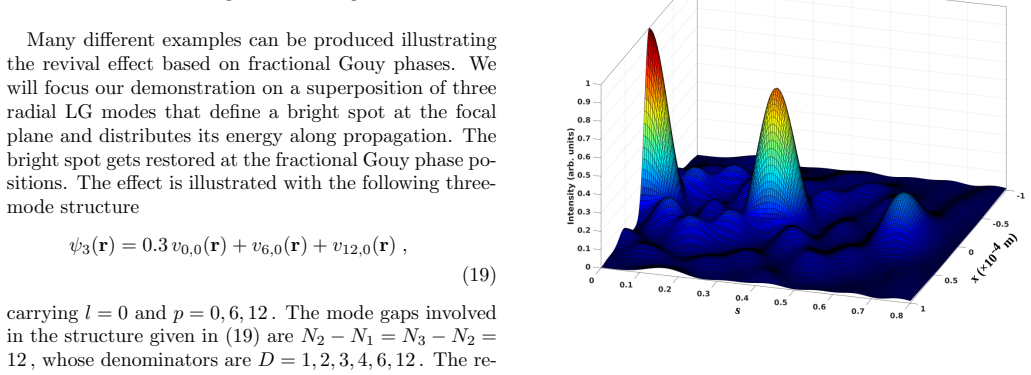
The central claim is that pattern revivals, usually associated with periodic self-imaging of gratings, also arise in superpositions of a few discrete paraxial modes. For modes sharing a common Rayleigh range and optical axis, each mode carries a Gouy phase $\varphi_N(z)=(N+1)\arctan(z/z_0)$, and the revival condition reduces to $(N_{j+1}-N_j) s(z)=4q_j$ with $s(z)=(2/\pi)\arctan(z/z_0)$. When this holds, all relative phasors in the mode superposition align, and the field becomes $e^{i\bar{\varphi}} e^{2\pi i r/d}$ times a scaled copy of the initial pattern. The paper demonstrates the effect with the mode structure $\psi_3(r)=0.3 v_{0,0}(r)+v_{6,0}(r)+v_{12,0}(r)$, whose mode-order gaps are both 12, giving revivals at $s=1/3$ and $s=2/3$, and it reports matching experimental images of a spot that reconstitutes itself along the beam.
Load-bearing premise
The whole derivation assumes every component mode shares the same Rayleigh range and the same optical axis, so that the Gouy phase advance and the transverse width scaling are identical for all modes; if modes with different $z_0$ or different axes were mixed, no single propagation parameter could restore the original pattern.
Editorial extensions
If this is right
- A radially structured spot made from three LG modes can concentrate its energy on a bright central spot at the focal plane, dissolve it during propagation, and reconcentrate it at two later positions, giving a way to address light to a target without moving any lens or mirror.
- Because the revival positions are fixed by the mode-order gaps, a beam can be engineered to revive at a chosen longitudinal plane by choosing commensurable gaps, offering a design rule for self-imaging structured light.
- The revival condition holds for any basis of paraxial modes with the same Rayleigh range, so the effect is not tied to the specific radial modes used in the demonstration.
- Since Gouy phases also appear in matter waves, the same synchronization condition may produce revivals in electron beams and Bose-Einstein condensates, as the authors note.
- The revival field carries an overall phase factor that is invisible in intensity but may affect coherent or quantum applications, potentially allowing the effect to be used as an interferometric probe.
Reading between the lines
- A natural next experiment is a four-mode superposition with gaps 8 and 16, where the same formula predicts a revival at $s=1/2$; observing it would test the scaling beyond the three-mode example.
- If two constituent modes were intentionally given different Rayleigh ranges, the revival condition would fail, so the effect could be turned into a sensitive probe of axial alignment or focal-position mismatch in a beam.
- The SU($d$) phasor picture connects the revival to cyclic evolution of a diagonal unitary; exploring the same geometry with orbital-angular-momentum modes could yield rotating or helicoidal revivals, a variant the paper does not discuss.
- The number-theoretic link to commensurability suggests that a random choice of mode orders almost never produces revivals, so the effect is structurally fragile by design; this may be useful for encryption or as a fingerprint of the mode set.
Signed reviews
Editorial analysis
A structured set of objections, weighed in public.
Referee Report
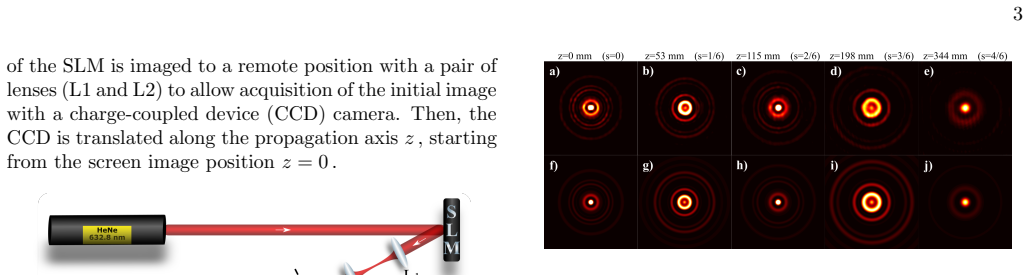
Summary. The paper investigates pattern revivals in superpositions of discrete paraxial modes, showing that when component modes share a common Rayleigh range z0 and a common axis, their Gouy phases can synchronize at specific longitudinal positions, reconstructing the initial transverse pattern up to an overall phase. The main theoretical result is Eq. (17), (N_{j+1}-N_j) s(z) = 4 q_j with s(z) = (2/pi) arctan(z/z0), which locates the revival positions. The effect is illustrated with a three-mode superposition, psi_3 = 0.3 v00 + v60 + v120, for which revivals are predicted at s = 1/3 and 2/3. The authors generate this superposition with a spatial light modulator and report revival-like patterns at z = 118 mm and 328 mm, comparing measured and calculated intensity distributions visually.
Significance. The analytical derivation is self-contained and parameter-free (apart from the optional relative amplitude A1 in the illustrative superposition), and it provides a clean test of a fundamental property of Gouy phases. If the experimental claims are substantiated quantitatively, the work would offer a simple and useful tool for energy delivery with structured light, with potential applications in tweezing and communications. However, the current experimental evidence is qualitative, and missing beam parameters prevent a quantitative verification of the central claim.
major comments (2)
- [Fig. 4 and the paragraph reporting z = 118 mm and 328 mm] The Rayleigh range z0 and the location of the beam waist relative to the nominal z = 0 image plane are never reported. For a single z0 with the waist at z = 0, Eq. (17) with s(z_j) = 1/3 and 2/3 predicts the ratio z(2/3)/z(1/3) = tan(pi/3)/tan(pi/6) = 3, whereas the reported ratio is 328/118 = 2.78. An origin offset of about 13 mm would reconcile the ratio, but no such offset is stated or ruled out. Without z0, the claimed mapping of the observed revivals to s = 1/3 and 2/3 cannot be verified. Please report the measured z0 (and how it was obtained), the waist position relative to the z = 0 image plane, and a fit or direct comparison of the observed revival positions against Eq. (17).
- [Figs. 2 and 4] The agreement between experiment and theory is asserted as 'remarkable' from visual inspection, with no quantitative fidelity metric, no error bars, and no comparison of measured intensity profiles along a transverse cut (the analogous theoretical plot is shown in Fig. 3). Please provide a quantitative metric, such as the normalized cross-correlation or structural similarity between measured and calculated intensity patterns at the revival planes and at intermediate planes, including uncertainties from repeated measurements. This is essential because the paper's contribution is precisely the experimental demonstration of the predicted revival positions.
minor comments (4)
- [Text after Eq. (16)] The recurrence r_{j+1} = r_j + 2d q_j is inconsistent with the preceding definition Delta_j = 2 pi r_j/d and with the relation Delta_{j+1} - Delta_j = 2 pi q_j; it should read r_{j+1} = r_j + d q_j, as can be checked for the d = 3, q_1 = q_2 = 1 example where the correct values are r = (-3, 0, 3).
- [Introduction] There is a missing space in 'so calledghost images' in the introductory paragraph.
- [Eq. (9) and surrounding text] 'Polinomials' should be 'polynomials' in the text following Eq. (9).
- [Conclusion] The word 'comensurability' should be 'commensurability' in the final paragraph.
Circularity Check
No circularity: the revival condition is rederived from first principles in Eqs. (1)-(17); the sole self-citation (Ref. [15]) is not load-bearing.
full rationale
The derivation is self-contained. The paper starts from paraxial HG/LG modes with a common Rayleigh range z0 (Eqs. (1)-(9)), forms a superposition of modes with different orders (Eq. (11)), and defines revivals by Gouy phase synchronization (Eq. (12)). The fractional phase condition (Eq. (16)) is derived explicitly from Eqs. (12) and (15) ('To see this more explicitly we can use Eqs.(12) and (15) to arrive at...'), and the revival positions (Eq. (17)) follow algebraically: (N_{j+1}-N_j) s(z) = 4 q_j with s(z)=(2/pi) arctan(z/z0). No parameter is fitted to the observed revival positions; the example with mode gaps of 12 gives s = 1/3 and 2/3 by simple arithmetic. The citation of the authors' own Ref. [15] for the SU(d) phase structure is contextual and not load-bearing, since the needed condition is rederived in the same paragraph. The experimental section reports revival positions without giving z0 or waist-offset uncertainties, but that is a quantitative-validation concern, not circularity: there is no indication that a fitted value was renamed as a prediction. Hence no circular step can be exhibited, and the score is 0.
Assumptions & free parameters
free parameters (1)
- relative amplitude A1 for v00 mode =
0.3
assumptions (3)
- domain assumption Paraxial wave equation and Hermite-Gaussian/Laguerre-Gaussian modes as a complete orthonormal basis for beam propagation
- domain assumption All component modes share a common Rayleigh range z0 and beam axis
- domain assumption The spatial light modulator produces a faithful complex amplitude approximation of the ideal superposition at z=0
Cite this review
Pith. "Pith review of Pattern revivals from fractional Gouy phases in structured light." pith.science (2026). https://pith.science/paper/7KLMPFCZ
@misc{pith2026190801740,
  author       = {Pith},
  title        = {Pith review of: Pattern revivals from fractional Gouy phases in structured light},
  year         = {2026},
  howpublished = {\url{https://pith.science/paper/7KLMPFCZ}},
  note         = {Machine review of arXiv:1908.01740}
}
read the original abstract
We investigate pattern revivals in specially designed optical structures that combine different transverse modes. In general, the resulting pattern is not preserved under free propagation and gets transformed due to non synchronized Gouy phases. However, it is possible to build structures in which the Gouy phases synchronize at specific fractional values, thus recovering the initial pattern at the corresponding longitudinal positions. This effect is illustrated with a radially structured light spot in which the beam energy can be addressed to different positions without the need of intermediate optical components, what can be useful for optical communications and optical tweezing with structured beams.
Figures

Reference graph
Works this paper leans on
-
[1]
S. P. Walborn, C.H. Monken, S. P´ adua, and P.H. Souto Ribeiro, Physics Reports 495, 87 (2010)
work page 2010
-
[2]
M. J. Padgett, Opt. Express 25, 11265 (2017)
2017
-
[3]
C. H. Monken, P. H. Souto Ribeiro, S. P´ adua, Phys. Rev. A 57, 3123 (1998)
work page 1998
-
[4]
M. J. Padgett, R. W. Boyd, Phil. Trans. R. Soc. A 375, 20160233 (2017)
work page 2017
-
[5]
P. A. Moreau, E. Toninelli, T. Gregory, and M. J. Pad- gett, Laser & Photonic Reviews 12, 1700143 (2018)
work page 2018
- [6]
-
[7]
I. Rodrigues, O. Cosme, and S P´ adua, J. Phys. B: At. Mol. Opt. Phys. 43, 125505 (2010)
work page 2010
-
[8]
A. Z. Khoury, L. E. Oxman, B. Marques, A. Matoso, and S. P´ adua, Phys. Rev. A87, 042113 (2013)
work page 2013
Show all 16 references
-
[9]
S. M. Baumann, D. M. Kalb, L. H. MacMillan and E. J. Galvez, Opt. Exp. 17, 9818 (2009)
2009
-
[10]
H. F. Talbot, The London, Edinburgh, and Dublin Philo- sophical Magazine and Journal of Science 9, 401 (1836)
-
[11]
M. S. Chapman, C. R. Ekstrom, T. D. Hammond, J. Schmiedmayer, B. E. Tannian, S. Wehinger, and D. E. Pritchard, Phys. Rev. A 51, R14 (1995)
1995
-
[12]
Patorsky, The Self-Imaging Phenomenon and its Ap- plications, PROGRESS IN OPTICS XXVII, Edited by E
K. Patorsky, The Self-Imaging Phenomenon and its Ap- plications, PROGRESS IN OPTICS XXVII, Edited by E. WOLF, Elsevier Science Publishers B. V. (1989)
1989
-
[13]
B. P. S. Ahluwalia, X-C. Yuan, and S.H. Tao, Opt. Comm. 238, 177 (2004)
2004
-
[14]
Courtial, G
J. Courtial, G. Whyte, Z. Bouchal, J. Wagner, Opt. Exp. 14, 2108 (2006)
2006
-
[15]
L. E. Oxman and A. Z. Khoury, Phys. Rev. Lett. 106, 240503 (2011)
2011
-
[16]
S. Wolk, W. Merkel, W. P. Schleich, I. S. Averbukh, and B. Girard, New J. Phys. 13, 103007 (2011)
2011
Reviewed August 14, 2026 · model on record in the stance chip above.
Discussion (0). Continue with ORCID to comment.