REVIEW 1 major objections 5 minor 37 references
Hydrogen Molecules in the Dark Ages Halos: Thermal Emission vs. Resonant Scattering
T0 review · 1 major / 5 minor · reviewed 2026-08-14 · deepseek-v4-flash
Pith's one-line read Dark ages halos would emit microkelvin H2 lines only if virialized gas reaches thousands of kelvins.
desk verdict Careful warm-halo calculation with honest nanokelvin results; the microkelvin headline rests on an unmodeled hot-halo scenario and should be reframed. read the letter →
The pith
A machine-rendered reading of the paper's core claim, the machinery that carries it, and where it could break.
The reading
What carries the argument
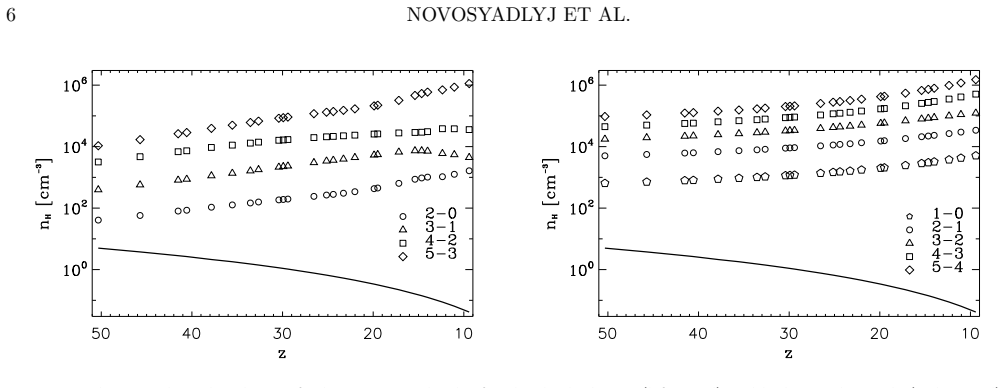
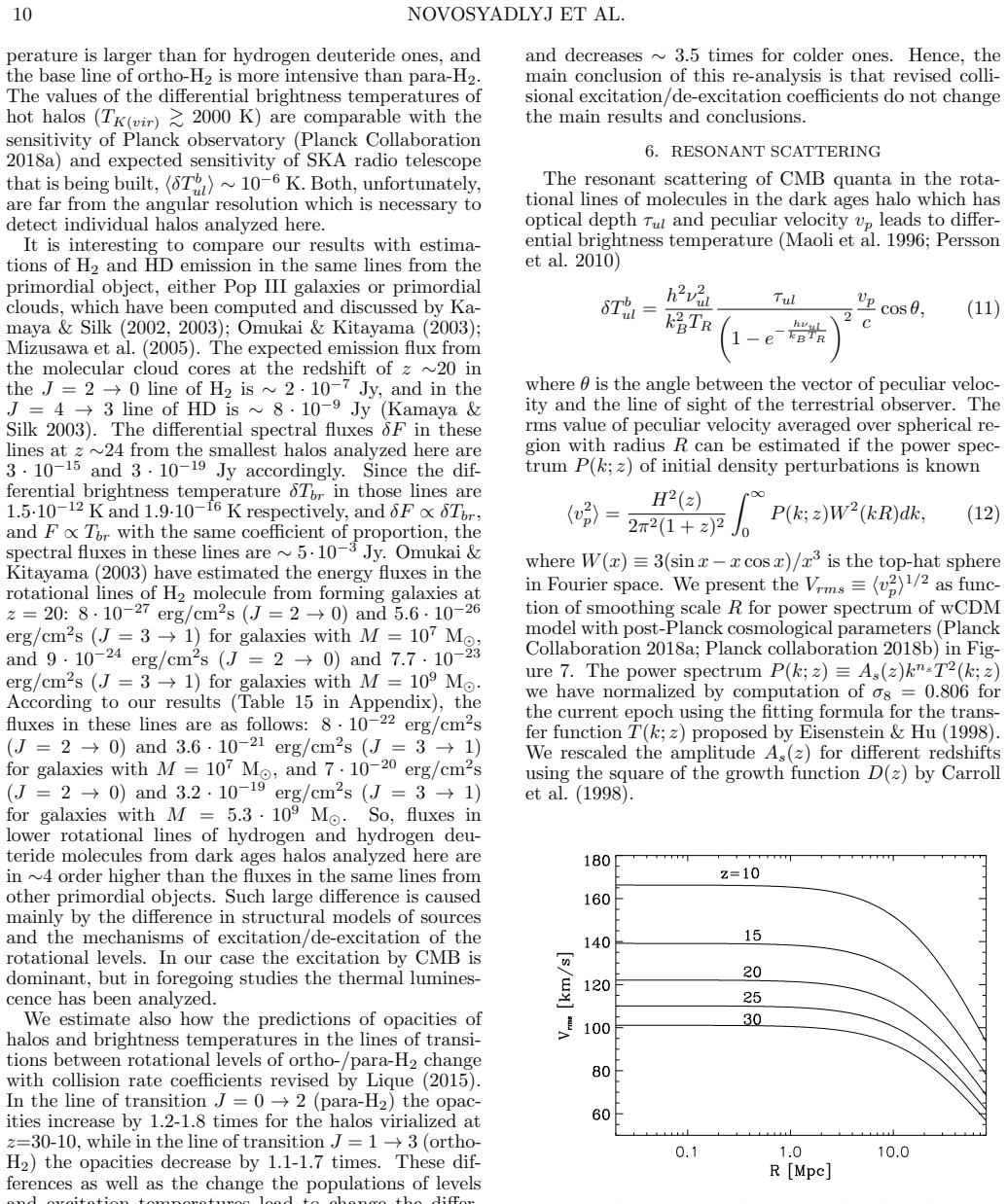
The central object is a six-level rotational system for each molecule (J=0–5 for H2; J=0–5 for HD), with populations coupled by CMB radiative transitions (electric quadrupole for H2, electric dipole for HD) and by collisional excitation and de-excitation with neutral hydrogen atoms. Level populations are solved both by integrating kinetic equations through halo formation and by solving the stationary algebraic system after virialization, giving excitation temperatures $T_{\rm ex}$. The emitted signal is then the optically thin brightness temperature, proportional to the opacity $\tau_{ul}$ times the difference between the Planck function at $T_{\rm ex}$ and at the CMB temperature, with $\tau_{ul}$ set by molecular number density, Einstein A coefficient, thermal line width, and halo radius; resonant scattering adds a term proportional to $\tau_{ul} v_p/c \cos\theta$. This machinery converts the halo model and molecular data into concrete predictions for both differential brightness temperature and spectral flux.
What would settle it
A cosmological hydrodynamics simulation that tracks post-virialization gas temperatures in $10^{6}$–$10^{10}$ solar-mass halos at z=10–50 would settle the claim: if no halo sustains $T_K\ge 2000$ K for a significant time, the predicted few-microkelvin ortho-H2 brightness temperatures are ruled out, while a survey at 300–600 GHz with roughly one-microkelvin sensitivity would test the signal directly if such halos exist.
Extended reading notes
Core claim
The central claim is that dark ages halos are intrinsic sources and scatterers of line radiation in the rotational transitions of H2 and HD, and that the expected signal size hinges on the post-virialization kinetic temperature. In the standard adiabatic model, halos with masses near $10^{6}$ to 5×$10^{9}$ solar masses virializing at z≈10–50 have kinetic temperatures of roughly 60–800 K, and their thermal emission yields differential brightness temperatures of at most a nanokelvin at 200–600 GHz, comparable to or slightly above the resonant-scattering signal. If, instead, the same halos reach kinetic temperatures of 2000–5000 K after virialization, the ortho-H2 J=3→1 and para-H2 J=2→0 lines brighten by orders of magnitude, reaching a few microkelvins, with spectral fluxes around $10^{-5}$ microjansky. The paper further claims that resonant scattering dominates thermal emission for HD lines, peaking at a few nanokelvins near 85–170 GHz for massive warm halos, and that revised collisional rate coefficients change line strengths by factors of order unity without altering these conclusions.
Load-bearing premise
The load-bearing premise is the Section 5 supposition that virialized halos can reach kinetic temperatures of 2000–5000 K regardless of formation redshift; if real halos stay at the computed adiabatic temperatures of 60–800 K, every predicted signal falls to nanokelvins or below and the microkelvin detectability claim disappears.
Editorial extensions
If this is right
- For warm halos ($T_K\sim 200$–800 K), both thermal emission and resonant scattering produce only nanokelvin differential brightness temperatures, below the sensitivity of current submillimeter telescopes.
- If hot halos exist, the ortho-H2 J=3→1 line near 560 GHz (and the para-H2 2→0 line near 338 GHz, depending on redshift) becomes the brightest molecular signature, at a few microkelvins.
- The same calculation makes resonant scattering the dominant HD signature, with maximal values around a few nanokelvins at 85–170 GHz for massive warm halos.
- Replacing older H2 collisional rate coefficients with the revised ones changes predicted opacities and brightness temperatures by factors of roughly 1.1–5.4, but does not flip the ordering of mechanisms or the detectability conclusions.
- Spectral fluxes from these halos are predicted to be about four orders of magnitude larger than earlier estimates for primordial objects in the same lines, because CMB excitation rather than pure thermal luminescence dominates the level populations.
Reading between the lines
- Editorial inference: if the hot-halo scenario is correct, the 300–600 GHz ortho-H2 lines become a direct thermometer for the kinetic temperature of the first virialized objects, since the brightness temperature rises steeply with $T_K$; targeted follow-up of any 21-cm absorption features could test this.
- Editorial inference: the predicted microkelvin signals sit in a frequency range where high-redshift CO line emission from foreground galaxies could mimic or mask a compact source, so line-foreground confusion may be the practical bottleneck even with sufficient sensitivity.
- Editorial inference: the homogeneous top-hat assumption neglects clumping; if the gas fragments into dense cold clumps embedded in a hot medium, the collisionally excited emission could be boosted or suppressed relative to the uniform-halo prediction, a testable extension with subgrid models.
- Editorial inference: the strong sensitivity to the ortho-to-para ratio means that constraints on H2 formation history in minihalos, which set that ratio, could matter more than collisional rate uncertainties; a measurement of the 3→1/2→0 line ratio would directly probe this ratio.
Signed reviews
Editorial analysis
A structured set of objections, weighed in public.
Referee Report
Summary. The paper computes the expected rotational line signals of H2 and HD molecules in dark ages halos, for two mechanisms: thermal emission/absorption (collisional plus CMB excitation) and resonant scattering of CMB photons by halos with peculiar velocities. The halo physical parameters and molecular abundances are taken from the authors' previous spherical top-hat collapse models (Novosyadlyj et al. 2016, 2018), covering halo masses 1.3e6-5.3e9 Msun virializing at z~10-50. Level populations are solved both by integrating the kinetic equations during halo evolution and by solving the stationary algebraic system, and opacities, differential brightness temperatures, and spectral fluxes are tabulated. The paper finds that for the adiabatically heated 'warm' halos (TK~60-800 K) the signals are at the nanokelvin level or below and are not detectable. For an assumed 'hot' phase with TK=2000-5000 K, thermal ortho-H2 emission reaches a few microkelvin at observed frequencies 300-600 GHz, which the abstract and conclusions argue could be detected by next-generation telescopes.
Significance. If the hot-halo scenario were physically justified, the paper would provide a concrete, falsifiable prediction for a new dark ages probe in molecular rotational lines, with the useful quantitative conclusion that warm halos are far below detectability. The modeling has genuine strengths: the radiative transfer and level-population equations are standard; the two independent solution methods give consistent results; the sensitivity of the conclusions to the revised Lique (2015) collisional rate coefficients is explicitly tested; and the frequency and flux predictions are concrete. The significance is limited, however, by the fact that the only signal of observational interest, the few-microkelvin claim, rests on an ad hoc assumption about post-virialization halo temperatures that is not derived from the authors' halo formation model or supported by an independent physical calculation.
major comments (1)
- [Section 5, after Eq. (9); Abstract; Section 7, conclusion 4] The headline detectability claim depends entirely on an assumption that is introduced, not derived. Section 5 states 'We suppose that halos after virialization reach some temperatures TK(vir) > TK(ad) independent on the redshift of virialization' and Figure 6 plots TK(vir)=1000, 2000, 5000 K, but Table 1 shows the adiabatic virialization temperatures of the authors' own halos are only 60-834 K. No physical mechanism, heating timescale, or supporting calculation is given for why dark ages halos would sustain 2000-5000 K, and the molecular abundances in Table 1 were computed for the lower adiabatic temperatures; the hot-halo calculation does not recompute H2 and HD chemistry at the higher kinetic temperature. The abstract and conclusion 4 nevertheless present the resulting 'few microkelvins' as the predicted signal that 'could be detectable with telescopes of a new generation.' This is a load-bearing gap: without a physical model for the hot phase, or a clear reframing of the claim as a purely conditional upper-bound scenario, the paper's main observational conclusion is not supported by the model developed in Sections 2-6.
minor comments (5)
- [Section 5, comparison with Kamaya & Silk (2003)] The paragraph comparing fluxes with Kamaya & Silk is internally inconsistent: after reporting the authors' differential fluxes as 3e-15 and 3e-19 Jy, the text concludes that 'the spectral fluxes in these lines are ~5e-3 Jy.' This sentence needs to be rewritten so that the comparison is arithmetically clear.
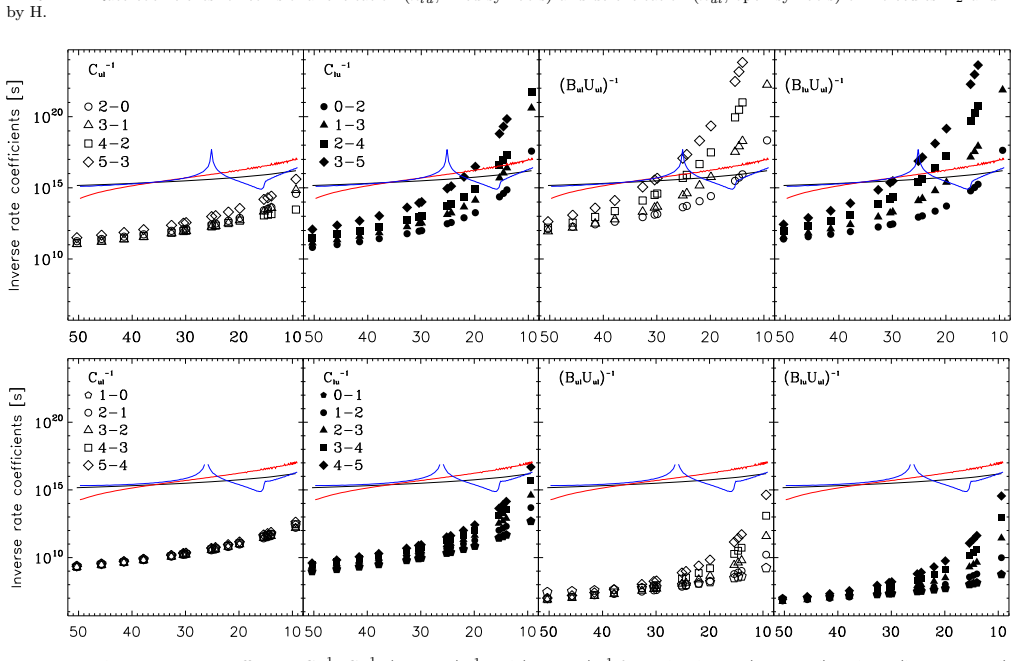
- [Section 3 and Table 13] The H2 collisional rate coefficients are extrapolated below 100 K by a second-order polynomial through three nearest data points, and the HD rates are extrapolated from a fit that is stated to cover 100-2080 K. The text gives no estimate of the uncertainty of these extrapolations; because the coldest halos (TK~60-100 K) rely on them, the numerical values in Tables 7, 8, 15, and 16 for those halos should be labeled as extrapolation-dependent.
- [Section 4] Typo: 'They are presented for for l-u levels' should read 'They are presented for the l-u levels.'
- [Figure 5 caption] The caption contains 'evolution of of opacity' and 'bright column'; these should read 'evolution of opacity' and 'right column.'
- [Section 7, conclusion 4] The kinetic temperature range is written as '(TK∼2000−5000)' with the unit K missing; it should be '(TK∼2000−5000 K).'
Circularity Check
No circularity: the brightness temperatures are computed from independent halo-formation inputs and external collisional data, not fitted to the predicted signal.
full rationale
The paper's derivation chain is self-contained. Halo densities, temperatures, and molecular abundances are taken from the authors' previous perturbation-theory calculations (Novosyadlyj et al. 2016, 2018), which are parameter-free structure-formation computations whose assumptions do not include the target brightness temperatures; they are independent inputs, not fits to the emission signal. Collisional rate coefficients come from the external VAMDC database and from published calculations (Flower, Wrathmall, Lique, etc.), with only a transparent low-temperature polynomial extrapolation that does not feed the headline claim. The differential brightness temperatures are obtained by solving level-population kinetic equations and applying standard radiative-transfer formulas, so the outputs are computed, not fitted. The few-microkelvin hot-halo result is explicitly presented as a scenario ('We suppose that halos after virialization reach some temperatures TK(vir) > TK(ad)'), i.e., a conditional assumption rather than a derived prediction, and the paper clearly labels it as such in Section 5 and Conclusion 4. No equation reduces to its own input, and no self-citation is invoked to forbid alternatives or to justify the central derivation. The weak hot-halo assumption is a physical-scenario concern, not a circularity.
Assumptions & free parameters
free parameters (2)
- hot halo virial temperature TK(vir) =
1000, 2000, and 5000 K
- low-temperature collision rate extrapolation =
second-order polynomial coefficients in Tables 12 and 13
assumptions (4)
- domain assumption Dark ages halos are homogeneous top-hat spheres with uniform density and temperature that does not evolve after virialization.
- domain assumption Collisional rate coefficients from the VAMDC database (Flower 1997/1998, Wrathmall 2007, Flower and Roueff 1999, Lique 2015) are accurate, including the quadratic extrapolation below 100 K.
- domain assumption A six-level rotational model (J=0-5) with only quadrupole (H2) or dipole (HD) radiative transitions and H-atom collisions is sufficient to compute the line emission.
- ad hoc to paper Some dark ages halos become 'hot' (TK = 2000-5000 K) after virialization, independent of their formation redshift.
Cite this review
Pith. "Pith review of Hydrogen Molecules in the Dark Ages Halos: Thermal Emission vs. Resonant Scattering." pith.science (2026). https://pith.science/paper/ZHMHTRN3
@misc{pith2026190801746,
  author       = {Pith},
  title        = {Pith review of: Hydrogen Molecules in the Dark Ages Halos: Thermal Emission vs. Resonant Scattering},
  year         = {2026},
  howpublished = {\url{https://pith.science/paper/ZHMHTRN3}},
  note         = {Machine review of arXiv:1908.01746}
}
abstract
The emission from dark ages halos in the lines of transitions between lowest rotational levels of hydrogen and hydrogen deuteride molecules is analyzed. It is assumed molecules to be excited by CMB and collisions with hydrogen atoms. The physical parameters of halos and number density of molecules are precalculated in assumption that halos are homogeneous top-hat spheres formed from the cosmological density perturbations in the four-component Universe with post-Planck cosmological parameters. The differential brightness temperatures and differential spectral fluxes in the rotational lines of H$_2$-HD molecules are computed for two phenomena: thermal luminescence and resonant scattering of CMB radiation. The results show that expected maximal values of differential brightness temperature of warm halos ($T_K\sim$200-800 K) are at the level of nanokelvins, are comparable for both phenomena, and are below sensitivity of modern sub-millimeter radio telescopes. For hot halos ($T_K\sim$2000-5000 K) the thermal emission of H2-ortho molecules dominates and the differential brightness temperatures are predicted to be of a few microkelvins at the frequencies 300-600 GHz, that could be detectable with telescopes of a new generation.
Figures

Figures from the paper (4 more)


Reference graph
Works this paper leans on
-
[1]
2001, Phys
Barkana, R., Loeb, A. 2001, Phys. Rep., 349, 125
2001
-
[2]
Basu, K. 2007, New Astron. Rev., 51, 431 de Bernardis, P., Dubrovich, V., Encrenaz, P. et al. 1993, A&A, 269, 1
work page 2007
-
[3]
Bowman, J.D., Rogers, A.E.E., Monsalve, R.A. et al. 2018, Nature, 555, 67
work page 2018
- [4]
- [5]
-
[6]
Chen, R. & McKeever, S.W. 1997, Theory of Thermoluminescence and Related Phenomena. World Scientific, Singapore, 400 p
work page 1997
-
[7]
Dubrovich, V. K. 1977, Sov. Astron. Lett., 3, 128
work page 1977
-
[8]
Dubrovich, V., Bajkova, A., Khaikin, V. B. 2008, New Astron., 13, 28
work page 2008
Show all 37 references
-
[9]
Eisenstein, D.J. & Hu, W. 1998, ApJ, 496, 605
1998
-
[10]
& Keating, B
Fan, X., Carilli, C.L. & Keating, B. 2006, Ann. Rev. A&A, 44, 415
2006
-
[11]
B., Somerville, W
Field, G. B., Somerville, W. B. & Dressler, K. 1966, Ann. Rev. A&A, 4, 207
1966
-
[12]
1997, MNRAS, 288, 627
Flower, D.R. 1997, MNRAS, 288, 627
1997
-
[13]
& Roueff, E
Flower, D.R. & Roueff, E. 1998, J.Phys. B, 31, 955
1998
-
[14]
Flower, D. R. & Roueff, E. 1999, MNRAS, 309, 833
1999
-
[15]
Flower, D. R. & Pineau des Forˆ ets, G. 2000, MNRAS, 316, 901
2000
-
[16]
Furlanetto, S.R., Oh, S. P. & Briggs, F.H. 2006, Physics Reports, 433, 181
2006
-
[17]
V., Dubrovich, V
Gosachinskij, I. V., Dubrovich, V. K., Zhelenkov, S. R., Ilin, G. N., & Prozorov, V. A. 2002, Astron. Rep., 46, 543
2002
-
[18]
& Field, G.B
Goss, W.M. & Field, G.B. 1968, ApJ, 151, 177
1968
-
[19]
& Martel, H
Iliev, I.T., Shapiro, P.R., Ferrara, A. & Martel, H. 2002, ApJ, 572, L123
2002
-
[20]
& Silk, J
Kamaya, H. & Silk, J. 2002, MNRAS, 332, 251
2002
-
[21]
& Silk, J
Kamaya, H. & Silk, J. 2003, MNRAS, 339, 1256
2003
-
[22]
Lang, K. R. 1974, Astrophysical Formulae. A. Compendium for the Physicist and Astrophysicist. Springer-Verlag, Berlin,
1974
-
[23]
& Faure, A
Lique, F., Honvault, P. & Faure, A. 2012, J. Chem. Phys., 137, 154304
2012
-
[24]
2015, MNRAS, 453, 810
Lique, F. 2015, MNRAS, 453, 810
2015
-
[25]
1994, ApJ, 425, 372
Maoli, R., Melchiorri, F., & Tosti, D. 1994, ApJ, 425, 372
1994
-
[26]
1996, ApJ, 457, 1
Maoli, R., Ferrucci, V., Melchiorri, F., & Tosti, D. 1996, ApJ, 457, 1
1996
-
[27]
& Nishi, R
Mizusawa, H., Omukai, K. & Nishi, R. 2005, Publ. Astron. Soc. Japan, 57, 951
2005
-
[28]
2018, ApJ, 865, 38
Novosyadlyj, B., Shulga, V., Han, W., Kulinich, Yu., & Tsizh, M. 2018, ApJ, 865, 38
2018
-
[29]
2016, Gen
Novosyadlyj, B., Tsizh, M., Kulinich, Yu. 2016, Gen. Relativ. Grav., 48, 30 N´ u˜ nez-L´ opez, R., Lipovka, A. & Avila-Reese, V. 2006, 369, 2005
2016
-
[30]
& Kitayama, T
Omukai, K. & Kitayama, T. 2003, ApJ, 599, 738
2003
-
[31]
Persson, C. M., R. Maoli, R., Encrenaz, P. et al. 2010, A&A, 515, A72 Planck Collaboration: Akrami, Y., Arroja, F., Ashdown, M. et al. 2018, arXiv:1807.06205 Planck Collaboration: Aghanim, N., Akrami, Y., Ashdown, M. et al. 2018, arXiv:1807.06209
2010 arXiv
-
[32]
& Loeb, A
Pritchard, J.R. & Loeb, A. 2012, Reports on Progress in Physics, 75,id. 086901
2012
-
[33]
1952, ApJ, 116, 457
Purcell, E.M. 1952, ApJ, 116, 457
1952
-
[34]
& Barrett, A.H
Rogers, A.E.E. & Barrett, A.H. 1968, ApJ, 151, 163 Roueff, E. & Flower, D. R. 1999, MNRAS, 305, 353
1968
-
[35]
& Nishimura, S
Takayanagi, K. & Nishimura, S. 1960, PASJ, 12, 163
1960
-
[36]
1963, Progr
Takayanagi, K. 1963, Progr. Theor. Phys. Suppl., 25, 1
1963
-
[37]
& Flower, D.R
Wrathmall, S.A., Gusdorf, A. & Flower, D.R. 2007, MNRAS, 382, 133 HYDROGEN MOLECULES IN THE DARK AGES HALOS 13 APPENDIX A. TABLES AND FIGURES FOR THE ONLINE VERSION ONLY. TABLE 11 Physical values and chemical composition of halos virialized at different zv: M is the total mass...
2007
Reviewed August 14, 2026 · model on record in the stance chip above.
Discussion (0). Continue with ORCID to comment.