REVIEW 3 major objections 5 minor 11 references
Laser-assisted interaction between nonrelativistic electrons and positrons
T0 review · 3 major / 5 minor · reviewed 2026-08-14 · deepseek-v4-flash
Pith's one-line read Intense pulsed laser fields can make two same-charged electrons or positrons behave as if attracted.
desk verdict A phase-tuned numerical demo of laser-induced effective attraction between same-charge particles, with a real but overgeneralized asymptotic claim. read the letter →
The pith
A machine-rendered reading of the paper's core claim, the machinery that carries it, and where it could break.
The reading
What carries the argument
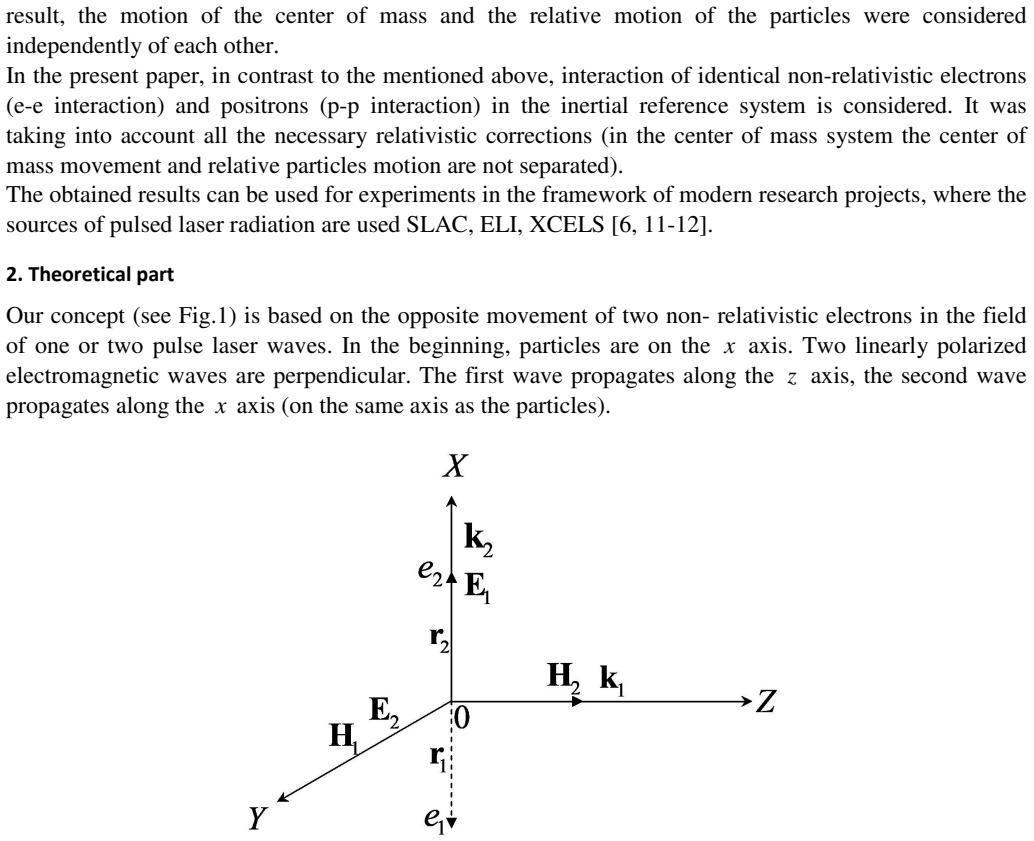
The machinery is a pair of coupled dimensionless equations of motion, Eqs. (9)-(14), for two point charges in the electric and magnetic fields of one or two linearly polarized pulsed waves. The laser intensity enters through the classical parameter $\eta_i = eE_{0i}/mc\omega$, the ratio of the oscillation velocity in the pulse peak to the speed of light; the pulse shape enters through Gaussian envelopes $f_i$; and the Coulomb interaction enters through $\beta$, the ratio of the Coulomb energy at one wavelength to the rest energy. The equations include relativistic corrections to order $v/c$ in the laboratory frame, which couples center-of-mass and relative motion. The load-bearing step is the choice of the initial laser phase: the paper fixes the phase so that the field influence at particle arrival is maximal, and that phase choice is what turns the two trajectories into a long, practically parallel beam.
What would settle it
Scan the initial laser phase over $0$ to $2\pi$ for the single-wave configuration of Figure 3 while keeping all other parameters fixed: the central claim predicts a broad interval of phases producing nearly parallel trajectories and an increased return time, whereas finding such trajectories only at isolated phase values would falsify the generic effective-attraction claim. A second, experimental falsifier would be a scattering experiment in which the separation of a monoenergetic electron pair is measured after passage through an intense pulsed laser field; if the outgoing relative velocity and separation are indistinguishable from no-field Coulomb scattering, the claimed delayed return is refuted.
Extended reading notes
Core claim
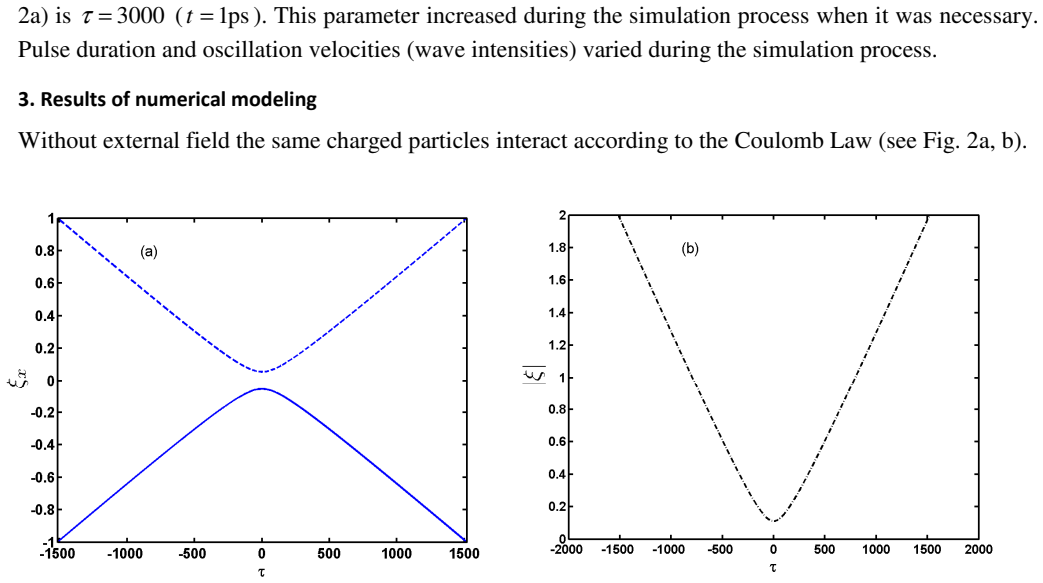
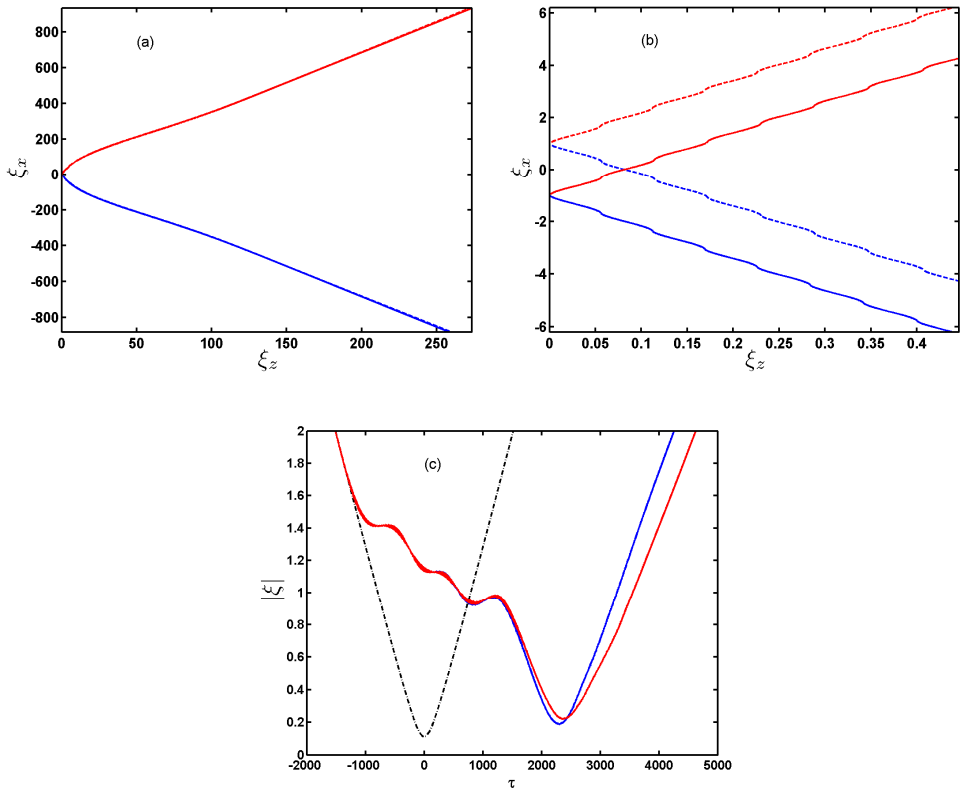
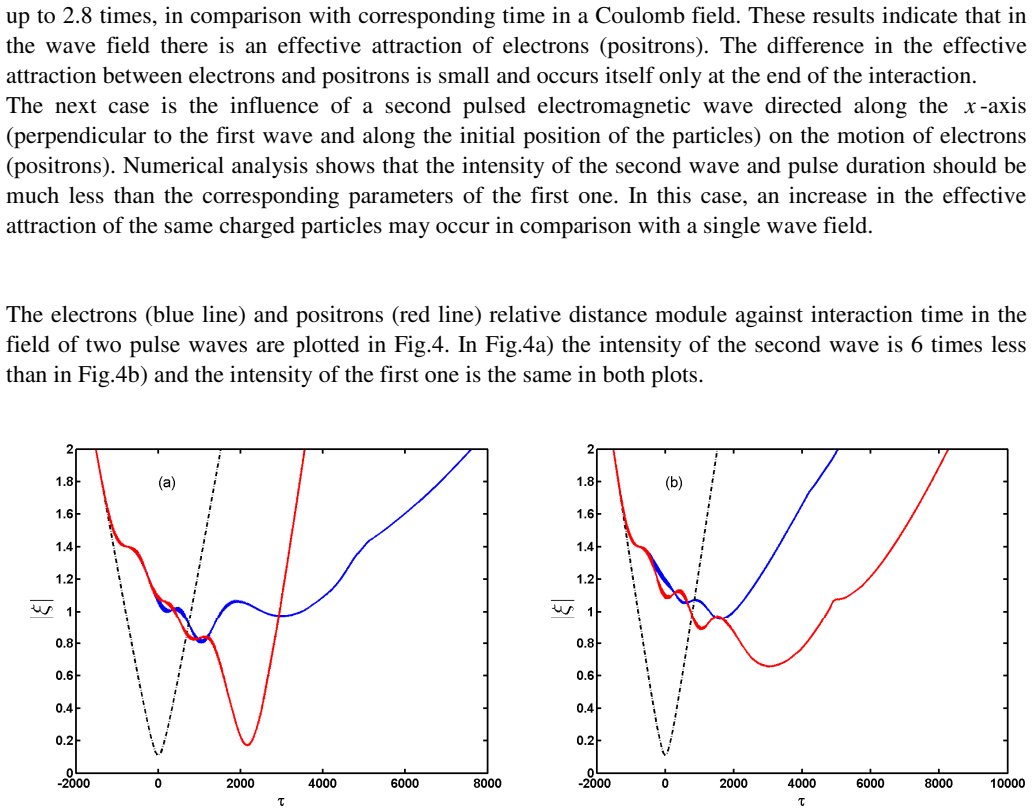
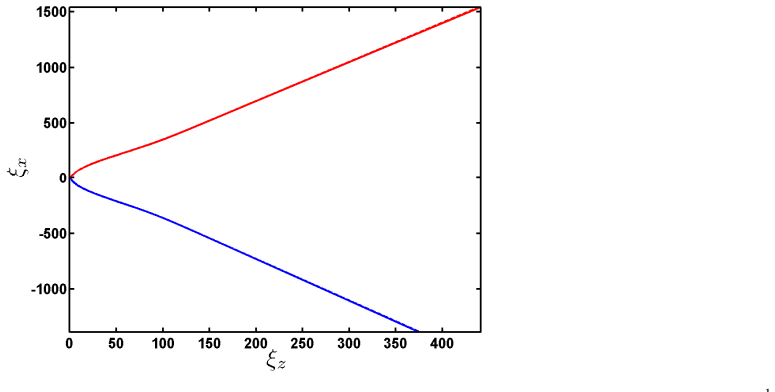
The central claim, stated on the paper's own terms, is that strong pulsed laser radiation produces an effective attraction between two identical classical charges in the nonrelativistic regime. Solving the dimensionless Newton-Lorentz equations with small relativistic corrections in the laboratory frame, the authors find that one wave with peak intensity around $10^{17}\,\text{W/cm}^2$ makes two electrons or positrons move on nearly parallel trajectories; their relative separation first decreases slowly, by almost an order of magnitude, and then returns to the initial value. The time needed to return grows by a factor of about 2.8 relative to pure Coulomb motion, and with an additional perpendicular wave of much lower intensity the return time grows up to about 3 times the Coulomb value. The reported asymmetry is quantitative: with the second wave at $\eta_2 = 10^{-3}$, electrons return to the initial separation in roughly twice the time positrons do, with the longer return time reported as $\Delta\tau = 4053$; when the second wave's intensity is increased sixfold, to $\eta_2 = 6\times 10^{-3}$, positrons are held up to 1.6 times as long, with $\Delta\tau = 3219$, so the ordering of effective attraction reverses.
Load-bearing premise
The load-bearing premise is the hand-picked initial laser phase reported in Section 3: the paper states that the long, practically parallel beam becomes possible only because the phase is chosen so that the initial field influence is maximal, and the quoted confinement times are computed at that phase, with one initial separation, one initial velocity, and pulse peaks timed at closest approach; if no broad phase window exists, the general conclusion that pulsed radiation effectively attracts same-charged particles does not follow from these simulations.
Editorial extensions
If this is right
- If the simulations are right, intense pulsed fields can transiently confine same-charge pairs without requiring relativistic initial particle energies.
- Adding a second, weaker perpendicular wave and tuning its intensity provides a control knob for confinement time, extending the single-wave 2.8-fold increase to about 3-fold.
- Because the effective attraction differs between electron pairs and positron pairs, the same field configuration can favor one species over the other, and the favored species flips when the second-wave intensity is raised sixfold.
- The near-parallel trajectories mean same-charge pairs can travel together over long distances, up to about 450 times their initial separation along the propagation axis, so the effect could show up as correlated propagation rather than a tightly bound pair.
Reading between the lines
- The paper tests one initial separation, one initial speed, and specifically tuned pulse-peak timing and laser phase; the natural next step is a phase and parameter scan to see how broad the effective-attraction window is, and whether the effect survives outside a narrow phase interval.
- A classical charge-sign asymmetry between electrons and positrons in the same fields hints that the small relativistic corrections, rather than the Coulomb term, carry the species dependence; a perturbation expansion in $v/c$ could isolate which term decides the sign of the asymmetry and predict its scaling with intensity.
- The time-to-return metric could be converted into an experimentally observable momentum transfer: comparing the outgoing relative velocity with and without the pulse would test the attraction without resolving nanometre-scale separations.
- The same equations imply that pairs with unequal masses or charges could have their effective attraction tuned by pulse phase and intensity, a direction the paper does not discuss.
Signed reviews
Editorial analysis
A structured set of objections, weighed in public.
Referee Report
Summary. The paper studies the classical effective interaction of two identical nonrelativistic electrons or positrons in the field of one or two intense pulsed laser waves, with small relativistic corrections included in the laboratory frame. Using numerically integrated Newton-Lorentz equations, the authors report that a strong pulsed wave can make the two particles move along nearly parallel trajectories, approach each other, and then return to their initial separation over a time up to about 2.8 times longer than in pure Coulomb motion; adding a second, weaker perpendicular wave extends this to about three times the Coulomb time. The paper further claims that the effective attraction is substantially asymmetric between electron pairs and positron pairs, and that the sign of this asymmetry reverses when the second-wave intensity is increased sixfold. The central qualitative claim is that intense pulsed radiation can transiently bind same-charge classical particles even in the nonrelativistic regime.
Significance. If the reported effect is robust, it would extend earlier relativistic results (Kazantsev and Sokolov) to nonrelativistic energies and pulsed fields, with possible relevance to laser-plasma interactions at facilities such as SLAC, ELI, and XCELS. The paper gives explicit parameter values (intensities, pulse durations, initial energies), presents the equations of motion in full, and compares against a pure Coulomb baseline, which makes the numerical experiment concrete and repeatable in principle. The electron-positron asymmetry, if confirmed, would be an interesting species-dependent effect in classical electrodynamics. However, the demonstration rests on a limited set of hand-picked initial conditions and phases, and the numerical integration is not documented, so the quantitative predictions (2.8x, 3x, asymmetry ratios) should be treated as preliminary.
major comments (3)
- [Section 3, Fig. 3 and discussion] The central claim of effective attraction is demonstrated only for a hand-picked initial laser phase. The authors state that forming the long, practically parallel beam 'becomes possible due to the choice of the initial phase' and that 'it is necessary to select a phase at which the initial influence of the field will be maximal.' No phase scan or statistical characterization is provided, so the reported 2.8-fold and 3-fold increases in return time may be outliers specific to a specially tuned phase rather than a generic property of intense pulsed radiation. Because the Conclusions state without qualification that 'effective attraction of same charged particles in the presence of external pulsed electromagnetic radiation is occur,' the generality of the paper's central conclusion currently exceeds the evidence.
- [Section 2, Eqs. (9)-(14) and Section 3] The manuscript gives no information about the numerical integrator, time-step size, adaptive stepping, or convergence checks used to solve the coupled equations of motion. The problem involves disparate scales: the field oscillation velocity (eta_1 = 3e-2 c) is more than an order of magnitude larger than the initial particle velocity (7e-4 c), and the integration extends over thousands of wave periods (tau up to 3000 or more). Without numerical validation, the quantitative claims of 2.8-fold, 3-fold, and 1.6-fold changes in return time, and especially the small asymmetry reversal between electrons and positrons (4053 tau versus 3219 tau in Fig. 4), cannot be assessed for accuracy. Please specify the solver, tolerances, step-size choices, and at least one convergence test (for example, halving the step size and confirming the return times change by less than a few percent).
- [Section 3, Fig. 4 and asymmetry claims] The electron-positron asymmetry is established from just two simulation runs at two second-wave intensities (eta_2 = 1e-3 and 6e-3), with one initial phase, one initial separation (xi = 2), and one initial velocity magnitude (7e-4 c). The reversal of the asymmetry with intensity is therefore a two-point observation. The paper's statement that 'the effective attraction of electrons is significantly greater than the one of positrons' and then that the pattern 'changes to the opposite' would be considerably stronger if supported by a small parameter scan (variation of eta_2, pulse timing, initial phase, or initial velocity) showing that the crossing is not an artifact of the specific chosen phase or numerical noise.
minor comments (5)
- [Figure 5 caption] The caption refers to intensities 'in Fug.4a' and 'in Fug.4b'; these are typographical errors for 'Fig. 4a' and 'Fig. 4b'.
- [Section 3, Fig. 3 caption] The caption text reads 'enlarged scale of the Fig. 2a', but the figure being enlarged is Fig. 3a, not Fig. 2a; please correct the cross-reference.
- [Eqs. (2)-(6)] The notation for the phase f_ij and the exponential envelope is introduced before the variables f_1 and f_2 are defined in Eq. (13); the ordering makes the equations difficult to follow. Defining all symbols at first use would improve readability.
- [Throughout] The language would benefit from careful proofreading: for example, 'taking into account' appears in several places where 'taken into account' is meant, and 'is occur' in the Conclusions should be 'occurs'.
- [Introduction, references] Reference [1] is a review relevant to laser-assisted processes but is not cited at a specific claim; the authors might also cite the classical relativistic attraction result [3] more precisely in the Introduction to frame their nonrelativistic extension.
Circularity Check
No significant circularity: the central quantities are genuine numerical outputs of the stated equations of motion.
full rationale
The paper's claims (parallel trajectories, increased return time, and electron-positron asymmetry) are obtained by numerically integrating the Newton-Lorentz equations (9)-(14) with the stated Coulomb interaction, pulse shapes, and initial conditions. The return times and ratios (2.8x, 3x, 4053, 3219) are outputs of those integrations, not fitted parameters renamed as predictions. The cited earlier works [7-10] serve as motivation and prior context in the Introduction; the present calculation does not import a fitted effective potential, uniqueness theorem, or ansatz from those papers, so the self-citations are not load-bearing. The hand-picked initial laser phase is a tuning of initial conditions, as the text explicitly says a phase of maximal initial field influence must be selected, but that is a parameter-dependence/generality concern rather than a circular reduction: the simulation result is not defined as the phase choice, and the paper does not claim phase statistics. No equation is shown to equal its own input by construction, and no prediction is equivalent to a fitted quantity. Thus the derivation chain is self-contained with respect to circularity, even though its physical generality may be limited.
Assumptions & free parameters
free parameters (4)
- Initial laser phase (phi_ij) =
not stated numerically; tuned to maximize initial field influence
- Initial separation and velocity =
xi2 - xi1 = 2 (about 200 nm); xi-dot = plus or minus 7e-4 (0.1 eV)
- Pulse durations tau1 and tau2 =
tau1 = 1500 (0.5 ps), tau2 = 300
- Oscillation velocity parameters eta1 and eta2 =
eta1 = 3e-1; eta2 = 3e-3 or 6e-3
assumptions (3)
- domain assumption Classical Newton-Lorentz equations with instantaneous Coulomb interaction describe two point charges in pulsed plane-wave fields
- domain assumption Velocity is small enough that first-order-in-v/c relativistic corrections suffice
- ad hoc to paper The unspecified numerical integrator is accurate enough for the reported return-time ratios and asymmetry reversal
Cite this review
Pith. "Pith review of Laser-assisted interaction between nonrelativistic electrons and positrons." pith.science (2026). https://pith.science/paper/E2N57PKW
@misc{pith2026190801751,
  author       = {Pith},
  title        = {Pith review of: Laser-assisted interaction between nonrelativistic electrons and positrons},
  year         = {2026},
  howpublished = {\url{https://pith.science/paper/E2N57PKW}},
  note         = {Machine review of arXiv:1908.01751}
}
read the original abstract
The effective interaction between two classical nonrelativistic electrons (positrons) in the presence of intense electromagnetic radiation (one and two waves) is theoretically studied. Small relativistic corrections are taking into account in the laboratory reference frame. The field of an intense wave forms the movement of particles in such a way that their trajectories are practically parallel for quite a long time, and in the perpendicular direction the particles shift slightly, approaching first and then moving away from each other. This result can be considered as an effective attraction of same charged particles. Shown that the effective attraction of two electrons and two positrons could be substantially asymmetric.
Figures
Figures from the paper (2 more)
Reference graph
Works this paper leans on
-
[1]
Cajiao Vélez F, Kami ński J Z, Krajewska K 2019 Atoms 7 34
work page 2019
-
[2]
Oleinik V P 1967 Zh. Eksp. Teor. Fiz. 52 1049
work page 1967
-
[3]
Kazantsev A P and Sokolov V P 1984 Zh. Eks. Teor. Fiz. 86 896
work page 1984
-
[4]
Zavtrak S T 1989 Letter in Zh. Eks. Teor. Fiz. 15 14
work page 1989
-
[5]
Piazza A Di, M¨uller C, Hatsagortsyan K Z and Keitel C H 2012 Rev. Mod. Phys. 84 1177
work page 2012
-
[6]
Cole JM et al 2018 Phys Rev X 8 011020
work page 2018
-
[7]
Starodub S S and Roshchupkin S P 2012 Las. Phys. 22 1202
work page 2012
- [8]
Show all 11 references
-
[9]
Starodub S S et al 2016 Laser Phys. Lett. 13 116001 [10]Starodub S S et al 2018 Laser and Particle Beams 36 55
2016
-
[11]
http://www.eli-laser.eu/
Extreme light infrastructure (ELI). http://www.eli-laser.eu/. Accessed 13 Feb 2019
2019
-
[12]
http://www.xcels.iapras.ru/
Exawatt center for extreme light studies (XCELS). http://www.xcels.iapras.ru/. Accessed 13 Feb 2019
2019
Reviewed August 14, 2026 · model on record in the stance chip above.
Discussion (0). Continue with ORCID to comment.