REVIEW 1 major objections 6 minor 23 references
Entropy and dimension of disintegrations of stationary measures
T0 review · 1 major / 6 minor · reviewed 2026-08-14 · deepseek-v4-flash
Pith's one-line read The paper proves that for ergodic stationary measures on complete flags of $\mathbb{R}^d$, each one-dimensional conditional measure is exact dimensional, with dimension equal to the quotient of a foliation entropy by the corresponding…
desk verdict A substantial and plausible extension of Ledrappier/Hochman-Solomyak to all dimensions, with one unproved measurability step in Lemma 5 that needs repairing before the proof is complete. read the letter →
The pith
A machine-rendered reading of the paper's core claim, the machinery that carries it, and where it could break.
The reading
What carries the argument
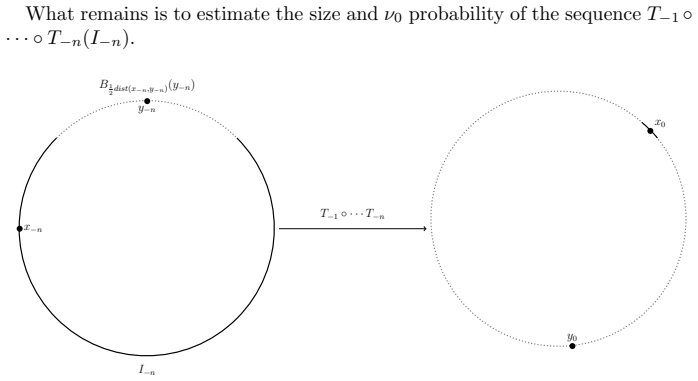
The argument is carried by three pieces. First, conditional mutual information between the random matrix $A$ and the flag $AF$ given the base point $AF_i$ is shown, via the theorem identifying mutual information with the expected logarithm of a Radon-Nikodym derivative, to equal the entropy $\kappa_i$ and to force $A\nu_{F_i}\ll\nu_{AF_i}$ almost surely. Second, an exact Jacobian identity for the rotationally invariant fiber measure $\eta_{F_i}$, namely $\frac{dA\eta_{F_i}}{d\eta_{AF_i}}(AF)=\frac{|\det_{S_i}A|^2}{|\det_{S_{i-1}}A||\det_{S_{i+1}}A|}$, identifies the Lyapunov gap $\chi_i-\chi_{i+1}$ as the asymptotic logarithmic cost of pushing measures along the foliation. Third, the multiplicative ergodic theorem applied to the two-dimensional quotients $S_{i+1}/S_{i-1}$ produces, for each time $n$, a complementary subspace $S_i'(n)$ whose angle with $S_i(n)$ has logarithm $o(n)$; translating the flag action into random circle diffeomorphisms and using a maximal inequality together with an ergodic theorem for triangular arrays shows that carefully chosen intervals shrink at rate $e^{-(\chi_i-\chi_{i+1})n}$ while their conditional probability decays at rate $e^{-\kappa_i n}$. These two exponential rates are exactly what pins the local dimension to the ratio.
What would settle it
For a concrete stationary measure on flags of $\mathbb{R}^3$ with $\kappa_2>0$, estimate numerically the local dimensions of the conditional measures on the circle of flags sharing a line and a plane and compare them with $\kappa_2/(\chi_2-\chi_3)$; a single example where the local dimensions differ or fail to be constant would refute Theorem 2. The unproved measurability in Lemma 5 can also be tested by constructing a stationary flag process in which $F_i(n)$ is not a function of the past matrices, which would break the proof.
Extended reading notes
Core claim
The central claim is Theorem 2: if $\nu$ is an ergodic stationary probability on the space of complete flags and is the unique stationary probability projecting to a fixed incomplete-flag distribution, and if the associated entropy $\kappa_i$ is positive, then almost surely the conditional measure $\nu_{F_i}$ on the circle of flags sharing all subspaces except the $i$-dimensional one is exact dimensional, with dimension $\kappa_i/(\chi_i-\chi_{i+1})$. The paper also proves Theorem 1, which bounds $0\le\kappa_i\le\chi_i-\chi_{i+1}$ and characterizes $\kappa_i=0$ as the case where the conditional family is invariant under almost every matrix. Together these theorems give a complete answer, in the uniqueness regime, to the question of what determines the dimension of disintegrations of stationary measures on complete flags in $\mathbb{R}^d$.
Load-bearing premise
The proof relies on the unproved claim that the incomplete flag at each time is already determined by the past random matrices; the conditional independence of two subspaces, and with it the whole circle-diffeomorphism construction, depends on this.
Editorial extensions
If this is right
- Where the hypotheses hold, the dimension of the conditional measures is a deterministic function of the Lyapunov spectrum and the entropy, so no finer data about the measure or the group action enters.
- The strict inequality $\kappa_i>0$ forces $\chi_i>\chi_{i+1}$, so positive entropy on an $i$-foliation is a certificate that the $i$-th Lyapunov gap is open.
- Absence of invariant conditional families, for every $i$, implies the Lyapunov spectrum is simple, giving a purely measure-theoretic route to spectral simplicity.
- The theorem extends the two-dimensional projective-space result to every one-dimensional foliation of complete flag space obtained by forgetting a single subspace.
Reading between the lines
- A natural quantity the paper leaves implicit is the defect $\chi_i-\chi_{i+1}-\kappa_i$; it may measure how singular the conditional measures are relative to the rotationally invariant fiber measure, and numerical experiments on random matrix products could reveal whether it is positive exactly when the conditional measures are singular.
- The circle-diffeomorphism machinery may transfer to other settings with one-dimensional fibers over a base space, such as non-complete flag varieties or other homogeneous spaces, whenever an analogous Jacobian cocycle and a Lyapunov splitting are available.
- A testable algorithmic consequence of Theorem 1 is that estimating $\kappa_i$ from simulations of a random matrix product gives a lower bound on the corresponding Lyapunov gap, so a strictly positive estimate certifies simplicity of the spectrum in practice.
Signed reviews
Editorial analysis
A structured set of objections, weighed in public.
Referee Report
Summary. This paper studies µ-stationary probabilities ν on the space of complete flags in R^d. For each i, the conditional measures ν_{F_i} on the one-dimensional fiber obtained by forgetting the i-dimensional subspace are considered. Theorem 1 establishes an inequality 0 ≤ κ_i ≤ χ_i − χ_{i+1}, where κ_i is the entropy of the conditional measures, and characterizes κ_i = 0 by invariance of the disintegration. Theorem 2 states that, under ergodicity, uniqueness of the stationary lift, and κ_i > 0, the conditional measures are almost surely exact dimensional with dimension κ_i/(χ_i − χ_{i+1}). The proof of Theorem 1 proceeds by approximation with absolutely continuous conditional measures and conditional mutual information; the proof of Theorem 2 uses Oseledets subspaces in a two-dimensional quotient and a construction of random intervals on the circle, with estimates obtained by Maker's theorem and an Orlicz maximal inequality.
Significance. If the results are correct, this is a substantial extension of the Ledrappier–Hochman–Solomyak dimension formula from SL_2(R) to disintegrations of stationary measures on flag manifolds of GL(R^d). The formula κ_i/(χ_i − χ_{i+1}) gives a parameter-free prediction for the fractal dimension of these conditional measures, and Theorem 1 connects the entropy κ_i to simplicity of the Lyapunov spectrum. The paper is careful and self-contained, with detailed proofs of the mutual-information identities, the perturbation argument, and the ergodic-theoretic estimates; it also acknowledges an earlier error and an anonymous referee's contribution. The main weakness is a missing justification at a load-bearing point in Lemma 5.
major comments (1)
- [Section 5, Lemma 5] The assertion that Fi(n) is σ(A(n−1), A(n−2), . . .)-measurable is not proved and is not true for an arbitrary two-sided stationary sequence satisfying the cocycle relation; a stationary solution may carry an extra initial condition that is not a function of the past matrices. This assertion is load-bearing: it is used to infer that the past block (A(n−1), A(n−2), ...) and the future block (A(n), A(n+1), ...) are conditionally independent given Fi(n), and hence that the Oseledets subspaces Eu(n) and Es(n) are conditionally independent. That conditional independence is in turn used in Lemma 6 to obtain P(ν_n(I_n) ≥ 1/2) ≥ 1/2 and in the construction of the stationary intervals in Section 6.2. The paper needs to either prove the measurability under the stated hypotheses (unique stationary lift and κ_i > 0) or explicitly use the natural extension of the one-sided Markov chain, where Fi(n) is independent of the future increments and the past and future increments are independent; this weaker property is sufficient for the conditional-independence conclusion. As written, the proof has a genuine gap at a load-bearing step.
minor comments (6)
- [Section 1.1] The displayed formula for the lower local dimension is garbled; it should be a fraction with log(ν(B_r(x))) divided by log(r).
- [Section 5, Lemma 4 proof] The sentence 'By ergodicity and one has' should read 'By ergodicity one has'.
- [Section 5, Lemma 5] The notation 'eo(n)' is not defined; it should be written as e^{o(n)}.
- [Section 6.5] The statement 'taking a subsequence we may assume n_k = 2k + o(k)' is terse; a short justification via the ergodic theorem and a thinning argument would improve readability.
- [Section 3.2.2] The phrase 'there is an associated action of Pt on the space of probability measures' should refer to the adjoint operator P_t^*.
- [Section 6.4.2, Lemma 10 proof] There is a typo: 'random varaible' should be 'random variable'.
Circularity Check
No significant circularity: the dimension formula is a theorem derived from independent entropy and Lyapunov-gap estimates.
full rationale
The paper's derivation is self-contained. The quantity κ_i is defined directly in Theorem 1 as E(log(dAν_{F_i}/dν_{A F_i}(AF))), and the target formula dim(ν_{F_i}) = κ_i/(χ_i−χ_{i+1}) in Theorem 2 is obtained by constructing stationary random intervals whose lengths decay at rate χ_i−χ_{i+1} and whose ν_0-measures decay at rate κ_i; the final local-dimension bounds then follow from Maker's theorem and an ergodic subsequence argument. No step fits a parameter to a subset of data and then 'predicts' a close relative, and no quantity is defined in terms of the target dimension. The only self-citation ([CLP19, §6.1.6] in Claim 1) is a cross-reference for a claim that is proved immediately by the Komlós subsequence argument, so it is not load-bearing. The proof of Lemma 5 does contain an unproved assertion that F_i(n) is σ(A(n−1), A(n−2), …)-measurable, used for the conditional independence of the Oseledets subspaces; that is a potential correctness gap, but it is not circularity, because the asserted dimension formula does not reduce to that measurability statement by construction or by definition. Overall, the central claim is a genuine theorem rather than a restatement of its inputs.
Assumptions & free parameters
assumptions (4)
- standard math Multiplicative ergodic theorem of Oseledets applied to the quotient cocycles on V(n) = S_{i+1}(n)/S_{i-1}(n).
- standard math Gelfand-Yaglom-Perez theorem relating mutual information to expected log Radon-Nikodym derivatives.
- standard math Maker's theorem and Breiman's individual ergodic theorem for information theory.
- ad hoc to paper The incomplete flag F_i(n) is measurable with respect to the past sigma-algebra of the random matrix sequence.
Cite this review
Pith. "Pith review of Entropy and dimension of disintegrations of stationary measures." pith.science (2026). https://pith.science/paper/S6SYRC55
@misc{pith2026190801754,
  author       = {Pith},
  title        = {Pith review of: Entropy and dimension of disintegrations of stationary measures},
  year         = {2026},
  howpublished = {\url{https://pith.science/paper/S6SYRC55}},
  note         = {Machine review of arXiv:1908.01754}
}
abstract
We extend a result of Ledrappier, Hochman, and Solomyak on exact dimensionality of stationary measures for $\text{SL}_2(\mathbb{R})$ to disintegrations of stationary measures for $\text{GL}(\mathbb{R}^d)$ onto the one dimensional foliations of the space of flags obtained by forgetting a single subspace. The dimensions of these conditional measures are expressed in terms of the gap between consecutive Lyapunov exponents, and a certain entropy associated to the group action on the one dimensional foliation they are defined on. It is shown that the entropies thus defined are also related to simplicity of the Lyapunov spectrum for the given measure on $\text{GL}(\mathbb{R}^d)$.
Figures
Reference graph
Works this paper leans on
-
[1]
David Blackwell and Lester E. Dubins. An extension of S korohod's almost sure representation theorem. Proc. Amer. Math. Soc. , 89(4):691--692, 1983
work page 1983
-
[2]
Convergence of probability measures
Patrick Billingsley. Convergence of probability measures . Wiley Series in Probability and Statistics: Probability and Statistics. John Wiley & Sons Inc., New York, second edition, 1999. A Wiley-Interscience Publication
work page 1999
-
[3]
The individual ergodic theorem of information theory
Leo Breiman. The individual ergodic theorem of information theory. Ann. Math. Statist. , 28:809--811, 1957
work page 1957
-
[4]
K. L. Chung. A note on the ergodic theorem of information theory. Ann. Math. Statist. , 32:612--614, 1961
work page 1961
-
[5]
On the speed of distance stationary sequences
Matias Carrasco , Pablo Lessa , and Elliot Paquette . On the speed of distance stationary sequences . arXiv e-prints , page arXiv:1912.12523, December 2019
work page Pith review arXiv 1912
-
[6]
Differentiation of integrals in R n
Miguel de Guzm\' a n. Differentiation of integrals in R n . Lecture Notes in Mathematics, Vol. 481. Springer-Verlag, Berlin-New York, 1975. With appendices by Antonio C\' o rdoba, and Robert Fefferman, and two by Roberto Moriy\' o n
work page 1975
-
[7]
R. L. Dobru s in. A general formulation of the fundamental theorem of S hannon in the theory of information. Uspehi Mat. Nauk , 14(6 (90)):3--104, 1959
work page 1959
-
[8]
H. Furstenberg and Y. Kifer. Random matrix products and measures on projective spaces. Israel J. Math. , 46(1-2):12--32, 1983
work page 1983
Show all 23 references
-
[9]
Noncommuting random products
Harry Furstenberg. Noncommuting random products. Trans. Amer. Math. Soc. , 108:377--428, 1963
1963
-
[10]
I. Ya. Gol dshe d and G. A. Margulis. Lyapunov exponents of a product of random matrices. Uspekhi Mat. Nauk , 44(5(269)):13--60, 1989
1989
-
[11]
I. M. Gel fand and A. M. Yaglom. Calculation of the amount of information about a random function contained in another such function. Amer. Math. Soc. Transl. (2) , 12:199--246, 1959
1959
-
[12]
Propri\' e t\' e s de contraction d'un semi-groupe de matrices inversibles
Yves Guivarc'h and Albert Raugi. Propri\' e t\' e s de contraction d'un semi-groupe de matrices inversibles. C oefficients de L iapunoff d'un produit de matrices al\' e atoires ind\' e pendantes. Israel J. Math. , 65(2):165--196, 1989
1989
-
[13]
Robert M. Gray. Entropy and information theory. 2nd ed. New York, NY: Springer, 2nd ed. edition, 2011
2011
-
[14]
On the dimension of F urstenberg measure for SL_2( R) random matrix products
Michael Hochman and Boris Solomyak. On the dimension of F urstenberg measure for SL_2( R) random matrix products. Invent. Math. , 210(3):815--875, 2017
2017
-
[15]
Koml \'o s
J. Koml \'o s. A generalization of a problem of S teinhaus. Acta Math. Acad. Sci. Hungar. , 18:217--229, 1967
1967
-
[16]
Ledrappier
F. Ledrappier. Quelques propri\' e t\' e s des exposants caract\' e ristiques. In \' E cole d'\' e t\' e de probabilit\' e s de S aint- F lour, XII ---1982 , volume 1097 of Lecture Notes in Math. , pages 305--396. Springer, Berlin, 1984
1982
-
[17]
Philip T. Maker. The ergodic theorem for a sequence of functions. Duke Math. J. , 6:27--30, 1940
1940
-
[18]
J. Neveu. Discrete-parameter martingales . North-Holland Publishing Co., Amsterdam-Oxford; American Elsevier Publishing Co., Inc., New York, revised edition, 1975. Translated from the French by T. P. Speed, North-Holland Mathematical Library, Vol. 10
1975
-
[19]
V. I. Oseledec. A multiplicative ergodic theorem. C haracteristic L japunov, exponents of dynamical systems. Trudy Moskov. Mat. Ob s c . , 19:179--210, 1968
1968
-
[20]
Information theory with an abstract alphabet
Albert Perez. Information theory with an abstract alphabet. G eneralized forms of M c M illan's limit theorem for the case of discrete and continuous times. Theor. Probability Appl. , 4:99--102, 1959
1959
-
[21]
M. S. Pinsker. Information and information stability of random variables and processes . Translated and edited by Amiel Feinstein. Holden-Day, Inc., San Francisco, Calif.-London-Amsterdam, 1964
1964
-
[22]
C. E. Shannon. A mathematical theory of communication. Bell System Tech. J. , 27:379--423, 623--656, 1948
1948
-
[23]
Elias M. Stein. Singular integrals and differentiability properties of functions . Princeton Mathematical Series, No. 30. Princeton University Press, Princeton, N.J., 1970
1970
Reviewed August 14, 2026 · model on record in the stance chip above.
Discussion (0). Continue with ORCID to comment.