REVIEW 3 major objections 6 minor 63 references
Turbulence generation through an iterative cascade of the elliptical instability
T0 review · 3 major / 6 minor · reviewed 2026-08-14 · deepseek-v4-flash
Pith's one-line read Two colliding vortices can reach turbulence through repeated elliptical instabilities, a concrete real-space mechanism for the energy cascade.
desk verdict A mostly sound, visually striking demonstration that a single vortex-pair collision generates a few generations of perpendicular filaments and a transient Kolmogorov spectrum; the second-generation elliptical-instability mechanism is asserted, not proven. read the letter →
The pith
A machine-rendered reading of the paper's core claim, the machinery that carries it, and where it could break.
The reading
What carries the argument
The engine is the elliptical instability, a parametric resonance in which the strain field of a neighboring vortex excites internal wave modes of a vortex core at wavelengths comparable to the core radius. In this flow it is what generates each generation of the cascade: the antisymmetric growth of the perturbations flattens parts of the cores into vortex sheets, the sheet edges roll up into perpendicular counter-rotating secondary filaments, and those filaments then strain each other the way the original pair did, seeding the next iteration. The quantitative lever is a self-similar reduction rule in which circulation is multiplied by $x_\Gamma$ and length scale by $x_\delta$ at each step; with the measured values, the estimated cascade time is finite because $x_\delta^2 < x_\Gamma$.
What would settle it
Run a direct numerical simulation initialized with a single pair of secondary filaments with their measured circulation, spacing, and core size, and watch whether they generate a tertiary pair with circulation ratio near 0.25; failure to reproduce the ratio, or failure to form tertiary filaments at all, would falsify the self-similar iteration rule that the cascade claim depends on.
Extended reading notes
Core claim
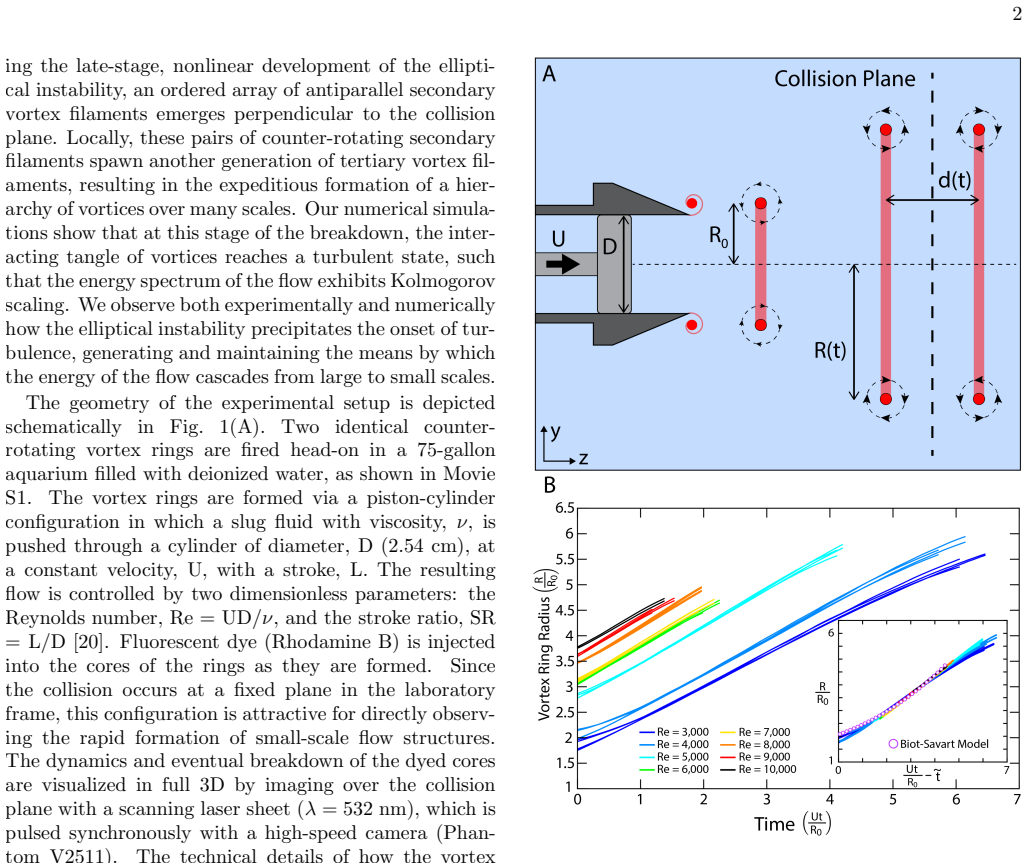
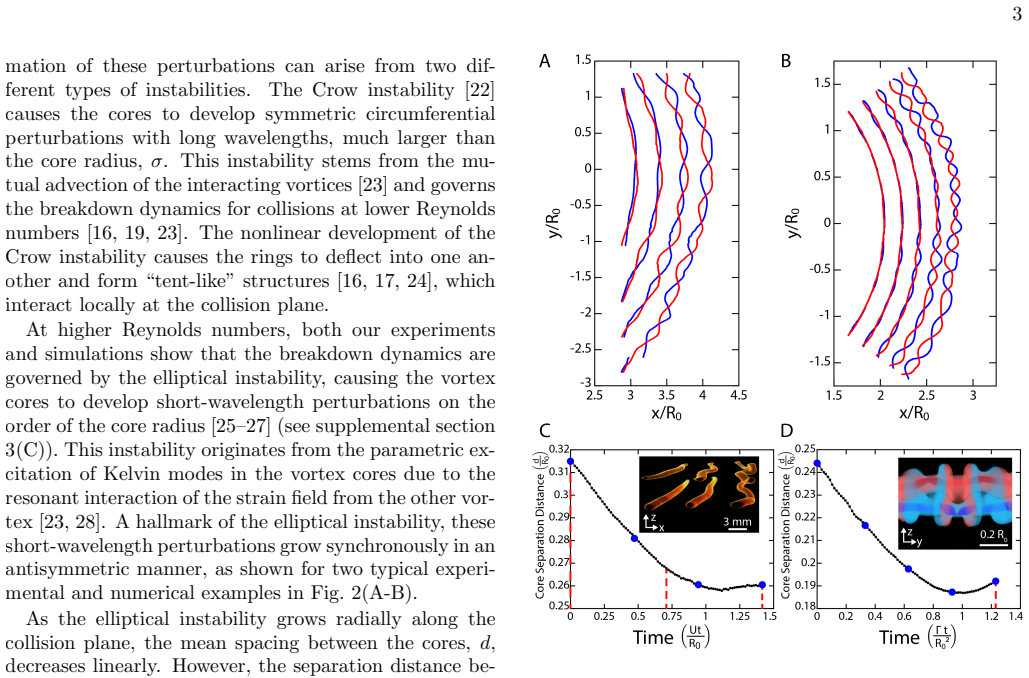
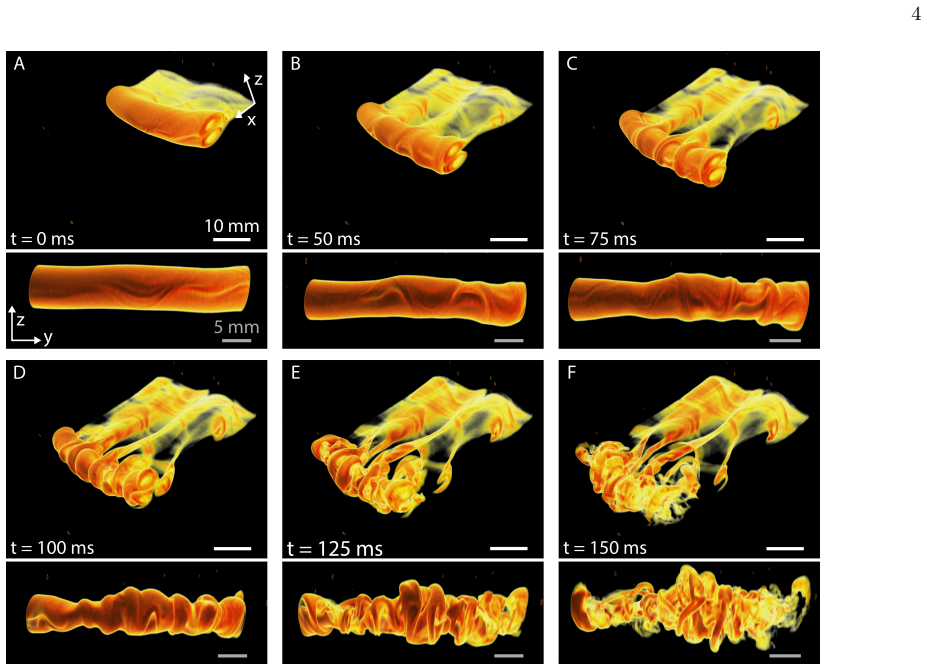
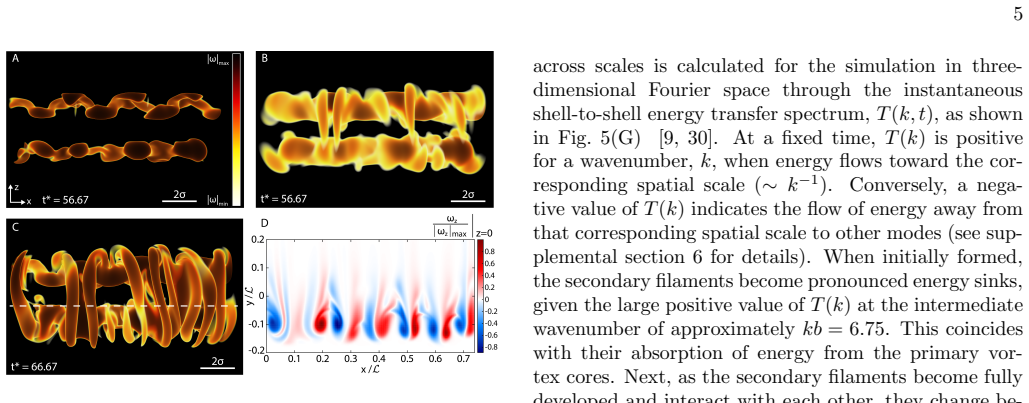
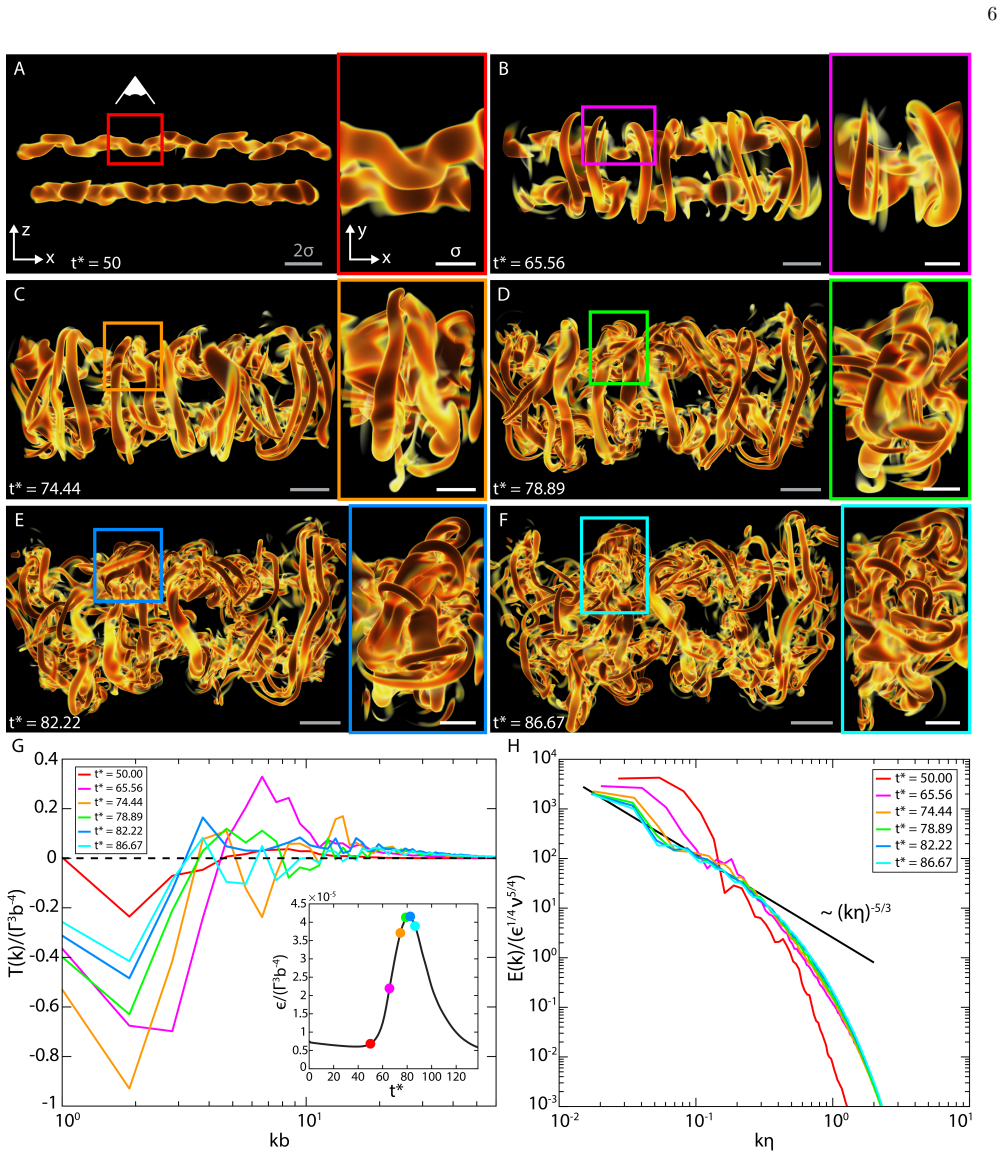
The paper's central discovery claim is that the late-stage, nonlinear development of the elliptical instability, not the Crow instability, initiates the turbulent breakdown of colliding counter-rotating vortices: the elliptical instability generates an ordered array of antiparallel secondary filaments perpendicular to the primary cores, and each adjacent counter-rotating pair of these filaments acts as a smaller replica of the original pair, so the same instability repeats and generates even smaller tertiary filaments. Circulation is conserved in this transfer, with roughly 25% of the original streamwise circulation conveyed to each secondary filament. Using the measured per-step reductions in circulation ($x_\Gamma \sim 0.25$) and scale ($x_\delta \sim 0.2$–$0.4$), the proposed cascade would reach dissipative scales in finite time. At the moment of peak dissipation, after two to three iterations, the vortices form a disordered tangle whose energy spectrum matches the $k^{-5/3}$ law, and the secondary filaments switch from energy sinks to energy sources, the signature of energy being passed down the cascade.
Load-bearing premise
The load-bearing premise is that each newly formed pair of perpendicular filaments is a true smaller replica of the initial vortex pair, so the circulation reduction factor ($x_\Gamma \sim 0.25$) and scale reduction factor ($x_\delta \sim 0.2$–$0.4$) measured at the first steps stay the same all the way down to dissipative scales; if the growing tangle of other vortices prevents clean pairing before that, the iterative cascade could stall.
Editorial extensions
If this is right
- A pair of counter-rotating vortices with no walls, forcing, or external strain is sufficient to reach a turbulent state, so turbulence can be studied as a local, repeatable vortex interaction rather than a global statistical condition.
- The elliptical instability provides a built-in energy-transfer pathway: secondary filaments first absorb energy from the primary cores and then release it to smaller scales, which is the real-space counterpart of a forward energy cascade.
- At lower Reynolds numbers the second iteration is instead dominated by the Crow instability flattening and splitting a filament, so the Reynolds number selects which instability carries each step of the cascade.
- If the cascade factors remain constant, energy is transferred to dissipative scales in finite time, and only a modest number of simultaneous pair interactions would be enough to sustain a $k^{-5/3}$ spectrum.
Reading between the lines
- A direct test of the self-similar premise would be to initialize a simulation with just one pair of secondary filaments, extracted at the moment they form, and see whether they produce tertiary filaments with the same $x_\Gamma \approx 0.25$ and $x_\delta$; if the surrounding vortex soup is needed, the cascade is not a pure iteration of the elliptical instability.
- Because only two to three iterations already produce the $k^{-5/3}$ spectrum, the mechanism predicts that turbulence onset is abrupt even at very high Reynolds numbers: the cascade does not need to proceed through many discrete generations before the flow looks turbulent.
- The same perpendicular-filament hierarchy should appear wherever antiparallel vortex pairs interact locally, such as in wakes and mixing layers, which would make the elliptical instability a common route to small-scale mixing rather than a special feature of colliding rings.
- Measuring the two cascade factors at the third and fourth generations, rather than inferring them from the first one or two, would determine whether the finite-time condition $x_\delta^2 < x_\Gamma$ persists or whether the cascade slows as the vortex soup becomes disordered.
Signed reviews
Editorial analysis
A structured set of objections, weighed in public.
Referee Report
Summary. The paper investigates the breakdown of colliding counter-rotating vortex rings and interacting antiparallel vortex tubes, using dye visualization experiments and DNS. It reports that the elliptical instability generates a periodic array of perpendicular, counter-rotating secondary vortex filaments, that these secondary filaments mutually interact to produce a further generation of tertiary filaments, and that the resulting disordered vortex tangle exhibits an energy spectrum consistent with Kolmogorov -5/3 scaling at peak dissipation. The authors propose an iterative cascade model in which each generation inherits a fraction xΓ of the circulation and a fraction xδ of the spatial scale, and they estimate from the first generation that xΓ ≈ 0.25 and xδ ≈ 0.2–0.4, giving a finite-time cascade condition xδ² < xΓ.
Significance. If the central claim is correct, the paper offers a concrete, real-space mechanism for the turbulent energy cascade: repeated elliptical instabilities of antiparallel vortex pairs. The study combines high-quality 3D experiments and DNS, identifies the initial instability using an independent published theory (Le Dizès and Laporte 2002), and measures rather than tunes the cascade parameters. The circulation transfer to secondary filaments is quantified via a vorticity-flux conservation argument, and the shell-to-shell energy transfer data provide direct evidence of a forward cascade. The finite-time cascade estimate is an interesting, falsifiable prediction. These strengths make the paper potentially significant for the fluid dynamics community, provided the evidence for the second and later iterations is made rigorous.
major comments (3)
- [SI Sec. 7; Fig. 5; Movie S9] The claim that the tertiary filaments form through another iteration of the elliptical instability is explicitly labeled "We propose" in SI Sec. 7, and no growth-rate or wavelength calculation is provided for the secondary-filament pair. This matters because SI Sec. 5 shows that the same flattening-and-splitting morphology at ReΓ = 3500 is attributed to the Crow instability. The observed formation of tertiary filaments is therefore not, by itself, diagnostic of a second elliptical instability. The authors should either provide a quantitative stability analysis for the secondary-filament geometry (e.g., using a suitably adapted version of Eq. (11)) or present the second iteration as a hypothesis rather than as part of the demonstrated claim.
- [Main text, paragraph beginning "Once formed"; SI Sec. 4B] The self-similar cascade model assumes that xΓ ≈ 0.25 and xδ ≈ 0.2–0.4 remain constant across generations. The value of xΓ is measured once, from the axial-circulation fluctuation amplitude in a single ReΓ = 4500 simulation (SI Sec. 4B), and xδ is an estimated visual scale reduction; neither quantity is checked at the second generation. The finite-time condition xδ² < xΓ, which is central to the cascade scenario, depends on this extrapolation. If the secondary-filament pairs do not behave as scaled replicas of the primary pair, or if the surrounding turbulent soup disrupts antiparallel pairing, the cascade may stall and the finite-time estimate loses its basis. The authors should either measure xΓ and xδ at the next generation or explicitly frame the constant-factor assumption as a conjecture and soften the corresponding finite-time conclusion.
- [Abstract; Fig. 3; Fig. 5] The abstract states that "In experiments and simulations, we observe two and three iterations of this cascade, respectively," but the iteration count is never precisely defined, and the experimental evidence in Fig. 3 does not clearly resolve a distinct tertiary generation. The experimental sequence shows secondary filaments and then a fine-scale turbulent cloud, without an identifiable ordered tertiary-filament stage comparable to the DNS in Fig. 5. The number of experimentally observed iterations should be stated with explicit criteria (e.g., appearance of a new perpendicular filament array with measurable circulation), or the abstract should be revised to avoid overstating the experimental evidence.
minor comments (6)
- [SI Sec. 2, first paragraph] "patricle image velocimetry" should read "particle image velocimetry."
- [Fig. S8 caption] "vorticty" should be "vorticity."
- [SI Sec. 4A, paragraph on alternating structure] "anti-note" should be "anti-node" in the sentence describing the periodic structure of the perturbations.
- [Main text, Sec. after Fig. 1(B)] "Re /greaterorsimilar5000" appears to be a rendering artifact and should be typeset as "Re ≳ 5000."
- [Main text, final paragraph before Methods] "we suggest that iterations of this cascade" should begin with a capital "We."
- [SI reference list, ref. [1]] The year for McKeown et al. is listed as 2008; the correct year is 2018, matching the main-text reference.
Circularity Check
No significant circularity: the elliptical-instability identification uses an independent published growth-rate theory, and the cascade factors xΓ and xδ are measured from the simulated flow, not fitted to force the observed Kolmogorov spectrum.
full rationale
The paper's claimed derivation chain is observational and numerical: the first elliptical instability is identified with the independent Le Dizès–Laporte growth-rate formula (SI Eq. 11), the secondary filaments are visualized and their circulation transfer is measured (Γx fluctuations ≈ 0.25Γ0, SI §4B), and the turbulent spectra are computed directly from the DNS velocity fields (Fig. 5H, SI §7A). No fitted parameter is renamed as a prediction: xΓ ≈ 0.25 and xδ ≈ 0.2–0.4 are measured or estimated from the first generation and then used in an explicitly speculative self-similar model ('One may speculate... in the spirit of [17]') to ask whether the cascade could reach small scales in finite time. That extrapolation is an interpretation, not a construction of the observed spectrum. The citation to the authors' prior work [17] is descriptive ('strongly reminiscent'), not load-bearing: the central claim that two to three observed iterations of the elliptical-instability-induced breakdown accompany the emergence of Kolmogorov scaling rests on the direct measurements. The unverified assertion that tertiary filaments form via another elliptical instability (SI §7A) is a genuine mechanistic gap, but it is a completeness or correctness risk, not a circular reduction: the paper does not define elliptical instability in terms of the observed turbulence, nor does it fit a parameter to the spectra and then 'predict' them. Therefore score 0.
Assumptions & free parameters
free parameters (3)
- experimental-to-circulation Reynolds number slope =
0.678
- cascade circulation ratio xGamma =
0.25 (approximate)
- cascade scale ratio xDelta =
0.2 to 0.4 (range)
assumptions (7)
- domain assumption Incompressible Navier-Stokes equations govern the vortex dynamics.
- domain assumption Biot-Savart filament model with core regularization describes the mean ring evolution.
- domain assumption Le Dizes' linear stability theory for the elliptical instability in a two-vortex flow predicts the observed perturbation growth.
- domain assumption The dye, advected as a passive scalar, traces the vortex structures.
- ad hoc to paper Each secondary filament pair acts as a smaller replica of the initial vortex pair (self-similarity across iterations).
- domain assumption Imposed five-fold rotational symmetry in the vortex-ring DNS does not alter the cascade dynamics.
- domain assumption The shell-to-shell energy transfer formalism for homogeneous turbulence applies to the transient collision flow.
Cite this review
Pith. "Pith review of Turbulence generation through an iterative cascade of the elliptical instability." pith.science (2026). https://pith.science/paper/3FBZCQNE
@misc{pith2026190801804,
  author       = {Pith},
  title        = {Pith review of: Turbulence generation through an iterative cascade of the elliptical instability},
  year         = {2026},
  howpublished = {\url{https://pith.science/paper/3FBZCQNE}},
  note         = {Machine review of arXiv:1908.01804}
}
read the original abstract
The essence of turbulent flow is the conveyance of energy through the formation, interaction, and destruction of eddies over a wide range of spatial scales--from the largest scales where energy is injected, down to the smallest scales where it is dissipated through viscosity. Currently, there is no mechanistic framework that captures how the interactions of vortices drive this cascade. We show that iterations of the elliptical instability, arising from the interactions between counter-rotating vortices, lead to the emergence of turbulence. We demonstrate how the nonlinear development of the elliptical instability generates an ordered array of antiparallel secondary filaments. The secondary filaments mutually interact, leading to the formation of even smaller tertiary filaments. In experiments and simulations, we observe two and three iterations of this cascade, respectively. Our observations indicate that the elliptical instability could be one of the fundamental mechanisms by which the turbulent cascade develops.
Figures
Figures from the paper (2 more)
Reference graph
Works this paper leans on
-
[1]
I. Lavin, “Leonardo’s watery chaos,” IAS, The Institute Letter, Spring 2018 (2018)
work page 2018
- [2]
-
[3]
G. I. Taylor, Proc. Roy. Soc. A 151, 444 (1935)
work page 1935
-
[4]
L. F. Richardson, Weather prediction by numerical pro- cess (Cambridge University Press, 1922) p. 236
work page 1922
- [5]
-
[8]
D. R. Chapman, AIAA Journal 17, 1293 (1979)
work page 1979
-
[9]
S. B. Pope, Turbulent flows (Cambridge University Press,
-
[10]
Betchov, Archiv of Mechanics, Archiwum Mechaniki Stosowanej 28, 837 (1976)
R. Betchov, Archiv of Mechanics, Archiwum Mechaniki Stosowanej 28, 837 (1976)
work page 1976
Show all 63 references
-
[11]
Keylock, S
C. Keylock, S. Kida, and N. Peters, Fluid Dynamics Research 48 (2016)
2016
-
[12]
Frisch, Turbulence: the legacy of AN Kolmogorov (Cambridge University Press, 1995)
U. Frisch, Turbulence: the legacy of AN Kolmogorov (Cambridge University Press, 1995)
1995
-
[13]
C. L. Fefferman, The Millennium Prize problems , 57 (2006)
2006
-
[14]
Lundgren, Phys
T. Lundgren, Phys. Fluids 25, 2193 (1982)
1982
-
[15]
Cuypers, A
Y. Cuypers, A. Maurel, and P. Petitjeans, Phys. Rev. Lett. 91, 194502 (2003)
2003
-
[16]
McKeown, R
R. McKeown, R. Ostilla-M´ onico, A. Pumir, M. P. Bren- ner, and S. M. Rubinstein, Phys. Rev. Fluids 3, 124702 (2018)
2018
-
[17]
M. P. Brenner, S. Hormoz, and A. Pumir, Phys. Rev. Fluids 1, 084503 (2016)
2016
-
[18]
Pumir and E
A. Pumir and E. D. Siggia, Physics of Fluids 30, 1606 (1987)
1987
-
[19]
Lim and T
T. Lim and T. Nickels, Nature 357, 225 (1992)
1992
-
[21]
G. K. Batchelor, An introduction to Fluid Dynamics (Cambridge University Press, 1970)
1970
-
[24]
Hormoz and M
S. Hormoz and M. P. Brenner, J. Fluids Mech. 707, 191 (2012)
2012
-
[25]
Tsai and S
C.-Y. Tsai and S. E. Widnall, Journal of Fluid Mechanics 73, 721 (1976)
1976
-
[26]
D. W. Moore and P. G. Saffman, in Proceedings of the Royal Society of London A: Mathematical, Physical and Engineering Sciences, Vol. 346 (The Royal Society, 1975) pp. 413–425
1975
-
[27]
Schaeffer and S
N. Schaeffer and S. Le Diz` es, J. Fluid Mech. 646, 471 (2010)
2010
-
[28]
R. R. Kerswell, Annu. Rev. Fluid Mech. 34, 83 (2002)
2002
-
[30]
C. C. Lin, in Proceedings of the First Symposium of Ap- plied Mathematics (1947)
1947
-
[32]
Goto, Progress of Theoretical Physics Supplement 195, 139 (2012)
S. Goto, Progress of Theoretical Physics Supplement 195, 139 (2012)
2012
-
[33]
S. Goto, Y. Saito, and G. Kawahara, Phys. Rev. Fluids 2, 064603 (2017)
2017
-
[34]
Motoori and S
Y. Motoori and S. Goto, Journal of Fluid Mechanics 865, 1085 (2019). Turbulence generation through an iterative cascade of the elliptical instability Supplementary Information Ryan McKeown1, Rodolfo Ostilla-M´ onico2,∗, Alain Pumir 3, Michael P. Brenner1,4, and Shmuel M. Rubin...
2019
-
[35]
Methods and materials 2
-
[36]
PIV analysis of vortex ring geometry 3
-
[37]
Biot-Savart model and regularization 5 B
Simulating vortex ring collisions using the Biot-Savart approximation 5 A. Biot-Savart model and regularization 5 B. Dynamic evolution of the vortex rings 6 C. Elliptical instability 7
-
[38]
Formation of secondary vortex filaments 9 B
Nonlinear development of the elliptical instability 9 A. Formation of secondary vortex filaments 9 B. Transfer of circulation 11
-
[39]
Interactions of secondary vortex filaments 12
-
[40]
Analysis of the transfer of energy in a turbulent flow 13
-
[41]
Dissipation rate evolution and energy spectra 14 B
Emergence of turbulence from the elliptical instability with increasing Reynolds number 14 A. Dissipation rate evolution and energy spectra 14 B. Vorticity evolution 14
-
[42]
Supplemental movie descriptions 16 References 17 arXiv:1908.01804v2 [physics.flu-dyn] 21 Nov 2019 2
1908 arXiv
-
[43]
Experimentally, we examine the head-on collision of vortex rings, and numerically we examine the collision of vortex rings and vortex tubes
METHODS AND MATERIALS We use both experiments and simulations to probe the dynamic formation of the turbulent cascade resulting from the interaction between counter-rotating vortices. Experimentally, we examine the head-on collision of vortex rings, and numerically we examine ...
2000
-
[44]
The fluid is seeded with polyamide particles with a diameter of 50 µm and a density of 1.03 g/mL (Dantec Dynamics)
PIV ANALYSIS OF VORTEX RING GEOMETRY The vortex rings are characterized experimentally through 2D patricle image velocimetry (PIV). The fluid is seeded with polyamide particles with a diameter of 50 µm and a density of 1.03 g/mL (Dantec Dynamics). A laser sheet is positioned al...
-
[45]
SIMULATING VORTEX RING COLLISIONS USING THE BIOT-SAVART APPROXIMATION A. Biot-Savart model and regularization In this section, we establish the conditions that lead to the emergence of the elliptical instability in vortex ring collisions, focusing on the range of Reynolds numb...
-
[46]
With the parameterization proposed in Eq
(3) The evolution equations reduce to two simple ordinary differential equations for R(t) and d(t), as explained in turn. With the parameterization proposed in Eq. (2), an elementary calculation shows that the contribution of the filament 1 to the velocity at the point r1(θ) red...
-
[47]
NONLINEAR DEVELOPMENT OF THE ELLIPTICAL INSTABILITY A. Formation of secondary vortex filaments Following the development of antisymmetric perturbations that result from the elliptical instability, an array of secondary vortex filaments spontaneously forms perpendicular to the or...
-
[48]
INTERACTIONS OF SECONDARY VORTEX FILAMENTS Through the creation of secondary filaments, the elliptical instability provides a mechanism by which smaller generations of counter-rotating vortex filaments form and interact to generate small-scale flow structures. During the evolutio...
-
[49]
ANALYSIS OF THE TRANSFER OF ENERGY IN A TURBULENT FLOW This section examines the derivation and meaning of the shell-to-shell energy transfer spectrum, T (k,t ), introduced in the main text and plotted in Fig. 5(G). A typical method for characterizing a turbulent flow, which en...
-
[50]
grind down
EMERGENCE OF TURBULENCE FROM THE ELLIPTICAL INSTABILITY WITH INCREASING REYNOLDS NUMBER A. Dissipation rate evolution and energy spectra Direct numerical simulations of the interacting, counter-rotating vortex tubes are performed at a range of Reynolds numbers to examine by wh...
-
[51]
Head-on collision of vortex rings
SUPPLEMENTAL MOVIE DESCRIPTIONS Movie S1. Head-on collision of vortex rings. Underwater view of the head-on collision of two vortex rings dyed separately, where Re = UD/ν = 6000 and SR = L/D = 2.5. The rings expand radially as they collide at the midplane before rapidly breaki...
-
[52]
McKeown, R
R. McKeown, R. Ostilla-M´ onico, A. Pumir, M. P. Brenner, and S. M. Rubinstein, Phys. Rev. Fluids 3, 124702 (2008)
2008
-
[53]
Kim and P
J. Kim and P. Moin, Journal of Computational Physics 59, 308 (1985)
1985
-
[54]
Verzicco and P
R. Verzicco and P. Orlandi, Journal of Computational Physics 123, 402 (1996)
1996
-
[55]
Gharib, E
M. Gharib, E. Rambod, and K. Shariff, Journal of Fluid Mechanics 360, 121 (1998)
1998
-
[56]
D. W. Moore and P. G. Saffman, Philos. Trans. R. Soc. London Ser. A 272, 403 (1972)
1972
-
[57]
E. D. Siggia, Physics of Fluids 28, 794 (1985)
1985
-
[58]
E. D. Siggia and A. Pumir, Phys. Rev. Lett. 55, 1749 (1985). 18
1985
-
[59]
Le Diz` es and F
S. Le Diz` es and F. Laporte, J. Fluid Mech. 201, 169 (2002)
2002
-
[60]
Leweke and C
T. Leweke and C. H. K. Williamson, J. Fluid Mech. 360, 85 (1998)
1998
-
[61]
Leweke, S
T. Leweke, S. Le Diz` es, and C. H. Williamson, Annual Review of Fluid Mechanics 48, 507 (2016)
2016
-
[62]
Theoretical predictions for the elliptical instability in a two-vortex flow,
S. Le Diz` es and F. Laporte, “Theoretical predictions for the elliptical instability in a two-vortex flow,” (2002), erratum, private communication
2002
-
[63]
Laporte and A
F. Laporte and A. Corjon, Phys. Fluids 12, 1016 (2000)
2000
-
[64]
S. C. Crow, AIAA journal 8, 2172 (1970)
1970
-
[65]
Pumir and E
A. Pumir and E. D. Siggia, Physics of Fluids A 2, 220 (1990)
1990
-
[66]
R. M. Kerr, Physics of Fluids A 5, 1725 (1993)
1993
-
[67]
S. B. Pope, Turbulent flows (Cambridge University Press, 2000) p. 773
2000
-
[68]
C. C. Lin, in Proceedings of the First Symposium of Applied Mathematics (1947)
1947
-
[69]
A. N. Kolmogorov, in Dokl. Akad. Nauk SSSR , Vol. 30 (1941) pp. 299–303
1941
-
[70]
G. I. Taylor and A. E. Green, Proc. Roy. Soc. A 158, 499 (1937)
1937
Reviewed August 14, 2026 · model on record in the stance chip above.
Discussion (0). Continue with ORCID to comment.