REVIEW 4 major objections 6 minor 131 references
Scaling relations for globular cluster systems in early-type galaxies
T0 review · 4 major / 6 minor · reviewed 2026-08-14 · deepseek-v4-flash
Pith's one-line read A galaxy's globular cluster system size tracks its dark halo size in nearly fixed proportions.
desk verdict Useful new GCS profile measurements for low-density-environment early-type galaxies, but the quantitative halo-scaling claim rests on extrapolated radii and fitted normalizations, and the mass-break is suggestive rather than demonstrated. read the letter →
The pith
A machine-rendered reading of the paper's core claim, the machinery that carries it, and where it could break.
The reading
What carries the argument
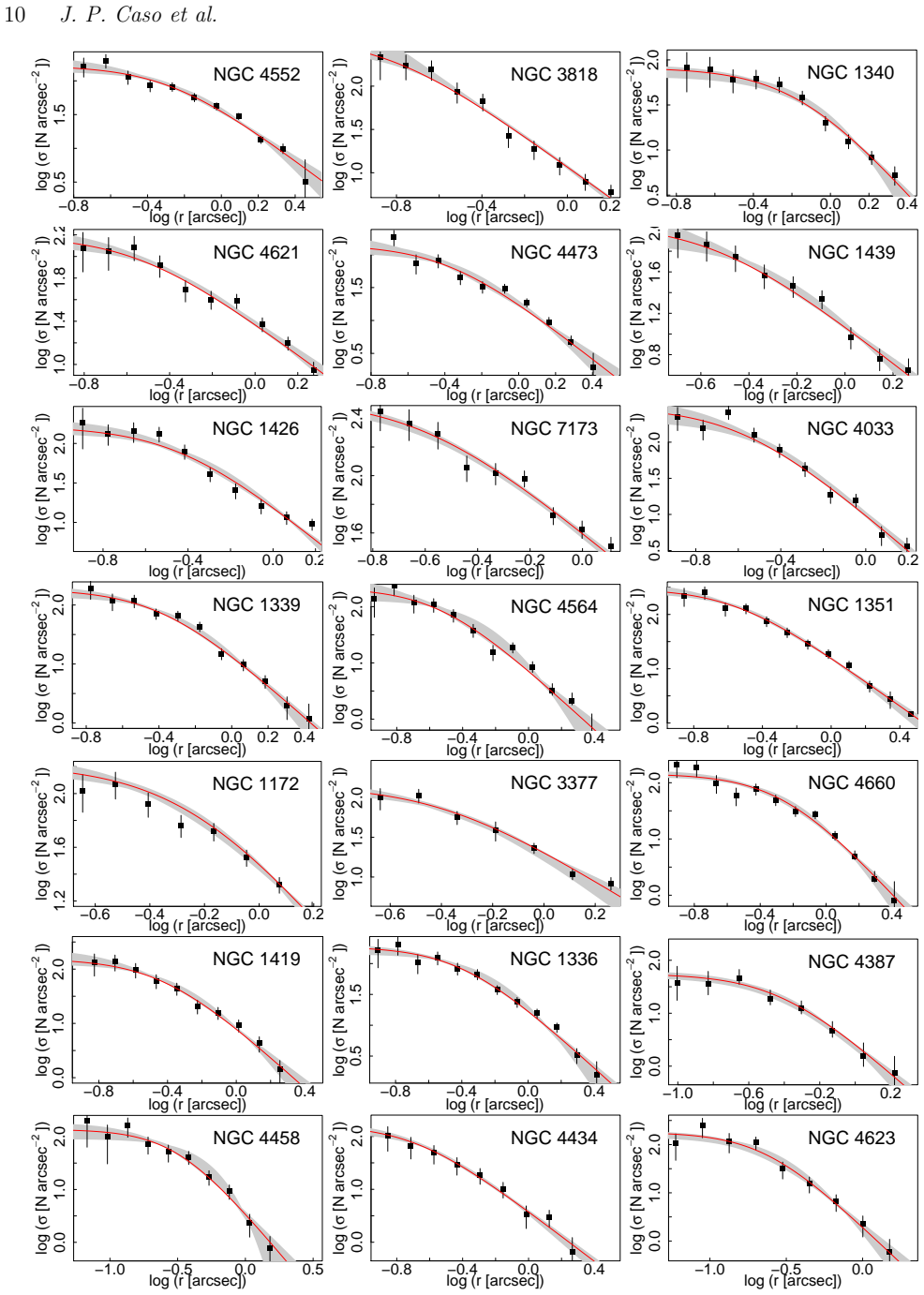
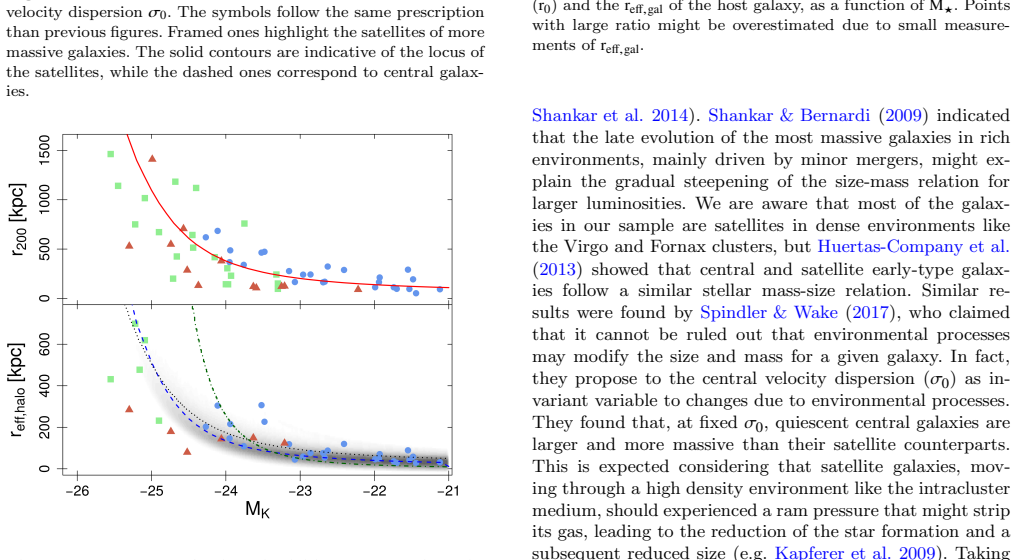
The load-bearing tool is the modified Hubble profile $n(r)=a\,[1+(r/r_0)^2]^{-b}$, fitted to completeness- and contamination-corrected projected GC densities; the outer extension $r_L$ is defined as the radius where this profile falls to 30 per cent of the adopted background density ($1\,\mathrm{arcmin}^{-2}$), and the effective radius $r_{\mathrm{eff,GCS}}$ is computed from the fitted parameters. For the halo side, dark-matter haloes from a cosmological simulation are represented by an NFW (standard dark-halo density) profile, projected, and fitted with Sérsic profiles to obtain $r_{\mathrm{eff,halo}}$, with $r_{200}$ taken from the simulation catalogue. The comparison works by matching simulation haloes and galaxies one-to-one through a monotonic luminosity ranking, then fitting the constant factors that align the two radius scales.
What would settle it
Direct wide-field photometry that reaches the adopted $r_L$ for a few of the most extended GCSs would settle whether the extrapolated modified Hubble profile is real; if the observed GC density beyond the current field falls above or below the fitted law, the reported $r_L$ values and the constant factors $r_{200}/r_L=8.5$ and $r_{\mathrm{eff,halo}}/r_{\mathrm{eff,GCS}}=16.7$ would shift.
Extended reading notes
Core claim
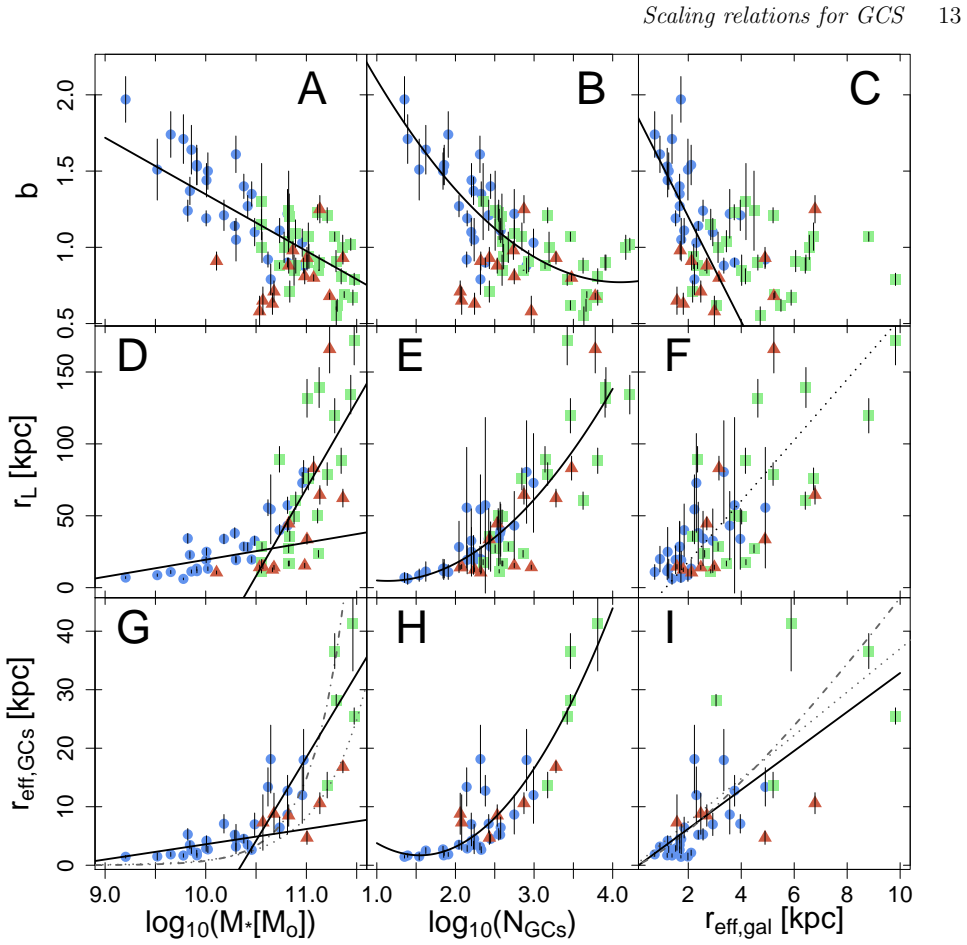
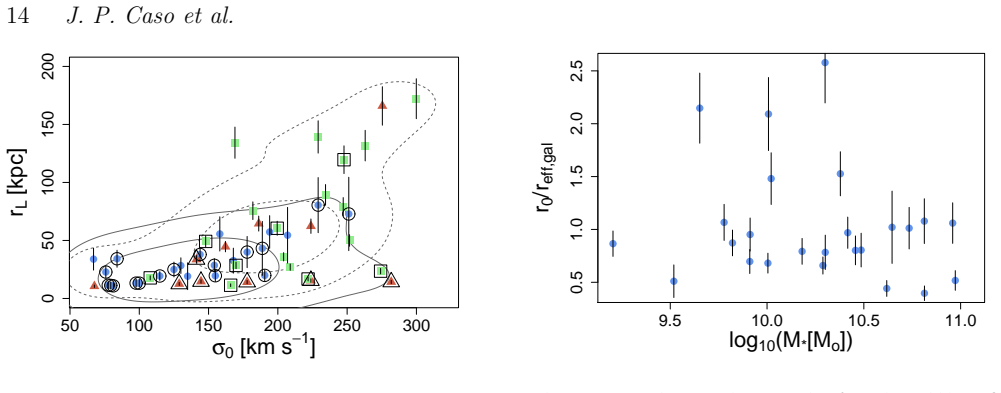
The paper's central claim is that GCS sizes and halo sizes are tied by simple, near-constant scale factors. From modified Hubble fits to 27 radial profiles (their own fits to low-density-field, Virgo, Fornax, and stacked systems) plus literature GCSs, the authors report that both the effective radius $r_{\mathrm{eff,GCS}}$ and the outer extension $r_L$ of the GCS scale with the host galaxy's stellar mass, with a bilinear break near $M_\star \simeq 4\times10^{10}\,M_\odot$ (their Equations 9 and 11). The statistical comparison with a dark-matter simulation yields $r_{200} = (8.5 \pm 0.5)\, r_L$ and $r_{\mathrm{eff,halo}} = (16.7 \pm 2.3)\, r_{\mathrm{eff,GCS}}$, where $r_{200}$ is the radius at which the mean density is 200 times the critical density and $r_{\mathrm{eff,halo}}$ is the projected Sérsic effective radius of the simulated halo. They also find that $r_L$ correlates with central velocity dispersion $\sigma_0$ for central galaxies but is roughly flat for satellites, which they interpret as a sign that the two populations have different accretion and stripping histories.
Load-bearing premise
The results depend on assuming the fitted modified Hubble profile continues far beyond the image field, because for the most extended globular cluster systems the outer radius $r_L$ is extrapolated rather than observed.
Editorial extensions
If this is right
- A GCS radial profile from relatively shallow imaging becomes a proxy for the dark halo's size, because the measured extension converts directly to the virial radius.
- GCS size–stellar mass calibrations need two pieces: a single power law across the break near 4e10 solar masses would bias low-mass halo-size estimates.
- Satellite galaxies should be separated from central galaxies in GCS scaling work, because their extension does not follow the same central-velocity-dispersion relation.
- The break mass coinciding with the peak of the stellar-to-halo mass ratio supports the idea that GCS size records the assembly history of the halo, not just the stellar mass.
- Future surveys can use the fitted constants to turn GC counts into halo-radius estimates for large samples of early-type galaxies without expensive dynamical measurements.
Reading between the lines
- Because $r_L$ is defined at a fixed contamination density, deeper photometry would push measured extensions outward, so the quoted 8.5 factor is likely tied to survey depth and should be re-derived on a uniform depth scale.
- Wide-field, ground-based imaging of a few of the largest GCSs could check whether the 8.5 and 16.7 constants still hold at the radii where the halo comparison was calibrated, or whether tidal truncation changes the outer slope.
- If the bilinear break is real, GCS size could serve as a halo-mass tracer exactly in the intermediate-mass regime where weak lensing is noisy; comparing GCS-based virial-radius estimates with lensing masses for the same galaxies would calibrate the bias.
- A direct test of the satellite interpretation would be to look for preferentially metal-poor (blue) GCs stripped from satellites: if tidal stripping removes the outer GCs, the surviving satellite GCSs should be redder and more compact.
Signed reviews
Editorial analysis
A structured set of objections, weighed in public.
Referee Report
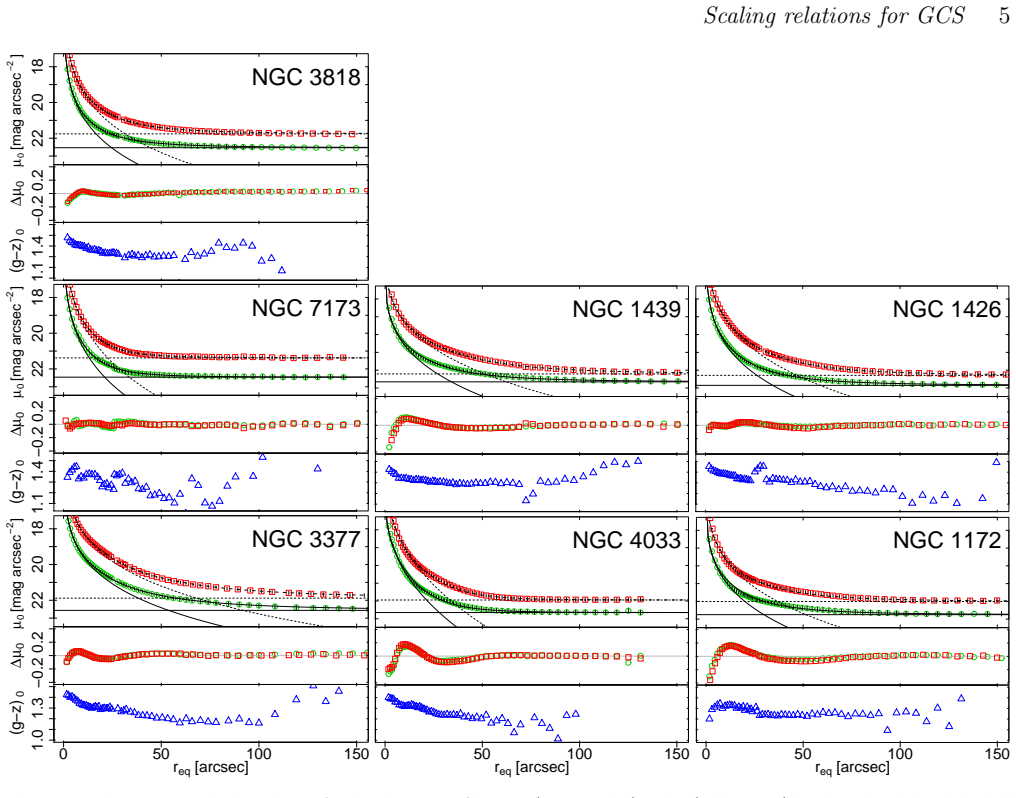
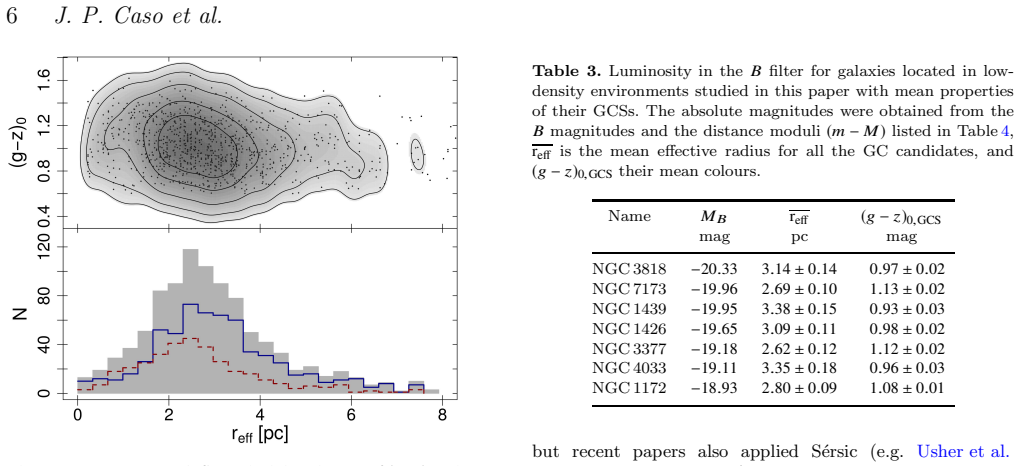
Summary. The paper presents a photometric study of globular cluster systems (GCSs) in early-type galaxies, combining HST/ACS imaging of seven low-density-environment galaxies with literature photometry for Virgo and Fornax cluster galaxies and compiled data from previous studies. The authors fit modified Hubble profiles to the projected GC density distributions and derive the effective radius, extension, and concentration of each GCS. They report correlations between these GCS parameters and host-galaxy stellar mass, number of GCs, effective radius, and central velocity dispersion, including a bilinear relation between GCS extension rL and log Mstar that steepens above roughly 4e10 Msun (Eq. 9). They further compare the observed rL and effective radius with dark-matter haloes from the SMDPL simulation, claiming that rL scales with the virial radius (r200 = 8.5 × rL) and that the GCS effective radius scales with the projected effective radius of haloes (reff,halo = 16.7 × reff,GCS).
Significance. If the results hold, the paper usefully extends GCS scaling relations to intermediate-luminosity early-type galaxies and provides empirical support for using GCS sizes as tracers of dark-matter halo sizes. The analysis is careful in several respects: the photometry and completeness corrections are described in detail, the profile fitting includes uncertainty bands from varying bin breaks, and the literature compilation is substantial. The agreement of the color and size trends with previous work is a strength. However, the headline halo comparison depends on rL values that are extrapolated well beyond the ACS field for the most extended systems, and the constants f200 and feff are fitted rather than predicted, so the strength of the halo-scaling claim should be tempered. The significance of the bilinear fit is also not quantified.
major comments (4)
- [Section 4.3, Table 4, Eq. (9), Fig. 8] This is the most load-bearing issue because the extrapolated rL values enter both the mass-scaling relations and the simulation comparison.
- [Section 4.4.4, Fig. 8] This limitation affects the interpretation of a headline result; it can be addressed with a clearer statement of what is fitted versus predicted.
- [Section 4.4.2, Eq. (9) and Section 4.4.3, Eq. (11)] This is load-bearing for the claimed change of slope at intermediate galaxy masses.
- [Section 4.4.3, panel H] This is a secondary but important caveat for one of the scaling-relation claims.
minor comments (6)
- [Section 4.4.3, Eq. (11)] The dependent variable in Eq. (11) is labelled rL, but the text and panel G indicate that the quantity being fitted is reff,GCS; this should be corrected.
- [Section 4.4.2 and Section 4.4.3, Eqs. (10) and (12)] Equations (10) and (12) use 'b =' on the left-hand side, but the quantities being fitted are rL and reff,GCS, respectively; the labels should be changed.
- [Section 5, Discussion] The sentence 'The stellar mass at which the slope changes in our Equation 8' refers to Eq. (9), not Eq. (8), which is the b versus reff,gal relation; the cross-reference should be fixed.
- [Section 4.3] The text states the radial binning is constant on a logarithmic scale with 'a typical size of log10∆r [arcsec] = 8'; this presumably means 0.8 in log10(arcsec), and the notation should be clarified.
- [Introduction and Section 4.3] Several citations appear as '?' in the text (e.g., in the introduction and near the discussion of the background level), indicating incomplete reference entries; these need to be completed before publication.
- [Figure 8 caption] The caption reads 'scaled to fit this latter one by a factor f200' and is awkwardly phrased; the wording should be revised for clarity.
Circularity Check
Fitted halo scaling factors and shared-profile variables make part of the 'agreement' and correlations built in, but the core empirical fits and external comparisons remain independent.
-
fitted input called prediction
[Section 4.4.4, Figure 8 (upper and lower panels)]
"There seems to be an agreement in the behaviour of both parameters as a function of MK. The scaling factor results r200 = f200 × rL with f200 = 8.5 ± 0.5. ... In this case the scaling factor was fitted to the dashed line, on the basis of a possible correlation between the parameters, resulting that reff,halo = feff × reff,GCS, with feff = 16.7 ± 2.3. ... This gives confidence to the assumption that the reff of haloes and GCSs are correlated."
The constants f200 and feff are not derived from the simulation; they are fitted so that the observed rL and reff,GCS points lie on the simulated r200(MK) and reff,halo(MK) curves. Hence the normalizations r200 = 8.5 rL and reff,halo = 16.7 reff,GCS are outputs of the fitting procedure, not independent predictions. The subsequent 'good agreement' and 'gives confidence' statements rest partly on this fitted alignment. Only the shape or trend of the two distributions is a genuine test, and the paper does not isolate that from the fitted normalization.
-
self definitional
[Section 4.3 (Table 4, NGCs for Fornax galaxies) and Section 4.4.3 (panel H)]
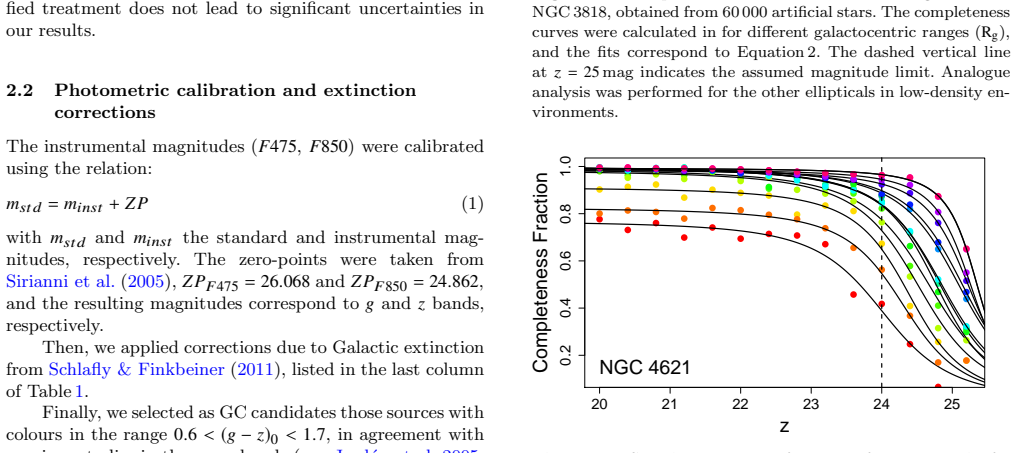
"Then, we numerically integrated the radial profiles up to the distance rL, resulting in the number of GCs brighter than 24 mag in the z-band. ... Although there is a clear dependence in the calculus of both parameters, it is worth to emphasize the tight correlation between them, pointing to the richness of the GCS as the main factor to determine its extension."
Both variables come from the same fitted modified Hubble profile: reff,GCS is calculated from the fitted rL, r0 and b (Section 4.3), and for Fornax galaxies NGCs is obtained by numerically integrating that same fitted profile out to rL. Therefore the 'tight correlation' between reff,GCS and NGCs is partly a mathematical artifact of using one fitted curve to define both axes, rather than a fully independent empirical relation. The paper explicitly acknowledges the 'clear dependence' but still presents the correlation as evidence that richness controls extension. This is a partial self-definitional step, though it is disclosed, which limits its severity.
full rationale
This is an empirical scaling-relation paper, not a derivation from first principles. The modified Hubble profile fits and the correlations of b, rL, and reff,GCS with stellar mass, galaxy effective radius, and velocity dispersion are independent fits, and they are compared explicitly with external results (Kartha et al. 2014; Forbes 2017; Hudson & Robison 2018). I find no load-bearing self-citation chain, no imported uniqueness theorem, and no ansatz smuggled in via citation: the choice of the modified Hubble profile is stated directly in Section 4.3, and the rL definition is given in the text. The two flagged issues are real but partial: in Section 4.4.4 the halo scaling factors f200 and feff are fitted to align the data with SMDPL simulations, so the absolute normalization agreement is built in; and in Section 4.4.3 the tight reff,GCS-NGCs correlation is partly constructed because both quantities are derived from the same fitted profile for part of the sample. Both limitations are acknowledged in the paper. The acknowledged extrapolation of rL beyond the ACS field of view (Section 4.3) is a data-quality and model-dependence concern that affects accuracy, but it is not circularity. Overall, the central empirical content remains independent, so a moderate score of 4 is appropriate.
Assumptions & free parameters
free parameters (3)
- f200 =
8.5 ± 0.5
- feff =
16.7 ± 2.3
- M_break =
~4e10 Msun
assumptions (6)
- domain assumption HOD monotonic relation ng(>L) = nh(>M) is used to assign K-band luminosities to SMDPL haloes.
- domain assumption Dark matter haloes are described by NFW profiles in the simulation comparison.
- domain assumption The Schechter luminosity function parameters from Kochanek et al. (2001) are valid at z=0 for the K band.
- domain assumption Each dark matter halo hosts exactly one galaxy; main haloes correspond to central galaxies and subhaloes to satellites.
- domain assumption The extension rL defined at 30% of the adopted background remains meaningful when the fitted Hubble profile is extrapolated beyond the ACS field of view.
- domain assumption Completeness corrections derived for NGC 4621 and NGC 1340 can be transferred to other Virgo/Fornax galaxies using mean surface brightness matching.
Cite this review
Pith. "Pith review of Scaling relations for globular cluster systems in early-type galaxies." pith.science (2026). https://pith.science/paper/ZDSKGYUF
@misc{pith2026190801807,
  author       = {Pith},
  title        = {Pith review of: Scaling relations for globular cluster systems in early-type galaxies},
  year         = {2026},
  howpublished = {\url{https://pith.science/paper/ZDSKGYUF}},
  note         = {Machine review of arXiv:1908.01807}
}
read the original abstract
The formation and growth of globular cluster systems (GCSs) is closely related to the evolutionary processes experienced by their host galaxies. In particular, their radial distributions scale with several properties of the galaxies and their halos. We performed a photometric study, by means of HST/ACS archival data of several intermediate luminosity galaxies located in low density environments. It was supplemented with available photometric data of GCSs from the Virgo and Fornax clusters, resulting in a sample of almost 30 GCSs for which we fitted their radial profiles. The resulting overall properties agree with those from previous studies, as we found that the effective radius, extension and concentration of the GCS radial profiles correlate with the stellar mass, effective radius and number of globular clusters, presenting in some cases a bilinear relation. The extension also correlates with the central velocity dispersion for central galaxies, but not for satellites. From a statistical comparison with numerical simulations we obtained good agreement between the effective radius and extension of the GCS scale with the effective and virial radius of the halos, respectively. Finally, we analysed these results in the literature context.
Figures

Figures from the paper (5 more)
Reference graph
Works this paper leans on
-
[1]
C., 2019, , 482, 2978
Amorisco N. C., 2019, , 482, 2978
2019
-
[2]
P., Caso J
Bassino L. P., Caso J. P., 2017, MNRAS, 466, 4259
2017
-
[3]
P., Faifer F
Bassino L. P., Faifer F. R., Forte J. C., Dirsch B., Richtler T., Geisler D., Schuberth Y., 2006a, A&A
-
[4]
P., Richtler T., Dirsch B., 2006b, MNRAS
Bassino L. P., Richtler T., Dirsch B., 2006b, MNRAS
-
[5]
P., Richtler T., Dirsch B., 2008, MNRAS, 386, 1145
Bassino L. P., Richtler T., Dirsch B., 2008, MNRAS, 386, 1145
2008
-
[6]
S., Conroy C., Wechsler R
Behroozi P. S., Conroy C., Wechsler R. H., 2010, , 717, 379
2010
-
[7]
F., McIntosh D
Bell E. F., McIntosh D. H., Katz N., Weinberg M. D., 2003, ApJS, 149, 289
2003
-
[8]
Bertin E., Arnouts S., 1996, A&AS, 117, 393
1996
Show all 131 references
-
[9]
Bezanson R., van Dokkum P., Franx M., 2012, , 760, 62
2012
-
[10]
Binney J., Tremaine S., 1987, Galactic dynamics
1987
-
[11]
P., Jord \'a n A., Mei S., C \^o t \'e P., Ferrarese L., Infante L., Peng E
Blakeslee J. P., Jord \'a n A., Mei S., C \^o t \'e P., Ferrarese L., Infante L., Peng E. W., Tonry J. L., West M. J., 2009, ApJ, 694, 556
2009
-
[12]
R., Forbes D
Blom C., Spitler L. R., Forbes D. A., 2012, MNRAS, 420, 37
2012
-
[13]
Brockamp M., K \"u pper A. H. W., Thies I., Baumgardt H., Kroupa P., 2014, MNRAS, 441, 150
2014
-
[14]
P., Romanowsky A
Brodie J. P., Romanowsky A. J., Strader J., Forbes D. A., 2011, AJ, 142, 199
2011
-
[15]
C., Kroupa P., 2012, A&A, 547, A65
Br \"u ns R. C., Kroupa P., 2012, A&A, 547, A65
2012
-
[16]
P., Bassino L
Calder \'o n J. P., Bassino L. P., Cellone S. A., Richtler T., Caso J. P., G \'o mez M., 2015, MNRAS, 451, 791
2015
-
[17]
Capuzzo-Dolcetta R., Mastrobuono-Battisti A., 2009, A&A, 507, 183
2009
-
[18]
P., Bassino L
Caso J. P., Bassino L. P., G \'o mez M., 2015, MNRAS, 453, 4421
2015
-
[19]
P., Bassino L
Caso J. P., Bassino L. P., G \'o mez M., 2017, MNRAS, 470, 3227
2017
-
[20]
P., Bassino L
Caso J. P., Bassino L. P., Richtler T., Calder \'o n J. P., Smith Castelli A. V., 2014, MNRAS, 442, 891
2014
-
[21]
P., Bassino L
Caso J. P., Bassino L. P., Richtler T., Salinas R., 2019, MNRAS, 483, 4371
2019
-
[22]
P., Richtler T., Bassino L
Caso J. P., Richtler T., Bassino L. P., Salinas R., Lane R. R., Romanowsky A., 2013, A&A, 555, A56
2013
-
[23]
Charlton P. J. L., Hudson M. J., Balogh M. L., Khatri S., 2017, , 472, 2367
2017
-
[24]
B., Marzke R
Chiboucas K., Tully R. B., Marzke R. O., Phillipps S., Price J., Peng E. W., Trentham N., Carter D., Hammer D., 2011, ApJ, 737, 86
2011
-
[25]
M., Blakeslee J
Cho J., Sharples R. M., Blakeslee J. P., Zepf S. E., Kundu A., Kim H.-S., Yoon S.-J., 2012, MNRAS, 422, 3591
2012
-
[26]
Y., Li H., 2018, MNRAS, 480, 2343
Choksi N., Gnedin O. Y., Li H., 2018, MNRAS, 480, 2343
2018
-
[27]
Ciotti L., 1991, A&A, 249, 99
1991
-
[28]
H., Kravtsov A
Conroy C., Wechsler R. H., Kravtsov A. V., 2006, , 647, 201
2006
-
[29]
A., Vega-Mart \' nez C
Cora S. A., Vega-Mart \' nez C. A., Hough T., Ruiz A. N., Orsi \'A . A., Mu \ n oz Arancibia A. M., Gargiulo I. D., Collacchioni F., Padilla N. D., Gottl \"o ber S., Yepes G., 2018, , 479, 2
2018
-
[30]
P., Chen C.-W., Infante L., Merritt D., Mei S., Peng E
C \^o t \'e P., Ferrarese L., Jord \'a n A., Blakeslee J. P., Chen C.-W., Infante L., Merritt D., Mei S., Peng E. W., Tonry J. L., West A. A., West M. J., 2007, ApJ, 671, 1456
2007
-
[31]
H., Teodorescu A
Das P., Gerhard O., Mendez R. H., Teodorescu A. M., de Lorenzi F., 2011, , 415, 1244
2011
-
[32]
C., Bassino L
Dirsch B., Richtler T., Geisler D., Forte J. C., Bassino L. P., Gieren W. P., 2003, AJ, 125, 1908
2003
-
[33]
Dirsch B., Schuberth Y., Richtler T., 2005, A&A, 433, 43
2005
-
[34]
R., C \^o t \'e P., Peng E
Durrell P. R., C \^o t \'e P., Peng E. W., Blakeslee J. P., Ferrarese L., Mihos J. C., Puzia T. H., Lan c on A., Liu C., Zhang H., Cuillandre J.-C., McConnachie A., Jord \'a n A., Accetta K., Boissier S., Boselli A., Courteau S., 2014, ApJ, 794, 103
2014
-
[35]
G., Faifer F
Escudero C. G., Faifer F. R., Bassino L. P., Calder\'on J. P., Caso J. P., 2015, MNRAS, 0, 0
2015
-
[36]
G., Faifer F
Escudero C. G., Faifer F. R., Smith Castelli A. V., Forte J. C., Sesto L. A., Gonz \'a lez N. M., Scalia M. C., 2018, MNRAS, 474, 4302
2018
-
[37]
M., Wegner G., Burstein D., Davies R
Faber S. M., Wegner G., Burstein D., Davies R. L., Dressler A., Lynden-Bell D., Terlevich R. J., 1989, , 69, 763
1989
-
[38]
R., Forte J
Faifer F. R., Forte J. C., Norris M. A., Bridges T., Forbes D. A., Zepf S. E., Beasley M., Gebhardt K., Hanes D. A., Sharples R. M., 2011, MNRAS, 416, 155
2011
-
[39]
W., Blakeslee J
Ferrarese L., C \^o t \'e P., Jord \'a n A., Peng E. W., Blakeslee J. P., Piatek S., Mei S., Merritt D., Milosavljevi \'c M., Tonry J. L., West M. J., 2006, ApJS, 164, 334
2006
-
[40]
A., 2017, MNRAS, 472, L104
Forbes D. A., 2017, MNRAS, 472, L104
2017
-
[41]
A., Forte J
Forbes D. A., Forte J. C., 2001, MNRAS, 322, 257
2001
-
[42]
A., Grillmair C
Forbes D. A., Grillmair C. J., Williger G. M., Elson R. A. W., Brodie J. P., 1998, MNRAS, 293, 325
1998
-
[43]
A., Ponman T., O'Sullivan E., 2012, MNRAS, 425, 66
Forbes D. A., Ponman T., O'Sullivan E., 2012, MNRAS, 425, 66
2012
-
[44]
A., Read J
Forbes D. A., Read J. I., Gieles M., Collins M. L. M., 2018, MNRAS, 481, 5592
2018
-
[45]
A., S \'a nchez-Bl \'a zquez P., Phan A
Forbes D. A., S \'a nchez-Bl \'a zquez P., Phan A. T. T., Brodie J. P., Strader J., Spitler L., 2006, MNRAS, 366, 1230
2006
-
[46]
A., Spitler L
Forbes D. A., Spitler L. R., Strader J., Romanowsky A. J., Brodie J. P., Foster C., 2011, MNRAS, 413, 2943
2011
-
[47]
C., Geisler D., Ostrov P
Forte J. C., Geisler D., Ostrov P. G., Piatti A. E., Gieren W., 2001, AJ, 121, 1992
2001
-
[48]
R., Romanowsky A
Foster C., Spitler L. R., Romanowsky A. J., Forbes D. A., Pota V., Bekki K., Strader J., Proctor R. N., Arnold J. A., Brodie J. P., 2011, MNRAS, 415, 3393
2011
-
[49]
C., Hou J., 2010, , 408, 2201
Gan J., Kang X., van den Bosch F. C., Hou J., 2010, , 408, 2201
2010
-
[50]
Gavazzi G., Boselli A., 1996, Astrophysical Letters and Communications, 35, 1
1996
-
[51]
J., Diaferio A., Kurtz M
Geller M. J., Diaferio A., Kurtz M. J., 1999, , 517, L23
1999
-
[52]
Y., Puzia T
Georgiev I. Y., Puzia T. H., Hilker M., Goudfrooij P., 2009, MNRAS, 392, 879
2009
-
[53]
P., Chen C.-W., Infante L., Mei S., Tonry J
Glass L., Ferrarese L., C \^o t \'e P., Jord \'a n A., Peng E., Blakeslee J. P., Chen C.-W., Infante L., Mei S., Tonry J. L., West M. J., 2011, ApJ, 726, 31
2011
-
[54]
G \'o mez M., Richtler T., 2004, A&A, 415, 499
2004
-
[55]
R., Rhode K
Hargis J. R., Rhode K. L., 2012, AJ, 144, 164
2012
-
[56]
R., Rhode K
Hargis J. R., Rhode K. L., Strader J., Brodie J. P., 2011, , 738, 113
2011
-
[57]
Harris G. L. H., Harris W. E., Geisler D., 2004, AJ, 128, 723
2004
-
[58]
E., 2009a, ApJ, 699, 254
Harris W. E., 2009a, ApJ, 699, 254
-
[59]
E., 2009b, ApJ, 703, 939
Harris W. E., 2009b, ApJ, 703, 939
-
[60]
E., Harris G
Harris W. E., Harris G. L. H., Alessi M., 2013, ApJ, 772, 82
2013
-
[61]
E., Harris G
Harris W. E., Harris G. L. H., Barmby P., McLaughlin D. E., Forbes D. A., 2006, , 132, 2187
2006
-
[62]
E., Kavelaars J
Harris W. E., Kavelaars J. J., Hanes D. A., Pritchet C. J., Baum W. A., 2009, AJ, 137, 3314
2009
-
[63]
E., Racine R., 1979, , 17, 241
Harris W. E., Racine R., 1979, , 17, 241
1979
-
[64]
J., Harris G
Hudson M. J., Harris G. L., Harris W. E., 2014, ApJL, 787, L5
2014
-
[65]
J., Robison B., 2018, MNRAS, 477, 3869
Hudson M. J., Robison B., 2018, MNRAS, 477, 3869
2018
-
[66]
Huertas-Company M., Shankar F., Mei S., Bernardi M., Aguerri J. A. L., Meert A., Vikram V., 2013, , 779, 29
2013
-
[67]
P., Peng E
Jord \'a n A., Blakeslee J. P., Peng E. W., Mei S., C \^o t \'e P., Ferrarese L., Tonry J. L., Merritt D., Milosavljevi \'c M., West M. J., 2004, ApJS, 154, 509
2004
-
[68]
P., Ferrarese L., McLaughlin D
Jord \'a n A., C \^o t \'e P., Blakeslee J. P., Ferrarese L., McLaughlin D. E., Mei S., Peng E. W., Tonry J. L., Merritt D., Milosavljevi \'c M., Sarazin C. L., Sivakoff G. R., West M. J., 2005, ApJ, 634, 1002
2005
-
[69]
E., C \^o t \'e P., Ferrarese L., Peng E
Jord \'a n A., McLaughlin D. E., C \^o t \'e P., Ferrarese L., Peng E. W., Mei S., Villegas D., Merritt D., Tonry J. L., West M. J., 2007, ApJs, 171, 101
2007
-
[70]
W., Blakeslee J
Jord \'a n A., Peng E. W., Blakeslee J. P., C \^o t \'e P., Eyheramendy S., Ferrarese L., 2015, , 221, 13
2015
-
[71]
W., Blakeslee J
Jord \'a n A., Peng E. W., Blakeslee J. P., C \^o t \'e P., Eyheramendy S., Ferrarese L., Mei S., Tonry J. L., West M. J., 2009, ApJs, 180, 54
2009
-
[72]
J., 2007, , 374, 775
Kampakoglou M., Benson A. J., 2007, , 374, 775
2007
-
[73]
Kapferer W., Sluka C., Schindler S., Ferrari C., Ziegler B., 2009, , 499, 87
2009
-
[74]
S., Forbes D
Kartha S. S., Forbes D. A., Alabi A. B., Brodie J. P., Romanowsky A. J., Strader J., Spitler L. R., Jennings Z. G., Roediger J. C., 2016, MNRAS, 458, 105
2016
-
[75]
S., Forbes D
Kartha S. S., Forbes D. A., Spitler L. R., Romanowsky A. J., Arnold J. A., Brodie J. P., 2014, MNRAS, 437, 273
2014
-
[76]
King I., 1962, AJ, 67, 471
1962
-
[77]
R., 1966, AJ, 71, 64
King I. R., 1966, AJ, 71, 64
1966
-
[78]
Kissler-Patig M., Richtler T., Storm J., della Valle M., 1997, A&A, 327, 503
1997
-
[79]
Klypin A., Yepes G., Gottl \"o ber S., Prada F., He S., 2016, MNRAS, 457, 4340
2016
-
[80]
S., Pahre M
Kochanek C. S., Pahre M. A., Falco E. E., Huchra J. P., Mader J., Jarrett T. H., Chester T., Cutri R., Schneider S. E., 2001, ApJ, 560, 566–579
2001
-
[81]
V., 2013, , 764, L31
Kravtsov A. V., 2013, , 764, L31
2013
-
[82]
Kruijssen J. M. D., 2014, Classical and Quantum Gravity, 31, 244006
2014
-
[83]
Kruijssen J. M. D., 2015, MNRAS, 454, 1658
2015
-
[84]
M., Stebbins A., Annis J., Dell'Antonio I
Kubo J. M., Stebbins A., Annis J., Dell'Antonio I. P., Lin H., Khiabanian H., Frieman J. A., 2007, , 671, 1466
2007
-
[85]
M., Avila-Reese V., Abonza-Sane J., del Olmo A., 2016, A&A, 588, A79
Lacerna I., Hern \'a ndez-Toledo H. M., Avila-Reese V., Abonza-Sane J., del Olmo A., 2016, A&A, 588, A79
2016
-
[86]
S., 1999, A&AS, 139, 393
Larsen S. S., 1999, A&AS, 139, 393
1999
-
[87]
Y., 2014, ApJ, 796, 10
Li H., Gnedin O. Y., 2014, ApJ, 796, 10
2014
-
[88]
L., Mamon G
okas E. L., Mamon G. A., 2003, MNRAS, 343, 401
2003
-
[89]
P., Leigh N
Madrid J. P., Leigh N. W. C., Hurley J. R., Giersz M., 2017, , 470, 1729
2017
-
[90]
Makarov D., Prugniel P., Terekhova N., Courtois H., Vauglin I., 2014, , 570, A13
2014
-
[91]
L., Jord \'a n A., C \^o t \'e P., Ferrarese L., Blakeslee J
Masters K. L., Jord \'a n A., C \^o t \'e P., Ferrarese L., Blakeslee J. P., Infante L., Peng E. W., Mei S., West M. J., 2010, ApJ, 715, 1419
2010
-
[92]
P., Somerville R
Moster B. P., Somerville R. S., Maulbetsch C., van den Bosch F. C., Macci \`o A. V., Naab T., Oser L., 2010, , 710, 903
2010
-
[93]
L., Gnedin O
Muratov A. L., Gnedin O. Y., 2010, ApJ, 718, 1266
2010
-
[94]
F., Frenk C
Navarro J. F., Frenk C. S., White S. D. M., 1996, , 462, 563
1996
-
[95]
W., Jord \'a n A., C \^o t \'e P., Blakeslee J
Peng E. W., Jord \'a n A., C \^o t \'e P., Blakeslee J. P., Ferrarese L., Mei S., West M. J., Merritt D., Milosavljevi \'c M., Tonry J. L., 2006, ApJ, 639, 95
2006
-
[96]
W., Jord \'a n A., C \^o t \'e P., Takamiya M., West M
Peng E. W., Jord \'a n A., C \^o t \'e P., Takamiya M., West M. J., Blakeslee J. P., Chen C.-W., Ferrarese L., Mei S., Tonry J. L., West A. A., 2008, ApJ, 681, 197
2008
-
[97]
M., Hanes D
Perrett K. M., Hanes D. A., Butterworth S. T., Kavelaars J., Geisler D., Harris W. E., 1997, AJ, 113, 895
1997
-
[98]
Planck Collaboration Ade P. A. R., Aghanim N., Armitage-Caplan C., Arnaud M., Ashdown M., Atrio-Barandela F., Aumont J., Baccigalupi C., Banday A. J., et al. 2013, ArXiv e-prints
2013
-
[99]
L., Zepf S
Rhode K. L., Zepf S. E., 2004, AJ, 127, 302
2004
-
[100]
L., Zepf S
Rhode K. L., Zepf S. E., Kundu A., Larner A. N., 2007, , 134, 1403
2007
-
[101]
470 of Astronomical Society of the Pacific Conference Series, Globular cluster systems of early-type galaxies: do we understand them?
Richtler T., 2013, in Pugliese G., de Koter A., Wijburg M., eds, 370 Years of Astronomy in Utrecht Vol. 470 of Astronomical Society of the Pacific Conference Series, Globular cluster systems of early-type galaxies: do we understand them? . p. 327
2013
-
[102]
R., Hilker M., Schirmer M., 2015, A&A, 574, A21
Richtler T., Salinas R., Lane R. R., Hilker M., Schirmer M., 2015, A&A, 574, A21
2015
-
[103]
Rodr \' guez-Puebla A., Behroozi P., Primack J., Klypin A., Lee C., Hellinger D., 2016, , 462, 893
2016
-
[104]
R., 2015, A&A, 577, A59
Salinas R., Alabi A., Richtler T., Lane R. R., 2015, A&A, 577, A59
2015
-
[105]
Schechter P., 1976, , 203, 297
1976
-
[106]
F., Finkbeiner D
Schlafly E. F., Finkbeiner D. P., 2011, ApJ, 737, 103
2011
-
[107]
P., Romanowsky A
Schuberth Y., Richtler T., Hilker M., Dirsch B., Bassino L. P., Romanowsky A. J., Infante L., 2010, A&A, 513, A52
2010
-
[108]
S., 2012, A&A, 544, A115
Schuberth Y., Richtler T., Hilker M., Salinas R., Dirsch B., Larsen S. S., 2012, A&A, 544, A115
2012
-
[109]
L., 1968, Atlas de galaxias australes
Sersic J. L., 1968, Atlas de galaxias australes
1968
-
[110]
A., Faifer F
Sesto L. A., Faifer F. R., Forte J. C., 2016, MNRAS, 461, 4260
2016
-
[111]
Shankar F., Bernardi M., 2009, , 396, L76
2009
-
[112]
Shankar F., Mei S., Huertas-Company M., Moreno J., Fontanot F., Monaco P., Bernardi M., Cattaneo A., Sheth R., Licitra R., Delaye L., Raichoor A., 2014, , 439, 3189
2014
-
[113]
J., White S
Shen S., Mo H. J., White S. D. M., Blanton M. R., Kauffmann G., Voges W., Brinkmann J., Csabai I., 2003, , 343, 978
2003
-
[114]
J., Ben \' tez N., Blakeslee J
Sirianni M., Jee M. J., Ben \' tez N., Blakeslee J. P., Martel A. R., Meurer G., Clampin M., De Marchi G., Ford H. C., Gilliland R., Hartig G. F., Illingworth G. D., Mack J., McCann W. J., 2005, PASP, 117, 1049
2005
-
[115]
H., Aguerri J
Smith R., S \'a nchez-Janssen R., Fellhauer M., Puzia T. H., Aguerri J. A. L., Farias J. P., 2013, MNRAS, 429, 1066
2013
-
[116]
Spindler A., Wake D., 2017, , 468, 333
2017
-
[117]
R., Forbes D
Spitler L. R., Forbes D. A., Strader J., Brodie J. P., Gallagher J. S., 2008, MNRAS, 385, 361
2008
-
[118]
P., Forbes D
Strader J., Brodie J. P., Forbes D. A., 2004, AJ, 127, 295
2004
-
[119]
Tonini C., 2013, ApJ, 762, 39
2013
-
[120]
B., Courtois H
Tully R. B., Courtois H. M., Dolphin A. E., Fisher J. R., H \'e raudeau P., Jacobs B. A., Karachentsev I. D., Makarov D., Makarova L., Mitronova S., Rizzi L., Shaya E. J., Sorce J. G., Wu P.-F., 2013, AJ, 146, 86
2013
-
[121]
A., Spitler L
Usher C., Forbes D. A., Spitler L. R., Brodie J. P., Romanowsky A. J., Strader J., Woodley K. A., 2013, MNRAS, 436, 1172
2013
-
[122]
P., 2006, MNRAS, 371, 1173
Vale A., Ostriker J. P., 2006, MNRAS, 371, 1173
2006
-
[123]
G., Whitaker K
van Dokkum P. G., Whitaker K. E., Brammer G., Franx M., Kriek M., Labb \'e I., Marchesini D., Quadri R., Bezanson R., Illingworth G. D., Muzzin A., Rudnick G., Tal T., Wake D., 2010, ApJ, 709, 1018
2010
-
[124]
W., Blakeslee J
Villegas D., Jord \'a n A., Peng E. W., Blakeslee J. P., C \^o t \'e P., Ferrarese L., Kissler-Patig M., Mei S., Infante L., Tonry J. L., West M. J., 2010, ApJ, 717, 603
2010
-
[125]
J., Brodie J., van Dokkum P., Conroy C., Villaume A., Forbes D
Wasserman A., Romanowsky A. J., Brodie J., van Dokkum P., Conroy C., Villaume A., Forbes D. A., Strader J., Alabi A., Bellstedt S., 2018, , 863, 130
2018
-
[126]
J., Leigh N., Sills A., Harris W
Webb J. J., Leigh N., Sills A., Harris W. E., Hurley J. R., 2014, , 442, 1569
2014
-
[127]
Wehner E. M. H., Harris W. E., Whitmore B. C., Rothberg B., Woodley K. A., 2008, ApJ, 681, 1233
2008
-
[128]
D., Dowell J
Young M. D., Dowell J. L., Rhode K. L., 2012, , 144, 103
2012
-
[129]
E., Ashman K
Zepf S. E., Ashman K. M., 1993, MNRAS, 264, 611
1993
-
[130]
write newline
" write newline "" before.all 'output.state := FUNCTION fin.entry write newline FUNCTION new.block output.state before.all = 'skip after.block 'output.state := if FUNCTION new.sentence output.state after.block = 'skip output.state before.all = 'skip after.sentence 'output.stat...
-
[131]
write newline
" write newline "" before.all 'output.state := FUNCTION fin.entry write newline FUNCTION new.block output.state before.all = 'skip after.block 'output.state := if FUNCTION new.sentence output.state after.block = 'skip output.state before.all = 'skip after.sentence 'output.stat...
Reviewed August 14, 2026 · model on record in the stance chip above.
Discussion (0). Continue with ORCID to comment.