REVIEW 3 major objections 3 minor 96 references
Mass discrepancy analysis for a select sample of Type II-Plateau supernovae
T0 review · 3 major / 3 minor · reviewed 2026-08-14 · deepseek-v4-flash
Pith's one-line read Hydrodynamic modelling of six well-observed SNe II-P yields progenitor masses in agreement with direct detections, not the systematic overestimate previously reported.
desk verdict A transparent re-analysis that undercuts its own central claim: the one object that fails the paper's 'secured progenitor' criterion is the only outlier under the preferred mass-loss calibration. read the letter →
The pith
A machine-rendered reading of the paper's core claim, the machinery that carries it, and where it could break.
The reading
What carries the argument
The central machinery is a one-dimensional Lagrangian radiation-hydrodynamics code that simulates the explosion and predicts bolometric light curves and photospheric velocities. The pre-supernova structures are double-polytropic models—hydrostatic configurations built from a dense core plus an extended hydrogen-rich envelope—so that mass and radius can be treated independently; fixing the radius to the values from pre-explosion photometry breaks the mass–radius–energy degeneracy. The remaining free parameters (pre-supernova mass, explosion energy, and $^{56}$Ni mass) are adjusted until the light curve and velocity evolution match. The second load-bearing component is the conversion of directly detected zero-age main-sequence masses into pre-supernova masses using stellar-evolution calculations with a wind mass-loss prescription, evaluated at two wind efficiencies ($\eta = 1.0$ and $0.33$); the lower value is motivated by the factor of two to ten uncertainty in mass-loss rates. The radiative-transfer treatment also includes a minimum opacity floor to compensate for opacities underestimated under local thermodynamic equilibrium in rapidly expanding, non-thermally ionised ejecta.
What would settle it
Measure the actual mass-loss rates of nearby red supergiants comparable to these progenitors using multi-epoch high-resolution spectroscopy at optical and infrared wavelengths; if the measured rates are close to the standard unclumped values rather than a factor of three lower, the reduced-efficiency comparison that produces the claimed agreement would fail, and the hydrodynamic masses would again sit above the direct estimates for SN 2012aw and SN 2004et.
Extended reading notes
Core claim
On the paper's own terms, the central claim is that for six SNe II-P (SN 2004A, SN 2004et, SN 2005cs, SN 2008bk, SN 2012aw, and SN 2012ec) hydrodynamic modelling of bolometric light curves together with Fe ii 5169 Å photospheric velocities can reproduce the observations with pre-supernova masses that agree with the masses from direct progenitor detections. Since the detected-star masses are zero-age main-sequence values while the hydrodynamic masses are pre-explosion values, the comparison needs a mass-loss calculation in between; using the standard wind prescription causes two of the six models to overestimate, whereas reducing the wind efficiency to one third—justified by evidence that computed mass-loss rates are too high by factors of two to ten—leaves only SN 2004et discrepant, an object whose progenitor identification is not secure. This is offered as evidence against the systematic offset claimed in earlier hydrodynamical studies, and the paper also finds a strong mass–explosion-energy correlation (correlation coefficient $\rho = 0.91$) and shows that the widely used 1980s analytic scaling relations overestimate ejected mass and underestimate radius for this sample.
Load-bearing premise
The comparison assumes the stellar wind mass-loss rates used to convert directly measured initial masses into pre-supernova masses are known well enough; if the true rates are close to the standard high values rather than the reduced value used here, the agreement for SN 2012aw disappears and for SN 2004et worsens.
Editorial extensions
If this is right
- For each of the six best-observed II-P supernovae there exists a hydrodynamic model that satisfies the light curve, the velocity evolution, and the directly measured progenitor radius and mass, so the previously claimed systematic disagreement is not forced by the observations.
- The deciding layer is stellar mass loss, not explosion physics: with standard wind rates two objects disagree (SN 2004et and SN 2012aw), while with the reduced rate only the uncertain-identification object SN 2004et remains discrepant.
- Simple analytic relations that estimate mass, radius, and energy from a few plateau observables are not reliable for this sample: they overestimate ejected mass by about a factor of 1.75 and underestimate pre-supernova radius by about a factor of 3.3.
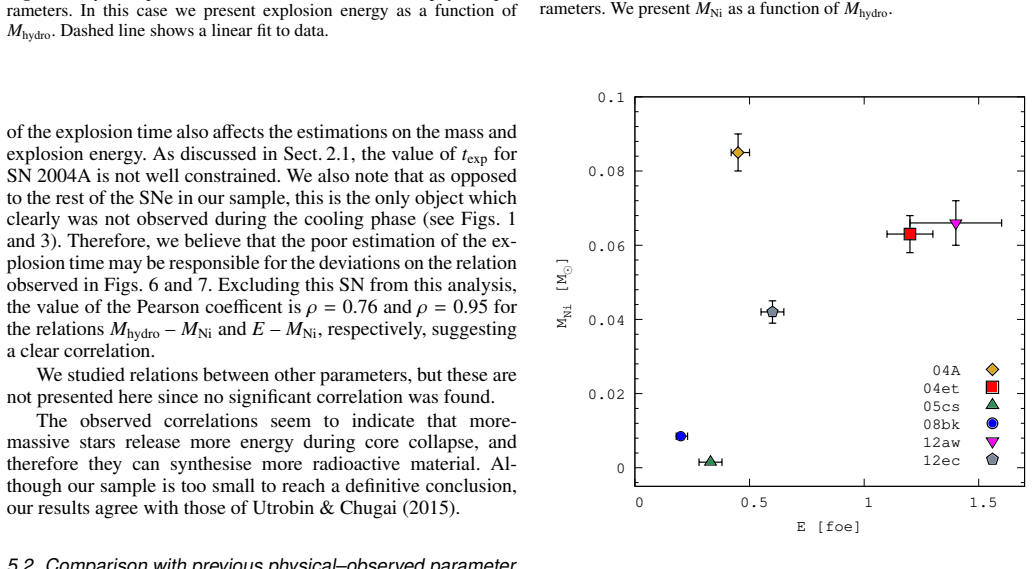
- Progenitor mass and explosion energy are strongly correlated (correlation coefficient $\rho = 0.91$), and correlations involving nickel mass tighten once SN 2004A's uncertain explosion epoch is set aside.
Reading between the lines
- Beyond the paper: if the factor-of-three reduction in wind mass-loss rates is independently confirmed, then the historical II-P mass discrepancy may be best described as a calibration artifact of stellar winds, and direct-imaging and hydrodynamic masses can be treated as mutually validating measurements.
- Beyond the paper: the need for radii above the photometric range in SNe 2004A and 2004et suggests that bolometric-correction radii for dusty or crowded red-supergiant environments could be systematically low; this is testable with resolved multi-band imaging of other nearby red supergiants.
- Beyond the paper: a calibrated mass–explosion-energy correlation derived from a larger set of modelled II-P could be used to estimate progenitor masses for distant II-P where no progenitor is detected, effectively turning light-curve modelling into a population-level mass estimator.
Signed reviews
Editorial analysis
A structured set of objections, weighed in public.
Referee Report
Summary. The paper models the bolometric light curves and photospheric velocity evolution of six Type II-Plateau supernovae (SN 2004A, SN 2004et, SN 2005cs, SN 2008bk, SN 2012aw, and SN 2012ec) using the 1D Lagrangian hydrodynamic code of Bersten et al. (2011). The authors adopt double-polytropic pre-SN models, fix the progenitor radius to values from pre-explosion imaging where possible, and derive hydrodynamic masses Mhydro, explosion energies, and nickel masses. They then compare Mhydro with pre-SN masses MpreSN obtained by evolving the ZAMS mass ranges from direct progenitor detections with MESA stellar models under two wind-efficiency choices (eta=1.0 and eta=0.33). The central claim is that, contrary to previous literature, the hydrodynamic masses are not systematically larger than the masses derived from direct detections; the paper concludes that the two methods give good agreement for this sample.
Significance. If the central claim holds, the paper would provide an important counterexample to a widely discussed mass discrepancy between hydrodynamic modeling and direct progenitor detections for SNe II-P. The work has several strengths: it uses a published hydrodynamic code with a documented history, it models both light curves and photospheric velocities, it compares against multiple previous modeling efforts (Morozova et al. 2018; Pumo et al. 2017; Utrobin & Chugai 2008, 2009), it tests a stellar-evolution pre-SN model for SN 2008bk in Appendix A, and it gives explicit parameter ranges with a candid discussion that they are not statistical errors. The sample is small but deliberately selected for data quality, and the comparison with direct detections is a genuine empirical test. However, the strength of the conclusion is weakened by two intertwined issues: one object (SN 2004et) does not appear to meet the paper's own selection criterion, and the agreement depends on which wind efficiency is adopted in the MESA conversions.
major comments (3)
- [Section 2.2 and Section 5.4] SN 2004et does not satisfy the paper's stated selection criterion (iii). Section 2.2 reports that Crockett et al. (2011) found the original Li et al. candidate still visible after the SN faded and resolved into at least three sources, with the progenitor detected only as an excess of R- and I-band flux and a tentative ZAMS mass of 8+5-1 Msun that the authors say still needs confirmation. This directly contradicts the statement in Section 5.4 that 'all our objects have secured progenitor identifications.' The issue is load-bearing because Figure 11 shows SN 2004et is the clearest outlier under both wind efficiencies: under eta=1.0 it lies above the MpreSN range together with SN 2012aw, and under eta=0.33 it is the only object that does so. The authors should either present additional evidence that justifies keeping SN 2004et in the sample or repeat the comparison on the five objects that actually meet criterion (iii), reporting the outcome for both eta values.
- [Section 5.4 and Figure 11] The 'good agreement' conclusion is not robust to the adopted wind efficiency in the MESA mass-loss prescription. With eta=1.0, two objects (SN 2004et and SN 2012aw) have hydrodynamic masses above the pre-SN mass ranges, while with eta=0.33 the overestimate remains only for SN 2004et. Section 5.4 itself states that mass-loss rates are uncertain by a factor of two to ten, so the choice eta=0.33 is not uniquely forced by the quoted literature. Since the entire mass-discrepancy verdict depends on this choice, the paper needs either a principled argument for why eta=0.33 is the physically appropriate value for these RSG progenitors, or an explicit sensitivity statement showing how the number of discrepant objects changes as eta is varied within the stated uncertainty range.
- [Section 4 and Table 3] The quantitative basis of the comparison is limited by the model-selection procedure and by parameter adjustments that are not part of the direct-detection constraints. The paper states in Section 4 that the preferred models were chosen by visual comparison and that the ranges in Table 3 are not statistical errors. In addition, for SNe 2004A, 2008bk, and 2012ec the explosion epoch was adjusted based on the modelling, and for SNe 2004A and 2004et the progenitor radius was set to values outside the ranges listed in Table 2. These adjustments are described as necessary to fit the observations, but their covariance with Mhydro is not quantified. Because the claim is that the two mass-determination methods agree, the authors should show, at least for the discrepant objects, that the conclusion is unchanged when the literature radius or explosion epoch is used, or provide a justification for why the adjusted values should be preferred.
minor comments (3)
- [Abstract and Section 2] The abstract and Section 2 state that all six objects satisfy criterion (iii), but Section 2.2 shows that SN 2004et does not; the wording should be corrected or the criterion relaxed and the sample description revised accordingly.
- [Section 4, Figure 3] The dashed line for the CSM model of SN 2004et is described in the text as improving the early light curve, but the figure caption does not define the dashed line; please add a legend or caption note for clarity.
- [Section 5.3 and Table 5] The comparison with previous hydrodynamic modeling results in Table 5 would be easier to interpret if the table included the explosion energies and radii from those works, since the degeneracy between Mhydro, R, and E is a central theme of the paper.
Circularity Check
No significant circularity: the hydrodynamic masses are fitted to light curves and velocities, which are independent of the direct-detection masses; the comparison is a genuine two-method test.
full rationale
The central claim—that hydrodynamic masses agree with pre-explosion masses for this sample—is a genuine comparison, not a derivation from its own inputs. Mhydro is obtained by matching bolometric light curves and Fe ii 5169 Å velocity evolution (Section 4) to a grid of double-polytropic models in which mass and radius are independent parameters; the paper explicitly avoids evolutionary pre-SN models because they would tie M and R together (Section 3: 'For parametric models, the progenitor mass and radius can be treated as independent parameters, as opposed to the evolutionary models. This is the main motivation to use double polytropic models as pre-SN structures.'). The only direct-detection input to the hydro models is the progenitor radius range (Table 2), and radius is not the quantity being compared: the paper notes that radius, not mass, is the most direct observable from pre-explosion SEDs. The comparison quantity MpreSN is computed separately with MESA from the literature MZAMS ranges using the Dutch wind scheme, and the two wind efficiencies are motivated by external mass-loss studies (Puls et al. 2008; Smith 2014; Renzo et al. 2017), not fitted to the Mhydro–MpreSN residuals. The self-citations (Bersten & Hamuy 2009 bolometric correction; Bersten et al. 2011 hydro code) are published, externally usable tools and do not encode the conclusion. There is a real sample-integrity problem—SN 2004et does not meet criterion (iii) because Crockett et al. (2011) found the original candidate still visible and resolved into at least three sources, yet Section 5.4 calls all identifications secured—but that is a selection and reporting flaw, not a circular reduction of the mass comparison to its inputs.
Assumptions & free parameters
free parameters (6)
- Hydrodynamic progenitor mass Mhydro per SN =
10 to 23 Msun (Table 3)
- Explosion energy E per SN =
0.2 to 1.4 foe
- Nickel mass MNi per SN =
0.0015 to 0.085 Msun
- Progenitor radius R for SNe 2004A and 2004et =
1000 and 1250 Rsun
- Wind efficiency eta in MESA =
1.0 and 0.33
- Explosion epoch texp for SNe 2004A, 2008bk, 2012ec =
Table 1 values, adjusted from literature
assumptions (6)
- domain assumption Spherical symmetry is a valid approximation for the bulk of SNe II-P ejecta.
- domain assumption LTE with an opacity floor adequately approximates radiation transport in the ejecta.
- domain assumption Double polytropic models faithfully represent the pre-SN density structure of red supergiants.
- domain assumption The MESA Dutch wind scheme with Z=0.02 and wind efficiency eta maps ZAMS mass to pre-SN mass correctly.
- domain assumption The compact remnant mass is 1.4 Msun for all progenitors.
- domain assumption The Fe ii 5169 Angstrom line traces the photospheric velocity.
Cite this review
Pith. "Pith review of Mass discrepancy analysis for a select sample of Type II-Plateau supernovae." pith.science (2026). https://pith.science/paper/BO3ZJFWI
@misc{pith2026190801828,
  author       = {Pith},
  title        = {Pith review of: Mass discrepancy analysis for a select sample of Type II-Plateau supernovae},
  year         = {2026},
  howpublished = {\url{https://pith.science/paper/BO3ZJFWI}},
  note         = {Machine review of arXiv:1908.01828}
}
read the original abstract
The detailed study of supernovae (SNe) and their progenitors allows to better understand the evolution of massive stars and how these end their lives. Despite its importance, the range of physical parameters for the most common type of explosion, the type II supernovae (SNe II), is still unknown. In particular, previous studies of type II-Plateau supernovae (SNe II-P) showed a discrepancy between the progenitor masses inferred from hydrodynamic models and those determined from the analysis of direct detections in archival images. Our goal is to derive physical parameters (progenitor mass, radius, explosion energy and total mass of nickel) through hydrodynamical modelling of light curves and expansion velocity evolution for a select group of 6 SNe II-P (SN 2004A, SN 2004et, SN 2005cs, SN 2008bk, SN 2012aw, and SN 2012ec) that fulfilled the following three criteria: 1) they have enough photometric and spectroscopic monitoring to allow for a reliable hydrodynamical modelling; 2) there is a direct progenitor detection; and 3) there is a confirmation of the progenitor identification via its disappearance in post-explosion images. We then compare the masses obtained by our hydrodynamic models with those obtained by direct detections of the progenitors to test the existence of such a discrepancy. As opposed to some previous works, we find a good agreement between both methods.
Figures


Figures from the paper (7 more)




Reference graph
Works this paper leans on
-
[1]
P., González-Gaitán, S., Hamuy, M., et al
Anderson, J. P., González-Gaitán, S., Hamuy, M., et al. 2014, ApJ, 786, 67
2014
-
[2]
M., et al
Arcavi, I., Gal-Yam, A., Kasliwal, M. M., et al. 2010, ApJ, 721, 777
2010
-
[3]
Arnett, W. D. 1980, ApJ, 237, 541
1980
-
[4]
Barbarino, C., Dall’Ora, M., Botticella, M. T. et al. 2015, MNRAS, 448, 2312
2015
-
[5]
1979, A&A, 72, 287
Barbon, R., Ciatti, F., & Rosino, L. 1979, A&A, 72, 287
1979
-
[6]
C., & Hamuy, M
Bersten, M. C., & Hamuy, M. 2009, ApJ, 701, 200
2009
-
[7]
C., Benvenuto, O
Bersten, M. C., Benvenuto, O. & Hamuy, M. 2011, ApJ, 729, 61
2011
-
[8]
C., Benvenuto, O
Bersten, M. C., Benvenuto, O. G., Nomoto, K. et al. 2012, ApJ, 757, 31
2012
Show all 96 references
-
[9]
Bose, S., Kumar, B., Sutaria, F. et al. 2013, MNRAS, 433, 1871
2013
-
[10]
Bouret, J., Lanz, T., & Hillier, D. J. 2005, A&A, 438, 301 Childress M., Scalzo R., Yuan F., Schimdt B. 2012, CBET, 3201, 2
2005
-
[11]
N., & Utrobin, V
Chugai, N. N., & Utrobin, V . P. 2000, A&A, 354, 557
2000
-
[12]
M., Smartt, S
Crockett, R. M., Smartt, S. J., Pastorello, A., Eldridge, J. J. et al. 2011, MNRAS, 410, 2767 Dall’Ora, M., Botticella, M. T., Pumo, M. L. et al. 2014, ApJ, 787, 139
2011
-
[13]
Davies, B., & Beasor, E. R. 2018, MNRAS, 474, 2116 de Jaeger, T., González-Gaitán, S., Anderson, J. P., et al. 2015, ApJ, 815, 121 de Jager, C., Nieuwenhuijzen, H., & van der Hucht, K. A. 1988, A&AS, 72, 259
2018
-
[14]
Dessart, L., & Hillier, D. J. 2005, A&A, 439, 671
2005
-
[15]
Dessart, L., & Hillier, D. J. 2019, A&A, 625, A9
2019
-
[16]
J., Crowther, P
Evans, C. J., Crowther, P. A., Fullerton, A. W., & Hillier, D. J. 2004, ApJ, 610, 1021
2004
-
[17]
2012, CBET, 3054, 1
Fagotti, P., Dimai, A., Quadri, U., et al. 2012, CBET, 3054, 1
2012
-
[18]
W., & Arnett, W
Falk, S. W., & Arnett, W. D. 1977, ApJS, 33, 515
1977
-
[19]
Filippenko, A. V . 1997, Annual Review of Astronomy and Astrophysics, 35, 309
1997
-
[20]
2016, MNRAS, 456, 16
Fraser, M. 2016, MNRAS, 456, 16
2016
-
[21]
R., Smartt, S
Fraser, M., Maund, J. R., Smartt, S. J. et al. 2012, ApJL, 759, L13
2012
-
[22]
W., Massa, D
Fullerton, A. W., Massa, D. L., & Prinja, R. K. 2006, ApJ, 637, 1025
2006
-
[23]
E., Pols, O
Glebbeek, E., Gaburov, E., de Mink, S. E., Pols, O. R., & Portegies Zwart, S. F. 2009, A&A, 497, 255
2009
-
[24]
A., Bildsten, L., & Paxton, B
Goldberg, J. A., Bildsten, L., & Paxton, B. 2019, ApJ, 879, 3
2019
-
[25]
K., Imshennik, V
Grassberg, E. K., Imshennik, V . S., & Nadyozhin, D. K. 1971, Ap&SS, 10, 28
1971
-
[26]
K., Sahu, D
Gurugubelli, U. K., Sahu, D. K., Anupama, G. C., Chakradhari, N.K. 2008, Bul- letin of the Astronomical Society of India, 36, 79
2008
-
[27]
2001, PhD thesis, Univ
Hamuy, M. 2001, PhD thesis, Univ. Arizona
2001
-
[28]
Hamuy, M., & Pinto, P. A. 2002, ApJ, 566, L63
2002
-
[29]
Heger, A., Langer, N., & Woosley, S. E. 2000, ApJ, 528, 368
2000
-
[30]
A., Smartt, S
Hendry, M. A., Smartt, S. J., Crockett, R. M., Maund, J. R., et al. 2006, MNRAS, 369, 1303
2006
-
[31]
2012, A&A, 546, A28
Jerkstrand, A., Fransson, C., Maguire, K., et al. 2012, A&A, 546, A28
2012
-
[32]
J., Fraser, M., et al
Jerkstrand, A., Smartt, S. J., Fraser, M., et al. 2014, MNRAS, 439, 3694
2014
-
[33]
H., Lasher, G., Chan, K
Karp, A. H., Lasher, G., Chan, K. L., & Salpeter, E. E. 1977, ApJ, 214, 161
1977
-
[34]
E., 2009, ApJ, 703, 2205 Kawakita H., Kinugasa K., Ayani K., Yamaoka H., 2004, IAUC, 8266, 2
Kasen, D., & Woosley, S. E., 2009, ApJ, 703, 2205 Kawakita H., Kinugasa K., Ayani K., Yamaoka H., 2004, IAUC, 8266, 2
2009
-
[35]
P., & Kwan, J
Kirshner, R. P., & Kwan, J. 1974, ApJ, 193, 27
1974
-
[36]
2005, IAUC 8553, 1
Kloehr, W., Muendlein, R., Li, W., et al. 2005, IAUC 8553, 1
2005
-
[37]
S., Khan, R., & Dai, X
Kochanek, C. S., Khan, R., & Dai, X. 2012, ApJ, 759, 20
2012
-
[38]
Kotak, R., Meikle, W. P. S., Farrah, D. et al. 2009, ApJ, 704, 306
2009
-
[39]
M., & Hirschi, R
Kozyreva, A., Kromer, M., Noebauer, U. M., & Hirschi, R. 2018, MNRAS, 479, 3106
2018
-
[40]
C., & Filippenko, A
Leonard, D. C., & Filippenko, A. V . 2005, in ASP Conf. Ser. 342, 1604–2004: Supernovae as Cosmological Lighthouses, ed. M. Turatto et al. (San Fran- cisco, CA: ASP), 330
2005
-
[41]
D., Filippenko, A
Li, W., Van Dyk, S. D., Filippenko, A. V ., & Cuillandre, J. C. 2005, PASP, 117, 121
2005
-
[42]
D., Filippenko, A
Li, W., Van Dyk, S. D., Filippenko, A. V . et al. 2006, ApJ, 641, 1060
2006
-
[43]
D., Filippenko, A
Li, W., Van Dyk, S. D., Filippenko, A. V ., et al. 2008, CBET, 1319, 1
2008
-
[44]
2011, MNRAS, 412, 1441
Li, W., Leaman, J., Chornock, R., et al. 2011, MNRAS, 412, 1441
2011
-
[45]
Litvinova, I. Y . & Nadëzhin, D. K. 1983, Ap&SS, 89, 89
1983
-
[46]
Litvinova, I. Y . & Nadëzhin, D. K. 1985, Soviet Astronomy Letters, 11, 145
1985
-
[47]
D., Bersier, D., James, P
Lyman, J. D., Bersier, D., James, P. A., Mazzali, P. A. et al. 2016, MNRAS, 457, 328
2016
-
[48]
Maguire, K., Di Carlo, E., Smartt, S. J. et al. 2010, MNRAS, 404, 981
2010
-
[49]
Martinez, L., & Bersten, M. C. 2018, Boletín de la Asociación Argentina de Astronomía, 60, 23
2018
-
[50]
J., Eldridge, J
Mattila, S., Smartt, S. J., Eldridge, J. J., Maund, J. R. et al. 2008, ApJ, 688, L91
2008
-
[51]
J., Maund, J., Benetti, S., & Ergon, M
Mattila, S., Smartt, S. J., Maund, J., Benetti, S., & Ergon, M. 2010, arXiv:1011.5494
2010 arXiv
-
[52]
Maund, J. R. 2017, MNRAS, 469, 2202
2017
-
[53]
R., Smartt, S
Maund, J. R., Smartt, S. J., & Danziger, I. J. 2005, MNRAS, 364, L33
2005
-
[54]
R., Fraser, M., Smartt, S
Maund, J. R., Fraser, M., Smartt, S. J. et al. 2013, MNRASL, 431, L102
2013
-
[55]
Misra, K., Pooley, D., Chandra, P. et al. 2007, MNRAS, 381, 280
2007
-
[56]
Modjaz, M., Kirshner R., Challis, P. et al. 2005, IAUC, 8555, 1
2005
-
[57]
Monard, L. A. G. 2008, CBET, 1315, 1
2008
-
[58]
Monard, L. A. G., Childress, M., Scalzo, R., et al. 2012, CBET, 3201, 1
2012
-
[59]
Morozova, V ., Piro, A. L. & Valenti, S. 2018, ApJ, 858, 15
2018
-
[60]
2008, CBET, 1335, 1 Munari U., Vagnozzi A., Castellani F
Morrell, N., & Stritzinger, M. 2008, CBET, 1335, 1 Munari U., Vagnozzi A., Castellani F. 2012, CBElT, 3054, 3
2008
-
[61]
2004, IAUC, 8265, 1
Nakano, S., Itagaki, K., Kushida, R., & Kushida, Y . 2004, IAUC, 8265, 1
2004
-
[62]
Pastorello, A., Sauer, D., Taubenberger, S. et al. 2006, MNRAS, 370, 1752
2006
-
[63]
2009, MNRAS, 394, 2266
Pastorello, A., Valenti, S., Zampieri, L., et al. 2009, MNRAS, 394, 2266
2009
-
[64]
2011, ApJS, 192, 3
Paxton, B., Bildsten, L., Dotter, A., et al. 2011, ApJS, 192, 3
2011
-
[65]
2013, ApJS, 208, 4
Paxton, B., Cantiello, M., Arras, P., et al. 2013, ApJS, 208, 4
2013
-
[66]
2015, ApJS, 220, 15
Paxton, B., Marchant, P., Schwab, J., et al. 2015, ApJS, 220, 15
2015
-
[67]
B., et al
Paxton, B., Schwab, J., Bauer, E. B., et al. 2018, ApJS, 234, 34
2018
-
[68]
Pejcha, O., & Prieto, J. L. 2015, ApJ, 806, 225
2015
-
[69]
2009, AIP Conference Proceedings 1111, 551
Pignata, G., Maza, J., Antezana, R., et al. 2009, AIP Conference Proceedings 1111, 551
2009
-
[70]
Popov, D. V . 1993, ApJ, 414, 712
1993
-
[71]
S., & Najarro, F
Puls, J., Vink, J. S., & Najarro, F. 2008, A&A Rev., 16, 209
2008
-
[72]
L., Zampieri, L., Spiro, S., Pastorello, A
Pumo, M. L., Zampieri, L., Spiro, S., Pastorello, A. et al. 2017, MNRAS, 464, 3013
2017
-
[73]
D., Shore, S
Renzo, M., Ott, C. D., Shore, S. N. & de Mink, S. E. 2017, A&A, 603, A118
2017
-
[74]
Ricks, W., & Dwarkadas, V . V . 2019, ApJ, 880, 59 Rodríguez, Ó., Clocchiatti, A., & Hamuy, M. 2014, AJ, 148, 107
2019
-
[75]
K., Anupama, G
Sahu, D. K., Anupama, G. C., Srividya, S. & Muneer, S. 2006, MNRAS, 372, 1315
2006
-
[76]
E., de Koter, A
Sana, H., de Mink, S. E., de Koter, A. et al. 2012, Science, 337, 444
2012
-
[77]
1990, ApJ, 360, 242 Siviero A., Tomasella, L., Pastorello, A., et al
Shigeyama, T., & Nomoto, K. 1990, ApJ, 360, 242 Siviero A., Tomasella, L., Pastorello, A., et al. 2012, CBET, 3054, 4
1990
-
[78]
Smartt, S. J. 2015, Publications of the Astronomical Society of Australia, 32, 16
2015
-
[79]
J., Maund, J
Smartt, S. J., Maund, J. R., Henry, M. A., Tout, C. A., Gilmore, G. F., Mattila, S., & Benn, C. R. 2004, Science, 303, 499
2004
-
[80]
J., Eldridge, J
Smartt, S. J., Eldridge, J. J., Crockett, R. M., & Maund, J. R. 2009, MNRAS, 395, 1409
2009
-
[81]
2014, ARA&A, 52, 487
Smith, N. 2014, ARA&A, 52, 487
2014
-
[82]
J., Weiler, K
Stockdale, C. J., Weiler, K. W., Van Dyk, S. D. et al. 2004, IAUC, 8415, 1
2004
-
[83]
D., Bersten M., Baron, E
Taddia, F., Stritzinger M. D., Bersten M., Baron, E. et al. 2018, A&A, 609, A136
2018
-
[84]
Utrobin, V . P. 2007, A&A, 461, 233
2007
-
[85]
P., & Chugai, N
Utrobin, V . P., & Chugai, N. N. 2008, A&A, 491, 507
2008
-
[86]
P., & Chugai, N
Utrobin, V . P., & Chugai, N. N. 2009, A&A, 506, 829
2009
-
[87]
P., & Chugai, N
Utrobin, V . P., & Chugai, N. N. 2013, A&A, 555, A145
2013
-
[88]
P., & Chugai, N
Utrobin, V . P., & Chugai, N. N. 2015, A&A, 575, A100
2015
-
[89]
P., & Chugai, N
Utrobin, V . P., & Chugai, N. N. 2017, MNRAS, 472, 5004 Van Dyk, S. D. 2013, The Astronomical Journal, 146, 24 Van Dyk, S. D., Li, W., & Filippenko, A. V . 2003, PASP, 115, 1289 Van Dyk, S. D., Davidge, T. J., Elias-Rosa, N. et al. 2012a, The Astronomical Journal, 143, 19 Van ...
2017
-
[90]
S., de Koter, A., & Lamers, H
Vink, J. S., de Koter, A., & Lamers, H. J. G. L. M. 2001, A&A, 369, 574
2001
-
[91]
Gnuplot 5.0: an interactive plotting program
Williams, T., & Kelley, C. 2015, "Gnuplot 5.0: an interactive plotting program"
2015
-
[92]
Woosley, S. E. & Weaver, T. A. 1995, ApJS, 101, 181
1995
-
[93]
E., Heger, A
Woosley, S. E., Heger, A. & Weaver, T. A. 2002, Reviews of Modern Physics, 74, 1015
2002
-
[94]
Yamaoka, H., Itagaki, K., Klotz, A. et al. 2004, IAUC, 8413, 2
2004
-
[95]
A., Gal-Yam, A
Yaron, O., Perley, D. A., Gal-Yam, A. et al. 2017, Nature Physics, 13, 510
2017
-
[96]
Zwitter, T., Munari, U., & Moretti, S. 2004, IAUC, 8413, 1 Article number, page 14 of 17 Martinez & Bersten: Mass discrepancy analysis of SNe II-Plateau Appendix A: Pre-supernova models Here, we complete the description of the pre-SN models used in our sample. Figure A.1 shows...
2000
Reviewed August 14, 2026 · model on record in the stance chip above.
Discussion (0). Continue with ORCID to comment.