REVIEW 3 major objections 4 minor 6 references
Local versus Global Strategies in Social Query Expansion
T0 review · 3 major / 4 minor · reviewed 2026-08-14 · deepseek-v4-flash
Pith's one-line read Daily Twitter context beats one global expansion for hashtag queries.
desk verdict A sensible question and one good example, but the evaluation consists of raw match counts with no relevance judgments, so the central claim is unsupported. read the letter →
The pith
A machine-rendered reading of the paper's core claim, the machinery that carries it, and where it could break.
The reading
What carries the argument
The load-bearing object is the contextual vector: a ranked list of one- to four-word ngrams computed from all tweets for a hashtag in a time period, where each Twitter account can cast only one vote per period so spam accounts cannot skew counts. A sibling object, the social signature, is the same kind of ranked ngram list computed for a shared link, and the hashtag index stores both objects keyed by date. For query expansion, the system computes similarity between a document link's title or description and the hashtag plus its top ngrams, combining tweet and retweet votes with fixed weights. The local strategy takes the contextual vector of the day; the global strategy merges all daily vectors into one fixed list. The daily vote-and-rank step is what lets the local strategy adapt to the subtopic being discussed on each date.
What would settle it
Take the same twenty hashtags and the same 1-October-to-3-November-2016 period, have independent judges label each matched link as relevant or not to the hashtag on its day, and compute precision and recall for the two strategies; if the global strategy's extra matches are judged relevant at the same rate as the local strategy's matches, the paper's conclusion that local expansion performs better would not survive.
Extended reading notes
Core claim
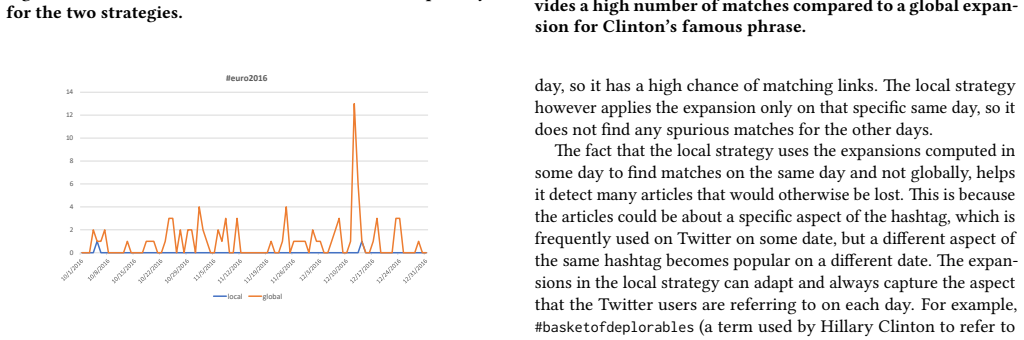
The central claim is stated in the conclusion: 'the temporally sensitive social data performs better for query expansion than using a global set of expansions.' Concretely, the paper builds daily contextual vectors from tweets containing each hashtag, uses the top ten ngrams of each day to expand a same-day retrieval query, and re-ranks shared links by similarity between their titles or descriptions and the expanded query. The comparison covers twenty hashtags from 1 October to 3 November 2016, counting link matches per day under each strategy. The paper's interpretation of the counts is that a global strategy inflates recall with spurious matches, while a local strategy finds the day's relevant subtopic; four observed patterns are presented and used to justify including local matches and discarding weak-signal days.
Load-bearing premise
The comparison assumes that a link whose title or description contains the day's expanded terms is a relevant result, so the paper's daily link-match counts are treated as evidence of retrieval quality even though no human judges checked the links.
Editorial extensions
If this is right
- For a hashtag tied to a single one-time event, the local and global expansions nearly coincide, so the local advantage is small; the benefit appears when a hashtag's meaning changes from day to day.
- Local expansions find articles about day-specific subtopics, such as the different people in the news during the #basketofdeplorables discussion, that a fixed global expansion would miss entirely.
- A large number of matches from the global strategy is not evidence of good retrieval, since those matches include off-topic results from expansions like 'Ronaldo' applied long after the #euro2016 event.
- The local-versus-global comparison can act as a decision rule: include matched links when the local strategy finds many matches, and suppress them when both strategies find only a few, raising recall without sacrificing precision.
- The voting scheme, with one vote per account per day, prevents a small number of spam or advertising accounts from making an expansion term appear artificially popular.
Reading between the lines
- An untested extension: the same local-versus-global contrast should apply to other timestamped social streams, such as Reddit or Mastodon, whenever a term's sense drifts with events; repeating the daily-pooled comparison on another platform would test the generality.
- The match-count evidence could be turned into a direct precision test by sampling matched links on random days and asking judges whether each link is relevant to that day's hashtag; if the global strategy's extra matches are not mostly irrelevant, the conclusion would need revision.
- A practical byproduct not developed in the paper: consecutive days with high local match counts mark the life of a story, and the top ngrams of those days form a readable timeline of subtopic shifts.
- The four observed patterns suggest that low local and low global match counts are a sign the hashtag is dormant, so suppressing expansion on such days is safer than returning the weak matches.
Signed reviews
Editorial analysis
A structured set of objections, weighed in public.
Referee Report
Summary. The paper proposes using Twitter data as a source of temporal context for query expansion. It computes contextual vectors and social signatures from tweet/retweet votes, then compares two expansion strategies over a 34-day period for 20 hashtags: a local strategy that uses daily contextual vectors and a global strategy that uses a fixed set of top expansions aggregated across all days. The evaluation counts document-link matches in titles and descriptions. The paper reports that the global strategy yields more raw matches but claims these are often spurious, while the local strategy better captures day-specific aspects of a hashtag, and concludes that temporally sensitive local social data performs better for query expansion.
Significance. If the central claim were properly established, the paper would make a useful practical contribution to temporal query expansion in social media. The voting scheme to mitigate spam, the use of a full Twitter firehose, and the clear comparison of local versus global expansions are commendable and give the approach a concrete basis. The three worked examples are illustrative and help communicate the intended behavior. However, the evaluation does not measure retrieval quality: it only reports raw link-match counts, without relevance judgments, precision/recall, or statistical testing. Consequently, the claimed advantage of the local strategy is not currently supported, and the significance for the field remains potential rather than demonstrated.
major comments (3)
- [Section 3 (Analysis and Evaluation), Figures 1-6] The central comparison rests entirely on raw link-match counts. Figure 1 shows that the global strategy finds more matching document links than the local strategy, but no relevance judgments are collected and no precision, recall, or F-measure is computed. The statement 'The recall is high, but the precision is low' (Section 3) is therefore unsupported; the data as presented cannot distinguish high-recall/low-precision from low-recall/high-precision behavior. Without a labeled relevance pool and a significance test, the conclusion in Section 4 that the local strategy 'performs better' does not follow from the evidence shown.
- [Section 3, behavior taxonomy items (1)-(4)] The four-way classification of strategy behavior is asserted from a few hand-selected examples (#euro2016, #basketofdeplorables, #berlin, #carriefisher). No explicit relevance criteria, annotation procedure, or inter-annotator agreement are reported, and no aggregate counts across the 20 hashtags show how often each of the four behaviors actually occurs. Because the conclusion depends on the claim that global-only matches are typically 'spurious' while local-only matches are 'useful,' this anecdotal basis is not adequate to support the paper's central claim.
- [Section 3, experimental setup] The set of 'predetermined 20 hashtags' is not listed, and the selection criteria are not given. The procedure for choosing the top-10 expansions for each day and for the global strategy is also under-specified, as is the exact matching rule beyond 'titles or descriptions contain the hashtag, the word-broken hashtag, or any of the expanded ngrams.' This makes the experiment non-reproducible and prevents a reader from assessing whether the hashtag sample is biased toward the authors' conclusion.
minor comments (4)
- [Throughout manuscript] LaTeX control sequences appear literally in the text (e.g., '/T_he', '/Q_uery', '/f_irst'), indicating the version under review is not cleanly compiled; the authors should provide a properly rendered manuscript.
- [Section 2.4, weight formula] The notation 'ht.ltTweetVotes' is not defined, and the coefficients 0.35 and 0.5 do not sum to 1, so the intended normalization of the counter c should be clarified.
- [Section 2.1, Table 1] The claim that contextual vectors are 'very sensitive to time' is illustrated with two examples, but a quantitative measure of temporal drift (e.g., term-overlap between consecutive days) would strengthen the motivation.
- [Section 1, 'no manual intervention'] The statement that the approach works 'without any manual intervention' is somewhat overstated because the choice of the 20 hashtags and the manual interpretation of the examples are human decisions; clarify that the absence of manual intervention applies to the term extraction and weighting steps.
Circularity Check
No circularity: the local-vs-global comparison is an empirical evaluation, not a derivation from fitted inputs.
full rationale
The paper's central claim is that a temporally local query-expansion strategy outperforms a global one. The local strategy computes day-specific expansion terms and matches same-day links, while the global strategy uses a fixed expansion set across all days; the comparison is then measured by counting matching link titles/descriptions. No parameter is fitted to the evaluation outcome: the manual weights (pw=0.8, rtw=0.2, valtw=0.35, lw=0.5) are arbitrary constants, not optimized on the observed match counts, and the top-10 expansion threshold is fixed in advance. The conclusion therefore is not equivalent to any input by construction. The only self-citation, to Alonso et al. [1] for SPRF/SQE techniques, is descriptive and not load-bearing: the local-versus-global evaluation is performed in this paper and does not reduce to a claim from the cited work. The paper's real weakness is evidentiary: it asserts that global matches are spurious ('the recall is high, but the precision is low') without relevance judgments, precision/recall computation, or significance testing, and the higher global match counts could plausibly indicate higher recall rather than lower precision. That is a validity threat, not a circularity. On the circularity axis, the derivation chain is self-contained.
Assumptions & free parameters
free parameters (5)
- tweet weight pw =
0.8
- retweet weight rtw =
0.2
- vote weight valtw =
0.35
- link weight lw =
0.5
- top-k expansions =
10
assumptions (3)
- domain assumption Fine-grained voting (one account one vote) represents genuine human popularity without spam distortion.
- domain assumption Contextual vectors and social signatures derived from tweets are valid query expansion terms.
- domain assumption Link title and description matching captures retrieval relevance.
Cite this review
Pith. "Pith review of Local versus Global Strategies in Social Query Expansion." pith.science (2026). https://pith.science/paper/ZNYVW5WS
@misc{pith2026190801868,
  author       = {Pith},
  title        = {Pith review of: Local versus Global Strategies in Social Query Expansion},
  year         = {2026},
  howpublished = {\url{https://pith.science/paper/ZNYVW5WS}},
  note         = {Machine review of arXiv:1908.01868}
}
read the original abstract
Link sharing in social media can be seen as a collaboratively retrieved set of documents for a query or topic expressed by a hashtag. Temporal information plays an important role for identifying the correct context for which such annotations are valid for retrieval purposes. We investigate how social data as temporal context can be used for query expansion and compare global versus local strategies for computing such contextual information for a set of hashtags.
Figures


Figures from the paper (1 more)

Reference graph
Works this paper leans on
-
[1]
Omar Alonso, Vasileios Kandylas, and Serge-Eric Tremblay. 2018. How it Hap- pened: Discovering and Archiving the Evolution of a Story Using Social Signals. In Proceedings of JCDL . 193–202
work page 2018
-
[2]
Van Dang and W. Bruce Cro/f_t. 2010. /Q_uery Reformulation Using Anchor Text. In Proc. of WSDM. 41–50
work page 2010
-
[3]
Taiki Miyanishi, Kazuhiro Seki, and Kuniaki Uehara. 2013. Improving Pseudo- relevance Feedback via Tweet Selection. In Proc. of CIKM. 439–448
work page 2013
-
[4]
Yashen Wang, Heyan Huang, and Chong Feng. 2017. /Q_uery Expansion Based on a Feedback Concept Model for Microblog Retrieval. In Proc. of WWW . 559–568
work page 2017
-
[5]
Jinxi Xu and W. Bruce Cro/f_t. 2000. Improving the Effectiveness of Information Retrieval with Local Context Analysis. ACM Trans. Inf. Syst. 18, 1 (2000), 79–112
work page 2000
-
[6]
Meriem Amina Zingla, Chiraz Latiri, Philippe Mulhem, Catherine Berrut, and Yahya Slimani. 2018. Hybrid query expansion model for text and microblog information retrieval. Inf. Retr. Journal 21, 4 (2018), 337–367
work page 2018
Reviewed August 14, 2026 · model on record in the stance chip above.
Discussion (0). Continue with ORCID to comment.