REVIEW 3 major objections 5 minor 17 references
A Formally Verified HOL Algebra for Dynamic Reliability Block Diagrams
T0 review · 3 major / 5 minor · reviewed 2026-08-14 · deepseek-v4-flash
Pith's one-line read The paper claims that dynamic reliability block diagrams, including systems with spare parts, can be expressed in a small algebra whose reliability formulas are machine-checked by the HOL4 theorem prover.
desk verdict A genuinely useful HOL4 DRBD algebra, but the spare-reliability theorem relies on an unproved DRBD/DFT complementarity; needs a bridge lemma and reproducible scripts before I'd trust the central claim. read the letter →
The pith
A machine-rendered reading of the paper's core claim, the machinery that carries it, and where it could break.
The reading
What carries the argument
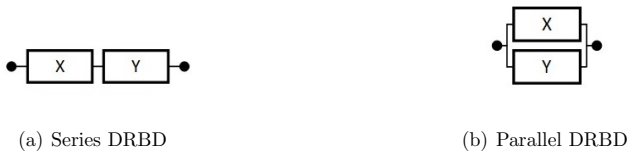
The load-bearing object is a family of DRBD operators defined pointwise on time-to-failure random variables: AND as the minimum, OR as the maximum, the after operator as '$X$ if $X > Y$, else $+\infty$', and the simultaneous and inclusive-after variants, with identity elements ALWAYS (fails at time 0) and NEVER (never fails). The after operator carries the dynamics — it encodes the condition that one component outlives another, exactly what a spare must satisfy. On top of these, the paper builds the spare construct $Q_{\mathrm{spare}} = (X_a \vartriangleright Y) \cdot (Y \vartriangleright X_d)$ and reuses a previously verified failure probability of the dynamic fault tree spare gate to obtain the spare's reliability. The n-ary AND and OR operators, built by iterating over finite index sets, connect the algebra to the standard set-based definitions of series and parallel structures, which is what allows verifying nested structures of arbitrary depth.
What would settle it
Choose concrete distributions — for example exponential failure rates for the main part, the active spare, and the dormant spare — simulate the physical behavior the spare construct is meant to capture (main fails, spare activates, spare fails) and compare the simulated reliability with the closed form in Theorem 3.6; any systematic divergence under the theorem's own independence and density assumptions would show that the asserted complementarity between the fault-tree spare gate and the DRBD spare construct is false.
Extended reading notes
Core claim
The central claim is that every DRBD structure function can be written as an algebraic expression in a few operators — the minimum of failure times for series (AND), the maximum for parallel (OR), and the after operator $X \vartriangleright Y$, which returns $X$'s failure time when $X$ fails after $Y$ and $+\infty$ otherwise — and that the reliability of the whole diagram is then computable from these expressions. For the spare construct, the structure function is $Q_{\mathrm{spare}} = (X_a \vartriangleright Y) \cdot (Y \vartriangleright X_d)$: the active spare must outlive the main part, and the main part must outlive the dormant spare. The authors verify in HOL4 that the reliability of this construct equals one minus the failure probability of the corresponding dynamic fault tree spare gate, and they verify generic reliability expressions for series, parallel, series-parallel, and deeper nested structures over arbitrary finite index sets. Because the expressions are generic — independent of the failure distributions — the same verified theorem covers any distribution that satisfies the stated independence and continuity conditions.
Load-bearing premise
The central spare-reliability proof assumes, without proving it inside the HOL development, that the DRBD spare construct and the dynamic fault tree spare gate describe complementary behaviors, so the verified failure probability of the fault tree gate can be subtracted from one to give the DRBD reliability.
Editorial extensions
If this is right
- Systems with spare parts can receive reliability formulas that have been checked by a theorem prover, so trust shifts from hand algebra or simulation to a machine-checked proof.
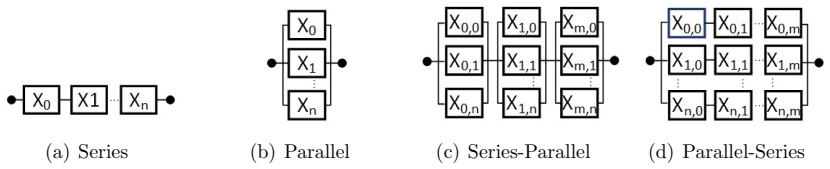
- The verified series and parallel formulas are generic in the number of blocks and in the failure distributions, so one theorem covers any finite instance that meets the stated conditions.
- Hot, warm, and cold spares are all special cases of the verified spare theorem, since the warm structure function $Q_{\mathrm{spare}}$ subsumes the other two variants.
- The shuffle-exchange network case shows the algebra can express a whole system — spares plus nested parallel paths — and yield an end-to-end machine-checked reliability formula.
Reading between the lines
- Because the operators are defined purely on failure times, a natural extension would give the algebra time-varying dormancy factors or state-dependent activation by refining the density assumptions alone, leaving the algebraic layer unchanged.
- The set-indexed nesting used for series-parallel structures points toward a general recursive structure theorem: any finite tree of AND, OR, and after operators could receive a reliability formula by structural recursion rather than one theorem per nesting depth.
- The independence assumptions behind the product-form reliability expressions leave common-cause failures and load-sharing dependencies out of scope; extending the algebra to dependent components would require conditional reliability expressions in place of the products.
- A cascade of spares — a spare for the spare — would need a new structure function, but the same after-operator pattern suggests an inductive form: each additional spare layer adds one more after condition to the conjunction.
Signed reviews
Editorial analysis
A structured set of objections, weighed in public.
Referee Report
Summary. The paper proposes a higher-order-logic algebra for dynamic reliability block diagrams (DRBDs), with operators for series, parallel, temporal after/simultaneous/inclusive-after constructs, and n-ary structure operators, together with simplification theorems. It reports a HOL4 formalization in which generic reliability expressions are verified for series, parallel, series-parallel, and deeper nested structures, and it applies the development to the formal reliability analysis of a drive-by-wire system and a shuffle-exchange network with spare constructs. The main claimed contribution is machine-checked, distribution-independent reliability expressions for DRBDs, with the spare construct as the central dynamic case.
Significance. If the formalization is complete and the proof scripts are sound, this is a useful contribution to formal reliability analysis: it gives generic, distribution-independent reliability formulas that can be composed hierarchically, and the set-indexed treatment of series-parallel structures goes beyond earlier RBD formalizations in HOL. The algebraic identities and the n-ary structure theorems are stated cleanly, and the two case studies illustrate how the building blocks can be assembled. The main reservation is that the central spare-reliability theorem is not derived from the DRBD semantics alone: it imports the DFT spare-gate failure probability from the authors' earlier work, and the required semantic bridge is asserted rather than machine-checked. The absence of the HOL4 scripts in the paper also makes the machine-checked claim difficult to assess.
major comments (3)
- The reliability expression for the DRBD spare construct is not established from the DRBD semantics presented in this paper. Section 2.2 asserts that the DRBD spare construct and the DFT spare gate 'exhibit complementary behavior,' and Theorem 3.6 is then proved by importing the DFT warm-spare failure probability from [13]. For this inference to be sound inside HOL4, one must prove a bridge lemma—for example, that the DRBD success event {R_WSP Y Xa Xd > t} equals the complement of the DFT spare-gate failure event under the stated assumptions—and include that lemma in the formal development. No such lemma is stated, proved, or referenced. In addition, the DISJOINT WSP hypothesis is load-bearing: it prevents the active-spare and dormant-spare failure events from overlapping, and the paper does not show how this condition follows from the component semantics or how it is satisfied in the exponential instantiations of Section 4. Without these pieces, Theorem 3.6 is a theorem about the DFT spare gate rather than about the DRBD algebra, and the applications in Section 4 inherit the gap.
- The paper states that the proof script is available at [15], but the script is not included in the manuscript and no commit hash or archived version identifier is provided. Because the central claims are that Theorems 3.3, 3.5, and 3.6 are machine-checked in HOL4, the reader cannot currently verify either the theorem statements or the existence of the required bridge lemma in the actual theory files. Please provide the proof scripts as a stable archive with a version identifier, and explicitly map each numbered theorem to the corresponding HOL4 theory and theorem name.
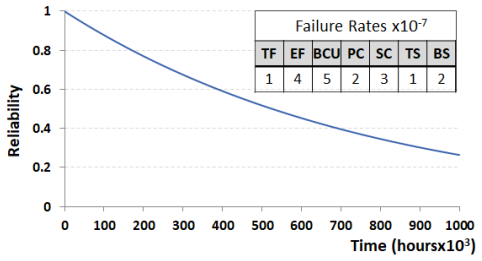
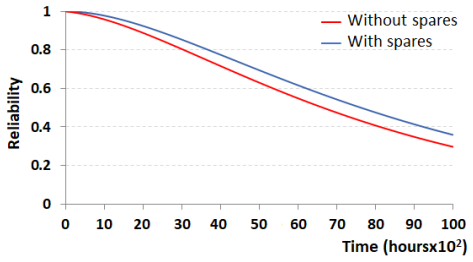
- The case studies use the spare-reliability expression but do not demonstrate that the assumptions of Theorem 3.6 are discharged for the example distributions. Figures 5 and 7 report numerical evaluations based on exponential distributions, yet the paper does not state or prove that those rate parameters satisfy rv_gt0_ninfinity, continuity, measurability, independence, and the disjointness condition up to the considered time horizon. The text should either provide verified instantiation lemmas for the example distributions or explicitly distinguish the numerically evaluated mathematical expression from the formally verified theorem.
minor comments (5)
- The sentence after Eq. (7) says 'FX is the probability density function (PDF) of X'; it should say fX is the PDF, while FX denotes the CDF.
- In the Parallel structure row, the product is written as '∏n 1=1' rather than '∏n i=1'; please correct the index.
- The entry 'X rhd (Y ⊿ Z)' uses an undefined symbol 'rhd'; this appears to be a rendering issue and should be clarified or replaced with the intended operator notation.
- The notation for the conditional density is inconsistent between Eq. (9) ('f(Xa|Y=y)') and Theorem 3.6 ('fXa|Y'); please unify the notation.
- The helper functions event set and ind set are only described in prose and are not formally defined in the paper; their definitions should be included so that Theorems 4.1 and 4.2 are self-contained.
Circularity Check
The spare-construct reliability theorem is not self-contained as presented: it imports the authors' prior DFT spare-gate result across an informally asserted DRBD/DFT complementarity, though this is a proof-gap rather than a definitional circularity.
-
other
[Section 2.2, Eq. (8)-(9); Theorem 3.6 (Section 3.4)]
"Since the spare construct of the DRBD and the spare gate of the DFT exhibit complementary behavior, i.e., the DRBDs consider the success and the DFTs consider the failure, we can use the probability of failure of the spare DFT gate [9] to find the reliability of the spare DRBD construct. ... Theorem 3.6 is verified by ... prove the expression based on the probability of failure of the DFT spare gate, which is verified based on the properties of the Lebesgue integral."
Theorem 3.6 concludes Eq. (9) for the new DRBD operator R WSP, but the proof route is to reuse the authors' prior DFT warm-spare-gate failure probability from [13] after asserting that the DRBD and DFT events are complementary. The paper does not state or prove a bridge lemma showing that the DRBD success event {R WSP > t} is the complement of the DFT WSP failure event used in [13]. Without such a bridge, the theorem is a statement about the DFT gate rather than about the DRBD algebra; with the bridge, the reuse of [13] is legitimate and non-circular because [13] is machine-checked and parameter-free. The circularity-relevant defect is therefore an omitted formal bridge and a load-bearing self-citation, not a definitional identity between the theorem's input and output.
full rationale
The paper does not exhibit the most severe circularity patterns: the series, parallel, and nested-structure reliability theorems are derived from independence assumptions and standard measure-theoretic identities; the simplification theorems are proved from the operator definitions; and the AND/OR reliability expressions are not fitted to the conclusions. The spare and after-operator reliability results, however, rely on an asserted complementarity between the new DRBD success events and the authors' prior DFT failure events, with the actual probability computation imported from the self-cited machine-checked DFT formalization in [13]. Because the complementarity bridge is not presented as a proved lemma in this paper, the central spare theorem is not fully self-contained as written. This is better characterized as a correctness/trust gap and a load-bearing self-citation than as a circular definition: the prior DFT result is machine-checked and the bridge is in principle provable from the given definitions. Accordingly, the circularity score is moderate but not high.
Assumptions & free parameters
assumptions (6)
- domain assumption System components are non-repairable and represented by time-to-failure random variables.
- domain assumption For components with continuous failure distributions, simultaneous failure is negligible.
- domain assumption DRBD events and DFT events are complementary for spare constructs.
- domain assumption The relevant random variables have density functions and continuous CDFs where required.
- standard math The HOL4 theorem prover and its mechanized probability and measure theory are sound.
- domain assumption Independence of components is required for reliability products.
Cite this review
Pith. "Pith review of A Formally Verified HOL Algebra for Dynamic Reliability Block Diagrams." pith.science (2026). https://pith.science/paper/TOLHYZPW
@misc{pith2026190801930,
  author       = {Pith},
  title        = {Pith review of: A Formally Verified HOL Algebra for Dynamic Reliability Block Diagrams},
  year         = {2026},
  howpublished = {\url{https://pith.science/paper/TOLHYZPW}},
  note         = {Machine review of arXiv:1908.01930}
}
read the original abstract
Dynamic reliability block diagrams (DRBDs) are introduced to overcome the modeling limitations of traditional reliability block diagrams, such as the inability to capture redundant components. However, so far there is no algebraic framework that allows conducting the analysis of a given DRBD based on its structure function and enables verifying its soundness using higher-order logic (HOL) theorem proving. In this work, we propose a new algebra to formally express the structure function and the reliability of a DRBD with spare constructs based on basic system blocks and newly introduced DRBD operators. We present several simplification properties that allow reducing the structure of a given DRBD. We provide the HOL formalization of the proposed algebra, and formally verify its corresponding properties using the HOL4 theorem prover. This includes formally verifying generic reliability expressions of the spare construct, series, parallel and deeper structures in an extensible manner that allows verifying the reliability of complex systems. Finally, we demonstrate the applicability of this algebra by formally analyzing the terminal reliability analysis of a shuffle-exchange network in HOL4.
Figures

Figures from the paper (4 more)


Reference graph
Works this paper leans on
-
[13]
Proba- bilistic Analysis of Dynamic Fault Trees using HOL Theorem Proving
Yassmeen Elderhalli, Waqar Ahmad, Osman Hasan, and Sofi` ene Tahar. Proba- bilistic Analysis of Dynamic Fault Trees using HOL Theorem Proving. Journal of Applied Logics, 2631(3):469, 2019
work page 2019
-
[15]
Y. Elderhalli. DRBD Formal Analysis: HOL4 Script, http://hvg.ece.concordia.ca/code/hol/DRBD/index.php, 2019
work page 2019
-
[1]
E. Ruijters and M. Stoelinga. Fault Tree Analysis: A Survey of the State-of-the- art in Modeling, Analysis and Tools. Computer Science Review , 15-16:29 – 62, 2015
work page 2015
- [2]
- [3]
- [4]
-
[5]
G. Smith. The Object-Z Specification Language , volume 1. Springer Science & Business Media, 2012
work page 2012
-
[6]
R. Robidoux, H. Xu, L. Xing, and M. Zhou. Automated Modeling of Dynamic Re- liability Block Diagrams using Colored Petri Nets.IEEE Transactions on Systems, Man and Cybernetics , 40(2):337, 2010
work page 2010
Show all 17 references
-
[7]
Ahmed, O
W. Ahmed, O. Hasan, and S. Tahar. Formalization of Reliability Block Diagrams in Higher-order Logic. Journal of Applied Logic , 18:19–41, 2016
2016
-
[8]
https://hol-theorem-prover.org/, 2019
HOL4. https://hol-theorem-prover.org/, 2019
2019
-
[9]
G. Merle. Algebraic Modelling of Dynamic Fault Trees, Contribution to Qualitative and Quantitative Analysis . PhD thesis, ENS, France, 2010
2010
-
[10]
Mhamdi, O
T. Mhamdi, O. Hasan, and S. Tahar. Formalization of Entropy Measures in HOL. In Interactive Theorem Proving, LNCS 6898, pages 233–248. Springer, 2011
2011
-
[11]
Qasim, O
M. Qasim, O. Hasan, M. Elleuch, and S. Tahar. Formalization of Normal Random Variables in HOL. In Intelligent Computer Mathematics, LNCS 9791, pages 44–59. Springer, 2016
2016
-
[12]
T. Mhamdi. Information-theoretic Analysis using Theorem Proving . PhD thesis, Concordia University, Montreal, QC, Canada, 2012
2012
-
[14]
https://isabelle.in.tum.de/, 2019
Isabelle. https://isabelle.in.tum.de/, 2019
2019
-
[16]
Altby and D
A. Altby and D. Majdandzic. Design and Implementation of a Fault-tolerant Drive-by-wire System. Master’s thesis, Chalmers University of Technology, Swe- den, 2014
2014
-
[17]
Bistouni and M
F. Bistouni and M. Jahanshahi. Analyzing the Reliability of Shuffle-exchange Networks using Reliability Block Diagrams. Reliability Engineering & System Safety, 132:97–106, 2014. 25
2014
Reviewed August 14, 2026 · model on record in the stance chip above.
Discussion (0). Continue with ORCID to comment.