REVIEW 4 major objections 6 minor 9 references
GPU Tracking in the COMET Phase-I Cylindrical Drift Chamber
T0 review · 4 major / 6 minor · reviewed 2026-08-14 · deepseek-v4-flash
Pith's one-line read The paper claims that GPU-parallel seed scanning solves the hit-to-turn assignment for COMET's multi-turn electrons, with 76% classification efficiency, 90% purity, and 33x speedup over CPU.
desk verdict A credible GPU seed-scanning tracker for COMET's multi-turn electrons, with a solid speedup benchmark and conditional physics metrics. read the letter →
The pith
A machine-rendered reading of the paper's core claim, the machinery that carries it, and where it could break.
The reading
What carries the argument
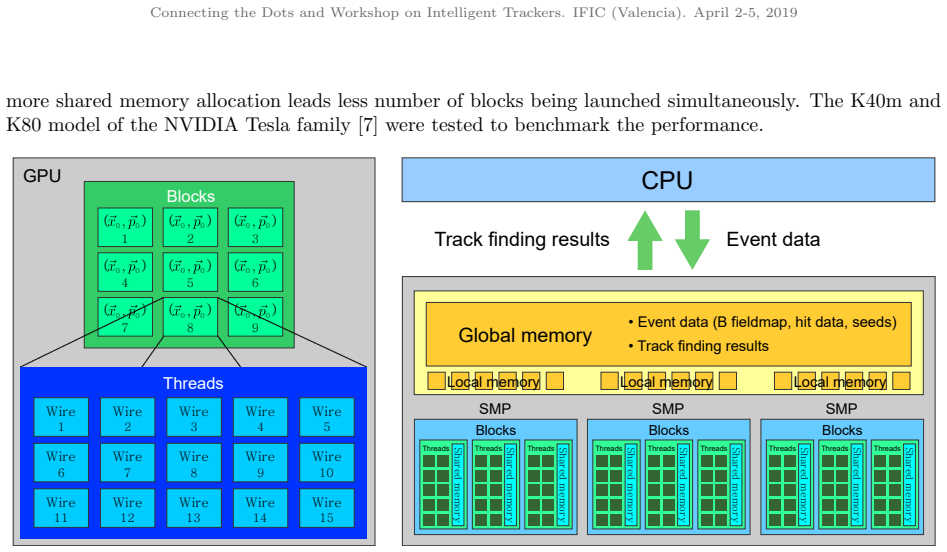
The load-bearing mechanism is the seed-scanning loop: a set of a few tens of thousands of starting track parameters is prepared with a Hough transform and the detector geometry; each GPU block receives one seed and propagates it with RKN integration; each thread in the block computes the distance of closest approach to one wire and contributes $\min(d_L^2,d_R^2,\lambda)$ to the score $E=\sum_{\text{wires}}\min(d_L^2,d_R^2,\lambda)$, where $d_L,d_R$ are the left/right wire distances and $\lambda$ is a cutoff that suppresses hits from other turns. The best few seeds are then refined over ten passes with finer granularity, and the final hit assignment feeds a Kalman filter. This mechanism replaces combinatorial hit enumeration with a fixed, embarrassingly parallel parameter scan, which is what makes the GPU speedup possible.
What would settle it
Build a Monte Carlo sample that includes realistic wire misalignments and background hits, apply the paper's described seed ranges and granularity, and count how often a true multi-turn signal track's first-turn starting parameters fall inside the scanned grid; if that coverage drops below 90 percent, the reported 76 percent efficiency and 90 percent purity cannot survive on real COMET data.
Extended reading notes
Core claim
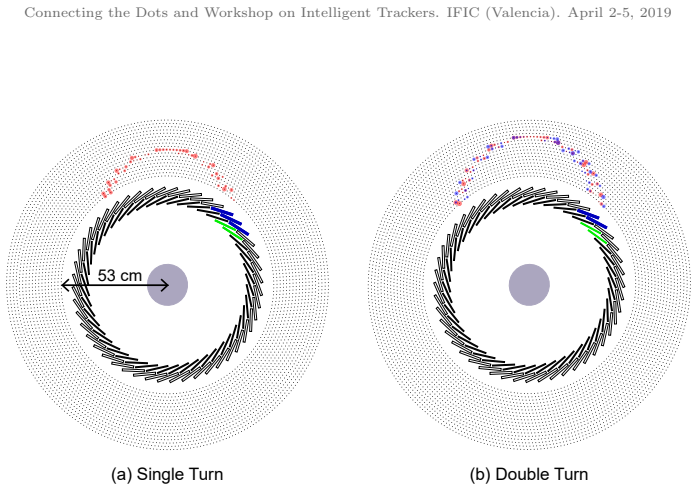
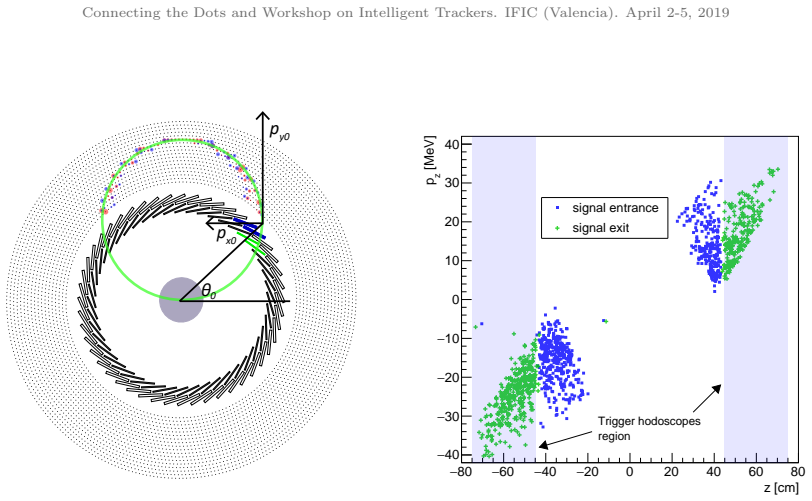
The central claim is that scanning a finite grid of five-parameter seeds—transverse position $\theta_0$, longitudinal position $z_0$, and momentum components $p_{x0},p_{y0},p_{z0}$—yields correct turn-by-turn hit classification and a first-turn momentum measurement for multi-turn electrons, when each seed is propagated with the Runge-Kutta-Nyström method in parallel on a GPU. The transverse part of the grid is initialized by a Hough transform on the wire hits, and the longitudinal part is constrained by the requirement that triggered tracks end at the hodoscope. After ten rounds of coarse-to-fine scanning, the best seed is selected by a chi-square-like score that ignores distant hits through a cutoff, and bidirectional extrapolation plus a common-hit quality cut ($N_c\ge20$) filters out misleading results before Kalman filtering. The paper presents the measured 300 keV core energy resolution and the 76%/90% efficiency/purity as evidence that the method is acceptable for COMET Phase-I, while noting that parameters such as the cutoff and seed granularity still need optimization.
Load-bearing premise
The method assumes that the precomputed list of starting guesses, tuned to cover at least 90 percent of simulated signal tracks without exceeding GPU memory, will still cover the true starting points when the real detector has misalignments, extra backgrounds, or different hit efficiencies.
Editorial extensions
If this is right
- If the results hold, the hit-to-turn assignment problem for multi-turn tracks is solved by a parameter scan rather than by combinatorial search, so the reconstruction time no longer grows with the number of hit combinations.
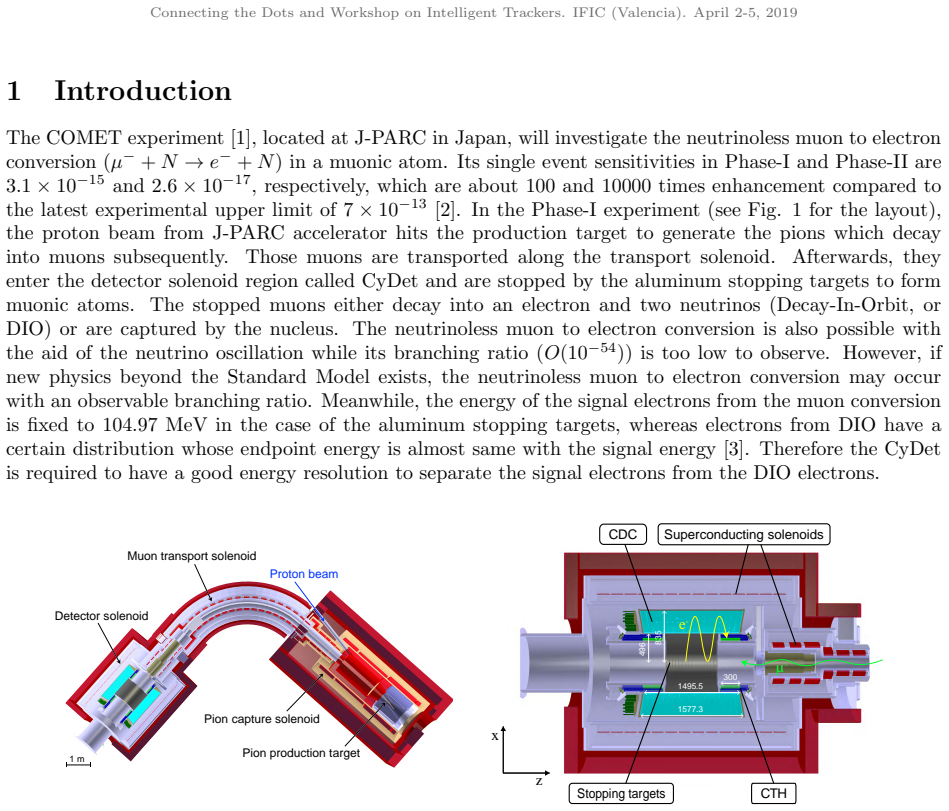
- The reported 300 keV core resolution is presented as sufficient to separate the 104.97 MeV conversion signal from the Decay-In-Orbit background endpoint, which is the physics goal that motivates the detector.
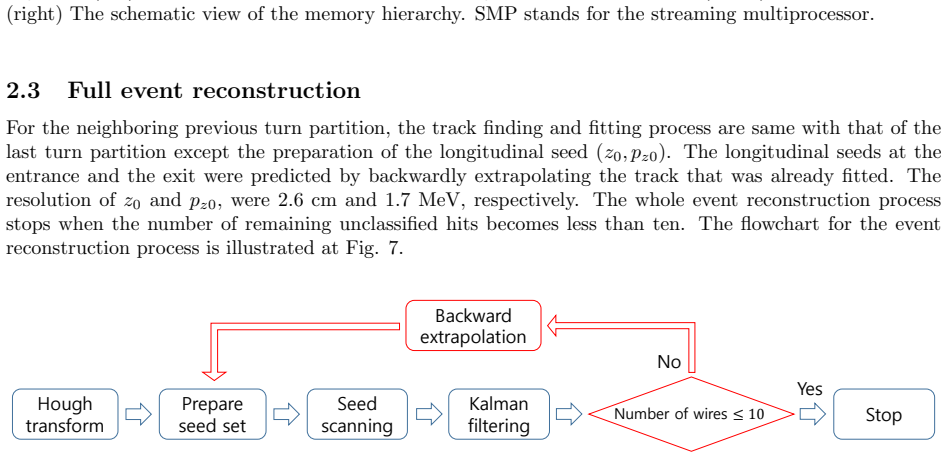
- The same seed-scanning loop is reused for each earlier turn by backward extrapolation from the fitted last turn, so the method can chain through an arbitrary number of turns until fewer than ten hits remain.
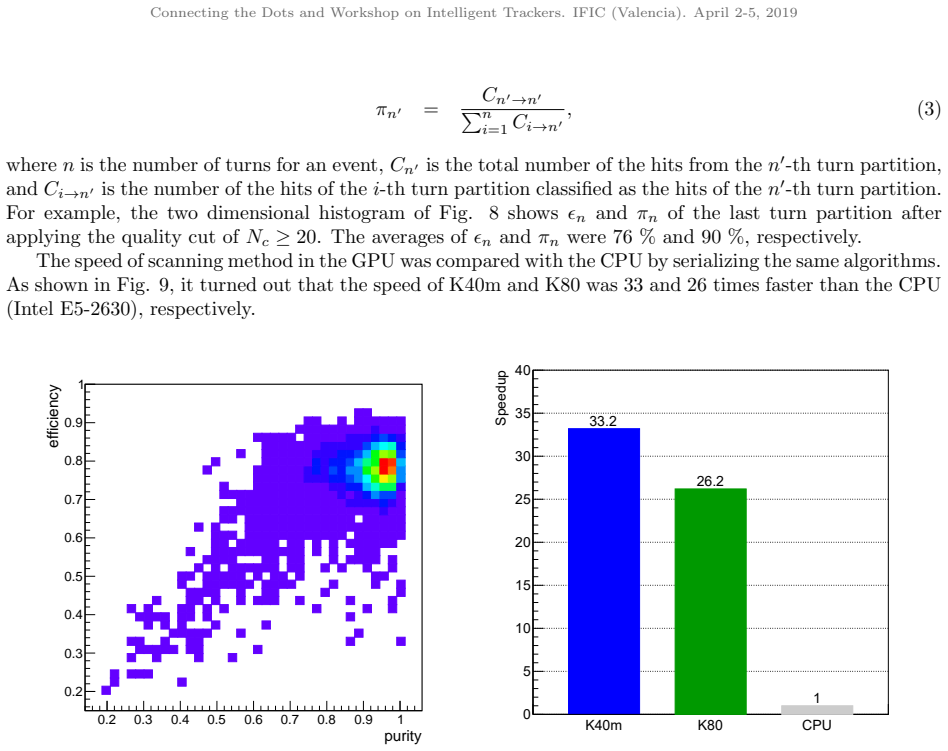
- The speedups of 33x and 26x come from serializing the identical algorithm on a CPU, so the acceleration is a property of the parallelisation, not of a simplified track model.
- The authors state that further optimization of the cutoff value and seed granularity is required, meaning the reported efficiency and resolution are not yet the ceiling of the method.
Reading between the lines
- The main transferability risk is the precomputed seed grid: if real detector alignment or backgrounds shift the true starting parameters outside the scanned ranges, the 90-percent coverage assumption fails; an adaptive per-event grid derived from the Hough transform would remove that dependence.
- The block-per-seed, thread-per-wire mapping should generalize to other solenoid drift chambers with looping tracks, because the per-thread workload is independent of the number of hits and the scan order does not depend on detector size.
- A stronger stress test than the presented Monte Carlo would inject known conversion-like electron tracks into real detector noise and measure the reconstructed momentum peak's width and position; a core resolution close to 300 keV under those conditions would validate the method under actual trigger and background environments.
Signed reviews
Editorial analysis
A structured set of objections, weighed in public.
Referee Report
Summary. This proceedings paper presents a GPU-accelerated track-finding algorithm for the COMET Phase-I cylindrical drift chamber. The method avoids combinatorial hit-to-turn assignment in multi-turn electron events by scanning a precomputed set of track seeds: transverse seed parameters are initialized with a Hough transform, longitudinal seeds are constrained by the CTH trigger geometry, and each seed is propagated with the Runge-Kutta-Nyström method on the GPU, scoring hits by a chi-square-like distance-of-closest-approach sum. Candidate seeds are refined in several iterations, and Kalman filtering is applied after hit classification. On Monte Carlo CTH-triggered events the authors report a last-turn classification efficiency of 76% and purity of 90%, a core momentum resolution of about 300 keV for the first-turn momentum, and GPU speedups of 33x (K40m) and 26x (K80) relative to a CPU implementation of the same algorithm.
Significance. If the quantitative claims are robust, the work makes a useful contribution: it demonstrates that seed scanning, rather than combinatorial hit scanning, can handle the multi-turn hit-assignment problem at acceptable quality, and it provides a credible GPU parallelization strategy (seed-per-block, wire-per-thread mapping, two-kernel separation, and memory-bandwidth analysis). The reported speedups are plausible and the physics workflow is clearly described. The strength of the paper is that it states explicitly how the seed grid was tuned (to cover 90% of MC truth) and where the computational bottleneck lies. Its significance is limited by the fact that the evaluation sample is the same Monte Carlo used for that tuning, so the efficiency/purity/resolution numbers are conditional on the simulation and on the chosen grid, and by the absence of statistical uncertainties throughout.
major comments (4)
- [Section 2.1 and Section 3] The seed scanning range and granularity are tuned to cover at least 90% of the Monte Carlo truth values of the CTH triggering event samples, and the same sample is used in Section 3 to report the 76% efficiency, 90% purity, and 300 keV resolution. This makes the headline quality metrics conditional on the tuning: if real COMET data have seed-parameter shifts from alignment, field-map, hit-efficiency, or background differences, the precomputed grid may no longer cover the true seeds, and the reported numbers could degrade. The paper does not report any robustness study varying these inputs. Please add such a study, even a simple variation of the seed ranges and hit efficiency, or explicitly frame the results as simulation-conditional rather than as expected data performance.
- [Section 3.1 and Section 3.2] The central quantitative claims—76% and 90% averages for efficiency and purity, 33.2 and 26.2 speedups, and the 300 keV core energy resolution—are reported without statistical uncertainties, sample sizes, or fit ranges. For example, the 'gaussian fitting' that yields 300 keV is not described (fit range, binning, number of events), and the speedups in Fig. 9 have no error bars or benchmark-event count. Provide these quantities, or at least a cut-flow table, so the reader can judge whether the differences among cases are significant.
- [Section 3.1, Eqs. (2)-(3)] The efficiency and purity definitions in Eqs. (2) and (3) are applied after the quality cut Nc>=20, and the reported averages of 76% and 90% are conditional on that cut. The subsequent tracking-efficiency definition for single- and multi-turn events uses additional cuts (NDF>=35, chi2/NDF<=2) and a different denominator. The relationship between these two efficiency metrics is not clarified, and the acceptance of the quality cuts is not quoted. Report the cut acceptance and the efficiency/purity both before and after each cut, or clearly distinguish the conditional metric from the end-to-end efficiency.
- [Section 2.2] The seed refinement step is underspecified: 'we took the several candidate seeds with the lowest E' does not state how many candidates, and the repeated scanning is described only as 'repeated ten times' with no convergence criterion. Since the seed granularity is limited by GPU memory rather than by a demonstrated convergence, the track quality may depend strongly on these choices. A sensitivity check over the number of refinement candidates and iterations should be included to show that the reported efficiency and resolution are not artifacts of the chosen procedure.
minor comments (6)
- [Abstract and Section 2.2] The abstract and Section 2.2 contain the typo 'Runge-Kutta-Nystrm' for Runge-Kutta-Nyström.
- [Figure 5] The axes are labeled ambiguously; the text describes the (z0,pz0) distribution, but the axis labels as typeset do not clearly identify z0 and p_z0. Please use explicit axis labels with units.
- [Section 2.2, Eq. (1)] The cutoff value lambda is never specified, although it is central to the hit-classification criterion d^2<lambda. State the chosen value or the procedure used to set it.
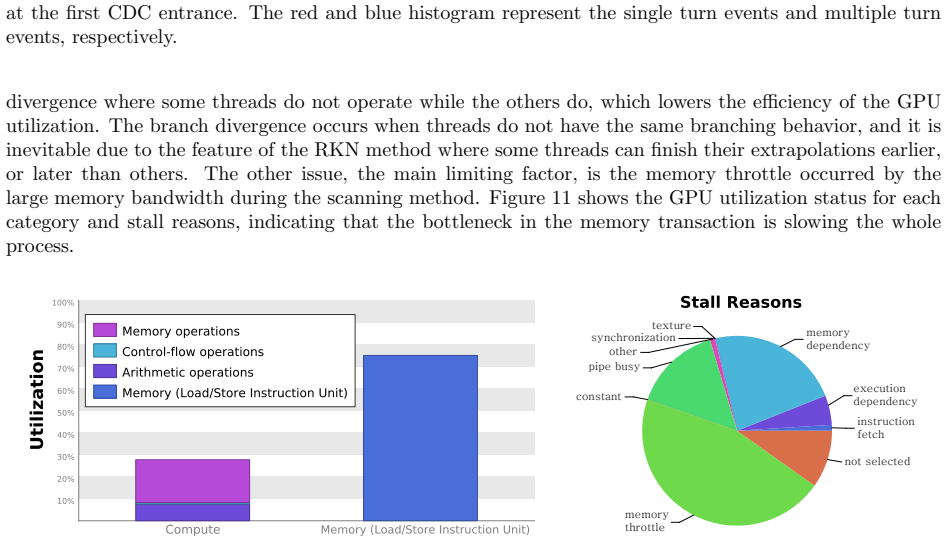
- [Section 4.1] The sentence 'the occupancy is proportional to the number of the fired wires' is imprecise; occupancy depends on block and grid dimensions and resource usage per thread, not simply on the total number of wires. Rephrase to say that occupancy increases with the number of threads per block.
- [References] Reference [5] lists the page range as 'P04001–P04001'; the duplicated page number should be corrected.
- [Section 3.1] The comparison of GPU and CPU speeds would benefit from specifying the CPU benchmark conditions (single-threaded vs multithreaded, CUDA version, and number of events averaged), since the reported speedup factors otherwise cannot be reproduced.
Circularity Check
No significant circularity found: GPU speedup is an independent benchmark and the track-quality metrics are MC closure results, not forced by construction from their inputs.
full rationale
The derivation chain is self-contained: Hough transform and CTH endpoint information prepare a 5-parameter seed grid; RKN propagation computes DCA values and a chi-square-like goodness; iterative refinement and bidirectional extrapolation classify hits; Kalman filtering produces the fitted momentum. None of these components is defined in terms of the reported output quantities. The 33x/26x GPU speedup is measured by running the same algorithm serially on CPU versus on GPU, so no fitted input is renamed as a prediction. The reported 76% efficiency, 90% purity, and 300 keV core energy resolution are evaluated on Monte Carlo events after explicit quality cuts and depend on hit classification, DCA cutoffs, and Kalman filtering, not solely on the seed range. The only overlap between tuning and evaluation is that the seed scanning range was set to cover at least 90% of the Monte Carlo truth values of CTH triggering events, while the performance numbers are quoted for CTH triggering events. This is a standard development-sample overlap and a transferability caveat, not a by-construction reduction: the seed coverage condition does not mathematically force the subsequent efficiency, purity, or resolution values. Self-citations appear only in passing, such as reference [9] for other new physics processes, and are not load-bearing for the tracking claim. The paper explicitly lists further parameter optimization and background studies as future work, which is consistent with a preliminary algorithmic study rather than a circular derivation.
Assumptions & free parameters
free parameters (5)
- Hough transform resolutions for theta0, px0, py0 =
0.01 rad; 2.5 MeV
- Seed scanning range =
Coverage of at least 90% of Monte Carlo truth values
- Seed granularity =
A few tens of thousands of seeds
- Chi-square-like cutoff lambda =
Not quoted
- Quality cuts Nc, NDF, chi2/NDF =
Nc >= 20, NDF >= 35, chi2/NDF <= 2
assumptions (5)
- domain assumption The Runge-Kutta-Nystrom propagation accurately models electron trajectories in the 1 T field including multiple scattering and energy loss.
- domain assumption Triggering tracks always end at the CTH, so the last turn partition has a constrained (z0,pz0) pattern.
- domain assumption The Hough transform and detector geometry sufficiently constrain the transverse seed parameters (theta0, px0, py0).
- domain assumption Bidirectional extrapolation adequately mitigates multiple scattering effects.
- domain assumption The Monte Carlo simulation is representative of real detector data.
Cite this review
Pith. "Pith review of GPU Tracking in the COMET Phase-I Cylindrical Drift Chamber." pith.science (2026). https://pith.science/paper/GW3HKW3T
@misc{pith2026190801949,
  author       = {Pith},
  title        = {Pith review of: GPU Tracking in the COMET Phase-I Cylindrical Drift Chamber},
  year         = {2026},
  howpublished = {\url{https://pith.science/paper/GW3HKW3T}},
  note         = {Machine review of arXiv:1908.01949}
}
abstract
The GPU-accelerated track finding method is investigated to track electrons from neutrinoless muon decay in the COMET Phase-I experiment. Inside the cylindrical drift chamber, one third of the signal electron trajectories are composed of multiple turns where the correct hit assignments to each turn partition are significant in the track finding. Scanning all possible track seeds of position and momentum can resolve the hit-to-turn assignment problem with a high robustness, but requires a huge computational cost: The initial track seeds $(\theta,z,p_x,p_y,p_z)$ have broad uncertainties, so there exists many number of seeds that should be compared. In this article, this problem of massive computations are mitigated with 1) the parallel computing of Runge-Kutta-Nystr\"om track propagation with the GPU, and 2) an initial guess on the seeds using the Hough transform and the detector geometry. The computation speed enhancement compared to the CPU is also presented.
Figures
Figures from the paper (5 more)

Reference graph
Works this paper leans on
- [1]
-
[2]
W. H. Bertl et al. [SINDRUM II Collaboration], Eur. Phys. J. C 47, 337 (2006)
work page 2006
-
[3]
A.Czarnecki, X. Garcia i Tormo, and W. J. Marciano, Phys. Rev. D 84, 013006 (2011)
work page 2011
-
[4]
J. Nickolls, I. Buck, M. Garland, and K. Skadron, ACM Queue 6, 40–53 (2008)
work page 2008
-
[5]
E. Lund, L. Bugge, I. Gavrilenko and A. Strandli, JINST 4, P04001–P04001 (2009)
work page 2009
- [6]
-
[7]
E. Lindholm, J. Nickolls, S. Oberman, and J. Montrym, IEEE Micro 28, 39–55 (2008)
work page 2008
-
[8]
NVIDIA Visual Profiler, https://developer.nvidia.com/nvidia-visual-profiler
Show all 9 references
-
[9]
B. Yeo, Y. Kuno, M. Lee, K. Zuber, Phys. Rev. D 96, 075027 (2017). 7
2017
Reviewed August 14, 2026 · model on record in the stance chip above.
Discussion (0). Continue with ORCID to comment.