REVIEW 4 major objections 5 minor 39 references
Generalized Multiscale Finite Element Method for the poroelasticity problem in multicontinuum media
T0 review · 4 major / 5 minor · reviewed 2026-08-14 · deepseek-v4-flash
Pith's one-line read The paper claims a coarse-grid multiscale method reproduces coupled poroelastic flow in fractured multicontinuum media to within a few percent error using few basis functions per node.
desk verdict Solid incremental GMsFEM extension, but the accuracy claims are only tested for a reduced two-continuum model, not the advertised multicontinuum model. read the letter →
The pith
A machine-rendered reading of the paper's core claim, the machinery that carries it, and where it could break.
The reading
What carries the argument
The central object is the projection matrix $R$ built from multiscale basis functions, which is block diagonal with separate blocks for pressures and displacement: $R = \begin{pmatrix} R_p & 0 \\ 0 & R_u \end{pmatrix}$. The pressure basis functions come from local spectral problems on a snapshot space formed by solving multicontinuum flow equations with delta-function boundary conditions in each coarse neighborhood, and the displacement basis functions come from a similar local spectral problem for linear elasticity. The paper's specific simplifying step removes the fracture continuum by setting $\alpha_f = 0$, $\sigma_{2f} = 0$, and $p_1 = p_f$, leaving a dual-continuum problem for pressures $p_1, p_2$ and displacement $u$, with the fracture pressure absorbed into the first continuum.
What would settle it
Run the same two-dimensional test but keep the fracture continuum in the model with $\alpha_f > 0$ and $p_1 \neq p_f$, then compare the GMsFEM errors forced to 8 basis functions per node; if the displacement L2 error exceeds the reported 4.4 percent by a large margin, the simplification is load-bearing. Alternatively, build local poroelastic basis functions that couple pressure and displacement and compare against the separate construction on the same test problems.
Extended reading notes
Core claim
The central claim is that the coupled poroelasticity system in multicontinuum fractured media can be reduced to a small coarse-grid system by solving local spectral problems separately for displacements and pressures, and that this reduced system reproduces fine-grid pressures within about 0.08 to 4.05 percent and displacement within roughly 2.4 to 11.8 percent relative L2 error on the tested heterogeneous two- and three-dimensional models. The authors identify that pressure basis functions should be constructed from a coupled multicontinuum eigenvalue problem, and that the number of pressure basis functions strongly affects displacement accuracy; increasing the pressure basis count from 2 to 8 cuts displacement error from about 40 percent to 4.4 percent in the two-dimensional case. They emphasize that the coarse model has far fewer unknowns than the fine model while keeping good accuracy for the tested problems.
Load-bearing premise
The accuracy result depends on the premise that separately constructed pressure and displacement multiscale bases, after removing the fracture continuum with $\alpha_f = 0$, $\sigma_{2f} = 0$, and $p_1 = p_f$, can still resolve the coupled poroelastic response; if that simplification loses a key coupling mode, the reported displacement errors would grow.
Editorial extensions
If this is right
- If the central claim is correct, coarse-grid poroelastic simulations of fractured reservoirs can be run with only thousands of unknowns instead of tens or hundreds of thousands, with pressure errors of a few percent.
- The number of pressure basis functions is the main accuracy lever, since displacement error drops sharply as the pressure basis count increases, suggesting a practical error-control strategy of enriching the pressure basis first.
- The offline-online splitting means the expensive construction of multiscale basis functions is done once per fracture geometry and heterogeneity, after which many time steps become cheap.
- The method is formulated for a general number of continua, so the same workflow extends beyond dual-continuum models to triple-continuum or denser multicontinuum descriptions without changing the coarse-grid structure.
- The reported error reductions when going from 8 to 16 basis functions suggest that further enrichment should continue to improve accuracy, at least on problems similar to those tested.
Reading between the lines
- The persistent displacement errors, 2.4 to 11.8 percent, suggest that the separate construction of pressure and displacement bases is the main accuracy bottleneck; building coupled poroelastic local basis functions would likely improve displacement capture, at a higher offline cost.
- The simplification $p_1 = p_f$ means the method has been validated for cases where fracture pressure matches the matrix pressure; testing with strongly conductive fractures where $p_f$ clearly differs from $p_1$ would stress the model and show whether the simplification is safe.
- A natural extension would be to use the eigenvalues of the local spectral problems to select the number of basis functions per coarse node adaptively, rather than using the same count everywhere, which could reduce the coarse system further on easy regions.
Signed reviews
Editorial analysis
A structured set of objections, weighed in public.
Referee Report
Summary. The manuscript develops a Generalized Multiscale Finite Element Method (GMsFEM) for a coupled poroelasticity problem in fractured multicontinuum media. It formulates a fine-grid FEM/DFM discretization, constructs multiscale basis functions for pressures and displacement from local snapshot and spectral problems, and then reports relative L2 errors between the coarse and fine solutions for two- and three-dimensional heterogeneous fractured test problems. The central claim is that the proposed coarse model achieves good accuracy with few degrees of freedom, with error tables showing monotone improvement as the number of multiscale basis functions is increased.
Significance. If the numerical evidence supports the claim, the paper provides a useful reduction framework for coupled flow-and-geomechanics simulations in fractured reservoirs. The method contains no fitted parameters, the construction is a natural extension of established GMsFEM ideas, and the numerical implementation is based on the open-source FEniCS library, which aids reproducibility. The main value of the contribution depends on whether the reported tests actually exercise the announced multicontinuum model and whether the fine-grid reference solution is trustworthy.
major comments (4)
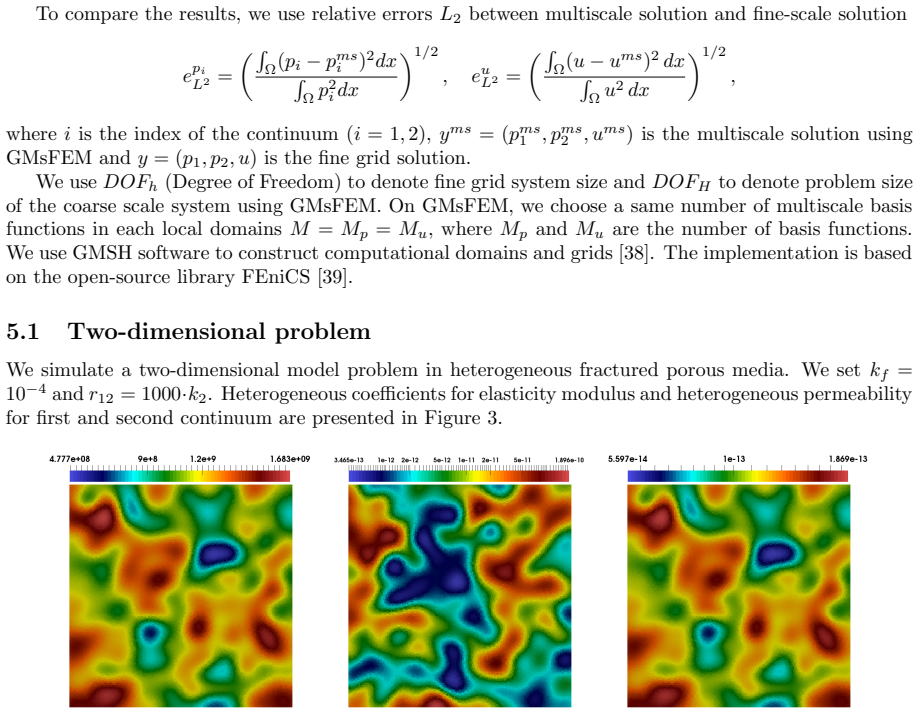
- [Section 3, after Eq. (8)] The numerical validation does not exercise the multicontinuum model announced in the title and abstract. The fine-grid system is reduced by setting alpha_f=0, sigma_2f=0, and p1^h=p_f^h, then eliminating p_f^h, so Tables 1-3 compare GMsFEM against a two-continuum (p1,p2,u) problem rather than the full triple-continuum system. No experiment uses an independent fracture pressure, nonzero alpha_f, or nonzero q2f. Consequently, the abstract/conclusion claim of accuracy for multicontinuum fractured media goes beyond the evidence. Please add at least one numerical test with the full triple-continuum system, or explicitly restrict the claims to the reduced dual-continuum model.
- [Section 5, Tables 1-3] The fine-grid reference solution is never validated. All reported errors are differences with respect to one discrete solution on a single mesh (DOFh=57504 in 2D and 108045 in 3D), so the tables do not demonstrate convergence to the PDE solution. A manufactured-solution test or a mesh-refinement study for the fine-grid discretization is needed before the numbers can support the stated accuracy claim.
- [Section 4, 'Coarse grid system'] The stated size of the coarse system, NH=(Mp+Mu)·N_H^v, is inconsistent with the tables. For the reduced model with d=2, the table values require NH=2(Mp+Mu)N_H^v, and for d=3, NH=(2Mp+3Mu)N_H^v; for example, Table 1 reports DOFH=484 for the 10×10 coarse grid and M=1, while the stated formula gives 242. Please correct the formula and explicitly define the componentwise multiplicity of the pressure and displacement basis functions.
- [Tables 2-3] Displacement is the limiting accuracy component. With Mu=1, displacement L2 errors remain at 38-51% in 2D and 76-92% in 3D even as Mp increases to 16, while pressure errors drop below around 2% in several cases; acceptable displacement accuracy requires Mu>=8. Since the conclusion emphasizes 'few degrees of freedoms,' the paper should quantify the basis choice needed for a target displacement accuracy and discuss why displacement convergence is much slower than pressure convergence.
minor comments (5)
- [Section 3] The symbol sigma_2f is not defined in the text; from the context it should presumably be q2f=0, the mass-transfer coefficient between the second continuum and the fracture continuum.
- [Section 4] The sentence 'We define snapshot space for pressures in multicontinuum media' is immediately followed by a definition of Vsnap for displacements; the labels Wsnap and Vsnap should be used consistently to avoid confusion.
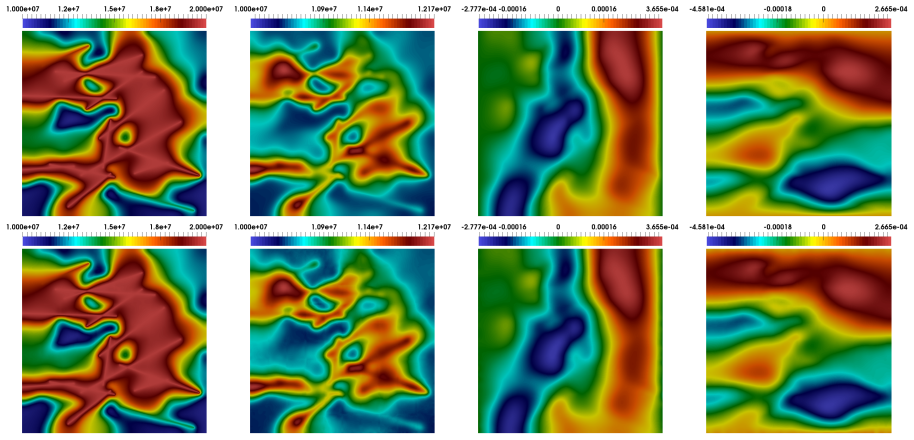
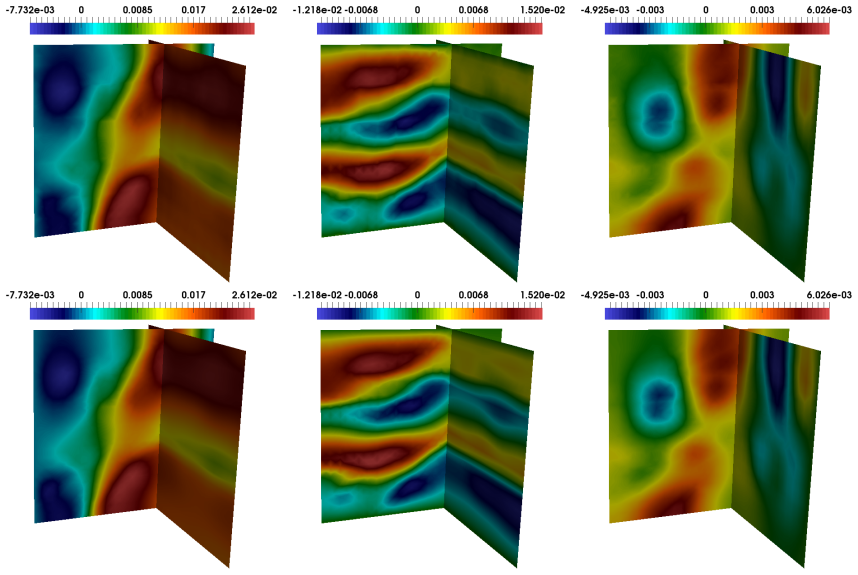
- [Figures 4, 6, and 7] The captions do not clearly identify all rows and columns; for example, 'displacement along X andY pressure' should be rephrased and each panel labeled with the plotted quantity and units.
- [Section 5] The time step is fixed (tau=10 in 2D and tau=300 in 3D), but no time-step refinement study is reported; the paper should at least state that the reported errors are for a fixed time discretization and acknowledge that temporal error is included in the comparison.
- [Abstract and Eq. (3)] The abstract describes 'volume force sources that are proportional to the sum of the pressure gradients,' but the mechanical equation is -div sigma(u)+sum alpha_i grad p_i=0 with no explicit body force; the wording could be clarified to avoid implying an additional source term.
Circularity Check
No significant circularity: the GMsFEM coarse model is a projection-based reduction benchmarked against an independent fine-grid discretization.
full rationale
The paper's central numerical claim is that GMsFEM coarse models with 8–16 basis functions approximate the fine-grid poroelasticity solution within the reported L2 errors. The multiscale basis functions are constructed from local snapshot problems (Eqs. 9 and 12) and local spectral problems (Eqs. 11 and 14) that depend only on the fine-scale operators, coarse geometry, and heterogeneity, not on the target fine-scale solution or on any fitted parameter. The coarse system is the Galerkin projection R A R^T of the fine-grid system, and errors are measured against a separately assembled fine-grid FEM/DFM solution. This is a benchmark of a reduction method against an independent discretization, not a prediction forced by construction. Self-citations to prior GMsFEM work (e.g., [21], [22], [30], [31]) supply the general algorithmic framework, but the present derivation and numerical tests are self-contained: the implementation uses FEniCS, and the fine-grid reference solution is independently discretized. The Section 3 simplification alpha_f = 0, sigma_2f = 0, and p1^h = p_f^h restricts the numerical experiments to a dual-continuum reduction of the announced triple-continuum model; that is a scope or correctness limitation, not circularity, because it does not make the coarse-scale solution an input to the fine-grid benchmark.
Assumptions & free parameters
free parameters (1)
- M = Mp = Mu (number of multiscale basis functions per local domain) =
1, 2, 4, 8, 12, 16
assumptions (5)
- domain assumption Linear Biot poroelasticity with two matrix continua plus a discrete fracture network is an adequate model for fractured reservoirs and geothermal fields (Eqs. 1-3).
- ad hoc to paper Fracture pressure can be eliminated by setting alpha_f=0, sigma_2f=0, and p1=pf (Section 3, 'for simplification of the matrix construction').
- domain assumption The smallest eigenvectors of the local spectral problems A phi = lambda S phi on each coarse neighborhood span the important multiscale modes (Eqs. 11 and 14).
- standard math Linear partition-of-unity functions multiplied by local eigenvectors produce globally conforming basis functions (Section 4).
- domain assumption The fine-grid FEM solution is an accurate reference for error comparisons (Section 5).
Cite this review
Pith. "Pith review of Generalized Multiscale Finite Element Method for the poroelasticity problem in multicontinuum media." pith.science (2026). https://pith.science/paper/7ZEM6HR3
@misc{pith2026190801965,
  author       = {Pith},
  title        = {Pith review of: Generalized Multiscale Finite Element Method for the poroelasticity problem in multicontinuum media},
  year         = {2026},
  howpublished = {\url{https://pith.science/paper/7ZEM6HR3}},
  note         = {Machine review of arXiv:1908.01965}
}
read the original abstract
In this paper, we consider a poroelasticity problem in heterogeneous multicontinuum media that is widely used in simulations of the unconventional hydrocarbon reservoirs and geothermal fields. Mathematical model contains a coupled system of equations for pressures in each continuum and effective equation for displacement with volume force sources that are proportional to the sum of the pressure gradients for each continuum. To illustrate the idea of our approach, we consider a dual continuum background model with discrete fracture networks that can be generalized to a multicontinuum model for poroelasticity problem in complex heterogeneous media. We present a fine grid approximation based on the finite element method and Discrete Fracture Model (DFM) approach for two and three-dimensional formulations. The coarse grid approximation is constructed using the Generalized Multiscale Finite Element Method (GMsFEM), where we solve local spectral problems for construction of the multiscale basis functions for displacement and pressures in multicontinuum media. We present numerical results for the two and three dimensional model problems in heterogeneous fractured porous media. We investigate relative errors between reference fine grid solution and presented coarse grid approximation using GMsFEM with different numbers of multiscale basis functions. Our results indicate that the proposed method is able to give accurate solutions with few degrees of freedoms.
Figures


Figures from the paper (4 more)


Reference graph
Works this paper leans on
-
[1]
Yu-Shu Wu, Yuan Di, Zhijiang Kang, and Perapon Fakcharoenphol. A multiple-continuum model for simulating single-phase and multiphase flow in naturally fractured vuggy reservoirs. Journal of Petroleum Science and Engineering , 78(1):13–22, 2011
work page 2011
-
[2]
Qiuqi Li, Yuhe Wang, and Maria Vasilyeva. Multiscale model reduction for fluid infiltration simula- tion through dual-continuum porous media with localized uncertainties. Journal of Computational and Applied Mathematics , 336:127–146, 2018
work page 2018
-
[3]
I Yucel Akkutlu, Yalchin Efendiev, Maria Vasilyeva, and Yuhe Wang. Multiscale model reduction for shale gas transport in a coupled discrete fracture and dual-continuum porous media. Journal of Natural Gas Science and Engineering , 48:65–76, 2017
work page 2017
-
[4]
Multiscale gas transport in shales with local kerogen hetero- geneities
I Yucel Akkutlu, Ebrahim Fathi, et al. Multiscale gas transport in shales with local kerogen hetero- geneities. SPE journal, 17(04):1–002, 2012. 13 Mu DOFu H p1 p2 u ep1 L2 (%) ep2 L2 (%) eu L2 (%) Mp = 1 1 1080 25.713 29.035 92.385 Mp = 2 1 1512 20.461 22.644 130.73 2 2106 20.496 22.648 82.179 Mp = 4 1 2376 6.453 6.991 86.899 2 3024 6.557 7.114 59.549 4 ...
work page 2012
-
[5]
A triple-continuum pressure-transient model for a naturally fractured vuggy reservoir
Yu-Shu Wu, Christine Ehlig-Economides, Guan Qin, Zhijang Kang, Wangming Zhang, Babatunde Ajayi, and Qingfeng Tao. A triple-continuum pressure-transient model for a naturally fractured vuggy reservoir. 2007
work page 2007
-
[6]
Basic concepts in the theory of seepage of homogeneous liquids in fissured rocks [strata]
GI Barenblatt, Iu P Zheltov, and IN Kochina. Basic concepts in the theory of seepage of homogeneous liquids in fissured rocks [strata]. Journal of applied mathematics and mechanics , 24(5):1286–1303, 1960
work page 1960
-
[7]
The behavior of naturally fractured reservoirs
JE Warren, P Jj Root, et al. The behavior of naturally fractured reservoirs. Society of Petroleum Engineers Journal, 3(03):245–255, 1963
1963
-
[8]
Derivation of the double porosity model of single phase flow via homogenization theory
Todd Arbogast, Jim Douglas, Jr, and Ulrich Hornung. Derivation of the double porosity model of single phase flow via homogenization theory. SIAM Journal on Mathematical Analysis , 21(4):823– 836, 1990
work page 1990
Show all 39 references
-
[9]
Splitting schemes for poroelastic- ity and thermoelasticity problems
Alexandr E Kolesov, Petr N Vabishchevich, and Maria V Vasilyeva. Splitting schemes for poroelastic- ity and thermoelasticity problems. Computers & Mathematics with Applications , 67(12):2185–2198, 2014
2014
-
[10]
Sequential methods for coupled geomechanics and multiphase flow, 2010
Jihoon Kim. Sequential methods for coupled geomechanics and multiphase flow, 2010. 14
2010
-
[11]
Modeling fractures and barriers as interfaces for flow in porous media
Vincent Martin, J´ erˆ ome Jaffr´ e, and Jean E Roberts. Modeling fractures and barriers as interfaces for flow in porous media. SIAM Journal on Scientific Computing , 26(5):1667–1691, 2005
2005
-
[12]
A reduced model for darcy’s prob- lem in networks of fractures
Luca Formaggia, Alessio Fumagalli, Anna Scotti, and Paolo Ruffo. A reduced model for darcy’s prob- lem in networks of fractures. ESAIM: Mathematical Modelling and Numerical Analysis , 48(4):1089– 1116, 2014
2014
-
[13]
A mixed finite element method for darcy flow in fractured porous media with non-matching grids
Carlo D’Angelo and Anna Scotti. A mixed finite element method for darcy flow in fractured porous media with non-matching grids. ESAIM: Mathematical Modelling and Numerical Analysis , 46(2):465–489, 2012
2012
-
[14]
On the coupling of 1d and 3d diffusion-reaction equations: application to tissue perfusion problems
Carlo D’angelo and Alfio Quarteroni. On the coupling of 1d and 3d diffusion-reaction equations: application to tissue perfusion problems. Mathematical Models and Methods in Applied Sciences , 18(08):1481–1504, 2008
2008
-
[15]
Hierarchical modeling of flow in naturally fractured formations with multiple length scales
Seong H Lee, MF Lough, and CL Jensen. Hierarchical modeling of flow in naturally fractured formations with multiple length scales. Water resources research, 37(3):443–455, 2001
2001
-
[16]
Efficient field-scale simulation for black oil in a naturally fractured reservoir via discrete fracture networks and homogenized media
Liyong Li, Seong Hee Lee, et al. Efficient field-scale simulation for black oil in a naturally fractured reservoir via discrete fracture networks and homogenized media. InInternational oil & gas conference and exhibition in China . Society of Petroleum Engineers, 2006
2006
-
[17]
Multiscale model reduction for shale gas transport in poroelastic fractured media
I Yucel Akkutlu, Yalchin Efendiev, Maria Vasilyeva, and Yuhe Wang. Multiscale model reduction for shale gas transport in poroelastic fractured media. Journal of Computational Physics , 353:356–376, 2018
2018
-
[18]
Efficient field-scale simulation of black oil in a naturally fractured reservoir through discrete fracture networks and homogenized media
Liyong Li, Seong H Lee, et al. Efficient field-scale simulation of black oil in a naturally fractured reservoir through discrete fracture networks and homogenized media. SPE Reservoir Evaluation & Engineering, 11(04):750–758, 2008
2008
-
[19]
An efficient discrete fracture model applicable for general purpose reservoir simulators
Mohammad Karimi-Fard, Luis J Durlofsky, Khalid Aziz, et al. An efficient discrete fracture model applicable for general purpose reservoir simulators. InSPE Reservoir Simulation Symposium. Society of Petroleum Engineers, 2003
2003
-
[20]
Algebraic multiscale solver for flow in heterogeneous fractured porous media
Matei Tene, MS Al Kobaisi, H Hajibeygi, et al. Algebraic multiscale solver for flow in heterogeneous fractured porous media. In SPE Reservoir Simulation Symposium . Society of Petroleum Engineers, 2015
2015
-
[21]
Efendiev, J
Y. Efendiev, J. Galvis, and T. Hou. Generalized multiscale finite element methods. Journal of Computational Physics, 251:116–135, 2013
2013
-
[22]
Adaptive multiscale model reduction with generalized multiscale finite element methods
Eric Chung, Yalchin Efendiev, and Thomas Y Hou. Adaptive multiscale model reduction with generalized multiscale finite element methods. Journal of Computational Physics , 320:69–95, 2016
2016
-
[23]
Efendiev and T
Y. Efendiev and T. Hou. Multiscale Finite Element Methods: Theory and Applications. 4, 2009
2009
-
[24]
Adaptive multiscale finite-volume method for multiphase flow and transport in porous media
Patrick Jenny, Seong H Lee, and Hamdi A Tchelepi. Adaptive multiscale finite-volume method for multiphase flow and transport in porous media. Multiscale Modeling & Simulation, 3(1):50–64, 2005
2005
-
[25]
Multiscale finite-volume method for compressible multiphase flow in porous media
Ivan Lunati and Patrick Jenny. Multiscale finite-volume method for compressible multiphase flow in porous media. Journal of Computational Physics , 216(2):616–636, 2006
2006
-
[26]
Iterative multiscale finite- volume method
Hadi Hajibeygi, Giuseppe Bonfigli, Marc Andre Hesse, and Patrick Jenny. Iterative multiscale finite- volume method. Journal of Computational Physics , 227(19):8604–8621, 2008
2008
-
[27]
Hajibeygi, D
H. Hajibeygi, D. Kavounis, and P. Jenny. A hierarchical fracture model for the iterative multiscale finite volume method. Journal of Computational Physics , 230(24):8729–8743, 2011. 15
2011
-
[28]
Algebraic multiscale method for flow in heterogeneous porous media with embedded discrete fractures (f-ams)
Matei T ¸ ene, Mohammed Saad Al Kobaisi, and Hadi Hajibeygi. Algebraic multiscale method for flow in heterogeneous porous media with embedded discrete fractures (f-ams). Journal of Computational Physics, 321:819–845, 2016
2016
-
[29]
Multiscale two-stage solver for biot’s poroelasticity equations in subsurface media
Nicola Castelletto, Sergey Klevtsov, Hadi Hajibeygi, and Hamdi A Tchelepi. Multiscale two-stage solver for biot’s poroelasticity equations in subsurface media. Computational Geosciences, pages 1–18, 2018
2018
-
[30]
Hierarchical multiscale modeling for flows in fractured media using generalized multiscale finite element method
Yalchin Efendiev, Seong Lee, Guanglian Li, Jun Yao, and Na Zhang. Hierarchical multiscale modeling for flows in fractured media using generalized multiscale finite element method. GEM-International Journal on Geomathematics , 6(2):141–162, 2015
2015
-
[31]
Multiscale model reduction for shale gas trans- port in fractured media
IY Akkutlu, Yalchin Efendiev, and Maria Vasilyeva. Multiscale model reduction for shale gas trans- port in fractured media. Computational Geosciences, pages 1–21, 2015
2015
-
[32]
A generalized multiscale finite element method for poroelas- ticity problems i: linear problems
Donald L Brown and Maria Vasilyeva. A generalized multiscale finite element method for poroelas- ticity problems i: linear problems. Journal of Computational and Applied Mathematics, 294:372–388, 2016
2016
-
[33]
A generalized multiscale finite element method for poroelas- ticity problems ii: Nonlinear coupling
Donald L Brown and Maria Vasilyeva. A generalized multiscale finite element method for poroelas- ticity problems ii: Nonlinear coupling. Journal of Computational and Applied Mathematics, 297:132– 146, 2016
2016
-
[34]
Non-local multi-continua upscaling for flows in heterogeneous fractured media
Eric T Chung, Yalchin Efendiev, Wing Tat Leung, Maria Vasilyeva, and Yating Wang. Non-local multi-continua upscaling for flows in heterogeneous fractured media. Journal of Computational Physics, 372:22–34, 2018
2018
-
[35]
Constraint energy minimizing general- ized multiscale finite element method
Eric T Chung, Yalchin Efendiev, and Wing Tat Leung. Constraint energy minimizing general- ized multiscale finite element method. Computer Methods in Applied Mechanics and Engineering , 339:298–319, 2018
2018
-
[36]
Constrained energy minimization based upscaling for coupled flow and mechanics
Maria Vasilyeva, Eric T Chung, Yalchin Efendiev, and Jihoon Kim. Constrained energy minimization based upscaling for coupled flow and mechanics. Journal of Computational Physics , 376:660–674, 2019
2019
-
[37]
Nonlocal multicontinua upscaling for multicontinua flow problems in fractured porous media
Maria Vasilyeva, Eric T Chung, Siu Wun Cheung, Yating Wang, and Georgy Prokopev. Nonlocal multicontinua upscaling for multicontinua flow problems in fractured porous media. Journal of Computational and Applied Mathematics , 355:258–267, 2019
2019
-
[38]
Gmsh: A 3-d finite element mesh generator with built-in pre-and post-processing facilities
Christophe Geuzaine and Jean-Fran¸ cois Remacle. Gmsh: A 3-d finite element mesh generator with built-in pre-and post-processing facilities. International journal for numerical methods in engineer- ing, 79(11):1309–1331, 2009
2009
-
[39]
Automated solution of differential equations by the finite element method: The FEniCS book , volume 84
Anders Logg, Kent-Andre Mardal, and Garth Wells. Automated solution of differential equations by the finite element method: The FEniCS book , volume 84. Springer Science & Business Media, 2012. 16
2012
Reviewed August 14, 2026 · model on record in the stance chip above.
Discussion (0). Continue with ORCID to comment.