REVIEW 2 major objections 3 minor 33 references
Isometric deformations of mixed type surfaces in Lorentz-Minkowski space
T0 review · 2 major / 3 minor · reviewed 2026-08-14 · deepseek-v4-flash
Pith's one-line read Generic mixed type surfaces flex at lightlike points
desk verdict Strong new ideas, but the main existence theorem has an internal sign inconsistency in the PDE system that needs fixing before the result is reliable. read the letter →
The pith
A machine-rendered reading of the paper's core claim, the machinery that carries it, and where it could break.
The reading
What carries the argument
The central object is the L-Gauss map, a lightlike transversal vector field defined along a mixed type surface at non-degenerate lightlike points, together with the L-coordinate systems in which the metric takes the form $ds^2 = E du^2 + G dv^2$ with $E>0$ and $G=0$ on the lightlike set. The adapted frame $(f_u, f_v, \psi)$ satisfies a first-order system whose compatibility condition is exactly the Gauss and Codazzi equations; this yields a fundamental theorem for mixed type surfaces. The proof of the main theorem uses this fundamental theorem to convert the prescribed curve data into initial values, and then applies the Cauchy-Kowalevski theorem to the PDE system (6.1), producing the required isometric surfaces with the prescribed lightlike set image.
What would settle it
Take a real analytic generic mixed type surface and compute the set of real analytic local isometric surfaces sharing its first fundamental form whose lightlike set images lie on a fixed real analytic spacelike curve of non-zero curvature; if the number is not four in the Frenet case or two in the non-Frenet case, the counting claim of Theorem A fails. Alternatively, exhibit a real analytic generic mixed type surface at whose lightlike point every local isometric deformation is congruent to the original surface, contradicting Corollary B.
Extended reading notes
Core claim
On its own terms, the paper's discovery is Theorem A: given any real analytic generic mixed type surface with first fundamental form $ds^2$, a lightlike point $p$, and a real analytic spacelike curve $\gamma$ with non-zero curvature through the origin, there are exactly four (when $\gamma$ is a Frenet curve) or two (when $\gamma$ is a non-Frenet curve) real analytic mixed type surfaces whose first fundamental form is $ds^2$, which send $p$ to the origin, and whose lightlike set images lie on $\gamma$. No further such surfaces exist. The direct corollary is that every real analytic generic mixed type surface admits non-trivial local isometric deformations, and consequently the lightlike normal curvature $\kappa_N$, and also the lightlike geodesic torsion $\kappa_G$, are extrinsic invariants at generic lightlike points of the first kind.
Load-bearing premise
The construction requires the metric and the prescribed curve to be real analytic, because existence of the deformations is obtained from the Cauchy-Kowalevski theorem; for merely smooth generic mixed type surfaces the existence of non-trivial isometric deformations is not established, and the result is local.
Editorial extensions
If this is right
- Every real analytic generic mixed type surface is locally bendable at each lightlike point: its first fundamental form does not determine the surface where the metric becomes degenerate.
- The lightlike normal curvature $\kappa_N$ is extrinsic for generic lightlike points of the first kind, so it cannot be read off from the induced metric alone.
- Given any real analytic spacelike curve with non-zero curvature, a real analytic generic mixed type metric has exactly four (Frenet) or two (non-Frenet) local mixed type realizations whose lightlike set images follow that curve.
- At type II lightlike points, genericity is characterized by an unbounded geodesic curvature function or equivalently a non-zero limiting geodesic curvature, and the same deformation conclusion holds there.
- The local isometric realization theorem for real analytic generic mixed type metrics is a Lorentzian analogue of the classical isometric embedding theorem for Riemannian metrics.
Reading between the lines
- Editorial inference: The four-vs-two count for Frenet versus non-Frenet curves suggests that the non-Frenet case is genuinely new: the Lorentzian geometry of the lightlike set image loses the sign freedom that produces the four surfaces in the Frenet case.
- Editorial inference: Since the proof is local and depends on real analyticity through the Cauchy-Kowalevski theorem, a smooth non-analytic generic mixed type surface could behave differently; testing the construction on non-analytic data would show whether real analyticity is essential or merely a proof technique.
- Editorial inference: The deformation used to prove extrinsicity of $\kappa_N$ shifts the causal curvature function while keeping the first fundamental form fixed; this suggests families of isometric surfaces can be parameterized by the causal curvature of the lightlike set image, which may give a way to construct explicit examples beyond the unit-circle one in the paper.
Signed reviews
Editorial analysis
A structured set of objections, weighed in public.
Referee Report
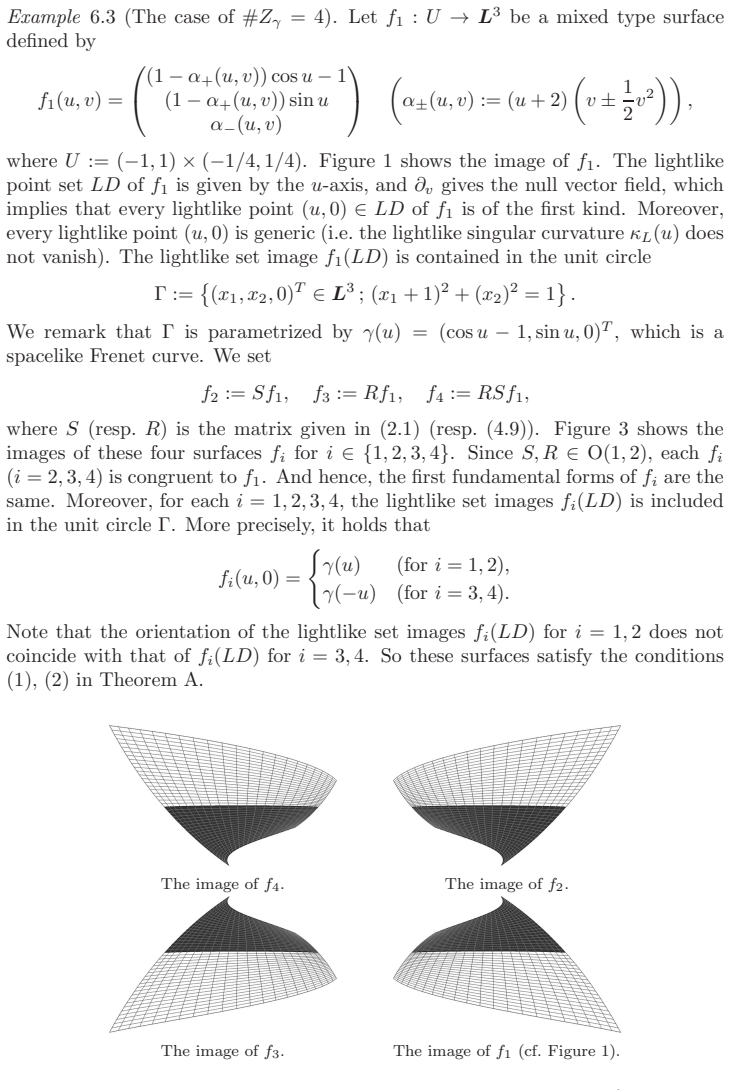
Summary. The paper studies mixed type surfaces in Lorentz-Minkowski 3-space, i.e. surfaces whose spacelike, timelike and lightlike point sets are all non-empty. The author introduces an L-Gauss map defined in adapted L-coordinates, derives the Gauss and Codazzi equations for the frame (fu, fv, ψ) in Lemma 4.6, and states a fundamental theorem of surface theory for mixed type surfaces at non-degenerate lightlike points (Theorem 4.7). Using this, the paper computes curve invariants of the images f∘c of characteristic or transverse curves (Propositions 5.5 and 5.7) and proves an isometric realization theorem for real analytic generic mixed type metrics via the Cauchy-Kowalevski theorem (Theorem 6.1). From this it derives Theorem A, asserting that for a prescribed real analytic spacelike curve γ there are exactly four (Frenet case) or two (non-Frenet case) local real analytic mixed type surfaces with a given first fundamental form whose lightlike set image lies in γ, together with Corollaries B and C on nontrivial isometric deformations and the extrinsicity of the lightlike normal curvature κN and the lightlike geodesic torsion κG.
Significance. If the construction is correct, the paper gives a substantial and natural result: every real analytic generic mixed type surface admits nontrivial local isometric deformations at lightlike points, and the invariants κN and κG are extrinsic. The use of a null transversal field (the L-Gauss map) instead of the usual unit normal is well motivated, and the explicit examples in Examples 6.3 and 6.4 illustrate the four-versus-two dichotomy in a helpful way. The paper is also careful about the distinction between intrinsic and extrinsic invariants and connects the problem to known cuspidal-edge results. However, the central existence proof in Theorem 6.1 contains sign errors in the PDE system, and the load-bearing compatibility calculation in Lemma 4.6 is stated without proof. The significance of the results is therefore conditional on these issues being repaired.
major comments (2)
- [Section 6.1, Eqs. (6.1)-(6.2)] There is a sign inconsistency in the Cauchy-Kowalevski system. Solving the Gauss equation (G) for Z gives Z = [E_vv + G_uu - (E_u G_u + E_v^2)/(2E) - G_v X + 2 G_u Y + 2 G Y^2] / (2 G X + E_v). The printed formula (6.2) has denominator 2 G X - E_v and reversed signs in the terms -G_v X + 2 G_u Y, so setting Z = Δ as defined in (6.2) does not solve (G). Independently, substituting Z = Δ into (C1) yields X_v = Y_u + (E_v X - E_u Y)/(2E) + Y^2 - X Δ, whereas the first equation of (6.1) is X_v = Y_u + (E_v X + E_u Y)/(2E) + X Δ - Y^2. These two equations are not equivalent: the E_u term, the Δ term, and the Y^2 term all have the wrong sign in (6.1). Consequently the solution of (6.1) with Z = Δ is not a solution of the compatibility system (C1), (C2), (G), and the proof of Theorem 6.1 is not valid as written. Since Theorem A and Corollaries B and C depend entirely on Theorem 6.1, the central existence and uniqueness claims are unverified in the present text. The issue appears repairable by correcting the signs in (6.1) and (6.2), but the corrected system must be written explicitly and the Cauchy-Kowalevski argument re-checked.
- [Section 4.1, Lemma 4.6] Lemma 4.6 is the sole source of the compatibility equations used in the fundamental theorem and in the proof of Theorem 6.1, but its proof is omitted with the sentence 'As Lemma 4.6 is proved by direct calculation, and we omit the proof.' Since the application in Theorem 6.1 contains sign errors in exactly the equations that Lemma 4.6 is supposed to justify, this omission is load-bearing rather than merely cosmetic. The manuscript should include the full derivation of (C1), (C2) and (G), or at least a detailed appendix verification, so that the reader can check the signs in (6.1) and (6.2) against the compatibility system.
minor comments (3)
- [Section 6.1, proof of Theorem 6.1] In the definition of the adapted frame after the application of Corollary 4.8, the text reads Fi := ((fi)u, (fi)u, ψi); the second entry should be (fi)v.
- [Section 6.2, proof of Corollary C] The proof sets θs(u) := θ(u) + s with an arbitrary non-zero constant s. To guarantee that γs has non-zero curvature, s should be chosen so that θ + s does not vanish on the relevant interval; this is a minor but necessary qualification.
- [Section 2.2, Eq. (2.13)] The notation E 3√Gv is ambiguous; it should be written as E ∛Gv, i.e. E times the cube root of Gv.
Circularity Check
No significant circularity: the isometric deformation construction is a genuine PDE existence argument from metric and prescribed curve data.
full rationale
The central claim (Theorem A / Theorem 6.1) is not derived from the conclusion it purports to prove. The proof fixes an admissible mixed type metric g and a real analytic spacelike curve gamma, extracts the initial functions x(u), y(u) from gamma's curvature/torsion (or pseudo-torsion) invariants via Propositions 5.5 and 5.7, then solves the PDE system (6.1) by the Cauchy-Kowalevski theorem. The resulting functions X, Y and Z := Delta are used to define a second fundamental form h, and Corollary 4.8 produces a surface f whose first fundamental form is exactly the input g and whose lightlike image has the prescribed invariants; the fundamental theorems for spacelike curves then identify that image with gamma. No fitted parameter is renamed as a prediction: the unprescribed quantities X, Y, Z are constructed from the input data by solving differential equations, not by fitting to the target surface. The invariants kappa_L and kappa_N are introduced by citing the author's prior work [14], but the paper proves the intrinsic formula for kappa_L in Lemma 2.5, and the extrinsicity of kappa_N (Corollary C) is shown by constructing a genuinely different curve gamma_s with changed causal curvature and then applying Theorem A; it does not assume the extrinsicity. The cited spacelike-curve uniqueness theorems, including the author's [8] for type L_k curves, are independent curve-geometry statements about prescribed curvature and torsion data and do not contain the mixed-type-surface conclusion. The skeptical note about possible sign inconsistencies in equations (6.1)-(6.2) and the resulting gap in the proof of Theorem 6.1 is a correctness concern, not a circularity concern; a flawed derivation is not the same as a derivation whose output is identical to its input by construction. Accordingly, no circular step can be identified from the paper's equations, and the score is 0.
Assumptions & free parameters
assumptions (4)
- standard math Cauchy-Kowalevski theorem for real analytic PDE systems
- domain assumption Division lemma for smooth functions (Umehara-Yamada [30])
- standard math Fundamental theorems for spacelike curves in L3 (Frenet, type L, type Lk)
- domain assumption Genericity of lightlike points (kappa_L not equal to 0 for type I; unbounded geodesic curvature for type II)
Cite this review
Pith. "Pith review of Isometric deformations of mixed type surfaces in Lorentz-Minkowski space." pith.science (2026). https://pith.science/paper/BOIZIZSX
@misc{pith2026190801967,
  author       = {Pith},
  title        = {Pith review of: Isometric deformations of mixed type surfaces in Lorentz-Minkowski space},
  year         = {2026},
  howpublished = {\url{https://pith.science/paper/BOIZIZSX}},
  note         = {Machine review of arXiv:1908.01967}
}
read the original abstract
A connected regular surface in Lorentz-Minkowski 3-space is called a mixed type surface if the spacelike, timelike and lightlike point sets are all non-empty. Lightlike points on mixed type surfaces may be regarded as singular points of the induced metrics. In this paper, we introduce the L-Gauss map around non-degenerate lightlike points, and show the fundamental theorem of surface theory for mixed type surfaces at non-degenerate lightlike points. As an application, we prove that a real analytic mixed type surface admits non-trivial isometric deformations around generic lightlike points.
Figures


Figures from the paper (2 more)


Reference graph
Works this paper leans on
-
[14]
Mixed type surfaces with bounded Gaussian curvature in three-dimensional Lorentzian manifolds
A. Honda, K. Saji, and K. Teramoto, Mixed type surfaces with bounded Gaussian curvature in three-dimensional Lorentzian manifolds , preprint, arXiv:1811.11392
-
[1]
S. Akamine, M. Umehara and K. Yamada, Improvement of the Bernstein-type theorem for space-like zero mean curvature graphs in Lorentz-Minkowsk i space using fluid mechanical duality, preprint, arXiv:1904.08046
arXiv 1904
-
[2]
S. Akamine, M. Umehara and K. Yamada, Space-like maximal surfaces containing entire null lines in Lorentz-Minkowski 3-space , preprint, arXiv:1907.00739
arXiv 1907
-
[3]
S. Akamine, A. Honda, M. Umehara and K. Yamada, Bernstein-type theorem for zero mean curvature hypersurfaces without time-like points in L orentz-Minkowski space, preprint, arXiv:1907.01754
work page Pith review arXiv 1907
-
[4]
M. Bergner and L. Sch¨ afer, Isometric embedding of semi-Riemannian metrics into Minko wski space, Analysis (Munich) 31 (2011), 313–329
work page 2011
-
[5]
E. Cartan, Sur la possibilit´ e de plonger un espace riemannien donn´ e d ans un espace eu- clid´ een, Ann. Soc. Polon. Math., 6 (1927), 1–7
work page 1927
-
[6]
S. Fujimori, Y. Kawakami, M. Kokubu, W. Rossman, M. Umeha ra and K. Yamada, Entire zero-mean curvature graphs of mixed type in Lorentz-Minkow ski 3-space , Q. J. Math. 67 (2016), no. 4, 801–837
work page 2016
-
[7]
M. Hasegawa, A. Honda, K. Naokawa, K. Saji, M. Umehara and K. Yamada, Intrinsic properties of surfaces with singularities , Internat. J. Math. 26 (2015), no. 4, 1540008, 34 pp
work page 2015
Show all 33 references
-
[8]
Honda, Fundamental theorem of spacelike curves in Lorentz-Minkow ski space , preprint, arXiv:1905.03367
A. Honda, Fundamental theorem of spacelike curves in Lorentz-Minkow ski space , preprint, arXiv:1905.03367
1905 arXiv
-
[9]
Honda, M
A. Honda, M. Koiso, M. Kokubu, M. Umehara and K. Yamada, Mixed type surfaces with bounded mean curvature in 3-dimensional space-times, Differential Geometry and its Appli- cations 52 (2017) 64–77
2017
-
[10]
Honda, K
A. Honda, K. Naokawa, M. Umehara and K. Yamada, Isometric deformations of wave fronts at non-degenerate singular points , preprint (arXiv:1710.02999)
-
[11]
Honda, K
A. Honda, K. Naokawa, K. Saji, M. Umehara and K. Yamada, Duality on general- ized cuspidal edges preserving singular set images and first fundamental forms , preprint (arXiv:1906.02556)
1906 arXiv
-
[12]
Honda, K
A. Honda, K. Naokawa, K. Saji, M. Umehara and K. Yamada, Cuspidal edges with the same first fundamental forms along a common closed space curve , preprint
-
[13]
Honda and K
A. Honda and K. Saji, Geometric invariants of 5/2-cuspidal edges, to appear in Kodai Math- ematical Journal (arXiv:1710.06014)
-
[15]
Izumiya and F
S. Izumiya and F. Tari, Self-adjoint operators on surfaces with a singular metric , J. Dyn. Control Syst. 16 (2010), 329–353
2010
-
[16]
Izumiya and F
S. Izumiya and F. Tari, Apparent contours in Minkowski 3-space and first order ordin ary differential equations , Nonlinearity 26 (2013), 911–932
2013
-
[17]
Janet, Sur la possibilit´ e de plonger un espace Riemannien donn´ e dans un espace euclidien , Ann
M. Janet, Sur la possibilit´ e de plonger un espace Riemannien donn´ e dans un espace euclidien , Ann. Soc. Polon. Math., 5 (1926), 38–43
1926
-
[18]
Kokubu, W
M. Kokubu, W. Rossman, K. Saji, M. Umehara, and K. Yamada , Singularities of flat fronts in hyperbolic 3-space, Pacific J. Math. 221 (2005), 303–351
2005
-
[19]
Kossowski, Pseudo-Riemannian metrics singularities and the extendab ility of parallel transport, Proc
M. Kossowski, Pseudo-Riemannian metrics singularities and the extendab ility of parallel transport, Proc. Amer. Math. Soc. 99 (1987), 147–154
1987
-
[20]
Kossowski, Realizing a singular first fundamental form as a nonimmersed surface in Euclidean 3-space, J
M. Kossowski, Realizing a singular first fundamental form as a nonimmersed surface in Euclidean 3-space, J. Geom. 81 (2004), 101–113
2004
-
[21]
L´ opez, Differential Geometry of Curves and Surfaces in Lorentz-Min kowski space, Inter- national Electronic Journal of Geometry 7 (2014), 44–107
R. L´ opez, Differential Geometry of Curves and Surfaces in Lorentz-Min kowski space, Inter- national Electronic Journal of Geometry 7 (2014), 44–107
2014
-
[22]
L. F. Martins and K. Saji, Geometric invariants of cuspidal edges , Canad. J. Math. 68 (2016), no. 2, 445–462
2016
-
[23]
L. F. Martins, K. Saji, M. Umehara and K. Yamada, Behavior of Gaussian curvature and mean curvature near non-degenerate singular points on wave fronts, Geometry and Topology of Manifold, Springer Proc. in Math. & Stat. 154, 2016, Springer, 247–282
2016
-
[24]
Naokawa, M
K. Naokawa, M. Umehara and K. Yamada, Isometric deformations of cuspidal edges , Tohoku Math. J. (2) 68 (2016), 73–90
2016
-
[25]
Pavlova and A.O
N.G. Pavlova and A.O. Remizov, A brief survey on singularities of geodesic flows in smooth signature changing metrics on 2-surfaces , In: Ara´ ujo dos Santos R., Menegon Neto A., Mond D., Saia M., Snoussi J. (eds) Singularities and Foliati ons. Geometry, Topology and Applicatio...
2018
-
[26]
Remizov and F
A.O. Remizov and F. Tari, Singularities of the geodesic flow on surfaces with pseudo- Riemannian metrics , Geom. Dedicata 185 (2016), 131–153
2016
-
[27]
Tari, Caustics of surfaces in the Minkowski 3-space , Q
F. Tari, Caustics of surfaces in the Minkowski 3-space , Q. J. Math. 63 (2012), 189–209
2012
-
[28]
Tari, Umbilics of surfaces in the Minkowski 3-space , J
F. Tari, Umbilics of surfaces in the Minkowski 3-space , J. Math. Soc. Japan 65 (2013), 723–731
2013
-
[29]
K. Saji, M. Umehara and K. Yamada, The geometry of fronts , Ann. of Math. (2) 169 (2009), 491–529
2009
-
[30]
Umehara and K
M. Umehara and K. Yamada, Surfaces with light-like points in Lorentz-Minkowski 3-sp ace with applications , In: Ca˜ nadas-Pinedo M., Flores J., Palomo F. (eds) Lorentz ian Geometry and Related Topics. GELOMA 2016. Springer Proceedings in Ma thematics & Statistics, pp 253–273 (...
2017
-
[31]
Umehara and K
M. Umehara and K. Yamada, Differential Geometry of Curve s and Surfaces, 2017, W orld Scientific Inc
2017
-
[32]
Umehara and K
M. Umehara and K. Yamada, Hypersurfaces with light-like points in a Lorentzian manif old, to appear in the Journal of Geometric Analysis. https://doi .org/10.1007/s12220-018-00118-7
-
[33]
W alrave, Curves and surfaces in Minkowski space , Thesis (Ph.D.), Katholieke Universiteit, Leuven (Belgium), 1995
J. W alrave, Curves and surfaces in Minkowski space , Thesis (Ph.D.), Katholieke Universiteit, Leuven (Belgium), 1995. Department of Applied Mathematics, F aculty of Engineering, Yokohama National University, 79-5 Tokiw adai, Hodogaya, Yokohama 240-8501, Jap an E-mail address ...
1995
Reviewed August 14, 2026 · model on record in the stance chip above.
Discussion (0). Continue with ORCID to comment.