REVIEW 3 major objections 4 minor 58 references
Predictive Generalized Graph Fourier Transform for Attribute Compression of Dynamic Point Clouds
T0 review · 3 major / 4 minor · reviewed 2026-08-14 · deepseek-v4-flash
Pith's one-line read Under a Gaussian Markov random field model of dynamic point cloud attributes, the optimal inter prediction is a low-pass filtered reference frame and the optimal residual transform is the generalized graph Fourier transform.
desk verdict Good inter-coding framework for dynamic point cloud attributes with strong reported gains; the GGFT transform claim holds up, but the optimal prediction claim relies on a one-to-one correspondence the motion search doesn't enforce. read the letter →
The pith
A machine-rendered reading of the paper's core claim, the machinery that carries it, and where it could break.
The reading
What carries the argument
The load-bearing object is the spatio-temporal generalized graph Laplacian $L_t+I$, assembled from spatial edges within each geometry cluster (weighted by a Gaussian kernel of local normal directions) and temporal edges of weight 1 between corresponding points found by registration-based motion estimation. Interpreting the GMRF precision matrix as this generalized Laplacian makes the conditional distribution of the current frame given the previous one computable from a single signal observation: its mean is $(L_t+I)^{-1}x_{t-1}$ and its precision is $L_t+I$. The generalized graph Fourier transform is the eigenvector transform of this matrix, and the derivation identifies it with the Karhunen-Loeve transform of the conditional model.
What would settle it
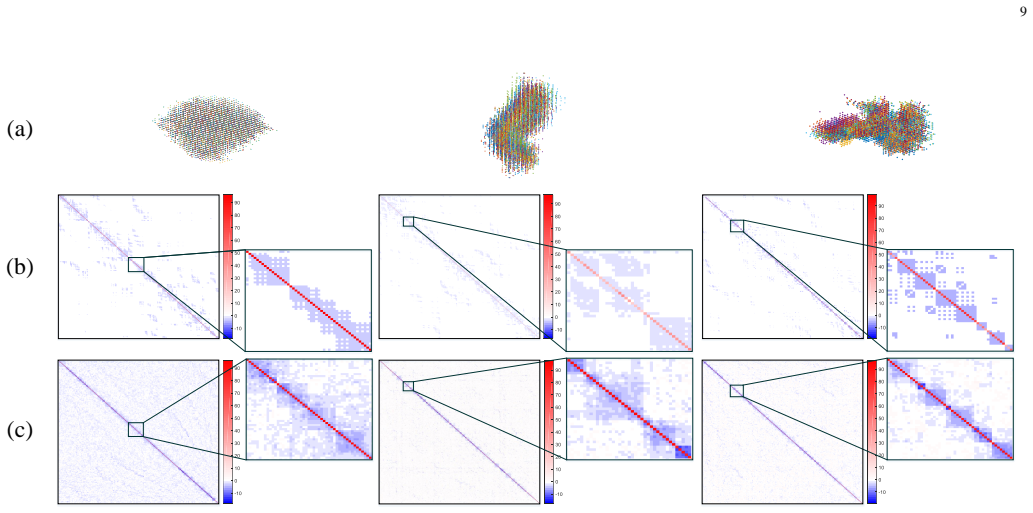
Estimate the empirical precision matrix from many aligned attribute patches of a real sequence, compute a numerical error against the constructed $L_t+I$, and check whether coding with the empirical Karhunen-Loeve basis beats the GGFT by a meaningful margin; a large error or a meaningful coding gain for the empirical basis would show the central claim does not hold for that data.
Extended reading notes
Core claim
On the paper's own terms, the central discovery is that the Gaussian Markov random field assumption plus a spatio-temporal graph turns inter prediction and residual coding into spectral operations on one generalized graph Laplacian. With temporal edges of weight 1 connecting each point to its matched point in the previous frame, the conditional precision of the current frame given the reference is $L_t+I$, so the conditional mean is $(L_t+I)^{-1}x_{t-1}$ and the optimal decorrelating basis is the eigenbasis of $L_t+I$. That basis is exactly the generalized graph Fourier transform of the spatio-temporal graph. Because this generalized Laplacian encodes both spatial smoothness and temporal boundary conditions, the derived transform decorrelates the prediction residual in both dimensions at once, which the paper argues is the correct optimal inter-coding under the model.
Load-bearing premise
The whole derivation stands on the assumption that real dynamic point cloud attributes are well described by a Gaussian Markov random field whose precision matrix equals the generalized graph Laplacian built from spatial edges plus unit-weight temporal edges between matched points; if that model fails, the derived predictor and transform are no longer optimal.
Editorial extensions
If this is right
- Inter prediction becomes a low-pass filtering operation $(L_t+I)^{-1}$ on the reference attributes, so the predictor carries no motion vectors beyond the point correspondences themselves.
- Residual coding with the eigenbasis of $L_t+I$ removes spatial and inter-frame correlation in one transform, yielding lower bit rate at matched reconstruction quality.
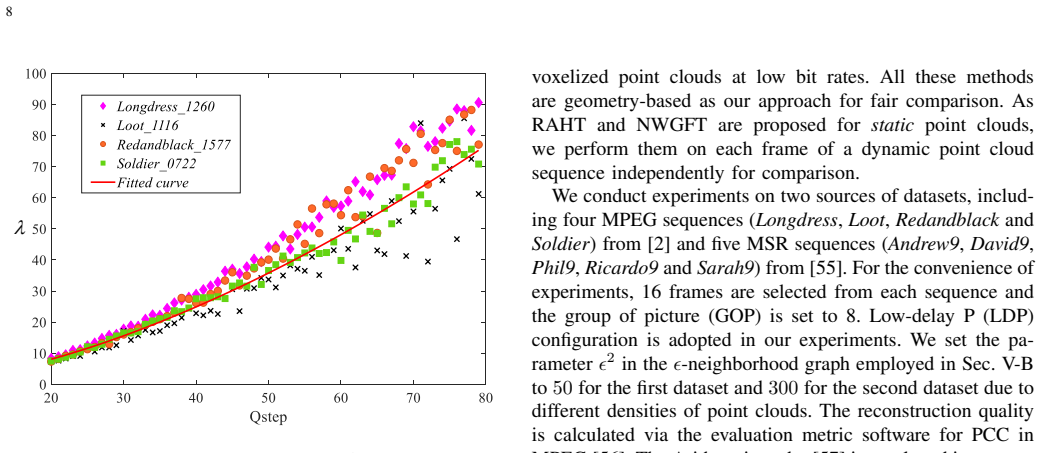
- Each cluster can independently choose intra or inter mode through a rate-distortion cost with an offline-trained lambda-Q model, making the codec adaptive to local motion and texture.
- Reported bit-rate savings are about 17% on average against dynamic point cloud codecs and 27-30% against per-frame static attribute transforms, with larger gains on slow-motion, simple-texture sequences.
- The framework assumes geometry is available at encoder and decoder, so it addresses attribute coding in settings where geometry is already coded or given.
Reading between the lines
- The same derivation would apply to any time-varying graph signal with reliable one-to-one correspondence, such as animated mesh attributes or sensor-network time series; the point cloud is one instance, not the only one.
- The unit temporal edge weight is the strongest modeling choice; a learned or distance-aware temporal weight function could extend the framework to imperfect correspondences, though the paper does not explore this.
- A direct test beyond the paper's visual comparison is to measure, on many real clusters, how much coding gain survives when the proposed predictor is replaced by an empirical optimal linear predictor estimated from training data.
- The claimed gains likely concentrate in regions with coherent motion; splitting results by motion magnitude or texture complexity would reveal where the inter mode helps most.
Signed reviews
Editorial analysis
A structured set of objections, weighed in public.
Referee Report
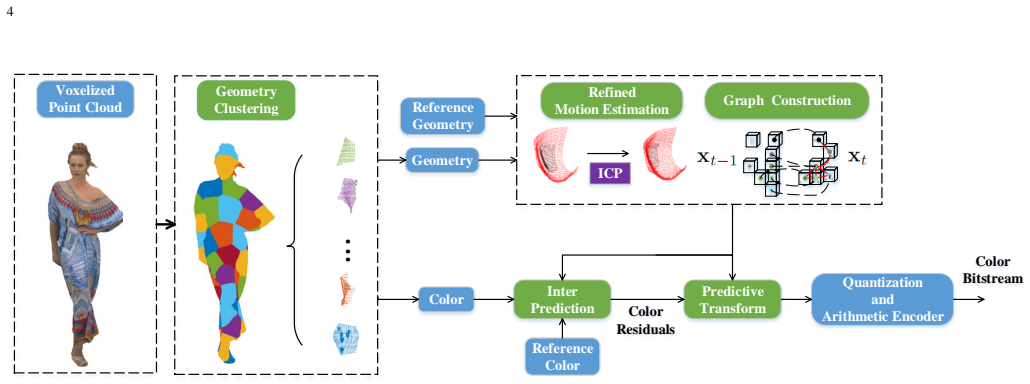
Summary. The paper proposes a complete coding framework for attributes of dynamic point clouds, focusing on inter-frame coding. The authors model the joint distribution of attributes in adjacent frames as a Gaussian Markov Random Field on a spatio-temporal graph whose precision matrix is the generalized graph Laplacian. Under this model, they derive the optimal inter-prediction as a low-pass filtered version of the reference attribute vector and the optimal predictive transform as the generalized graph Fourier transform of the spatio-temporal Laplacian. They also introduce an ICP-based refined motion estimation step and a rate-distortion mode decision between intra- and inter-coding. Experiments on MPEG and Microsoft datasets report average bit-rate reductions of about 17% over dynamic point cloud codecs and larger gains over static codecs.
Significance. If the technical claims are correct, the paper makes a solid contribution to dynamic point cloud attribute coding by giving a principled derivation of inter-prediction and predictive transform from a probabilistic graph model, and by demonstrating consistent bit-rate savings on standard datasets. The comparative experiments are reasonably extensive, covering four MPEG and five MSR sequences and comparing against both static and dynamic baselines. The strength of the contribution depends on the validity of the assumed GMRF model and, in particular, on the structural assumption that temporal correspondences form a one-to-one matching; this is exactly where the paper's derivation is vulnerable.
major comments (3)
- [Section IV-D, Eq. (16)] The equality Q_{t,t-1} = -I is derived under the assumption that each current point has exactly one temporal edge to a distinct reference point. The motion estimation in Section IV-B assigns to each point of x_t its nearest neighbor in the reference bounding box, without any uniqueness or injectivity constraint. If two points in x_t map to the same reference point, the corresponding column of Q_{t,t-1} contains two -1 entries, and Eq. (16) fails. The conditional mean in Eq. (13) then becomes mu_t + (L_t+I)^{-1} A_temp (x_{t-1}-mu_{t-1}), where A_temp is the actual many-to-one temporal adjacency matrix, not the simple predictor of Eq. (19). The paper should either enforce a one-to-one correspondence (e.g., by a greedy or Hungarian matching) or re-derive the predictor with the true adjacency structure and report how frequently duplicate matches occur in the test sequences.
- [Section IV-D, Eq. (19)] The step from Eq. (18) to Eq. (19) assumes zero means for both x_t and x_{t-1}. This assumption is not justified for color attributes, which are non-negative and have non-zero per-cluster means. Without an explicit mean-removal or DC-coding step in the encoder, the derived predictor is biased and the 'optimal' claim in the paper is not supported. The authors should describe how the per-cluster mean is handled (e.g., transmitted as side information or subtracted before prediction) and provide evidence that the zero-mean assumption is approximately satisfied for the tested attributes.
- [Section VI-B] The validation of the precision matrix approximation is weak. The paper compares the constructed generalized graph Laplacian with a statistically estimated precision matrix only visually, using three surface patches and K=19 aligned samples. There is no quantitative error metric, and the temporal block Q_{t,t-1} of the precision matrix is never inspected. Given that the main theoretical claim depends on Q being a generalized graph Laplacian with a specific temporal structure, the authors should provide a numerical measure of approximation error (e.g., normalized Frobenius norm) and explicitly verify whether the estimated temporal block matches the -I or -A_temp structure assumed in the derivation.
minor comments (4)
- [Section IV-B] The statement that x_t and its corresponding set x_{t-1} 'contain the same number of points n_k' is ambiguous when the nearest-neighbor search returns duplicate coordinates; the paper should clarify whether duplicate reference points are retained as separate vertices or merged, as this directly affects the graph construction.
- [Figure 4] The label 'Arithmatic Encoder' is misspelled; it should be 'Arithmetic Encoder'.
- [Section VI-A] The parameter ε² is described as the squared radius of the ε-neighborhood graph; using the superscript notation is confusing, and the authors should define ε explicitly or rename the parameter.
- [Tables III and IV] The dynamic codec comparisons report only the Y component of BD-BR; for completeness, the U and V results should be provided or the omission should be justified.
Circularity Check
No significant circularity: the GGFT optimality is a conditional consequence of the stated GMRF model, not an input-equivalent prediction.
full rationale
The paper's derivation chain is self-contained in the conditional sense it explicitly states. Under the GMRF assumption with precision matrix Q set equal to the generalized graph Laplacian L of the constructed spatio-temporal graph, the conditional mean and precision follow from the standard GMRF formulas in Eqs. (13)-(14). The subsequent specialization in Eqs. (15)-(17) is a modeling choice: the temporal edge weights are set to 1 and the precision matrix is interpreted as a generalized graph Laplacian. Substituting these into the conditional formulas yields Eq. (19) for inter-prediction and Eq. (20) for the predictive transform basis. The GGFT designation then follows from the definition in Eq. (6), not from a fitted parameter renamed as a prediction. The important modeling assumptions -- temporal edge weight 1, exact one-to-one temporal correspondence, and Q equals the generalized graph Laplacian -- are stated as assumptions rather than derived, and Section VI-B attempts an external check of the Q-as-Laplacian approximation on aligned patches, albeit only visually and with K=19 samples. Self-citations to [8], [23], and [54] are not load-bearing: [23] supplies the definition of GGFT, while the optimality claim here is re-derived from the GMRF conditional-precision argument. The reviewer's many-to-one correspondence concern is a correctness or robustness issue about whether the model assumptions hold for irregular point clouds; it does not make the derivation circular. No fitted parameter is presented as a prediction, and no result reduces by construction to its own input.
Assumptions & free parameters
free parameters (9)
- temporal_edge_weight =
1
- lambda_Q_alpha =
0.0624
- lambda_Q_beta =
1.6238
- epsilon_neighborhood =
50 (MPEG), 300 (MSR)
- normal_k =
15
- sigma_squared =
0.4
- cluster_size =
600 average points
- bounding_box_expansion_delta =
300%
- voxelization_N =
4096
assumptions (5)
- domain assumption Attribute values of adjacent frames follow a GMRF with precision matrix equal to the constructed generalized graph Laplacian.
- ad hoc to paper Attributes are zero-mean in both frames.
- domain assumption Temporal correspondence is one-to-one, so Q_{t,t-1}=-I.
- domain assumption Geometry of every frame is available at both encoder and decoder.
- domain assumption Spatial graph construction from normals captures the true conditional dependence structure.
Cite this review
Pith. "Pith review of Predictive Generalized Graph Fourier Transform for Attribute Compression of Dynamic Point Clouds." pith.science (2026). https://pith.science/paper/5XCDKWA3
@misc{pith2026190801970,
  author       = {Pith},
  title        = {Pith review of: Predictive Generalized Graph Fourier Transform for Attribute Compression of Dynamic Point Clouds},
  year         = {2026},
  howpublished = {\url{https://pith.science/paper/5XCDKWA3}},
  note         = {Machine review of arXiv:1908.01970}
}
abstract
As 3D scanning devices and depth sensors advance, dynamic point clouds have attracted increasing attention as a format for 3D objects in motion, with applications in various fields such as immersive telepresence, navigation for autonomous driving and gaming. Nevertheless, the tremendous amount of data in dynamic point clouds significantly burden transmission and storage. To this end, we propose a complete compression framework for attributes of 3D dynamic point clouds, focusing on optimal inter-coding. Firstly, we derive the optimal inter-prediction and predictive transform coding assuming the Gaussian Markov Random Field model with respect to a spatio-temporal graph underlying the attributes of dynamic point clouds. The optimal predictive transform proves to be the Generalized Graph Fourier Transform in terms of spatio-temporal decorrelation. Secondly, we propose refined motion estimation via efficient registration prior to inter-prediction, which searches the temporal correspondence between adjacent frames of irregular point clouds. Finally, we present a complete framework based on the optimal inter-coding and our previously proposed intra-coding, where we determine the optimal coding mode from rate-distortion optimization with the proposed offline-trained $\lambda$-Q model. Experimental results show that we achieve around 17% bit rate reduction on average over competitive dynamic point cloud compression methods.
Figures


Figures from the paper (10 more)





Reference graph
Works this paper leans on
-
[1]
Use cases for point cloud compres- sion (PCC),
C. Tulvan, R. Mekuria, and Z. Li, “Use cases for point cloud compres- sion (PCC),” in ISO/IEC JTC1/SC29/WG11 (MPEG) output document N16331, June 2016
work page 2016
-
[2]
8i voxelized full bodies, version 2 a voxelized point cloud dataset,
T. M. Eugene dEon, Bob Harrison and P. A. Chou, “8i voxelized full bodies, version 2 a voxelized point cloud dataset,” in ISO/IEC JTC1/SC29/WG11 m40059 ISO/IEC JTC1/SC29/WG1 M74006 , Jan. 2017
work page 2017
-
[3]
Geometric 3D point cloud compression,
V . Morell, S. Orts, M. Cazorla, and J. Garcia-Rodriguez, “Geometric 3D point cloud compression,” Pattern Recognition Letters, vol. 50, pp. 55–62, 2014
work page 2014
-
[4]
Octree-based point-cloud compression
R. Schnabel and R. Klein, “Octree-based point-cloud compression.” in Eurographics Symposium on Point-Based Graphics, 2006, pp. 111–120
work page 2006
-
[5]
3D is here: Point cloud library (PCL),
R. B. Rusu and S. Cousins, “3D is here: Point cloud library (PCL),” in IEEE International Conference on Robotics and Automation (ICRA) , 2011, pp. 1–4. 13 Ours MCIC OursOriginal PCC- MP3DGOriginal Frame 5 Frame 12 Frame 0537 Frame 0538 Fig. 12. Subjective comparison with MCIC on two reconstructed frames in the dynamic point cloud Ricardo (MCIC). They are ...
work page 2011
-
[6]
A volumetric approach to point cloud compression–part II: Geometry compression,
M. Krivoku ´ca, P. A. Chou, and M. Koroteev, “A volumetric approach to point cloud compression–part II: Geometry compression,” IEEE Transactions on Image Processing , vol. 29, pp. 2217–2229, 2019
work page 2019
-
[7]
Point cloud attribute compression with graph transform,
C. Zhang, D. Florencio, and C. Loop, “Point cloud attribute compression with graph transform,” in IEEE International Conference on Image Processing (ICIP), 2014, pp. 2066–2070
work page 2014
-
[8]
Cluster-based point cloud coding with normal weighted graph fourier transform,
Y . Xu, W. Hu, S. Wang, X. Zhang, S. Wang, S. Ma, and W. Gao, “Cluster-based point cloud coding with normal weighted graph fourier transform,” in IEEE International Conference on Acoustics, Speech and Signal Processing (ICASSP) , 2018, pp. 1753–1757
work page 2018
Show all 58 references
-
[9]
Compression of 3D point clouds using a region-adaptive hierarchical transform,
R. L. De Queiroz and P. A. Chou, “Compression of 3D point clouds using a region-adaptive hierarchical transform,” IEEE Transactions on Image Processing, vol. 25, no. 8, pp. 3947–3956, 2016
2016
-
[10]
3D point cloud attribute compression using geometry-guided sparse representation,
S. Gu, J. Hou, H. Zeng, H. Yuan, and K.-K. Ma, “3D point cloud attribute compression using geometry-guided sparse representation,” IEEE Transactions on Image Processing , vol. 29, pp. 796–808, 2019
2019
-
[11]
A volumetric approach to point cloud compression–part I: Attribute compression,
P. A. Chou, M. Koroteev, and M. Krivoku ´ca, “A volumetric approach to point cloud compression–part I: Attribute compression,” IEEE Transac- tions on Image Processing , vol. 29, pp. 2203–2216, 2019
2019
-
[12]
Graph-based compression of dynamic 3D point cloud sequences,
D. Thanou, P. A. Chou, and P. Frossard, “Graph-based compression of dynamic 3D point cloud sequences,” IEEE Transactions on Image Processing, vol. 25, no. 4, pp. 1765–1778, 2016
2016
-
[13]
PCC test model category 2 v0,
K. Mammou, “PCC test model category 2 v0,” in ISO/IEC JTC1/SC29/WG11 (MPEG) output document N17248 , Oct. 2017
2017
-
[14]
Compression of dynamic 3D point clouds using subdivisional meshes and graph wavelet transforms,
A. Anis, P. A. Chou, and A. Ortega, “Compression of dynamic 3D point clouds using subdivisional meshes and graph wavelet transforms,” in IEEE International Conference on Acoustics, Speech and Signal Processing (ICASSP), 2016, pp. 6360–6364
2016
-
[15]
Motion-compensated compression of point cloud video,
R. L. De Queiroz and P. A. Chou, “Motion-compensated compression of point cloud video,” in IEEE International Conference on Image Processing (ICIP), 2017, pp. 1417–1421
2017
-
[16]
Motion-compensated compression of dynamic voxelized point clouds,
R. L. De Queiroz and P. A. Chou, “Motion-compensated compression of dynamic voxelized point clouds,” IEEE Transactions on Image Processing, vol. 26, no. 8, pp. 3886–3895, 2017
2017
-
[17]
Verbal reports from subgroups at 125th meeting,
MPEG, “Verbal reports from subgroups at 125th meeting,” in ISO/IEC JTC1/SC29/WG11 (MPEG) output document w18110 , Feb. 2019
2019
-
[18]
Dynamic polygon cloud compression,
E. Pavez and P. A. Chou, “Dynamic polygon cloud compression,” in IEEE International Conference on Acoustics, Speech and Signal Processing (ICASSP), 2017, pp. 2936–2940
2017
-
[19]
Dynamic polygon clouds: Representation and compression for VR/AR,
E. Pavez, P. A. Chou, R. L. De Queiroz, and A. Ortega, “Dynamic polygon clouds: Representation and compression for VR/AR,” APSIPA Transactions on Signal and Information Processing , vol. 7, pp. 1–22, 2018
2018
-
[20]
Rue and L
H. Rue and L. Held, Gaussian Markov random fields: theory and applications. Chapman and Hall/CRC, 2005
2005
-
[21]
F. R. Chung and F. C. Graham, Spectral graph theory . American Mathematical Soc., 1997, no. 92
1997
-
[22]
The emerging field of signal processing on graphs: Ex- tending high-dimensional data analysis to networks and other irregular domains,
D. I. Shuman, S. K. Narang, P. Frossard, A. Ortega, and P. Van- dergheynst, “The emerging field of signal processing on graphs: Ex- tending high-dimensional data analysis to networks and other irregular domains,” IEEE Signal Processing Magazine , vol. 30, no. 3, pp. 83–98, 2013
2013
-
[23]
Intra-prediction and generalized graph Fourier transform for image coding,
W. Hu, G. Cheung, and A. Ortega, “Intra-prediction and generalized graph Fourier transform for image coding,” IEEE Signal Processing Letters, vol. 22, no. 11, pp. 1913–1917, Nov 2015
1913
-
[24]
Object modelling by registration of multiple range images,
Y . Chen and G. Medioni, “Object modelling by registration of multiple range images,” Image and vision computing, vol. 10, no. 3, pp. 145–155, 1992
1992
-
[25]
Method for registration of 3D shapes,
P. J. Besl and N. D. McKay, “Method for registration of 3D shapes,” in Sensor Fusion IV: Control Paradigms and Data Structures , vol. 1611. International Society for Optics and Photonics, 1992, pp. 586–607
1992
-
[26]
Predictive point- cloud compression
S. Gumhold, Z. Kami, M. Isenburg, and H.-P. Seidel, “Predictive point- cloud compression.” in Siggraph Sketches, 2005, p. 137
2005
-
[27]
Geometric compression for inter- active transmission,
O. Devillers and P.-M. Gandoin, “Geometric compression for inter- active transmission,” in IEEE Proceedings Visualization. (Cat. No. 00CH37145), 2000, pp. 319–326
2000
-
[28]
Ochotta and D
T. Ochotta and D. Saupe, Compression of point-based 3D models by shape-adaptive wavelet coding of multi-height fields , 2004
2004
-
[29]
Real-time compression of point cloud streams,
J. Kammerl, N. Blodow, R. B. Rusu, S. Gedikli, M. Beetz, and E. Steinbach, “Real-time compression of point cloud streams,” in IEEE International Conference on Robotics and Automation , 2012, pp. 778– 785
2012
-
[30]
The JPEG still picture compression standard,
G. K. Wallace, “The JPEG still picture compression standard,” IEEE transactions on consumer electronics , vol. 38, no. 1, pp. xviii–xxxiv, 1992
1992
-
[31]
Design, implementation and evaluation of a point cloud codec for tele-immersive video,
R. Mekuria, K. Blom, and P. Cesar, “Design, implementation and evaluation of a point cloud codec for tele-immersive video,” IEEE Transactions on Circuits and Systems for Video Technology , vol. 27, no. 4, pp. 828–842, 2016. 14
2016
-
[32]
Overview of the high efficiency video coding (HEVC) standard,
G. J. Sullivan, J.-R. Ohm, W.-J. Han, and T. Wiegand, “Overview of the high efficiency video coding (HEVC) standard,” IEEE Transactions on circuits and systems for video technology , vol. 22, no. 12, pp. 1649– 1668, 2012
2012
-
[33]
A generic scheme for progressive point cloud coding,
Y . Huang, J. Peng, C.-C. J. Kuo, and M. Gopi, “A generic scheme for progressive point cloud coding,”IEEE Transactions on Visualization and Computer Graphics, vol. 14, no. 2, pp. 440–453, 2008
2008
-
[34]
Information technology MPEG-I (coded representation of im- mersive media) part 9: Geometry-based point cloud compression,
3DG, “Information technology MPEG-I (coded representation of im- mersive media) part 9: Geometry-based point cloud compression,” in ISO/IEC JTC1/SC29/WG11 (MPEG) output document w18179 , March 2019
2019
-
[35]
Zur theorie der orthogonalen funktionensysteme,
A. Haar, “Zur theorie der orthogonalen funktionensysteme,” Mathema- tische Annalen, vol. 69, no. 3, pp. 331–371, 1910
1910
-
[36]
Adaptive run-length/golomb-rice encoding of quantized generalized Gaussian sources with unknown statistics,
H. S. Malvar, “Adaptive run-length/golomb-rice encoding of quantized generalized Gaussian sources with unknown statistics,” in IEEE Data Compression Conference (DCC’06), 2006, pp. 23–32
2006
-
[37]
Wavelets on graphs via spectral graph theory,
D. K. Hammond, P. Vandergheynst, and R. Gribonval, “Wavelets on graphs via spectral graph theory,” Applied and Computational Harmonic Analysis, vol. 30, no. 2, pp. 129–150, 2011
2011
-
[38]
Edge-adaptive transforms for efficient depth map coding,
G. Shen, W.-S. Kim, S. K. Narang, A. Ortega, J. Lee, and H. Wey, “Edge-adaptive transforms for efficient depth map coding,” in IEEE Picture Coding Symposium , Nagoya, Japan, December 2010, pp. 566– 569
2010
-
[39]
Multiresolution graph Fourier transform for compression of piecewise smooth images,
W. Hu, G. Cheung, A. Ortega, and O. C. Au, “Multiresolution graph Fourier transform for compression of piecewise smooth images,” IEEE Transactions on Image Processing , vol. 24, no. 1, pp. 419–433, 2015
2015
-
[40]
Edge-adaptive transforms for efficient depth map coding,
G. Shen, W.-S. Kim, S. K. Narang, A. Ortega, J. Lee, and H. Wey, “Edge-adaptive transforms for efficient depth map coding,” in IEEE Picture Coding Symposium (PCS) , 2010, pp. 566–569
2010
-
[41]
Depth map coding using graph based transform and transform domain sparsi- fication,
G. Cheung, W.-S. Kim, A. Ortega, J. Ishida, and A. Kubota, “Depth map coding using graph based transform and transform domain sparsi- fication,” in Multimedia Signal Processing (MMSP), IEEE 13th Inter- national Workshop, 2011, pp. 1–6
2011
-
[42]
Depth map compression using multi-resolution graph-based transform for depth-image-based rendering,
W. Hu, G. Cheung, X. Li, and O. C. Au, “Depth map compression using multi-resolution graph-based transform for depth-image-based rendering,” in IEEE International Conference on Image Processing , Orlando, FL, September 2012, pp. 1297–1300
2012
-
[43]
Nodal domain theorems and bipartite subgraphs,
T. Biyikoglu, J. Leydold, and P. F. Stadler, “Nodal domain theorems and bipartite subgraphs,” 2005
2005
-
[44]
Jointly optimized spatial prediction and block transform for video and image coding,
J. Han, A. Saxena, V . Melkote, and K. Rose, “Jointly optimized spatial prediction and block transform for video and image coding,” IEEE Transactions on Image Processing, vol. 21, no. 4, pp. 1874–1884, April 2012
2012
-
[45]
Automated detection and identifi- cation of persons in video using a coarse 3-D head model and multiple texture maps,
M. Everingham and A. Zisserman, “Automated detection and identifi- cation of persons in video using a coarse 3-D head model and multiple texture maps,” IEE Proceedings-Vision, Image and Signal Processing , vol. 152, no. 6, pp. 902–910, 2005
2005
-
[46]
Tools for 3D-object retrieval: Karhunen-loeve transform and spherical harmonics,
D. V . Vranic, D. Saupe, and J. Richter, “Tools for 3D-object retrieval: Karhunen-loeve transform and spherical harmonics,” in IEEE Fourth Workshop on Multimedia Signal Processing (Cat. No. 01TH8564), 2001, pp. 293–298
2001
-
[47]
Generalized laplacian precision matrix es- timation for graph signal processing,
E. Pavez and A. Ortega, “Generalized laplacian precision matrix es- timation for graph signal processing,” in International Conference on Acoustics, Speech and Signal Processing (ICASSP) , 2016, pp. 6350– 6354
2016
-
[48]
Graph learning from data under Laplacian and structural constraints,
H. E. Egilmez, E. Pavez, and A. Ortega, “Graph learning from data under Laplacian and structural constraints,” IEEE Journal of Selected Topics in Signal Processing , vol. 11, no. 6, pp. 825–841, 2017
2017
-
[49]
Graph signal processing- a probabilistic framework,
C. Zhang, D. Flor ˆencio, and P. A. Chou, “Graph signal processing- a probabilistic framework,” Microsoft Res., Redmond, WA, USA, Tech. Rep. MSR-TR-2015-31, 2015
2015
-
[50]
Approximate fast graph Fourier transforms via multilayer sparse approximations,
L. Le Magoarou, R. Gribonval, and N. Tremblay, “Approximate fast graph Fourier transforms via multilayer sparse approximations,” IEEE Transactions on Signal and Information Processing over Networks , vol. 4, no. 2, pp. 407–420, 2017
2017
-
[51]
Liii. on lines and planes of closest fit to systems of points in space,
K. Pearson, “Liii. on lines and planes of closest fit to systems of points in space,” vol. 2, no. 11. Taylor & Francis, 1901, pp. 559–572
1901
-
[52]
Rate-distortion optimization for video compression,
G. J. Sullivan and T. Wiegand, “Rate-distortion optimization for video compression,” IEEE Signal Processing Magazine , vol. 15, no. 6, pp. 74–90, 1998
1998
-
[53]
Just-noticeable difference-based perceptual optimization for jpeg compression,
X. Zhang, S. Wang, K. Gu, W. Lin, S. Ma, and W. Gao, “Just-noticeable difference-based perceptual optimization for jpeg compression,” IEEE Signal Processing Letters , vol. 24, no. 1, pp. 96–100, 2017
2017
-
[54]
Rate-distortion optimized scan for point cloud color compression,
Y . Xu, S. Wang, X. Zhang, S. Wang, N. Zhang, S. Ma, and W. Gao, “Rate-distortion optimized scan for point cloud color compression,” in IEEE Visual Communications and Image Processing (VCIP) , 2017, pp. 1–4
2017
-
[55]
Microsoft voxelized upper bodies-a voxelized point cloud dataset,
C. Loop, Q. Cai, S. O. Escolano, and P. A. Chou, “Microsoft voxelized upper bodies-a voxelized point cloud dataset,” in ISO/IEC JTC1/SC29 Joint WG11/WG1 (MPEG/JPEG) input document m38673/M72012 , 2016
2016
-
[56]
Updates and integration of evaluation metric software for PCC,
D. Tian, H. Ochimizu, C. Feng, R. Cohen, and A. Vetro, “Updates and integration of evaluation metric software for PCC,” in ISO/IEC JTC1/SC29/WG11 MPEG2016/M40522, April 2017
2017
-
[57]
Arithmetic coding,
J. Rissanen and G. G. Langdon, “Arithmetic coding,” IBM Journal of research and development, vol. 23, no. 2, pp. 149–162, 1979
1979
-
[58]
Improvement of BD-PSNR model,
G. Bjøntegaard, “Improvement of BD-PSNR model,” VCEG-AI11, July 2008
2008
Reviewed August 14, 2026 · model on record in the stance chip above.
Discussion (0). Continue with ORCID to comment.