REVIEW 4 major objections 5 minor 18 references
Decorrelation Deep Learning for Fingerprint-based Indoor Localization
T0 review · 4 major / 5 minor · reviewed 2026-08-14 · deepseek-v4-flash
Pith's one-line read Decorrelation preprocessing of channel fingerprints cuts localization errors to 3–4% at 20 dB SNR in simulation.
desk verdict A clean simulation study showing a real but incremental gain—decorrelation front-ends improve MNN fingerprint localization—yet the headline SNR numbers are unreproducible because the noise model is never defined. read the letter →
The pith
A machine-rendered reading of the paper's core claim, the machinery that carries it, and where it could break.
The reading
What carries the argument
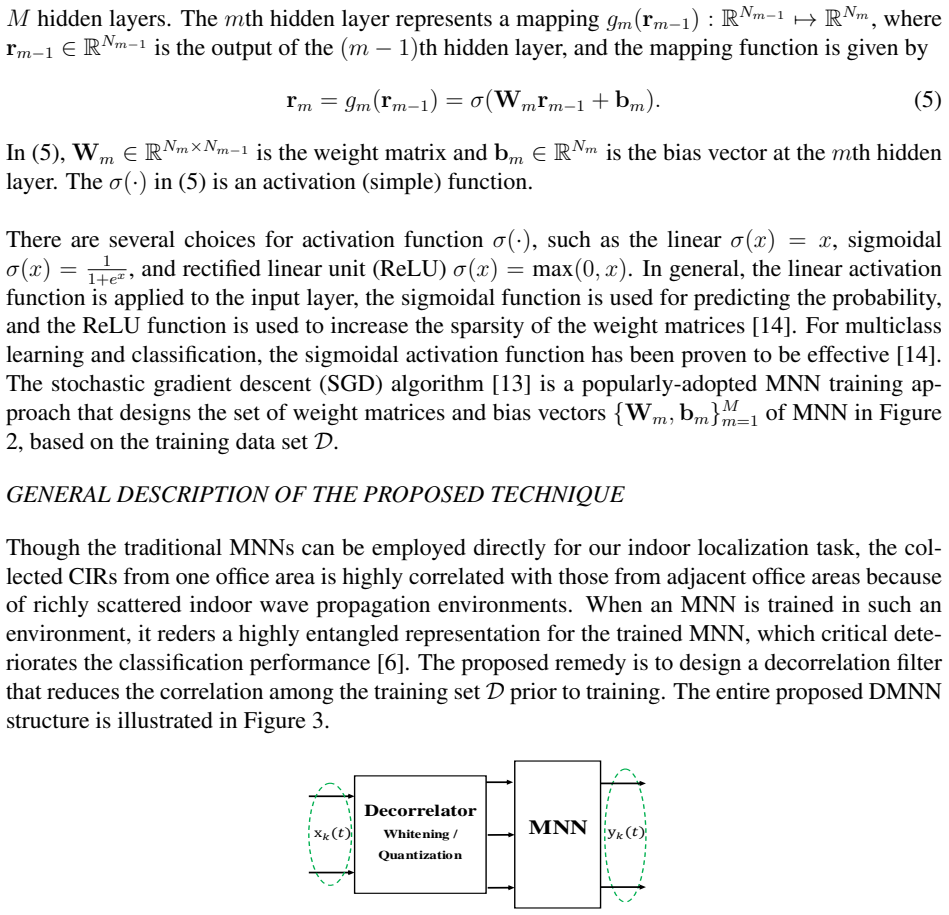
The carrying mechanism is the decorrelation filter inserted between raw CIR fingerprint vectors and the MNN. For the linear branch, the whitening matrix $T = \Lambda^{-1/2} U^T$ follows from the eigendecomposition of the training covariance $\Sigma = U\Lambda U^T$; it maps the covariance to the identity while its rotation is chosen to maximize the sum of squared entries of $T\Sigma$, keeping the whitened data as close as possible to the original. For the nonlinear branch, the filter is a scalar quantizer with $M$ levels whose positions solve the optimal-distortion fixed-point equations $\partial e_Q(\Psi)/\partial q_i = 0$ under a Gaussian assumption on the fingerprint entries, computed by a standard fixed-point recursion. Both filters force highly correlated adjacent-office fingerprints into a more separated and less redundant input space, which is what makes the subsequent MNN classification stable.
What would settle it
Take the same 15-office, 3-sensor experiment with measured CIR data or a held-out ray-tracing dataset untouched by training, and compare QMNN, WMNN, plain MNN, and SVM at the same SNRs; if the decorrelated networks do not consistently beat the two baselines, the simulated advantage is an artifact of the channel model.
Extended reading notes
Core claim
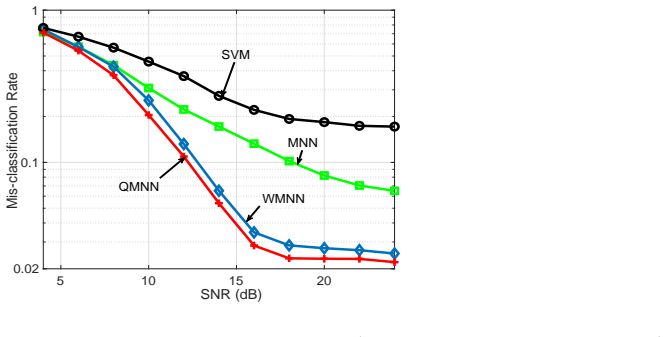
The central claim is that applying a decorrelation filter to CIR fingerprints before training an MNN produces a large and reliable improvement in indoor location classification, because correlation among fingerprints from adjacent offices entangles the neural representation and makes it sensitive to small channel fluctuations. The paper designs a linear whitening filter, derived from PCA by choosing the rotation that maximizes the sum of squared entries of the cross-covariance between the whitened and original data, giving $T = \Lambda^{-1/2} U^T$, and a nonlinear distortion-optimal scalar quantizer whose levels solve the fixed-point equations of expected squared quantization error under a Gaussian model of the fingerprint entries. In simulation, both variants, called QMNN and WMNN, reach a misclassification rate around 3–4% at 20 dB SNR, while the MNN and SVM benchmarks sit higher; doubling the number of offices to 30 requires five sensors to recover the same rate. The practical thesis is that decorrelation, not a deeper or more complex architecture, is the bottleneck.
Load-bearing premise
All the reported error rates come from the same synthetic channel model that generated the training data, so the 3–4% figure and the advantage over MNN and SVM rest on that model faithfully matching real indoor channel correlation and fluctuation.
Editorial extensions
If this is right
- With the same architecture, training data, and simulation setup, inserting either decorrelation filter before the MNN lowers the misclassification rate below that of plain MNN and SVM.
- The reported 3–4% rate is specific to 15 offices with 3 sensors; doubling the offices to 30 needs 5 sensors to recover it, so spatial diversity and decorrelation act together.
- Both filters are preprocessing-only: once designed from the training statistics, they are fixed and add no online classification cost.
- Because the decorrelators depend only on second-order statistics or marginal distributions, they can be designed once and reused with different network sizes or training runs.
Reading between the lines
- The same whitening or quantization idea should transfer to other fingerprint modalities such as RSSI or CSI whenever their feature dimensions are statistically correlated, since neither filter is tied to the CIR structure itself.
- A natural testable extension is to design the decorrelators from unlabeled or coarsely labeled channel measurements before fine-tuning the classifier, which could cut the labeled training overhead.
- If real indoor small-scale fading is non-Gaussian, the Gaussian-based quantizer may need re-estimation, while the PCA whitening branch is distribution-free and may be the more robust of the two.
- The paper trains and tests on the same synthetic channel statistics, so the decisive next experiment is cross-condition transfer: train on one channel model and test on measured data, or on a held-out environment, to see whether the decorrelation gap survives model mismatch.
Signed reviews
Editorial analysis
A structured set of objections, weighed in public.
Referee Report
Summary. The manuscript proposes a decorrelation deep learning framework (DMNN) for fingerprint-based indoor localization, where channel impulse responses (CIRs) are used as fingerprints to classify office locations. Two decorrelation preprocessors are designed before training a multi-layer neural network (MNN): a linear PCA-whitening filter (Eqs. (6)-(9)) and a nonlinear scalar quantizer optimized to minimize squared distortion (Eqs. (10)-(15)). The paper claims, based on synthetic indoor channel simulations, that the proposed QMNN and WMNN achieve a mis-classification rate of about 3-4% at SNR = 20 dB, significantly outperforming plain MNN and SVM.
Significance. If the reported result holds, the paper identifies a simple, computationally cheap preprocessing step that can substantially improve deep-learning-based indoor localization from CIR fingerprints. The whitening derivation in Eqs. (6)-(9) is standard and cleanly presented, and the quantizer design is a recognizable Lloyd-Max procedure. The proposed methods are easy to implement and compare against reasonable baselines. However, the evidence is entirely simulation-based, generated from one synthetic channel model with Gaussian small-scale fading and manually chosen path powers; no real-world measurements or independent data are provided. The lack of a defined SNR model, detailed in the major comments, currently prevents reproduction of the headline numerical claim. The paper would be strengthened by releasing code or specifying the noise injection procedure precisely.
major comments (4)
- [Numerical Simulations, Figs. 5-6; System Model Eqs. (1)-(3)] The SNR axis is not defined. The channel model in Eqs. (1)-(3) contains no additive noise term, and the text explicitly assumes 'perfect CIR knowledge available.' Yet the Numerical Simulations section states that N = 100 training measurements are collected at a 'training signal-to-noise ratio (SNR) 20 dB,' and Figures 5 and 6 plot mis-classification rate versus SNR from 5 to 20 dB. The manuscript does not specify how noise is added to the perfect CIR, whether the SNR is per-path, per-sensor, or global, or whether the same noise model is used for training and testing. Since the headline 'QMNN and WMNN achieve a mis-classification rate of around 3-4% at SNR = 20 dB' and the comparison against MNN/SVM are read from this axis, the main quantitative claim is not reproducible from the text. Please define the noise model explicitly or provide the simulation code.
- [Nonlinear Decorrelation Filter Design, Eqs. (10)-(15)] The quantizer is designed by minimizing scalar squared distortion (Eqs. (11)-(12)), which is a standard Lloyd-Max quantizer for a scalar Gaussian source. No argument is given that element-wise application of Q(x) decorrelates the vector CIR features or reduces the covariance of the training data. The sentence 'a well-designed quantizer can force highly correlated data into a distinct discrete grid to make them separable' is an assertion, not a derivation, and reference [16] concerns vector quantization in a numerical-analysis context without being connected to Eq. (12). Thus the causal claim that QMNN's improvement is due to decorrelation is not supported; the gain could equally arise from denoising, regularization, or added nonlinearity. Please provide a theoretical or empirical characterization, such as the covariance matrices of the input before and after quantization, to substantiate the decorrelation interpretation.
- [Numerical Simulations, Eqs. (2)-(3)] All performance numbers are generated from a single synthetic channel model in which training and test data are drawn from the same multi-wall path-loss and Gaussian small-scale fading assumptions. No real-world measurement data or independent test set is used, so the external validity of the claimed 3-4% mis-classification rate and of the superiority of WMNN/QMNN over MNN/SVM is not established. At minimum, the paper should state this limitation explicitly and discuss, through additional simulations, which model parameters (e.g., small-scale fading variance, wall losses, sensor layout, number of paths) drive the observed improvement. Without such discussion, the practical significance of the results is unclear.
- [General Description and Introduction] The central motivation that high correlation among training CIRs 'critically' degrades MNN performance is supported only by a generic citation to [6], a practical recommendations chapter on deep learning. That reference does not specifically address CIR correlation or indoor localization. Since this claim is load-bearing for the entire proposed approach, the paper should provide direct evidence, for example, a controlled experiment showing that MNN classification degrades as the correlation among training fingerprints increases, or at least a quantitative covariance analysis of the channel model used in the simulations.
minor comments (5)
- [General Description] There are typos: 'reders' should be 'renders' and 'critical deteriorates' should be 'critically deteriorates.'
- [Nonlinear Decorrelation Filter Design, Eq. (15)] The Newton-Raphson recursion is described as converging 'based on the central limit theorem [18],' which is not the correct justification; convergence of Lloyd-Max iterations is a fixed-point property. Please correct the citation or rephrase.
- [Numerical Simulations, Figs. 5-6] The figures do not show markers or confidence intervals. Since MNN training is stochastic, reporting averages over several random seeds (or showing error bars) would make the claimed improvement more convincing.
- [Notation and Nomenclature] The symbol M is used both for the number of quantization levels and for the number of hidden layers, which is confusing. Use separate symbols, e.g., M_q for quantization levels and H for hidden layers.
- [Introduction] The paper discusses K-nearest-neighbors [5] in the introduction but does not include it as a benchmark in the numerical comparisons. Either include KNN in the experiments or explain why it is omitted.
Circularity Check
No significant circularity: the decorrelation filters are standard preprocessors fitted only to input statistics, and performance is evaluated on held-out test data.
full rationale
The paper's central claim is that PCA-whitening and distortion-optimal quantization, applied as preprocessing before training an MNN, improve fingerprint-based indoor localization. This claim is not circular by construction. The whitening filter in Eq. (9), T = Λ^{-1/2}U^T, is derived solely from the covariance matrix Σ of the training inputs; it does not use the labels y_k(t) or the target office class. The quantizer in Eqs. (11)-(15) minimizes the mean squared quantization distortion E|x-Q(x)|^2, a function of the input distribution only, and is solved by a standard Newton-Raphson recursion citing external work (ref. [18]); no classification outcome is used to fit the quantizer. The numerical comparisons in Figures 5 and 6 are made against MNN and SVM on separate online test measurements, so the reported 3-4% mis-classification rate is not a refitting of training data renamed as a prediction. The only author self-citation, ref. [11] (T. Kim et al.), supports the unrelated statement that 'CIR estimation is a well-studied area' and is not load-bearing for the decorrelation derivation. Finally, the reported gap that no SNR noise model is explicitly defined in the system model is a serious reproducibility and correctness concern, but it is not an instance of circular reasoning; it does not make the claimed result equivalent to its inputs by construction. Therefore no circular step is present.
Assumptions & free parameters
free parameters (5)
- M, number of scalar quantization levels =
10
- Small-scale fading mean and variance (mu, sigma^2) =
mu=1, sigma^2=0.1
- Per-path transmit powers P_s^1, P_s^2, P_s^3 =
20, 16, 10 dB
- Training data size N per office =
100
- MNN architecture sizes =
100-200-100-50 hidden units
assumptions (7)
- domain assumption The multi-wall path loss model h_d,large = P_s^d - (2 log10 r + 3 n_wall + 0.2 n_door) dB represents a realistic indoor office channel at 3.5 GHz (Eq. 3)
- domain assumption Small-scale fading amplitudes are i.i.d. Gaussian with N(1, 0.1) (Eq. 2)
- domain assumption The training input elements are Gaussian with mean nu and variance sigma^2, so the distortion-optimal scalar quantizer applies (Section Nonlinear Decorrelation Filter Design)
- ad hoc to paper High correlation among training CIRs critically entangles MNN representations and degrades classification (Introduction and General Description, citing [6])
- domain assumption Perfect CIR knowledge is available for training and testing (end of System Model)
- standard math Whitening matrix existence and SVD: T = R Sigma^{-1/2} satisfies T Sigma T^T = I for a positive definite covariance, and R* = U^T maximizes the relaxed objective (Eqs. 6-9)
- standard math Newton-Raphson recursion converges to the optimal quantizer for a Gaussian source (Eq. 15, citing [18])
Cite this review
Pith. "Pith review of Decorrelation Deep Learning for Fingerprint-based Indoor Localization." pith.science (2026). https://pith.science/paper/ZGYSUDQO
@misc{pith2026190802014,
  author       = {Pith},
  title        = {Pith review of: Decorrelation Deep Learning for Fingerprint-based Indoor Localization},
  year         = {2026},
  howpublished = {\url{https://pith.science/paper/ZGYSUDQO}},
  note         = {Machine review of arXiv:1908.02014}
}
read the original abstract
Indoor localization is of particular interest due to its immense practical applications. However, the rich multipath and high penetration loss of indoor wireless signal propagation make this task arduous. Though recently studied fingerprint-based techniques can handle the multipath effects, the sensitivity of the localization performance to channel fluctuation is a drawback. To address the latter challenge, we adopt an artificial multi-layer neural network (MNN) to learn the complex channel impulse responses (CIRs) as fingerprint measurements. However, the performance of the location classification using MNN critically depends on the correlation among the training data. Therefore, we design two different decorrelation filters that preprocess the training data for discriminative learning. The first one is a linear whitening filter combined with the principal component analysis (PCA), which forces the covariance matrix of different feature dimensions to be identity. The other filter is a nonlinear quantizer that is optimized to minimize the distortion incurred by the quantization. Numerical results using indoor channel models illustrate the significant improvement of the proposed decorrelation MNN (DMNN) compared to other benchmarks.
Figures


Figures from the paper (3 more)


Reference graph
Works this paper leans on
-
[6]
Practical recommendations for gradient-based training of deep architectures,
Y . Bengio, “Practical recommendations for gradient-based training of deep architectures,” in Neural Networks: Tricks of the Trade (2nd ed.) , vol. 7700, pp. 437–478, Springer, 2012
work page 2012
-
[16]
Introduction to vector quantization and its application for numerics,
G. Pages, “Introduction to vector quantization and its application for numerics,” ESAIM: Proceedings and Surveys, vol. 48, no. 1, pp. 22–79, 2015
work page 2015
-
[1]
Recent advances in indoor localization: A survey on theoretical approaches and applica- tions,
A. Yassin, Y . Nasser, M. Awad, A. Al-Dubai, R. Liu, C. Yuen, R. Raulefs, and E. Aboutanios, “Recent advances in indoor localization: A survey on theoretical approaches and applica- tions,” IEEE Communications Surveys & Tutorials, vol. 19, no. 2, pp. 1327–1346, 2016
work page 2016
-
[2]
Robust indoor localization and tracking using GSM fingerprints,
Y . Tian, B. Denby, I. Ahriz, P. Roussel, and G. Dreyfus, “Robust indoor localization and tracking using GSM fingerprints,” EURASIP Journal on Wireless Communications and Net- 9 working, vol. 2015, pp. 1–12, Jun 2015
work page 2015
-
[3]
Fingerprinting-based positioning in distributed massive MIMO systems,
V . Savic and E. G. Larsson, “Fingerprinting-based positioning in distributed massive MIMO systems,” in 2015 IEEE 82nd V ehicular Technology Conference (VTC2015-Fall) , pp. 1–5, 2015
work page 2015
-
[4]
Survey of cellular mobile radio localization methods: From 1G to 5G,
J. A. del Peral-Rosado, R. Raulefs, J. A. Lpez-Salcedo, and G. Seco-Granados, “Survey of cellular mobile radio localization methods: From 1G to 5G,” IEEE Communications Surveys Tutorials, vol. 20, pp. 1124–1148, Secondquarter 2018
work page 2018
-
[5]
An improved K-nearest-neighbor indoor localization method based on spearman distance,
Y . Xie, Y . Wang, A. Nallanathan, and L. Wang, “An improved K-nearest-neighbor indoor localization method based on spearman distance,” IEEE Signal Processing Letters , vol. 23, pp. 351–355, March 2016
work page 2016
-
[7]
From RSSI to CSI: Indoor localization via channel response,
Z. Yang, Z. Zhou, and Y . Liu, “From RSSI to CSI: Indoor localization via channel response,” ACM Comput. Surv., vol. 46, pp. 25–32, Dec. 2013
work page 2013
Show all 18 references
-
[8]
A multi-wall-and-floor model for indoor radio propagation,
M. Lott and I. Forkel, “A multi-wall-and-floor model for indoor radio propagation,” in IEEE VTC 53rd V ehicular Technology Conference, Spring 2001, vol. 1, pp. 464–468, 2001
2001
-
[9]
Wireless channel measurements and mod- eling for an office topology at 3.5 GHz,
T. Chrysikos, C. Papadakos, and S. Kotsopoulos, “Wireless channel measurements and mod- eling for an office topology at 3.5 GHz,” in 2015 Wireless Telecommunications Symposium (WTS), pp. 1–6, April 2015
2015
-
[10]
Channel models: A tutorial,
R. Jain, “Channel models: A tutorial,” in WiMAX forum AATG, pp. 1–6, 2007
2007
-
[11]
An approach to sensor network throughput en- hancement by PHY-aided MAC,
T. Kim, D. J. Love, M. Skoglund, and Z. Jin, “An approach to sensor network throughput en- hancement by PHY-aided MAC,” IEEE Transactions on Wireless Communications , vol. 14, pp. 670–684, Feb 2015
2015
-
[12]
Sesia, I
S. Sesia, I. Toufik, and M. Baker, LTE, The UMTS Long Term Evolution: From Theory to Practice. Wiley Publishing, 2009
2009
-
[13]
Goodfellow, Y
I. Goodfellow, Y . Bengio, and A. Courville,Deep Learning. MIT Press, 2016
2016
-
[14]
Neural networks and deep learning,
M. A. Nielsen, “Neural networks and deep learning,” 2018
2018
-
[15]
MMSE whitening and subspace whitening,
Y . C. Eldar and A. V . Oppenheim, “MMSE whitening and subspace whitening,”IEEE Trans- actions on Information Theory , vol. 49, pp. 1846–1851, July 2003
2003
-
[17]
Optimal whitening and decorrelation,
A. Kessy, A. Lewin, and K. Strimmer, “Optimal whitening and decorrelation,”The American Statistician, pp. 1–6, Dec. 2016
2016
-
[18]
Optimal quadratic quantization for numerics: the gaussian case,
G. Pag `es and J. Printems, “Optimal quadratic quantization for numerics: the gaussian case,” Monte Carlo Methods and Applications , vol. 9, p. 135–166, 2003. 10
2003
Reviewed August 14, 2026 · model on record in the stance chip above.
Discussion (0). Continue with ORCID to comment.