REVIEW 2 major objections 5 minor 12 references
On the identification of source term in the heat equation from sparse data
T0 review · 2 major / 5 minor · reviewed 2026-08-14 · deepseek-v4-flash
Pith's one-line read Two boundary flux measurements can determine both factors of a heat source term.
desk verdict The two-point sparse-data uniqueness result is plausible and the paper mostly clean, but Lemma 3.6 contains a genuine, load-bearing boundedness error that needs fixing before the proof is complete. read the letter →
The pith
A machine-rendered reading of the paper's core claim, the machinery that carries it, and where it could break.
The reading
What carries the argument
The carrying identity is the Laplace-domain representation (12), $$$s^{2}$\mathcal{L}\left(-\int_0^t \frac{\partial u}{\partial n}(z,\tau)\,d\tau\right)(s)=\left(\sum_{k=1}^K q_k $e^{{-c_k s}}$\right)\left(\sum_{n=1}^\infty a_n(z)p_n\frac{\lambda_n}{s+\lambda_n}\right),$$ where $a_n(z)$ is the boundary value of the $n$-th eigenfunction at $z$ (in the disc, an angular trigonometric factor times a Bessel normalization), $p_n$ the Fourier coefficient of $p$, and $\{c_k,q_k\}$ the jumps and amplitudes of $q$. The first factor is a Dirichlet-type series encoding $q$; the second encodes $p$. The proof compares two such products at two sensors, using the angular separation condition to keep the $2\times2$ coefficient matrix nonsingular (Lemma 3.4), using analyticity and a zero-accumulation lemma for absolutely convergent series of exponentials to peel off the factors of $q$ one by one, and using an entire-function argument (Lemma 3.6) to show the only way a certain limit at infinity vanishes is that $p$ itself vanishes. The numerical scheme mirrors this split: alternating Tikhonov updates for $p$ and total-variation-regularized updates for the step function $q$.
What would settle it
Look for a nonzero $p\in D((-\Delta)^\gamma)$ whose boundary flux at two sensors separated by an irrational multiple of $\pi$ is identically zero for all $t>0$; if such a $p$ exists, then $(p,q_1)$ and $(p,q_2)$ give identical data for any two distinct admissible step functions $q_1,q_2$, contradicting Theorem 1. The calculation reduces to checking whether the infinite matrix $\{a_n(z_\ell)\}_{\ell=1,2,\,n\ge1}$ has a nontrivial null vector, and the paper's Lemma 3.6 asserts it does not under the angular condition.
Extended reading notes
Core claim
Theorem 1 is the core discovery: under Assumption 2.1, two boundary flux observations uniquely determine $(p,q)$ up to multiplication, provided $\theta_1-\theta_2\notin\pi\mathbb{Q}$. Precisely, if two admissible pairs produce the same flux traces $\partial u/\partial n(z_\ell,\cdot)$ for $\ell=1,2$ on $t>0$, then there is a nonzero constant $C_0$ with $p=C_0\tilde p$ in $L^2(\Omega)$ and $q=C_0^{-1}\tilde q$ on $[0,\infty)$. The admissible class requires $p\in D((-\Delta)^\gamma)$ for some $\gamma>0$ and $q$ a finite or infinite linear combination of Heaviside steps whose jump times are separated by a fixed positive gap. The scaling ambiguity is intrinsic to the product structure $f=pq$ and cannot be removed from any data. The paper notes that the regularity on $p$ excludes characteristic functions of subdomains, the case treated in earlier work on discontinuous sources, but such sources can be approximated arbitrarily closely.
Load-bearing premise
The load-bearing premise is that $p$ lies in $D((-\Delta)^\gamma)$ for some $\gamma>0$, which makes the spectral series $\sum_n a_n(z)p_n$ converge absolutely and underpins the Laplace-transform representation; the paper notes this excludes characteristic functions of subdomains, and without it the coefficient-peeling argument is not justified.
Editorial extensions
If this is right
- Two pointwise flux sensors, placed so that their angular separation is not in $\pi\mathbb{Q}$, are enough in principle to fix both $p$ and $q$ up to the intrinsic scaling; dense boundary data is not needed for uniqueness.
- The uniqueness is global within the admissible class, not merely local near a known source, extending the earlier two-sensor result for a known uniform source to unknown time dependence.
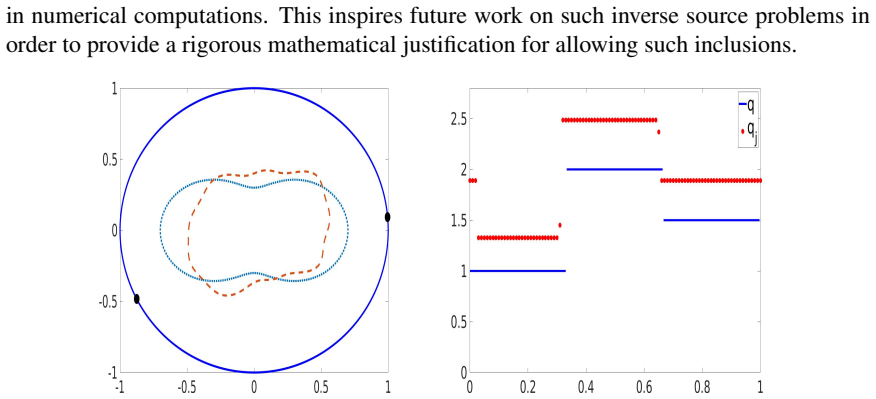
- The regularity assumption $p\in D((-\Delta)^\gamma)$ excludes discontinuous characteristic-function sources, but such sources can be approximated arbitrarily well, and the paper's numerical experiments treat them successfully with a different reconstruction scheme.
- The proof carries over to smooth bounded domains in $\mathbb{R}^2$ and self-adjoint elliptic operators $L=-\nabla\cdot(a\nabla u)+q_0u$, provided the measurement points avoid zeros of boundary traces of eigenfunctions, as stated in Remark 3.1.
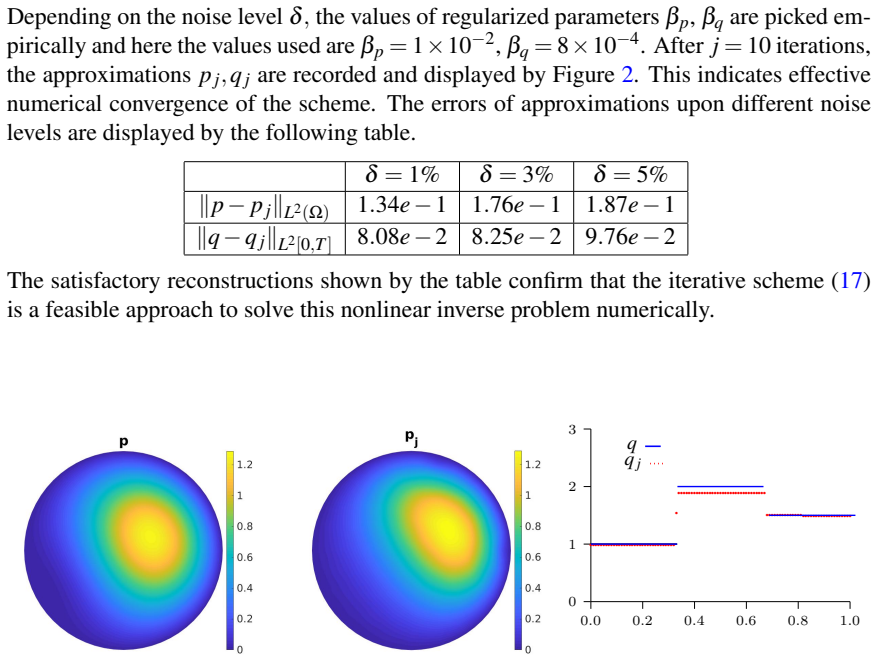
- The alternating algorithm with Tikhonov and total-variation regularization reconstructs both factors from noisy flux data at 1% to 5% noise in the reported experiments.
Reading between the lines
- An implication the paper leaves implicit is that the irrational-separation condition is not a practical obstacle: for the finitely many eigenmodes that matter numerically, one can avoid rational separations with small denominators by choosing sensors from the degree-scale angular gaps the paper maps out.
- The Laplace-transform structure suggests a testable extension to fractional diffusion, where $e^{-\lambda_n t}$ is replaced by a Mittag-Leffler function; the same analyticity and zero-accumulation arguments should yield an analogous uniqueness theorem, with different short-time decay altering numerical conditioning.
- The intrinsic scale ambiguity means any practical inversion must fix a normalization such as $\|p\|_{L^2}=1$; without that choice the data-to-solution map is locally flat along the one-parameter scaling family even though the quotient problem is unique.
- If the angular condition fails, the coefficient matrix in the proof becomes singular on infinitely many eigenmodes, so the condition is likely necessary as well as sufficient; constructing a nonzero $p$ whose two-point flux vanishes at a rational separation would demonstrate this sharply.
Signed reviews
Editorial analysis
A structured set of objections, weighed in public.
Referee Report
Summary. The paper studies the inverse problem of recovering a separated source term f(x,t)=p(x)q(t) in the heat equation on the unit disc, with zero Dirichlet data and zero initial data, from normal-derivative traces recorded at two boundary points for all positive times. Under Assumption 2.1, which requires p to belong to D((-Δ)^γ) for some γ>0 and q to be a piecewise-constant L^1 function with a positive minimum gap between consecutive jump times, the main theorem (Theorem 1) claims that the pair (p,q) is determined uniquely up to the multiplicative ambiguity (p,q)↦(C p, C^{-1}q), provided the angular separation of the two measurement points is not a rational multiple of π. The proof combines a harmonic-function representation of the flux, a Laplace transform identity, and several auxiliary lemmas on Dirichlet series; a numerical section presents an alternating Tikhonov iteration with total-variation regularization for step-function sources and shows reconstructions for several test examples.
Significance. If Theorem 1 is established, the paper makes a meaningful contribution: it demonstrates that two time-resolved boundary flux measurements can determine a two-component product source up to scaling, extending the two-point result of Hettlich and Rundell to a genuinely time-dependent factor. The proof is largely self-contained, the regularity assumptions and the resulting limitations are stated candidly, and the numerical experiments illustrate the practical behavior of a reconstruction scheme. However, the central proof contains a specific gap in Lemma 3.6, which is invoked twice in the proof of Theorem 1. Because the gap is load-bearing for the uniqueness claim, the paper cannot be accepted in its present form; nevertheless, the statement of Lemma 3.6 is plausible and a repair appears feasible within the scope of the manuscript, so a major revision is the appropriate outcome.
major comments (2)
- [Lemma 3.6, proof, after the decomposition of L1 into S_l^1 and S_l^2] The inference 'This implies that S_l^1(s) is bounded on C+' is not justified. The preceding limit, lim_{Re s→∞} S_l^1(s)=0, controls the behavior only along a ray (or at best uniformly in vertical strips if the limit is interpreted that way); it does not preclude growth such as e^{ε Re s} in other parts of the half-plane. The separately derived bound for Re s<0 does not cover Re s≥0, so the function has not been shown to be bounded on C. Consequently, the Liouville-theorem step that S_l^1 is constant, and then zero, is not established. This is a genuine gap because Lemma 3.6 is used twice in the proof of Theorem 1: once to conclude p=0 from lim_{Re s→∞} e^{εs} q_1 P_l(s)=0 when c_1≠c~_1, and again to obtain q_1 p - q~_1 p~ = 0 after c_1=c~_1. The lemma's statement may still be true, but a different argument is needed, for example showing directly from the assumption that the Dirichlet series F_l(t)=∑ a_n(z_l)p_n e^{-λ_n t} vanishes on (0,ε), or obtaining a genuine uniform bound for S_l^1 on C+ by a more refined estimate.
- [Proof of Theorem 1, final case K < K~] The step from 'the union of the sets of zeros of the two factors covers C+' to 'we can find an open connected nonempty subset C1⊂C+ such that P~_l(s)≡0 on C1' is terse. The intended argument is a Baire category argument: the zero set of the finite exponential sum has no accumulation points and is therefore nowhere dense, so if the union of the zero sets covers C+, the zero set of P~_l must have nonempty interior. This requires the additional observation that P~_l is not identically zero, which follows from Lemma 3.6 and Assumption 2.1. Please spell out this argument; as written, the conclusion does not follow from the preceding sentence alone.
minor comments (5)
- [Remark 3.1] The claim that the eigenfunctions form a complete basis for L^2(Ω) and that their restrictions to ∂Ω also form a complete set is inaccurate as written: Dirichlet eigenfunctions vanish on the boundary. If the intended object is instead the normal derivatives, or the traces of the harmonic functions ξ_j, the statement should be corrected and a proof or reference supplied.
- [Lemma 3.6 and Theorem 1] The notation lim_{Re s→∞} is ambiguous. If the limit is taken only along the real axis, the boundedness inference in Lemma 3.6 is even more clearly invalid; if it is intended uniformly for all s with Re s→∞, that should be stated explicitly, since the subsequent arguments rely on the meaning.
- [Proof of Lemma 3.6, application of Lemma 3.5] When applying Lemma 3.5 to the equation ∑ a_n p_n (1−e^{-λ_n t})=0 on (0,ε), the text says 'the conditions of Lemma 3.5 are satisfied' but does not explicitly note that the constant term ∑ a_n p_n must be included as a zero-exponent term in the Dirichlet series. This is a minor omission; please clarify.
- [Section 4.2, paragraph on measurement points] The condition 'k(θ1−θ2) ≠ jπ for any integers j,k' should specify k≠0; when k=0 the inequality is false for j=0. The intended condition is that m(θ1−θ2) is not an integer multiple of π for every nonzero integer m.
- [Throughout] There are several typographical and grammatical issues: in the Introduction, 'we have unable to allow' should be 'we have been unable to allow'; in Section 4.1, 'saves the edge-preserving property' should be 'has the edge-preserving property'; in Lemma 3.2, 'Cauchy-Schwartz' should be 'Cauchy-Schwarz'.
Circularity Check
No significant circularity: the uniqueness proof is parameter-free and does not reduce to fitted data or to a restatement of prior work.
full rationale
Theorem 1 is a parameter-free uniqueness statement: equality of two flux traces forces p = C0 tilde-p and q = C0^{-1} tilde-q. No parameter is fitted to data and then renamed a prediction; the data appear only as the hypothesis that the two traces coincide. The representation (Corollary 3.1 and equation (12)) is derived from the eigenfunction expansion and the harmonic-basis identity (8). The identity (8) is quoted from [6], whose first author overlaps with the present paper, but it is a published, parameter-free computation about products of harmonic functions and Laplacian eigenfunctions; it does not assume the conclusion of Theorem 1 and it is not the same as the time-dependent uniqueness theorem. Lemmas 3.4, 3.5, and 3.6 are proved in the paper: Lemma 3.4 uses only the angular structure of the eigenfunctions and the irrationality condition; Lemma 3.5 is a standard Dirichlet-series zero argument; Lemma 3.6 is a Laplace-transform/Liouville-type argument. The possible boundedness gap in Lemma 3.6 noted by the skeptic is a correctness issue, not a circularity, so per the instructions it does not affect this score. The step-function form of q is an explicit assumption, not a conclusion smuggled in. Numerical experiments are presented as reconstructions, not as evidence for the theorem. Thus no step reduces by construction to its own input; the score of 2 merely acknowledges the presence of self-citations ([6], [10], [11]) without treating them as circular.
Assumptions & free parameters
assumptions (7)
- standard math The eigenfunctions of the Dirichlet Laplacian on the unit disc form an orthonormal basis of L2, and the eigenvalues satisfy lambda_n = O(n) (Weyl's law).
- standard math Bessel functions of integer order have no common positive zeros (Bourget's hypothesis, proven by Siegel).
- standard math The trace map from H^{2γ+2}(Ω) to H^{2γ+1/2}(∂Ω) is continuous for the normal derivative, and H^s(∂Ω) embeds into C^{0,2γ} for appropriate s.
- standard math If the Laplace transform of an integrable function vanishes on a right half-plane, the function is zero almost everywhere.
- domain assumption The time factor q is a linear combination of Heaviside steps, q in L1(0,∞), with a positive minimal gap η between switching times.
- domain assumption The space factor p lies in D((-Δ)^γ) for some γ > 0.
- domain assumption Flux data are measured for all t in (0,∞) at two boundary points.
Cite this review
Pith. "Pith review of On the identification of source term in the heat equation from sparse data." pith.science (2026). https://pith.science/paper/JPMGIJLY
@misc{pith2026190802015,
  author       = {Pith},
  title        = {Pith review of: On the identification of source term in the heat equation from sparse data},
  year         = {2026},
  howpublished = {\url{https://pith.science/paper/JPMGIJLY}},
  note         = {Machine review of arXiv:1908.02015}
}
abstract
We consider the recovery of a source term $f(x,t)=p(x)q(t)$ for the nonhomogeneous heat equation in $\Omega\times (0,\infty)$ where $\Omega$ is a bounded domain in $\mathbb{R}^2$ with smooth boundary $\partial\Omega$ from overposed lateral data on a sparse subset of $\partial\Omega\times(0,\infty)$. Specifically, we shall require a small finite number $N$ of measurement points on $\partial\Omega$ and prove a uniqueness result; namely the recovery of the pair $(p,q)$ within a given class, by a judicious choice of $N=2$ points. Naturally, with this paucity of overposed data, the problem is severely ill-posed. Nevertheless we shall show that provided the data noise level is low, effective numerical reconstructions may be obtained.
Figures

Figures from the paper (3 more)

Reference graph
Works this paper leans on
-
[1]
J. R. Cannon. Determination of an unknown heat source from overspecified boundary data source in the heat equation. SIAM Journal on Numerical Analysis, 5(2), 1968
work page 1968
-
[2]
J. R. Cannon and S. P. Esteva. An inverse problem for the heat equation. Inverse Prob- lems, 2(4):395–403, nov 1986
work page 1986
-
[3]
Di Nezza, G
E. Di Nezza, G. Palatucci, and E. Valdinoci. Hitchhiker’s guide to the fractional Sobolev spaces. Bull. Sci. Math., 136(5):521–573, 2012
2012
-
[4]
D. S. Grebenkov and B.-T. Nguyen. Geometrical structure of Laplacian eigenfunctions. SIAM Rev., 55(4):601–667, 2013
work page 2013
-
[5]
M. Hanke and W. Rundell. On rational approximation methods for inverse source prob- lems. Inverse Probl. Imaging, 5(1):185–202, 2011
work page 2011
-
[6]
F. Hettlich and W. Rundell. Identification of a discontinuous source in the heat equation. Inverse Problems, 17(5):1465–1482, 2001
work page 2001
-
[7]
V . Isakov. Inverse source problems, volume 34 of Mathematical Surveys and Mono- graphs. American Mathematical Society, Providence, RI, 1990. 24
work page 1990
-
[8]
J.-L. Lions and E. Magenes. Non-homogeneous boundary value problems and applica- tions. Vol. I. Springer-Verlag, New York-Heidelberg, 1972. Translated from the French by P. Kenneth, Die Grundlehren der mathematischen Wissenschaften, Band 181
work page 1972
Show all 12 references
-
[9]
J. L. Mueller and S. Siltanen. Linear and nonlinear inverse problems with practical applications, volume 10 ofComputational Science & Engineering. Society for Industrial and Applied Mathematics (SIAM), Philadelphia, PA, 2012
2012
-
[10]
W. Rundell. An inverse problem for a parabolic partial differential equation. Rocky Mountain J. Math., 13(4):679–688, 1983
1983
-
[11]
Rundell and Z
W. Rundell and Z. Zhang. Recovering an unknown source in a fractional diffusion prob- lem. J. Comput. Phys., 368:299–314, 2018
2018
-
[12]
C. L. Siegel. ¨Uber einige Anwendungen diophantischer Approximationen [reprint of Abhandlungen der Preußischen Akademie der Wissenschaften. Physikalisch- mathematische Klasse 1929, Nr. 1]. In On some applications of Diophantine approx- imations, volume 2 of Quad./Monogr., page...
1929
Reviewed August 14, 2026 · model on record in the stance chip above.
Discussion (0). Continue with ORCID to comment.