REVIEW 3 major objections 4 minor 38 references
Stability of slip channel flow revisited
T0 review · 3 major / 4 minor · reviewed 2026-08-14 · deepseek-v4-flash
Pith's one-line read With sufficiently large slip, both streamwise and spanwise wall slip switch the leading instability of channel flow to three-dimensional modes; spanwise slip can reduce the critical Reynolds number to about 336, while streamwise slip…
desk verdict The 3-D instability results are interesting and likely right, but the paper omits the derivation of the one boundary condition everything new depends on, so it needs a serious referee and an independent check. read the letter →
The pith
A machine-rendered reading of the paper's core claim, the machinery that carries it, and where it could break.
The reading
What carries the argument
The central object that carries the argument is the velocity–vorticity form of the linearized incompressible Navier–Stokes equations, in which the wall-normal velocity $u_y$ satisfies a fourth-order Orr–Sommerfeld-type equation and the wall-normal vorticity $\eta=\partial u_x/\partial z-\partial u_z/\partial x$ satisfies a second-order equation, coupled at the walls through the Navier slip condition. This formulation lets the authors build a spectral Fourier–Chebyshev eigenvalue problem and scan the four-parameter space $(Re,\alpha,\beta,\lambda)$ to locate the first unstable mode. For non-modal growth, they use an adjoint-based time-stepping method in primitive variables, iterated with a Krylov subspace solver, which gives the maximum transient growth $G(t)$ and the optimal perturbation. The key conceptual distinction is two-dimensional ($\beta=0$) versus three-dimensional modes, because the earlier conclusion that slip stabilizes the flow came from considering only the two-dimensional modes.
What would settle it
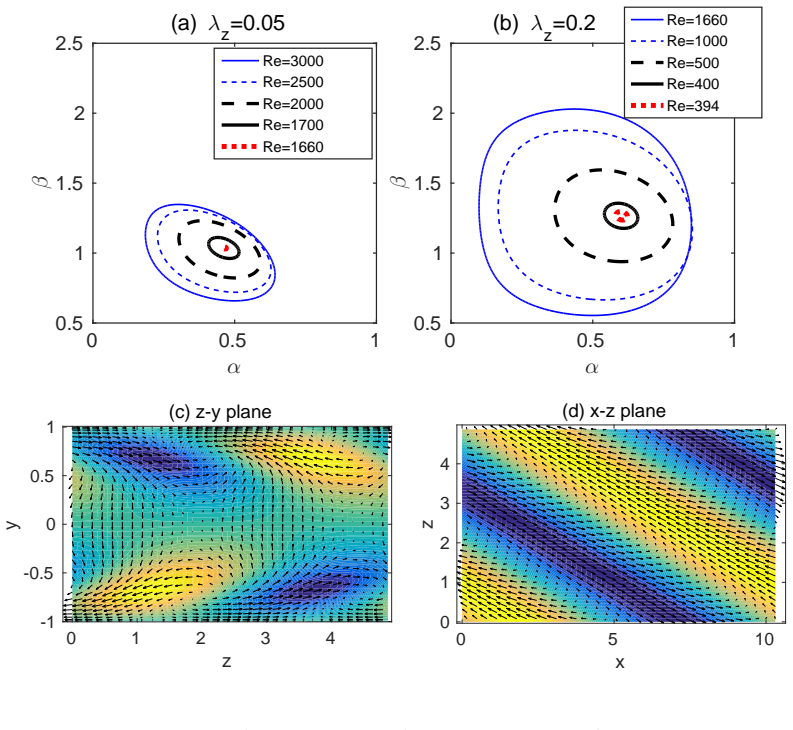
Run an independent primitive-variable linear stability calculation (solving the linearized Navier–Stokes equations directly with the Navier slip condition, without the velocity–vorticity $\eta$ boundary condition) for $\lambda_z=0.2$ at $Re=400$: if no mode with streamwise wavenumber $\alpha\simeq0.6$ and spanwise wavenumber $\beta\simeq1.27$ is unstable, the paper's $\eta$ boundary condition is incorrect; if the mode is reproduced, the claim is confirmed.
Extended reading notes
Core claim
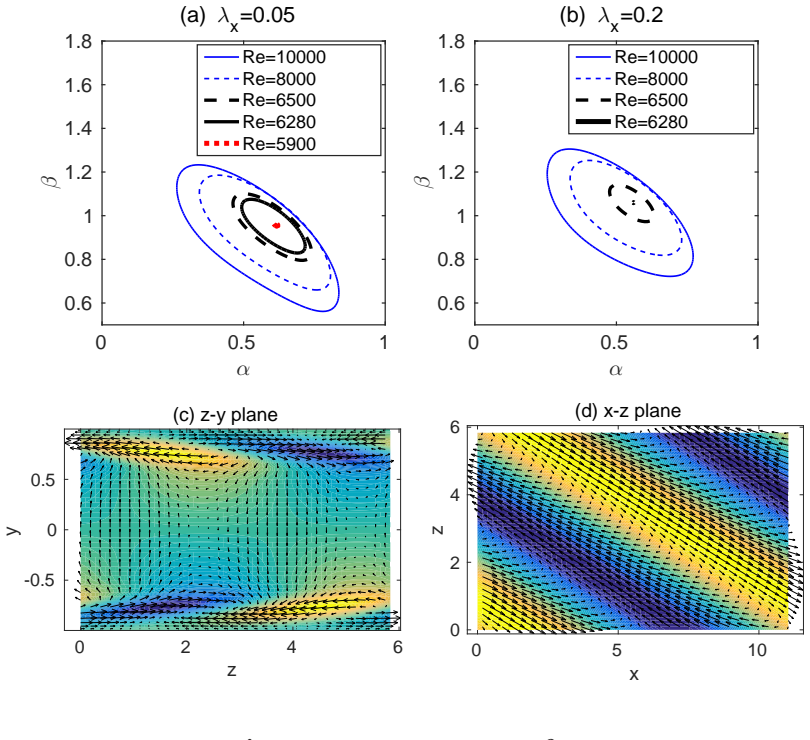
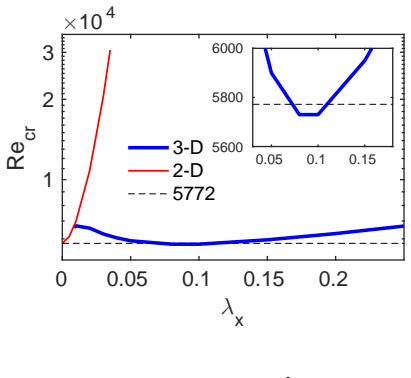
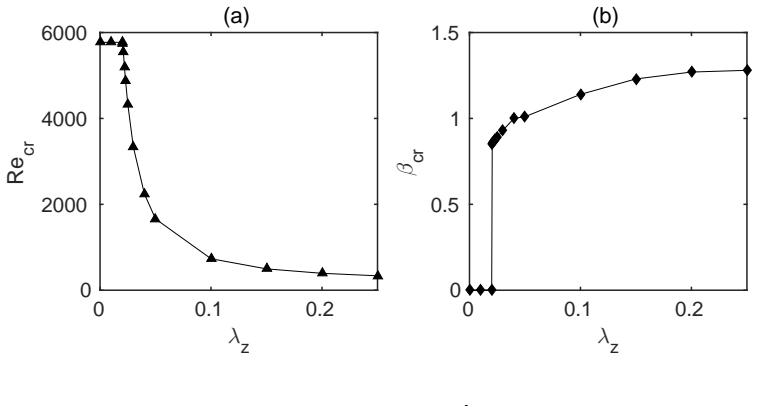
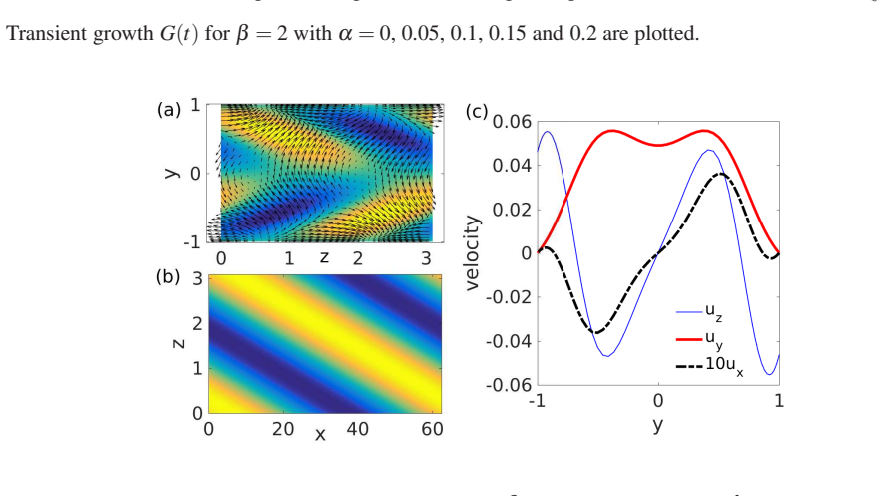
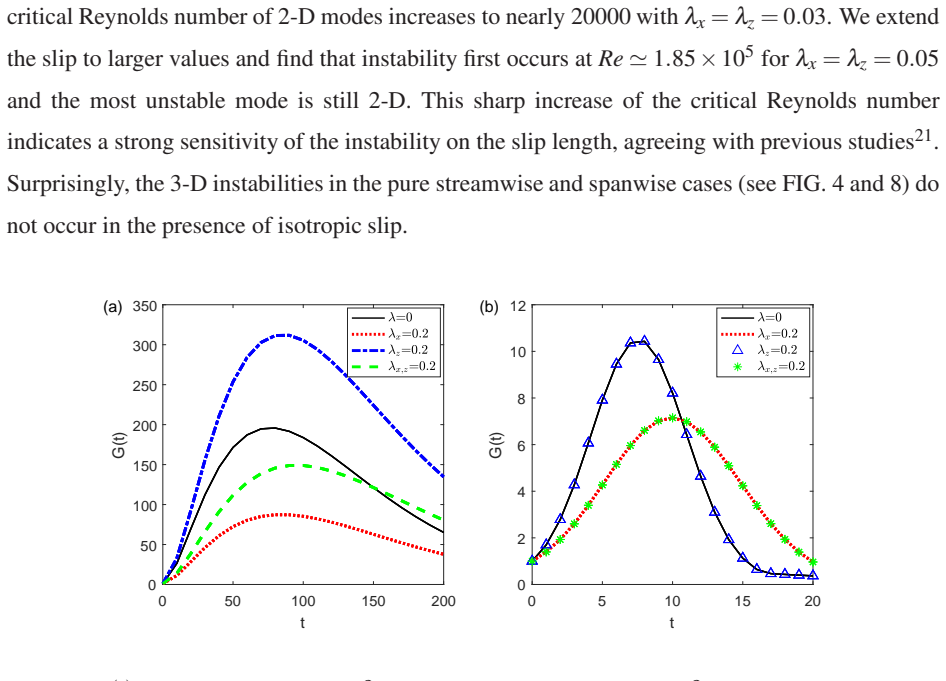
The central discovery is that the linear stability of slip channel flow is controlled by the direction of slip. Using the velocity–vorticity formulation of the linearized Navier–Stokes equations with the Navier slip boundary condition at both walls, the paper computes eigenvalues over the streamwise and spanwise wavenumbers $(\alpha,\beta)$ for a wider range of slip lengths than earlier work. For streamwise slip ($\lambda_x$), two-dimensional modes ($\beta=0$) do become more stable as $\lambda_x$ grows, but above $\lambda_x\simeq 0.008$ three-dimensional modes are the most dangerous, so the critical Reynolds number stays near the no-slip value $Re_{cr}\simeq 5772$, reaching about 6280 at $\lambda_x=0.2$ and even dipping below 5772 for $0.07\lesssim\lambda_x\lesssim0.11$. For spanwise slip ($\lambda_z$), which does not alter the parabolic base flow, three-dimensional instabilities appear once $\lambda_z$ exceeds about 0.02 and the critical Reynolds number falls sharply, to about 394 at $\lambda_z=0.2$ and 336 at $\lambda_z=0.25$. Equal slip in both directions removes these three-dimensional instabilities and raises the critical Reynolds number to about $1.85\times10^5$ at $\lambda=0.05$. The paper also reports that spanwise slip enlarges the non-modal transient growth and moves the optimal perturbations to small finite streamwise wavenumbers, producing tilted streak structures instead of streamwise rolls.
Load-bearing premise
The three-dimensional results rest on the paper's unshown derivation of the boundary condition that couples the wall-normal vorticity $\eta$ to derivatives of the wall-normal velocity $u_y$ at the channel walls; if that boundary condition or its numerical implementation is wrong, the reported three-dimensional eigenvalues and critical Reynolds numbers would be invalid.
Editorial extensions
If this is right
- Three-dimensional modes, not spanwise-invariant Tollmien–Schlichting waves, set the stability threshold for slip lengths above $\lambda_x\simeq0.008$ or $\lambda_z\simeq0.02$; any stability analysis that restricts to two-dimensional modes will overestimate the stabilizing effect of slip.
- Spanwise slip can make a channel linearly unstable at Reynolds numbers an order of magnitude below the no-slip threshold—$Re_{cr}\simeq394$ at $\lambda_z=0.2$—so flows previously assumed linearly stable in this range can be unstable.
- Streamwise slip does not strongly stabilize the flow: $Re_{cr}$ stays around 5900–6300 for $\lambda_x$ up to 0.2, with a small window of $\lambda_x$ where the flow is slightly less stable than no-slip flow.
- Isotropic slip with equal streamwise and spanwise lengths suppresses the three-dimensional instabilities and greatly raises the critical Reynolds number, so the destabilizing effect is specifically due to anisotropy rather than to slip itself.
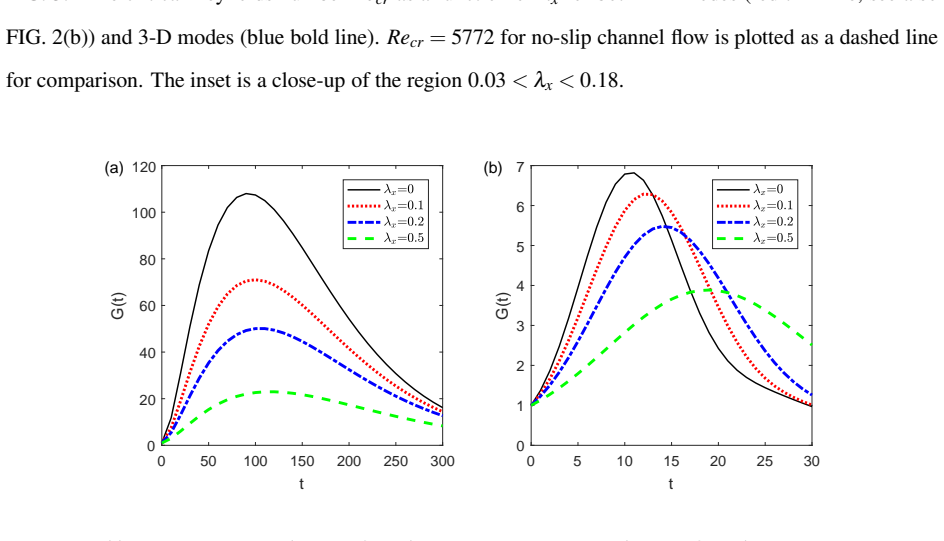
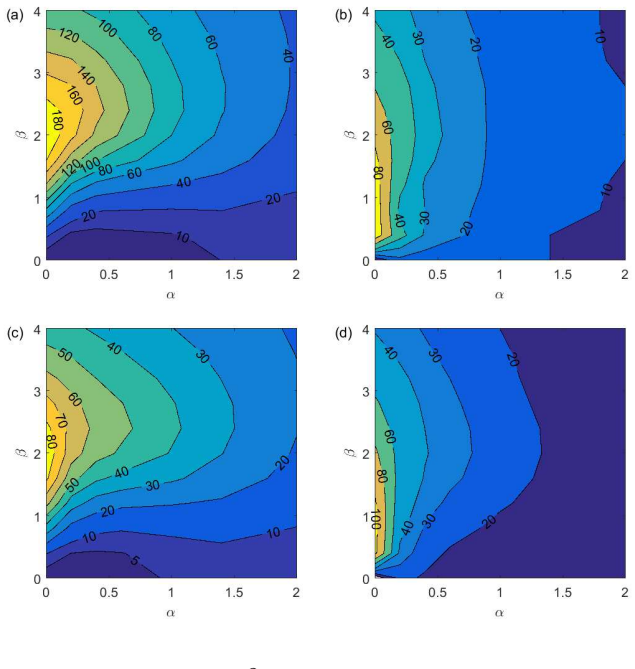
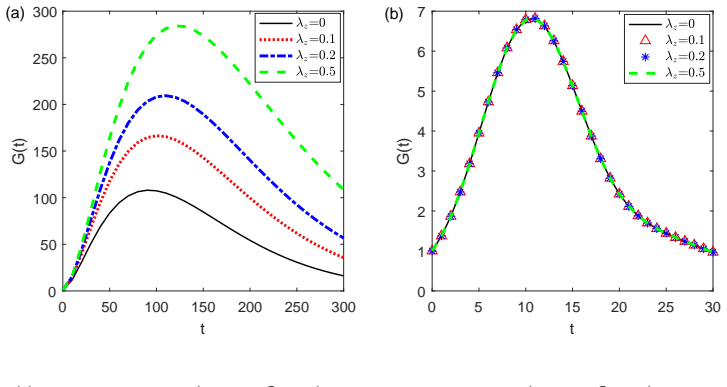
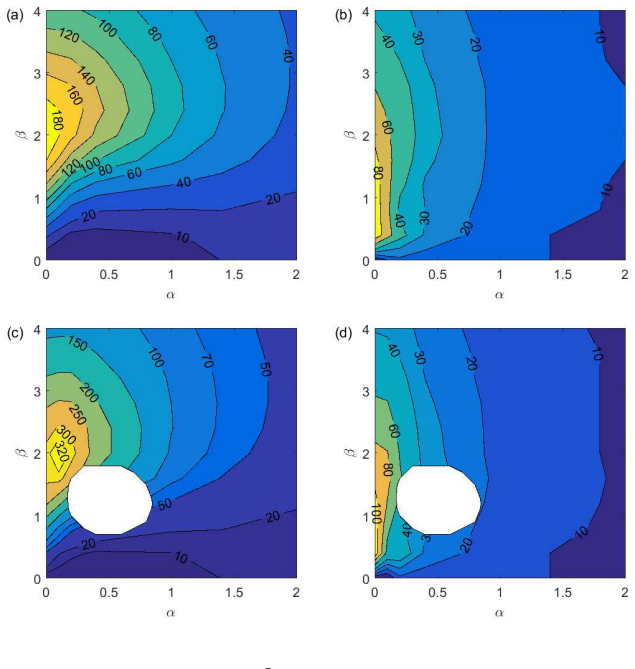
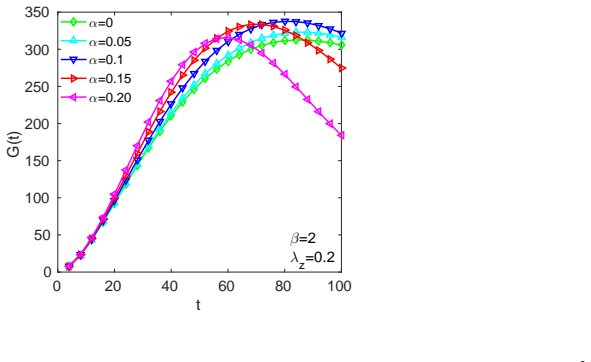
- Spanwise slip changes the shape of the most amplified transient perturbations, replacing streamwise rolls with tilted long-wavelength structures, while streamwise slip reduces transient growth without changing the dominant structure.
Reading between the lines
- If the critical Reynolds number for spanwise slip is as low as roughly 336, then in millimeter-scale channels with effective slip lengths on the order of 0.2 times the half-gap, linear instability should be observable at flow speeds far below the usual transition threshold; this is a testable experimental prediction with superhydrophobic surfaces that slip only in the spanwise direction.
- The finding that spanwise slip destabilizes while leaving the base flow unchanged suggests the instability is produced by the modified wall condition acting on fluctuations rather than by reduced shear; an energy-budget or resolvent analysis of the three-dimensional eigenmodes could identify the production term responsible.
- The same tilted three-dimensional modes likely connect the single-phase slip-channel results to oblique-wave instabilities reported in earlier two-fluid slippery channel studies; the paper's mode shapes could be compared directly with those earlier eigenfunctions to test whether the mechanism is shared.
Signed reviews
Editorial analysis
A structured set of objections, weighed in public.
Referee Report
Summary. The paper revisits the linear modal and non-modal stability of plane channel flow subject to Navier slip at the walls, treating streamwise and spanwise slip as two separate limiting cases of anisotropic slip and also considering isotropic slip. Using a velocity-vorticity formulation for modal stability and an adjoint-based time-stepper for transient growth, the authors report that sufficiently large streamwise slip (λx above about 0.008) or spanwise slip (λz above about 0.02) makes three-dimensional modes the leading unstable modes, in contrast to the two-dimensional leading modes of no-slip channel flow. They report that the critical Reynolds number is only mildly increased by streamwise slip (Recr about 5900 at λx=0.05 and 6280 at λx=0.2) but is drastically reduced by spanwise slip (Recr about 394 at λz=0.2 and 336 at λz=0.25), while equal isotropic slip strongly stabilizes the flow. They also report that streamwise slip suppresses transient growth, spanwise slip enhances it and changes the optimal perturbation structure, and isotropic slip yields transient growth dominated by the streamwise-slip effect.
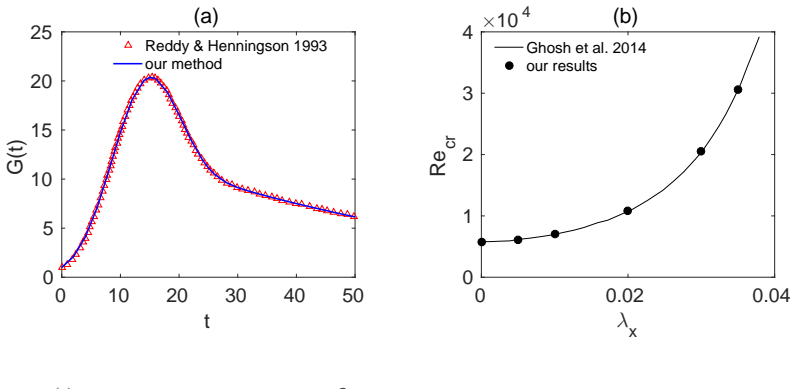
Significance. If the reported three-dimensional instabilities are correct, the paper provides a substantive correction to the earlier conclusion, attributed to Lauga & Cossu (2005) and Min & Kim (2005), that velocity slip suppresses linear instability: that conclusion was based on two-dimensional modes, and this paper shows that sufficiently large anisotropic slip can make oblique/three-dimensional modes unstable at lower Reynolds numbers, even below the no-slip critical value for spanwise slip. The non-modal results, especially the shift of the optimal perturbation from streamwise-invariant rolls to finite-small-α oblique structures under spanwise slip, are also physically interesting and falsifiable. The paper's strengths include two explicit benchmark validations (no-slip transient growth against Reddy & Henningson (1993), and two-dimensional streamwise-slip critical Reynolds numbers against Ghosh et al. (2014)), a systematically explored parameter range, and internally consistent smooth trends in the reported eigenvalue data.
major comments (3)
- [§II.E, Eqs. (7)–(10)] The boundary condition for the wall-normal vorticity η is the load-bearing step for all three-dimensional modal results, but neither its derivation nor its final form is shown. The paper states that the η boundary condition 'can be derived using the slip boundary condition (2)' and that 'four boundary conditions coupling η and uy' result, yet the explicit conditions at y=±1 are absent. Since Eqs. (9)–(10) express ux and uz in terms of η and ∂uy/∂y, imposing Eq. (2) on ux and uz yields boundary relations involving η, ∂η/∂y, and second derivatives of uy; the reader cannot check the signs, the wall-normal orientation, or the handling of the (α²+β²)-¹ factor. If this derivation is incorrect, the eigenvalues in Figs. 4, 5, 8, and 9, and therefore every reported Recr value for three-dimensional modes, are not eigenvalues of the stated physical problem. The authors must present the full derivation and the final boundary conditions.
- [§III.A, Fig. 2; §III.B–C] No validation or convergence check exercises the three-dimensional coupled η–uy boundary condition. The two reported validations are a no-slip transient-growth calculation using the primitive-variable time-stepper and two-dimensional (β=0) streamwise-slip critical Reynolds numbers; neither involves the coupling of η with uy at nonzero β that is central to the new three-dimensional instability results. Moreover, no grid-convergence study is reported for any of the eigenvalue computations shown in Figs. 4, 5, 8, or 9. I request an explicit N-convergence test for a representative unstable three-dimensional mode, e.g., the λz=0.2, Re=394, (α,β)=(0.6,1.27) case, together with an independent check against direct temporal integration of the primitive-variable linearized equations (3) for the same parameters.
- [§III.D] The claim that three-dimensional instabilities 'disappear' under isotropic slip is supported too thinly. The text reports that for λx=λz=0.05 the first instability occurs at Re≃1.85×10⁵ and that the most unstable mode is still two-dimensional, but it does not state the range of (α,β) searched, the eigenvalue algorithm's convergence at such high Reynolds numbers, or how the absence of unstable three-dimensional modes was established. Because this negative result is used to contrast anisotropic and isotropic slip, it needs the same level of documentation as the positive instability searches.
minor comments (4)
- [§I] The sentence stating that subcritical transition 'can occur way below this Reynolds number at about Re=6601' is self-contradictory, since 6601 is above the no-slip critical value 5772; this appears to be a typo and should be corrected.
- [Throughout] There are numerous typographical errors that should be fixed in a revision, including 'Cartisian' (Cartesian), 'exerpiments' (experiments), 'boundanry' (boundary), 'stuctures' (structures), and 'steamwise' (streamwise).
- [Fig. 2(b) caption] The caption should identify clearly which curve is the reference data from Ghosh et al. and which points are the present results; the current text says the reference values are plotted as a solid line but does not state the symbol/line style for 'our results'.
- [§II.B] The claim that the adjoint system uses 'the same boundary condition (2)' would benefit from a one-line justification, since the adjoint Robin condition is not automatic for every non-self-adjoint formulation; a short derivation or citation would remove ambiguity.
Circularity Check
No significant circularity: slip lengths are specified model inputs and the stability results follow from solving the linearized equations, with validation against independent external benchmarks.
full rationale
The paper's central results are eigenvalues and transient-growth curves obtained by solving the linearized Navier-Stokes equations subject to the externally imposed Navier slip condition (2). The streamwise and spanwise slip lengths are prescribed model parameters, not fitted to the reported critical Reynolds numbers or optimal-growth curves, so there is no fitted-input-called-prediction pattern. The method is validated against two independent external references: the no-slip transient growth of Reddy & Henningson (1993) and the 2-D critical Reynolds numbers of Ghosh et al. (2014); these benchmarks do not depend on the paper's fitted values. The derivation of the wall-normal vorticity boundary condition in Section II.E is not shown, and the missing derivation is a legitimate correctness concern for the 3-D eigenvalues, but an omitted or unverified step is not circularity unless it reduces the output to an input by construction. No self-citation chain carries the load-bearing argument, no known result is merely renamed, and no prediction is equivalent to its inputs by definition. Accordingly, the honest finding is no significant circularity.
Assumptions & free parameters
free parameters (2)
- streamwise slip length λx =
not fitted; parameter sweep (values include 0, 0.05, 0.1, 0.2, 0.5; up to 0.25 in Recr trends)
- spanwise slip length λz =
not fitted; parameter sweep (values include 0, 0.05, 0.1, 0.2, 0.5; up to 0.25 in Recr trends)
assumptions (3)
- domain assumption The Navier slip boundary condition with homogeneous, constant, directionally independent slip lengths (Eq. 2) also applies to the perturbation velocity field and to the adjoint field.
- standard math The velocity-vorticity formulation (Eqs. 7-10) with six boundary conditions, including the slip-derived boundary condition for η, is equivalent to the linearized Navier-Stokes system with the Navier slip condition.
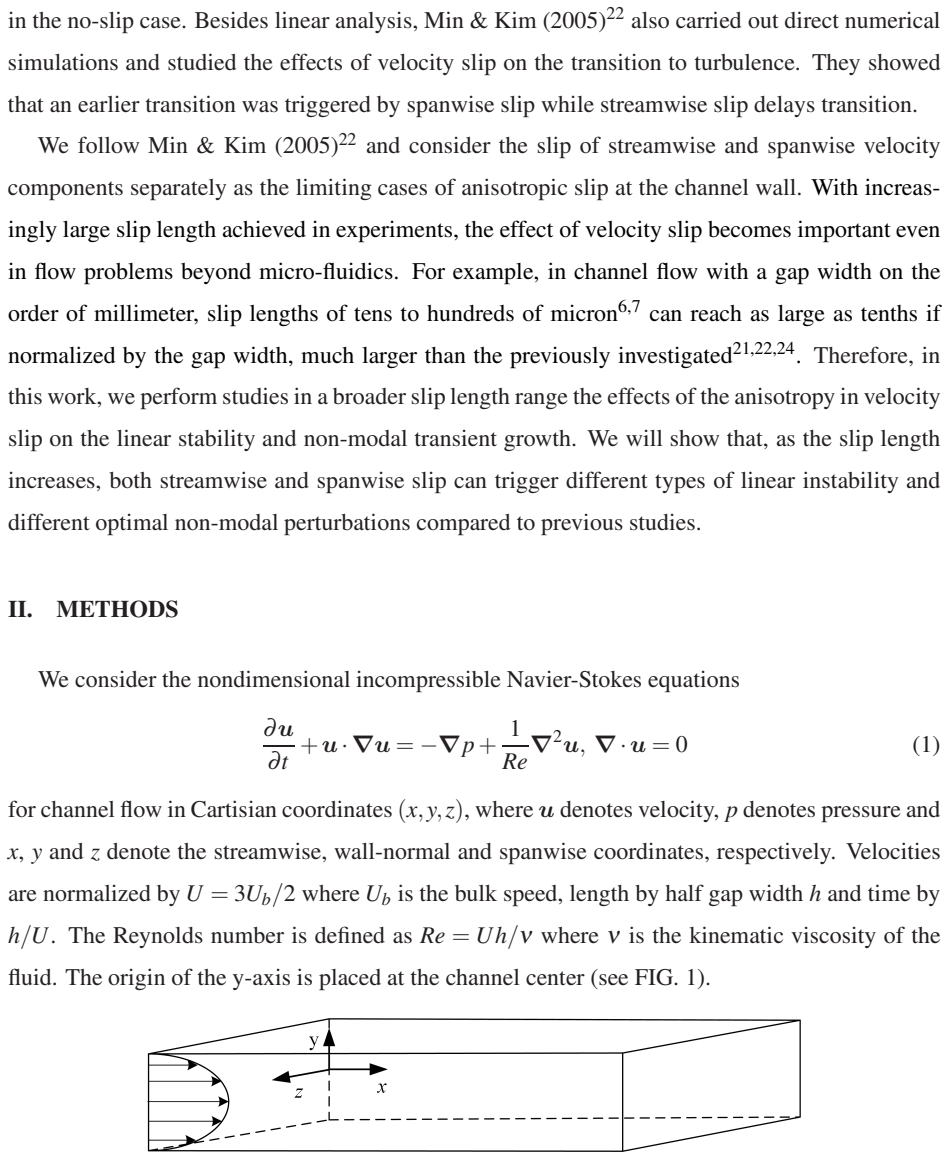
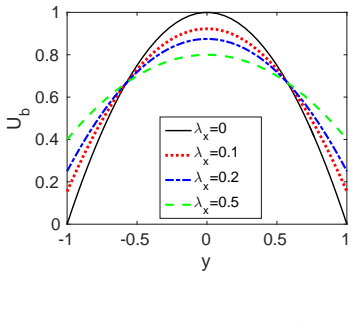
- domain assumption The base flow is a steady, parallel, parabolic profile with fixed bulk velocity; for streamwise slip the profile flattens with increasing λx, and for spanwise slip the profile is unchanged.
Cite this review
Pith. "Pith review of Stability of slip channel flow revisited." pith.science (2026). https://pith.science/paper/GSJ754N3
@misc{pith2026190802027,
  author       = {Pith},
  title        = {Pith review of: Stability of slip channel flow revisited},
  year         = {2026},
  howpublished = {\url{https://pith.science/paper/GSJ754N3}},
  note         = {Machine review of arXiv:1908.02027}
}
read the original abstract
In this work, we revisit the temporal stability of slip channel flow. Lauga & Cossu (Phys. Fluids 17, 088106 (2005)) and Min & Kim (Phys. Fluids 17, 108106 (2005)) have investigated both modal stability and non-normality of slip channel flow and concluded that the velocity slip greatly suppresses linear instability and only modestly affects the non-normality. Here we study the stability of channel flow with streamwise and spanwise slip separately as two limiting cases of anisotropic slip and explore a broader range of slip length than previous studies did. We find that, with sufficiently large slip, both streamwise and spanwise slip trigger three-dimensional leading instabilities. Overall, the critical Reynolds number is only slightly increased by streamwise slip, whereas it can be greatly decreased by spanwise slip. Streamwise slip suppresses the non-modal transient growth, whereas spanwise slip enlarges the non-modal growth although it does not affect the base flow. Interestingly, as the spanwise slip length increases, the optimal perturbations exhibit flow structures different from the well-known streamwise rolls. However, in the presence of equal slip in both directions, the three-dimensional leading instabilities disappear and the flow is greatly stabilized. The results suggest that earlier instability and larger transient growth can be triggered by introducing anisotropy in the velocity slip.
Figures
Figures from the paper (11 more)
Reference graph
Works this paper leans on
-
[1]
merlin.mbs aapmrev4-1.bst 2010-07-25 4.21a (PWD, AO, DPC) hacked
FUNCTION id.bst "merlin.mbs aapmrev4-1.bst 2010-07-25 4.21a (PWD, AO, DPC) hacked" ENTRY address archive archivePrefix author bookaddress booktitle chapter collaboration doi edition editor eid eprint howpublished institution isbn issn journal key language month note number organization pages primaryClass publisher school SLACcitation series title translat...
2010
-
[2]
merlin.mbs aipauth4-1.bst 2010-07-25 4.21a (PWD, AO, DPC) hacked
FUNCTION id.bst "merlin.mbs aipauth4-1.bst 2010-07-25 4.21a (PWD, AO, DPC) hacked" ENTRY address archive archivePrefix author bookaddress booktitle chapter collaboration doi edition editor eid eprint howpublished institution isbn issn journal key language month note number organization pages primaryClass publisher school SLACcitation series title translat...
2010
-
[3]
merlin.mbs aipnum4-1.bst 2010-07-25 4.21a (PWD, AO, DPC) hacked
FUNCTION id.bst "merlin.mbs aipnum4-1.bst 2010-07-25 4.21a (PWD, AO, DPC) hacked" ENTRY address archive archivePrefix author bookaddress booktitle chapter collaboration doi edition editor eid eprint howpublished institution isbn issn journal key language month note number organization pages primaryClass publisher school SLACcitation series title translati...
2010
-
[4]
merlin.mbs apsrev4-1.bst 2010-07-25 4.21a (PWD, AO, DPC) hacked
FUNCTION id.bst "merlin.mbs apsrev4-1.bst 2010-07-25 4.21a (PWD, AO, DPC) hacked" ENTRY address archive archivePrefix author bookaddress booktitle chapter collaboration doi edition editor eid eprint howpublished institution isbn issn journal key language month note number organization pages primaryClass publisher school SLACcitation series title translati...
2010
-
[5]
merlin.mbs apsrmp4-1.bst 2010-07-25 4.21a (PWD, AO, DPC) hacked
FUNCTION id.bst "merlin.mbs apsrmp4-1.bst 2010-07-25 4.21a (PWD, AO, DPC) hacked" ENTRY address archive archivePrefix author bookaddress booktitle chapter collaboration doi edition editor eid eprint howpublished institution isbn issn journal key language month note number organization pages primaryClass publisher school SLACcitation series title translati...
2010
-
[6]
J. J. Tao, B. Eckhardt, and X. M. Xiong. Extended localized structures and the onset of turbulence in channel flow. Physical Review Fluids , 3:011902, 2018
work page 2018
-
[7]
L. N. Trefethen, A. E. Trefethen, S. C. Reddy, and T. A. Driscoll. Hydrodynamic instability without eigenvalues. Science , 261:578--584, 1993
work page 1993
-
[8]
S. Reddy and D. S. Henningson. Energy growth in viscous channel flows. J.\,Fluid Mech. , 252:209--238, 1993
work page 1993
Show all 38 references
-
[9]
J Schmid and D
P. J Schmid and D. S. Henningson. Optimal energy density growth in hagen-poiseuille flow. J.\,Fluid Mech. , 277:197--225, 1994
1994
-
[10]
J Schmid
P. J Schmid. Nonmodal stability theory. Ann.\ Rev.\ Fluid Mech. , 39:129--162, 2007
2007
-
[11]
Lee, C.-H
C. Lee, C.-H. Choi, and C.-J Jim. Structured surfaces for a giant liquid slip. Phys.\ Rev.\ Lett. , 101:064501, 2008
2008
-
[12]
Lee and C.-J Jim
C. Lee and C.-J Jim. Maximizing the giant liquid slip on superhydrophobic microstructures by nanostructuring their sidewalls. Langmuir , 25:12812, 2009
2009
-
[13]
R. S. Voronov, D. V. Papavassiliou, and L. L. Lee. Review of fluid slip over superhy - drophobic surfaces and its dependence on the contact angle. Industr. Eng. Chem. Res. , 47:2455--2477, 2008
2008
-
[14]
Chattopadhyay, K
G. Chattopadhyay, K. C. Sahu, and R. Usha. Spatio - temporal instability of two superposed fluids in a channel with boundary slip. International Journal of Multiphase Flow , 113:264--278, 2019
2019
-
[15]
Lauga and H
E. Lauga and H. A. Stone. Effective slip in pressure-driven stokes flow. J.\,Fluid Mech. , 489:55--77, 2003
2003
-
[16]
M. Z. Bazant and O. I. Vinogradova. Tensorial hydrodynamic slip. J.\,Fluid Mech. , 613:125--134, 2008
2008
-
[17]
Kamrin, M
K. Kamrin, M. Z. Bazant, and H. A. Stone. Effective slip boundary conditions for arbitrarily patterned surfaces. Phys.\ Fluids , 23:031701, 2011
2011
-
[18]
H. Park, H. Park, and J. Kim. A numerical study of the effects of superhydrophobic surface on skin - friction drag in turbulent channel flow. Phys.\ Fluids , 25:110815, 2013
2013
-
[19]
Seo and A
J. Seo and A. Mani. On the scaling of the slip velocity in turbulent flows over superhydrophobic surfaces. Phys.\ Fluids , 28:025110, 2016
2016
-
[20]
K. H. Yu, C. J. Teo, and B. C. Khoo. Linear stability of pressure - driven flow over longitudinal superhydrophobic grooves. Phys.\ Fluids , 28:022001, 2016
2016
-
[21]
Kumar, S
A. Kumar, S. Datta, and D. Kalyanasundaram. Permeability and effective slip in confined flows transverse to wall slippage patterns. Phys.\ Fluids , 28:082002, 2016
2016
-
[22]
S. H. Aghdam and P. Ricco. Laminar and turbulent flows over hydrophobic surfaces with shear - dependent slip length. Phys.\ Fluids , 28:035109, 2016
2016
-
[23]
Jr. J. M. Gersting. Hydrodynamic instability of plane porous slip flow. Phys.\ Fluids , 17:2126--2127, 1974
1974
-
[24]
O. I. Vinogradova. Slippage of water over hydrophobic surfaces. Int. J. Min. Process , 56:31--60, 1999
1999
-
[25]
Kwang-Hua Chu
A. Kwang-Hua Chu. Instability of navier slip flow of liquids. C. R. Mechanique , 332:895--900, 2004
2004
-
[26]
Lauga and C
E. Lauga and C. Cossu. A note on the stability of slip channel flows. Phys.\ Fluids , 17:088106, 2005
2005
-
[27]
Min and J
T. Min and J. Kim. Effects of hydrophobic surface on stability and transition. Phys.\ Fluids , 17:108106, 2005
2005
-
[28]
Ghosh, R
S. Ghosh, R. Usha, and K. C. Sahu. Double - diffusive two - fluid flow in a slippery channel: A linear stability analysis. Phys.\ Fluids , 26:127101, 2014
2014
-
[29]
Ghosh, R
S. Ghosh, R. Usha, and K. C. Sahu. Linear stability analysis of miscible two-fluid flow in a channel with velocity slip at the walls. Phys.\ Fluids , 26:014107, 2014
2014
-
[30]
Ghosh, R
S. Ghosh, R. Usha, and K. C. Sahu. Absolute and convective instabilities in double - diffusive two-fluid flow in a slippery channel. Chemical Engineering Science , 134:1--11, 2015
2015
-
[31]
Chattopadhyay, R
G. Chattopadhyay, R. Usha, and K. C. Sahu. Core - annular miscible two - fluid flow in a slippery pipe: A stability analysis. Phys.\ Fluids , 29:097106, 2017
2017
-
[32]
Chakraborty, T
S. Chakraborty, T. W - H Sheu, and K. C. Sahu. Dynamics and stability of a power - law film flowing down a slippery slope. Phys.\ Fluids , 31:013102, 2019
2019
-
[33]
K. C. Sahu, A. Sameen, and R. Govindarajan. The relative roles of divergence and velocity slip in the stability of plane channel flow. Eur. Phys. J. Appl. Phys. , 44:101--107, 2008
2008
-
[34]
Barkley, H
D. Barkley, H. M. Blackburn, and S. J. Sherwin. Direct optimal growth analysis for timesteppers. Int. J. Numer. Meth. Fluids , 57:1435--1458, 2008
2008
-
[35]
L. N. Trefethen. Spectral methods in Matlab . SIAM, 2000
2000
-
[36]
An improved projection scheme applied to pseudospectral methods for the incompressible navier-stokes equations
Sandrine Hugues and Anthony Randriamampianina. An improved projection scheme applied to pseudospectral methods for the incompressible navier-stokes equations. Int. J.\,Num.\ Meth.\ Fluids , 28:501--521, 1998
1998
-
[37]
J. Jimenez. How linear is wall - bounded turbulence. Phys.\ Fluids , 25:110814, 2013
2013
-
[38]
K. C. Sahu and O. K. Matar. Three - dimensional convective and absolute instabilities in pressure - driven two - layer channel flow. International Journal of Multiphase Flow , 37:987--993, 2011
2011
Reviewed August 14, 2026 · model on record in the stance chip above.
Discussion (0). Continue with ORCID to comment.