REVIEW 5 major objections 5 minor 174 references
Digital Watermarking of video streams: Review of the State-Of-The-Art
T0 review · 5 major / 5 minor · reviewed 2026-08-14 · deepseek-v4-flash
Pith's one-line read To pick a video watermarking scheme, first fix the trade-off among invisibility, robustness, and efficiency; the survey argues the right location and method follow from that balance.
desk verdict A broad, useful survey of video watermarking whose abstract overpromises a design framework the body never delivers; fixable with honest framing and a few corrections. read the letter →
The pith
A machine-rendered reading of the paper's core claim, the machinery that carries it, and where it could break.
The reading
What carries the argument
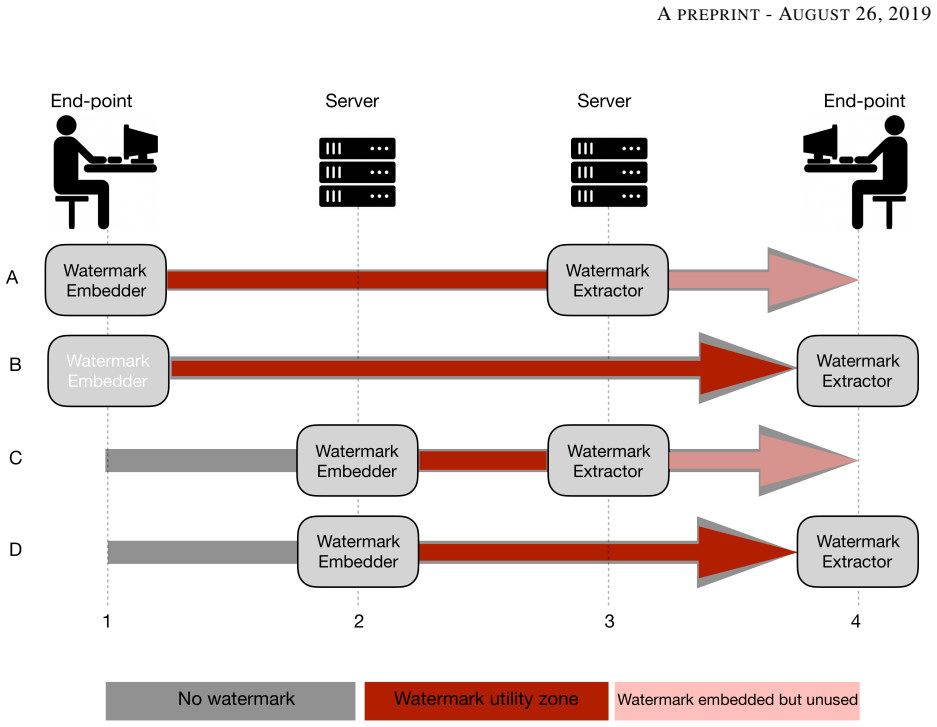
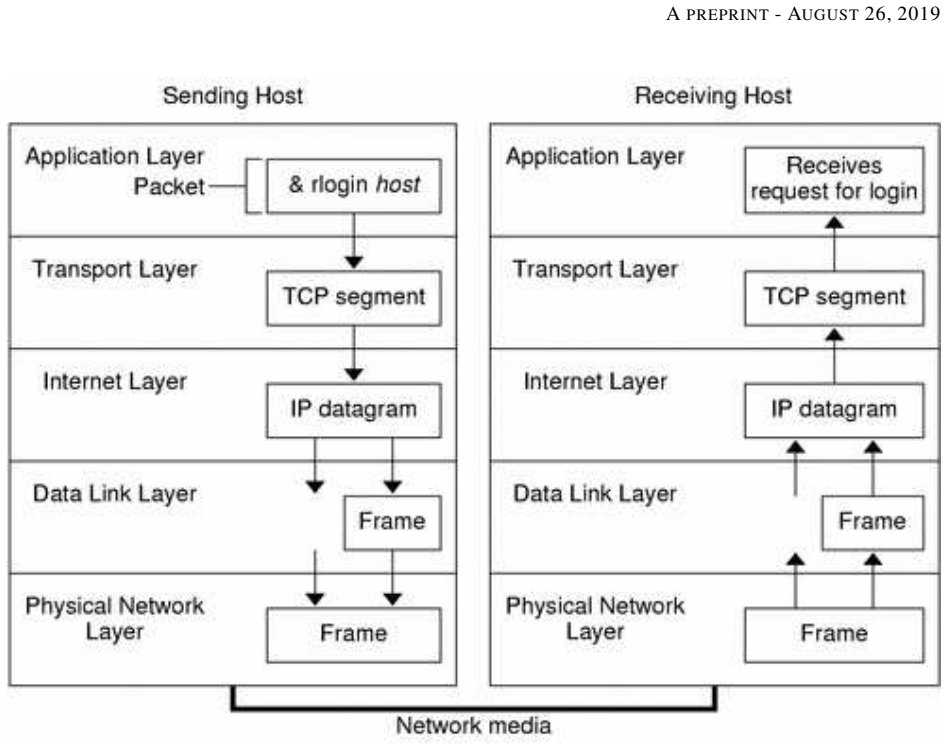
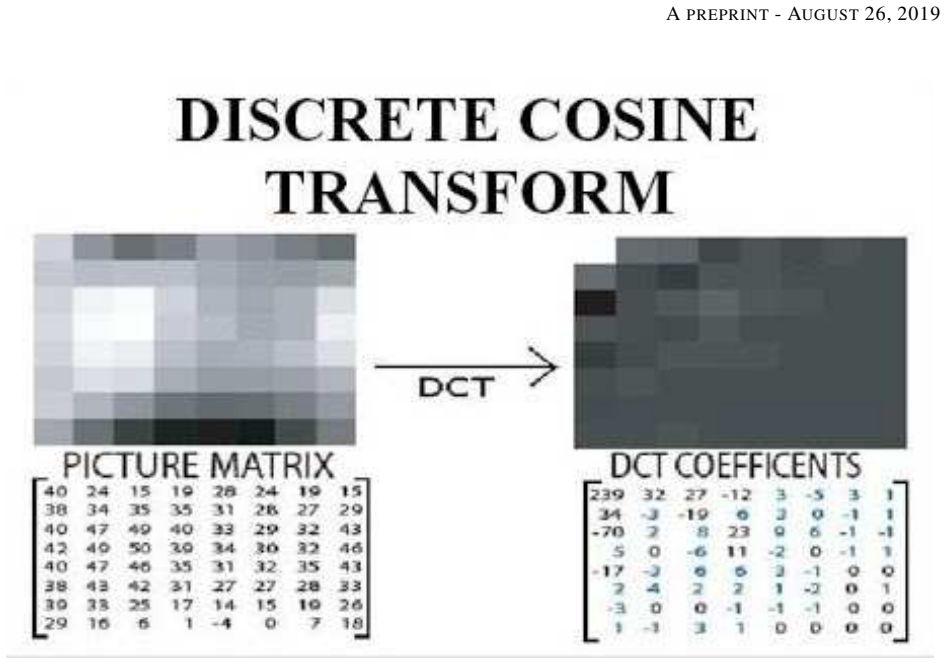
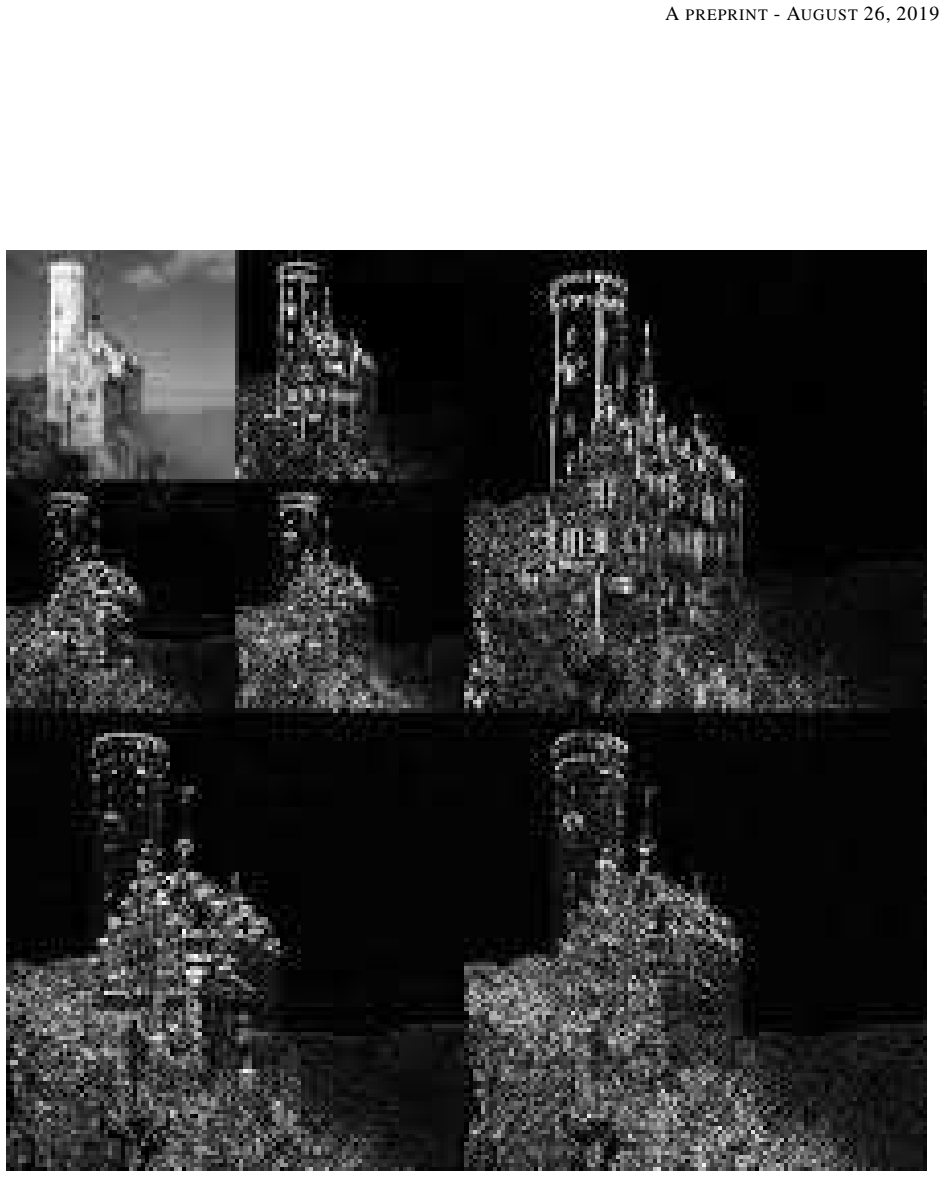
The carrying device is a two-level taxonomy. At the property level, watermarking schemes are characterized by medium fidelity (invisibility), watermark fidelity and recognizability, blindness, robustness, capacity, and time complexity, with the first three in explicit tension. At the design level, the paper decomposes any scheme into location (videos as visual objects with HVS-based block selection, or videos as network data with physical-layer, storage-channel, timing-channel, and application-protocol embedding) and method (spatial versus frequency domain, including DCT, DST, DWT, DFT, SVD, and hybrid domains, plus motion-vector embedding). The survey's central claim is that fixing the equilibrium point on the three headline properties, together with the threat model, is enough to walk this taxonomy and reach the best location and method.
What would settle it
Find two applications with identical weights on invisibility, robustness, and efficiency but different capacity or blindness needs, and exhibit that the optimal location/method differs; this would contradict the claim that the equilibrium point alone determines the choice. The paper's own examples, a fragile tampering watermark versus a robust copyright watermark, suggest such a pair exists.
Extended reading notes
Core claim
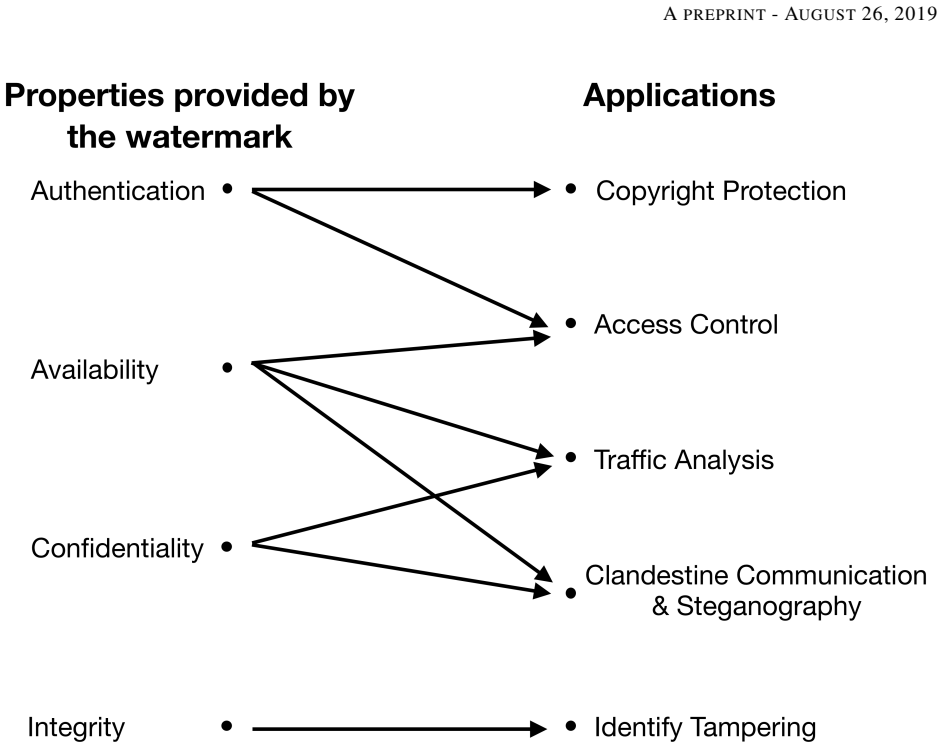
On its own terms, this paper claims that the sprawling design space of video watermarking can be navigated in three decisions: first fix the desired equilibrium among invisibility (how little distortion the watermark causes), robustness (how hard it is to remove), and efficiency (embedding and extraction cost); then deduce where to embed (metadata or packet level, whole frames, or selected regions of frames chosen by human visual system criteria); then choose how to embed (spatial-domain methods such as least-significant-bit and linear masking, or frequency-domain methods such as DCT, DWT, DFT, SVD and hybrids). It organizes the surveyed literature as responses to these criteria and links each property to applications: copyright protection, tampering identification, clandestine communication, traffic analysis, and access control. The survey also finds that no robust scheme has been shown to embed within the time budget of real-time communication, which points to a concrete open problem.
Load-bearing premise
The whole deduction rests on the premise that the desired balance among invisibility, robustness, and efficiency is the main determinant of the best embedding location and method; if capacity, blindness, or reversibility dominates for a given application, the promised deduction is incomplete.
Editorial extensions
If this is right
- Application needs and threat model narrow the candidate set to a small number of location/method pairs, so a developer can select a surveyed scheme without building a custom comparison.
- The taxonomy predicts that robustness-oriented applications such as copyright protection should prefer frequency-domain methods and HVS-selected blocks, while capacity-oriented steganography can accept spatial-domain embedding at lower robustness.
- The identified gap implies a concrete research target: a robust watermarking scheme whose embedding completes within the frame acquisition budget, 33 ms at 30 fps and 16 ms at 60 fps.
- Combining watermarking with homomorphic encryption, machine-learning detection, blockchain provenance, or quantum transforms extends the same location/method taxonomy to new carriers without changing its structure.
Reading between the lines
- The three-way equilibrium is probably only part of the decision: capacity, blindness, and reversibility can change the optimal location and method even when invisibility, robustness, and efficiency weights are fixed, so the framework is best read as a starting point rather than a complete decision procedure.
- The survey's organization suggests a testable quantitative version: assemble reported PSNR, bit-error rate, and embedding-time measurements and plot surveyed schemes in the equilibrium space to see whether location/method clusters actually separate by application.
- The real-time gap may be closed by embedding in the compressed domain during encoding, for example in P-frame coefficients, since raw-frame spatial methods would not fit the time budget; this is an extension the paper points to but does not test.
Signed reviews
Editorial analysis
A structured set of objections, weighed in public.
Referee Report
Summary. This paper presents a survey of digital video watermarking, organizing the field into watermarking properties (fidelity, blindness, robustness, capacity, time complexity), applications (copyright protection, tampering identification, clandestine communication, traffic analysis, access control), threat models, embedding locations (visual-object level vs. network-flow level), and embedding methods (spatial, DCT, DST, DWT, DFT, SVD, hybrid, and other domains). The stated goal, in the abstract and introduction, is to enable a designer to first define a desired equilibrium among invisibility, robustness, and efficiency and then deduce the best embedding location and method from that balance. The paper compiles a large set of references and provides a useful taxonomy, but the promised decision procedure is never actually specified, and several property definitions contain factual errors.
Significance. If the claimed design framework were actually delivered, the paper would provide a valuable decision aid for practitioners choosing a video watermarking scheme. The survey's strengths include its broad compilation of roughly 170 references, a clear separation between visual-object watermarking and network-flow watermarking (Section 4.2), a systematic threat-model taxonomy (Section 3), and useful discussions of hybrid transform domains (Section 5.2.6) and scalability-aware embedding (Section 4.1.5). However, the central assertion that a property-based equilibrium can determine the best location and method is not substantiated: sections 4 and 5 present taxonomies without a decision rule or worked example, and the efficiency axis is defined inconsistently. The paper is therefore a reasonably organized survey whose main advertised contribution remains unrealized.
major comments (5)
- [Section 2.2.1, Correlation Coefficient] The text states: "The higher the correlation is, the more distorted the signal is." This is reversed. The formula C(X, X̂) = cov(X, X̂) / sqrt(var(X) · var(X̂)) is a similarity measure: high correlation means the watermarked signal closely matches the original, i.e., low distortion. Because medium fidelity/invisibility is one of the three axes in the abstract's equilibrium point, this inversion corrupts the metric basis of the proposed framework and must be corrected.
- [Section 2.2.6, Time Complexity and BIR] Time complexity is defined as the embedding/extraction delay, but the quantified measure, BIR = (R_X̂ − R_X)/R_X × 100, is a bit-rate overhead, not a runtime measure. The survey never reports actual embedding or extraction times for any scheme in Sections 4 or 5, so the "efficiency" axis of the invisibility/robustness/efficiency equilibrium cannot be instantiated. This conflation also undermines the conclusion's claim that embedding speed is overlooked, since BIR-based studies do not measure speed.
- [Abstract and Sections 4-5, 7] The abstract promises that, given an equilibrium among invisibility, robustness, and efficiency, the designer can "deduce the best location of the information embedding as well as the method used to embed it." The body never performs or specifies this deduction. Sections 4 and 5 catalog locations and methods side by side but contain no decision rule, scoring function, or worked example that maps property weights to a recommended scheme. Section 7 merely asserts that the developer "can select a precise location" based on visibility and robustness. The load-bearing claim is therefore unsupported as stated.
- [Section 2.2 and Section 2.3] The abstract's equilibrium triad of invisibility, robustness, and efficiency omits other properties that the paper itself identifies as application-dependent: capacity (Section 2.2.5), blindness (Section 2.2.3), and robustness level (fragile vs. semi-fragile vs. robust, Section 2.2.4). For steganography, capacity and undetectability dominate; for access control, reversibility matters; for tamper detection, fragile behavior is decisive. The promised deduction from a three-way equilibrium is therefore incomplete unless these additional properties are folded into the selection procedure.
- [Title, Abstract, and Section 7] The title promises a "Review of the State-Of-The-Art," and Section 7 makes an explicit gap claim ("Robust watermark scheme allowing a watermark embedding in a such short time is still to be developed"), but the paper gives no search methodology, inclusion criteria, or coverage analysis. Without this, the completeness of the survey and the real-time gap claim cannot be assessed; notable recent directions such as deep-learning-based watermarking are absent from the reviewed schemes.
minor comments (5)
- [Section 4.1.5] The text refers to "the flowchart of Figure 4.1.5"; the referenced figure is numbered Figure 6.
- [Section 5.2.4, DFT domain] The sentence "the magnitude yields much more information about the spatial structure of the image" is backwards for image processing; the phase of the Fourier coefficients carries most structural information. This should be corrected to avoid misleading readers about DFT-domain watermarking.
- [Section 2.1] Minor typo: "the most important step of the all scheme" should read "of the whole scheme."
- [References [81] and [95]] References [81] and [95] appear to cite the same paper by Nakano-Miyatake and Perez-Meana in two different bibliographic forms; please consolidate.
- [Section 2.3.3] The terminology "steganography is watermark-oriented" followed by "we define watermarking focused on the medium as carrier signal-oriented" is confusing and appears to reverse the intended distinction; please clarify the definitions.
Circularity Check
No circularity: this is a literature survey with no fitted parameters or derivations; the abstract's design-procedure promise is unsupported but not circular.
full rationale
The paper is a literature survey and makes no quantitative derivation, so there is no fitted parameter, no input dataset, and no predicted quantity that could reduce to an input by construction. Its organizing claim that a designer can first choose an equilibrium among invisibility, robustness, and efficiency and then deduce embedding location and method is a stated goal rather than a derived result; the body catalogs properties, locations, and methods without connecting them through any equation or decision rule. The fact that Section 2.2.6 defines efficiency via bitrate increase while the conclusion discusses runtime is a weakness in the survey's coverage, not a circular step, because no quantity is predicted from a fitted parameter. Citations are used to attribute surveyed techniques and definitions; none is load-bearing in the sense of being invoked to forbid alternatives or to justify the paper's own claims through a chain of prior work by the same authors. External benchmarks such as Stirmark and standard PSNR/BER definitions appear only as reported evaluation conventions. I therefore find no specific reduction, and per the hard rules the unsupported promise of the abstract is a completeness or correctness concern, not circularity.
Assumptions & free parameters
assumptions (3)
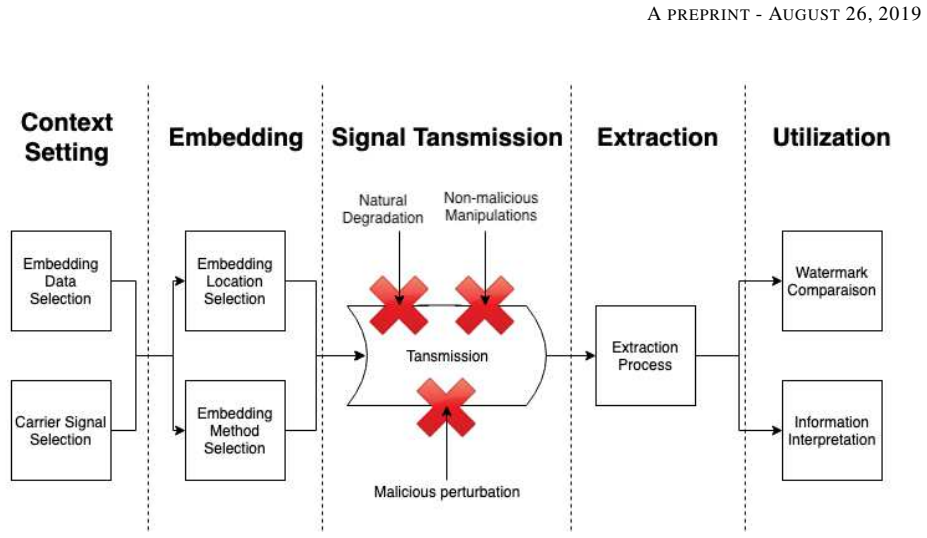
- domain assumption The five-step watermark lifecycle model (Section 2.1) applies to all watermarking processes.
- domain assumption The reviewed papers are representative of the current state of the art.
- domain assumption The threat model taxonomy in Section 3 is complete enough to guide scheme selection.
Cite this review
Pith. "Pith review of Digital Watermarking of video streams: Review of the State-Of-The-Art." pith.science (2026). https://pith.science/paper/7FQ77U56
@misc{pith2026190802039,
  author       = {Pith},
  title        = {Pith review of: Digital Watermarking of video streams: Review of the State-Of-The-Art},
  year         = {2026},
  howpublished = {\url{https://pith.science/paper/7FQ77U56}},
  note         = {Machine review of arXiv:1908.02039}
}
read the original abstract
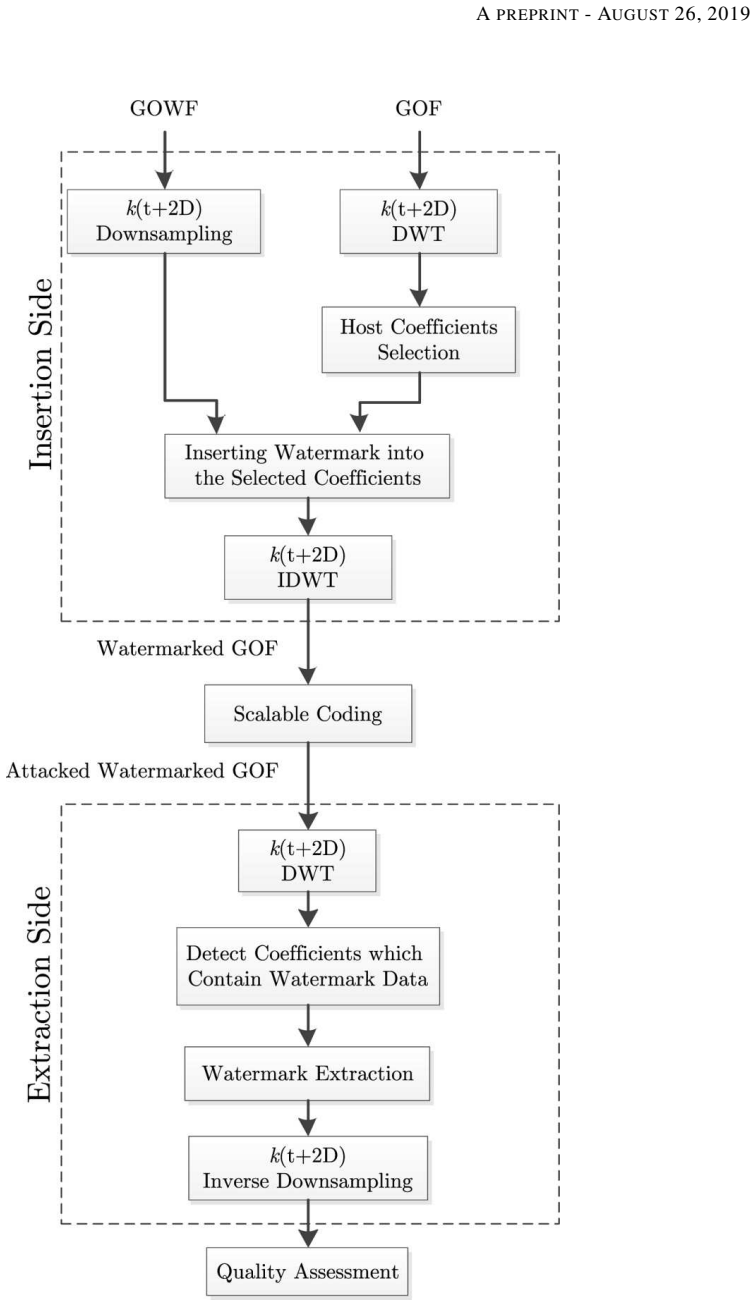
Digital Watermarking is an extremely wide aspect of information security, either by its applications, by its properties, or by its designs. In particular, a lot of research has been made about video watermarking and it can make it quite difficult to put into perspective the various schemes possible in order to implement a watermarking process for a given application. This paper presents an in-depth overview of the current video watermarking technologies and how they each respond to certain criteria that may be imposed by the aimed application. The goal being in first place to be able to define the desired equilibrium point between invisibility, robustness and efficiency for an application. Then, given this balance, being able to deduce the best location of the information embedding as well as the method used to embed it. The equilibrium point is to be found using the needed properties of the watermark and by studying the threat model that the scheme will have to face. The location describes whether the extra information should be added to the metadata of the video, to its frames or to specific regions of its frames. Finally, the method to embed the watermark refers to the insertion domain and its coefficients to be altered in order to insert the wanted information.
Figures

Figures from the paper (8 more)


Reference graph
Works this paper leans on
-
[1]
Watermarking applications and their properties
Ingemar J Cox, Matthew L Miller, and Jeffrey A Bloom. Watermarking applications and their properties. In Proceedings International Conference on Information Technology: Coding and Computing (Cat. No. PR00540), pages 6–10. IEEE, 2000
-
[2]
Analysis of digital image watermark attacks
Chunlin Song, Sud Sudirman, Madjid Merabti, and David Llewellyn-Jones. Analysis of digital image watermark attacks. In 2010 7th IEEE Consumer Communications and Networking Conference, pages 1–5. IEEE, 2010
2010
-
[3]
Adaptive noise smoothing filter for images with signal-dependent noise
Darwin T Kuan, Alexander A Sawchuk, Timothy C Strand, and Pierre Chavel. Adaptive noise smoothing filter for images with signal-dependent noise. IEEE Transactions on Pattern Analysis & Machine Intelligence, pages 165–177, 1985
1985
-
[4]
A watermark for image integrity and ownership verification
Ping Wah Wong. A watermark for image integrity and ownership verification. In PICS, pages 374–379, 1998
1998
-
[5]
A new lsb-s image steganography method blend with cryptography for secret communication
Kamaldeep Joshi and Rajkumar Yadav. A new lsb-s image steganography method blend with cryptography for secret communication. In 2015 Third International Conference on Image Information Processing (ICIIP), pages 86–90. IEEE, 2015
2015
-
[6]
Robust network-based attack attribution through probabilistic watermarking of packet flows
Xinyuan Wang, Douglas S Reeves, Peng Ning, and Fang Feng. Robust network-based attack attribution through probabilistic watermarking of packet flows. Technical report, North Carolina State University. Dept. of Computer Science, 2005
2005
-
[7]
A survey of digital image watermarking techniques
Vidyasagar M Potdar, Song Han, and Elizabeth Chang. A survey of digital image watermarking techniques. In INDIN’05. 2005 3rd IEEE International Conference on Industrial Informatics, 2005., pages 709–716. IEEE, 2005
2005
-
[8]
A robust video watermarking in motion vectors
Zina Liu, Huaqing Liang, Xinxin Niu, et al. A robust video watermarking in motion vectors. In Proceedings 7th International Conference on Signal Processing, 2004. Proceedings. ICSP’04. 2004., volume 3, pages 2358–2361. IEEE, 2004
2004
Show all 174 references
-
[9]
Combined video and audio watermarking: Embedding content information in multimedia data
Jana Dittmann, Martin Steinebach, Ivica Rimac, Stephan Fischer, and Ralf Steinmetz. Combined video and audio watermarking: Embedding content information in multimedia data. In Security and Watermarking of Multimedia Contents II, volume 3971, pages 455–465. International Societ...
2000
-
[10]
Dropwat: an invisible network flow watermark for data exfiltration traceback
Alfonso Iacovazzi, Sanat Sarda, Daniel Frassinelli, and Yuval Elovici. Dropwat: an invisible network flow watermark for data exfiltration traceback. IEEE Transactions on Information Forensics and Security, 13(5):1139– 1154, 2018
2018
-
[11]
Media-independent watermarking classification and the need for combining digital video and audio watermarking for media authentication
Jana Dittmann, Anirban Mukherjee, and Martin Steinebach. Media-independent watermarking classification and the need for combining digital video and audio watermarking for media authentication. In Proceedings International Conference on Information Technology: Coding and Computi...
2000
-
[12]
A new blockchain-based trusted drm scheme for built-in content protection
Ma Zhaofeng, Huang Weihua, and Gao Hongmin. A new blockchain-based trusted drm scheme for built-in content protection. EURASIP Journal on Image and Video Processing, 2018(1):91, 2018
2018
-
[13]
A drift compensated reversible watermarking scheme for h
Sibaji Gaj, Shuvendu Rana, Arijit Sur, and Prabin Kumar Bora. A drift compensated reversible watermarking scheme for h. 265/hevc. In 2016 IEEE 18th International Workshop on Multimedia Signal Processing (MMSP), pages 1–6. IEEE, 2016
2016
-
[14]
A security risk for publicly available watermark detectors
Ton Kalker et al. A security risk for publicly available watermark detectors. InSYMPOSIUM ON INFORMATION THEORY IN THE BENELUX, pages 119–126. Citeseer, 1998. 26 A PREPRINT - AUGUST 26, 2019
1998
-
[15]
Watermark detection and extraction using independent component analysis method
Dan Yu, Farook Sattar, and Kai-Kuang Ma. Watermark detection and extraction using independent component analysis method. EURASIP Journal on Advances in Signal Processing, 2002(1):523219, 2002
2002
-
[16]
A dual watermarking technique for images
Saraju P Mohanty, KR Ramakrishnan, and Mohan Kankanhalli. A dual watermarking technique for images. In Proceedings of the seventh ACM international conference on Multimedia (Part 2), pages 49–51. Citeseer, 1999
1999
-
[17]
Blind dual watermarking for color images’ authentication and copyright protection
Xiao-Long Liu, Chia-Chen Lin, and Shyan-Ming Yuan. Blind dual watermarking for color images’ authentication and copyright protection. IEEE Transactions on Circuits and Systems for Video Technology, 28(5):1047–1055, 2018
2018
-
[18]
Properties of digital image watermarking
Mohammad Abdullatif, Akram M Zeki, Jalel Chebil, and Teddy Surya Gunawan. Properties of digital image watermarking. In 2013 IEEE 9th international colloquium on signal processing and its applications , pages 235–240. IEEE, 2013
2013
-
[19]
On the properties of non-media digital watermarking: a review of state of the art techniques
Arezou Soltani Panah, Ron Van Schyndel, Timos Sellis, and Elisa Bertino. On the properties of non-media digital watermarking: a review of state of the art techniques. IEEE Access, 4:2670–2704, 2016
2016
-
[20]
An efficient framework for compressed domain watermarking in p frames of high-efficiency video coding (hevc)–encoded video
Tanima Dutta and Hari Prabhat Gupta. An efficient framework for compressed domain watermarking in p frames of high-efficiency video coding (hevc)–encoded video. ACM Transactions on Multimedia Computing, Communications, and Applications (TOMM), 13(1):12, 2017
2017
-
[21]
Fair benchmark for image watermarking systems
Martin Kutter and Fabien AP Petitcolas. Fair benchmark for image watermarking systems. In Security and Watermarking of Multimedia Contents , volume 3657, pages 226–240. International Society for Optics and Photonics, 1999
1999
-
[22]
Elements of information theory, second edition
Thomas M Cover. Elements of information theory, second edition
-
[23]
Mean squared error of empirical predictor
Kalyan Das, Jiming Jiang, JNK Rao, et al. Mean squared error of empirical predictor. The Annals of Statistics, 32(2):818–840, 2004
2004
-
[24]
The correlation coefficient: An overview.Critical reviews in analytical chemistry, 36(1):41–59, 2006
AG Asuero, A Sayago, and AG Gonzalez. The correlation coefficient: An overview.Critical reviews in analytical chemistry, 36(1):41–59, 2006
2006
-
[25]
Fairness beyond disparate treatment & disparate impact: Learning classification without disparate mistreatment
Muhammad Bilal Zafar, Isabel Valera, Manuel Gomez Rodriguez, and Krishna P Gummadi. Fairness beyond disparate treatment & disparate impact: Learning classification without disparate mistreatment. In Proceedings of the 26th International Conference on World Wide Web, pages 1171–...
2017
-
[26]
Combining predictors for classification using the area under the receiver operating characteristic curve
Margaret Sullivan Pepe, Tianxi Cai, and Gary Longton. Combining predictors for classification using the area under the receiver operating characteristic curve. Biometrics, 62(1):221–229, 2006
2006
-
[27]
A robust public watermark for halftone images
Ming Sun Fu and Oscar C Au. A robust public watermark for halftone images. In 2002 IEEE International Symposium on Circuits and Systems. Proceedings (Cat. No. 02CH37353), volume 3, pages III–III. IEEE, 2002
2002
-
[28]
Comparison of video copy detection techniques: The robustness against distortion and attacking
Wei-Lun Chao. Comparison of video copy detection techniques: The robustness against distortion and attacking. Technical Paper, Graduate Institute of Communication Engineering, National Taiwan University, 2009
2009
-
[29]
P. H. W. Wong and O. C. Au. A novel semi-private watermarking technique. In 2002 IEEE International Symposium on Circuits and Systems. Proceedings (Cat. No.02CH37353), volume 3, pages III–III, May 2002
2002
-
[30]
Key independent watermark detection
Ron G Van Schyndel, Andrew Z Tirkel, and Imants D Svalbe. Key independent watermark detection. In Proceedings IEEE International Conference on Multimedia Computing and Systems, volume 1, pages 580–585. ieee, 1999
1999
-
[31]
A new data hiding method for h.265/hevc video streams without intra-frame distortion drift
Yunxia Liu, Shuyang Liu, Hongguo Zhao, and Si Liu. A new data hiding method for h.265/hevc video streams without intra-frame distortion drift. Multimedia Tools and Applications, Jul 2018
2018
-
[32]
Ahmed and S
F. Ahmed and S. My. A hybrid- watermarking scheme for asymmetric and symmetric watermark extraction. In 2005 Pakistan Section Multitopic Conference, pages 1–6, Dec 2005
2005
-
[33]
Fabien A. P. Petitcolas. Kerckhoffs’ Principle, pages 675–675. Springer US, Boston, MA, 2011
2011
-
[34]
Fragile image watermarking with pixel-wise recovery based on overlapping embedding strategy
Chuan Qin, Ping Ji, Xinpeng Zhang, Jing Dong, and Jinwei Wang. Fragile image watermarking with pixel-wise recovery based on overlapping embedding strategy. Signal Processing, 138:280–293, 2017
2017
-
[35]
Gagandeep Kaur, Singara Singh Kasana, and M. K. Sharma. An efficient authentication scheme for high efficiency video coding/h.265. Multimedia Tools and Applications, Mar 2019
2019
-
[36]
Robust and blind watermarking technique in dct domain using inter-block coefficient differencing
Shabir A Parah, Javaid A Sheikh, Nazir A Loan, and Ghulam M Bhat. Robust and blind watermarking technique in dct domain using inter-block coefficient differencing. Digital Signal Processing, 53:11–24, 2016
2016
-
[37]
Fabien A. P. Petitcolas, Ross J. Anderson, and Markus G. Kuhn. Attacks on copyright marking systems. Information Hiding Lecture Notes in Computer Science, page 218–238, 1998. 27 A PREPRINT - AUGUST 26, 2019
1998
-
[38]
Petitcolas
F.a.p. Petitcolas. Watermarking schemes evaluation. IEEE Signal Processing Magazine, 17(5):58–64, 2000
2000
-
[39]
Principles of information security
Michael E Whitman and Herbert J Mattord. Principles of information security. Cengage Learning, 2011
2011
-
[40]
Multimedia watermarking techniques
Frank Hartung and Martin Kutter. Multimedia watermarking techniques. Proceedings of the IEEE, 87(7):1079– 1107, 1999
1999
-
[41]
Digital music distribution and audio watermarking
Steve Czerwinski, Richard Fromm, and Todd Hodes. Digital music distribution and audio watermarking. UCB IS, 219, 2007
2007
-
[42]
Watermarking software in practical applications
P Lipi ´nski. Watermarking software in practical applications. Bulletin of the Polish Academy of Sciences: Technical Sciences, 59(1):21–25, 2011
2011
-
[43]
Watermarking 2d-vector data for geographical information systems
Michael V oigt and Christoph Busch. Watermarking 2d-vector data for geographical information systems. In Security and Watermarking of Multimedia Contents IV, volume 4675, pages 621–629. International Society for Optics and Photonics, 2002
2002
-
[44]
M H. M. Schellekens. Digital watermarks as legal evidence. Digital Evidence and Electronic Signature Law Review, 8, 01 2014
2014
-
[45]
A cryptographic checksum for integrity protection
Fred Cohen. A cryptographic checksum for integrity protection. Computers & Security, 6(6):505–510, 1987
1987
-
[46]
A novel tree based method for data hiding and integrity in medical images
R Sreejith and S Senthil. A novel tree based method for data hiding and integrity in medical images. In 2017 IEEE International Conference on Electrical, Instrumentation and Communication Engineering (ICEICE), pages 1–4. IEEE, 2017
2017
-
[47]
The prisoners’ problem and the subliminal channel
Gustavus J Simmons. The prisoners’ problem and the subliminal channel. In Advances in Cryptology, pages 51–67. Springer, 1984
1984
-
[48]
Message in a bottle: Sailing past censorship
Luca Invernizzi, Christopher Kruegel, and Giovanni Vigna. Message in a bottle: Sailing past censorship. In Proceedings of the 29th Annual Computer Security Applications Conference, pages 39–48. ACM, 2013
2013
-
[49]
Advanced persistent threats and how to monitor and deter them.Network security, 2011(8):16–19, 2011
Colin Tankard. Advanced persistent threats and how to monitor and deter them.Network security, 2011(8):16–19, 2011
2011
-
[50]
Digital watermarking, volume 53
Ingemar J Cox, Matthew L Miller, Jeffrey Adam Bloom, and Chris Honsinger. Digital watermarking, volume 53. Springer, 2002
2002
-
[51]
Watermark based access control to copyrighted content
Rade Petrovic and Venkatraman Atti. Watermark based access control to copyrighted content. In 2013 11th International Conference on Telecommunications in Modern Satellite, Cable and Broadcasting Services (TELSIKS), volume 1, pages 315–322. IEEE, 2013
2013
-
[52]
Digital communications, volume 2
Bernard Sklar. Digital communications, volume 2. Prentice hall Upper Saddle River, NJ, USA:, 2001
2001
-
[53]
Computer Networking: Principles, Protocols and Practice
Olivier Bonaventure et al. Computer Networking: Principles, Protocols and Practice. Citeseer, 2011
2011
-
[54]
Digital video processing
A Murat Tekalp. Digital video processing. Prentice Hall Press, 2015
2015
-
[55]
Digital video transcoding
Jun Xin, Chia-Wen Lin, and Ming-Ting Sun. Digital video transcoding. Proceedings of the IEEE, 93(1):84–97, 2005
2005
-
[56]
Removing rain from single images via a deep detail network
Xueyang Fu, Jiabin Huang, Delu Zeng, Yue Huang, Xinghao Ding, and John Paisley. Removing rain from single images via a deep detail network. In Proceedings of the IEEE Conference on Computer Vision and Pattern Recognition, pages 3855–3863, 2017
2017
-
[57]
New attacks on timing-based network flow watermarks
Zi Lin and Nicholas Hopper. New attacks on timing-based network flow watermarks. In Presented as part of the 21st{USENIX} Security Symposium ({USENIX} Security 12), pages 381–396, 2012
2012
-
[58]
On the effectiveness of visible watermarks
Tali Dekel, Michael Rubinstein, Ce Liu, and William T Freeman. On the effectiveness of visible watermarks. In Proceedings of the IEEE Conference on Computer Vision and Pattern Recognition, pages 2146–2154, 2017
2017
-
[59]
Watermark copy attack
Martin Kutter, Sviatoslav V V oloshynovskiy, and Alexander Herrigel. Watermark copy attack. InSecurity and Watermarking of Multimedia Contents II, volume 3971, pages 371–381. International Society for Optics and Photonics, 2000
2000
-
[60]
Spread spectrum watermarking: Malicious attacks and counterattacks
Frank H Hartung, Jonathan K Su, and Bernd Girod. Spread spectrum watermarking: Malicious attacks and counterattacks. In Security and Watermarking of Multimedia Contents , volume 3657, pages 147–159. International Society for Optics and Photonics, 1999
1999
-
[61]
On the invertibility of invisible watermark- ing techniques
Scott Craver, Nasir Memon, Boon-Lock Yeo, and Minerva M Yeung. On the invertibility of invisible watermark- ing techniques. In Proceedings of International Conference on Image Processing, volume 1, pages 540–543. IEEE, 1997
1997
-
[62]
False watermark extraction and re-watermarking issues with image watermarking techniques
Neha Singh, Sandeep Joshi, and Shilpi Birla. False watermark extraction and re-watermarking issues with image watermarking techniques. Indian Journal of Science and Technology, 10:7, 2017. 28 A PREPRINT - AUGUST 26, 2019
2017
-
[63]
Digital watermarking techniques and security issues in the information and communication society
Jordi Nin and Sergio Ricciardi. Digital watermarking techniques and security issues in the information and communication society. In 2013 27th International Conference on Advanced Information Networking and Applications Workshops, pages 1553–1558. IEEE, 2013
2013
-
[64]
Dsss-based flow marking technique for invisible traceback
Wei Yu, Xinwen Fu, Steve Graham, Dong Xuan, and Wei Zhao. Dsss-based flow marking technique for invisible traceback. In 2007 IEEE Symposium on Security and Privacy (SP’07), pages 18–32. IEEE, 2007
2007
-
[65]
Blind detection attack resistant image watermarking
Bharat Singh, VS Dhaka, and Ravi Saharan. Blind detection attack resistant image watermarking. In 2014 IEEE 3rd Global Conference on Consumer Electronics (GCCE), pages 289–293. Ieee, 2014
2014
-
[66]
Blind detection of spread spectrum flow watermarks
Weijia Jia, Fung Po Tso, Zhen Ling, Xinwen Fu, Dong Xuan, and Wei Yu. Blind detection of spread spectrum flow watermarks. Security and Communication Networks, 6(3):257–274, 2013
2013
-
[67]
A covert timing channel based on fountain codes
Rennie Archibald and Dipak Ghosal. A covert timing channel based on fountain codes. In 2012 IEEE 11th International Conference on Trust, Security and Privacy in Computing and Communications, pages 970–977. IEEE, 2012
2012
-
[68]
Design and Detection of Covert Communication: Timing Channels and Application Tunneling
Dipak Ghosal. Design and Detection of Covert Communication: Timing Channels and Application Tunneling. PhD thesis, University of California, Davis, 2013
2013
-
[69]
A study on the collusion security of lut-based client-side watermark embedding
Yuan-Gen Wang, Dongqing Xie, and Brij B Gupta. A study on the collusion security of lut-based client-side watermark embedding. IEEE Access, 6:15816–15822, 2018
2018
-
[70]
Fraternal twins: Unifying attacks on machine learning and digital watermarking
Erwin Quiring, Daniel Arp, and Konrad Rieck. Fraternal twins: Unifying attacks on machine learning and digital watermarking. arXiv preprint arXiv:1703.05561, 2017
2017 arXiv
-
[71]
Forgotten siblings: Unifying attacks on machine learning and digital watermarking
Erwin Quiring, Daniel Arp, and Konrad Rieck. Forgotten siblings: Unifying attacks on machine learning and digital watermarking. In 2018 IEEE European Symposium on Security and Privacy (EuroS&P), pages 488–502. IEEE, 2018
2018
-
[72]
Zhang and S
X. Zhang and S. Wang. Watermarking scheme capable of resisting sensitivity attack. IEEE Signal Processing Letters, 14(2):125–128, Feb 2007
2007
-
[73]
Adversarial machine learning against digital watermarking
Erwin Quiring and Konrad Rieck. Adversarial machine learning against digital watermarking. In 2018 26th European Signal Processing Conference (EUSIPCO), pages 519–523. IEEE, 2018
2018
-
[74]
A pseudo-zernike moment based audio watermarking scheme robust against desynchronization attacks
Xiang-Yang Wang, Tian-Xiao Ma, and Pan-Pan Niu. A pseudo-zernike moment based audio watermarking scheme robust against desynchronization attacks. Computers & Electrical Engineering, 37(4):425 – 443, 2011
2011
-
[75]
Information hiding-a survey
Fabien AP Petitcolas, Ross J Anderson, and Markus G Kuhn. Information hiding-a survey. Proceedings of the IEEE, 87(7):1062–1078, 1999
1999
-
[76]
An overview of attacks against digital watermarking and their respective countermeasures
Maryam Tanha, Seyed Dawood Sajjadi Torshizi, Mohd Taufik Abdullah, and Fazirulhisyam Hashim. An overview of attacks against digital watermarking and their respective countermeasures. In Proceedings Title: 2012 International Conference on Cyber Security, Cyber Warfare and Digita...
2012
-
[77]
Study of possible attacks on image and video watermark
PS Venugopala, Shravya Jain, H Sarojadevi, and Niranjan N Chiplunkar. Study of possible attacks on image and video watermark. In 2016 3rd International Conference on Computing for Sustainable Global Development (INDIACom), pages 3505–3510. IEEE, 2016
2016
-
[78]
Human visual system features enabling watermarking
Jean-François Delaigle, Christophe Devleeschouwer, Benoit Macq, and L Langendijk. Human visual system features enabling watermarking. In Proceedings. IEEE International Conference on Multimedia and Expo , volume 2, pages 489–492. IEEE, 2002
2002
-
[79]
Standard rgb color spaces
Sabine Süsstrunk, Robert Buckley, and Steve Swen. Standard rgb color spaces. InColor and Imaging Conference, volume 1999, pages 127–134. Society for Imaging Science and Technology, 1999
1999
-
[80]
Robust and invisible image watermarking in rgb color space using svd
D Vaishnavi and TS Subashini. Robust and invisible image watermarking in rgb color space using svd. Procedia Computer Science, 46:1770–1777, 2015
2015
-
[81]
Video watermarking technique using visual sensibility and motion vector
Mariko Nakano-Miyatake and Hector Perez-Meana. Video watermarking technique using visual sensibility and motion vector. In Visual Servoing. IntechOpen, 2010
2010
-
[82]
A digital video watermarking technique based on identical frame extraction in 3-level dwt
Tamanna Tabassum and SM Mohidul Islam. A digital video watermarking technique based on identical frame extraction in 3-level dwt. In 2012 15th International Conference on Computer and Information Technology (ICCIT), pages 101–106. IEEE, 2012
2012
-
[83]
Fuzzy based invisible watermarking
T Rvijaya Lakshmi. Fuzzy based invisible watermarking. International Journal of Advanced Research in Computer Science, 8(7), 2017
2017
-
[84]
Jadhav and M
A. Jadhav and M. Kolhekar. Digital watermarking in video for copyright protection. In 2014 International Conference on Electronic Systems, Signal Processing and Computing Technologies, pages 140–144, Jan 2014. 29 A PREPRINT - AUGUST 26, 2019
2014
-
[85]
A semi-blind hvs based image watermarking scheme using elliptic curve cryptography
Ritu Gupta, Anurag Mishra, and Sarika Jain. A semi-blind hvs based image watermarking scheme using elliptic curve cryptography. Multimedia Tools and Applications, 77(15):19235–19260, 2018
2018
-
[86]
Video watermarking algorithm for h
Jianfeng Lu, Li Li, and Zhenhua Yang. Video watermarking algorithm for h. 264 scalable video coding. KSII Transactions on Internet & Information Systems, 7(1), 2013
2013
-
[87]
Adaptive image watermarking scheme based on visual masking
Jiwu Huang and Yun Q Shi. Adaptive image watermarking scheme based on visual masking. Electronics letters, 34(8):748–750, 1998
1998
-
[88]
A semi blind dwt-svd video watermarking
Divjot Kaur Thind and Sonika Jindal. A semi blind dwt-svd video watermarking. Procedia Computer Science, 46:1661 – 1667, 2015. Proceedings of the International Conference on Information and Communication Technologies, ICICT 2014, 3-5 December 2014 at Bolgatty Palace & Island R...
2015
-
[89]
Real-time watermarking algorithm of h
Lotfi Abdi, Faten Ben Abdallah, and Aref Meddeb. Real-time watermarking algorithm of h. 264/avc video stream. International Arab Journal of Information Technology (IAJIT), 14(2), 2017
2017
-
[90]
Video watermark technique in motion vector
Jun Zhang, Jiegu Li, and Ling Zhang. Video watermark technique in motion vector. InProceedings XIV Brazilian Symposium on Computer Graphics and Image Processing, pages 179–182. IEEE, 2001
2001
-
[91]
A low complexity video watermarking in h
Azadeh Mansouri, Ahmad Mahmoudi Aznaveh, Farah Torkamani-Azar, and Fatih Kurugollu. A low complexity video watermarking in h. 264 compressed domain. IEEE Transactions on Information Forensics and Security, 5(4):649–657, 2010
2010
-
[92]
An empirical study of secure mpeg video transmissions
Iskender Agi and Li Gong. An empirical study of secure mpeg video transmissions. In Proceedings of Internet Society Symposium on Network and Distributed Systems Security, pages 137–144. IEEE, 1996
1996
-
[93]
A video watermarking drm method based on h
Zhaofeng Ma, Jianqing Huang, Ming Jiang, and Xinxin Niu. A video watermarking drm method based on h. 264 compressed domain with low bit-rate increasement. Chinese Journal of Electronics, 25(4):641–647, 2016
2016
-
[94]
A 3-d video watermark embedding technology in dct-cs domain
Longfei Cai, Huimin Zhao, Jun Cai, and Li Zhu. A 3-d video watermark embedding technology in dct-cs domain. International Journal of Machine Learning and Computing, 5:206–213, 06 2015
2015
-
[95]
Video watermarking technique using visual sensibility and motion vector
Mariko Nakano-Miyatake and Hector Perez-Meana. Video watermarking technique using visual sensibility and motion vector. In Rong-Fong Fung, editor, Visual Servoing, chapter 10. IntechOpen, Rijeka, 2010
2010
-
[96]
Overview of the scalable video coding extension of the h
Heiko Schwarz, Detlev Marpe, and Thomas Wiegand. Overview of the scalable video coding extension of the h. 264/avc standard. To appear in IEEE Transactions on Circuits and Systems for Video Technology, page 1, 2007
2007
-
[97]
Mpeg-2 video test model 5
Test Model Editing Committee et al. Mpeg-2 video test model 5. ISO/IEC JTC1/SC29/WG11 Doc N, 400, 1993
1993
-
[98]
Hvs-based scalable video watermarking
Mehran Deljavan Amiri, Ali Amiri, and Majid Meghdadi. Hvs-based scalable video watermarking. Multimedia Systems, pages 1–19, 2019
2019
-
[99]
Scalable watermark extraction for real-time authentication of jpeg 2000 images
Charith Abhayaratne and Deepayan Bhowmik. Scalable watermark extraction for real-time authentication of jpeg 2000 images. Journal of real-time image processing, 8(3):307–325, 2013
2000
-
[100]
TCP/IP protocol suite
Behrouz A Forouzan. TCP/IP protocol suite. McGraw-Hill, Inc., 2002
2002
-
[101]
Digital watermarking of text, image, and video documents
Jonathan K Su, Frank Hartung, and Bernd Girod. Digital watermarking of text, image, and video documents. Computers & Graphics, 22(6):687–695, 1998
1998
-
[102]
Physical layer watermarking of direct sequence spread spectrum signals
Xiang Li, Chansu Yu, Murad Hizlan, Won-Tae Kim, and Seungmin Park. Physical layer watermarking of direct sequence spread spectrum signals. In MILCOM 2013-2013 IEEE Military Communications Conference, pages 476–481. IEEE, 2013
2013
-
[103]
Practical internet steganography: data hiding in ip
Deepa Kundur and Kamran Ahsan. Practical internet steganography: data hiding in ip. Proc. Texas wksp. security of information systems, 2003
2003
-
[104]
Covert channels in the ip time to live field
Sebastian Zander, Grenville Armitage, and Philip Branch. Covert channels in the ip time to live field. 2006
2006
-
[105]
Secure network steganographic scheme exploiting tcp sequence numbers
Vengala Satish Kumar, Tanima Dutta, Arijit Sur, and Sukumar Nandi. Secure network steganographic scheme exploiting tcp sequence numbers. In International Conference on Network Security and Applications, pages 281–291. Springer, 2011
2011
-
[106]
Trends toward real-time network data steganography
James Collins and Sos Agaian. Trends toward real-time network data steganography. arXiv preprint arXiv:1604.02778, 2016
2016 arXiv
-
[107]
Network flow watermarking: A survey
Alfonso Iacovazzi and Yuval Elovici. Network flow watermarking: A survey. IEEE Communications Surveys & Tutorials, 19(1):512–530, 2016
2016
-
[108]
Rainbow: A robust and invisible non-blind watermark for network flows
Amir Houmansadr, Negar Kiyavash, and Nikita Borisov. Rainbow: A robust and invisible non-blind watermark for network flows. In NDSS, 2009
2009
-
[109]
Youskyde: information hiding for skype video traffic
Wojciech Mazurczyk, Maciej Kara ´s, Krzysztof Szczypiorski, and Artur Janicki. Youskyde: information hiding for skype video traffic. Multimedia Tools and Applications, 75(21):13521–13540, Nov 2016. 30 A PREPRINT - AUGUST 26, 2019
2016
-
[110]
Tcp covert timing channels: Design and detection
Xiapu Luo, Edmond WW Chan, and Rocky KC Chang. Tcp covert timing channels: Design and detection. In 2008 IEEE International Conference on Dependable Systems and Networks With FTCS and DCC (DSN), pages 420–429. IEEE, 2008
2008
-
[111]
Requirements for internet hosts-application and support
Robert Braden. Requirements for internet hosts-application and support. Technical report, 1989
1989
-
[112]
Syntax and semantics-preserving application-layer protocol steganography
Norka B Lucena, James Pease, Payman Yadollahpour, and Steve J Chapin. Syntax and semantics-preserving application-layer protocol steganography. In International Workshop on Information Hiding, pages 164–179. Springer, 2004
2004
-
[113]
Steganography of hypertext transfer protocol version 2 (http/2)
Biljana Dimitrova and Aleksandra Mileva. Steganography of hypertext transfer protocol version 2 (http/2). Journal of Computer and Communications, 5:98–111, 2017
2017
-
[114]
On the Move to Meaningful Internet Systems
Wojciech Mazurczyk and Krzysztof Szczypiorski. Steganography of voip streams. In OTM Confederated International Conferences" On the Move to Meaningful Internet Systems", pages 1001–1018. Springer, 2008
2008
-
[115]
Image steganography and visible watermarking using lsb extraction technique
Santhoshi Bhatt, Arghya Ray, Avishake Ghosh, and Ananya Ray. Image steganography and visible watermarking using lsb extraction technique. In 2015 IEEE 9th International Conference on Intelligent Systems and Control (ISCO), pages 1–6. IEEE, 2015
2015
-
[116]
Video watermarking by adjusting the pixel values and using scene change detection
PS Venugopala, H Sarojadevi, Niranjan N Chiplunkar, and Vani Bhat. Video watermarking by adjusting the pixel values and using scene change detection. In 2014 Fifth International Conference on Signal and Image Processing, pages 259–264. IEEE, 2014
2014
-
[117]
Video watermark application for embedding recipient id in real-time-encoding vod server
Takaaki Yamada, Michiro Maeta, and Fuminori Mizushima. Video watermark application for embedding recipient id in real-time-encoding vod server. Journal of Real-Time Image Processing, 11(1):211–222, 2016
2016
-
[118]
Robust image watermarking in the spatial domain
Nikos Nikolaidis and Ioannis Pitas. Robust image watermarking in the spatial domain. Signal processing, 66(3):385–403, 1998
1998
-
[119]
Feature based watermarking using watermark template match
Wei Lu, Hongtao Lu, and Fu-Lai Chung. Feature based watermarking using watermark template match. Applied Mathematics and Computation, 177(1):377–386, 2006
2006
-
[120]
Novel reversible watermarking scheme for authentication of military images
Govindarajan Yamuna and Dakshinamurthi Sivakumar. Novel reversible watermarking scheme for authentication of military images. International Journal of Signal and Imaging Systems Engineering, 2(3):134–140, 2009
2009
-
[121]
Discrete-time signal processing
Alan V Oppenheim. Discrete-time signal processing. Pearson Education India, 1999
1999
-
[122]
A watermarking technique based on the frequency domain
Huang-Chi Chen, Yu-Wen Chang, and Rey-Chue Hwang. A watermarking technique based on the frequency domain. journal of multimedia, 7(1):82, 2012
2012
-
[123]
Image compression and discrete cosine transform, college of redwoods, 2008
Ken Cabeen and Peter Gent. Image compression and discrete cosine transform, college of redwoods, 2008
2008
-
[124]
Object based watermarking for h
Sibaji Gaj, Ashish Singh Patel, and Arijit Sur. Object based watermarking for h. 264/avc video resistant to rst attacks. Multimedia Tools and Applications, 75(6):3053–3080, 2016
2016
-
[125]
Real time implementation of digital watermarking algorithm for image and video application
Amit Joshi, Vivekanand Mishra, and RM Patrikar. Real time implementation of digital watermarking algorithm for image and video application. In Watermarking-Volume 2. IntechOpen, 2012
2012
-
[126]
Toward a better understanding of dct coefficients in watermarking
Jun Xiao and Ying Wang. Toward a better understanding of dct coefficients in watermarking. In 2008 IEEE Pacific-Asia Workshop on Computational Intelligence and Industrial Application, volume 2, pages 206–209. IEEE, 2008
2008
-
[127]
Image watermarking based on dc component in dct
Gaorong Zeng and Zhengding Qiu. Image watermarking based on dc component in dct. In 2008 International Symposium on Intelligent Information Technology Application Workshops, pages 573–576. IEEE, 2008
2008
-
[128]
Digital video watermarking in p-frames with controlled video bit-rate increase
Maneli Noorkami and Russell M Mersereau. Digital video watermarking in p-frames with controlled video bit-rate increase. IEEE transactions on information forensics and security, 3(3):441–455, 2008
2008
-
[129]
Dc-ac coefficients based multiple watermarking technique
Mehul S Raval. Dc-ac coefficients based multiple watermarking technique. In 2009 Annual IEEE India Conference, pages 1–4. IEEE, 2009
2009
-
[130]
A novel algorithm for robust audio watermarking based on quantification dct domain
Zhiping Zhou and Lihua Zhou. A novel algorithm for robust audio watermarking based on quantification dct domain. In Third International Conference on Intelligent Information Hiding and Multimedia Signal Processing (IIH-MSP 2007), volume 1, pages 441–444. IEEE, 2007
2007
-
[131]
Robust video watermarking of h
Jing Zhang, Anthony TS Ho, Gang Qiu, and Pina Marziliano. Robust video watermarking of h. 264/avc. IEEE Transactions on Circuits and Systems II: Express Briefs, 54(2):205–209, 2007
2007
-
[132]
A novel watermarking scheme for h
Dawen Xu, Rangding Wang, and Jicheng Wang. A novel watermarking scheme for h. 264/avc video authentica- tion. Signal Processing: Image Communication, 26(6):267–279, 2011
2011
-
[133]
Design of real-time video watermarking based on integer dct for h
Amit M Joshi, Vivekanand Mishra, and RM Patrikar. Design of real-time video watermarking based on integer dct for h. 264 encoder. International Journal of Electronics, 102(1):141–155, 2015. 31 A PREPRINT - AUGUST 26, 2019
2015
-
[134]
Secure and robust digital image watermarking scheme using logistic and rsa encryption
Yang Liu, Shanyu Tang, Ran Liu, Liping Zhang, and Zhao Ma. Secure and robust digital image watermarking scheme using logistic and rsa encryption. Expert Systems with Applications, 97:95 – 105, 2018
2018
-
[135]
Discrete wavelet transform for image processing
Dipalee Gupta and Siddhartha Choubey. Discrete wavelet transform for image processing. International Journal of Emerging Technology and Advanced Engineering, 4(3):598–602, 2015
2015
-
[136]
Barni, F
M. Barni, F. Bartolini, and A. Piva. Improved wavelet-based watermarking through pixel-wise masking. IEEE Transactions on Image Processing, 10(5):783–791, May 2001
2001
-
[137]
C. Pun. A novel dft-based digital watermarking system for images. In 2006 8th international Conference on Signal Processing, volume 2, Nov 2006
2006
-
[138]
Digital watermarking in the fractional fourier transformation domain
Igor Djurovic, Srdjan Stankovic, and Ioannis Pitas. Digital watermarking in the fractional fourier transformation domain. Journal of Network and Computer Applications, 24(2):167 – 173, 2001
2001
-
[139]
Urvoy, D
M. Urvoy, D. Goudia, and F. Autrusseau. Perceptual dft watermarking with improved detection and robustness to geometrical distortions. IEEE Transactions on Information Forensics and Security, 9(7):1108–1119, July 2014
2014
-
[140]
A new video watermarking algorithm based on 1d dft and radon transform
Yan Liu and Jiying Zhao. A new video watermarking algorithm based on 1d dft and radon transform. Signal Processing, 90(2):626 – 639, 2010
2010
-
[141]
O’Ruanaidh Thierry Pun Frederic Deguillaume, Gabriela Csurka
Joseph J.K. O’Ruanaidh Thierry Pun Frederic Deguillaume, Gabriela Csurka. Robust 3d dft video watermarking, 1999
1999
-
[142]
A robust blind color image watermarking in quaternion fourier transform domain
xiang yang Wang, Chunpeng Wang, Hong-ying Yang, and Pan-pan Niu. A robust blind color image watermarking in quaternion fourier transform domain. Journal of Systems and Software, 86:255–277, 02 2013
2013
-
[143]
Svd based image processing applications: state of the art, contributions and research challenges
Rowayda A Sadek. Svd based image processing applications: state of the art, contributions and research challenges. arXiv preprint arXiv:1211.7102, 2012
2012 arXiv
-
[144]
An svd-based watermarking scheme for protecting rightful ownership
Ruizhen Liu and Tieniu Tan. An svd-based watermarking scheme for protecting rightful ownership. IEEE Transactions on Multimedia, 4(1):121–128, March 2002
2002
-
[145]
On svd-based watermarking algorithm
Kuo-Liang Chung, Wei-Ning Yang, Yong-Huai Huang, Shih-Tung Wu, and Yu-Chiao Hsu. On svd-based watermarking algorithm. Applied Mathematics and Computation, 188(1):54 – 57, 2007
2007
-
[146]
Eskicioglu
Emir Ganic and Ahmet M. Eskicioglu. Robust dwt-svd domain image watermarking: embedding data in all frequencies. pages 166–174, 01 2004
2004
-
[147]
Digital watermarking based on dwt (discrete wavelet transform) and dct (discrete cosine transform)
Nawaf Hazim, Zaid Saeb, and Khaldoun L Hameed. Digital watermarking based on dwt (discrete wavelet transform) and dct (discrete cosine transform). 7:4825–4829, 02 2019
2019
-
[148]
A novel hybrid dct and dwt based robust watermarking algorithm for color images
Ahmed Khaleel Abdulrahman and Serkan Ozturk. A novel hybrid dct and dwt based robust watermarking algorithm for color images. Multimedia Tools and Applications, Jan 2019
2019
-
[149]
Robust and secure multiple watermarking for medical images
Abhilasha Sharma, Amit Kumar Singh, and Satya Prakash Ghrera. Robust and secure multiple watermarking for medical images. Wireless Personal Communications, 92(4):1611–1624, 2017
2017
-
[150]
A digital watermarking algorithm based on dct and dwt
Mei Jiansheng, Li Sukang, and Tan Xiaomei. A digital watermarking algorithm based on dct and dwt. 01 2009
2009
-
[151]
A proposed secure multiple watermarking technique based on dwt, dct and svd for application in medicine
Aditi Zear, Amit Kumar Singh, and Pardeep Kumar. A proposed secure multiple watermarking technique based on dwt, dct and svd for application in medicine. Multimedia Tools and Applications, 77(4):4863–4882, Feb 2018
2018
-
[152]
Watermarking in image using slantlet transform
Iman M.G.Alwan. Watermarking in image using slantlet transform. Baghdad journal for science, 52:225–230, 01 2011
2011
-
[153]
R. T. Mohammed and B. E. Khoo. Image watermarking using slantlet transform. In 2012 IEEE Symposium on Industrial Electronics and Applications, pages 281–286, Sep. 2012
2012
-
[154]
Ahmaderaghi, F
B. Ahmaderaghi, F. Kurugollu, J. M. D. Rincon, and A. Bouridane. Blind image watermark detection algorithm based on discrete shearlet transform using statistical decision theory. IEEE Transactions on Computational Imaging, 4(1):46–59, March 2018
2018
-
[155]
Dual video watermarking algorithm based on sift and hvs in the contourlet domain
Zhi Li, Shu qin Chen, and Xin Yu Cheng. Dual video watermarking algorithm based on sift and hvs in the contourlet domain. IEEE Access, 2019
2019
-
[156]
Imperceptible 3d video watermarking technique based on scene change detection
Jumana Waleed, Saad Abid, and Taha Hasan. Imperceptible 3d video watermarking technique based on scene change detection. International Journal of Advanced Science and Technology, 82:11–22, 09 2015
2015
-
[157]
X. Li, Y . Wang, Q. Wang, S. Kim, and X. Zhou. Copyright protection for holographic video using spatiotemporal consistent embedding strategy. IEEE Transactions on Industrial Informatics, pages 1–1, 2019
2019
-
[158]
Communication security: An introduction to cryptography
Serge Vaudenay. Communication security: An introduction to cryptography. Course notes, 2005, 2004. 32 A PREPRINT - AUGUST 26, 2019
2005
-
[159]
Abdallah, Osama S
Hanaa A. Abdallah, Osama S. Faragallah, Hala S. Elsayed, Mohiy M. hadhoud, Abdalhameed A. Shaalan, and Fathi E. Abd El-samie. Robust image watermarking method using homomorphic block-based klt. Optik, 127(4):2374 – 2381, 2016
2016
-
[160]
Secure watermarking scheme against watermark attacks in the encrypted domain
Jianting Guo, Peijia Zheng, and Jiwu Huang. Secure watermarking scheme against watermark attacks in the encrypted domain. Journal of Visual Communication and Image Representation, 30:125–135, 2015
2015
-
[161]
A time-efficient optimization for robust image watermarking using machine learning
Assem Mahmoud Abdelhakim and Mai Abdelhakim. A time-efficient optimization for robust image watermarking using machine learning. Expert Systems with Applications, 100:197 – 210, 2018
2018
-
[162]
Quiring and K
E. Quiring and K. Rieck. Adversarial machine learning against digital watermarking. In 2018 26th European Signal Processing Conference (EUSIPCO), pages 519–523, Sep. 2018
2018
-
[163]
Fractal block coding of images
Donald M Monro and Frank Dudbridge. Fractal block coding of images. Electronics letters, 28(11):1053–1055, 1992
1992
-
[164]
Digital watermarking using fractal coding
Rama Seshagiri Rao Channapragada and Munaga VNK Prasad. Digital watermarking using fractal coding. In Advances in Signal Processing and Intelligent Recognition Systems, pages 109–118. Springer, 2016
2016
-
[165]
A multi-purpose digital image watermarking using fractal block coding
Soheila Kiani and Mohsen Ebrahimi Moghaddam. A multi-purpose digital image watermarking using fractal block coding. Journal of Systems and Software, 84(9):1550 – 1562, 2011. Selected papers from the 2009 Joint Working IEEE/IFIP Conference on Software Architecture & European Co...
2011
-
[166]
Fractal image coding with digital watermarks
Candik M, Dusan Levicky, and Klenovicova Z. Fractal image coding with digital watermarks. Radioengineering, 9, 01 2000
2000
-
[167]
A novel lsb based quantum watermarking
Shahrokh Heidari and Mosayeb Naseri. A novel lsb based quantum watermarking. International Journal of Theoretical Physics, 55(10):4205–4218, Oct 2016
2016
-
[168]
A watermark strategy for quantum images based on quantum fourier transform
Wei-Wei Zhang, Fei Gao, Bin Liu, Qiao-Yan Wen, and Hui Chen. A watermark strategy for quantum images based on quantum fourier transform. Quantum Information Processing, 12(2):793–803, Feb 2013
2013
-
[169]
Analysis and improvement of the dynamic watermarking scheme for quantum images using quantum wavelet transform
Yu-Guang Yang, Peng Xu, Ju Tian, and Hua Zhang. Analysis and improvement of the dynamic watermarking scheme for quantum images using quantum wavelet transform. Quantum Information Processing, 13(9):1931– 1936, Sep 2014
1931
-
[170]
Bhowmik and T
D. Bhowmik and T. Feng. The multimedia blockchain: A distributed and tamper-proof media transaction framework. In 2017 22nd International Conference on Digital Signal Processing (DSP), pages 1–5, Aug 2017
2017
-
[171]
Z. Meng, T. Morizumi, S. Miyata, and H. Kinoshita. Design scheme of copyright management system based on digital watermarking and blockchain. In 2018 IEEE 42nd Annual Computer Software and Applications Conference (COMPSAC), volume 02, pages 359–364, July 2018
2018
-
[172]
A blockchain-based scheme for secure sharing of x-ray medical images
Bingqi Liu, Mingzhe Liu, Xin Jiang, Feixiang Zhao, and Ruili Wang. A blockchain-based scheme for secure sharing of x-ray medical images. In Ching-Nung Yang, Sheng-Lung Peng, and Lakhmi C. Jain, editors, Security with Intelligent Computing and Big-data Services, pages 29–42, Ch...
2020
-
[173]
Transcoding resilient video watermarking scheme based on spatio-temporal hvs and dct
Antonio Cedillo-Hernandez, Manuel Cedillo-Hernandez, Mireya Garcia-Vazquez, Mariko Nakano-Miyatake, Hector Perez-Meana, and Alejandro Ramirez-Acosta. Transcoding resilient video watermarking scheme based on spatio-temporal hvs and dct. Signal Processing, 97:40 – 54, 2014
2014
-
[174]
A robust video watermarking technique in the spatial domain
R Lancini, F Mapelli, and S Tubaro. A robust video watermarking technique in the spatial domain. In International Symposium on VIPromCom Video/Image Processing and Multimedia Communications , pages 251–256. IEEE, 2002. 33
2002
Reviewed August 14, 2026 · model on record in the stance chip above.
Discussion (0). Continue with ORCID to comment.