REVIEW 3 major objections 3 minor 67 references
Gaia DR2 distances to Collinder 419 and NGC 2264 and new astrometric orbits for HD 193 322 Aa,Ab and 15 Mon Aa,Ab
T0 review · 3 major / 3 minor · reviewed 2026-08-14 · deepseek-v4-flash
Pith's one-line read Using Gaia DR2, this paper measures distances of about 1.0 kpc and 719 pc for Collinder 419 and NGC 2264, and derives orbit-based total masses of 76 and 45 solar masses for their central O-star binaries.
desk verdict Solid Gaia distances, honest orbit work, but the 15 Mon period is provisional and the mass table should include distance systematics. read the letter →
The pith
A machine-rendered reading of the paper's core claim, the machinery that carries it, and where it could break.
The reading
What carries the argument
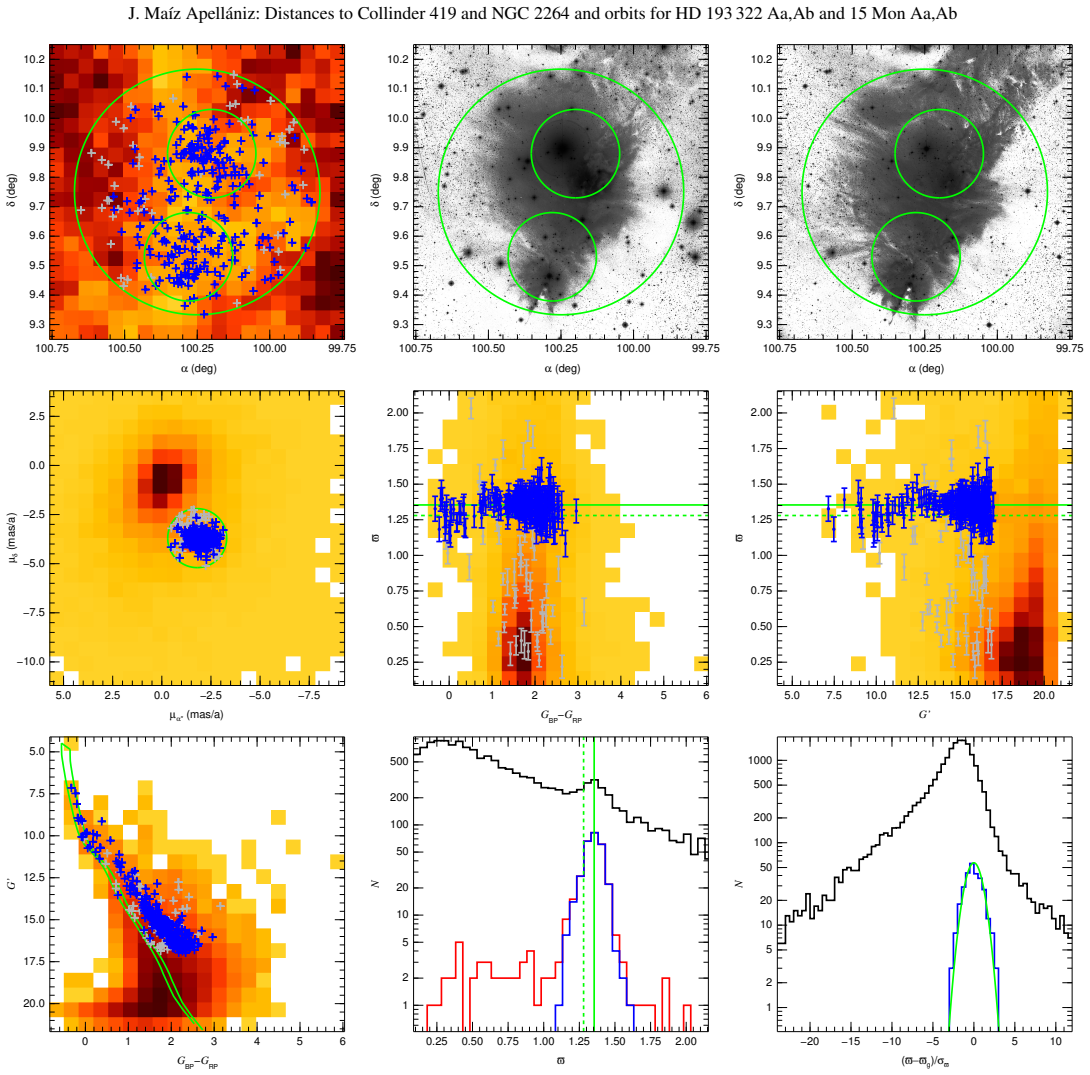
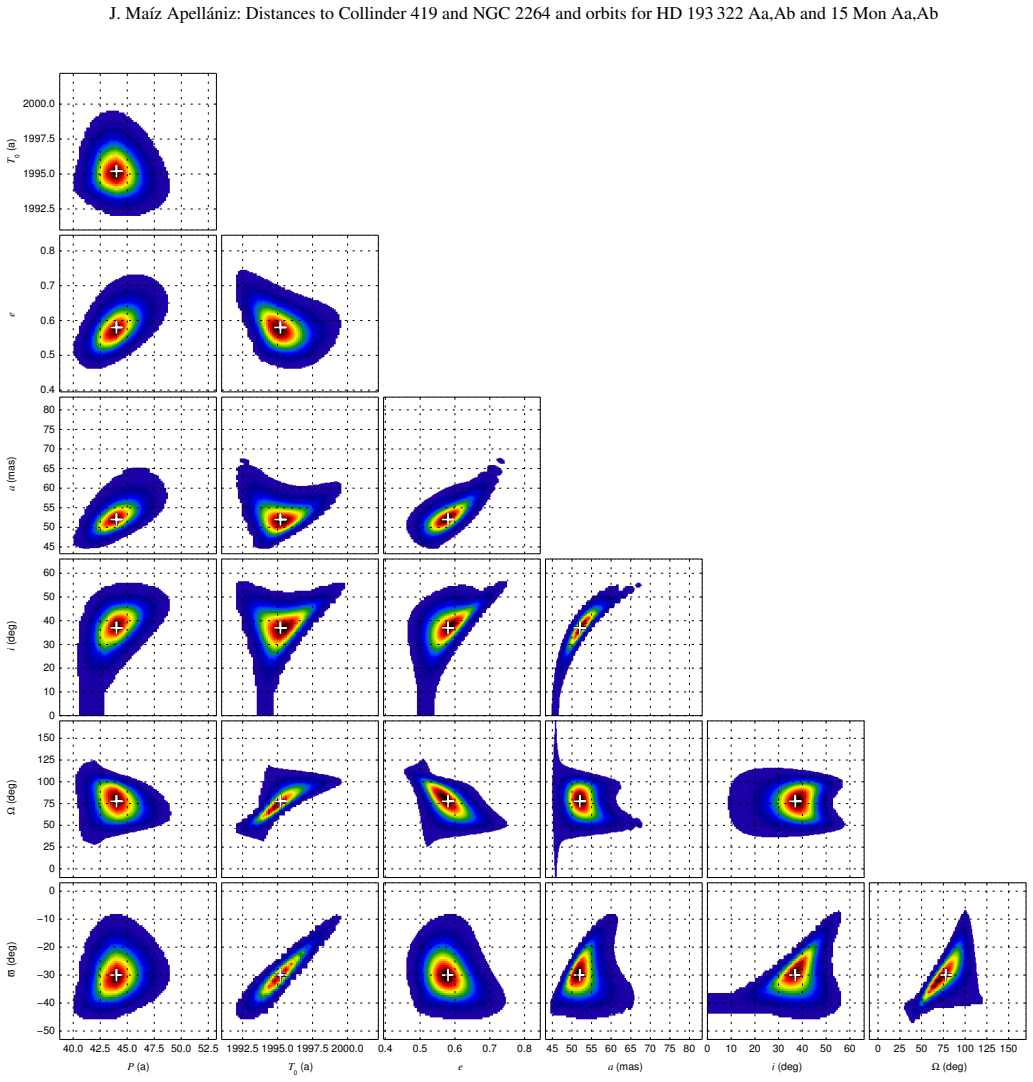
The load-bearing machinery is two methods. The distance method is supervised and multifilter: it starts from a spectroscopically chosen reference O star, removes Gaia sources with poor astrometry (RUWE > 1.4), contaminated photometry ($d_{\rm CC} > 0.2$ mag), or large external parallax uncertainty, then applies position, proper-motion, and isochrone-with-extinction-band cuts, and finally a normalized-parallax $\sigma$-clip; the surviving objects are combined in a weighted mean that explicitly includes the spatial covariance of the Gaia DR2 parallaxes, the mean is shifted by a single $+0.040$ mas zero-point correction with a further $0.010$ mas added to the uncertainty, and a Bayesian prior for young disk populations converts the parallax into a distance. The orbit method replaces the usual local $\chi^2$ fit with a global likelihood search: 128 seeded minimizations probe the whole seven-dimensional space, promising solutions are rounded onto a 255-point-per-dimension grid, and the algorithm expands through adjacent grid cells like an amoeba until no more above-threshold points appear; parameters are re-parametrized as periastron distance $d \equiv a\sin i$ and $\varpi \equiv \omega+\Omega$ to break the correlations that make the likelihood surface snake-shaped. The astrometric input is the Washington Double Star catalog combined with AstraLux lucky-imaging measurements, whose new calibration uses Gaia DR2 reference coordinates.
What would settle it
Take an independent geometric distance to either cluster—an improved water-maser parallax for NGC 2264, or a future Gaia data release with a per-star parallax zero point—and compare it with the quoted values; a disagreement larger than the combined uncertainties falsifies the single-offset assumption. The tightest check is the 15 Mon Aa,Ab mass: obtain resolved radial velocities of the two components, combine them with the visual orbit to get a purely dynamical mass, and compare with $45.1^{+3.6}_{-3.3}\,M_\odot$; because mass scales as distance cubed, any discrepancy also pinpoints the distance error.
Extended reading notes
Core claim
The central claim is that a careful, supervised combination of Gaia DR2 data yields robust parallaxes for Collinder 419 and NGC 2264, and that a global search of the seven-parameter orbital space gives reliable elements for the two central binaries. For Collinder 419 the paper obtains a distance of $1006^{+37}_{-34}$ pc, which it argues rules out the earlier $741\pm36$ pc CMD-based value of Roberts et al. (2010); for NGC 2264 it obtains $719\pm16$ pc, in agreement with the water-maser distance of Kamezaki et al. (2014). The new orbit for HD 193 322 Aa,Ab has $P = 44\pm1$ yr and $e = 0.58^{+0.03}_{-0.04}$, implying a total mass of $76.1^{+9.9}_{-7.4}\,M_\odot$ for its three components, about half the value the previous orbit implied at the old distance. The 15 Mon Aa,Ab orbit has $P = 108\pm12$ yr and $e = 0.770^{+0.023}_{-0.030}$, implying $45.1^{+3.6}_{-3.3}\,M_\odot$ for its two components, with a random uncertainty below ten percent. The paper also reports that the two NGC 2264 subclusters lie at the same distance but move with significantly different proper motions, and that a bright M-type star near Collinder 419 may be a runaway from a younger star-forming region behind the cluster.
Load-bearing premise
The load-bearing premise is that a single Gaia DR2 parallax zero-point correction of $+0.040$ mas applies to every member star in both clusters; the true zero point depends on magnitude, color, and sky position, and an error of $0.010$ mas would shift the Collinder 419 distance by about 1% and the derived binary masses by about 3%.
Editorial extensions
If this is right
- If the distances stand, Collinder 419 is a ~1.0 kpc cluster rather than the ~0.74 kpc of the earlier CMD study, shifting the absolute magnitudes of all its members and halving the inferred HD 193 322 Aa,Ab mass to 76 $M_\odot$, a value consistent with three late-O/early-B stars.
- The 15 Mon Aa,Ab total mass of $45.1^{+3.6}_{-3.3}\,M_\odot$ has a random uncertainty below ten percent, making it one of the best constrained masses for an O-type visual binary and a direct test for stellar evolution models at high mass.
- The combination of Gaia DR2 with WDS and AstraLux data, together with the grid-searching orbit code, is a prescription for measuring orbits and masses of other massive binaries within ~1 kpc.
- For NGC 2264 the two subclusters are at the same distance yet show a significant relative proper motion, indicating separate dynamical units within the cluster; the internal velocity dispersion within each subcluster dominates their proper-motion spreads.
- For HD 193 322 Aa,Ab, the ephemerides imply the system will not complete its first observed revolution until the late 2020s, and the next periastron occurs around 2040, so continued astrometric monitoring will keep tightening the orbital parameters and mass.
Reading between the lines
- Because the parallax zero point varies with magnitude, color, and position, a single-offset correction is a systematic risk; if future per-star zero points from later Gaia releases differ from +0.040 mas by 0.010 mas, the distances shift by roughly 1% and the derived masses by about 3% (mass $\propto$ distance cubed), so comparisons across clusters should carry that systematic in quadrature.
- The period history of 15 Mon (published values from 23.6 to 190.5 years) shows how local fits on short arcs can lock onto wrong solutions; the same global-search approach used here could re-examine other long-period binaries whose published orbits disagree, since it maps the full likelihood surface instead of a local minimum.
- If the approved spatially resolved spectroscopy of 15 Mon Aa and Ab succeeds, the new astrometric orbit plus double-lined radial velocities would yield individual component masses, converting the current total-mass measurement into a genuine calibration point for the upper main sequence.
- The apparent counterclockwise relative motion between the NGC 2264 subclusters, combined with the cluster's young age and gas content, raises a testable dynamical question: the projected separation of about 4.5 pc is small compared with the distance uncertainties, and future radial-velocity or proper-motion data could reveal whether the two halves are bound or expanding apart.
Signed reviews
Editorial analysis
A structured set of objections, weighed in public.
Referee Report
Summary. This paper presents two methodological applications of Gaia DR2 and ground-based lucky imaging. First, a supervised membership/distance algorithm combining Gaia astrometry (positions, proper motions, parallaxes) and photometry with quality cuts (RUWE, dCC) is applied to two clusters containing O stars. It yields distances of 1006+37-34 pc for Collinder 419 and 719±16 pc for NGC 2264, with uncertainties dominated by spatial covariance of Gaia parallaxes, and it shows the two NGC 2264 subclusters are at the same distance but have different proper motions. Second, a global grid-search orbit-fitting code for visual binaries is applied to WDS and AstraLux data, giving an eccentric 44-yr orbit for HD 193 322 Aa,Ab with total mass 76.1+9.9-7.4 Msun, and an eccentric 108±12-yr orbit for 15 Mon Aa,Ab with total mass 45.1+3.6-3.3 Msun.
Significance. If the results hold, the paper replaces uncertain photometric and Hipparcos distances for two nearby O-star clusters with Gaia-based distances and provides two new dynamical mass anchors for massive binaries. The distance pipeline is a careful treatment of correlated Gaia parallaxes, quality filtering, and robustness Monte Carlos, and the orbit code is a genuine improvement over local chi-squared fitting because it maps the full seven-dimensional likelihood and handles multimodality and non-ellipsoidal uncertainties. A notable strength is the explicit discussion of the distance covariance term, which dominates the distance errors, and the systematic parallax zero-point term. The main scientific value, however, rests on the 15 Mon orbit, where the observed arc is short relative to the period; that result needs additional support before the mass can be considered a reliable anchor.
major comments (3)
- [Section 4, Table 6, Abstract] The headline mass uncertainties in Table 6 and the Abstract exclude the distance contribution, as stated at the start of Section 4 ("do not include the uncertainties associated with distance"). Since the mass scales as distance cubed, the 3-4% distance uncertainty for Collinder 419 adds roughly a 10% systematic to the 76.1 Msun mass, and the 2% distance uncertainty for NGC 2264 adds roughly 7% to the 45.1 Msun mass. These are comparable to or larger than the quoted random uncertainties. The text mentions this in Sections 4.1 and 4.2, but the Abstract presents the masses without that caveat. Please propagate the distance uncertainty into the quoted mass uncertainties (or, at minimum, state the combined uncertainty prominently in the Abstract).
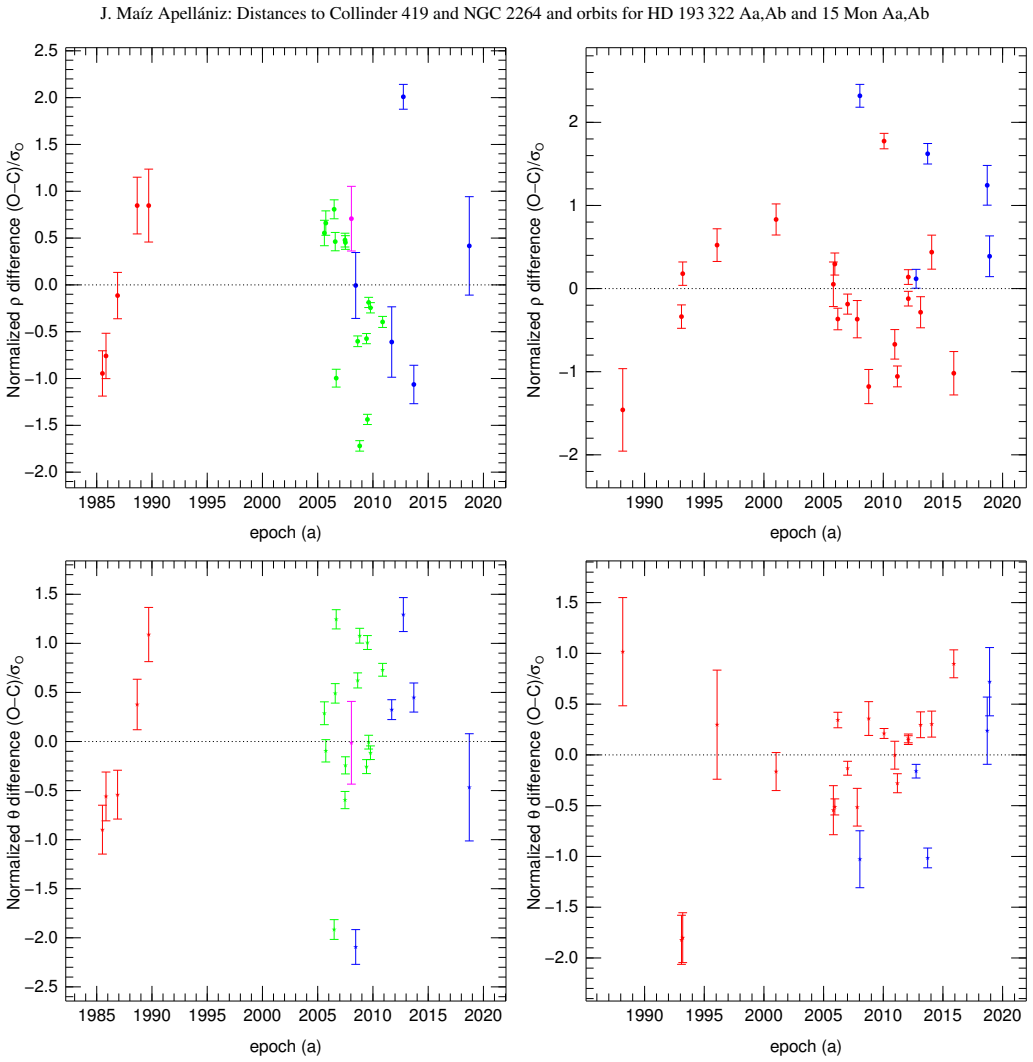
- [Section 4.2, Fig. 6] The 15 Mon Aa,Ab orbit is based on an arc spanning 1988.17-2018.91 (Table 5), which is less than one-third of the 108-yr best-fit period, and the paper correctly notes the system will not return to its first observed epoch until near the end of the century. Published periods range from 23.6 to 190.5 yr (Table 1). The statement that \"the likelihood around 190 a is very low\" relies on the adopted weights for the many WDS data points whose uncertainties are not directly measured but assigned and iterated in Section 2.2.2. With such a short arc, systematic errors in a few early epochs could plausibly move the solution between period families. Please add robustness tests: re-fit after excluding the early McAlister/Gies points, after excluding the 2018 AstraLux epochs, and after varying the weights assigned to the unmeasured-uncertainty points by plausible factors, and report whether the 108-yr period family and the resulting mass remain the preferred solution.
- [Section 2.2.2] The iterative weighting scheme for measurements lacking published uncertainties is described only qualitatively (``I also select initial values for their uncertainties'' followed by iteration). To make the orbit results reproducible and to allow an assessment of the influence of the weighting on the final solution, please specify the initial weight choices, the iteration rule, the convergence criterion, and the final assigned uncertainties (or at least a summary of how they changed from the initial values). This is directly relevant to the robustness of the period and mass claims, especially for 15 Mon.
minor comments (3)
- [Section 2.1, Eq. (2)] The parallax zero-point is applied as a single constant +0.040 mas with an added 0.010 mas systematic, despite the paper noting that the zero point depends on magnitude, color, and position. Given that the observed cluster members span a range of G magnitudes, please state explicitly whether 0.040±0.010 is meant to cover the full range across the sample, or whether the systematic uncertainty would need to be larger to account for the magnitude-dependent zero-point spread.
- [Section 3.3] The word "Montecarlo" appears twice; should be "Monte Carlo".
- [Section 3 heading] The heading reads "Distances to and membership of to Collinder 419 and NGC 2264"; the second "to" is extraneous.
Circularity Check
No significant circularity: distances, orbits, and masses are derived from external astrometry and independent calibrations.
full rationale
The paper's central results are two Gaia DR2 cluster distances, obtained as the zero-point-corrected weighted mean of the parallaxes of member stars selected by position, proper motion, color-magnitude, and quality filters (Sec. 2.1, Eq. 2), and two visual-binary orbits fit to WDS and AstraLux relative astrometry (Sec. 2.2). The distances are not used to define the membership filter: the CMD isochrone is anchored to the reference star's observed photometry and to extinction parameters from Maíz Apellániz & Barbá (2018), not to the target distance, and the final distance is the measured parallax, not the isochrone. The orbit parameters (P, a, e, etc.) come from a global likelihood search over the data in Tables 4 and 5; those data are independent of the derived masses. The masses follow from Kepler's third law using the fitted P and a and the separately derived distances, so no equation defines an output as its own input. Self-citations (photometric sensitivity curves, extinction laws, the Bayesian distance prior, the earlier AstraLux data paper) are general calibrations or observations with stated assumptions that do not contain the target distances or masses; they are thus independent support, not circular inputs. The acknowledged short observed arc for 15 Mon (less than one-third of the fitted 108-yr period, Sec. 4.2) is a robustness concern and is correctly flagged by the author; it does not make the derivation circular.
Assumptions & free parameters
free parameters (3)
- Gaia DR2 parallax zero-point correction =
0.040 mas
- Isochrone age =
3.2 Ma (Collinder 419), 1 Ma (NGC 2264)
- Membership filter thresholds =
Table 3 (RUWE<1.4, dCC<0.2, sigma_pi<0.1, r, r_mu, color range)
assumptions (5)
- standard math Kepler's third law relates orbital period, angular semi-major axis, distance, and total mass.
- ad hoc to paper The Gaia DR2 parallax zero point is constant at 0.040 mas for all member stars in both clusters.
- domain assumption The spatial covariance of Gaia DR2 parallaxes is described by the Lindegren et al. (2018) recipe and Campillay et al. (2019) Eq. 5.
- domain assumption The young-disk distance prior of Maiz Apellaniz (2001, 2005) is appropriate for these clusters.
- domain assumption The relative motion of each visual binary is a single Keplerian orbit with negligible perturbation from other components, such as HD 193 322 B or the inner Ab1,Ab2 pair.
Cite this review
Pith. "Pith review of Gaia DR2 distances to Collinder 419 and NGC 2264 and new astrometric orbits for HD 193 322 Aa,Ab and 15 Mon Aa,Ab." pith.science (2026). https://pith.science/paper/QB6DW3K7
@misc{pith2026190802040,
  author       = {Pith},
  title        = {Pith review of: Gaia DR2 distances to Collinder 419 and NGC 2264 and new astrometric orbits for HD 193 322 Aa,Ab and 15 Mon Aa,Ab},
  year         = {2026},
  howpublished = {\url{https://pith.science/paper/QB6DW3K7}},
  note         = {Machine review of arXiv:1908.02040}
}
read the original abstract
[ABRIDGED] CONTEXT: Gaia DR2 has opened a trove of astrometric and photometric data for Galactic clusters close to the Sun. Lucky imaging has been an operational technique to measure the positions of visual binary systems for a decade and a half, enough to apply its results to the calculation of orbits of some massive multiple systems within ~1 kpc of the Sun. AIMS: We are measuring distances to Galactic stellar groups containing O stars and I start with two of them: Collinder 419 in Cygnus and NGC 2264 in Monoceros. I also aim to derive new astrometric orbits for the Aa,Ab components for the main ionizing sources for both clusters: HD 193 322 and 15 Mon, respectively. METHODS: First, I present a method that uses Gaia DR2 photometry, positions, proper motions, and parallaxes to obtain the membership and distance of a stellar group and apply it to Collinder 419 and NGC 2264. Second, I present a new code that calculates astrometric orbits by searching the whole 7-parameter orbit space and apply it to HD 193 322 Aa,Ab and 15 Mon Aa,Ab using as input literature data from the Washington Double Star Catalog (WDS) and the AstraLux measurements recently presented by Ma\'iz Apell\'aniz et al. (2019). RESULTS: I obtain Gaia DR2 distances of 1006+37-34 pc for Collinder 419 and 719+-16 pc for NGC 2264, with the main contribution to the uncertainties coming from the spatial covariance of the parallaxes. The two NGC 2264 subclusters are at the same distance (within the uncertainties) and they show a significant relative proper motion. The distances are shown to be robust. HD 193 322 Aa,Ab follows an eccentric (e = 0.58+0.03-0.04) orbit with a period of 44+-1 a and the three stars it contains have a total mass of 76.1+9.9-7.4 M_Sol. The orbit of 15 Mon Aa,Ab is even more eccentric (e = 0.770+0.023-0.030), with a period of 108+-12 a and a total mass of 45.1+3.6-3.3 M_Sol for its two stars.
Figures

Figures from the paper (4 more)


Reference graph
Works this paper leans on
-
[1]
Aldoretta, E. J., Caballero-Nieves, S. M., Gies, D. R., et al. 2015, AJ, 149, 26
work page 2015
- [2]
- [3]
-
[4]
Brown, A. G. A., Vallenari, A., Prusti, T., et al. 2018, A&A, 616, A1
work page 2018
-
[5]
Caballero, J. A. & Dinis, L. 2008, AN, 329, 801
work page 2008
-
[6]
Campillay, A. R., Arias, J. I., Barb \'a , R. H., et al. 2019, MNRAS, 484, 2137
work page 2019
-
[7]
2018, A&A, 618, A93
Cantat-Gaudin, T., Jordi, C., Vallenari, A., et al. 2018, A&A, 618, A93
2018
-
[8]
2009, Publications of the Astronomical Observatory of Belgrade, 86, 331
Cvetkovi \'c , Z., Vince, I., & Ninkovi \'c , S. 2009, Publications of the Astronomical Observatory of Belgrade, 86, 331
work page 2009
Show all 67 references
-
[9]
2010, New Astronomy, 15, 302
Cvetkovi \'c , Z., Vince, I., & Ninkovi \'c , S. 2010, New Astronomy, 15, 302
2010
-
[10]
Dahm, S. E. 2008, Handbook of Star Forming Regions, Volume I (Astronomical Society of the Pacific), 966
2008
-
[11]
W., Riello, M., De Angeli, F., et al
Evans, D. W., Riello, M., De Angeli, F., et al. 2018, A&A, 616, A4
2018
-
[12]
R., Mason, B
Gies, D. R., Mason, B. D., Bagnuolo, Jr., W. G., et al. 1997, ApJL, 475, L49
1997
-
[13]
R., Mason, B
Gies, D. R., Mason, B. D., Hartkopf, W. I., et al. 1993, AJ, 106, 2072
1993
-
[14]
& Alfaro, E
Gonz \'a lez, M. & Alfaro, E. J. 2017, MNRAS, 465, 1889
2017
-
[15]
I., Tokovinin, A., & Mason, B
Hartkopf, W. I., Tokovinin, A., & Mason, B. D. 2012, AJ, 143, 42
2012
-
[16]
P., Casetti-Dinescu, D
Horch, E. P., Casetti-Dinescu, D. I., Camarata, M. A., et al. 2017, AJ, 153, 212
2017
-
[17]
P., Falta, D., Anderson, L
Horch, E. P., Falta, D., Anderson, L. M., et al. 2010, AJ, 139, 205
2010
-
[18]
P., van Altena, W
Horch, E. P., van Altena, W. F., Cyr, Jr., W. M., et al. 2008, AJ, 136, 312
2008
-
[19]
2008, Journal of Physics Conference Series, 131, 012051
Hormuth, F., Brandner, W., Hippler, S., & Henning, T. 2008, Journal of Physics Conference Series, 131, 012051
2008
-
[20]
2014, ApJS, 211, 18
Kamezaki, T., Imura, K., Omodaka, T., et al. 2014, ApJS, 211, 18
2014
-
[21]
2019, arXiv e-prints
Khan, S., Miglio, A., Mosser, B., et al. 2019, arXiv e-prints
2019
-
[22]
& Moitinho, A
Krone-Martins, A. & Moitinho, A. 2014, A&A, 561, A57
2014
-
[23]
2018, GAIA-C3-TN-LU-LL-124-01
Lindegren, L. 2018, GAIA-C3-TN-LU-LL-124-01
2018
-
[24]
2018 a , A&A, 616, A2
Lindegren, L., Hern \'a ndez, J., Bombrun, A., et al. 2018 a , A&A, 616, A2
2018
-
[25]
Lindegren, L. et al. 2018 b , https://www.cosmos.esa.int/documents/29201/1770596/Lindegren_GaiaDR2_Astrometry_extended.pdf
2018
-
[26]
Luri, X., Brown, A. G. A., Sarro, L. M., et al. 2018, A&A, 616, A9
2018
-
[27]
2001, AJ, 121, 2737
Ma \' z Apell \'a niz, J. 2001, AJ, 121, 2737
2001
-
[28]
2004, PASP, 116, 859
Ma \' z Apell \'a niz, J. 2004, PASP, 116, 859
2004
-
[29]
2005, in ESA Special Publication, Vol
Ma \' z Apell \'a niz, J. 2005, in ESA Special Publication, Vol. 576, The Three-Dimensional Universe with Gaia, ed. C. Turon, K. S. O'Flaherty, & M. A. C. Perryman, 179
2005
-
[30]
2010, A&A, 518, A1
Ma \' z Apell \'a niz, J. 2010, A&A, 518, A1
2010
- [31]
-
[32]
& Barb \'a , R
Ma \' z Apell \'a niz, J. & Barb \'a , R. H. 2018, A&A, 613, A9
2018
-
[33]
H., Sim \'o n-D \' az, S., et al
Ma \' z Apell \'a niz, J., Barb \'a , R. H., Sim \'o n-D \' az, S., et al. 2018, A&A, 615, A161
2018
-
[34]
H., Sota, A., & Sim \'o n-D \' az, S
Ma \' z Apell \'a niz, J., Barb \'a , R. H., Sota, A., & Sim \'o n-D \' az, S. 2015, A&A, 583, A132
2015
-
[35]
J., Barb \'a , R
Ma \' z Apell \'a niz, J., Evans, C. J., Barb \'a , R. H., et al. 2014, A&A, 564, A63
2014
-
[36]
Ma \' z Apell \'a niz, J., P \'e rez, E., & Mas-Hesse, J. M. 2004, AJ, 128, 1196
2004
-
[37]
H., Le Bouquin, J.-B., & Gamen, R
Ma \' z Apell \'a niz, J., Sana, H., Barb \'a , R. H., Le Bouquin, J.-B., & Gamen, R. C. 2017, MNRAS, 464, 3561
2017
-
[38]
I., et al
Ma \' z Apell \'a niz, J., Sota, A., Arias, J. I., et al. 2016, ApJS, 224, 4
2016
-
[39]
R., et al
Ma \' z Apell \'a niz, J., Sota, A., Walborn, N. R., et al. 2011, in HSA6, 467--472
2011
-
[40]
& Weiler, M
Ma \' z Apell \'a niz, J. & Weiler, M. 2018, A&A, 619, A180
2018
-
[41]
Ma \' z Apell \'a niz, J. et al. 2019, A&A, accepted (arXiv:1904.11385)
2019 arXiv
-
[42]
D., Hartkopf, W
Mason, B. D., Hartkopf, W. I., Gies, D. R., Henry, T. J., & Helsel, J. W. 2009, AJ, 137, 3358
2009
-
[43]
D., Hartkopf, W
Mason, B. D., Hartkopf, W. I., Raghavan, D., et al. 2011, AJ, 142, 176
2011
-
[44]
D., Wycoff, G
Mason, B. D., Wycoff, G. L., Hartkopf, W. I., Douglass, G. G., & Worley, C. E. 2001, AJ, 122, 3466
2001
-
[45]
A., Hartkopf, W
McAlister, H. A., Hartkopf, W. I., Hutter, D. J., Shara, M. M., & Franz, O. G. 1987, AJ, 93, 183
1987
-
[46]
A., Hartkopf, W
McAlister, H. A., Hartkopf, W. I., Sowell, J. R., Dombrowski, E. G., & Franz, O. G. 1989, AJ, 97, 510
1989
-
[47]
A., Mason, B
McAlister, H. A., Mason, B. D., Hartkopf, W. I., & Shara, M. M. 1993, AJ, 106, 1639
1993
-
[48]
P., Bagnuolo, Jr., W
McKibben, W. P., Bagnuolo, Jr., W. G., Gies, D. R., et al. 1998, PASP, 110, 900
1998
-
[49]
1998, Astronomical algorithms
Meeus, J. 1998, Astronomical algorithms
1998
-
[50]
J., C., C.-K., & de Lara, E
Neri, L. J., C., C.-K., & de Lara, E. 1993, A&AS, 102, 201
1993
-
[51]
R., The, P
P \'e rez, M. R., The, P. S., & Westerlund, B. E. 1987, PASP, 99, 1050
1987
-
[52]
Prusti, T., de Bruijne, J. H. J., Brown, A. G. A., et al. 2016, A&A, 595, A1
2016
-
[53]
C., Gies, D
Roberts, L. C., Gies, D. R., Parks, J. R., et al. 2010, AJ, 140, 744
2010
-
[54]
2014, ApJS, 215, 15
Sana, H., Le Bouquin, J.-B., Lacour, S., et al. 2014, ApJS, 215, 15
2014
-
[55]
A., Lorenzo, J., et al
Sim \'o n-D \' az, S., Caballero, J. A., Lorenzo, J., et al. 2015, ApJ, 799, 169
2015
-
[56]
R., et al
Sota, A., Ma \' z Apell \'a niz, J., Walborn, N. R., et al. 2011, ApJS, 193, 24
2011
-
[57]
A., O'Brien, D
ten Brummelaar, T. A., O'Brien, D. P., Mason, B. D., et al. 2011, AJ, 142, 21
2011
-
[58]
J., Hartmann, L., F u r \'e sz, G., Hsu, W.-H., & Mateo, M
Tobin, J. J., Hartmann, L., F u r \'e sz, G., Hsu, W.-H., & Mateo, M. 2015, AJ, 149, 119
2015
-
[59]
1992, in Astronomical Society of the Pacific Conference Series, Vol
Tokovinin, A. 1992, in Astronomical Society of the Pacific Conference Series, Vol. 32, IAU Colloq. 135: Complementary Approaches to Double and Multiple Star Research, ed. H. A. McAlister & W. I. Hartkopf, 573
1992
-
[60]
2018, IAU Comission G1 Circular, 195, 2
Tokovinin, A. 2018, IAU Comission G1 Circular, 195, 2
2018
-
[61]
D., & Hartkopf, W
Tokovinin, A., Mason, B. D., & Hartkopf, W. I. 2014, AJ, 147, 123
2014
-
[62]
D., Hartkopf, W
Tokovinin, A., Mason, B. D., Hartkopf, W. I., M \'e ndez, R. A., & Horch, E. P. 2015, AJ, 150, 50
2015
-
[63]
D., Hartkopf, W
Tokovinin, A., Mason, B. D., Hartkopf, W. I., M \'e ndez, R. A., & Horch, E. P. 2016, AJ, 151, 153
2016
-
[64]
Turner, D. G. 2012, AN, 333, 174
2012
-
[65]
2007, Hipparcos, the New Reduction of the Raw Data (Hipparcos, the New Reduction of the Raw Data
van Leeuwen, F. 2007, Hipparcos, the New Reduction of the Raw Data (Hipparcos, the New Reduction of the Raw Data. By Floor van Leeuwen, Institute of Astronomy, Cambridge University, Cambridge, UK Series: Astrophysics and Space Science Library, Vol. 350 20 Springer Dordrecht)
2007
-
[66]
G., et al
Venuti, L., Prisinzano, L., Sacco, G. G., et al. 2018, A&A, 609, A10
2018
-
[67]
R., Ma \' z Apell \'a niz, J., & Barb \'a , R
Walborn, N. R., Ma \' z Apell \'a niz, J., & Barb \'a , R. H. 2002, AJ, 124, 1601
2002
Reviewed August 14, 2026 · model on record in the stance chip above.
Discussion (0). Continue with ORCID to comment.