REVIEW 3 major objections 5 minor 31 references
Adaptive Critic Based Optimal Kinematic Control for a Robot Manipulator
T0 review · 3 major / 5 minor · reviewed 2026-08-14 · deepseek-v4-flash
Pith's one-line read By choosing a critic weight update that cancels the weight error against the control error, this paper gives a single-network adaptive critic with Lyapunov stability and convergence to the HJB optimal cost for robot kinematic control.
desk verdict The paper's central claim—that the proposed critic weight update converges to the optimal HJB cost—is not supported and fails in a minimal scalar example, though the hardware experiments and the SNAC formulation itself have merit. read the letter →
The pith
A machine-rendered reading of the paper's core claim, the machinery that carries it, and where it could break.
The reading
What carries the argument
The carrying mechanism is the critic weight-update law (19)/(38) together with the quadratic Lyapunov function $J_s$. The update is deliberately chosen so that, inside the Lyapunov derivative, the term containing the unknown weight error $\tilde{W}_c$ cancels against the corresponding term generated by the difference between optimal and estimated control; what remains is $\nabla J_s^T\dot{e}^*$ plus a bounded function-approximation error. Assumption 1, which asserts that the optimal closed-loop dynamics satisfy $\nabla J_s(e)^T\dot{e}^*=-\nabla J_s(e)^TM\nabla J_s(e)$, turns the remaining term into a negative definite quadratic bound, and Barbalat's lemma upgrades the resulting boundedness to asymptotic stability. For tracking the same machinery is applied to the augmented state $\xi=[e^T,x_d^T]^T$.
What would settle it
Compute $e(t)^T J(\theta) u^*(t)$ during the regulation experiments, or on the kinematic model, from the paper's random seed poses; if this quantity is ever positive, the optimal closed-loop dynamics do not make $J_s$ a strict Lyapunov function, and the negative-definite identity in Assumption 1 fails. A static version is to evaluate $\nabla J_s(e)^T J u^*$ on a grid of error states within the robot's reachable workspace for the UR10 Jacobian and check that no value is positive.
Extended reading notes
Core claim
The central claim is that optimal kinematic control of a manipulator reduces to choosing the critic weights by $\dot{\hat{W}}_c = \alpha\nabla\sigma_c J R^{-1} J^T \nabla J_s(e)$ for regulation and $\dot{\hat{W}}_c = \alpha\nabla\varphi_c G R^{-1} G^T \nabla J_s(\xi)$ for tracking, where $\xi=[e^T,x_d^T]^T$ augments the tracking error with the reference state and $\nabla J_s(e)=e$, $\nabla J_s(\xi)=\xi$. With this law the estimated control $\hat{u}^* = -\tfrac12 R^{-1}J^T\nabla\sigma_c^T\hat{W}_c$ is shown to converge to a bounded neighborhood of the true HJB-optimal control, and the Lyapunov function $L=\tfrac{1}{4\alpha}\tilde{W}_c^T\tilde{W}_c+J_s$ has a negative-semidefinite derivative once $\|\nabla J_s\|$ is large enough. Barbalat's lemma is then used to conclude asymptotic stability and convergence of the weight estimation error to zero. The same construction is carried out for tracking on the augmented system.
Load-bearing premise
The load-bearing premise is Assumption 1: under the optimal control law the quadratic error $J_s=e^Te/2$ is a strict Lyapunov function, meaning $\nabla J_s^T\dot e^* = -\nabla J_s^TM\nabla J_s$ for some positive definite $M$; the paper cites [23] for this but never verifies it on the UR10 Jacobian or the chosen trajectories.
Editorial extensions
If this is right
- A robot arm can be driven to a fixed target as an optimal regulation problem whose critic converges to the HJB-optimal cost, so the motion follows a near-optimal trajectory instead of an arbitrary inverse-kinematics solution.
- A time-varying task-space trajectory can be followed optimally by solving an optimal tracking problem on the augmented state $\xi=[e^T,x_d^T]^T$, with a control law that naturally combines feedforward and feedback action.
- The closed loop is stable in the Lyapunov sense, and under Barbalat's lemma the weight estimation error and tracking error converge to zero, giving an analytical guarantee that earlier back-propagation-based SNAC updates only suggested through simulations.
- In the quantitative comparison over 1,000 random regulation targets and 1,000 elliptical tracking trajectories, the proposed controller reports normalized trajectory costs of 5.78 and 3.30, compared with 49.74/48.32 and 14.39/32.21 for the two baselines.
Reading between the lines
- A testable extension the paper leaves open is applying the same weight law to redundant or mobile manipulators, since the update only uses $JR^{-1}J^T$ and never requires pseudo-inverting the Jacobian.
- The proof would become a fully practical guarantee if Assumption 1 were checked numerically on the UR10 Jacobian over the sampled workspace; the paper asserts it from a cited result rather than verifying it for its own trajectories.
- Because the experimental cost is a pre-chosen quadratic form, the optimality achieved in practice is the best approximation to the true value function within that function-approximation class; comparing the learned critic against the LQR solution of a linearized arm model would quantify that gap.
Signed reviews
Editorial analysis
A structured set of objections, weighed in public.
Referee Report
Summary. The paper proposes a single-network adaptive critic (SNAC) approach to optimal kinematic control of a robot manipulator. Regulation to a fixed target and tracking of a time-varying trajectory are formulated as infinite-horizon optimal control problems for the velocity-level kinematics ẋ = J u. The value function is approximated by a single-layer neural network, and a new critic weight update law is proposed in Eq. (19) for regulation and Eq. (38) for tracking. Stability and convergence to the optimal cost are claimed via a Lyapunov analysis and Barbalat's lemma. The scheme is validated in simulations and on a real UR10 manipulator, and a statistical comparison is made against an RNN-based method and the SVF method.
Significance. If the central convergence claim were correct, the paper would provide a simple, experimentally validated critic update for optimal kinematic control. The hardware experiments and the large-sample comparison on the UR10 are useful engineering contributions. However, the main theoretical claim, that the proposed update drives the critic to the HJB optimal cost while stabilizing the closed loop, is unsupported by the derivation and is false in a minimal exactly representable example. The contribution as stated is therefore not valid, although the experimental part could be reframed as a heuristic kinematic controller with empirical evaluation.
major comments (3)
- [Section III-B, Eq. (19)] Eq. (19) contains no HJB or Bellman residual and no dependence on Q; it is an algebraic function of e alone and is constructed to cancel the \tilde W_c term in the Lyapunov derivative. Consequently the update does not drive \hat W_c toward W*. In the scalar exactly representable case n=m=1, J=1, Q=R=1, σ_c(e)=e^2, the HJB solution is V*=e^2, so W*=1, and Assumption 1 holds with ˙e*=-e. The update (19) becomes \dot{\hat W}_c=2α e^2, independent of \hat W_c. With \dot e=-\hat W_c e, one obtains e^2=e_0^2-\hat W_c^2/(2α), so \hat W_c converges to e_0√(2α), which is not 1 in general. Thus the claimed convergence to the optimal cost is false in this minimal setting, and the same objection applies to the tracking law (38).
- [Section III-C, Eqs. (24)-(28)] After the construction cancels the weight-error term, \dot L in (24) contains no \tilde W_c dependence. Even if e(t)→0 and \dot L→0, this cannot imply \tilde W_c→0 without a persistence-of-excitation condition, which is neither assumed nor established. The Barbalat step is also not justified: (25)-(26) give \dot L≤0 only outside a ball, not globally, and Remark 2 simply asserts that \ddot L is bounded rather than proving it. The same issues are repeated in the tracking stability analysis in Section IV-D.
- [Section III-B, Assumption 1] Assumption 1 is a strong structural assumption: it states that the optimal closed-loop error dynamics make J_s(e)=e^T e/2 satisfy ∇J_s^T ˙e* = -∇J_s^T M∇J_s, i.e., that the quadratic tracking error is a strict Lyapunov function for the optimal closed loop. This is exactly the desired stability property, and Remark 1's invocation of [23] does not verify it for the UR10 Jacobian or for the chosen trajectories. If Assumption 1 fails, the negative definite term in (25) disappears and the claimed stability bound is unsupported. For tracking, Remark 3 assumes the same property for the augmented system, but no argument is given that the reference dynamics in (29) satisfy it.
minor comments (5)
- [Section III-B, Eq. (7)] The notation ∇V* is used in the Hamiltonian before the optimal value function is introduced; the Hamiltonian should be written with ∇V^T and the optimal value function should be defined first.
- [Section III-C, Eq. (28)] The quantities ˙e* and ¨e* are not defined as functions of the state, and the boundedness claim in Remark 2 is asserted without derivation.
- [Section V-B, V-C] The learning-rate schedule α=α_initial(tanh(n−k))+α_final is not clearly specified; the roles of n and k and the time dependence are unclear, and no values are given for all experiments.
- [Section V-E, Table I] The comparison reports only mean trajectory costs; no error bars, confidence intervals, or implementation details for the RNN [3] and SVF [26] baseline are provided, so the large cost differences in Table I are difficult to evaluate.
- [Figures 3 and 4] The individual subfigures are referenced only as groups, and the text does not explain the cost plots or how they relate to the HJB optimal cost.
Circularity Check
The critic update (19)/(38) is constructed to cancel the weight-error term in the Lyapunov derivative, so the claimed Barbalat convergence of W~c to zero, and hence convergence to the optimal cost, is not derived from the equations.
-
other
[Section III-B, Eq. (19); Section III-C, Eqs. (22)-(24), Remark 2]
"Moving on, a simple and novel critic weight tuning law is proposed. ˙ˆWc =α∇σcJR−1JT∇Js(e) (19) ... Using (23) in (22) and on simplification, ˙L(t) =∇JT s ˙e∗ + 1/2∇JT s JR−1JT∇εc (24) ... Barbalat’s Lemma [24] can be invoked to conclude the asymtotic stability of the system and convergence of the parameter estimation error and the weight estimation errors towards zero. In other words, it ensures that ~Wc→ 0."
Substituting (19) into (21)-(22) gives a term -1/2 W~c^T ∇σ J R^{-1} J^T ∇J_s. Equation (23) rewrites e_dot as e_dot* + 1/2 J R^{-1} J^T (∇σ^T W~c + ∇ε), so the W~c terms cancel exactly and (24) contains no weight error. The subsequent Barbalat inference that W~c→0 is therefore not a consequence of the Lyapunov analysis: the quantity whose convergence is asserted has been cancelled out of the derivative by construction. The update also contains no HJB/Bellman residual from (9) and no Q; in the scalar exactly representable case J=Q=R=1, σ(e)=e^2, (19) gives W_hat_dot=2αe^2, which does not drive W_hat to W*=1. The same construction is used for tracking, (38) and (43)-(44).
full rationale
The paper's central claim is that the novel update law (19) ensures convergence to the optimal cost. The derivation shows the opposite direction: the update is chosen so that the W~c term in L_dot cancels exactly when (23) is substituted, leaving (24) with no weight-error information. The later Barbalat conclusion that W~c→0, and hence that the critic converges to the HJB solution, does not follow from L_dot or L_ddot; the asserted convergence target has been removed from the Lyapunov analysis by construction. Equation (19) is an algebraic function of e alone through ∇J_s, contains no HJB/Bellman residual from (9), and is independent of Q, so the update is not driven by any optimal-cost error. The same cancellation is reused for the tracking update (38) and the tracking stability argument (43)-(44). This is a partial circularity by construction rather than a self-citation chain: Assumption 1 is imported from the external reference [23], and even granting it, the weight-error term is cancelled before Barbalat is invoked. The experimental and comparative results are empirical and not themselves circular. Overall, the central 'convergence to the desired optimal cost' prediction is not derived from the stated equations, warranting score 6.
Assumptions & free parameters
free parameters (4)
- Cost weighting matrices Q and R =
Q=I_3x3, R=I_6x6 in the experiments and Table I
- Critic learning-rate schedule for regulation =
alpha_initial=100, alpha_final=150, n=50
- Critic learning-rate schedule for tracking =
alpha_initial=20, alpha_final=70, n=10
- Number of hidden neurons in the critic networks =
not reported
assumptions (4)
- domain assumption Assumption 1: there exists a positive definite M such that ∇Js(e)^T ˙e* = -∇Js(e)^T M ∇Js(e), with Js(e)=e^Te/2.
- domain assumption Boundedness of Jacobian, activation gradients, and reconstruction errors: ||J||≤λJ, ||∇σc||≤λσ, ||∇εc||≤λ∇ε.
- domain assumption Reference trajectories are generated by ˙xd=φ(xd) with φ Lipschitz and φ(0)=0.
- domain assumption The optimal value function is exactly representable as Wc^T σ(e)+ε (or Wc^T φ(ξ)+ε) with bounded target weights and bounded approximation error.
Cite this review
Pith. "Pith review of Adaptive Critic Based Optimal Kinematic Control for a Robot Manipulator." pith.science (2026). https://pith.science/paper/DAOZWKOI
@misc{pith2026190802077,
  author       = {Pith},
  title        = {Pith review of: Adaptive Critic Based Optimal Kinematic Control for a Robot Manipulator},
  year         = {2026},
  howpublished = {\url{https://pith.science/paper/DAOZWKOI}},
  note         = {Machine review of arXiv:1908.02077}
}
read the original abstract
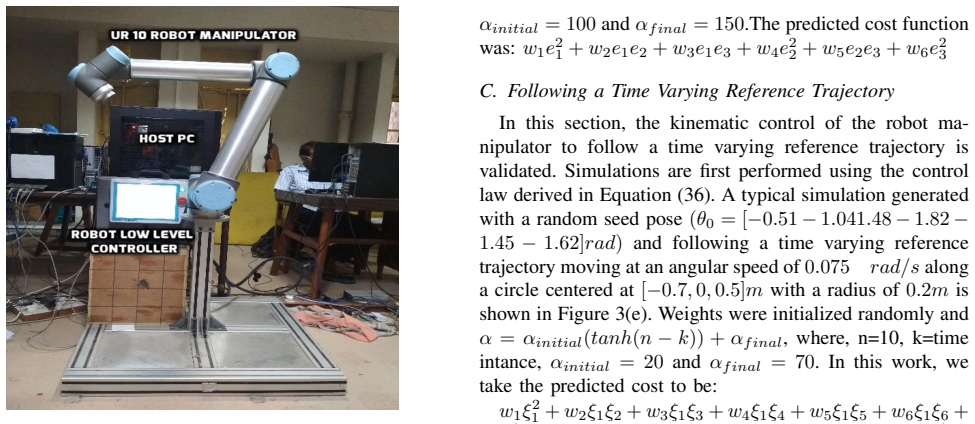
This paper is concerned with the optimal kinematic control of a robot manipulator where the robot end effector position follows a task space trajectory. The joints are actuated with the desired velocity profile to achieve this task. This problem has been solved using a single network adaptive critic (SNAC) by expressing the forward kinematics as input affine system. Usually in SNAC, the critic weights are updated using back propagation algorithm while little attention is given to convergence to the optimal cost. In this paper, we propose a critic weight update law that ensures convergence to the desired optimal cost while guaranteeing the stability of the closed loop kinematic control. In kinematic control, the robot is required to reach a specific target position. This has been solved as an optimal regulation problem in the context of SNAC based kinematic control. When the robot is required to follow a time varying task space trajectory, then the kinematic control has been framed as an optimal tracking problem. For tracking, an augmented system consisting of tracking error and reference trajectory is constructed and the optimal control policy is derived using SNAC framework. The stability and performance of the system under the proposed novel weight tuning law is guaranteed using Lyapunov approach. The proposed kinematic control scheme has been validated in simulations and experimentally executed using a real six degrees of freedom (DOF) Universal Robot (UR) 10 manipulator.
Figures


Figures from the paper (1 more)

Reference graph
Works this paper leans on
-
[23]
Optimal control of affine nonlinear continuous-time systems,
T. Dierks and S. Jagannathan, “Optimal control of affine nonlinear continuous-time systems,” in American Control Conference (ACC),
-
[1]
S. Kumar, L. Behera, and T. McGinnity, “Kinematic control of a redundant manipulator using inverse-forward adaptive scheme with a ksom based hint generator,” Robotics and Autonomous Systems , vol. 58, no. 5, pp. 622–633, 2010
work page 2010
-
[2]
P. Prem Kumar and L. Behera, “Visual servoing of a redundant manipulator with jacobian matrix estimation using self-organizing map,” Robotics and Autonomous Systems , vol. 58, no. 8, pp. 978–990, 2010
work page 2010
-
[3]
Kinematic control of redundant manipu- lators using neural networks,
S. Li, Y . Zhang, and L. Jin, “Kinematic control of redundant manipu- lators using neural networks,” IEEE transactions on neural networks and learning systems , vol. 28, no. 10, pp. 2243–2254, 2017
work page 2017
-
[4]
I. Sirazuddin, L. Behera, T. McGinnity, and S. Coleman, “Image based visual servoing of a 7 dof robot manipulator using an adaptive distributed fuzzy pd controller,” IEEE/ASME Trans on Mechatronics , vol. 19, no. 2, pp. 512–523, 2014
work page 2014
-
[5]
F. L. Lewis, D. Vrabie, and V . L. Syrmos, Optimal control . John Wiley & Sons, 2012
2012
-
[6]
An existence theorem for discrete-time infinite-horizon optimal control problems,
S. Keerthi and E. Gilbert, “An existence theorem for discrete-time infinite-horizon optimal control problems,” IEEE Transactions on Automatic Control, vol. 30, no. 9, pp. 907–909, 1985
work page 1985
-
[7]
D. P. Bertsekas, D. P. Bertsekas, D. P. Bertsekas, and D. P. Bertsekas, Dynamic programming and optimal control . Athena scientific Bel- mont, MA, 2005, vol. 1, no. 3
work page 2005
Show all 31 references
-
[8]
Generalized hamilton–jacobi–bellman formulation-based neural network control of affine nonlinear discrete- time systems,
Z. Chen and S. Jagannathan, “Generalized hamilton–jacobi–bellman formulation-based neural network control of affine nonlinear discrete- time systems,” IEEE Transactions on Neural Networks , vol. 19, no. 1, pp. 90–106, 2008
2008
-
[9]
Handbook of learning and approx. dynamics prog,
J. Si, A. Barto, W. Powell, and D. Wunsch, “Handbook of learning and approx. dynamics prog,” 2004
2004
-
[10]
A single network adaptive critic (snac) architecture for optimal control synthesis for a class of nonlinear systems,
R. Padhi, N. Unnikrishnan, X. Wang, and S. Balakrishnan, “A single network adaptive critic (snac) architecture for optimal control synthesis for a class of nonlinear systems,” Neural Networks , vol. 19, no. 10, pp. 1648–1660, 2006
2006
-
[11]
A single network adaptive critic-based redundancy resolution scheme for robot manip- ulators,
P. K. Patchaikani, L. Behera, and G. Prasad, “A single network adaptive critic-based redundancy resolution scheme for robot manip- ulators,” IEEE Transactions on Industrial Electronics , vol. 59, no. 8, pp. 3241–3253, 2012
2012
-
[12]
Predictive online inverse kinematics for redundant manipulators,
C. S. . T. B. . J. B. . J. P. . H. Ulbrich, “Predictive online inverse kinematics for redundant manipulators,” in ICRA Proceedings of the 2014 IEEE International Conference on . IEEE, 2014, pp. 5056–5061
2014
-
[13]
Analytical inverse kinematic solution for modularized 7-dof redundant manipulators with offsets at shoulder and wrist,
R. C. L. . T.-W. L. . Y .-H. Tsai, “Analytical inverse kinematic solution for modularized 7-dof redundant manipulators with offsets at shoulder and wrist,” in IROS Proceedings of the 2014 IEEE/RSJ International Conference on. IEEE, 2014, pp. 516–521
2014
-
[14]
Efficient kinematic planning for mobile manipulators with non- holonomic constraints using optimal control,
M. Giftthaler, F. Farshidian, T. Sandy, L. Stadelmann, and J. Buchli, “Efficient kinematic planning for mobile manipulators with non- holonomic constraints using optimal control,” in 2017 IEEE Inter- national Conference on Robotics and Automation (ICRA) , May 2017, pp. 3411–3417
2017
-
[15]
Redundancy resolution of manipulators through torque optimization,
J. Hollerbach and K. Suh, “Redundancy resolution of manipulators through torque optimization,” in Robotics and Automation. Proceed- ings. 1985 IEEE International Conference on , vol. 2. IEEE, 1985, pp. 1016–1021
1985
-
[16]
Redundancy resolution of robot manipulators using optimal kinematic control,
S.-W. Kim, K.-B. Park, and J.-J. Lee, “Redundancy resolution of robot manipulators using optimal kinematic control,” in Robotics and Automation, 1994. Proceedings., 1994 IEEE International Conference on. IEEE, 1994, pp. 683–688
1994
-
[17]
Resolution of kine- matic redundancy using optimization techniques,
D. P. Martin, J. Baillieul, and J. M. Hollerbach, “Resolution of kine- matic redundancy using optimization techniques,” IEEE Transactions on Robotics and Automation , vol. 5, no. 4, pp. 529–533, 1989
1989
-
[18]
Kinetic limitations on the use of redundancy in robotic manipulators,
A. Maciejewski, “Kinetic limitations on the use of redundancy in robotic manipulators,” in Robotics and Automation, 1989. Proceed- ings., 1989 IEEE International Conference on . IEEE, 1989, pp. 113–118
1989
-
[19]
Divergence of linear acceleration-based redundancy resolution schemes,
K. A. O’Neil, “Divergence of linear acceleration-based redundancy resolution schemes,” IEEE Transactions on Robotics and Automation , vol. 18, no. 4, pp. 625–631, 2002
2002
-
[20]
Novel reaction control techniques for redundant space manipulators: Theory and simulated microgravity tests,
S. Cocuzza, I. Pretto, and S. Debei, “Novel reaction control techniques for redundant space manipulators: Theory and simulated microgravity tests,” Acta Astronautica, vol. 68, no. 11-12, pp. 1712–1721, 2011
2011
-
[21]
Actor–critic-based optimal tracking for partially unknown nonlinear discrete-time systems,
B. Kiumarsi and F. L. Lewis, “Actor–critic-based optimal tracking for partially unknown nonlinear discrete-time systems,” IEEE transactions on neural networks and learning systems , vol. 26, no. 1, pp. 140–151, 2015
2015
-
[22]
Neural network robust tracking control with adaptive critic framework for uncertain nonlinear systems,
D. Wang, D. Liu, Y . Zhang, and H. Li, “Neural network robust tracking control with adaptive critic framework for uncertain nonlinear systems,” Neural Networks , vol. 97, pp. 11–18, 2018
2018
-
[24]
Vamvoudakis and S
K. Vamvoudakis and S. Jagannathan, Control of Complex Systems: Theory and Applications . Butterworth-Heinemann, 2016
2016
-
[25]
Backlash compensation in nonlinear systems using dynamic inversion by neural networks,
R. R. Selmic and F. L. Lewis, “Backlash compensation in nonlinear systems using dynamic inversion by neural networks,” in Control Applications, 1999. Proceedings of the 1999 IEEE International Conference on, vol. 2. IEEE, 1999, pp. 1163–1168
1999
-
[26]
Redundant inverse kinematics: Experimen- tal comparative review and two enhancements,
A. Colom ´e and C. Torras, “Redundant inverse kinematics: Experimen- tal comparative review and two enhancements,” in Intelligent Robots and Systems (IROS), 2012 IEEE/RSJ International Conference on . IEEE, 2012, pp. 5333–5340
2012
-
[27]
Multi-player non-zero-sum games: Online adaptive learning solution of coupled hamilton–jacobi equations,
K. G. Vamvoudakis and F. L. Lewis, “Multi-player non-zero-sum games: Online adaptive learning solution of coupled hamilton–jacobi equations,” Automatica, vol. 47, no. 8, pp. 1556–1569, 2011
2011
-
[28]
Optimal tracking control of affine nonlinear discrete-time systems with unknown internal dynamics,
T. Dierks and S. Jagannathan, “Optimal tracking control of affine nonlinear discrete-time systems with unknown internal dynamics,” in Decision and Control, 2009 held jointly with the 2009 28th Chinese Control Conference. CDC/CCC 2009. Proceedings of the 48th IEEE Conference on....
2009
-
[29]
Neural network approach to continuous- time direct adaptive optimal control for partially unknown nonlinear systems,
D. Vrabie and F. Lewis, “Neural network approach to continuous- time direct adaptive optimal control for partially unknown nonlinear systems,” Neural Networks , vol. 22, no. 3, pp. 237–246, 2009
2009
-
[30]
J.-J. E. Slotine, W. Li et al., Applied nonlinear control . Prentice hall Englewood Cliffs, NJ, 1991, vol. 199, no. 1
1991
-
[2010]
1568–1573
IEEE, 2010, pp. 1568–1573
2010
Reviewed August 14, 2026 · model on record in the stance chip above.
Discussion (0). Continue with ORCID to comment.