REVIEW 2 major objections 6 minor 22 references
MAGIC extragalactic highlights from a MeV perspective
T0 review · 2 major / 6 minor · reviewed 2026-08-14 · deepseek-v4-flash
Pith's one-line read MAGIC TeV observations imply that extreme blazars need extremely low magnetization and that the neutrino blazar TXS 0506+056 has a non-negligible proton-induced cascade contribution in its X-ray and very-high-energy bands.
desk verdict A competent conference proceedings summary of MAGIC extragalactic results with no new data; the one quantitative claim (low magnetization in extreme blazars) is unsupported here because it defers to papers in preparation. read the letter →
The pith
A machine-rendered reading of the paper's core claim, the machinery that carries it, and where it could break.
The reading
What carries the argument
The machinery carrying the argument is two radiative models applied to multi-wavelength spectral energy distributions. The one-zone synchrotron self-Compton (SSC) model takes the jet emission to come from a single homogeneous blob, where the same relativistic electrons make the synchrotron hump and up-scatter those photons to higher energies; fitting measured SEDs in this framework forces the magnetization extremely low. The one-zone lepto-hadronic spine-sheath model instead puts the emission in a fast jet spine with protons interacting with photon fields from a slower outer sheath, producing cascades and neutrinos; this is the mechanism that turns the TXS spectra into a statement about proton acceleration and ultra-high-energy cosmic rays. The claim about the MeV band ties these together: the MeV range is where photo-hadronic cascades and the synchrotron peaks of extreme blazars should appear, making it the direct probe of the mechanisms the TeV fits only infer.
What would settle it
A future neutrino-coincident flare of TXS 0506+056 observed simultaneously in hard X-rays and sub-TeV gamma rays would settle the hadronic claim: if the flare's X-ray-to-very-high-energy spectrum does not show the cascade hardening predicted by the spine-sheath model, the proton-induced contribution is not needed. An independent check for the extreme-blazar claim would be an X-ray polarization or Faraday-rotation measurement giving a jet magnetic field far above the value the one-zone SSC fit requires.
Extended reading notes
Core claim
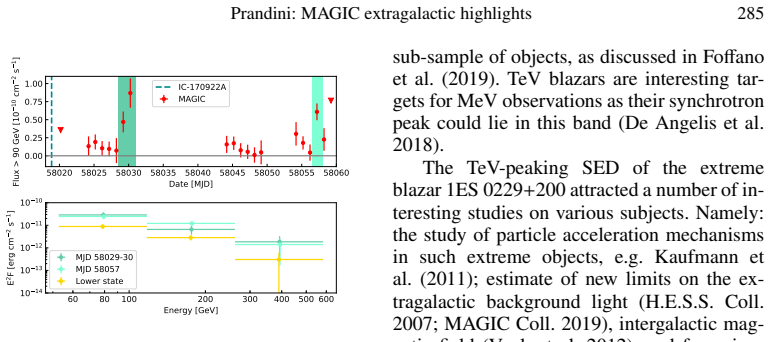
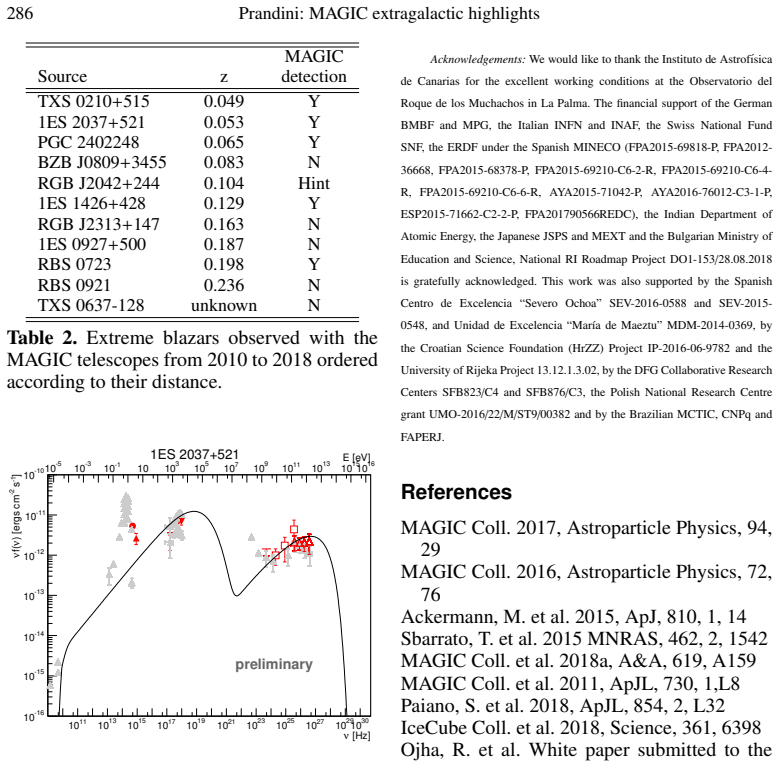
The paper's central results are two claims anchored in fits to measured spectral energy distributions. For the extreme-blazar campaign, MAGIC detected, or found a hint of, five of eleven observed sources between 2010 and 2018, and a one-zone synchrotron self-Compton fit to their SEDs requires an extremely low jet magnetization; the displayed fit for 1ES 2037+521 is labeled preliminary, with parameters in two papers in preparation. For TXS 0506+056, the broadband SED including MAGIC sub-TeV spectra in both quiescent and flaring states is modeled with a one-zone lepto-hadronic spine-sheath model, in which protons co-accelerated with electrons interact with photons from a slower surrounding sheath; the fit gives a non-negligible contribution from proton-induced cascades in the hard X-ray and very-high-energy bands, and a proton maximum energy consistent with a contribution to ultra-high-energy cosmic rays. The paper also reports that the very-high-energy spectral slope of TXS 0506+056 changes little between flaring and quiescent states, and that the minute-scale variability of PKS 1222+216 strains the standard picture in which such rapid variability would suffer strong self-absorption.
Load-bearing premise
The load-bearing premise is that each source's light comes from a single emitting zone with the assumed mix of electrons, protons, and target photons; if the real jet has several zones or different target light fields, the fitted low magnetization and proton-cascade contributions are not required by the data.
Editorial extensions
If this is right
- If extreme blazars are truly low-magnetization SSC emitters, their jets are matter-dominated rather than magnetically dominated, shifting the burden onto electron acceleration and Compton cooling models in weak fields.
- If the TXS 0506+056 SED really contains a proton-induced cascade component, blazar jets can simultaneously explain neutrino alerts, hard X-ray and very-high-energy excesses, and part of the ultra-high-energy cosmic-ray flux.
- If the FSRQ variability argument holds, minute-scale very-high-energy flares must originate in regions where absorption by the broad-line photon field is avoided, constraining the location of the emitting zone along the jet.
- MeV observations become a discriminating test of jet composition: a future MeV instrument measuring the photo-hadronic cascade hump can confirm or reject the hadronic contribution that TeV data alone cannot isolate.
Reading between the lines
- If the low-magnetization SSC fits are right for all five detected extreme blazars, one can search for a trend between the fitted magnetization and the synchrotron peak frequency; such a trend would link jet magnetization to the blazar sequence and to how the jet dissipates energy, an extension the paper does not make.
- The proton-cascade interpretation predicts that, during neutrino-coincident flares, the hard X-ray and very-high-energy bands should harden together; this correlation can be tested retroactively on the existing multi-wavelength light curves of TXS 0506+056 without needing a new detection.
- A future MeV survey, by mapping the 0.1-100 MeV sky, could find many more extreme-blazar-like sources whose synchrotron peaks fall in that band, turning the handful of objects studied here into a population for statistical tests of the low-magnetization picture.
- The paper's hadronic result implies that some of the diffuse neutrino flux seen by large neutrino observatories should come from the blazar population; quantifying that contribution from the inferred proton energies would be a natural next step not attempted in this proceedings.
Signed reviews
Editorial analysis
A structured set of objections, weighed in public.
Referee Report
Summary. This proceedings paper by E. Prandini on behalf of the MAGIC Collaboration summarizes recent MAGIC extragalactic results, oriented toward the MeV-TeV connection. Section 2.1 describes the eight FSRQs known at VHE and highlights MAGIC results on PKS 1222+216, PKS 1510-089, and TON 599. Section 2.2 reviews the TXS 0506+056 neutrino-blazar campaign and the one-zone lepto-hadronic spine-sheath model from MAGIC Collaboration (2018b), including the claim of a non-negligible proton-induced cascade contribution. Section 2.3 reports on a MAGIC campaign on 11 extreme blazars, five detections plus one hint, and states that one-zone SSC fits require 'an extremely low magnetization,' with parameter tables deferred to two papers in preparation.
Significance. The paper's value is as a concise programmatic summary connecting MeV and TeV phenomenology. It accurately represents the published FSRQ and TXS 0506+056 results, and the references allow a reader to trace those claims to refereed papers. The most novel quantitative assertion is the extreme-blazar low-magnetization result; if confirmed, it would favour low-magnetization SSC-dominated jets in these sources and sharpen the contrast with hadronic models. However, the manuscript does not itself provide the evidence for that claim, so the contribution's scientific advance is limited to reporting a collaboration result in a non-auditable form.
major comments (2)
- [Section 2.3 (paragraph after Table 2)] The central result 'an extremely low magnetization is required to successfully fit the data' is not supported within the manuscript. No numerical value for the magnetization, magnetic field, equipartition ratio, Doppler factor, or electron energy distribution is given; Fig. 3 shows one source only and is explicitly labelled 'preliminary'; and the parameter tables are deferred to two papers in preparation. Because a one-zone SSC fit has strong degeneracies among B, the electron normalization, the emitting-region size, and the Doppler factor, a claim of this strength needs at least one representative best-fit parameter set with uncertainties and, ideally, a comparison with an equipartition or high-magnetization solution. As written, the claim is an assertion that cannot be checked from the material presented.
- [Section 2.3, Table 2] The table reports detection/hint status for 11 sources but no exposure, significance, or flux values, so the reader cannot assess the campaign result that underlies the modelling claim. Please include the basic analysis quantities or clearly state that this is a preliminary summary to be published elsewhere.
minor comments (6)
- [Key words] The keyword list ('Stars: abundances – Stars: atmospheres – Stars: Population II – Galaxy: globular clusters – Galaxy: abundances – Cosmology: observations') is a placeholder unrelated to the paper's content and should be replaced with relevant astrophysics keywords.
- [Abstract] The abstract says 'In this talk, I will report' although this is a written contribution; rephrase to a written-paper form.
- [Section 2.2] 'TXS 0506 +650' should read 'TXS 0506+056'.
- [Sections 1.2 and 2.1] There are typos: 'no information is still available' in Section 1.2 and 'non-self absortion' in Section 2.1.
- [Figure 3] The figure has both a frequency axis in Hz and an energy axis in eV without clear separation; consider clarifying the dual-axis labeling.
- [References] Several references are incomplete (e.g., 'MNRAS accepted' for Foffano et al. 2019 and MAGIC Coll. et al. 2019, and no page numbers for proceedings entries); please update before publication.
Circularity Check
No significant circularity: the reported results are model fits to external multi-wavelength and neutrino data, not quantities defined by the conclusions.
full rationale
This is a MAGIC conference-highlights article rather than a derivation paper, and its claims are anchored to external measurements (MAGIC, Fermi-LAT, Swift, IceCube). The extreme-blazar 'extremely low magnetization' statement (Sect. 2.3) is presented explicitly as a fit result: the SEDs were modeled with a one-zone SSC model following Asano et al. (2014), so the magnetization is an output parameter constrained by the data, not a quantity defined in terms of the conclusion. Although the parameter tables are deferred to papers in preparation, that is an auditability/reproducibility limitation, not a circular reduction. The TXS 0506+056 hadronic-cascade statement (Sect. 2.2) cites MAGIC Coll. (2018b), a published, peer-reviewed fit to the broadband SED including MAGIC sub-TeV spectra; that is legitimate external support for a summary article, not a self-citation chain used to forbid alternatives. No equation is reused as a conclusion, no fitted parameter is relabeled a prediction, and no 'uniqueness' theorem from the authors is invoked. Self-citations are frequent in a collaboration-authored highlights paper but none is load-bearing in a way that makes the argument equivalent to its inputs.
Assumptions & free parameters
free parameters (2)
- Jet magnetization parameter in extreme blazar SSC fits =
Not given in this paper; deferred to MAGIC papers in preparation
- Maximum proton energy in the TXS 0506+056 lepto-hadronic model =
Not given in this paper; described as consistent with a UHECR contribution
assumptions (4)
- domain assumption Blazar SEDs can be described by a one-zone synchrotron self-Compton model.
- domain assumption The standard FSRQ scenario links minute-scale variability to strong self-absorption at tens of GeV.
- domain assumption The MeV band is an excellent proxy for photo-hadronic processes in blazar jets that produce neutrinos.
- ad hoc to paper The spine-sheath geometry with a slow-moving plasma layer around a faster jet spine applies to TXS 0506+056.
Cite this review
Pith. "Pith review of MAGIC extragalactic highlights from a MeV perspective." pith.science (2026). https://pith.science/paper/3MD6W4QZ
@misc{pith2026190802154,
  author       = {Pith},
  title        = {Pith review of: MAGIC extragalactic highlights from a MeV perspective},
  year         = {2026},
  howpublished = {\url{https://pith.science/paper/3MD6W4QZ}},
  note         = {Machine review of arXiv:1908.02154}
}
read the original abstract
In the past fifteen years, the way to study TeV gamma-ray emitters changed drastically. The detection-based approach aimed at populating the TeV gamma-ray sky evolved into a physics-driven one, with the ambitious objective of understanding the mechanisms responsible for the emission and their environments. The synergic collaboration between instruments operating in different electromagnetic bands and with different messengers is therefore crucial. In this talk, I will report highlights on extragalactic physics studies achieved with the MAGIC telescopes, with special emphasis on the MeV-TeV connection.
Figures

Reference graph
Works this paper leans on
- [1]
- [2]
-
[3]
Ackermann, M. et al. 2015, ApJ, 810, 1, 14
work page 2015
-
[4]
Sbarrato, T. et al. 2015 MNRAS, 462, 2, 1542
work page 2015
-
[5]
MAGIC Coll. et al. 2018a, A&A, 619, A159
-
[6]
MAGIC Coll. et al. 2011, ApJL, 730, 1,L8
work page 2011
-
[7]
Paiano, S. et al. 2018, ApJL, 854, 2, L32
work page 2018
-
[8]
IceCube Coll. et al. 2018, Science, 361, 6398
work page 2018
Show all 22 references
-
[9]
Ojha, R. et al. White paper submitted to the Astro2020 Decadal Survey
-
[10]
MAGIC Coll. et al. 2018b, ApJL, 863, 1, L10
-
[11]
2001, A&A, 371, 2
Costamante, L., et al. 2001, A&A, 371, 2
2001
-
[12]
2019, MNRAS accepted
Foffano, L., et al. 2019, MNRAS accepted
2019
-
[13]
De Angelis, A. et al. 2018, Journal of High Energy Astrophysics, 19, 1
2018
-
[14]
H.E.S.S. Coll. 2007, A&A, 475, 2, L9
2007
-
[15]
MAGIC Coll. et al. 2019, MNRAS accepted
2019
-
[16]
2012, ApJL, 747, 1, L14
Vovk, Ie et al. 2012, ApJL, 747, 1, L14
2012
-
[17]
High-Energy Phenomena and Relativistic Outflows V
Tavecchio, F. et al 2015, Proceedings of the Conference "High-Energy Phenomena and Relativistic Outflows V"
2015
-
[18]
Tavecchio, F. et al. 2018, MNRAS, 483, 2
2018
- [19]
-
[20]
Kaufmann, S. et al. 2011, A&A, 534, A130
2011
-
[21]
Tavecchio, F. et al. 2016, A&A, 585, A25
2016
-
[22]
Asano, K. et al. 2014, ApJ, 780, 1, 64
2014
Reviewed August 14, 2026 · model on record in the stance chip above.
Discussion (0). Continue with ORCID to comment.