REVIEW 3 major objections 5 minor 13 references
Numerical Simulations of Cosmic-Ray Acceleration at Core-Collapse Supernovae
T0 review · 3 major / 5 minor · reviewed 2026-08-14 · deepseek-v4-flash
Pith's one-line read A core-collapse supernova in a red supergiant may accelerate cosmic rays past 100 TeV within hours of shock breakout.
desk verdict Realistic RSG density profiles push Emax to a few hundred TeV within the first day, but the headline timing rests on an optimistic Te=Tp assumption and methods parked in an unpublished reference. read the letter →
The pith
A machine-rendered reading of the paper's core claim, the machinery that carries it, and where it could break.
The reading
What carries the argument
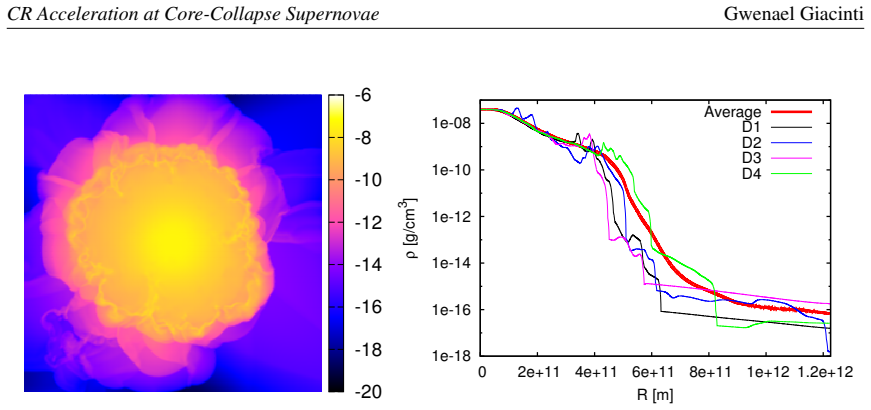
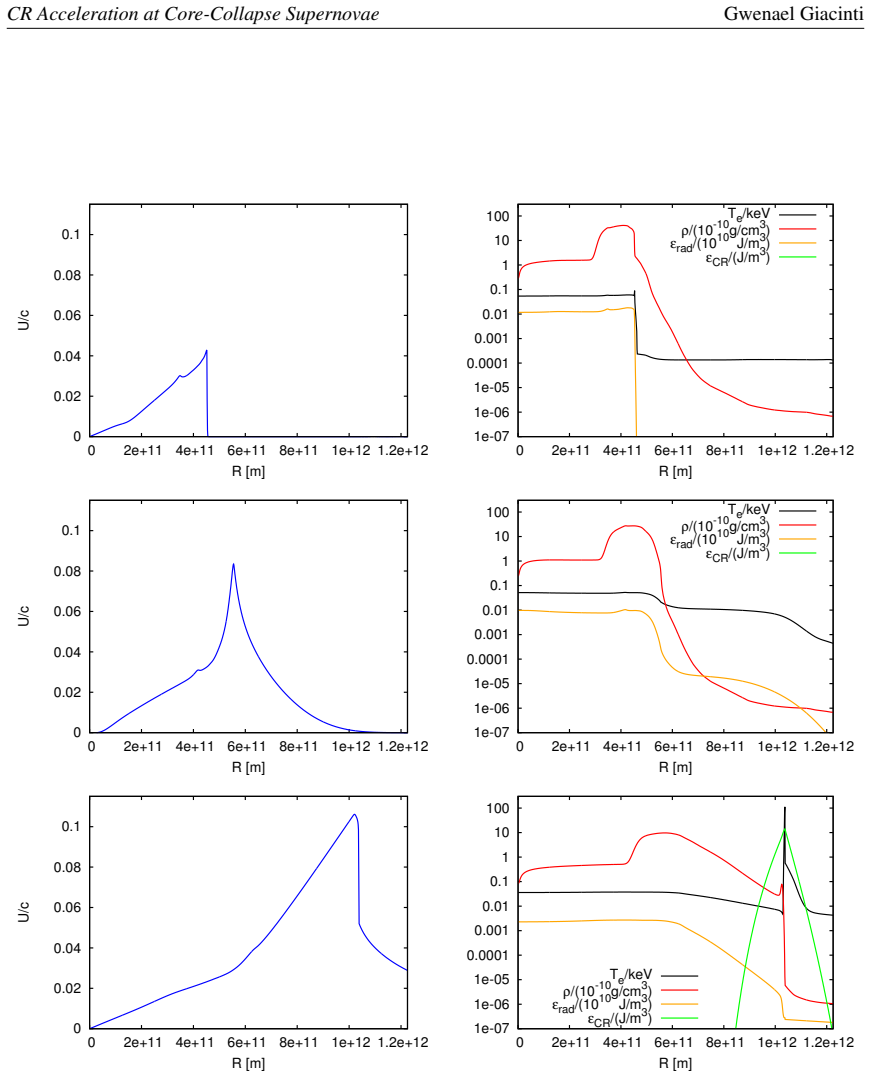
The argument is carried by a one-dimensional CR-radiation-hydrodynamics simulation that uses the spherically averaged density and temperature profiles of a three-dimensional convective red supergiant as input. The simulation follows the radiation-mediated shock through the star, identifies the moment a collisionless shock forms after the radiation flash of shock breakout, and adds cosmic-ray pressure to the fluid. At each time it compares the Bohm-diffusion acceleration time to 1 GeV with the Coulomb, pp-collision, and adiabatic loss times to decide when acceleration can start, then computes $E_{\max}$ from the current of escaping cosmic rays and the growth rate of the cosmic-ray-current-driven magnetic-field instability, checking the acceleration time to $E_{\max}$ against pp, p$\gamma$, and adiabatic losses.
What would settle it
Recompute the onset time with the same shock profiles but with electrons heated to a small fraction of the proton temperature, for example one tenth of it, as is typical of weak or oblique collisionless shocks, and check whether the 1 GeV acceleration time still drops below the Coulomb loss time within an hour of the collisionless shock forming. If it does not, the 'above 100 TeV within hours' result is an artefact of the electron-heating assumption. A complementary observational check is X-ray spectroscopy of a nearby Type II supernova within its first day: an electron temperature far below tens of keV would indicate stronger Coulomb losses than the simulation assumes.
Extended reading notes
Core claim
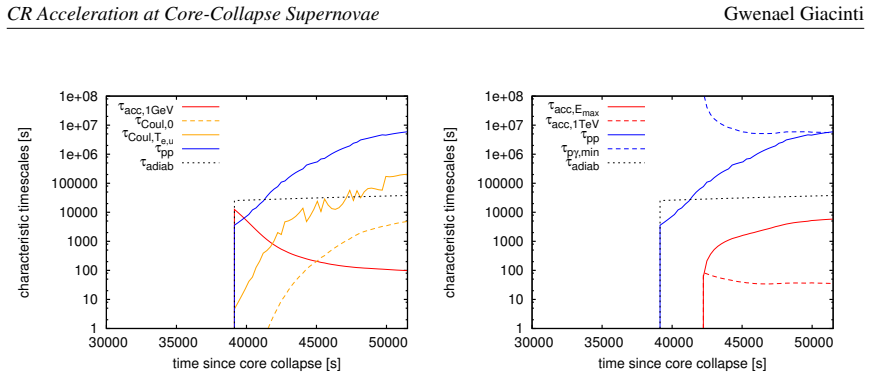
The paper's central claim is that the first day of a Type II supernova from a red supergiant already contains a working cosmic-ray accelerator. After shock breakout, a collisionless shock forms at $t \simeq 39000$ s, and the acceleration time to 1 GeV drops below the Coulomb loss time at $t \simeq 42000$ s, so particle acceleration starts only about an hour after the collisionless shock forms, for a 1 mG circumstellar magnetic field. From that onset, the maximum cosmic-ray energy $E_{\max}$ reaches $\geq 100$ TeV within roughly one hour and plateaus to a few hundred TeV by the end of the first day. The paper also finds that the limiting energy is set by the density of the circumstellar medium: in denser directions around the asymmetric progenitor, the plateau value of $E_{\max}$ is a few times higher, although all directions agree to order of magnitude.
Load-bearing premise
The simulation assumes electrons and protons have the same temperature behind the shock, which maximises the electron temperature, weakens Coulomb losses, and therefore makes cosmic-ray acceleration start as early as possible.
Editorial extensions
If this is right
- If the first day is already a cosmic-ray accelerator, core-collapse supernovae in dense winds are plausible sources of TeV and PeV neutrinos and gamma rays within hours of shock breakout, not only decades later as remnants.
- The maximum cosmic-ray energy plateau by the end of day one is set by circumstellar density, so red supergiants with denser winds should produce the highest very-high-energy emission in their earliest phases.
- Because Coulomb losses delay acceleration by only about an hour, searches for prompt high-energy emission from nearby supernovae should begin observing immediately after discovery rather than waiting for the remnant stage.
- The direction-dependent onset times in the asymmetric progenitor mean that part of the shock is already accelerating particles while other parts are not, so high-energy emission may be modulated as the shock encounters different clumps.
Reading between the lines
- The two-temperature assumption likely makes the quoted onset time an optimistic lower bound: if collisionless heating leaves electrons cooler than protons, Coulomb losses are stronger and the '100 TeV within hours' result would shift to later times, possibly beyond the first day.
- A natural extension is to rerun the same simulation with a separate electron temperature or a measured electron-heating prescription; the predicted spread in onset time would directly test how robust the early-emission window is.
- If the prompt high-energy phase is real, a Galactic core-collapse supernova would produce a neutrino and gamma-ray flash within about an hour of shock breakout, giving wide-field instruments a sharp, testable time profile that distinguishes this model from later remnant emission.
- A full three-dimensional CR-radiation-hydrodynamics run would be needed to know whether the spread in breakout times from clumpy structure is larger than the one-dimensional directional estimates; if clumps divert the shock, some lines of sight could lag much longer.
Editorial analysis
A structured set of objections, weighed in public.
Referee Report
Summary. The paper presents one-dimensional CR-radiation-hydrodynamics simulations of a red supergiant core-collapse supernova during the first day after core collapse. Starting from a 3D CO5BOLD progenitor density profile, the authors deposit 10^51 erg at the center and follow the shock until it becomes collisionless. They then compute the acceleration time to 1 GeV, the Coulomb, pp, adiabatic, and p-gamma loss times, and the maximum CR energy Emax using the Bell instability, assuming Bohm diffusion and a 1 mG initial magnetic field. The central quantitative claims are that CR acceleration starts roughly one hour after the formation of the collisionless shock and that Emax exceeds 100 TeV about one hour after the onset of acceleration, plateauing at a few hundred TeV by the end of the first day. The paper also explores how the three-dimensional structure of the progenitor affects the results by repeating the calculation along six different radial directions.
Significance. If the timing claim holds, this paper establishes that core-collapse supernovae exploding in dense winds become very-high-energy cosmic-ray accelerators within hours of shock breakout, with direct implications for TeV-PeV neutrino and gamma-ray searches during the first day after core collapse. The work combines a realistic 3D progenitor model with explicit CR pressure in the hydrodynamics and a Bell-instability-based calculation of Emax, and it shows that the plateau value of Emax is insensitive to the uncertain onset time. The direction-dependent analysis and the explicit caveat that a full 3D simulation is needed for a watertight estimate of the spread in breakout times are appropriate and honest. The main unresolved issue is not the eventual Emax but the delay before acceleration starts, because that delay controls the headline 'only a few hours after shock breakout' statement.
major comments (3)
- [Section 2 and Fig. 3] The code description states that 'electron and proton temperatures are assumed to be equal.' This maximizes the post-shock electron temperature and therefore maximizes the Coulomb loss time, making the onset of acceleration as early as possible. The paper's central timing claim—that acceleration starts only about one hour after CS formation and reaches >100 TeV 'only a few hours after shock breakout'—depends on this choice. The authors show the zero-temperature limiting curve tau_Coul,0 in Fig. 3 but do not report where tau_acc,1GeV crosses it. I request that crossing time, plus an intermediate case (for example Te = 0.1 Tp, which is more representative of weak or oblique collisionless shocks), and a revised timing statement if the zero-temperature intersection is significantly later. This is a sensitivity check for the headline quantitative result, not a circularity concern.
- [Section 2, magnetic field parameter] The onset time is inversely proportional to the initial magnetic field strength through tau_acc,1GeV, and the paper adopts B = 1 mG without a sensitivity scan. The text notes that stronger fields accelerate particles faster, but the abstract's 'only a few hours' is a timing statement whose robustness to a weaker field is not demonstrated. Please show the intersection time for at least one lower and one higher magnetic field value, or explicitly state that the timing claim is conditional on B being close to 1 mG.
- [Section 2 and Ref. [12]] The quantitative Emax calculation and the implementation of CR pressure are delegated to Ref. [12], which is listed as 'in preparation.' As a result, the core derivation of the central result cannot be checked from the present manuscript. Please include the essential equations (for example the Bell-instability growth rate, the CR current, and the condition determining Emax) either in an appendix or by making the companion paper available, so that the scaling of Emax with time and density is verifiable.
minor comments (5)
- [Section 3, text after Fig. 4] The word 'afer' in 'typically ∼ 1 hour afer the onset' should be 'after.'
- [Section 2, first paragraph] The phrase 'two-temperature, i.e. electron and proton temperatures are assumed to be equal' is self-contradictory; if Te = Tp, there is only one temperature. Please describe the closure as a single-temperature or equilibrated-temperature approximation.
- [Fig. 3 caption] The dashed orange curve tau_Coul,0 is discussed in the text but not defined in the caption. Please define all curves in the caption or refer explicitly to the text definitions so the figure is self-contained.
- [Abstract and Section 3] The abstract says 'only a few hours after shock breakout' while the detailed result in Section 3 is about one hour after the onset of acceleration, with the CS forming near 39000 s after core collapse. Please align these phrasings to make the quoted time relative to breakout versus relative to CS formation unambiguous.
- [Fig. 3, right panel] The line keys in the right panel are small and the difference between the solid red tau_acc,Emax and dashed red tau_acc,1TeV curves is central to the argument; consider larger fonts or explicit curve labels.
Circularity Check
No circular reduction found: the Emax curve and the acceleration-onset timing are forward outputs of a CR-RHD simulation, and the cited self-work supplies the model without encoding the claimed result.
full rationale
The derivation chain is a forward simulation rather than a fit. The progenitor structure is taken from independent CO5BOLD radiative-hydrodynamics simulations; the explosion is evolved with a 1D radiation-hydrodynamics code with CR pressure; and the shock velocity, density, and temperature profiles used to evaluate timescales and Emax are simulation outputs, not adjusted inputs. The acceleration start time is determined by comparing the computed tau_acc,1GeV with computed loss times, and the Emax curve is obtained by applying the published Bell-instability/escape-current model of Ref. [2] at each time step. No parameter is fitted to make tau_acc,1GeV cross tau_Coul near t = 42000 s, and no input is tuned to make Emax reach 100 TeV within about an hour. The two-temperature closure Te = Tp is an explicit modeling assumption that affects the Coulomb-loss time and therefore the quoted onset delay; this is a sensitivity/correctness caveat, not a circular step, because tau_acc,1GeV is computed independently from the shock dynamics and the assumed 1 mG field. The paper does rely on self-citations, notably Refs. [2] and [11] for the Emax model and CS-formation method, and points to the unpublished Ref. [12] for technical details; these are load-bearing in the sense that the calculation is not fully re-derived in the manuscript, but they do not reduce the target claim to the paper's own inputs. The cited model's assumptions do not include the specific result that this red supergiant shock reaches >= 100 TeV within the first day, and the quoted timing is an output of the simulation. Therefore the central claims are an application of an existing model to new hydrodynamic data, not a tautology.
Assumptions & free parameters
free parameters (3)
- Initial circumstellar magnetic field strength =
1 mG
- Supernova explosion energy =
1e51 erg
- CR spectral index at injection =
-2
assumptions (7)
- domain assumption The CR-radiation-hydrodynamics implementation described in Refs [11,12] correctly represents CR pressure feedback and shock structure.
- domain assumption The Bell instability model of Ref [2] correctly predicts Emax at the forward shock.
- domain assumption Electron and proton temperatures are equal behind the shock.
- domain assumption CR acceleration starts when the acceleration time to 1 GeV becomes shorter than all loss times.
- domain assumption A 1D spherical simulation with the averaged or individual density profiles captures the relevant shock evolution.
- domain assumption Bohm diffusion in the amplified magnetic field determines the acceleration time.
- domain assumption The CO5BOLD 3D RHD model of Ref [10] is a realistic red supergiant progenitor.
Cite this review
Pith. "Pith review of Numerical Simulations of Cosmic-Ray Acceleration at Core-Collapse Supernovae." pith.science (2026). https://pith.science/paper/E6CVVFYG
@misc{pith2026190802171,
  author       = {Pith},
  title        = {Pith review of: Numerical Simulations of Cosmic-Ray Acceleration at Core-Collapse Supernovae},
  year         = {2026},
  howpublished = {\url{https://pith.science/paper/E6CVVFYG}},
  note         = {Machine review of arXiv:1908.02171}
}
read the original abstract
Core-collapse supernovae exploding in dense winds are favorable sites for cosmic-ray (CR) acceleration to very high energies. We present our CR-radiation-hydrodynamics simulations of the explosion of a red supergiant. We study the evolution of the shock wave during the first day following core collapse, and estimate the time at which CR acceleration can start. We then calculate the maximum CR energy at the forward shock as a function of time, and show that it may already exceed 100 TeV only a few hours after shock breakout from the surface of the star.
Figures
Figures from the paper (1 more)

Reference graph
Works this paper leans on
- [12]
-
[1]
Radio emission and nonlinear diffusive shock acceleration of cosmic rays in the supernova SN 1993J
V . Tatischeff,Radio emission and nonlinear diffusive shock acceleration of cosmic rays in the supernova SN 1993J, Astron. Astrophys. 499 (2009) 191 [arXiv:0903.2944]. 6 CR Acceleration at Core-Collapse Supernovae Gwenael Giacinti
work page Pith review arXiv 2009
-
[2]
A. R. Bell, K. Schure, B. Reville, G. Giacinti, Cosmic ray acceleration and escape from supernova remnants, MNRAS 431 (2013) 415 [arXiv:1301.7264]
arXiv 2013
-
[3]
Cosmic-ray acceleration and gamma-ray signals from radio supernovae
A. Marcowith, M. Renaud, V . Dwarkadas, V . Tatischeff,Cosmic-ray acceleration and gamma-ray signals from radio supernovæ, Nucl. Phys. B Proc. Suppl. 256 (2014) 94 [arXiv:1409.3670]
work page Pith review arXiv 2014
-
[4]
Core collapse supernovae as Cosmic Ray sources
A. Marcowith, V . Dwarkadas, M. Renaud, V . Tatischeff, G. Giacinti,Core collapse supernovae as Cosmic Ray sources, MNRAS 479 (2018) 4470 [arXiv:1806.09700]
work page Pith review arXiv 2018
-
[5]
S. A. Colgate, ApJ 187 (1974) 321
work page 1974
-
[6]
R. A. Chevalier, R. I. Klein, Nonequilibrium processes in the evolution of type II supernovae, ApJ 234 (1979) 597
work page 1979
-
[7]
B. Freytag, M. Steffen, H.-G. Ludwig, S. Wedemeyer-Böhm, W. Schaffenberger, O. Steiner, Simulations of stellar convection with CO5BOLD, J. Comput. Phys. 231 (2012) 919 [arXiv:1110.6844]
arXiv 2012
Show all 13 references
-
[8]
Chiavassa, B
A. Chiavassa, B. Freytag, T. Masseron, B. Plez, Radiative hydrodynamics simulations of red supergiant stars. IV . Gray versus non-gray opacities, Astron. Astrophys. 535 (2011) A22 [arXiv:1109.3619]
2011 arXiv
-
[9]
Gustafsson, B
B. Gustafsson, B. Edvardsson, K. Eriksson, U. G. Jørgensen, Å Nordlund, B. Plez, A grid of MARCS model atmospheres for late-type stars. I. Methods and general properties, Astron. Astrophys. 486 (2008) 951 [arXiv:0805.0554]
2008 arXiv
-
[10]
Kravchenko, S
K. Kravchenko, S. Van Eck, A. Chiavassa, A. Jorissen, B. Freytag, B. Plez, Tomography of cool giant and supergiant star atmospheres. I. Validation of the method, Astron. Astrophys. 610 (2018) A29 [arXiv:1711.08327]
2018 arXiv
-
[11]
Giacinti, A
G. Giacinti, A. R. Bell, Collisionless shocks and TeV neutrinos before supernova shock breakout from an optically thick wind, MNRAS 449 (2015) 3693 [arXiv:1503.04170]
2015 arXiv
-
[13]
A. R. Bell, Turbulent amplification of magnetic field and diffusive shock acceleration of cosmic rays, MNRAS 353 (2004) 550. 7
2004
Reviewed August 14, 2026 · model on record in the stance chip above.
Discussion (0). Continue with ORCID to comment.