REVIEW 2 major objections 6 minor 62 references
HI observations of IC 10 with the DRAO synthesis telescope
T0 review · 2 major / 6 minor · reviewed 2026-08-14 · deepseek-v4-flash
Pith's one-line read Using about 1,000 hours of H I observations, this paper finds that the inner disk of the starburst dwarf IC 10 can be modeled by stars and gas alone, and that M31 is unlikely to explain the galaxy's outer H I streams.
desk verdict Solid new HI data on IC 10, but the no-dark-matter claim rests on a free M/L fit and the M31 'rule out' overstates what nine simulations can do. read the letter →
The pith
A machine-rendered reading of the paper's core claim, the machinery that carries it, and where it could break.
The reading
What carries the argument
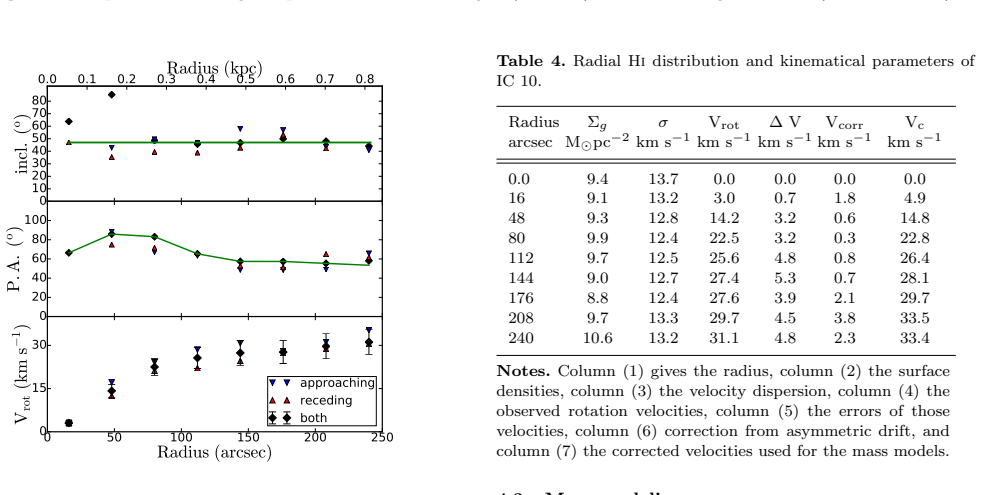
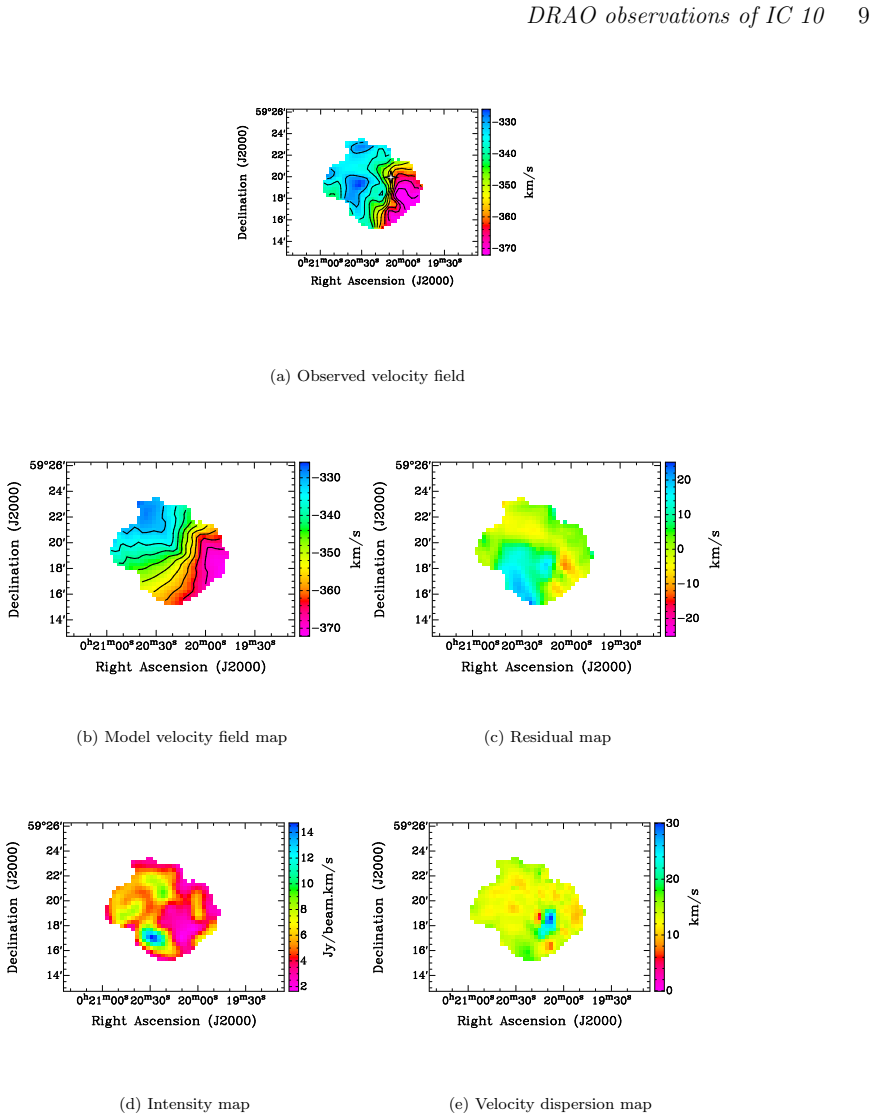
The load-bearing tool is the tilted-ring rotation-curve fit (ROTCUR) applied to the central velocity field, which yields rotation velocity, position angle, inclination, and systemic velocity for each ring; the resulting curve is corrected for asymmetric drift before mass modeling. Mass decomposition (ROTMAS) combines the gas, stellar, and optional halo contributions in quadrature via $V_{\rm rot}^2 = V_g^2 + V_d^2 + V_h^2$, using the H I surface density scaled by $1.4$ for helium and a stellar profile from WISE $3.4\,\mu$m light with a free mass-to-light ratio. For the interaction question, the machinery is a set of nine GalactICS equilibrium models of IC 10 and M31 that differ only in IC 10's proper motion within the VLBA uncertainties, evolved for $6$ Gyr with the Gadget-2 code and rendered as mock observations at DRAO and GBT resolutions to compare against the observed streams.
What would settle it
Measure the rotation curve beyond $0.8$ kpc with deeper, higher-resolution H I or CO observations: if $V_{\rm rot}$ rises above $\sim30$ km s$^{-1}$ while the baryonic mass profile stays flat, the no-dark-matter model would be falsified, whereas a continuing flat rotation would support it. An independent resolved-stellar-population estimate of the stellar mass-to-light ratio would test the same claim from the mass side.
Extended reading notes
Core claim
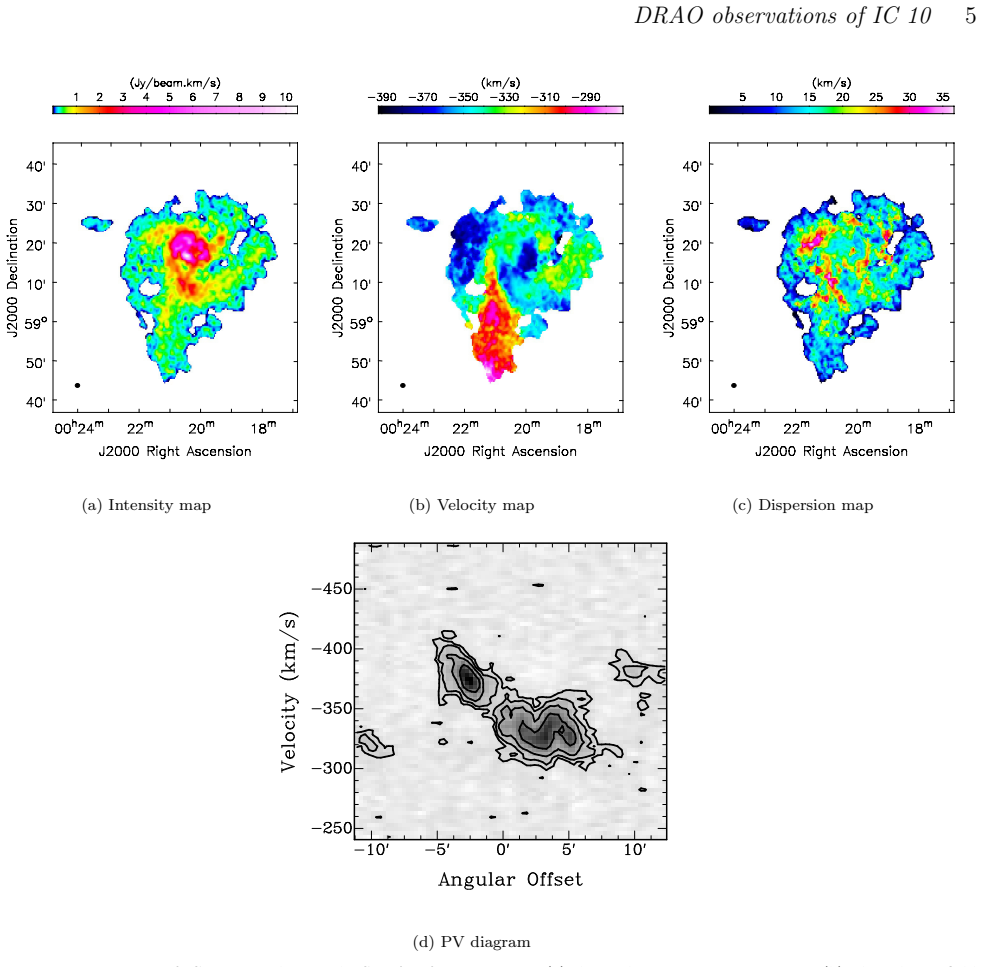
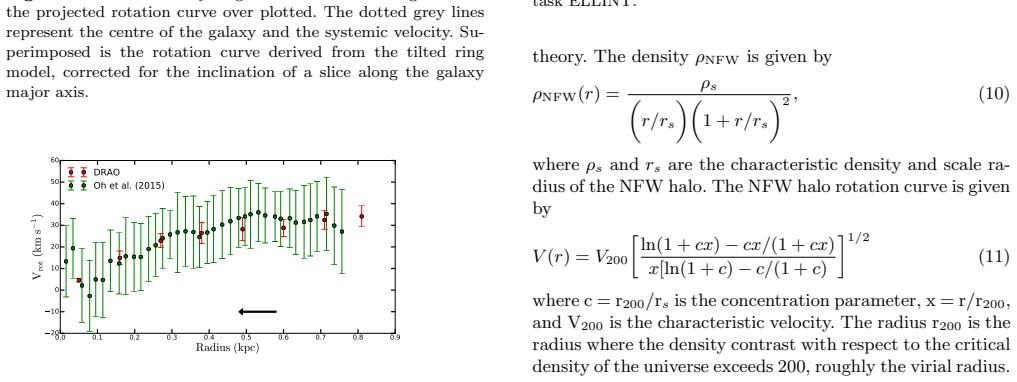
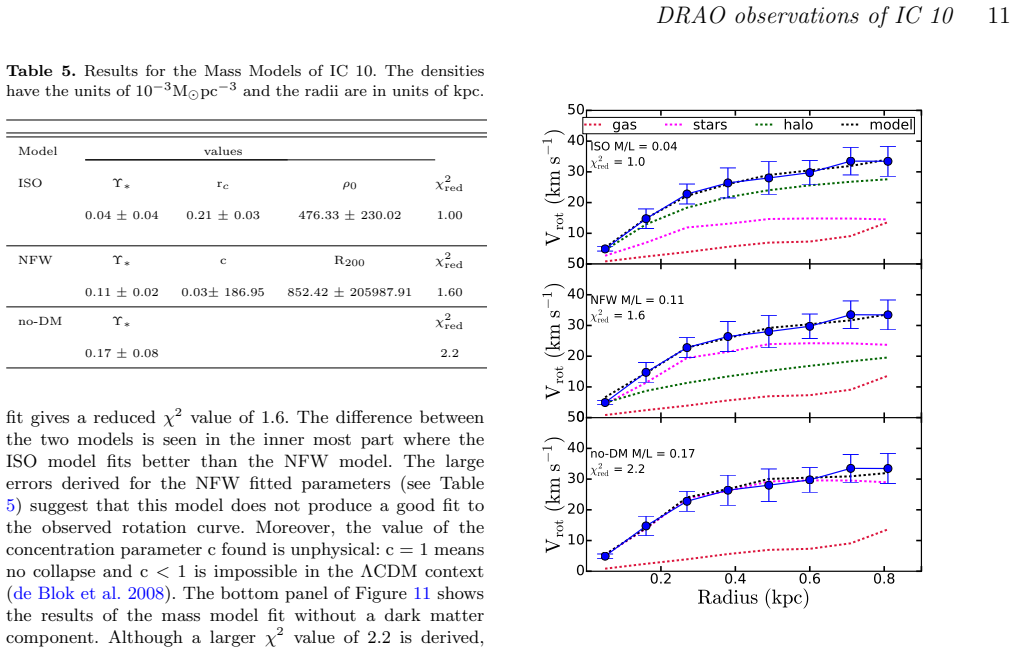
The paper's central claim is that the inner disk of IC 10 is baryon-dominated. Fitting the DRAO rotation curve out to $0.81$ kpc, the authors find that a model with no dark matter reproduces the steep rise and flattened branch with a reduced $\chi^2$ of $2.2$ and a stellar mass-to-light ratio of $0.17\pm0.08$, close to what is expected for dwarf galaxies. In contrast, an isothermal-halo fit requires an implausibly small stellar mass-to-light ratio of $0.04$, and an NFW fit returns a concentration parameter near $c\sim0.03$ that the authors regard as unphysical in the $\Lambda$CDM context. They therefore conclude that dark matter is not needed to describe the kinematics of the inner disk, while explicitly leaving open the possibility that a halo exists beyond the measured radius. On the interaction question, the nine simulated IC 10--M31 orbits produce, at best, tidal streams that are larger and fainter than the observed southern plume and outer features, so the authors conclude that M31 is unlikely to be their source and that the velocity-dispersion peaks where the features meet the disk indicate ongoing accretion.
Load-bearing premise
The baryon-only result stands on the assumption that the infrared starlight profile and the H I surface density, at the adopted distance and inclination, trace all the baryonic mass of the inner disk; if an unseen stellar component or a very different mass-to-light ratio changes that balance, a dark halo could be needed.
Editorial extensions
If this is right
- The inner disk of IC 10 out to $0.81$ kpc is baryon-dominated, so any dark matter in the galaxy must set in beyond that radius at column densities below current sensitivity.
- The steep inner rotation slope of roughly $65$ km s$^{-1}$ kpc$^{-1}$ indicates a very concentrated baryonic mass distribution in the starburst core, about three times steeper than typical dwarf galaxies.
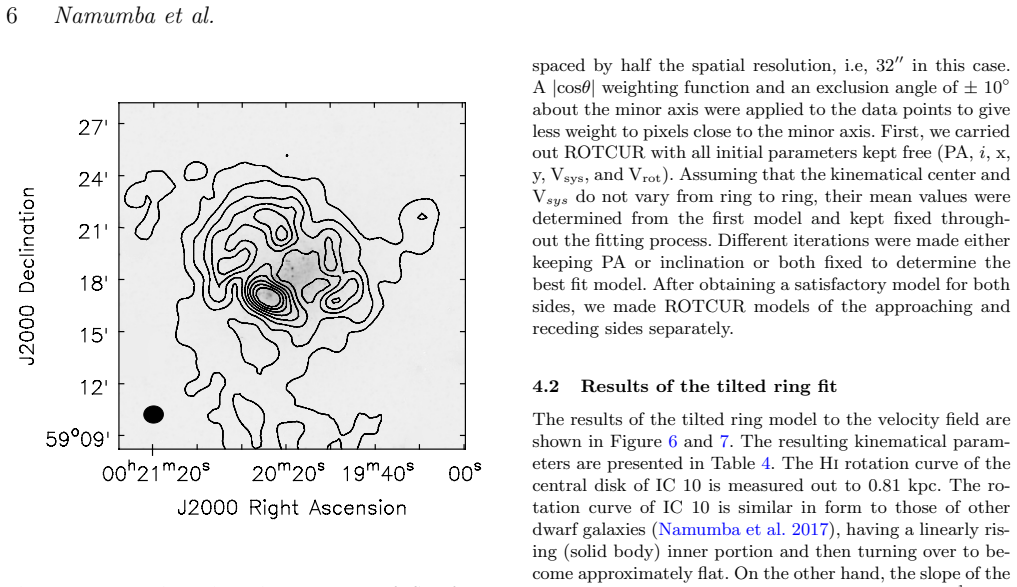
- The faint NW H I cloud is real at $4.7\times10^{5}\,M_{\odot}$ and connects to IC 10 by a low-column-density bridge, making it a target for deeper, higher-resolution H I follow-up to decide between a bound companion and tidal debris.
- The DRAO mosaic recovers the full single-dish H I mass of IC 10 ($7.8\times10^{7}\,M_{\odot}$), about 36% more than the VLA-based measurement, so large-scale faint structure is no longer being missed by interferometers.
- If M31 did not create the outer H I spurs and the southern plume, the counter-rotation and elevated velocity dispersions at the interfaces support ongoing cold accretion as the driver of the starburst.
Reading between the lines
- If the baryon-dominated inner disk is typical of blue compact dwarfs, starburst-triggering galaxies may assemble their central baryons before building an extended dark halo; a survey of a dozen BCDs with the same mass-model treatment could test that.
- The simulations fix IC 10's dark halo as a double-power-law profile with inner slope $\alpha=1$ and sample only nine proper-motion vectors, so the M31 rule-out is provisional: adding M33 or adopting a different IC 10 halo could change the predicted stream size and surface density.
- The NW cloud and its bridge are consistent with a dwarf-dwarf accretion event; high-resolution H I or CO observations of the cloud's internal velocity gradient could distinguish cold accretion from tidal debris.
- Because the no-DM fit has the lowest reduced-$\chi^2$ among physically plausible models, IC 10 is a clean test case for baryonic scaling relations: if it lies on the baryonic Tully-Fisher relation using stars and gas only, the baryon-dominated inner disk is dynamically consistent.
Signed reviews
Editorial analysis
A structured set of objections, weighed in public.
Referee Report
Summary. This paper presents approximately 1000 hours of DRAO synthesis telescope observations of the 21 cm HI line in the blue compact dwarf galaxy IC 10, with EBHIS single-dish data added to recover short spacings. The authors confirm the faint NW HI feature previously detected with the GBT, measure its mass as 4.7e5 Msun, and recover a total HI mass of 7.8e7 Msun that matches the GBT value, demonstrating that the interferometric data have not lost extended flux. They derive an inner-disk rotation curve out to 0.81 kpc using tilted-ring fits, find a steep inner rise followed by a flattening with Vmax about 30 km/s, and agree well with the earlier LITTLE THINGS rotation curve of Oh et al. (2015). The paper then fits ISO, NFW, and no-dark-matter mass models, concluding that the inner disk can be described without a dark matter halo, while not excluding dark matter on larger scales. Finally, a suite of nine Gadget-2 simulations of possible IC 10-M31 interactions is used to argue that the outer HI features are unlikely to be produced by M31 and that the observed velocity dispersions at the contact of the HI extensions with the main disk indicate ongoing accretion.
Significance. The observational contribution is solid and valuable: the DRAO data, after careful flux calibration and short-spacing correction, recover the total HI mass measured by the GBT, confirm the faint NW feature, and extend the detected HI disk beyond previous interferometric work. The rotation curve agreement with Oh et al. (2015) gives independent confidence in the kinematics. If the no-dark-matter interpretation is accepted, IC 10 becomes another example of a blue compact dwarf whose inner disk can be baryon-dominated, a useful counterpoint to standard dwarf-galaxy dark matter scaling relations. The simulations also make a concrete, falsifiable statement: M31-induced tidal streams should be more extended and at lower column density than current observations reach, so deeper HI observations can test this scenario. The main limitations are the mass-model degeneracy, which depends on a freely fitted stellar mass-to-light ratio, and the limited sampling of orbital and galaxy-model parameter space in the interaction simulations; these limit the strength of the headline conclusions but not the archival value of the data.
major comments (2)
- [Section 4.3.3, Table 5 and Figure 11] The claim that the inner disk of IC 10 can be described without a dark matter halo rests on a free fit of the stellar mass-to-light ratio, M/L = 0.17 +/- 0.08, which is about 3.5 times lower than the WISE-color value of 0.6 derived from Eq. (9), and no independent stellar-population or SED constraint is provided. At the same time, the no-DM model has the worst reduced chi-squared (2.2) of the three models; the preference for it is obtained only after rejecting the ISO fit because its M/L = 0.04 is unphysical and the NFW fit because its concentration parameter is unphysical. The conclusion would be considerably strengthened by a robustness test with M/L fixed to a physically motivated value, such as 0.2, or by a quantitative discussion of the inclination, distance, and non-circular-motion systematics that would be needed to reconcile M/L = 0.6 with the observed rotation curve. As written, the abstract's 'without the need of a dark matter halo' goes beyond what this fit alone demonstrates.
- [Section 5.3 and Table 6] The sentence 'The simulations do rule out M31 as a source for the Southern stream' is stronger than the simulation campaign supports. Only nine proper-motion orbits are sampled, and only a single GalactICS model of IC 10 is used, with a double-power-law dark halo of inner slope alpha = 1 and scale radius 2 kpc; the paper itself acknowledges a large unexplored parameter space, including the possible influence of M33 and variations in the galaxy models. The robust statement from Figures 12-14 is that, for the tested orbits, the simulated M31-induced features are larger and at lower surface density than the observed features, making an M31 origin less plausible. The word 'rule out' should either be softened to 'strongly disfavoured' or supported by additional model variations and a more systematic orbit sampling.
minor comments (6)
- [Table 1] The entries for Galactic latitude and Galactic longitude appear to be swapped (the text gives l = 118.95 deg and b = -3.33 deg), and the proper-motion units are printed as 'kms 2'; both should be corrected.
- [Section 4] The task name 'MOMNT' appears to be a typo and should read 'MOMENT'.
- [Section 5.3] The text refers to 'Fig. 4.12' in the discussion of the tidal stream; this should be Fig. 12.
- [Sections 3.1 and 6] The paper states in Section 3.1 that the DRAO HI mass is larger than the VLA value by about 36%, but Section 6(ii) says about 33%; these numbers should be reconciled.
- [Section 4.3.1] Equation (9) mixes W1/W2 notation with 3.4/4.6 micron notation; the band definitions should be stated once and used consistently.
- [References] The Deg et al. (2018) reference is listed as 'in prep'; if it has since appeared, the citation should be updated, otherwise a version or access date for the GalactICS code should be provided.
Circularity Check
No significant circularity: the rotation-curve mass models are straightforward fits with free parameters, and no prediction reduces to a fitted value by construction.
full rationale
This paper is an observational study. The central claim that the inner disk of IC 10 can be described without a dark matter halo is the outcome of fitting mass models to the DRAO rotation curve in Section 4.3, not a prediction from a previously fitted parameter. The stellar M/L is a free parameter in the no-DM fit (Table 5 gives M/L = 0.17 ± 0.08), and the paper explicitly notes that the WISE-color M/L of 0.6 was too large and that Equation 9 may not be usable for blue dwarf galaxies; this is an admitted model choice, not a circular reduction. The ISO and NFW halo fits also have free parameters, and the rejection of those models on grounds of unphysical fitted values (M/L = 0.04, c ≈ 0.03) is a model-selection statement, not a self-referential derivation. The M31-interaction simulations rest on the GalactICS IC 10 model and the Deg et al. (2018) code, but the paper itself flags the unexplored parameter space and the omission of M33, distance, and radial-velocity uncertainties in Section 5.3; this is a limitation in the strength of an exclusion claim, not circularity. No equation in the paper is equivalent by construction to its own input, and the externally anchored WISE-color estimate and Lelli et al. (2016) comparison provide independent reference points rather than load-bearing self-citations. The only self-citations (Namumba et al. 2017, 2018 for inner slopes; Deg et al. 2018 for the code) are contextual or instrumental and do not carry the central argument.
Assumptions & free parameters
free parameters (8)
- Stellar mass-to-light ratio (no-DM fit) =
0.17 +/- 0.08
- Stellar mass-to-light ratio (ISO fit) =
0.04 +/- 0.04
- ISO halo core radius rc =
0.21 +/- 0.03 kpc
- ISO central density rho0 =
476.33 +/- 230.02 (10^-3 Msun pc^-3)
- NFW concentration c =
0.03 +/- 186.95
- NFW R200 =
852.42 +/- 205987.91 kpc
- Inclination =
47 +/- 6 degrees
- Position angle =
65 +/- 4 degrees
assumptions (6)
- domain assumption Distance to IC 10 is 0.7 Mpc (Hunter et al. 2012).
- domain assumption HI gas is a thin disk, with surface density multiplied by 1.4 for helium and metals.
- domain assumption Stellar mass distribution follows the WISE 3.4 micron surface brightness with a single, constant mass-to-light ratio.
- ad hoc to paper The GalactICS IC 10 model with a double-power-law dark halo (alpha=1, rh=2 kpc, sigma_h=31 km/s) is a valid representation of IC 10 for the M31 encounter simulations.
- domain assumption The proper motions from Brunthaler et al. (2007) correctly specify IC 10's tangential velocity.
- standard math The tilted-ring model (Eq. 2) describes the inner disk kinematics with circular orbits and a constant inclination and position angle per ring.
Cite this review
Pith. "Pith review of HI observations of IC 10 with the DRAO synthesis telescope." pith.science (2026). https://pith.science/paper/445U3VXF
@misc{pith2026190802198,
  author       = {Pith},
  title        = {Pith review of: HI observations of IC 10 with the DRAO synthesis telescope},
  year         = {2026},
  howpublished = {\url{https://pith.science/paper/445U3VXF}},
  note         = {Machine review of arXiv:1908.02198}
}
abstract
HI observations of the nearby blue compact dwarf galaxy IC 10 obtained with the Dominion Radio Astrophysical Observatory synthesis telescope (DRAO), for a total integration of $\sim$1000 hours, are presented. We confirm the NW faint 21 cm HI emission feature discovered in GBT observations. The HI feature has an HI mass of 4.7 $\times 10^{5}$ M$_{\odot}$, which is only $\sim$ 0.6$\%$ of the total HI mass of the galaxy (7.8 $\times 10^{7}$ M$_{\odot}$). In the inner disk, the rotation curve of IC 10 rises steeply, then flattens until the last point where it rises again, with a maximum velocity of 30 km s$^{-1}$. Based on our mass models, the kinematics of the inner disk of IC 10 can be described without the need of a dark matter halo. However, this does not exclude the possible presence of dark matter on a larger scale. It is unlikely that the disturbed features seen in the outer HI disk of IC 10 are caused by an interaction with M 31. Features seen from our simulations are larger and at lower surface density than can be reached by current observations. The higher velocity dispersions seen in regions where several distinct HI features meet with the main core of IC 10 suggests that there is ongoing accretion.
Figures

Figures from the paper (10 more)





Reference graph
Works this paper leans on
-
[1]
Ashley T., Elmegreen B. G., Johnson M., Nidever D. L., Simpson C. E., Pokhrel N. R., 2014, @doi [ ] 10.1088/0004-6256/148/6/130 , http://adsabs.harvard.edu/abs/2014AJ....148..130A 148, 130
-
[2]
G., 1989, , http://adsabs.harvard.edu/abs/1989A
Begeman K. G., 1989, , http://adsabs.harvard.edu/abs/1989A
1989
-
[3]
Begeman K. G., Broeils A. H., Sanders R. H., 1991, @doi [ ] 10.1093/mnras/249.3.523 , http://adsabs.harvard.edu/abs/1991MNRAS.249..523B 249, 523
-
[4]
Bekki K., 2008, @doi [ ] 10.1111/j.1745-3933.2008.00489.x , http://adsabs.harvard.edu/abs/2008MNRAS.388L..10B 388, L10
arXiv 2008
-
[5]
J., Falcke H., Henkel C., Menten K
Brunthaler A., Reid M. J., Falcke H., Henkel C., Menten K. M., 2007, @doi [ ] 10.1051/0004-6361:20066430 , http://adsabs.harvard.edu/abs/2007A
-
[6]
Chemin L., Carignan C., Foster T., 2009, @doi [ ] 10.1088/0004-637X/705/2/1395 , http://adsabs.harvard.edu/abs/2009ApJ...705.1395C 705, 1395
-
[7]
Cloet-Osselaer A., De Rijcke S., Vandenbroucke B., Schroyen J., Koleva M., Verbeke R., 2014, @doi [ ] 10.1093/mnras/stu1071 , http://adsabs.harvard.edu/abs/2014MNRAS.442.2909C 442, 2909
-
[8]
Cluver M. E., et al., 2014, @doi [ ] 10.1088/0004-637X/782/2/90 , http://adsabs.harvard.edu/abs/2014ApJ...782...90C 782, 90
Show all 62 references
-
[9]
C., 2000, @doi [ ] 10.1086/316883 , http://adsabs.harvard.edu/abs/2000AJ....120.3027C 120, 3027
C \^o t \'e S., Carignan C., Freeman K. C., 2000, @doi [ ] 10.1086/316883 , http://adsabs.harvard.edu/abs/2000AJ....120.3027C 120, 3027
2000 doi
-
[10]
M., Randriamampandry T
Deg N., Widrow L. M., Randriamampandry T. H., Carignan C., 2018, in prep
2018
-
[11]
C., 1970, @doi [ ] 10.1086/150474 , http://adsabs.harvard.edu/abs/1970ApJ...160..811F 160, 811
Freeman K. C., 1970, @doi [ ] 10.1086/150474 , http://adsabs.harvard.edu/abs/1970ApJ...160..811F 160, 811
1970 doi
-
[12]
Gerbrandt S. A. N., McConnachie A. W., Irwin M., 2015, @doi [ ] 10.1093/mnras/stv2029 , http://adsabs.harvard.edu/abs/2015MNRAS.454.1000G 454, 1000
2015 doi
-
[13]
F., Pevunova O., 2003, @doi [ ] 10.1086/374737 , http://esoads.eso.org/abs/2003ApJS..147...29G 147, 29
Gil de Paz A., Madore B. F., Pevunova O., 2003, @doi [ ] 10.1086/374737 , http://esoads.eso.org/abs/2003ApJS..147...29G 147, 29
2003 doi
-
[14]
K., 1999, in Whitelock P., Cannon R., eds, IAU Symposium Vol
Grebel E. K., 1999, in Whitelock P., Cannon R., eds, IAU Symposium Vol. 192, The Stellar Content of Local Group Galaxies. p. 17 ( @eprint astro-ph/9812443 )
1999 arXiv
-
[15]
K., 1979, , http://adsabs.harvard.edu/abs/1979A
Huchtmeier W. K., 1979, , http://adsabs.harvard.edu/abs/1979A
1979
-
[16]
A., Elmegreen B
Hunter D. A., Elmegreen B. G., 2006, @doi [ ], 162, 49
2006
-
[17]
A., Elmegreen B
Hunter D. A., Elmegreen B. G., Baker A. L., 1998, @doi [ ] 10.1086/305158 , http://adsabs.harvard.edu/abs/1998ApJ...493..595H 493, 595
1998 doi
-
[18]
A., et al., 2012, @doi [ ] 10.1088/0004-6256/144/5/134 , http://adsabs.harvard.edu/abs/2012AJ....144..134H 144, 134
Hunter D. A., et al., 2012, @doi [ ] 10.1088/0004-6256/144/5/134 , http://adsabs.harvard.edu/abs/2012AJ....144..134H 144, 134
2012 doi
-
[19]
Kennicutt Jr. R. C., 1989, @doi [ ] 10.1086/167834 , http://adsabs.harvard.edu/abs/1989ApJ...344..685K 344, 685
1989 doi
-
[20]
G., Im M., Karoji H., Noumaru J., Tanaka I., 2009, @doi [ ] 10.1088/0004-637X/703/1/816 , https://ui.adsabs.harvard.edu/\#abs/2009ApJ...703..816K 703, 816
Kim M., Kim E., Hwang N., Lee M. G., Im M., Karoji H., Noumaru J., Tanaka I., 2009, @doi [ ] 10.1088/0004-637X/703/1/816 , https://ui.adsabs.harvard.edu/\#abs/2009ApJ...703..816K 703, 816
2009 doi
-
[21]
T., ed., IAU Symposium Vol
Kormendy J., 1987, in de Zeeuw P. T., ed., IAU Symposium Vol. 127, Structure and Dynamics of Elliptical Galaxies. pp 17--34
1987
-
[22]
L., Gray A
Kothes R., Landecker T. L., Gray A. D., 2010, in Kothes R., Landecker T. L., Willis A. G., eds, Astronomical Society of the Pacific Conference Series Vol. 438, The Dynamic Interstellar Medium: A Celebration of the Canadian Galactic Plane Survey. p. 415 ( @eprint arXiv 1010.6109 )
2010 arXiv
-
[23]
Kuijken K., Dubinski J., 1995, , http://adsabs.harvard.edu/abs/1995MNRAS.277.1341K 277, 1341
1995
-
[24]
L., et al., 2000, @doi [ ] 10.1051/aas:2000257 , http://adsabs.harvard.edu/abs/2000A
Landecker T. L., et al., 2000, @doi [ ] 10.1051/aas:2000257 , http://adsabs.harvard.edu/abs/2000A
2000 doi
-
[25]
C., Salzer J
Lee J. C., Salzer J. J., Melbourne J., 2004, @doi [ ] 10.1086/425156 , http://cdsads.u-strasbg.fr/abs/2004ApJ...616..752L 616, 752
2004 doi
-
[26]
Lelli F., Verheijen M., Fraternali F., Sancisi R., 2012a, @doi [ ] 10.1051/0004-6361/201117867 , http://adsabs.harvard.edu/abs/2012A
-
[27]
Lelli F., Verheijen M., Fraternali F., Sancisi R., 2012b, @doi [ ] 10.1051/0004-6361/201219457 , http://adsabs.harvard.edu/abs/2012A
-
[28]
S., Schombert J
Lelli F., McGaugh S. S., Schombert J. M., 2016, @doi [ ] 10.3847/0004-6256/152/6/157 , http://adsabs.harvard.edu/abs/2016AJ....152..157L 152, 157
2016 doi
-
[29]
K., Walter F., Brinks E., Bigiel F., de Blok W
Leroy A. K., Walter F., Brinks E., Bigiel F., de Blok W. J. G., Madore B., Thornley M. D., 2008, @doi [ ], 136, 2782
2008
-
[30]
1035 of American Institute of Physics Conference Series, IC 10-a cosmic bluebottle
Manthey E., Oosterloo T., 2008, in Minchin R., Momjian E., eds, The Evolution of Galaxies Through the Neutral Hydrogen Window Vol. 1035 of American Institute of Physics Conference Series, IC 10-a cosmic bluebottle . pp 156--158
2008
-
[31]
L., 1998, @doi [ ] 10.1146/annurev.astro.36.1.435 , http://adsabs.harvard.edu/abs/1998ARA
Mateo M. L., 1998, @doi [ ] 10.1146/annurev.astro.36.1.435 , http://adsabs.harvard.edu/abs/1998ARA
1998 doi
-
[32]
R., Mackie G., Carignan C., 1994, @doi [ ] 10.1086/117013 , http://adsabs.harvard.edu/abs/1994AJ....107.2021M 107, 2021
Meurer G. R., Mackie G., Carignan C., 1994, @doi [ ] 10.1086/117013 , http://adsabs.harvard.edu/abs/1994AJ....107.2021M 107, 2021
1994 doi
-
[33]
R., Carignan C., Beaulieu S
Meurer G. R., Carignan C., Beaulieu S. F., Freeman K. C., 1996, @doi [ ] 10.1086/117895 , https://ui.adsabs.harvard.edu/\#abs/1996AJ....111.1551M 111, 1551
1996 doi
-
[34]
R., Staveley-Smith L., Killeen N
Meurer G. R., Staveley-Smith L., Killeen N. E. B., 1998, @doi [ ] 10.1046/j.1365-8711.1998.01905.x , https://ui.adsabs.harvard.edu/\#abs/1998MNRAS.300..705M 300, 705
1998
-
[35]
Namumba B., Carignan C., de Blok W. J. G., Passmoor S., 2017, @doi [ ] 10.1093/mnras/stx2256 , 472, 3761
2017 doi
-
[36]
Namumba B., Carignan C., Passmoor S., 2018, @doi [ ] 10.1093/mnras/sty1056 , 478, 487
2018 doi
-
[37]
F., Frenk C
Navarro J. F., Frenk C. S., White S. D. M., 1997, @doi [ ] 10.1086/304888 , http://adsabs.harvard.edu/abs/1997ApJ...490..493N 490, 493
1997 doi
-
[38]
L., et al., 2013, @doi [ ] 10.1088/2041-8205/779/2/L15 , http://adsabs.harvard.edu/abs/2013ApJ...779L..15N 779, L15
Nidever D. L., et al., 2013, @doi [ ] 10.1088/2041-8205/779/2/L15 , http://adsabs.harvard.edu/abs/2013ApJ...779L..15N 779, L15
2013 doi
-
[39]
G., Iglesias-P \'a ramo J., V \' lchez J
Noeske K. G., Iglesias-P \'a ramo J., V \' lchez J. M., Papaderos P., Fricke K. J., 2001, @doi [ ] 10.1051/0004-6361:20010446 , http://adsabs.harvard.edu/abs/2001A
2001 doi
-
[40]
Oh S.-H., et al., 2015, @doi [ ] 10.1088/0004-6256/149/6/180 , http://adsabs.harvard.edu/abs/2015AJ....149..180O 149, 180
2015 doi
-
[41]
Prugniel P., Simien F., 1997, , http://adsabs.harvard.edu/abs/1997A
1997
-
[42]
G., et al., 2001, @doi [ ] 10.1051/0004-6361:20010206 , http://adsabs.harvard.edu/abs/2001A
Richer M. G., et al., 2001, @doi [ ] 10.1051/0004-6361:20010206 , http://adsabs.harvard.edu/abs/2001A
2001 doi
-
[43]
Sanders J., L., Binney J., 2013, MNRAS, http://adsabs.harvard.edu/abs/2013MNRAS.433.1813S 433, 1813
2013
-
[44]
Sargent W. L. W., Searle L., 1970, @doi [ ] 10.1086/180644 , http://adsabs.harvard.edu/abs/1970ApJ...162L.155S 162, L155
1970 doi
-
[45]
J., Finkbeiner D
Schlegel D. J., Finkbeiner D. P., Davis M., 1998, @doi [ ] 10.1086/305772 , http://adsabs.harvard.edu/abs/1998ApJ...500..525S 500, 525
1998 doi
-
[46]
Serra P., et al., 2015, @doi [ ] 10.1093/mnras/stv079 , http://adsabs.harvard.edu/abs/2015MNRAS.448.1922S 448, 1922
2015 doi
-
[47]
S., Skillman E
Shostak G. S., Skillman E. D., 1989, , http://adsabs.harvard.edu/abs/1989A
1989
-
[48]
Springel V., 2005, @doi [ ] 10.1111/j.1365-2966.2005.09655.x , http://adsabs.harvard.edu/abs/2005MNRAS.364.1105S 364, 1105
2005
-
[49]
D., 1993, @doi [ ] 10.1086/116413 , http://adsabs.harvard.edu/abs/1993AJ....105..128T 105, 128
Taylor C., Brinks E., Skillman E. D., 1993, @doi [ ] 10.1086/116413 , http://adsabs.harvard.edu/abs/1993AJ....105..128T 105, 128
1993 doi
-
[50]
L., Brinks E., Grashuis R
Taylor C. L., Brinks E., Grashuis R. M., Skillman E. D., 1995, @doi [ ] 10.1086/192193 , http://adsabs.harvard.edu/abs/1995ApJS...99..427T 99, 427
1995 doi
-
[51]
L., Brinks E., Grashuis R
Taylor C. L., Brinks E., Grashuis R. M., Skillman E. D., 1996a, @doi [ ] 10.1086/192256 , http://adsabs.harvard.edu/abs/1996ApJS..102..189T 102, 189
-
[52]
L., Thomas D
Taylor C. L., Thomas D. L., Brinks E., Skillman E. D., 1996b, @doi [ ] 10.1086/192358 , http://adsabs.harvard.edu/abs/1996ApJS..107..143T 107, 143
-
[53]
R., et al., 2003, @doi [ ] 10.1086/375301 , http://adsabs.harvard.edu/abs/2003AJ....125.3145T 125, 3145
Taylor A. R., et al., 2003, @doi [ ] 10.1086/375301 , http://adsabs.harvard.edu/abs/2003AJ....125.3145T 125, 3145
2003 doi
-
[54]
Weldrake D. T. F., de Blok W. J. G., Walter F., 2003, @doi [ ] 10.1046/j.1365-8711.2003.06170.x , http://cdsads.u-strasbg.fr/abs/2003MNRAS.340...12W 340, 12
2003
-
[55]
M., Pym B., Dubinski J., 2008, @doi [ ] 10.1086/587636 , http://adsabs.harvard.edu/abs/2008ApJ...679.1239W 679, 1239
Widrow L. M., Pym B., Dubinski J., 2008, @doi [ ] 10.1086/587636 , http://adsabs.harvard.edu/abs/2008ApJ...679.1239W 679, 1239
2008 doi
-
[56]
M., Miller B
Wilcots E. M., Miller B. W., 1998, @doi [ ] 10.1086/300595 , http://adsabs.harvard.edu/abs/1998AJ....116.2363W 116, 2363
1998 doi
-
[57]
Winkel B., Kerp J., Fl \"o er L., Kalberla P. M. W., Ben Bekhti N., Keller R., Lenz D., 2016, @doi [ ] 10.1051/0004-6361/201527007 , https://ui.adsabs.harvard.edu/\#abs/2016A&A...585A..41W 585, A41
2016 doi
-
[58]
R., Bernard-Salas J., Spoon H
Wu Y., Charmandaris V., Hao L., Brandl B. R., Bernard-Salas J., Spoon H. W. W., Houck J. R., 2006, @doi [ ] 10.1086/499226 , http://cdsads.u-strasbg.fr/abs/2006ApJ...639..157W 639, 157
2006 doi
-
[59]
de Blok W. J. G., Walter F., Brinks E., Trachternach C., Oh S.-H., Kennicutt Jr. R. C., 2008, @doi [ ] 10.1088/0004-6256/136/6/2648 , http://adsabs.harvard.edu/abs/2008AJ....136.2648D 136, 2648
2008 doi
-
[60]
de Vaucouleurs G., de Vaucouleurs A., Corwin Jr. H. G., Buta R. J., Paturel G., Fouqu \'e P., 1991a, Third Reference Catalogue of Bright Galaxies. Volume I: Explanations and references
-
[61]
de Vaucouleurs G., de Vaucouleurs A., Corwin Jr. H. G., Buta R. J., Paturel G., Fouqu \'e P., 1991b, Third Reference Catalogue of Bright Galaxies. Volume I: Explanations and references. Volume II: Data for galaxies between 0 ^ h and 12 ^ h . Volume III: Data for galaxies betwe...
-
[62]
P., Fardal M., Besla G., Beaton R
van der Marel R. P., Fardal M., Besla G., Beaton R. L., Sohn S. T., Anderson J., Brown T., Guhathakurta P., 2012, @doi [ ] 10.1088/0004-637X/753/1/8 , http://adsabs.harvard.edu/abs/2012ApJ...753....8V 753, 8
2012 doi
Reviewed August 14, 2026 · model on record in the stance chip above.
Discussion (0). Continue with ORCID to comment.