REVIEW 2 major objections 6 minor 8 references
Lowest-degree triple Massey products in moment-angle complexes
T0 review · 2 major / 6 minor · reviewed 2026-08-14 · deepseek-v4-flash
Pith's one-line read The paper proves that nontrivial triple Massey products of degree-three classes exist in H^8(Z_K) exactly when the one-skeleton of K contains one of eight six-vertex graphs as a full subcomplex.
desk verdict Useful short note extending Denham-Suciu to Massey products with non-trivial indeterminacy, but the 'if' direction of the main theorem rests on an unproved stability claim. read the letter →
The pith
A machine-rendered reading of the paper's core claim, the machinery that carries it, and where it could break.
The reading
What carries the argument
The load-bearing object is the pair consisting of the one-skeleton K^(1) and its edge-complement graph G, together with Hochster's formula, the isomorphism identifying H^*(Z_K) with the direct sum of reduced cohomology groups of full subcomplexes K_J. This identification turns each degree-three class into a reduced 0-cohomology class supported on a pair of non-adjacent vertices and makes the Massey product defining-system equations into finite linear conditions on the edges missing from K. The proof then becomes a finite case analysis on six-vertex graphs, packaged as the eight obstruction graphs whose presence in K^(1) is necessary and sufficient.
What would settle it
Concrete test: take a six-vertex simplicial complex whose one-skeleton is one of the eight obstruction graphs and that contains a 3-cycle, add the corresponding 2-simplex, and recompute ⟨α1,α2,α3⟩ using Hochster's formula. If the cocycle ω ceases to represent a nonzero class in $H^{8}$(Z_K) while the one-skeleton still contains the obstruction graph, the theorem's 'if' direction is false.
Extended reading notes
Core claim
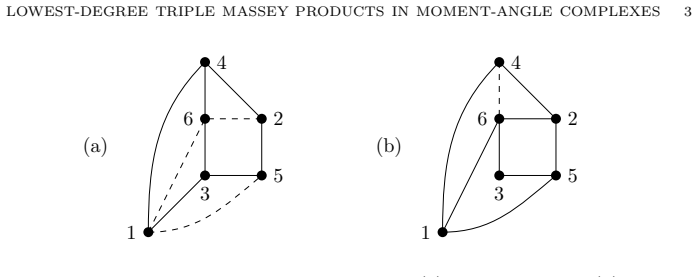
The central claim is a biconditional classification: for a moment-angle complex Z_K attached to a simplicial complex K, there is a nontrivial triple Massey product ⟨α1,α2,α3⟩ ⊂ $H^{8}$(Z_K) with α1,α2,α3 ∈ $H^{3}$(Z_K) if and only if the one-skeleton K^(1) contains a full subcomplex isomorphic to one of eight six-vertex graphs listed in Figure 1. The result improves on the earlier six-graph classification by covering Massey products with nontrivial indeterminacy; the additional graphs are precisely the configurations that create that indeterminacy. The proof reduces to six vertices via a retraction property, translates degree-three classes through Hochster's formula into classes supported on two-vertex full subcomplexes, and then shows that the existence of a defining system forces the edge-complement graph into two families whose complements are the eight listed graphs. A separate lemma verifies that no two graphs in the list are isomorphic, so the obstruction list is minimal.
Load-bearing premise
In the 'if' direction, the proof assumes that adding 2-simplices to a six-vertex complex whose one-skeleton is an obstruction graph does not make the computed Massey product trivial; this is asserted but not demonstrated.
Editorial extensions
If this is right
- Non-triviality of such Massey products can be checked by inspecting only six-vertex induced subgraphs of the one-skeleton; no computation in the full moment-angle complex is needed.
- The eight-graph list is sharp: because the graphs are pairwise non-isomorphic, no obstruction graph is redundant and the classification cannot be compressed.
- Triple Massey products with nontrivial indeterminacy are subsumed by the same graph criterion, and the smallest examples of this phenomenon appear in degree H^8.
- If the one-skeleton avoids all eight graphs, then no nontrivial triple Massey product of degree-three classes of this type exists in H^8(Z_K).
- A nontrivial product detected by a six-vertex subcomplex remains nontrivial after passing to the larger complex, assuming the proof's assertion that extra 2-simplices do not affect the calculation.
Reading between the lines
- The criterion is algorithmic as the paper does not explicitly say: enumerate all six-vertex induced subgraphs of a finite one-skeleton and compare them with the eight graphs, giving a finite, checkable procedure for detecting these Massey products.
- The same edge-complement and defining-system analysis may extend to higher Massey products or products involving classes of other degrees, since the obstruction is ultimately linear algebra on the missing edges.
- If the asserted invariance under adding 2-simplices fails for some complex, the theorem would likely survive for flag complexes, where the one-skeleton determines all higher simplices; constructing such a failure would sharpen the statement.
- The graph classification also supplies a way to build spaces with prescribed hidden cohomological extensions: choose a one-skeleton containing an obstruction graph and take the moment-angle complex of any simplicial complex with that one-skeleton.
Signed reviews
Editorial analysis
A structured set of objections, weighed in public.
Referee Report
Summary. The paper gives a combinatorial classification of non-trivial triple Massey products in the lowest degree (H^8) of moment-angle complexes, for classes α_i ∈ H^3(Z_K). The main theorem states that such a product exists in H^8(Z_K) iff the 1-skeleton K(1) contains a full subcomplex isomorphic to one of eight explicit graphs. The proof uses Hochster's formula to translate the Massey product into simplicial cochain computations in full subcomplexes of K, plus a case analysis on the edge-complement graph. The authors also prove a lemma showing the eight obstruction graphs are pairwise non-isomorphic, and give an example exhibiting non-trivial indeterminacy.
Significance. If correct, the theorem gives a complete and checkable combinatorial criterion for the existence of these Massey products, extending the Denham–Suciu result to cases with non-trivial indeterminacy. The explicit Example with non-trivial indeterminacy is a useful contribution, and the non-isomorphism lemma is a nice detail. The proof strategy is natural: it reduces to six-vertex complexes by the retraction property and then performs what appears to be a systematic finite case analysis. However, as detailed below, the proof as written does not fully justify the 'if' direction for complexes with 2-simplices, and some of the converse case-analysis steps use defining systems that are not shown to be valid.
major comments (2)
- [Theorem proof, first paragraph] The assertion that 'calculations in the Example are not affected by 2-simplices in K, and dim(K) ≤ 2' is not proved. The retraction argument only reduces to a full subcomplex on six vertices; it does not eliminate possible 2-simplices (or higher simplices). In the graph case the differential d: C^1 → C^2 is identically zero, so every 1-cochain is a cocycle; once 2-simplices are present, the cocycle condition on ω and the cohomology class [ω] in H^1(K) can change. Since the theorem claims a classification for arbitrary simplicial complexes, the 'if' direction must establish non-triviality for all six-vertex complexes with the given 1-skeleton, not just for the graph. A finite check over the eight graphs and all subsets of the triangular faces would settle this; as written, the proof is incomplete.
- [Theorem proof, converse case analysis] Several steps in the converse choose explicit representatives and defining systems without verifying the defining-system condition. For example, in the case {1,3}, {4,6} not in G with {2,5} in G, the proof sets a23 = χ5 and concludes ω = χ25 = 0. This is only valid if d(χ5) = a2a3 = χ35 in the full complex; but in the hypothesized graph, vertex 5 may have additional incident edges in K (since {2,5} in G means {2,5} is absent from K, while other edges such as {1,5} or {4,5} may be present), so d(χ5) is generally a sum of several terms. Similar issues occur in the final case with a23 = χ6. Without a valid defining system, the contradiction is not established. The case analysis should be rewritten with explicit, verified defining systems or replaced by a more systematic argument.
minor comments (6)
- [Definition of Massey product] The statement 'it does not depend on the representative a_i for α_i' is imprecise: the Massey product as a set is independent of the chosen representatives only up to the indeterminacy. Consider rephrasing to avoid confusion.
- [Example notation] The notation 'a = (-1)^{1+p} a' is confusing because the same symbol a is used for the cochain and its sign-twist. A more standard notation or a short clarification would help.
- [Theorem proof, reduction step] The reduction 'it is sufficient to prove the Theorem when K has six vertices' is not fully spelled out for the converse direction. One should argue that the Massey product element in H^8(Z_K) lives in the Hochster summand corresponding to J = S1 ∪ S2 ∪ S3, so only the full subcomplex on those six vertices matters.
- [Converse, labeling of vertices] The sentence 'Label the vertices of G so that there is a path 1,...,6' assumes G is connected. The previous conditions imply this, but it would be helpful to state why.
- [Figures] The figures are not included in the text, so the reader must rely on the valency lists in the Lemma to identify the graphs. Consider providing an explicit edge-list or adjacency table for the eight graphs.
- [Relation to Denham–Suciu] The sentence 'Those six graphs do not capture Massey products with non-trivial indeterminacy' would be clearer if the authors explicitly identified which two graphs in Figure 1 are new compared to [6, Theorem 6.1.1].
Circularity Check
No significant circularity: the classification is derived from Hochster's formula and explicit cochain computations, not from self-referential inputs.
full rationale
The claimed if-and-only-if is not equivalent to its inputs. The obstruction graphs in Figure 1 are obtained by explicit cochain and coboundary computations in the Example, and the converse is a finite case analysis on the edge-complement graph G; no parameter is fitted to the target conclusion. The six-vertex reduction uses the retraction property from [8], and the cochain-level identifications use Hochster's formula [7,3,1], both of which are external standard results and do not already contain the classification. The only questionable sentence is in the first paragraph of the Theorem proof: 'calculations in the Example are not affected by 2-simplices in K, and dim(K) ⩽ 2.' This is an unproved monotonicity claim about passing from a graph to a simplicial complex by filling 2-simplices. It is a genuine correctness gap, since adding a 2-simplex can change cocycles and coboundaries in the cochain complex; however, it is not a circular reduction, because it does not define the Massey product in terms of the obstruction graphs and does not force the conclusion by construction. A finite verification over the eight graphs and all subsets of their triangular faces would settle it, but that is a matter of rigor, not circularity. There are no load-bearing self-citations: the authors cite Denham-Suciu [6], Hochster [7], Buchstaber-Panov [3], Baskakov [1], and Theriault [8], all external to this paper, and the mention of [5] is only an application of the classification, not a support for it. No fitted quantity is renamed as a prediction, and no known result is repackaged as new under a different name. The derivation chain is therefore self-contained apart from the unverified 2-simplex assertion, which does not raise the circularity score.
Assumptions & free parameters
assumptions (3)
- standard math Hochster's formula for the cohomology of moment-angle complexes as a sum of reduced cohomology of full subcomplexes.
- domain assumption The retraction property: for a full subcomplex K_J of K, the moment-angle complex Z_{K_J} retracts off Z_K.
- standard math The standard definition of triple Massey products in a differential graded algebra.
Cite this review
Pith. "Pith review of Lowest-degree triple Massey products in moment-angle complexes." pith.science (2026). https://pith.science/paper/QGHQFI67
@misc{pith2026190802222,
  author       = {Pith},
  title        = {Pith review of: Lowest-degree triple Massey products in moment-angle complexes},
  year         = {2026},
  howpublished = {\url{https://pith.science/paper/QGHQFI67}},
  note         = {Machine review of arXiv:1908.02222}
}
read the original abstract
We give a combinatorial classification of non-trivial triple Massey products of three dimensional classes in the cohomology of a moment-angle complex. This work improves on a result by Denham and Suciu (2007) by considering triple Massey products with non-trivial indeterminacy.
Figures


Reference graph
Works this paper leans on
-
[6]
G. Denham and A. I. Suciu. Moment-angle complexes, monom ial ideals and Massey products. Pure Appl. Math. Q. , 3:25–60, 2007
work page 2007
-
[1]
I. V. Baskakov. Cohomology of K-powers of spaces and the combinatorics of simplicial divi- sions. Uspekhi Mat. Nauk , 57(5(347)):147–148, 2002
work page 2002
-
[2]
I. V. Baskakov. Triple Massey products in the cohomology of moment-angle complexes. Uspekhi Mat. Nauk , 58(5(353)):199–200, 2003
work page 2003
-
[3]
V. M. Buchstaber and T. E. Panov. Torus actions, combinat orial topology, and homological algebra. Russ. Math. Surv. , 55(5):825–921, 2000
work page 2000
-
[4]
V. M. Buchstaber and T. E. Panov. Toric topology, volume 204 of Mathematical Surveys and Monographs. American Mathematical Society, Providence, RI, 2015
work page 2015
-
[5]
V. M. Bukhshtaber, N. Y. Erokhovets, M. Masuda, T. E. Pano v, and S. Pak. Cohomological rigidity of manifolds defined by 3-dimensional polytopes. Uspekhi Mat. Nauk , 72(2(434)):3–66, 2017
work page 2017
- [7]
-
[8]
S. Theriault. Toric homotopy theory. In Combinatorial and toric homotopy , volume 35 of Lect. Notes Ser. Inst. Math. Sci. Natl. Univ. Singap. , pages 1–66. W orld Sci. Publ., Hackensack, NJ, 2018. School of Mathematics, University of Southampton, UK E-mail address : J.Grbic@soton.ac.uk School of Mathematics, University of Southampton, UK E-mail address : ...
work page 2018
Reviewed August 14, 2026 · model on record in the stance chip above.
Discussion (0). Continue with ORCID to comment.