REVIEW 5 minor 2 cited by
Anisotropic layer construction of anisotropic fracton models
T0 review · 0 major / 5 minor · reviewed 2026-08-14 · deepseek-v4-flash
Pith's one-line read Stacking 2D toric-code layers with staggered couplings gives, in the strong-coupling limit, an exactly solvable anisotropic fracton model with lineon and planon excitations.
desk verdict A clean one-directional coupled-layer construction that reproduces the known anisotropic fracton model in the strong-coupling limit; the derivation is sound and the limitations are honestly stated, but finite-coupling stability and several generalizations remain unproven. read the letter →
The pith
A machine-rendered reading of the paper's core claim, the machinery that carries it, and where it could break.
The reading
What carries the argument
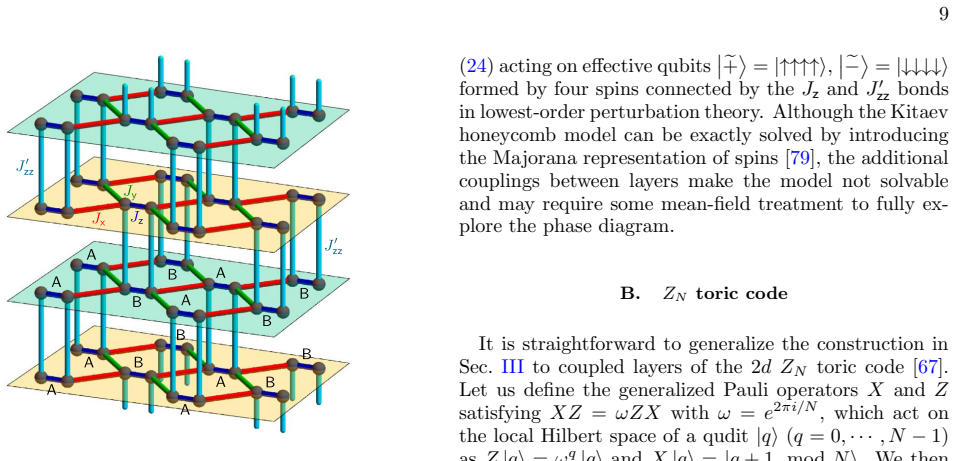
The load-bearing object is the coupled-layer Hamiltonian (18) together with its strong-coupling effective Hamiltonian (24). The effective qubits are formed by pairs of qubits on XX-coupled $x$-links (A sublattice) and ZZ-coupled $y$-links (B sublattice), which after squashing the bonds form a bcc lattice. The local terms of (24), $\tilde{A}_f$ and $\tilde{B}_f$, are products of four $\tilde{Z}$ operators on the corners of a $yz$ face and two $\tilde{X}$ operators on the ends of the perpendicular bond; the paper shows these terms commute pairwise, making the model exactly solvable. The physical mechanism carrying the argument is anyon-pair condensation: XX coupling condenses $ee$ pairs and ZZ coupling condenses $mm$ pairs between adjacent layers, and the pattern of which single anyons can pass through which condensates produces the directional mobility restrictions.
What would settle it
Compute the exact ground-state degeneracy of Hamiltonian (18) on a small torus, e.g. $L_y=L_z=2$, at large but finite $h_{XX}$ and $h_{ZZ}$; if it deviates from $2^{2(L_y+L_z-1)}=64$, the strong-coupling description fails. Alternatively, check whether higher-order terms in the $1/h$ expansion break the commutativity of the effective Hamiltonian or split the degeneracy at a power of $1/h$ smaller than the linear system size.
Extended reading notes
Core claim
The central claim is that the coupled-layer Hamiltonian (18), made of toric-code layers stacked along $z$ with alternating XX couplings on $x$-links and ZZ couplings on $y$-links, is driven by anyon condensation to a gapped phase whose strong-coupling fixed point is exactly solvable. Performing second-order degenerate perturbation theory in the strong-coupling limit $h_{XX},h_{ZZ}\to\infty$ yields the commuting-projector Hamiltonian (24) acting on effective qubits that live on a body-centered cubic lattice. This Hamiltonian and its excitations coincide with the anisotropic fracton model introduced by Shirley, Slagle, and Chen: lineons moving along the $x$ axis and planons formed by dipoles of lineons. The paper also establishes the ground-state degeneracy $2^{2(L_y+L_z-1)}$ on a three-torus and constructs the nonlocal logical operators, line-like and membrane-like, that protect it.
Load-bearing premise
The derivation rests on second-order degenerate perturbation theory in the strong-coupling limit, and the paper assumes that this expansion is controlled so that the exactly solvable commuting-projector phase survives for large but finite inter-layer couplings.
Editorial extensions
If this is right
- The anisotropic fracton model of Shirley, Slagle, and Chen can be built from a single stack of 2D toric codes, making the construction simpler than layer constructions that stack in all three directions and easier to realize in materials or simulators.
- The anyon-condensation picture explains the restricted mobility: lineons and planons are what remain when single anyons can pass through one type of condensate but must pair up to move through the other.
- The same scheme applied to $Z_N$ toric codes produces an exactly solvable anisotropic fracton model with ground-state degeneracy $N^{2(L_y+L_z-1)}$ on a torus.
- Stacked Kitaev-honeycomb, honeycomb-lattice toric-code, and doubled-semion layers all yield variants of the anisotropic fracton model with the same subextensive degeneracy $2^{2(L_y+L_z-1)}$.
- The coupled-layer picture gives a concrete handle on the phase diagram: the paper notes that the $Z_2$ transition relates to a stack of transverse Ising chains, offering a target for direct numerical study.
Reading between the lines
- If the construction is generic, then stacking any 2D topologically ordered phase in one direction and condensing bosonic anyon pairs between layers should produce anisotropic fracton order; this could be tested by repeating the derivation for chiral or fractional quantum Hall layers using coupled-wire analogues.
- Because the model has no truly immobile fractons, it sits at the boundary between fracton and conventional topological order; one might interpolate between this model and the X-cube by adding couplings in the remaining directions and search for a direct transition.
- The paper's discussion in Sec. V suggests a design rule: nontrivial anisotropic fracton order requires both $e$ and $m$ excitations to have one-dimensional paths through the condensates. This rule could be turned into a classification of all staggered coupling patterns on a given lattice, with the trivial patterns identified by the collapse to stacked 2D orders.
- The exact solvability of the strong-coupling limit makes the model a clean testbed for studying how foliated fracton order responds to local perturbations, since any splitting of the subextensive degeneracy below the linear system size would signal a breakdown of the commuting-projector description.
Editorial analysis
A structured set of objections, weighed in public.
Referee Report
Summary. This paper proposes a coupled-layer construction of anisotropic fracton models in three dimensions. The simplest model stacks two-dimensional toric codes in the z direction and couples adjacent layers with staggered XX (on x-links) and ZZ (on y-links) terms. In the strong-coupling limit hXX, hZZ → ∞, degenerate perturbation theory maps the model to a commuting-projector Hamiltonian that the author identifies with the anisotropic fracton model of Shirley, Slagle, and Chen. The paper derives the subextensive ground-state degeneracy 2^{2(Ly+Lz-1)} on a torus, describes lineon and planon excitations, and interprets the anisotropic mobility through anyon-pair condensation. It also extends the construction to layers of the Kitaev honeycomb model, Z_N toric codes, honeycomb-lattice toric codes, and doubled semion models.
Significance. The construction is significant because it obtains fracton topological order from a single stack of 2D topological orders, rather than the usual three-direction stacking, and it gives an explicit exactly solvable strong-coupling limit whose low-energy theory is a known commuting-projector fracton model. The anyon-condensation interpretation provides a physical picture for the anisotropic mobility. The paper's strengths include the concrete derivation of the effective Hamiltonian, the exact ground-state degeneracy count, the absence of fitted parameters, and the benchmark against Ref. [40]. The main limitations, acknowledged in Sec. V, are the lack of a finite-coupling stability proof and the conjectural nature of the phase-transition scenario.
minor comments (5)
- [Sec. III.B.1, Eqs. (30)-(32)] The text contains a sign typo in the counting of logical operators: 'Ly−Lz−1' should read 'Ly+Lz−1' in the three occurrences around Eqs. (30)-(32) and in the corresponding sentence.
- [Sec. III.B, Eq. (24)] The passage from the projection identities (22)-(23) to the effective Hamiltonian (24) is stated rather than derived; including the explicit second-order degenerate perturbation calculation, or an appendix, would make the central claim self-contained and easier to verify.
- [Sec. IV.A, Eq. (35)] The remark that 'we have only kept the first-order terms in J'_zz' is confusing because Eq. (35) also contains a second-order term in Jx and Jy; the authors should clarify the parameter regime and the sense in which Eq. (35) is unitarily equivalent to Eq. (18) under the transformation (36).
- [Sec. IV.D] For the doubled semion generalization, the modified cube terms ~Ac are only described pictorially; giving the explicit operator expressions would allow the reader to verify the commuting-projector property and the claimed ground-state degeneracy.
- [Introduction and Sec. V] The introduction states that the models 'undergo phase transitions from decoupled 2d topological phases to fracton topological phases,' but the analysis is confined to the strong-coupling limit; since Sec. V itself notes that the transition might be first order or accompanied by an intermediate phase, the wording should be softened to indicate that this is a conjecture.
Circularity Check
No significant circularity: the strong-coupling coupled-layer derivation is self-contained and the identification with Ref. [40] is an external benchmark, not an input.
full rationale
The central claim is that the coupled toric-code stack H0 + H1 in Eq. (18), in the strong-coupling limit hXX, hZZ -> infinity, yields the effective commuting-projector Hamiltonian in Eq. (24), which coincides with the anisotropic fracton model of Shirley, Slagle, and Chen [40]. I checked the derivation chain: the projection identities in Eqs. (22)-(23) are simple restrictions of the original Pauli operators to the low-energy subspace selected by the XX and ZZ bond terms, and the effective Hamiltonian (24) is obtained by a standard second-order degenerate perturbation expansion of H1. The operator content of Eq. (24) follows directly from the microscopic terms and the projection rules; it is not assumed or imported from Ref. [40]. The ground-state degeneracy 2^{2(Ly+Lz-1)} is then derived from the explicit constraints in Eqs. (26)-(27), and the logical operators are constructed explicitly in Eqs. (29)-(32). No parameter is fitted to any target result, and no load-bearing claim is justified solely by a self-citation. The one reference to the author's prior work, Ref. [84], appears only in the concluding remarks about possible coupled-wire generalizations and does not support any central result. The paper also explicitly acknowledges limitations, such as not determining the nature of the phase transitions in Sec. V; this is a scope limitation, not circularity. Overall, the derivation is self-contained, and the agreement with Ref. [40] is an independent consistency check rather than an input to the calculation.
Assumptions & free parameters
assumptions (4)
- domain assumption Degenerate perturbation theory in the strong-coupling limit hXX,hZZ to infinity is controlled and yields the effective Hamiltonian (24).
- domain assumption The anyon condensation of e-e and m-m pairs between layers correctly explains quasiparticle mobility in the coupled-layer model.
- standard math The Kitaev honeycomb model reduces to the 2D toric code in the strong Jz limit.
- standard math The doubled semion model is an exactly solvable commuting-projector model with bosonic excitations created by Z operators.
Cite this review
Pith. "Pith review of Anisotropic layer construction of anisotropic fracton models." pith.science (2026). https://pith.science/paper/42VLFBVB
@misc{pith2026190802257,
  author       = {Pith},
  title        = {Pith review of: Anisotropic layer construction of anisotropic fracton models},
  year         = {2026},
  howpublished = {\url{https://pith.science/paper/42VLFBVB}},
  note         = {Machine review of arXiv:1908.02257}
}
abstract
We propose a coupled-layer construction of a class of fracton topological orders in three spatial dimensions, which is characterized by spatially anisotropic mobility of quasiparticle excitations constrained in subdimensional manifolds. The simplest model is obtained by stacking and coupling layers of the two-dimensional toric codes on the square lattice and can be exactly solved in the strong-coupling limit. The resulting fracton excitations are understood as a consequence of anyon pair condensation induced by the coupling between layers. We also present generalizations of the construction for layers of the Kitaev-honeycomb models, the $Z_N$ toric codes, and the toric codes and the doubled semion models on the honeycomb lattice.
Figures


Figures from the paper (8 more)




Forward citations
Cited by 2 Pith papers
-
Electric Circuit Realizations of Fracton Physics
Networks of capacitors connected by ideal transformers conserve dipole moment, making electric charge immobile like fractons, with a linear steady-state charge profile.
-
Sorting topological stabilizer models in three dimensions
New bulk commutation diagnostics coarsely sort translation invariant 3D stabilizer codes into TQFT, foliated type-I, fractal type-I, or type-II topological order.
Reference graph
Works this paper leans on
-
[66]
Fractons from Polarons and Hole-Doped Antiferromagnets: Microscopic Models and Realization,
J. Sous and M. Pretko, “Fractons from Polarons and Hole-Doped Antiferromagnets: Microscopic Models and Realization,” arXiv:1904.08424
arXiv 1904
-
[40]
A. Prem, S. Vijay, Y.-Z. Chou, M. Pretko, and R. M. Nandkishore, Phys. Rev. B 98, 165140 (2018)
work page 2018
-
[1]
Ground-state degeneracy 6
-
[2]
Subdimensional excitations 7 C. Anyon condensation picture 7 IV. Generalization 8 A. Kitaev-honeycomb model 8 B. ZN toric code 9 C. Toric code on the honeycomb lattice 10 D. Doubled semion model 12 V. Conclusion and discussion 12 Acknowledgment 13 References 13 I. INTRODUCTION A peculiar phenomenon in strongly interacting many- body quantum systems is the...
arXiv 1908
-
[3]
membrane-like
Ground-state degeneracy As any two operators from ~Af and ~Bf commute, the effective Hamiltonian (24) is exactly solvable. Since~A2 f = ~B2 f = 1, the ground state is given by a simultaneous eigenstate of ~Af and ~Bf whose eigenvalues are all +1. Similarly to the toric code, there can be constraints that make certain products of the operators ~Af and ~Bf t...
-
[4]
lineons” or “planons
Subdimensional excitations The subextensive ground-state degeneracy computed above is a consequence of deconfined excitations re- stricted in lower-dimensional subspaces of the 3 d space. Since the local terms in the Hamiltonian, ~Af and ~Bf, have eigenvalues +1 in the ground state, excited states are obtained by flipping some of the eigenvalues by acting a...
-
[5]
Wen, Nat
X.-G. Wen, Nat. Sci. Rev. 3, 68 (2016)
2016
-
[6]
Hamma, P
A. Hamma, P. Zanardi, and X.-G. Wen, Phys. Rev. B 72, 035307 (2005)
2005
Show all 89 references
-
[7]
Wang and M
C. Wang and M. Levin, Phys. Rev. Lett. 113, 080403 (2014). 14
2014
-
[8]
Jiang, A
S. Jiang, A. Mesaros, and Y. Ran, Phys. Rev. X 4, 031048 (2014)
2014
-
[9]
Lin and M
C.-H. Lin and M. Levin, Phys. Rev. B 92, 035115 (2015)
2015
-
[10]
J. C. Wang and X.-G. Wen, Phys. Rev. B 91, 035134 (2015)
2015
-
[11]
Vijay, J
S. Vijay, J. Haah, and L. Fu, Phys. Rev. B 94, 235157 (2016)
2016
-
[12]
Chamon, Phys
C. Chamon, Phys. Rev. Lett. 94, 040402 (2005)
2005
-
[13]
Bravyi, B
S. Bravyi, B. Leemhuis, and B. M. Terhal, Ann. Phys. 326, 839 (2011)
2011
-
[14]
Haah, Phys
J. Haah, Phys. Rev. A 83, 042330 (2011)
2011
-
[15]
Yoshida, Phys
B. Yoshida, Phys. Rev. B 88, 125122 (2013)
2013
-
[16]
Vijay, J
S. Vijay, J. Haah, and L. Fu, Phys. Rev. B 92, 235136 (2015)
2015
-
[17]
D. J. Williamson, Phys. Rev. B 94, 155128 (2016)
2016
-
[18]
G. B. Hal´ asz, T. H. Hsieh, and L. Balents, Phys. Rev. Lett. 119, 257202 (2017)
2017
-
[19]
H. Ma, E. Lake, X. Chen, and M. Hermele, Phys. Rev. B 95, 245126 (2017)
2017
-
[20]
Petrova and N
O. Petrova and N. Regnault, Phys. Rev. B 96, 224429 (2017)
2017
-
[21]
A. Prem, J. Haah, and R. Nandkishore, Phys. Rev. B 95, 155133 (2017)
2017
-
[22]
Pretko, Phys
M. Pretko, Phys. Rev. B 95, 115139 (2017)
2017
-
[23]
Pretko, Phys
M. Pretko, Phys. Rev. B 96, 035119 (2017)
2017
-
[24]
Pretko, Phys
M. Pretko, Phys. Rev. B 96, 125151 (2017)
2017
-
[25]
Slagle and Y
K. Slagle and Y. B. Kim, Phys. Rev. B96, 165106 (2017)
2017
-
[26]
Slagle and Y
K. Slagle and Y. B. Kim, Phys. Rev. B96, 195139 (2017)
2017
-
[27]
T. H. Hsieh and G. B. Hal´ asz, Phys. Rev. B 96, 165105 (2017)
2017
-
[28]
Isotropic Layer Construction and Phase Dia- gram for Fracton Topological Phases,
S. Vijay, “Isotropic Layer Construction and Phase Dia- gram for Fracton Topological Phases,” arXiv:1701.00762
-
[29]
A Generalization of Non-Abelian Anyons in Three Dimensions,
S. Vijay and L. Fu, “A Generalization of Non-Abelian Anyons in Three Dimensions,” arXiv:1706.07070
-
[30]
Shi and Y.-M
B. Shi and Y.-M. Lu, Phys. Rev. B 97, 144106 (2018)
2018
-
[31]
Generalized U(1) Gauge Field Theories and Fractal Dynamics,
D. Bulmash and M. Barkeshli, “Generalized U(1) Gauge Field Theories and Fractal Dynamics,” (), arXiv:1806.01855
-
[32]
Bulmash and M
D. Bulmash and M. Barkeshli, Phys. Rev. B 97, 235112 (2018)
2018
-
[33]
Devakul, S
T. Devakul, S. A. Parameswaran, and S. L. Sondhi, Phys. Rev. B 97, 041110 (2018)
2018
-
[34]
Towards classification of Fracton phases: the multipole algebra,
A. Gromov, “Towards classification of Fracton phases: the multipole algebra,” arXiv:1812.05104
-
[35]
H. Ma, A. T. Schmitz, S. A. Parameswaran, M. Hermele, and R. M. Nandkishore, Phys. Rev. B 97, 125101 (2018)
2018
-
[36]
H. Ma, M. Hermele, and X. Chen, Phys. Rev. B 98, 035111 (2018)
2018
-
[37]
H. He, Y. Zheng, B. A. Bernevig, and N. Regnault, Phys. Rev. B 97, 125102 (2018)
2018
-
[38]
Pai and M
S. Pai and M. Pretko, Phys. Rev. B 97, 235102 (2018)
2018
-
[39]
A. Prem, M. Pretko, and R. M. Nandkishore, Phys. Rev. B 97, 085116 (2018)
2018
-
[41]
Pretko and L
M. Pretko and L. Radzihovsky, Phys. Rev. Lett. 120, 195301 (2018)
2018
-
[42]
Pretko and L
M. Pretko and L. Radzihovsky, Phys. Rev. Lett. 121, 235301 (2018)
2018
-
[43]
A. T. Schmitz, H. Ma, R. M. Nandkishore, and S. A. Parameswaran, Phys. Rev. B 97, 134426 (2018)
2018
-
[44]
Fractional excita- tions in foliated fracton phases,
W. Shirley, K. Slagle, and X. Chen, “Fractional excita- tions in foliated fracton phases,” (), arXiv:1806.08625
-
[45]
Shirley, K
W. Shirley, K. Slagle, Z. Wang, and X. Chen, Phys. Rev. X 8, 031051 (2018)
2018
-
[46]
Slagle and Y
K. Slagle and Y. B. Kim, Phys. Rev. B97, 165106 (2018)
2018
-
[47]
Fractonic Matter in Symmetry-Enriched U(1) Gauge Theory,
D. J. Williamson, Z. Bi, and M. Cheng, “Fractonic Matter in Symmetry-Enriched U(1) Gauge Theory,” arXiv:1809.10275
-
[48]
Symmetric Fracton Matter: Twisted and Enriched,
Y. You, T. Devakul, F. J. Burnell, and S. L. Sondhi, “Symmetric Fracton Matter: Twisted and Enriched,” (), arXiv:1805.09800
-
[49]
Higher or- der topological superconductors as generators of quan- tum codes,
Y. You, D. Litinski, and F. von Oppen, “Higher or- der topological superconductors as generators of quan- tum codes,” (), arXiv:1810.10556
-
[50]
Majorana Quantum Lego, a Route Towards Fracton Matter,
Y. You and F. von Oppen, “Majorana Quantum Lego, a Route Towards Fracton Matter,” arXiv:1812.06091
-
[51]
Bulmash and T
D. Bulmash and T. Iadecola, Phys. Rev. B 99, 125132 (2019)
2019
-
[52]
Gauging fractons: im- mobile non-Abelian quasiparticles, fractals, and position- dependent degeneracies,
D. Bulmash and M. Barkeshli, “Gauging fractons: im- mobile non-Abelian quasiparticles, fractals, and position- dependent degeneracies,” (), arXiv:1905.05771
1905 arXiv
-
[53]
A. Dua, D. J. Williamson, J. Haah, and M. Cheng, Phys. Rev. B 99, 245135 (2019)
2019
-
[54]
Gromov, Phys
A. Gromov, Phys. Rev. Lett. 122, 076403 (2019)
2019
-
[55]
Yan, Phys
H. Yan, Phys. Rev. B 99, 155126 (2019)
2019
-
[56]
Hyperbolic Fracton Model, Subsystem Symme- try, and Holography II: The Dual Eight-Vertex Model,
H. Yan, “Hyperbolic Fracton Model, Subsystem Symme- try, and Holography II: The Dual Eight-Vertex Model,” arXiv:1906.02305
1906 arXiv
-
[57]
H. Song, A. Prem, S.-J. Huang, and M. A. Martin- Delgado, Phys. Rev. B 99, 155118 (2019)
2019
-
[58]
Generalized Haah Codes and Fracton Models,
K. T. Tian and Z. Wang, “Generalized Haah Codes and Fracton Models,” arXiv:1902.04543
1902 arXiv
-
[59]
Fracton fusion and statistics,
S. Pai and M. Hermele, “Fracton fusion and statistics,” arXiv:1903.11625
1903 arXiv
-
[60]
Prem, S.-J
A. Prem, S.-J. Huang, H. Song, and M. Hermele, Phys. Rev. X 9, 021010 (2019)
2019
-
[61]
Gauging permuta- tion symmetries as a route to non-Abelian fractons,
A. Prem and D. J. Williamson, “Gauging permuta- tion symmetries as a route to non-Abelian fractons,” arXiv:1905.06309
1905 arXiv
-
[62]
Shirley, K
W. Shirley, K. Slagle, and X. Chen, Phys. Rev. B 99, 115123 (2019)
2019
-
[63]
Shirley, K
W. Shirley, K. Slagle, and X. Chen, SciPost Phys. 6, 41 (2019)
2019
-
[64]
Twisted foliated fracton phases,
W. Shirley, K. Slagle, and X. Chen, “Twisted foliated fracton phases,” (), arXiv:1907.09048
1907 arXiv
-
[65]
Slagle, D
K. Slagle, D. Aasen, and D. Williamson, SciPost Phys. 6, 43 (2019)
2019
-
[67]
Foliated fracton order in the Majorana checkerboard model,
T. Wang, W. Shirley, and X. Chen, “Foliated fracton order in the Majorana checkerboard model,” arXiv:1904.01111
1904 arXiv
-
[68]
Fractonic Chern-Simons and BF theories,
Y. You, T. Devakul, S. L. Sondhi, and F. J. Bur- nell, “Fractonic Chern-Simons and BF theories,” (), arXiv:1904.11530
1904 arXiv
-
[69]
R. M. Nandkishore and M. Hermele, Ann. Rev. Condens. Matter Phys. 10, 295 (2019)
2019
-
[70]
fractons
As a remark, while our models do not possess “fractons” as strictly immobile excitations, we abuse “fracton mod- els” or “fracton topological orders” to emphasize that the corresponding models are still distinguished from the conventional topological orders or their decoulpled stacks
-
[71]
Kitaev, Ann
A. Kitaev, Ann. Phys. 303, 2 (2003). 15
2003
-
[72]
F. A. Bais and J. K. Slingerland, Phys. Rev. B79, 045316 (2009)
2009
-
[73]
I. S. Eli¨ ens, J. C. Romers, and F. A. Bais, Phys. Rev. B 90, 195130 (2014)
2014
-
[74]
Kong, Nucl
L. Kong, Nucl. Phys. B 886, 436 (2014)
2014
-
[75]
Neupert, H
T. Neupert, H. He, C. von Keyserlingk, G. Sierra, and B. A. Bernevig, Phys. Rev. B 93, 115103 (2016)
2016
-
[76]
Burnell, Ann
F. Burnell, Ann. Rev. Condens. Matter Phys. 9, 307 (2018)
2018
-
[77]
Trebst, P
S. Trebst, P. Werner, M. Troyer, K. Shtengel, and C. Nayak, Phys. Rev. Lett. 98, 070602 (2007)
2007
-
[78]
Vidal, S
J. Vidal, S. Dusuel, and K. P. Schmidt, Phys. Rev. B 79, 033109 (2009)
2009
-
[79]
I. S. Tupitsyn, A. Kitaev, N. V. Prokof’ev, and P. C. E. Stamp, Phys. Rev. B 82, 085114 (2010)
2010
-
[80]
Dusuel, M
S. Dusuel, M. Kamfor, R. Or´ us, K. P. Schmidt, and J. Vidal, Phys. Rev. Lett. 106, 107203 (2011)
2011
-
[81]
F. Wu, Y. Deng, and N. Prokof’ev, Phys. Rev. B 85, 195104 (2012)
2012
-
[82]
Schuler, S
M. Schuler, S. Whitsitt, L.-P. Henry, S. Sachdev, and A. M. L¨ auchli, Phys. Rev. Lett.117, 210401 (2016)
2016
-
[83]
Kitaev, Ann
A. Kitaev, Ann. Phys. 321, 2 (2006)
2006
-
[84]
M. A. Levin and X.-G. Wen, Phys. Rev. B 71, 045110 (2005)
2005
-
[85]
Jackeli and G
G. Jackeli and G. Khaliullin, Phys. Rev. Lett. 102, 017205 (2009)
2009
-
[86]
Chaloupka, G
J. Chaloupka, G. Jackeli, and G. Khaliullin, Phys. Rev. Lett. 105, 027204 (2010)
2010
-
[87]
Jian and X.-L
C.-M. Jian and X.-L. Qi, Phys. Rev. X 4, 041043 (2014)
2014
-
[88]
Fuji and A
Y. Fuji and A. Furusaki, Phys. Rev. B 99, 241107 (2019)
2019
-
[89]
Iadecola, T
T. Iadecola, T. Neupert, C. Chamon, and C. Mudry, Phys. Rev. B 99, 245138 (2019)
2019
Reviewed August 14, 2026 · model on record in the stance chip above.
Discussion (0). Continue with ORCID to comment.