REVIEW 3 major objections 6 minor 37 references
LUCE: A Blockchain Solution for monitoring data License accoUntability and CompliancE
T0 review · 3 major / 6 minor · reviewed 2026-08-14 · deepseek-v4-flash
Pith's one-line read A blockchain watchdog for data licenses logs every reuse
desk verdict A clean, honest architecture sketch whose core enforcement claim fails on the uncontrolled-client problem; useful as a design pointer, not as a result. read the letter →
The pith
A machine-rendered reading of the paper's core claim, the machinery that carries it, and where it could break.
The reading
What carries the argument
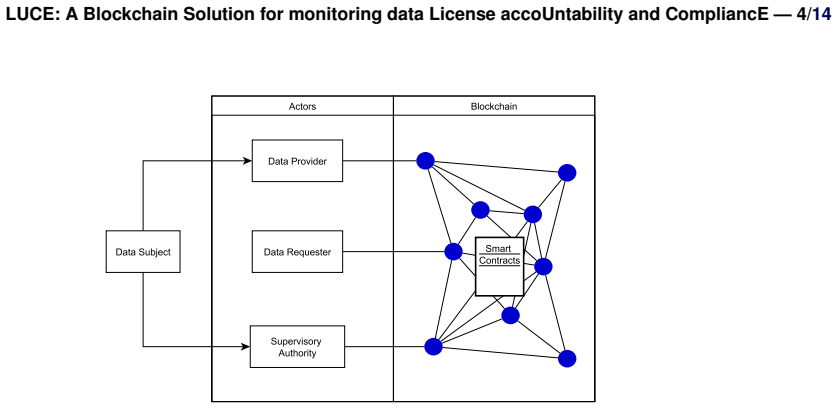
The central mechanism is the pairing of one smart contract per dataset with a monitored executable. The smart contract is a program stored on the Ethereum blockchain that holds the dataset's metadata, license, requester identities, purposes, and compliance status; it also controls the access-token lifecycle. The executable packages the dataset, the ccREL machine-readable form of the license, a license-monitoring submodule, and an update submodule; the update submodule sends compliance reports and log hashes to the smart contract on a timer. The access token, valid for a period T and renewable only when the contract judges the requester compliant, is the enforcement lever: losing the token means losing access. A separate modification module contacts all active copies when a data subject asserts rectification or erasure, so legal obligations reach every distributed copy.
What would settle it
Extract the dataset from the encrypted executable after decryption, use and redistribute it entirely outside the monitoring program, and then check the replicated event log: if no violation appears and the access token is still renewed, the central enforcement claim fails.
Extended reading notes
Core claim
The paper's central claim is that a per-dataset smart contract plus an encrypted executable can enforce data-license terms without a trusted third party. The executable contains the dataset, the machine-readable license, and a monitoring module; it logs uses and periodically reports compliance to the smart contract, which issues an access token valid for a fixed period and renews it only if the requester has complied. When a data subject requests access, rectification, or erasure, the data provider maps their ID to the dataset, the modification module instructs every active copy's monitoring module to update or delete the record, and the resulting transaction ID is stored as proof. In the paper's own description, this makes data accountability and license management automatic and distributed, and it is the contribution the authors put forward for data sharing and reuse.
Load-bearing premise
The load-bearing assumption is that the monitoring program running on the data requester's own computer faithfully detects and reports every use of the dataset and cannot be bypassed; the paper itself concedes it does not check whether the data are shared in another form.
Editorial extensions
If this is right
- A data provider can audit reuse by reading the smart contract's recorded events instead of relying on the requester's promises.
- A requester who breaks license terms loses token renewal and therefore loses access to the dataset at the end of the current period.
- A data subject's rectification or erasure request propagates to every known copy through the modification module, and the transaction identifier doubles as proof for the subject and the supervisory authority.
- Because the supervisory authority is a full node with access to replicated logs, GDPR oversight can be exercised without contacting each researcher individually.
- Machine-readable license metadata in ADA-M profiles makes datasets discoverable and lets requested purposes be checked against the original collection purpose before access is granted.
Reading between the lines
- Extension not developed in the paper: if the executable can be bypassed, the token-renewal mechanism becomes a public-commitment and audit tool rather than hard enforcement; combining it with remote attestation or trusted execution environments would close that gap.
- Extension not developed in the paper: because the smart contract stores requester identity, purpose, and compliance status per dataset, the same records could be aggregated into a subject-facing dashboard, letting data subjects see all uses of their data through a single query to the supervisory authority; currently all subject requests flow through the data provider.
- Extension not developed in the paper: the purpose recorded at request time could be used to generate machine-checkable purpose-compatibility proofs under the GDPR's secondary-use clause, not just as a human review step; the paper states compatibility checking but does not formalize the proof.
- Extension not developed in the paper: the authors' planned behavioral evaluation could test whether the visible, public compliance checkpoint alone increases data-sharing willingness, independent of enforcement strength.
Signed reviews
Editorial analysis
A structured set of objections, weighed in public.
Referee Report
Summary. The paper presents LUCE, an early-stage blockchain-based architecture intended to manage data licensing and support GDPR compliance in scientific data sharing. The proposed design couples a per-dataset Ethereum smart contract with a data-requester-side executable that contains the dataset, a machine-readable license, and a monitoring module. The monitoring module is said to check compliance with the license, maintain a log of events, and periodically report hashes and replication identifiers to the smart contract; access tokens are renewed only if compliance is recorded. A separate modification module is intended to propagate data-subject rectification and erasure requests to all copies of the dataset. The paper includes background on blockchain, smart contracts, ccREL, and GDPR, a review of related provenance and DRM work, an architecture with sequence diagrams, and a minimal Solidity prototype. The authors describe this as preliminary work and state that a full implementation and evaluation are still needed.
Significance. If the described architecture worked as claimed, it would address a real and recognized problem: the lack of automated, auditable enforcement of data licenses and GDPR data-subject rights in scientific data reuse. The paper usefully identifies limitations of existing provenance-only or DRM-based approaches and proposes a concrete integration of Ethereum smart contracts with ADA-M metadata and ccREL licenses. However, the central contribution as stated—'automatic management and enforcement' of licenses and the ability to 'ensure subjects' GDPR rights'—is not supported by the design. The enforcement mechanism runs entirely on the data requester's machine and can be bypassed by reading the dataset outside the monitored executable, a gap the authors concede in Section 7. No evaluation, security analysis, or performance measurement is provided; the only concrete artifact is a minimal smart contract stub. The paper is honestly framed as preliminary work, but the abstract and Section 4 make claims that outrun what the architecture can deliver.
major comments (3)
- [§5.2.2, §7] The paper's central claim that LUCE 'automatically manages and enforces licensing terms' (Section 4) is unsupported because the monitoring module executes on the data requester's own machine. Section 5.2.2 states that the dataset is 'embodied in an executable, which is encrypted' and that the License-Monitoring sub-module 'continuously checks whether the actions performed by the data requester on the data comply with the licensing terms.' However, once the executable is decrypted, the requester controls the runtime and can extract the .cvs file or process it with external tools, none of which are observable by the monitor. Section 7 explicitly concedes: 'currently, do not check if the data are shared in another form (i.e by exporting the data into another format).' This is a load-bearing gap: the log, its hash, and the replication records are not reliable evidence of compliance, and token revocation only prevents future access to the executable, not continued use of extracted data. Without trusted execution, remote attestation, or a comparable guarantee, the enforcement claim collapses.
- [§5.3.2, §7] The claim that LUCE 'can ensure subjects' GDPR rights to access, rectification and erasure' (Abstract) is not substantiated. Section 5.3.2 describes how the modification module contacts monitoring modules in the executables and asks them to erase or modify a record 'from its own copy of the dataset.' This assumes that the only copies of the data are those inside the monitored executables, but the admitted export gap in Section 7 means requesters can hold unmonitored copies. The architecture therefore cannot ensure that erasure or rectification is propagated to all copies, and the blockchain transaction identifier only proves that the monitored executable was asked to make a change, not that the data is no longer present elsewhere. This weakens the GDPR guarantee from an actual assurance to a best-effort notification to cooperating requesters.
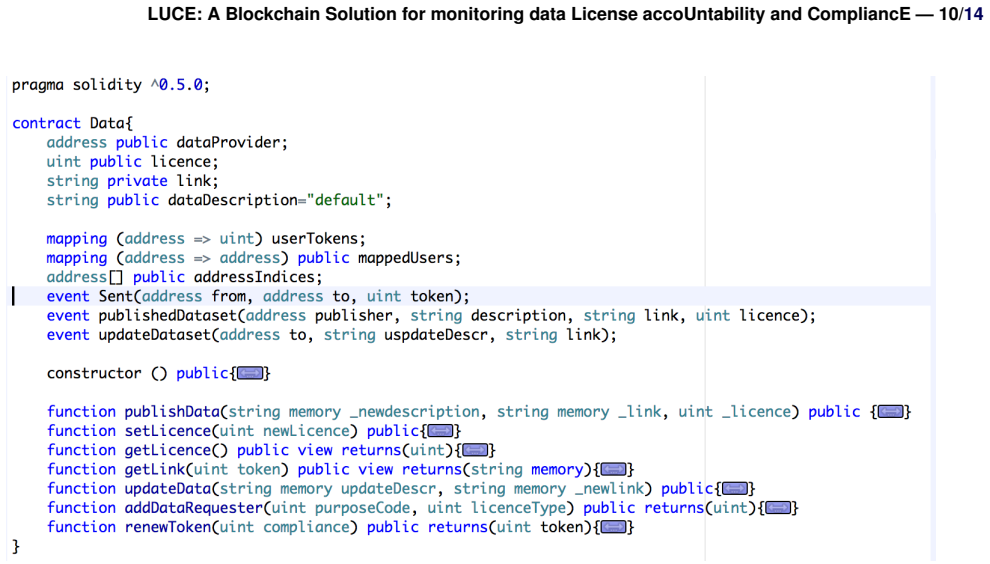
- [§6, §7] The manuscript provides no implementation evidence beyond a minimal Solidity prototype and no evaluation. Section 6 shows a prototype with functions publishDataset, addDataRequester, and renewToken, and states 'We are working towards fully implementing the LUCE platform.' Section 7 lists 'Evaluation' as future work, noting the need for 'technical feasibility and scalability' testing. Since the architecture's feasibility hinges on a monitoring module that can observe all relevant data uses, and since no adversary model or security evaluation is given, the paper is a design sketch rather than a demonstrated solution. This is acceptable for a position paper, but the abstract's definitive language overstates the maturity of the contribution.
minor comments (6)
- [§5.2.2] The phrase 'they cannot download the dataset alone' is misleading; the dataset is a .cvs file inside the decrypted executable, so after decryption the requester can read it directly. Consider rewording to say the dataset is bundled with monitoring tooling rather than implying copy protection.
- [§2.4] The description of GDPR actors is simplified; for instance, 'Data subjects can authorize a data controller' does not capture the legal roles precisely. The distinction between controller and processor could be tightened.
- [§4] There is a typo: 'is are currently not directly interacting' should be 'are currently not directly interacting.'
- [§5.2.2] 'the contracted identifier' should be 'the contract identifier.'
- [§6] There is a typo: 'this is due tot he fact' should be 'this is due to the fact.'
- [§7] The paper uses 'GDRP' once, which should be 'GDPR.' Also, 'i.e by exporting the data into another format' should be 'i.e., by exporting the data into another format.'
Circularity Check
No circular derivation: LUCE is an architecture proposal with no fitted quantities or derived predictions; its main weakness is unsupported client-side enforcement, not circular reasoning.
full rationale
This paper is an architecture/position paper. It contains no equations, no fitted parameters, no quantitative predictions, and no derivation chain whose output could be equivalent to its inputs by construction. The only self-citation is reference [8], a prior multiagent-system paper by some of the same authors, invoked in Section 5.2.1 only for the optional remark that 'further negotiations on the data can be set up at this stage as it has been discussed in [8]'. This is a background reference to an optional extension, not a load-bearing theorem, uniqueness claim, or ansatz, so it does not raise the circularity score. The paper's central claims that LUCE 'enforces' licensing terms and 'can ensure' GDPR rights to access, rectification and erasure are design assertions built on an encrypted executable containing a monitoring module; the known weakness is that the client-side monitor can be bypassed, and Section 7 concedes 'currently, do not check if the data are shared in another form (i.e by exporting the data into another format)'. That is a feasibility, trust, and security gap, not a circularity: the paper does not fit a parameter to data and then rename the fit as a prediction, nor does it define its target result into existence via a self-citation chain. Under the evidentiary bar of exhibiting a specific reduction, no circular step is present.
Assumptions & free parameters
assumptions (6)
- domain assumption Assumption 1: Datasets are shared as a whole.
- domain assumption Assumption 2: Dataset integration is not taken into account.
- domain assumption Assumption 3: All records of data subjects in a dataset have given the same consent.
- domain assumption Assumption 4: The license under which the dataset is shared is compatible with the consent of the data subjects.
- domain assumption Assumption 5: Data records are anonymized and only the data provider can map a data subject to their records.
- ad hoc to paper The monitoring executable on the data requester's machine will accurately observe and report all data uses and cannot be bypassed or tampered with.
invented entities (3)
-
LUCE platform
-
Monitoring module
-
Replication module
Cite this review
Pith. "Pith review of LUCE: A Blockchain Solution for monitoring data License accoUntability and CompliancE." pith.science (2026). https://pith.science/paper/H2M25CPW
@misc{pith2026190802287,
  author       = {Pith},
  title        = {Pith review of: LUCE: A Blockchain Solution for monitoring data License accoUntability and CompliancE},
  year         = {2026},
  howpublished = {\url{https://pith.science/paper/H2M25CPW}},
  note         = {Machine review of arXiv:1908.02287}
}
read the original abstract
In this paper we present our preliminary work on monitoring data License accoUntability and CompliancE (LUCE). LUCE is a blockchain platform solution designed to stimulate data sharing and reuse, by facilitating compliance with licensing terms. The platform enables data accountability by recording the use of data and their purpose on a blockchain-supported platform. LUCE allows for individual data to be rectified and erased. In doing so LUCE can ensure subjects' General Data Protection Regulation's (GDPR) rights to access, rectification and erasure. Our contribution is to provide a distributed solution for the automatic management of data accountability and their license terms.
Figures


Figures from the paper (7 more)




Reference graph
Works this paper leans on
-
[1]
Digital rights management-an overview of current challenges and solu- tions
Alapan Arnab and Andrew Hutchison. Digital rights management-an overview of current challenges and solu- tions. In Proceedings of Information Security South Africa (ISSA) Conference, volume 2004, 2004. LUCE: A Blockchain Solution for monitoring data License accoUntability and CompliancE — 11/14
work page 2004
- [2]
-
[3]
Data sharing by scien- tists: Practices and perceptions
Tenopir C., Allard S., Douglass K., Aydinoglu A.M., Wu L., Read E., Manoff M., and Frame M. Data sharing by scien- tists: Practices and perceptions. PLoS ONE, 6, 2011
work page 2011
-
[4]
Borgman C. L. The conundrum of sharing data. Journal of the American Society for Information Science and Technol- ogy, 63:1059–1078, 2012
work page 2012
-
[5]
Cardellino, C. (Inria). Licentia. http://licentia. inria.fr/. Accessed May 23, 2018
work page 2018
-
[6]
Creative Commons. https://creativecommons. org/. Accessed May 23, 2018
work page 2018
-
[7]
Research Data - Practical challenges for researchers in data sharing [White paper]
Stuart D., Baynes G., Hrynaszkiewics I., Allin K., Penny D., Lucraft M., and Astell M. Research Data - Practical challenges for researchers in data sharing [White paper]. https://www.springernature. com/in/open-research/open-data/ practical-challenges-white-paper , 2018. Retrieved May 22, 2018, from Springer Nature
work page 2018
-
[8]
A multiagent system for dynamic data aggregation in medical research
Alevtina Dubovitskaya, Visara Urovi, Imanol Barba, Karl Aberer, and Michael Ignaz Schumacher. A multiagent system for dynamic data aggregation in medical research. BioMed research international, 2016, 2016
work page 2016
Show all 37 references
-
[9]
Elixir. Elixir. https://www.elixir-europe. org/, 2017. Accessed June 21, 2018
2017
-
[10]
Licensing assistant
European Data Portal. Licensing assistant. www.europeandataportal.eu/en/content/ show-license?license_id=CC-BY4.0. Ac- cessed May 23, 2018
2018
-
[11]
Global Alliance for Genomics and Health
GA4GH. Global Alliance for Genomics and Health. https://www.ga4gh.org/, 2019. Accessed June 21, 2019
2019
-
[12]
ccREL: The Creative Commons Rights Expression Lan- guage
Abelson H., Adida B., Linksvayer M., and Yergler N. ccREL: The Creative Commons Rights Expression Lan- guage. https://wiki.creativecommons.org/ images/d/d6/Ccrel-1.0.pdf, 2008. Accessed June 26, 2018
2008
-
[13]
Open Data - The researcher perspective
Leiden University’s Centre for Science and Tech- nology Studies (CWTS) and Elsevier. Open Data - The researcher perspective. https: //www.elsevier.com/about/open-science/ research-data/open-data-report , 2017. Retrieved May 22, 2018, from Elsevier
2017
-
[14]
Provchain: A blockchain-based data provenance architecture in cloud environment with enhanced privacy and availability
Xueping Liang, Sachin Shetty, Deepak Tosh, Charles Kamhoua, Kevin Kwiat, and Laurent Njilla. Provchain: A blockchain-based data provenance architecture in cloud environment with enhanced privacy and availability. In Pro- ceedings of the 17th IEEE/ACM International Symposium on...
2017
-
[15]
Blockchain technology: principles and appli- cations
Pilkington M. Blockchain technology: principles and appli- cations. In Olleros F.X. and Zhegu M., editors, Research handbook on digital transformations , chapter 11, pages 225–253. Edward Elgar, Oxford, 2016
2016
-
[16]
Bitcoin: A peer-to-peer electronic cash system
Satoshi Nakamoto et al. Bitcoin: A peer-to-peer electronic cash system. 2008
2008
-
[17]
Biomedical Data Translator.https://ncats
National Center for Advancing Translational Sciences (NCATS). Biomedical Data Translator.https://ncats. nih.gov/translator, 2018. Accessed June 21, 2018
2018
-
[18]
Data Commons Pi- lots
National Institutes of Health (NIH). Data Commons Pi- lots. https://commonfund.nih.gov/commons,
-
[19]
A blockchain-based approach for data accountability and provenance tracking
Ricardo Neisse, Gary Steri, and Igor Nai-Fovino. A blockchain-based approach for data accountability and provenance tracking. arXiv preprint arXiv:1706.04507 , 2017
2017 arXiv
-
[20]
Ocean Protocol:A De- centralized Substrate for AI Data and ServicesTechni- cal Whitepaper
Ocean Protocol Foundation. Ocean Protocol:A De- centralized Substrate for AI Data and ServicesTechni- cal Whitepaper. https://oceanprotocol.com/ tech-whitepaper.pdf. Accessed May 18, 2019
2019
-
[21]
https://opendatacommons
Open Data Commons. https://opendatacommons. org/. Accessed May 23, 2018
2018
-
[22]
Using blockchain and smart contracts for secure data provenance management
Aravind Ramachandran, Dr Kantarcioglu, et al. Using blockchain and smart contracts for secure data provenance management. arXiv preprint arXiv:1709.10000, 2017
2017 arXiv
-
[23]
Consent codes: upholding standard data use conditions
Dykeand S., Philippakis A., De Argila J., Paltoo D., Luetke- meier E., Knoppers B., Brookes A., Spalding J.D., Thomp- son M., Roos M., et al. Consent codes: upholding standard data use conditions. PLoS genetics, 12(1):e1005772, 2016
2016
-
[24]
and Kalinov V
V oshmgir S. and Kalinov V . Blockchain Handbook: A Beginners Guide. https://s3.eu-west-2. amazonaws.com/blockchainhub.media/ Blockchain+Technology+Intro.pdf, 2017. Accessed June 26, 2018
2017
-
[25]
What is Blockchain Technology? How Blockchain Works.https://www.edureka.co/ blog/how-blockchain-works/, 2018
Shashank (edureka!). What is Blockchain Technology? How Blockchain Works.https://www.edureka.co/ blog/how-blockchain-works/, 2018. Accessed June 26. 2018
2018
-
[26]
Smart contracts: building blocks for digi- tal markets
Nick Szabo. Smart contracts: building blocks for digi- tal markets. EXTROPY: The Journal of Transhumanist Thought,(16), 18, 1996
1996
-
[27]
European Open Science Cloud
The European Commission. European Open Science Cloud. https://ec.europa.eu/ research/openscience/index.cfm?pg= open-science-cloud, 2018. Accessed June 21, 2018
2018
-
[28]
http://reusabledata
The (Re)Usable Data Project. http://reusabledata. org/. Accessed May 23, 2018
2018
-
[29]
European Union. Regulation (EU) 2016/679 of the European Parliament and of the Council of 27 April 2016 on the protection of natural persons with regard to the processing of personal data and on the free movement of LUCE: A Blockchain Solution for monitoring data License accoU...
2016
-
[30]
The legal framework for reproducible scientific research: Licensing and copyright
Stodden V . The legal framework for reproducible scientific research: Licensing and copyright. Computing in Science & Engineering, 11(1):35–40, 2009
2009
-
[31]
The open dig- ital rights language (odrl) vocabulary and expression 2.2
World Wide Web Consortium (W3C). The open dig- ital rights language (odrl) vocabulary and expression 2.2. https://www.w3.org/TR/odrl-vocab/,
-
[32]
Ethereum: A secure decentralised generalised transaction ledger, 2015
Gavin Wood. Ethereum: A secure decentralised generalised transaction ledger, 2015
2015
-
[33]
Accessed June 26, 2018
2018
-
[34]
Multi- media security technologies for digital rights management
Wenjun Zeng, Heather Yu, and Ching-Yung Lin. Multi- media security technologies for digital rights management . Elsevier, 2011
2011
-
[35]
automatable discovery and access matrix
J Patrick Woolley, Emily Kirby, Josh Leslie, Francis Jean- son, Moran N Cabili, Gregory Rushton, James G Hazard, Vagelis Ladas, Colin D Veal, Spencer J Gibson, et al. Re- sponsible sharing of biomedical data and biospecimens via the “automatable discovery and access matrix”(ad...
2018
-
[37]
LUCE: A Blockchain Solution for monitoring data License accoUntability and CompliancE — 13/14 Figure 8
Appendix The following figures show respectively the detailed sequence diagrams for: (i) Sharing a dataset Fig:8; (ii) Re-using a dataset Fig:9 and (iii) Complying with GDPR Fig:10. LUCE: A Blockchain Solution for monitoring data License accoUntability and CompliancE — 13/14 Fi...
-
[2018]
Accessed June 21, 2018
2018
Reviewed August 14, 2026 · model on record in the stance chip above.
Discussion (0). Continue with ORCID to comment.