REVIEW 4 major objections 4 minor 73 references
Diverse interactions and ecosystem engineering stabilize community assembly
T0 review · 4 major / 4 minor · reviewed 2026-08-14 · deepseek-v4-flash
Pith's one-line read Adding engineers to an assembly model, this paper claims that redundant engineering stabilizes communities by lowering colonization barriers and raising diversity, while sparse engineering raises primary extinction rates.
desk verdict A useful model extension with a redundancy result that is likely real but currently rests on an under-specified control and an uncalibrated competition ordering. read the letter →
The pith
A machine-rendered reading of the paper's core claim, the machinery that carries it, and where it could break.
The reading
What carries the argument
The central object is the ENIgMa network model, in which nodes are species plus abiotic modifier nodes, and directed links are trophic ('eat'), service ('need'), or engineering ('make') dependencies; community dynamics are simulated as presence–absence events with a Gillespie algorithm. The load-bearing mechanism is the competition-strength function $\sigma_i = c_n n_i - c_e e_i - c_v v_i$ with coefficients $c_n = \pi > c_e = \sqrt{2} > c_v = 1$, which encodes that each added mutualistic need increases competitive strength more than each added prey or predator decreases it; primary extinction hits any species that is not the strongest competitor for at least one of its resources. Two further rules do the specific work of the engineering result: modifiers persist stochastically after all their producers are gone, and each modifier is independently assigned to engineers, so that a fixed proportion of modifiers (about 42 percent) ends up produced by more than one species—this shared-production redundancy is what lowers colonization barriers and stabilizes diversity.
What would settle it
Re-run the simulations with the competition coefficients perturbed—for example with $c_v > c_e > c_n$ or with $c_n$ below $c_e$—and check whether the three headline results persist: increasing mutualism frequency still yields more nested networks, rare engineering still elevates primary extinction, and redundant engineering still raises steady-state richness. The claim would be falsified as stated if any of these patterns flips or disappears under a perturbed ordering, since the paper offers no other mechanism that would preserve them; a complementary empirical check would compare colonization success in real patches whose habitat modification is supplied by one engineer versus several redundant ones.
Extended reading notes
Core claim
In the ENIgMa assembly model (Eat–Need–Ignore–Make), where species and the abiotic modifiers they produce are present or absent and dynamics are driven by stochastic colonization and extinction events, the paper shows that ecosystem engineering alters assembly outcomes in ways that depend sharply on how common and how redundant engineering is. When each engineer produces a unique modifier, steady-state richness declines steeply because a species that needs several modifiers can only colonize after every required producer has arrived, magnifying priority effects. When multiple engineers can produce the same modifier, redundancy expands the accessible niche space, minimizes priority effects, and lowers the barriers to colonization, so a larger fraction of the source pool establishes and community diversity is maintained. The same model yields two further results: mutualism frequency increases nestedness at the cost of persistence, and a low density of engineers elevates primary extinctions of prey while compressing cascades, whereas a high density of engineers expands niche space and suppresses both primary and secondary extinction.
Load-bearing premise
The load-bearing premise is the coefficient ordering in the competition-strength equation $\sigma_i = c_n n_i - c_e e_i - c_v v_i$, namely $c_n = \pi > c_e = \sqrt{2} > c_v = 1$, which asserts that each additional mutualistic need strengthens a competitor more than each additional prey or predator weakens it; the paper provides no sensitivity analysis or empirical calibration for this ordering, and if the ordering were reversed the reported patterns could reverse as well.
Editorial extensions
If this is right
- Communities where several species produce the same environmental modification should reach higher steady-state species richness than otherwise identical communities with one-to-one engineering, because redundant modifiers admit more potential colonizers from the source pool.
- Higher frequencies of mutualistic (service) interactions make assembled networks more nested but lower average species persistence by increasing secondary extinction rates, implying higher species turnover in mutualism-rich systems.
- Sparse engineering ($\eta \leq 0.5$) raises primary extinction rates by stabilizing consumers and thereby increasing prey vulnerability, while abundant engineering ($\eta > 0.5$) expands niche space and suppresses both primary and secondary extinction.
- Even a small number of engineers reduces the magnitude of secondary extinction cascades, so disturbances in engineered communities tend to be compartmentalized into many small extinctions rather than a few large ones.
- Network assembly models that omit engineering dependencies will systematically underestimate both a source of robustness (niche-space creation) and a source of fragility (larger cascades), and will miss the diversity-maintaining role of redundant engineers.
Reading between the lines
- A conservation corollary the paper leaves implicit: protecting functionally redundant guilds of habitat modifiers matters for maintaining diversity even when no single engineer species is indispensable, because the redundancy itself, not any particular engineer, is what lowers colonization barriers.
- Because modifiers persist after their makers vanish, the model implies that legacy engineering effects—beaver ponds, shell beds, soil structure—should buffer communities against extinction cascades on timescales longer than an engineer's lifetime; the paper includes this persistence but does not explore explicit time lags.
- The analytically fixed redundancy fraction $\varphi \approx 0.418$, which is independent of $\eta$, is a precise quantitative prediction of the random-assignment scheme that could be tested in real engineered systems by measuring how many environmental modifications are shared by multiple species.
- An empirical test of the central mechanism: in habitat patches where a modification (burrows, dams, nests) is provided by several engineer species, incoming species needing that modification should show higher colonization success than in patches where a single engineer provides it.
Signed reviews
Editorial analysis
A structured set of objections, weighed in public.
Referee Report
Summary. The paper introduces ENIgMa, a stochastic presence/absence model of community assembly in which species interact through trophic (eat), service (need), and engineering (make) interactions, the last operating through abiotic modifier nodes. Colonization requires one eat interaction and all need interactions to be satisfied; primary extinction is driven by competitive exclusion parameterized by a linear competition-strength function, and secondary extinctions follow the loss of required interactions. Using Gillespie simulations with default parameters, the authors report that assembly without engineering reproduces several empirical patterns: generalists appear early under a steady-state-scaled generality measure, trophic-level distributions are hourglass-shaped, and networks become more nested as the frequency of mutualisms increases, at the cost of higher secondary extinction. Adding ecosystem engineers produces a nonmonotonic response of primary extinction rates, with rare engineering increasing primary extinction and abundant engineering suppressing it, and reduces secondary cascades. The paper's final claim is that redundancy in engineered effects (multiple species producing the same modifier) lowers colonization barriers and increases steady-state diversity relative to a control in which each modifier is unique to a single species.
Significance. If the main claims survive scrutiny, the paper provides a useful mechanistic framework for including ecosystem engineering in network-based assembly models and makes a specific, testable prediction: redundant engineering stabilizes diverse communities by reducing priority effects. The model is explicitly defined, simulation methods are standard and repeatable in principle, and the SI contains analytical derivations for expected modifier counts (Eqs. S1-S4), which are a genuine strength. However, the paper's qualitative conclusions rest on an uncalibrated ordering of competition coefficients and on a control condition for redundancy that is underspecified; both need to be resolved before the results can be taken as established.
major comments (4)
- [Materials and Methods, Eq. (1)] The competition-strength function sigma_i = cn*n_i - ce*e_i - cv*v_i with the chosen coefficients cn=pi, ce=sqrt(2), cv=1 encodes the assumption that each additional mutualistic need increases competitive strength more than each added prey or predator decreases it. All of the qualitative results on nestedness under mutualisms (Fig. 3) and on the nonlinear effect of engineering on primary extinction rates (Fig. 4A) depend on this ordering, yet the paper does not provide any sensitivity analysis, empirical calibration, or biological justification for the ordering. If the coefficients were varied, for example if the vulnerability penalty exceeded the mutualistic benefit, the reported patterns could reverse. I ask the authors to either justify the ordering from data or first principles, or to systematically explore the coefficient space and show that the qualitative conclusions are robust over a nontrivial region of it.
- [Fig. 4D and SI Figs. S6-S7] The central claim that redundant engineering promotes diversity is based on comparing the ENIgMa model to a control 'where each modifier is uniquely produced by a single species.' The manuscript does not specify whether this control (i) keeps the same modifier set and engineer set and prunes all but one maker per modifier, or (ii) assigns each maker-modifier pair a distinct modifier identity. Under implementation (ii), the expected number of modifier nodes changes from S_P*eta*(1 - 1/e) (SI Eq. S1) to S_P*eta, an increase of roughly 58%; because all need interactions are obligate for colonization, the unique condition would then have substantially more mandatory dependencies, and the observed decline in Su* could be caused by these added dependencies rather than by the absence of redundancy. The authors must specify the implementation, and if (ii) was used, repeat the comparison while holding the number of modifier nodes or the number of need interactions per species fixed.
- [Materials and Methods, 'A modifier is present'] The parameter rm, the rate at which a modifier disappears after its last maker goes extinct, is defined but never given a numerical value in the text or SI. The persistence of modifiers after engineer extinction is essential to the proposed mechanism by which redundancy lowers colonization barriers, and the effect of the engineering timescale cannot be assessed without this value. Please report the default value of rm and, ideally, test the sensitivity of the redundancy result to rm, including the limit rm -> infinity where modifiers disappear instantly.
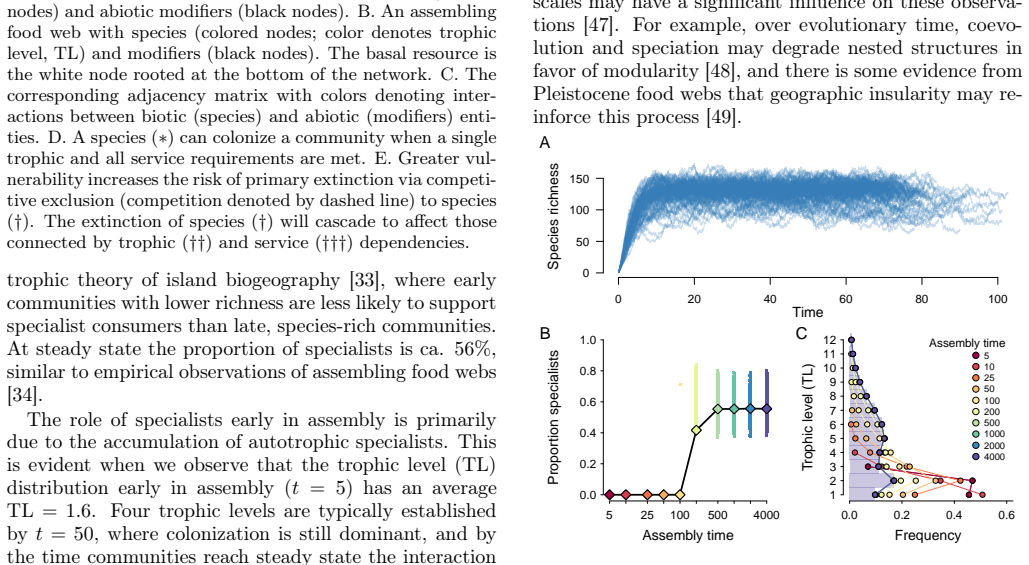
- [Fig. 2B and SI Section III / Fig. S4] The main text states that generalists dominate early in assembly and specialists increase later (Fig. 2B), but SI Section III reports that this pattern is an artifact of scaling generality to the steady-state value of L*/S*. With the two alternative scalings shown in Fig. S4 (Gall_i and Ghetero_i), specialists actually dominate early in assembly, so the main-text claim depends entirely on the chosen normalization. Because reproducing the empirically observed role of generalists is one of the paper's headline results, the authors should either frame the result as scaling-dependent in the main text or provide an ecological argument for why the steady-state scaling is the appropriate one.
minor comments (4)
- [Materials and Methods] The sentence 'where nodes represent ecological entities such as populations of species and or the presence of abiotic modifiers affecting species such as (examples)' contains a placeholder phrase and an incomplete list; please replace it with concrete examples or remove the parenthetical.
- [Materials and Methods and reference list] The text refers to 'Pilai et al.' when citing the metacommunity assembly model, but the reference list gives 'Pillai et al.'; please correct the in-text citation and verify all author name spellings.
- [Materials and Methods, simulation parameters] The default parameter list at the end of Materials and Methods gives S, pe, cn, ce, cv, and the number of iterations, but the values of pn, qe, qn, and rm, all needed to reproduce the simulations, are not reported explicitly; please provide a complete parameter table in the main text or SI.
- [Figures 3 and 4] The x-axis of Figs. 3 and 4 is labeled 'Frequency of service interactions' but the values are not defined in the figure captions; the relationship between this axis and pn should be stated.
Circularity Check
No significant circularity; the redundancy result follows from the model's stated rules but is not a fitted or renamed input.
full rationale
The ENIgMa model is a generative simulation with fixed parameter values (S=200, pe=0.01, cn=π, ce=√2, cv=1) and no data-fitting step, so the central outputs—nestedness with mutualisms, nonlinear primary-extinction curves, and higher steady-state richness with redundant engineering—are not fitted inputs renamed as predictions. The redundancy claim does follow directly from the model's colonization rule (all need interactions must be present; multiple makers increase the chance a modifier is present), but this is a transparent consequence of the stated rules, not a circular definition: redundancy is defined as 'more than one engineer can produce the same modifier,' and the outcome 'lower barriers to colonization' is not built into that definition. The competition-strength ordering cn>ce>cv in Eq. (1) is an arbitrary modeling assumption, but it is stated openly and not imported from a self-citation or from the target results. The unique-modifier control may be confounded if the alternative implementation changes the total number of modifier nodes, but that is a correctness/robustness concern rather than a circularity: the paper does not fit S* from itself. No self-citation is load-bearing, and no prediction reduces to a fitted parameter by construction. Score 0.
Assumptions & free parameters
free parameters (8)
- cn (need coefficient) =
pi
- ce (eat coefficient) =
sqrt(2)
- cv (vulnerability coefficient) =
1
- pe (eat probability) =
0.01
- pn (need probability) =
varied 0 to 0.002 in figures
- eta (expected modifiers per species) =
varied 0 to 2 in figures
- S (source pool size) =
200
- rc, re, rm (event rates) =
not reported
assumptions (5)
- domain assumption Presence/absence representation (following Pillai et al. 2011)
- domain assumption Obligate needs and flexible trophic links
- ad hoc to paper Linear competition function with cn > ce > cv
- domain assumption Random source pool with independent interactions
- domain assumption Basal resource always present
invented entities (1)
-
Abiotic modifier nodes
Cite this review
Pith. "Pith review of Diverse interactions and ecosystem engineering stabilize community assembly." pith.science (2026). https://pith.science/paper/MRHIBU4O
@misc{pith2026190802371,
  author       = {Pith},
  title        = {Pith review of: Diverse interactions and ecosystem engineering stabilize community assembly},
  year         = {2026},
  howpublished = {\url{https://pith.science/paper/MRHIBU4O}},
  note         = {Machine review of arXiv:1908.02371}
}
read the original abstract
The complexity of an ecological community can be distilled into a network, where diverse interactions connect species in a web of dependencies. Species interact not only with each other but indirectly through environmental effects, however the role of these ecosystem engineers has not yet been considered in models of ecological networks. Here we explore the dynamics of ecosystem assembly, where the colonization and extinction of species within a community depends on the constraints imposed by trophic, service, and engineering dependencies. We show that our assembly model reproduces many key features of ecological systems, such as the role of generalists during assembly, realistic maximum trophic levels, and increased nestedness with higher frequencies of mutualisms. We find that ecosystem engineering has large and nonlinear effects on extinction rates, facilitating robustness by creating niche space, but at the same time increasing the magnitude of extinction cascades. We emphasize the importance of redundancies in engineered effects and show that such redundancy lowers the barriers to colonization, promoting community diversity. Together, our results suggest that ecological engineers may enhance community diversity while increasing persistence by facilitating colonization and limiting competitive exclusion.
Figures


Figures from the paper (1 more)

Reference graph
Works this paper leans on
-
[1]
Consider how species with more service in- teractions compare to those with fewer
promotes both service-resource and service-service de- pendencies. Consider how species with more service in- teractions compare to those with fewer. More service interactions i) increase a species’ competition strength, lowering its primary extinction risk while alsoii) increas- ing inter-species dependencies and its secondary extinc- tion risk. While mu...
-
[2]
Proc Natl Acad Sci USA 99(20):12917–12922
Dunne JA, Williams RJ, Martinez ND (2002) Food-web structure and network theory: the role of connectance and size. Proc Natl Acad Sci USA 99(20):12917–12922
work page 2002
-
[3]
Paine RT (1966) Food web complexity and species diver- sity. Am. Nat. 100(910):65–75
work page 1966
-
[4]
loss of more flexible non-obligate mutualistic partners
Mutualistic motif: the least vulnerable species 1 with fewer mutualistic partners is subject to primary extinction without cascading effects. loss of more flexible non-obligate mutualistic partners. As such, we do not expect inclusion of non-obligate mutualisms to alter the qualitative nature of our findings. Assembly with ecosystem engineering The concept o...
-
[5]
(Oxford University Press, Oxford, UK)
Pascual M, Dunne J (2006)Ecological Networks: Linking Structure to Dynamics in Food Webs. (Oxford University Press, Oxford, UK)
work page 2006
-
[6]
(Princeton Univer- sity Press, Princeton, NJ)
Bascompte J, Jordano P (2013) Mutualistic Networks , Monographs in Population Biology. (Princeton Univer- sity Press, Princeton, NJ)
work page 2013
-
[7]
May RM (1972) Will a large complex system be stable? Nature 238(5364):413–414
work page 1972
-
[8]
Gross T, Levin SA, Dieckmann U (2009) Generalized models reveal stabilizing factors in food webs. Science 325(5941):747–750
work page 2009
Show all 73 references
-
[9]
Nature 483(7388):205–208
Allesina S, Tang S (2012) Stability criteria for complex ecosystems. Nature 483(7388):205–208
2012
-
[10]
PonisioLC,GaiarsaMP,KremenC(2017)Opportunistic attachment assembles plantâĂŞpollinator networks.Ecol Lett 20(10):1261–1272
2017
-
[11]
Nature 18:586
Guimarães Jr PR, Pires MM, Jordano P, Bascompte J, Thompson JN (2017) Indirect effects drive coevolution in mutualistic networks. Nature 18:586
2017
-
[12]
Kéfi S, Miele V, Wieters EA, Navarrete SA, Berlow EL (2016) How structured is the entangled bank? the sur- prisingly simple organization of multiplex ecological net- works leads to increased persistence and resilience.PLoS Biol 14(8):e1002527
2016
-
[13]
Nature Ecol Evol 1:0101
Pilosof S, Porter MA, Pascual M, Kéfi S (2017) The mul- tilayer nature of ecological networks. Nature Ecol Evol 1:0101
2017
-
[14]
Lawton JH (1994) What do species do in ecosystems? Oikos 71(3):367–374
1994
-
[15]
Q Rev Biol 88(1):4–28
Odling-Smee J, Erwin DH, Palkovacs EP, Feldman MW, Laland KN (2013) Niche construction theory: a practical guide for ecologists. Q Rev Biol 88(1):4–28
2013
-
[16]
(Princeton Univer- sity Press, Princeton, NJ)
Odling-Smee F, Laland K, Feldman M (2013)Niche Con- struction: The Neglected Process in Evolution (MPB-37) , Monographs in Population Biology. (Princeton Univer- sity Press, Princeton, NJ)
2013
-
[17]
Fukami T (2015) Historical Contingency in Community Assembly: Integrating Niches, Species Pools, and Prior- ity Effects.Annu Rev Ecol Evol Syst 46(1):1–23
2015
-
[18]
Oikos 69(3):373–386
Jones CG, Lawton JH, Shachak M (1994) Organisms as ecosystem engineers. Oikos 69(3):373–386
1994
-
[19]
Philos T Roy Soc B 364(1524):1755
OlffH,etal.(2009)Parallelecologicalnetworksinecosys- tems. Philos T Roy Soc B 364(1524):1755
2009
-
[20]
Geomorphology 157-158:99 – 107
Haynes G (2012) Elephants (and extinct relatives) as earth-movers and ecosystem engineers. Geomorphology 157-158:99 – 107
2012
-
[21]
Ecology 89(1):26–33
Pringle RM (2008) Elephants as agents of habitat cre- ation for small vertebrates at the patch scale. Ecology 89(1):26–33
2008
-
[22]
Reichman O, Seabloom EW (2002) The role of pocket go- phers as subterranean ecosystem engineers.Trends Ecol Evol 17(1):44 – 49
2002
-
[23]
BioScience 56(3):237–246
Moore JW (2006) Animal Ecosystem Engineers in Streams. BioScience 56(3):237–246
2006
-
[24]
Ecol Entomol 36(1):14–24
Meyer ST, Leal IR, Tabarelli M, Wirth R (2011) Ecosys- tem engineering by leaf-cutting ants: nests of atta cephalotes drastically alter forest structure and micro- climate. Ecol Entomol 36(1):14–24
2011
-
[25]
(2007) Ecosystem engineering in space and time
Hastings A, et al. (2007) Ecosystem engineering in space and time. Ecol Lett 10(2):153–164
2007
-
[26]
Trends Ecol Evol 23(6):304 – 310
Erwin DH (2008) Macroevolution of ecosystem engineer- ing, niche construction and diversity. Trends Ecol Evol 23(6):304 – 310
2008
-
[27]
Schirrmeister BE, de Vos JM, Antonelli A, Bagheri HC (2013) Evolution of multicellularity coincided with in- creased diversification of cyanobacteria and the great ox- idation event.Proc Natl Acad Sci USA 110(5):1791–1796
2013
-
[28]
Ecol Lett 14(3):244–250
Loladze I, Elser JJ (2011) The origins of the Red- field nitrogen-to-phosphorus ratio are in a homoeostatic protein-to-rRNA ratio. Ecol Lett 14(3):244–250
2011
-
[29]
Philos T Roy Soc B 365(1549):2093–2106
Woodward G, Perkins DM, Brown LE (2010) Climate change and freshwater ecosystems: impacts across mul- tiple levels of organization. Philos T Roy Soc B 365(1549):2093–2106
2010
-
[30]
(2012) Climate change in size-structured ecosystems
Brose U, et al. (2012) Climate change in size-structured ecosystems. Philos T Roy Soc B 367(1605):2903–2912
2012
-
[31]
Gibert JP (2019) Temperature directly and indirectly in- fluences food web structure.Sci Rep-UK 9(1):5312
2019
-
[32]
Getz WM (2011) Biomass transformation webs provide a unified approach to consumer-resource modelling.Ecol Lett 14(2):113–124
2011
-
[33]
Proc Natl Acad Sci USA 108(48):19293–19298
Pillai P, Gonzalez A, Loreau M (2011) Metacommunity theory explains the emergence of food web complexity. Proc Natl Acad Sci USA 108(48):19293–19298
2011
-
[34]
Proc Natl Acad Sci USA 100(16):9383–9387
Bascompte J, Jordano P, Melián CJ, Olesen JM (2003) The nested assembly of plant-animal mutualistic net- works. Proc Natl Acad Sci USA 100(16):9383–9387
2003
-
[35]
Gravel D, Massol F, Canard E, Mouillot D, Mouquet N (2011) Trophic theory of island biogeography.Ecol Lett 14(10):1010–1016
2011
-
[36]
trophic breadth
Piechnik DA, Lawler SP, Martinez ND (2008) Food- web assembly during a classic biogeographic study: species’“trophic breadth” corresponds to colonization or- der. Oikos 117(5)
2008
-
[37]
Nature 404(6774):180–183
WilliamsRJ,MartinezND(2000)Simplerulesyieldcom- plex food webs. Nature 404(6774):180–183
2000
-
[38]
Am Nat 163(3):458–468
Williams R, Martinez N (2004) Limits to trophic levels and omnivory in complex food webs: Theory and data. Am Nat 163(3):458–468
2004
-
[39]
Proc Natl Acad Sci USA 103(30):11211–11216
Lafferty KD, Dobson AP, Kuris AM (2006) Parasites dominate food web links. Proc Natl Acad Sci USA 103(30):11211–11216
2006
-
[40]
Turney S, Buddle CM (2016) Pyramids of species rich- ness: the determinants and distribution of species diver- sity across trophic levels.Oikos 125(9):1224–1232
2016
-
[41]
Science 8 345(6195):1253497–1253497
Rohr RP, Saavedra S, Bascompte J (2014) On the structural stability of mutualistic systems. Science 8 345(6195):1253497–1253497
2014
-
[42]
(2016) Niche partitioning due to adaptive foraging reverses effects of nestedness and con- nectance on pollination network stability
Valdovinos FS, et al. (2016) Niche partitioning due to adaptive foraging reverses effects of nestedness and con- nectance on pollination network stability. Ecol Lett 19(10):1277–1286
2016
-
[43]
Valdovinos FS (2019) Mutualistic networks: moving closer to a predictive theory.Ecol Lett 0(0)
2019
-
[44]
Oikos 117(11):1609–1618
Krishna A, Guimarães Jr PR, Jordano P, Bascompte J (2008) A neutral-niche theory of nestedness in mutualis- tic networks. Oikos 117(11):1609–1618
2008
-
[45]
Proc Natl Acad Sci USA 108(9):3648–3652
Stouffer DB (2011) Compartmentalization increases food-web persistence. Proc Natl Acad Sci USA 108(9):3648–3652
2011
-
[46]
Science 357(6347):199–201
GilarranzLJ,RayfieldB,Liñán-CembranoG,Bascompte J, Gonzalez A (2017) Effects of network modularity on the spread of perturbation impact in experimental metapopulations. Science 357(6347):199–201
2017
-
[47]
(2010) Nested diets: a novel pattern of individual-level resource use
Araújo MS, et al. (2010) Nested diets: a novel pattern of individual-level resource use. Oikos 119(1):81–88
2010
-
[48]
Pires MM, Prado PI, Guimarães Jr PR (2011) Do food web models reproduce the structure of mutualistic net- works? PLoS ONE 6(11):e27280
2011
-
[49]
Ecol Lett 14(3):313– 323
MassolF,etal.(2011)Linkingcommunityandecosystem dynamics through spatial ecology. Ecol Lett 14(3):313– 323
2011
-
[50]
(2019) A network perspective for com- munity assembly
Ponisio LC, et al. (2019) A network perspective for com- munity assembly. Front Ecol Evol 7:103
2019
-
[51]
Yeakel JD, Guimarães Jr PR, Bocherens H, Koch PL (2013) The impact of climate change on the structure of Pleistocene food webs across the mammoth steppe.Proc Roy Soc B 280(1762):20130239–20130239
2013
-
[52]
Phil Trans Roy Soc B 344(1307):83–90
Bond WJ, Lawton JH, May RM (1994) Do mutualisms matter? Assessing the impact of pollinator and disperser disruption on plant extinction. Phil Trans Roy Soc B 344(1307):83–90
1994
-
[53]
Ann Rev Ecol Evol Sys 43(1):183–203
Colwell RK, Dunn RR, Harris NC (2012) Coextinction and persistence of dependent species in a changing world. Ann Rev Ecol Evol Sys 43(1):183–203
2012
-
[54]
Dunn RR, Harris NC, Colwell RK, Koh LP, Sodhi NS (2009) The sixth mass coextinction: are most endan- gered species parasites and mutualists? Proc Roy Soc B 276(1670):3037–3045
2009
-
[55]
Oikos 117(8):1227–1239
Almeida-NetoM,GuimarãesP,GuimarãesJrPR,Loyola RD, Ulrich W (2008) A consistent metric for nestedness analysis in ecological systems: reconciling concept and measurement. Oikos 117(8):1227–1239
2008
-
[56]
Ramos-Jiliberto R, Valdovinos FS, Moisset de EspanÃľs P, Flores JD (2012) Topological plasticity increases ro- bustness of mutualistic networks.J Anim Ecol 81(4):896– 904
2012
-
[57]
Vieira MC, Almeida Neto M (2015) A simple stochas- tic model for complex coextinctions in mutualistic net- works: robustness decreases with connectance.Ecol Lett 18(2):144–152
2015
-
[58]
(2015) The extended evolutionary syn- thesis: its structure, assumptions and predictions
Laland KN, et al. (2015) The extended evolutionary syn- thesis: its structure, assumptions and predictions. Proc Roy Soc B 282(1813):20151019
2015
-
[59]
Gupta M, Prasad N, Dey S, Joshi A, Vidya T (2017) Niche construction in evolutionary theory: the construc- tion of an academic niche?J Gen 96(3):491–504
2017
-
[60]
Feldman MW, Odling-Smee J, Laland KN (2017) Why Gupta et al.âĂŹs critique of niche construction theory is off target.J Gen 96(3):505–508
2017
-
[61]
Ecol Model 178:335–347
Cuddington K (2004) Invasive engineers. Ecol Model 178:335–347
2004
-
[62]
Ecology85(8):2071–2081
Wright JP, Jones CG (2004) Predicting effects of ecosys- tem engineers on patch-scale species richness from pri- mary productivity. Ecology85(8):2071–2081
2004
-
[63]
Kylafis G, Loreau M (2008) Ecological and evolutionary consequences of niche construction for its agent.Ecol Lett 11(10):1072–1081
2008
-
[64]
Am Nat 173(1):26–40
Krakauer DC, Page KM, Erwin DH (2009) Diversity, dilemmas, and monopolies of niche construction. Am Nat 173(1):26–40
2009
-
[65]
Proc Natl Acad Sci USA 96(18):10242–10247
Laland KN, Odling-Smee FJ, Feldman MW (1999) Evo- lutionary consequences of niche construction and their implications for ecology. Proc Natl Acad Sci USA 96(18):10242–10247
1999
-
[66]
Nat Commun 8(1):1361
Kallus Y, Miller JH, Libby E (2017) Paradoxes in leaky microbial trade. Nat Commun 8(1):1361
2017
-
[67]
bioRxiv p
Muscarella ME, O’Dwyer JP (2017) Ecological insights from the evolutionary history of microbial innovations. bioRxiv p. 220939
2017
-
[68]
(2019) A rock-boring and rock- ingesting freshwater bivalve (shipworm) from the philip- pines
Shipway JR, et al. (2019) A rock-boring and rock- ingesting freshwater bivalve (shipworm) from the philip- pines. Proc Roy Soc B 286(1905):20190434
2019
-
[69]
Palaios 1(3):239–255
Kidwell SM (1986) Taphonomic feedback in Miocene as- semblages: testing the role of dead hardparts in benthic communities. Palaios 1(3):239–255
1986
-
[70]
Trends Genet 29(3):170 – 175
Polz MF, Alm EJ, Hanage WP (2013) Horizontal gene transfer and the evolution of bacterial and archaeal pop- ulation structure. Trends Genet 29(3):170 – 175
2013
-
[71]
Gillespie DT (1977) Exact stochastic simulation of cou- pled chemical reactions.J Phys Chem 81(25):2340–2361
1977
-
[72]
Williams RJ, Purves DW (2011) The probabilistic niche model reveals substantial variation in the niche structure of empirical food webs.Ecology92(9):1849–1857
2011
-
[73]
Theor Ecol 3(4):285–294
Warren CP, Pascual M, Lafferty KD, Kuris AM (2010) The inverse niche model for food webs with parasites. Theor Ecol 3(4):285–294. Acknowledgements We would like to thank Uttam Bhat, Irina Birskis Barros, Emmet Brickowski, Jean Philippe Gibert, Chris P Kempes, Taran Rallings, Sa...
2010
Reviewed August 14, 2026 · model on record in the stance chip above.
Discussion (0). Continue with ORCID to comment.