REVIEW 3 major objections 5 minor 76 references
A Search for Variable Stars in the Globular Cluster M4 with K2
T0 review · 3 major / 5 minor · reviewed 2026-08-14 · deepseek-v4-flash
Pith's one-line read Continuous 78-day K2 observations of M4, the nearest globular cluster, produce 4554 light curves and reveal 66 variable stars among cluster members, 52 of them new.
desk verdict A solid, honest survey paper that delivers the first general variable-star catalog from a K2 cluster superstamp with public light curves; the strong detections are credible, but the low-amplitude tail needs quantitative false-alarm control. read the letter →
The pith
A machine-rendered reading of the paper's core claim, the machinery that carries it, and where it could break.
The reading
What carries the argument
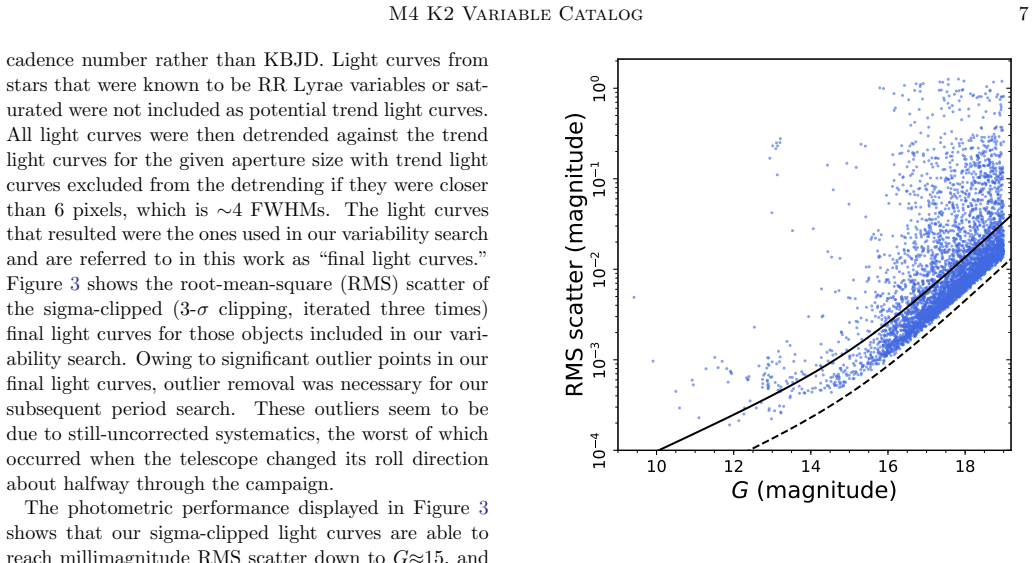
The machinery that carries the argument is a multi-stage photometric and classification pipeline. Stitched K2 target-pixel images are subtracted against a median reference using image subtraction to suppress crowding; the residuals are corrected for spacecraft roll via position decorrelation and cleaned of common trends with a trend filter. Periodicity is searched with three algorithms (generalized Lomb-Scargle, phase dispersion minimization, and box-fitting least squares), and candidate periods are accepted only if their periodogram signal-to-noise exceeds period-dependent thresholds set empirically by comparing known variables and injected transits against noise. A Fourier-amplitude comparison identifies which star in a 12-pixel neighborhood actually produces the signal, with a recursion that unmixes blended variables, and the surviving candidates are vetted by eye. The final periods and uncertainties come from fine-grid searches with bootstrap resampling.
What would settle it
Take the public light curves, remove all cadences within one resaturation period of each thruster event, and re-run the period search; if the 1.959-day signal in W4490 and the other near-1.962-day candidates disappear, the detections are systematics rather than stellar variability.
Extended reading notes
Core claim
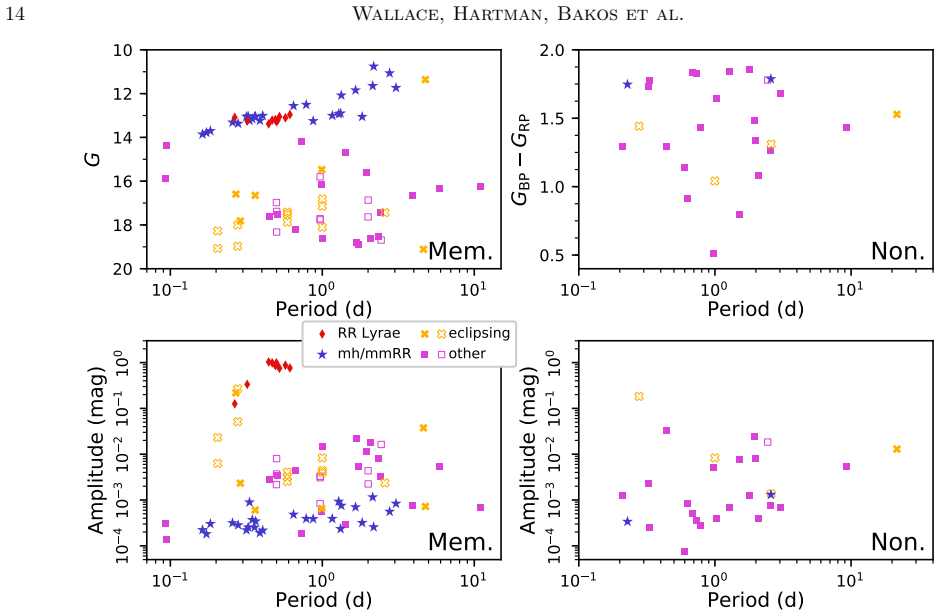
The central discovery claimed is a diverse variable-star sample extracted from continuous 78-day K2 monitoring of M4: 66 cluster-member variables (52 new), 24 non-member variables (20 new), 57 cluster-member suspected variables, 10 non-member suspected variables, and four variables of ambiguous membership. The most striking results are the horizontal-branch oscillators: six stars outside the instability strip and one inside it show asteroseismic variability at amplitudes near or below 1 mmag, extending a continuum between RR Lyrae pulsators and the previously reported millimagnitude RR Lyrae candidates. The paper also identifies a 4.6-day slightly eccentric detached eclipsing binary, an EW-class contact binary, a 22-day detached binary outside the cluster, and a 1.959-day periodic optical variation in a cluster member positionally coincident with a ROSAT X-ray source, interpreted as a candidate X-ray binary. One RR Lyrae, V7, is flagged as a candidate Blazhko variable with a period longer than the observing window.
Load-bearing premise
The catalog's reliability rests on the assumption that the period-dependent signal-to-noise thresholds, blend-removal rules, and by-eye vetting cleanly separate true stellar variability from K2 spacecraft systematics, most perilously near the 1.962-day resaturation period.
Editorial extensions
If this is right
- M4's census of certain variables within the superstamp area grows substantially, giving a fuller inventory of the cluster's pulsators and binaries.
- The sub-millimagnitude horizontal-branch light curves make M4 a testbed for studying asteroseismic oscillations outside the classical instability strip, connecting the new mmRR class to both ordinary RR Lyrae stars and non-pulsating HB stars.
- The 4.6-day detached eclipsing binary and the EW contact binaries give future radial-velocity programs concrete targets for precise masses and radii of metal-poor, old-population stars.
- The released 78-day light curves let other groups search for long-period variability that this paper's spline fitting demonstrably removes, and for transiting planets the paper did not focus on.
- The candidate X-ray binary W4490 gives an X-ray observatory a specific target whose 1.959-day optical period predicts when quiescent accretion variability should appear.
Reading between the lines
- The paper does not test this, but the same pipeline should transfer to the other K2 cluster superstamps the authors list, with recalibrated thresholds, since crowding and distance differ.
- The apparent continuation of the RR Lyrae period-luminosity relation to low-amplitude multiharmonic variables suggests that once modes are identified, oscillation periods could serve as density diagnostics across the horizontal branch and red giant branch in a single cluster; this goes beyond the paper's breadth-first presentation.
- A quick test of the resaturation-systematics hypothesis would be to stack the residuals of all 4554 light curves at 1.962 days and look for a common waveform; if such a common signal persists, any single-star period within a few percent of it deserves extra scrutiny.
- The box-shaped brightenings of W1834 and W2127 are suggestive of self-lensing by compact companions, a scenario the paper raises but does not commit to; targeted monitoring would test whether the events repeat.
Signed reviews
Editorial analysis
A structured set of objections, weighed in public.
Referee Report
Summary. The paper presents a variability search in the K2 Campaign 2 superstamp observations of the globular cluster M4. The authors extract light curves for 4554 Gaia DR1 sources with G < 19, process them with image subtraction, roll decorrelation, and TFA, and search for periodic variability with GLS, PDM, and BLS, using a custom deblending routine and period-dependent SNR thresholds. They report 66 cluster-member variables (52 claimed new), 24 non-member variables (20 new), 4 ambiguous-membership variables, and 67 suspected variables, including asteroseismic detections in horizontal-branch and red-giant stars, several eclipsing binaries, and a candidate X-ray binary. All light curves are made publicly available.
Significance. If the catalog is reliable, this is a valuable resource: it provides the longest continuous high-precision light curves for a globular cluster, recovers previously known variables with sensible periods, and adds many low-amplitude variables and asteroseismic targets. The public data release, the detailed pipeline description, and the candid discussion of the method's limitations in Section 4 are genuine strengths. The main risk is that the headline counts depend on detection thresholds and a manual vetting step whose false-positive rate is not quantified, and the paper overcounts two previously reported mmRR stars as new discoveries.
major comments (3)
- [Section 2.7 and Figure 4] The detection thresholds are calibrated using previously known variables and injected transits, but this procedure provides no estimate of the false-positive rate among candidates above the threshold. The final step reduces 1310 automated robust periods to 161 objects by eye, and Section 4 explicitly concedes that this manual step 'is less than ideal and likely to lead to incorrect determinations in some of the marginal cases.' Because many of the new variables in Table 3 have amplitudes at or below 0.5 mmag (e.g., W837 at 0.1 mmag and W491 at 0.3 mmag), the unquantified contamination rate directly affects the central claim of 66 cluster-member variables and 52 new discoveries. I request a quantitative false-alarm analysis (e.g., injection-recovery tests on the same cadences with the same noise properties, or empirical false-alarm probabilities from shuffled light curves) and per-object detection statistics.
- [Appendix A, Section 3.4, and Table 5] The retention of W92, W4268, and W4490 near the 1.962-day resaturation systematic is justified only by 'strength of signal,' with no quantitative criterion, while 26 other stars at the same period are discarded as systematics. For W4490, the adopted period of 1.959 d is only 0.15% away from the systematic period, and this period underpins the candidate X-ray binary classification. Please supply a statistical comparison of these light curves to the systematic template or to the rejected stars demonstrating that the signals cannot be produced by the resaturation artifact; otherwise these objects should be moved to the suspected-variable category with the systematic ambiguity stated.
- [Abstract and Section 4] The claimed number of new discoveries is inconsistent with the paper's own attribution. Section 3.3 identifies W2015 and W2386 as mmRR variables previously reported in Wallace et al. (2019a), but Section 4 states that '52 cluster members (when including the two mmRRs of Wallace et al. 2019a) ... are new discoveries.' If these two objects were already announced, they cannot be counted as new in this paper; the abstract's '52 are new discoveries' should be 50, with corresponding adjustments to the total new-variable count, unless the authors explicitly justify the double counting.
minor comments (5)
- [Keywords] The keyword 'Detatched binary stars' contains a typo and should be 'Detached binary stars.'
- [Section 5] The phrase 'all the the 67 suspected variables' contains a duplicated article and should be corrected.
- [Table 1 note] The note 'There is no W1873 in this table' is confusing; please explain the numbering gap or remove the note, as it reads like an artifact.
- [Section 2.2] The phrase 'the theG magnitudes' contains a typo; it should read 'the G magnitudes.'
- [Figure 4 caption] The caption states 'the blue points show the values...' but the blue points are not described in the main text; a brief definition of what is plotted would improve readability.
Circularity Check
No significant circularity; the catalog derivation is self-contained and externally benchmarked, with only minor non-load-bearing self-citations.
full rationale
The derivation chain—image subtraction, roll decorrelation, TFA detrending, GLS/PDM/BLS period searches, SNR thresholding, blend deblending, and by-eye vetting—does not reduce to its inputs. The period-dependent SNR thresholds in Section 2.7 are calibrated by comparing known variables and injected transits against the bulk of detected periods; this is standard detection-threshold calibration, and no newly reported object is defined by the threshold curve. Cluster membership for the headline count of 66 cluster-member variables is taken from the self-cited Wallace (2018b) catalog, but that catalog is an external Gaia-DR2 proper-motion product independent of this paper's variability analysis, so it is not a fitted input. The two mmRR variables (W2015, W2386) are transparently attributed to the companion paper Wallace et al. (2019a) and counted inclusively; this is a minor self-citation bookkeeping overlap, not a derivation reduction, and the remaining roughly 50 new cluster-member variables are independent. External checks against Clement, Stetson, Miglio, and Kuehn catalogs plus the public light-curve release provide independent validation. The skeptic's false-positive concern (e.g., W4490 near the 1.962-day resaturation period) is a reliability caveat the authors explicitly flag in Section 4 ('Relying so heavily on a manual and qualitative final vetting step is less than ideal and likely to lead to incorrect determinations in some of the marginal cases'); it is a correctness or completeness risk, not circularity.
Assumptions & free parameters
free parameters (4)
- GLS/PDM/BLS SNR thresholds =
Period-dependent curves selected from Figure 4, not tabulated numerically
- Blend search radius =
12 pixels
- B-spline breakpoint spacing =
1.5 days
- Gaia DR1 magnitude cutoff =
G < 19
assumptions (4)
- domain assumption Gaia DR1 and DR2 astrometry and photometry are accurate enough for K2 image registration, calibration, and duplicate resolution.
- domain assumption Proper-motion membership probabilities from Wallace (2018b) correctly classify cluster members.
- domain assumption Residual K2 systematics are either removed or identified as such during manual vetting.
- ad hoc to paper The custom SNR thresholds and by-eye vetting separate true variables from noise.
Cite this review
Pith. "Pith review of A Search for Variable Stars in the Globular Cluster M4 with K2." pith.science (2026). https://pith.science/paper/CQO7KQ3H
@misc{pith2026190802373,
  author       = {Pith},
  title        = {Pith review of: A Search for Variable Stars in the Globular Cluster M4 with K2},
  year         = {2026},
  howpublished = {\url{https://pith.science/paper/CQO7KQ3H}},
  note         = {Machine review of arXiv:1908.02373}
}
abstract
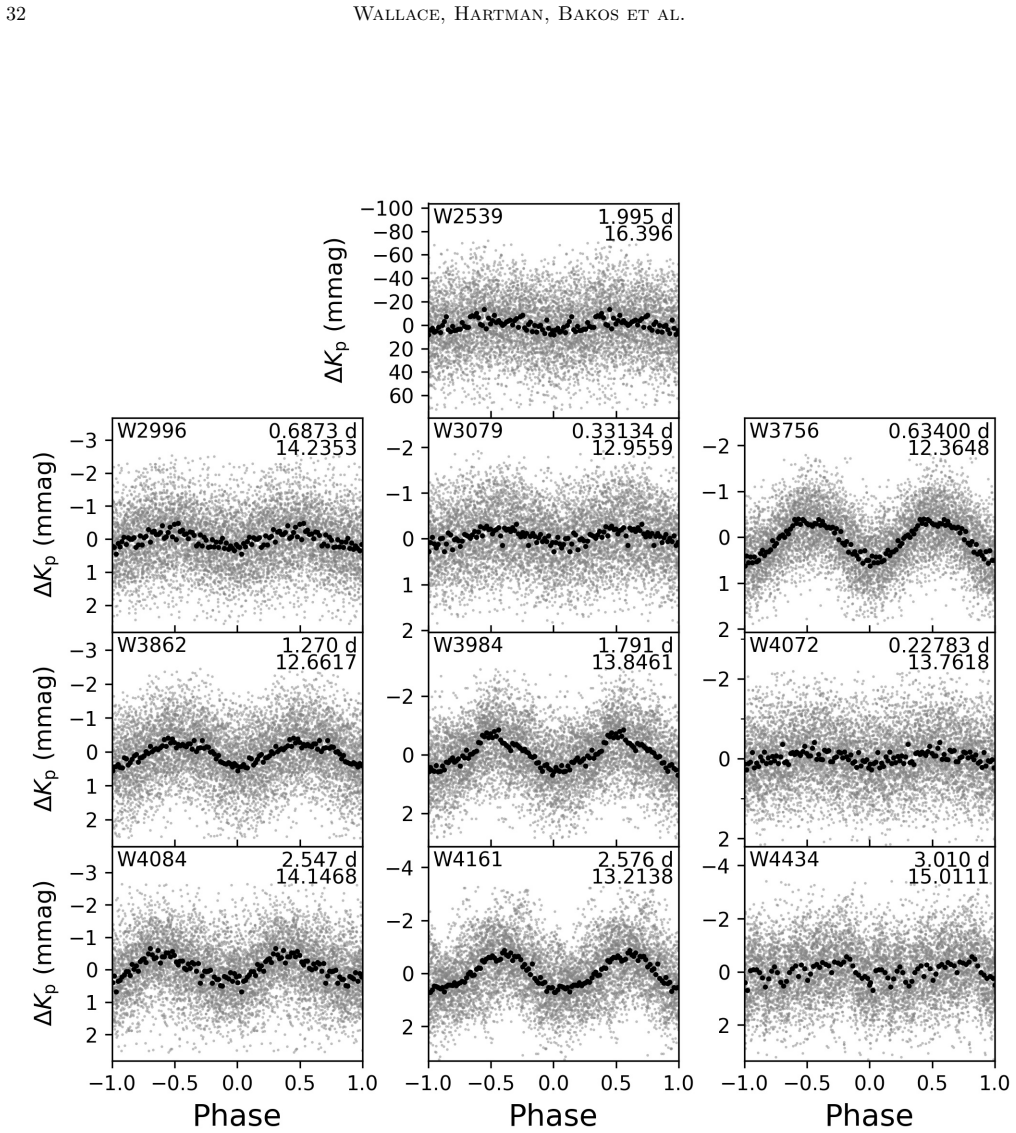
We extract light curves for 4554 objects with $9<G<19$ in the K2 superstamp observations of the globular cluster M4, including 3784 cluster members, and search for variability. Among cluster member objects, we detect 66 variables, of which 52 are new discoveries. Among objects not belonging to the cluster, we detect 24 variables, of which 20 are new discoveries. We additionally discover 57 cluster-member suspected variables, 10 cluster-non-member suspected variables, and four variables with ambiguous cluster membership. Our light curves reach sub-millimagnitude precision for the cluster horizontal branch, permitting us to detect asteroseismic activity in six horizontal branch stars outside the instability strip and one inside the strip but with only ~1 mmag amplitude variability. 19 additional stars along the red giant branch also have detected asteroseismic variability. Several eclipsing binaries are found in the cluster, including a 4.6-day detached eclipsing binary and an EW-class eclipsing binary, as well as an EW with uncertain cluster membership and three other candidate EWs. A 22-day detached eclipsing binary is also found outside the cluster. We identify a candidate X-ray binary that is a cluster member with quiescent and periodic ~20 mmag optical variability. We also obtain high-precision light curves for ten of the previously known RR Lyrae variables in the cluster and identify one as a candidate Blazhko variable with a Blazhko period in excess of 78 days. We make our light curves publicly available.
Figures


Figures from the paper (18 more)






Reference graph
Works this paper leans on
-
[1]
, " * write output.state after.block = add.period write newline
ENTRY address archivePrefix author booktitle chapter doi edition editor eprint howpublished institution journal key month number organization pages publisher school series title misctitle type volume year version url label extra.label sort.label short.list INTEGERS output.state before.all mid.sentence after.sentence after.block FUNCTION init.state.consts ...
-
[2]
write newline
" write newline "" before.all 'output.state := FUNCTION format.url url empty "" new.block "" url * "" * if FUNCTION format.eprint eprint empty "" archivePrefix empty "" archivePrefix "arXiv" = new.block " " eprint * " " * new.block " " eprint * " " * if if if FUNCTION format.doi doi empty "" " " doi * " " * if FUNCTION format.pid doi empty eprint empty ""...
-
[3]
A Method for Optimal Image Subtraction
thebibliography [1] 20pt to REFERENCES 6pt =0pt 10pt plus 3pt =0pt =0pt =1pt plus 1pt =0pt =0pt -12pt =13pt plus 1pt =20pt =13pt plus 1pt \@M =10000 =-1.0em =0pt =0pt 0pt =0pt =1.0em @enumiv\@empty 10000 10000 `\.\@m \@noitemerr \@latex@warning Empty `thebibliography' environment \@ifnextchar \@reference \@latexerr Missing key on reference command Each re...
arXiv 2001
-
[4]
Alard , C., & Lupton , R. H. 1998, , 503, 325, 10.1086/305984
doi:10.1086/305984 1998
-
[5]
Astropy Collaboration , Price-Whelan , A. M., Sip o cz , B. M., et al. 2018, , 156, 123, 10.3847/1538-3881/aabc4f
-
[6]
2016, barentsen/k2mosaic: v2.0.0, Zenodo, 10.5281/zenodo.167343
Barentsen, G. 2016, barentsen/k2mosaic: v2.0.0, Zenodo, 10.5281/zenodo.167343 . https://zenodo.org/record/167343#.W9nI15y1thE
-
[7]
2018, arXiv e-prints, arXiv:1810.12554
Barentsen , G., Hedges , C., Saunders , N., et al. 2018, arXiv e-prints, arXiv:1810.12554. 1810.12554
arXiv 2018
-
[8]
2004, , 609, 755, 10.1086/421259
Bassa , C., Pooley , D., Homer , L., et al. 2004, , 609, 755, 10.1086/421259
doi:10.1086/421259 2004
Show all 76 references
-
[9]
R., Salaris , M., Piotto , G., et al
Bedin , L. R., Salaris , M., Piotto , G., et al. 2009, , 697, 965, 10.1088/0004-637X/697/2/965
2009 doi
-
[10]
G., & Wallace, J
Bhatti, W., Bouma, L. G., & Wallace, J. 2017, astrobase , Zenodo, 10.5281/zenodo.1011188 . https://doi.org/10.5281/zenodo.1011188
2017 doi
-
[11]
2015, , 799, 165
Braga, V., Dall'Ora, M., Bono, G., et al. 2015, , 799, 165
2015
-
[12]
M., Muzzin , A., Dufton , Q., et al
Clement , C. M., Muzzin , A., Dufton , Q., et al. 2001, , 122, 2587, 10.1086/323719
2001 doi
-
[13]
1994, , 267, 83, 10.1093/mnras/267.1.83
Clementini , G., Merighi , R., Pasquini , L., Cacciari , C., & Gouiffes , C. 1994, , 267, 83, 10.1093/mnras/267.1.83
1994 doi
-
[14]
Eggen , O. J. 1972, , 172, 639, 10.1086/151383
1972 doi
-
[15]
W., Riello , M., De Angeli , F., et al
Evans , D. W., Riello , M., De Angeli , F., et al. 2018, , 616, A4, 10.1051/0004-6361/201832756
2018 doi
-
[16]
Gaia Collaboration , Brown , A. G. A., Vallenari , A., et al. 2016 a , , 595, A2, 10.1051/0004-6361/201629512
2016 doi
-
[17]
Gaia Collaboration , Prusti , T., de Bruijne , J. H. J., et al. 2016 b , , 595, A1, 10.1051/0004-6361/201629272
2016 doi
-
[18]
Gaia Collaboration , Brown , A. G. A., Vallenari , A., et al. 2018, , 616, A1, 10.1051/0004-6361/201833051
2018 doi
-
[19]
L., Brown , T
Gilliland , R. L., Brown , T. M., Guhathakurta , P., et al. 2000, , 545, L47, 10.1086/317334
2000 doi
-
[20]
Harris, W. E. 1996, , 112, 1487
1996
-
[21]
D., & Bakos , G
Hartman , J. D., & Bakos , G. \'A . 2016, Astronomy and Computing, 17, 1, 10.1016/j.ascom.2016.05.006
2016 doi
-
[22]
B., Sobeck , C., Haas , M., et al
Howell , S. B., Sobeck , C., Haas , M., et al. 2014, , 126, 398, 10.1086/676406
2014 doi
-
[23]
Hunter, J. D. 2007, Computing In Science & Engineering, 9, 90
2007
-
[24]
2001, SciPy : Open source scientific tools for Python
Jones, E., Oliphant, T., Peterson, P., et al. 2001, SciPy : Open source scientific tools for Python . http://www.scipy.org/
2001
-
[25]
B., & Krzeminski , W
Kaluzny , J., Thompson , I. B., & Krzeminski , W. 1997, , 113, 2219, 10.1086/118432
1997 doi
-
[26]
B., Rozyczka , M., & Krzeminski , W
Kaluzny , J., Thompson , I. B., Rozyczka , M., & Krzeminski , W. 2013 a , , 63, 181. 1306.2457
2013 arXiv
-
[27]
B., Rozyczka , M., et al
Kaluzny , J., Thompson , I. B., Rozyczka , M., et al. 2013 b , , 145, 43, 10.1088/0004-6256/145/2/43
2013 doi
-
[28]
Kov \'a cs , G., Bakos , G., & Noyes , R. W. 2005, , 356, 557, 10.1111/j.1365-2966.2004.08479.x
2005
-
[29]
2002, , 391, 369, 10.1051/0004-6361:20020802
Kov \'a cs , G., Zucker , S., & Mazeh , T. 2002, , 391, 369, 10.1051/0004-6361:20020802
2002 doi
-
[30]
A., Moskalik , P., & Drury , J
Kuehn , C. A., Moskalik , P., & Drury , J. A. 2017, in Seismology of the Sun and the Distant Stars - Using Today's Successes to Prepare the Future - TASC2 & KASC9 Workshop - SPACEINN & HELAS8 Conference, Azores Islands, Portugal, Edited by Monteiro, M.J.P.F.G.; Cunha, M.S.; Fe...
2017
-
[31]
M., Jek , K
LaCourse , D. M., Jek , K. J., Jacobs , T. L., et al. 2015, , 452, 3561, 10.1093/mnras/stv1475
2015 doi
-
[32]
S., & Pickering , E
Leavitt , H. S., & Pickering , E. C. 1904, Harvard College Observatory Circular, 90, 1
1904
-
[33]
R., Nardiello , D., & Piotto , G
Libralato , M., Bedin , L. R., Nardiello , D., & Piotto , G. 2016 a , , 456, 1137, 10.1093/mnras/stv2628
2016 doi
-
[34]
R., et al
Libralato , M., Nardiello , D., Bedin , L. R., et al. 2016 b , , 463, 1780, 10.1093/mnras/stw1932
2016 doi
-
[35]
2016, , 595, A4, 10.1051/0004-6361/201628714
Lindegren , L., Lammers , U., Bastian , U., et al. 2016, , 595, A4, 10.1051/0004-6361/201628714
2016 doi
-
[36]
2018, , 616, A2, 10.1051/0004-6361/201832727
Lindegren , L., Hern \'a ndez , J., Bombrun , A., et al. 2018, , 616, A2, 10.1051/0004-6361/201832727
2018 doi
-
[37]
Lomb , N. R. 1976, , 39, 447, 10.1007/BF00648343
1976 doi
-
[38]
2018, arXiv e-prints, arXiv:1808.10856
Masuda , K., & Hotokezaka , K. 2018, arXiv e-prints, arXiv:1808.10856. 1808.10856
2018 arXiv
-
[39]
J., Brogaard , K., et al
Miglio , A., Chaplin , W. J., Brogaard , K., et al. 2016, , 461, 760, 10.1093/mnras/stw1555
2016 doi
-
[40]
R., et al
Nardiello , D., Libralato , M., Bedin , L. R., et al. 2016, , 463, 1831, 10.1093/mnras/stw2169
2016 doi
-
[41]
R., Piotto , G., De Marchi , F., & Rich , R
Nascimbeni , V., Bedin , L. R., Piotto , G., De Marchi , F., & Rich , R. M. 2012, , 541, A144, 10.1051/0004-6361/201118655
2012 doi
-
[42]
2015, The Astrophysical Journal, 808, 11
Neeley, J., Marengo, M., Bono, G., et al. 2015, The Astrophysical Journal, 808, 11
2015
-
[43]
2006, Guide to NumPy (Trelgol Publishing)
Oliphant, T. 2006, Guide to NumPy (Trelgol Publishing). http://www.tramy.us/numpybook.pdf
2006
-
[44]
2012, , 421, 1825, 10.1111/j.1365-2966.2011.19813.x
P\'al, A. 2012, , 421, 1825, 10.1111/j.1365-2966.2011.19813.x
2012
-
[45]
2011, Journal of Machine Learning Research, 12, 2825
Pedregosa, F., Varoquaux, G., Gramfort, A., et al. 2011, Journal of Machine Learning Research, 12, 2825
2011
-
[46]
R., Winn , J
Ricker , G. R., Winn , J. N., Vanderspek , R., et al. 2015, Journal of Astronomical Telescopes, Instruments, and Systems, 1, 014003, 10.1117/1.JATIS.1.1.014003
2015 doi
-
[47]
W., et al
Riello , M., De Angeli , F., Evans , D. W., et al. 2018, , 616, A3, 10.1051/0004-6361/201832712
2018 doi
-
[48]
Russell , H. N. 1948, The Royal Road of Eclipses , Vol. 7 (Harvard Observatory Monographs), 181
1948
-
[49]
2016, , 151, 27, 10.3847/0004-6256/151/2/27
Safonova , M., Mkrtichian , D., Hasan , P., et al. 2016, , 151, 27, 10.3847/0004-6256/151/2/27
2016 doi
-
[50]
N., Kazarovets , E
Samus , N. N., Kazarovets , E. V., Durlevich , O. V., Kireeva , N. N., & Pastukhova , E. N. 2017, Astronomy Reports, 61, 80, 10.1134/S1063772917010085
2017 doi
-
[51]
Scargle , J. D. 1982, , 263, 835, 10.1086/160554
1982 doi
-
[52]
D., Bakos , G
Soares-Furtado , M., Hartman , J. D., Bakos , G. \'A ., et al. 2017, , 129, 044501, 10.1088/1538-3873/aa5c7c
2017 doi
-
[53]
Stellingwerf , R. F. 1978, , 224, 953, 10.1086/156444
1978 doi
-
[54]
B., Braga, V
Stetson, P. B., Braga, V. F., Dall'Ora, M., et al. 2014, , 126, 521
2014
-
[55]
W., De Angeli , F., et al
van Leeuwen , F., Evans , D. W., De Angeli , F., et al. 2017, , 599, A32, 10.1051/0004-6361/201630064
2017 doi
-
[56]
A., Brogaard , K., Leaman , R., & Casagrande , L
VandenBerg , D. A., Brogaard , K., Leaman , R., & Casagrande , L. 2013, , 775, 134, 10.1088/0004-637X/775/2/134
2013 doi
-
[57]
Vanderburg , A., & Johnson , J. A. 2014, , 126, 948, 10.1086/678764
2014 doi
-
[58]
W., Buchhave, L
Vanderburg, A., Latham, D. W., Buchhave, L. A., et al. 2016, , 222, 14
2016
-
[59]
2001, , 368, 137, 10.1051/0004-6361:20000469
Verbunt , F. 2001, , 368, 137, 10.1051/0004-6361:20000469
2001 doi
-
[60]
2018 a , M4\_pm\_membership: Version 1.0 , Zenodo, 10.5281/zenodo.1488302
Wallace, J. 2018 a , M4\_pm\_membership: Version 1.0 , Zenodo, 10.5281/zenodo.1488302 . https://doi.org/10.5281/zenodo.1488302
2018 doi
-
[61]
2019, simple\_deblend , Zenodo, 10.5281/zenodo.3248998
Wallace, J., & Hoffman, J. 2019, simple\_deblend , Zenodo, 10.5281/zenodo.3248998 . https://doi.org/10.5281/zenodo.3248998
2019 doi
-
[62]
Wallace, J. J. 2018 b , Research Notes of the AAS, 2, 213
2018
-
[63]
J., Hartman , J
Wallace , J. J., Hartman , J. D., Bakos , G. \'A ., & Bhatti , W. 2019 a , , 870, L7, 10.3847/2041-8213/aaf8ac
2019 doi
-
[64]
2019 b , Light Curves from a Search for Variable Stars in the Globular Cluster M4 with K2, DataSpace at Princeton University
---. 2019 b , Light Curves from a Search for Variable Stars in the Globular Cluster M4 with K2, DataSpace at Princeton University. http://arks.princeton.edu/ark:/88435/dsp01h415pd368
2019
-
[65]
A., & Price , A
Watson , C., Henden , A. A., & Price , A. 2017, VizieR Online Data Catalog, 1
2017
-
[66]
Weldrake , D. T. F., Sackett , P. D., & Bridges , T. J. 2008, , 674, 1117, 10.1086/524917
2008 doi
-
[67]
Weldrake , D. T. F., Sackett , P. D., Bridges , T. J., & Freeman , K. C. 2005, , 620, 1043, 10.1086/427258
2005 doi
-
[68]
2006 a , , 302, 241, 10.1007/s10509-006-9040-0
Yao , B.-A., Sheng , C.-J., & Shi , H.-M. 2006 a , , 302, 241, 10.1007/s10509-006-9040-0
2006 doi
-
[69]
2006 b , , 30, 351, 10.1016/j.chinastron.2006.10.001
Yao , B.-a., Sheng , C.-j., Zhang , C.-s., Hu , H.-m., & Lin , Q. 2006 b , , 30, 351, 10.1016/j.chinastron.2006.10.001
2006 doi
-
[70]
A., Sheng , C
Yao , B. A., Sheng , C. J., Zhang , C. S., Hu , H. M., & Lin , Q. 2007, Acta Astronomica Sinica, 48, 18
2007
-
[71]
1989, Information Bulletin on Variable Stars, 3334, 1
Yao , B.-A., & Tong , J.-H. 1989, Information Bulletin on Variable Stars, 3334, 1
1989
-
[72]
A., Tong , J
Yao , B. A., Tong , J. H., & Zhang , C. S. 1988, Acta Astronomica Sinica, 29, 243
1988
-
[73]
A., Yin , J
Yao , B. A., Yin , J. S., & Guo , Z. H. 1981 a , Acta Astrophysica Sinica, 1, 311
1981
-
[74]
1981 b , , 5, 476, 10.1016/0275-1062(81)90015-1
Yao , B.-a., Yin , J.-s., & Guo , Z.-h. 1981 b , , 5, 476, 10.1016/0275-1062(81)90015-1
1981 doi
-
[75]
2009, , 496, 577, 10.1051/0004-6361:200811296
Zechmeister , M., & K \"u rster , M. 2009, , 496, 577, 10.1051/0004-6361:200811296
2009 doi
-
[76]
X., Udalski , A., et al
Zhu , W., Huang , C. X., Udalski , A., et al. 2017, , 129, 104501, 10.1088/1538-3873/aa7dd7
2017 doi
Reviewed August 14, 2026 · model on record in the stance chip above.
Discussion (0). Continue with ORCID to comment.