REVIEW 3 major objections 6 minor 87 references
Primeval very low-mass stars and brown dwarfs -- VII. The discovery of the first wide M + L extreme subdwarf binary
T0 review · 3 major / 6 minor · reviewed 2026-08-14 · deepseek-v4-flash
Pith's one-line read The paper reports the first wide M + L extreme subdwarf binary, Gaia J0452−36AB, and uses it to show that the standard CaH/TiO metallicity index overestimates metallicities for late-type M and L subdwarfs.
desk verdict The first wide M+L extreme subdwarf binary is a real and useful discovery, but the paper's broader claim that zeta_CaH/TiO overestimates late-M metallicities rests on model metallicities and heterogeneous trace lines and needs independent calibration. read the letter →
The pith
A machine-rendered reading of the paper's core claim, the machinery that carries it, and where it could break.
The reading
What carries the argument
The central object is Gaia J0452−36AB, the first wide binary tying an M extreme subdwarf to an L extreme subdwarf; its shared metallicity is the anchor that makes the classification test possible. The classification machinery is the ζCaH/TiO metallicity index, formed from the CaH2, CaH3, and TiO5 band strengths, together with the spectral-type subclasses dM, sdM, esdM, and usdM. The paper draws two metallicity trace lines through spectral type for the esd and usd subclasses and shows that they leave the ζCaH/TiO–[Fe/H] correlation near M5.5–M6; synthetic atmosphere model fits provide $T_{\rm eff}$, [Fe/H], and log g, while evolutionary-model isomass contours supply the masses.
What would settle it
Measure a high-resolution, high-signal-to-noise optical spectrum of a late-type M subdwarf in the esdM subclass and derive its [Fe/H] from atomic absorption lines; if the line-based value matches the ζCaH/TiO subclass scale instead of the model-based trace line, the claimed index failure would not hold.
Extended reading notes
Core claim
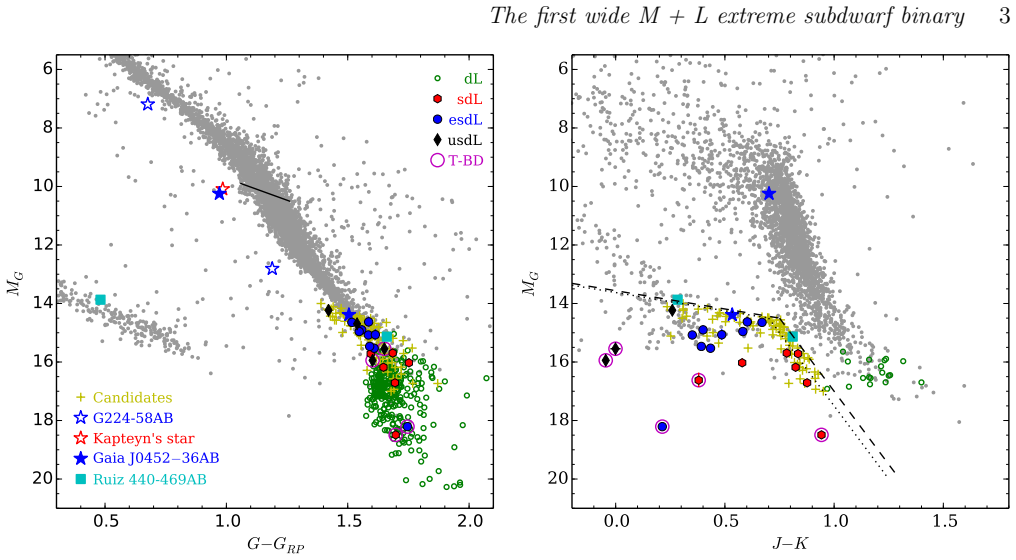
Gaia J0452−36AB is a gravitationally bound wide binary composed of an esdM1 star ($T_{\rm eff}\approx 3550$ K, mass $\approx 0.151\,M_\odot$) and an esdL0 object ($T_{\rm eff}\approx 2600$ K, mass $\approx 0.0855\,M_\odot$), at a distance of 137.27 pc with a projected separation of 15,828 au and typical halo kinematics. Its two components share [Fe/H] ≈ −1.4, making the system the first wide M + L extreme subdwarf binary and a benchmark for calibrating metallicity measurements of cool subdwarfs. Using this system and comparison subdwarfs, the paper argues that the ζCaH/TiO index assigns metallicities that are consistent only for early-type M subdwarfs, and that late-type M and L subdwarfs are more metal-poor than the index implies. It further explains the scarcity of late-type M extreme and ultra subdwarfs and the declining binary fraction from sdM to esdM to usdM as consequences of different mass ranges and biased spectral classification.
Load-bearing premise
The secondary conclusion that late-type M subdwarf metallicities are overestimated by the ζCaH/TiO index assumes that the synthetic-model-fitted $[\mathrm{Fe}/\mathrm{H}]$ values for late-type M and L subdwarfs are accurate, even though direct atomic-line metallicities exist only for M0–3 objects.
Editorial extensions
If this is right
- The ζCaH/TiO index and its refined versions should not be used to set metallicities for late-type M subdwarfs or L subdwarfs; those subclasses need a recalibrated classification scale.
- Late-type M subdwarfs with metallicities in the esdM0–5 range are currently misclassified into sdM and dM classes by ζCaH/TiO, inflating the apparent scarcity of extreme and ultra subdwarfs.
- M subdwarfs occupy lower and narrower mass ranges than M dwarfs of the same spectral subtype, so comparing M dwarfs and M subdwarfs subtype-by-subtype compares different mass populations.
- Gaia J0452−36AB gives a single-metallicity anchor at [Fe/H] ≈ −1.4 for calibrating near-infrared metallicity indicators and for testing very low-mass atmospheric and evolutionary models at subsolar metallicity.
Reading between the lines
- If the trace-line break is real, dedicated searches should recover a larger population of late-type M extreme and ultra subdwarfs by selecting on kinematics and photometric colours rather than on ζCaH/TiO.
- A direct atomic-line [Fe/H] for the L component, or for one of the late-type M subdwarfs used in the trace lines, would independently confirm or overturn the claimed index failure.
- Because the binary is wide and old, a full 3D orbit measured from future astrometry could eventually provide a dynamical test of tidal survival in the Galactic halo.
Signed reviews
Editorial analysis
A structured set of objections, weighed in public.
Referee Report
Summary. The paper reports the discovery of Gaia J0452-36AB, a wide binary consisting of an esdM1 primary and an esdL0 secondary, based on Gaia DR2 astrometry and WHT/ACAM spectroscopy, and argues that the system is a gravitationally bound, halo-metallicity ([Fe/H] ~ -1.4) benchmark at 137 pc with a projected separation of 15,828 au. It also presents Ruiz 440-469B, an M8 companion to a DA white dwarf. Using this binary and a literature sample of M and L subdwarfs with published metallicities, the paper tests the consistency of the zeta_CaH/TiO classification index across spectral subtypes, concludes that the index overestimates the metallicities of late-type M subdwarfs, and discusses the mass ranges and binary fractions of M subdwarf subclasses.
Significance. The primary discovery is significant: Gaia J0452-36AB appears to be the first wide M+L extreme subdwarf binary, and if confirmed it provides a valuable fixed-metallicity anchor for calibrating subdwarf classification, atmospheric models, and very low-mass evolutionary models. The astrometric and spectroscopic characterization is careful, with proper motions and parallaxes consistent within about 1 sigma and spectra that match comparison subdwarfs well. The secondary claim that zeta_CaH/TiO systematically overestimates metallicities for late-type M subdwarfs is interesting and potentially important for the classification of ultracool subdwarfs, but it is less secure because it rests on model-dependent metallicities and heterogeneous comparison samples. The paper also usefully highlights the bias introduced by comparing M subdwarf subclasses across different mass ranges.
major comments (3)
- [Section 5, Fig. 9(a)-(c), Table 3] The claim that zeta_CaH/TiO overestimates metallicities for late-type M subdwarfs is not established by the trace-line argument. The trace lines join objects with widely differing metallicities: the esdM/L sequence spans [Fe/H] from -1.2 to -1.6 and the usdM/L sequence from -1.7 to -2.4. The observed break away from Equation (19) could equally be produced by model systematics that grow toward cooler, dustier, higher-gravity atmospheres, or by comparing different metallicities, even if the index were perfectly behaved at fixed [Fe/H]. The only same-metallicity anchor, Gaia J0452-36AB itself, is a single pair, and its L0 component has a low S/N (~21), telluric-uncorrected spectrum with unquantified index uncertainty. To support the strong conclusion, the paper needs an independent calibration sample with fixed [Fe/H] across subtypes, or a demonstration that model-metallicity errors are smaller than the observed index offset.
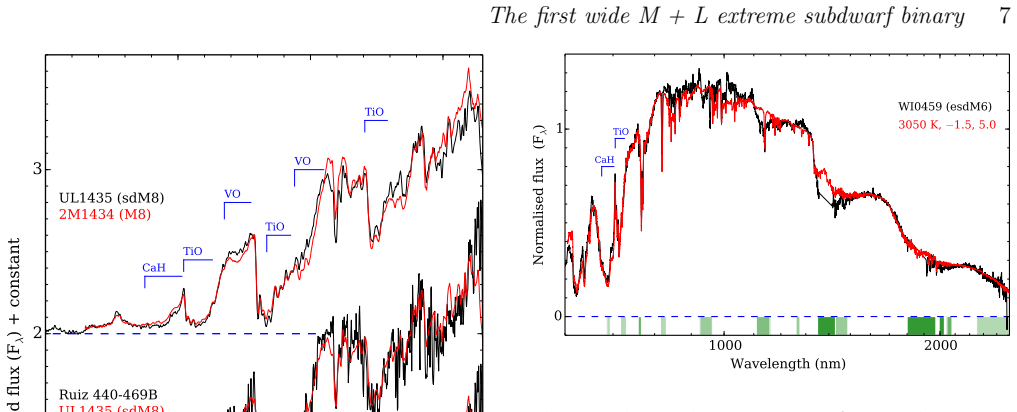
- [Section 4.1.2 and Table 1] The benchmark nature of the binary depends on the BT-Settl model metallicities for both components, which are derived from the same kind of molecular-band fitting that underlies the classification indices being tested. The reported equality of [Fe/H] = -1.4 for both components is an output of the model fits, not an independent measurement. Because the secondary spectrum is low S/N and telluric features contaminate the 720 nm TiO band, the claim that the system provides a 'fixed-metallicity' test of the classification index is overstated in the absence of a direct metallicity measurement (e.g., from atomic lines, if feasible, or from a more metal-poor sdM companion). The paper should explicitly separate the robust astrometric discovery from the model-dependent metallicity assignment.
- [Section 5, Table 3, Refs] There is a circularity risk in using BT-Settl model fits to validate a spectral-index calibration when those fits use the same CaH and TiO bands that define the index. Many of the [Fe/H] values in Table 3 come from the author's own Primeval series and from fits in this paper (Ref2 = 'This paper' for several rows), and no independent metallicity scale is available for late-type M and L subdwarfs. The paper should either provide an external cross-check (e.g., metallicity from NIR atomic features, or from a physically consistent binary ensemble) or temper the Section 5 conclusions to state that the results are suggestive but not definitive.
minor comments (6)
- [Abstract] The phrase 'the the metallicity index' contains a duplicated article; please correct.
- [Section 5 and Fig. 9] The notation is inconsistent: the text and Table 3 use zeta_CaH/TiO, while Fig. 9 panels (b)-(d) label the axis as zeta_TiO/CaH. Use one symbol consistently.
- [Section 4.1.2, paragraph 2] The sentence 'Kapteyn's star has Teff = 3570 +/- 160 K and [Fe/H] = 0.99 +/- 0.04' is missing a minus sign in the metallicity; it should read [Fe/H] = -0.99.
- [Section 4.1.2, paragraph 1] The phrase 'S/N of 63 at 825nm, and 40 at 122 and 135 nm' likely should refer to 1220 and 1350 nm; please correct the wavelengths.
- [Section 4.2] The statement 'Ruiz 440-469AB is also a gravitationally bound system' appears twice in the text (Section 4.2 and Section 7). Repetition is unnecessary.
- [Fig. 9 caption] The caption says 'The spectral indices of Gaia J0452-36B (blue open square) are measured from its low S/N spectrum thus have large uncertainty.' The grammar is awkward; consider rewording to '...are measured from a low-S/N spectrum and therefore have large uncertainties.'
Circularity Check
No circular derivation by construction; the Section 5 metallicity-scale claim is model-dependent and explicitly disclosed, not reduced to its own inputs.
full rationale
The paper's central discovery, Gaia J0452-36AB as a wide esdM1+esdL0 binary, is self-contained: it rests on Gaia DR2 astrometry (common proper motion and consistent parallaxes), WHT/ACAM spectroscopy, and a tidal-radius argument. No equation in this chain is defined in terms of the conclusion. The only place where circularity could be suspected is Section 5, where the author argues that the zeta_CaH/TiO index overestimates late-type M subdwarf metallicities. That argument compares observed zeta indices to [Fe/H] values obtained from BT-Settl model fits, many taken from the author's Primeval series. This is a real dependence on model accuracy, and the paper discloses it explicitly: '[Fe/H] of the rest M and L subdwarfs are from model spectral fittings (Pavlenko et al. 2015; Primeval I; Primeval II; Primeval III; Primeval V; This paper).' The model fits use the same CaH and TiO bands that define zeta, so the Section 5 conclusion is conditional on the models being correct; however, the paper does not fit zeta to the metallicities, nor does it define metallicity in terms of zeta. The 'overestimation' claim is an empirical comparison, not a reduction by construction. Self-citations are present and frequent, but they are not load-bearing for the binary discovery, which is independently supported by astrometry and spectroscopy. No uniqueness theorem, ansatz, or fitted parameter is renamed as a prediction. The appropriate verdict is therefore no significant circularity, with the model-dependence of the secondary claim flagged as a scientific robustness concern rather than a circular step.
Assumptions & free parameters
free parameters (5)
- Eq. 19 fit coefficients =
slope 1.949, intercept -1.853, rms 0.252
- BT-Settl parameters for Gaia J0452-36A =
Teff 3550 K, [Fe/H] -1.4, log g 5.0
- BT-Settl parameters for Gaia J0452-36B =
Teff 2600 K, [Fe/H] -1.4, log g 5.5
- BT-Settl metallicities for Table 3 sample =
-1.2 to -2.4 dex across objects
- Assumed masses of Ruiz 440-469A and B =
0.5 and 0.1 solar masses
assumptions (6)
- domain assumption Gaia DR2 parallax and proper motion measurements are accurate to the quoted formal errors for faint sources.
- domain assumption BT-Settl synthetic spectra reliably reproduce optical molecular bands of metal-poor M and L subdwarfs.
- domain assumption The 10 Gyr Baraffe and Chabrier evolutionary tracks correctly convert Teff and [Fe/H] to mass for very low-mass metal-poor stars.
- domain assumption Stars in a wide common proper motion binary are coeval and share the same initial chemical composition.
- domain assumption A projected separation of 0.092 Jacobi radius indicates a gravitationally bound system at roughly 10 Gyr.
- domain assumption Dust formation and higher surface gravity in ultracool atmospheres substantially alter CaH and TiO band strengths relative to early-M subdwarfs.
Cite this review
Pith. "Pith review of Primeval very low-mass stars and brown dwarfs -- VII. The discovery of the first wide M + L extreme subdwarf binary." pith.science (2026). https://pith.science/paper/7CX2RD6S
@misc{pith2026190802390,
  author       = {Pith},
  title        = {Pith review of: Primeval very low-mass stars and brown dwarfs -- VII. The discovery of the first wide M + L extreme subdwarf binary},
  year         = {2026},
  howpublished = {\url{https://pith.science/paper/7CX2RD6S}},
  note         = {Machine review of arXiv:1908.02390}
}
abstract
I present the discovery of the first wide M + L extreme subdwarf binary system Gaia J0452$-$36AB. The binary is located at a distance of 137.27$^{+0.68}_{-0.67}$ pc with a projected separation of 15828$\pm$78 au. I classified Gaia J0452$-$36AB as esdM1 and esdL0 subdwarfs, respectively. Gaia J0452$-$36AB have typical halo kinematics, metallicity of [Fe/H] $\approx -1.4$, and temperature of $\sim$ 3550 and 2600 K, respectively. Gaia J0452$-$36AB is a pair of very low-mass stars with masses of 0.151$^{+0.029}_{-0.019}$ and 0.0855$^{+0.0014}_{-0.0010}$ M$_{\odot}$, and is a gravitationally bound system. I tested the metallicity consistency of existing M subdwarf classification schemes with Gaia J0452$-$36AB and a sample of M and L subdwarfs with known metallicity. I found that the metallicity of each M subclass defined by the the metallicity index $\zeta_{\rm CaH/TiO}$ is not consistent from mid to late M subtypes. Because late-type M and L subdwarfs have dusty atmospheres and high surface gravity which have significant impacts on CaH and TiO indices that used in the classification. The metallicity scale of late-type M subdwarfs would be overestimated by the $\zeta_{\rm CaH/TiO}$ index. I discussed the mass range of M subdwarfs, and explained the lack of late-type M extreme and ultra subdwarfs, and decreasing binary fraction from sdM, to esdM, and usdM subclasses. The four M subclasses have different mass ranges. The comparison between M subclasses is between populations in different mass ranges. I also present the discovery of Ruiz 440-469B, an M8 dwarf wide companion to a cool DA white dwarf, Ruiz 440-469.
Figures


Figures from the paper (6 more)



Reference graph
Works this paper leans on
-
[1]
write newline
" write newline "" before.all 'output.state := FUNCTION fin.entry write newline FUNCTION new.block output.state before.all = 'skip after.block 'output.state := if FUNCTION new.sentence output.state after.block = 'skip output.state before.all = 'skip after.sentence 'output.state := if if FUNCTION not #0 #1 if FUNCTION and 'skip pop #0 if FUNCTION or pop #1...
-
[2]
Aganze C., et al., 2016, @doi [ ] 10.3847/0004-6256/151/2/46 , https://ui.adsabs.harvard.edu/abs/2016AJ....151...46A 151, 46
-
[3]
Allard F., 2014, in Booth M., Matthews B. C., Graham J. R., eds, IAU Symposium Vol. 299, Exploring the Formation and Evolution of Planetary Systems. pp 271--272, @doi 10.1017/S1743921313008545
-
[4]
H., 1995, @doi [ ] 10.1086/175708 , https://ui.adsabs.harvard.edu/abs/1995ApJ...445..433A 445, 433
Allard F., Hauschildt P. H., 1995, @doi [ ] 10.1086/175708 , https://ui.adsabs.harvard.edu/abs/1995ApJ...445..433A 445, 433
doi:10.1086/175708 1995
-
[5]
Anglada-Escude G., et al., 2014, @doi [ ] 10.1093/mnrasl/slu076 , https://ui.adsabs.harvard.edu/abs/2014MNRAS.443L..89A 443, L89
-
[6]
Baraffe I., Chabrier G., 2018, @doi [ ] 10.1051/0004-6361/201834062 , http://adsabs.harvard.edu/abs/2018A
-
[7]
H., 1997, , https://ui.adsabs.harvard.edu/abs/1997A&A...327.1054B 327, 1054
Baraffe I., Chabrier G., Allard F., Hauschildt P. H., 1997, , https://ui.adsabs.harvard.edu/abs/1997A&A...327.1054B 327, 1054
1997
-
[8]
Bate M. R., 2014, @doi [ ] 10.1093/mnras/stu795 , https://ui.adsabs.harvard.edu/abs/2014MNRAS.442..285B 442, 285
Show all 87 references
-
[9]
R., 2019, @doi [ ] 10.1093/mnras/stz103 , https://ui.adsabs.harvard.edu/abs/2019MNRAS.484.2341B 484, 2341
Bate M. R., 2019, @doi [ ] 10.1093/mnras/stz103 , https://ui.adsabs.harvard.edu/abs/2019MNRAS.484.2341B 484, 2341
2019 doi
-
[10]
Benn C., Dee K., Ag \'o cs T., 2008, in Ground-based and Airborne Instrumentation for Astronomy II. p. 70146X, @doi 10.1117/12.788694
2008 doi
-
[11]
P., Liu M
Bowler B. P., Liu M. C., Cushing M. C., 2009, @doi [ ] 10.1088/0004-637X/706/2/1114 , https://ui.adsabs.harvard.edu/abs/2009ApJ...706.1114B 706, 1114
2009 doi
-
[12]
J., 2004, @doi [ ] 10.1086/425418 , http://adsabs.harvard.edu/abs/2004ApJ...614L..73B 614, L73
Burgasser A. J., 2004, @doi [ ] 10.1086/425418 , http://adsabs.harvard.edu/abs/2004ApJ...614L..73B 614, L73
2004 doi
-
[13]
J., Kirkpatrick J
Burgasser A. J., Kirkpatrick J. D., 2006, @doi [ ] 10.1086/504375 , http://adsabs.harvard.edu/abs/2006ApJ...645.1485B 645, 1485
2006 doi
-
[14]
J., et al., 2002, @doi [ ] 10.1086/324033 , http://adsabs.harvard.edu/abs/2002ApJ...564..421B 564, 421
Burgasser A. J., et al., 2002, @doi [ ] 10.1086/324033 , http://adsabs.harvard.edu/abs/2002ApJ...564..421B 564, 421
2002 doi
-
[15]
J., et al., 2003, @doi [ ] 10.1086/375813 , https://ui.adsabs.harvard.edu/abs/2003ApJ...592.1186B 592, 1186
Burgasser A. J., et al., 2003, @doi [ ] 10.1086/375813 , https://ui.adsabs.harvard.edu/abs/2003ApJ...592.1186B 592, 1186
2003 doi
-
[16]
J., McElwain M
Burgasser A. J., McElwain M. W., Kirkpatrick J. D., Cruz K. L., Tinney C. G., Reid I. N., 2004, @doi [ ] 10.1086/383549 , http://adsabs.harvard.edu/abs/2004AJ....127.2856B 127, 2856
2004 doi
-
[17]
J., Cruz K
Burgasser A. J., Cruz K. L., Kirkpatrick J. D., 2007, @doi [ ] 10.1086/510148 , http://adsabs.harvard.edu/abs/2007ApJ...657..494B 657, 494
2007 doi
-
[19]
V., Lucas P
Burningham B., Smith L., Cardoso C. V., Lucas P. W., Burgasser A. J., Jones H. R. A., Smart R. L., 2014, @doi [ ] 10.1093/mnras/stu184 , https://ui.adsabs.harvard.edu/abs/2014MNRAS.440..359B 440, 359
2014 doi
-
[20]
M., 1999, @doi [ ] 10.1086/306811 , http://adsabs.harvard.edu/abs/1999ApJ...512..843B 512, 843
Burrows A., Sharp C. M., 1999, @doi [ ] 10.1086/306811 , http://adsabs.harvard.edu/abs/1999ApJ...512..843B 512, 843
1999 doi
-
[21]
B., Lunine J
Burrows A., Hubbard W. B., Lunine J. I., Liebert J., 2001, @doi [Reviews of Modern Physics] 10.1103/RevModPhys.73.719 , https://ui.adsabs.harvard.edu/abs/2001RvMP...73..719B 73, 719
2001 doi
-
[22]
Chabrier G., Baraffe I., 1997, , https://ui.adsabs.harvard.edu/abs/1997A&A...327.1039C 327, 1039
1997
-
[23]
Cross N. J. G., et al., 2012, @doi [ ] 10.1051/0004-6361/201219505 , http://adsabs.harvard.edu/abs/2012A
2012 doi
-
[24]
A., Stassun K
Dhital S., West A. A., Stassun K. G., Bochanski J. J., Massey A. P., Bastien F. A., 2012, @doi [ ] 10.1088/0004-6256/143/3/67 , http://adsabs.harvard.edu/abs/2012AJ....143...67D 143, 67
2012 doi
-
[25]
M., Ballester P., Forchi V., Garc \' a-Dabl \'o C
Freudling W., Romaniello M., Bramich D. M., Ballester P., Forchi V., Garc \' a-Dabl \'o C. E., Moehler S., Neeser M. J., 2013, @doi [ ] 10.1051/0004-6361/201322494 , http://adsabs.harvard.edu/abs/2013A
2013 doi
-
[26]
Gaia Collaboration et al., 2018, @doi [ ] 10.1051/0004-6361/201833051 , http://adsabs.harvard.edu/abs/2018A
2018 doi
-
[27]
Gill D., 1899, The Observatory, https://ui.adsabs.harvard.edu/abs/1899Obs....22...99G 22, 99
-
[28]
E., 1997, @doi [ ] 10.1086/118302 , http://adsabs.harvard.edu/abs/1997AJ....113..806G 113, 806
Gizis J. E., 1997, @doi [ ] 10.1086/118302 , http://adsabs.harvard.edu/abs/1997AJ....113..806G 113, 806
1997 doi
-
[30]
Hertzsprung E., 1909, @doi [Astronomische Nachrichten] 10.1002/asna.19081792402 , https://ui.adsabs.harvard.edu/abs/1909AN....179..373H 179, 373
1909 doi
-
[31]
J., et al., 2004, in Quinn P
Irwin M. J., et al., 2004, in Quinn P. J., Bridger A., eds, Vol. 5493, Optimizing Scientific Return for Astronomy through Information Technologies. pp 411--422, @doi 10.1117/12.551449
2004 doi
-
[32]
J., Beaulieu T
Jao W.-C., Henry T. J., Beaulieu T. D., Subasavage J. P., 2008, @doi [ ] 10.1088/0004-6256/136/2/840 , https://ui.adsabs.harvard.edu/abs/2008AJ....136..840J 136, 840
2008 doi
-
[33]
J., Winters J
Jao W.-C., Henry T. J., Winters J. G., Subasavage J. P., Riedel A. R., Silverstein M. L., Ianna P. A., 2017, @doi [ ] 10.3847/1538-3881/aa8b64 , https://ui.adsabs.harvard.edu/abs/2017AJ....154..191J 154, 191
2017 doi
-
[34]
J., Gies D
Jao W.-C., Henry T. J., Gies D. R., Hambly N. C., 2018, @doi [ ] 10.3847/2041-8213/aacdf6 , http://adsabs.harvard.edu/abs/2018ApJ...861L..11J 861, L11
2018 doi
-
[35]
Jiang Y.-F., Tremaine S., 2010, @doi [ ] 10.1111/j.1365-2966.2009.15744.x , https://ui.adsabs.harvard.edu/abs/2010MNRAS.401..977J 401, 977
2010
-
[36]
Jones H. R. A., Tsuji T., 1997, @doi [ ] 10.1086/310619 , http://adsabs.harvard.edu/abs/1997ApJ...480L..39J 480, L39
1997 doi
-
[37]
C., 1897, @doi [Astronomische Nachrichten] 10.1002/asna.18981450906 , https://ui.adsabs.harvard.edu/abs/1897AN....145..159K 145, 159
Kapteyn J. C., 1897, @doi [Astronomische Nachrichten] 10.1002/asna.18981450906 , https://ui.adsabs.harvard.edu/abs/1897AN....145..159K 145, 159
-
[38]
Y., et al., 2019, @doi [ ] 10.3847/1538-3881/aae982 , http://adsabs.harvard.edu/abs/2019AJ....157...63K 157, 63
Kesseli A. Y., et al., 2019, @doi [ ] 10.3847/1538-3881/aae982 , http://adsabs.harvard.edu/abs/2019AJ....157...63K 157, 63
2019 doi
-
[39]
D., Henry T
Kirkpatrick J. D., Henry T. J., Irwin M. J., 1997, @doi [ ] 10.1086/118357 , https://ui.adsabs.harvard.edu/abs/1997AJ....113.1421K 113, 1421
1997 doi
-
[40]
D., et al., 1999, @doi [ ] 10.1086/307414 , http://adsabs.harvard.edu/abs/1999ApJ...519..802K 519, 802
Kirkpatrick J. D., et al., 1999, @doi [ ] 10.1086/307414 , http://adsabs.harvard.edu/abs/1999ApJ...519..802K 519, 802
1999 doi
-
[41]
D., et al., 2014, @doi [ ] 10.1088/0004-637X/783/2/122 , http://adsabs.harvard.edu/abs/2014ApJ...783..122K 783, 122
Kirkpatrick J. D., et al., 2014, @doi [ ] 10.1088/0004-637X/783/2/122 , http://adsabs.harvard.edu/abs/2014ApJ...783..122K 783, 122
2014 doi
-
[42]
D., et al., 2016, @doi [ ] 10.3847/0067-0049/224/2/36 , http://adsabs.harvard.edu/abs/2016ApJS..224...36K 224, 36
Kirkpatrick J. D., et al., 2016, @doi [ ] 10.3847/0067-0049/224/2/36 , http://adsabs.harvard.edu/abs/2016ApJS..224...36K 224, 36
2016 doi
-
[43]
C., Blake C
Koren S. C., Blake C. H., Dahn C. C., Harris H. C., 2016, @doi [ ] 10.3847/0004-6256/151/3/57 , http://adsabs.harvard.edu/abs/2016AJ....151...57K 151, 57
2016 doi
-
[44]
C., Wood P
Kotoneva E., Innanen K., Dawson P. C., Wood P. R., De Robertis M. M., 2005, @doi [ ] 10.1051/0004-6361:20042287 , https://ui.adsabs.harvard.edu/abs/2005A&A...438..957K 438, 957
2005 doi
-
[45]
P., 1939, @doi [ ] 10.1086/144075 , https://ui.adsabs.harvard.edu/abs/1939ApJ....89..548K 89, 548
Kuiper G. P., 1939, @doi [ ] 10.1086/144075 , https://ui.adsabs.harvard.edu/abs/1939ApJ....89..548K 89, 548
1939 doi
-
[46]
P., 1940, @doi [ ] 10.1086/144166 , https://ui.adsabs.harvard.edu/abs/1940ApJ....91..269K 91, 269
Kuiper G. P., 1940, @doi [ ] 10.1086/144166 , https://ui.adsabs.harvard.edu/abs/1940ApJ....91..269K 91, 269
1940 doi
-
[47]
Lawrence A., et al., 2007, @doi [ ] 10.1111/j.1365-2966.2007.12040.x , https://ui.adsabs.harvard.edu/abs/2007MNRAS.379.1599L 379, 1599
2007
-
[48]
L \'e pine S., Scholz R.-D., 2008, @doi [ ] 10.1086/590183 , https://ui.adsabs.harvard.edu/abs/2008ApJ...681L..33L 681, L33
2008 doi
-
[49]
M., Rich R
L \'e pine S., Shara M. M., Rich R. M., 2003a, @doi [ ] 10.1086/374210 , https://ui.adsabs.harvard.edu/abs/2003ApJ...585L..69L 585, L69
-
[50]
M., Shara M
L \'e pine S., Rich R. M., Shara M. M., 2003b, @doi [ ] 10.1086/377069 , http://adsabs.harvard.edu/abs/2003ApJ...591L..49L 591, L49
-
[51]
M., Shara M
L \'e pine S., Rich R. M., Shara M. M., 2007, @doi [ ] 10.1086/521614 , http://adsabs.harvard.edu/abs/2007ApJ...669.1235L 669, 1235
2007 doi
-
[52]
J., Mann A
L \'e pine S., Hilton E. J., Mann A. W., Wilde M., Rojas-Ayala B., Cruz K. L., Gaidos E., 2013, @doi [ ] 10.1088/0004-6256/145/4/102 , http://adsabs.harvard.edu/abs/2013AJ....145..102L 145, 102
2013 doi
-
[53]
H., Fenner Y., Gibson B
Lineweaver C. H., Fenner Y., Gibson B. K., 2004, @doi [Science] 10.1126/science.1092322 , https://ui.adsabs.harvard.edu/abs/2004Sci...303...59L 303, 59
2004 doi
-
[54]
R., Solano E., Aberasturi M., Mart \' n E
Lodieu N., Espinoza Contreras M., Zapatero Osorio M. R., Solano E., Aberasturi M., Mart \' n E. L., 2012, @doi [ ] 10.1051/0004-6361/201118717 , http://adsabs.harvard.edu/abs/2012A
2012 doi
-
[55]
R., Solano E., Aberasturi M., Mart \' n E
Lodieu N., Espinoza Contreras M., Zapatero Osorio M. R., Solano E., Aberasturi M., Mart \' n E. L., Rodrigo C., 2017, @doi [ ] 10.1051/0004-6361/201629410 , https://ui.adsabs.harvard.edu/abs/2017A&A...598A..92L 598, A92
2017 doi
-
[56]
L., Sheppard S
Luhman K. L., Sheppard S. S., 2014, @doi [ ] 10.1088/0004-637X/787/2/126 , https://ui.adsabs.harvard.edu/abs/2014ApJ...787..126L 787, 126
2014 doi
-
[57]
MacDonald J., Gizis J., 2018, @doi [ ] 10.1093/mnras/sty1888 , http://adsabs.harvard.edu/abs/2018MNRAS.480.1711M 480, 1711
2018 doi
-
[58]
N., et al., 2013, @doi [ ] 10.1088/0004-637X/777/1/36 , https://ui.adsabs.harvard.edu/abs/2013ApJ...777...36M 777, 36
Mace G. N., et al., 2013, @doi [ ] 10.1088/0004-637X/777/1/36 , https://ui.adsabs.harvard.edu/abs/2013ApJ...777...36M 777, 36
2013 doi
-
[59]
G., Banerji M., Gonzalez E., Koposov S
McMahon R. G., Banerji M., Gonzalez E., Koposov S. E., Bejar V. J., Lodieu N., Rebolo R., VHS Collaboration 2013, The Messenger, http://adsabs.harvard.edu/abs/2013Msngr.154...35M 154, 35
2013
-
[60]
G., Dahn C
Monet D. G., Dahn C. C., Vrba F. J., Harris H. C., Pier J. R., Luginbuhl C. B., Ables H. D., 1992, @doi [ ] 10.1086/116091 , http://adsabs.harvard.edu/abs/1992AJ....103..638M 103, 638
1992 doi
-
[61]
R., Charbonneau D., Irwin J., Mann A
Newton E. R., Charbonneau D., Irwin J., Mann A. W., 2015, @doi [ ] 10.1088/0004-637X/800/2/85 , https://ui.adsabs.harvard.edu/abs/2015ApJ...800...85N 800, 85
2015 doi
-
[62]
V., Zhang Z
Pavlenko Y. V., Zhang Z. H., G \'a lvez-Ortiz M. C., Kushniruk I. O., Jones H. R. A., 2015, @doi [ ] 10.1051/0004-6361/201526810 , http://adsabs.harvard.edu/abs/2015A
2015 doi
-
[63]
J., et al., 2012, @doi [ ] 10.1111/j.1365-2966.2012.20549.x , https://ui.adsabs.harvard.edu/abs/2012MNRAS.422.1922P 422, 1922
Pinfield D. J., et al., 2012, @doi [ ] 10.1111/j.1365-2966.2012.20549.x , https://ui.adsabs.harvard.edu/abs/2012MNRAS.422.1922P 422, 1922
2012
-
[64]
G., Dhillon V
Rebassa-Mansergas A., Parsons S. G., Dhillon V. S., Ren J., Littlefair S. P., Marsh T. R., Torres S., 2019, @doi [Nature Astronomy] 10.1038/s41550-019-0746-7 , https://ui.adsabs.harvard.edu/abs/2019NatAs...3..553R 3, 553
2019 doi
-
[65]
N., Hawley S
Reid I. N., Hawley S. L., 2005, New light on dark stars : red dwarfs, low-mass stars, brown dwarfs . Springer-Verlag Berlin Heidelberg, @doi 10.1007/3-540-27610-6
2005 doi
-
[66]
N., Hawley S
Reid I. N., Hawley S. L., Gizis J. E., 1995, @doi [ ] 10.1086/117655 , http://adsabs.harvard.edu/abs/1995AJ....110.1838R 110, 1838
1995 doi
-
[67]
R., Muirhead P
Rojas-Ayala B., Covey K. R., Muirhead P. S., Lloyd J. P., 2012, @doi [ ] 10.1088/0004-637X/748/2/93 , https://ui.adsabs.harvard.edu/abs/2012ApJ...748...93R 748, 93
2012 doi
-
[68]
T., 1996, @doi [ ] 10.1086/117871 , http://adsabs.harvard.edu/abs/1996AJ....111.1267R 111, 1267
Ruiz M. T., 1996, @doi [ ] 10.1086/117871 , http://adsabs.harvard.edu/abs/1996AJ....111.1267R 111, 1267
1996 doi
-
[69]
N., 1914, Popular Astronomy, https://ui.adsabs.harvard.edu/abs/1914PA.....22..275R 22, 275
Russell H. N., 1914, Popular Astronomy, https://ui.adsabs.harvard.edu/abs/1914PA.....22..275R 22, 275
1914
-
[70]
S., West A
Savcheva A. S., West A. A., Bochanski J. J., 2014, @doi [ ] 10.1088/0004-637X/794/2/145 , http://adsabs.harvard.edu/abs/2014ApJ...794..145S 794, 145
2014 doi
-
[71]
Scholz R.-D., Lehmann I., Matute I., Zinnecker H., 2004, @doi [ ] 10.1051/0004-6361:20041059 , http://adsabs.harvard.edu/abs/2004A
2004 doi
-
[72]
J., 1999, , http://adsabs.harvard.edu/abs/1999A
Schweitzer A., Scholz R.-D., Stauffer J., Irwin M., McCaughrean M. J., 1999, , http://adsabs.harvard.edu/abs/1999A
1999
-
[73]
K., Gupchup J., 2009, @doi [ ] 10.1088/0004-637X/694/2/L140 , http://adsabs.harvard.edu/abs/2009ApJ...694L.140S 694, L140
Sivarani T., L \'e pine S., Kembhavi A. K., Gupchup J., 2009, @doi [ ] 10.1088/0004-637X/694/2/L140 , http://adsabs.harvard.edu/abs/2009ApJ...694L.140S 694, L140
2009 doi
-
[74]
Vernet J., et al., 2011, @doi [ ] 10.1051/0004-6361/201117752 , http://adsabs.harvard.edu/abs/2011A
2011 doi
-
[75]
M., Wallerstein G., 2005, @doi [ ] 10.1111/j.1365-2966.2004.08515.x , https://ui.adsabs.harvard.edu/abs/2005MNRAS.356..963W 356, 963
Woolf V. M., Wallerstein G., 2005, @doi [ ] 10.1111/j.1365-2966.2004.08515.x , https://ui.adsabs.harvard.edu/abs/2005MNRAS.356..963W 356, 963
2005
-
[76]
M., Wallerstein G., 2006, @doi [ ] 10.1086/498459 , http://adsabs.harvard.edu/abs/2006PASP..118..218W 118, 218
Woolf V. M., Wallerstein G., 2006, @doi [ ] 10.1086/498459 , http://adsabs.harvard.edu/abs/2006PASP..118..218W 118, 218
2006 doi
-
[77]
M., L \'e pine S., Wallerstein G., 2009, @doi [ ] 10.1086/597433 , http://adsabs.harvard.edu/abs/2009PASP..121..117W 121, 117
Woolf V. M., L \'e pine S., Wallerstein G., 2009, @doi [ ] 10.1086/597433 , http://adsabs.harvard.edu/abs/2009PASP..121..117W 121, 117
2009 doi
-
[78]
G., et al., 2000, @doi [ ] 10.1086/301513 , https://ui.adsabs.harvard.edu/abs/2000AJ....120.1579Y 120, 1579
York D. G., et al., 2000, @doi [ ] 10.1086/301513 , https://ui.adsabs.harvard.edu/abs/2000AJ....120.1579Y 120, 1579
2000 doi
-
[79]
Zhang Z., 2018, in 20th Cambridge Workshop on Cool Stars, Stellar Systems and the Sun. p. 44 ( @eprint arXiv 1810.07071 ), @doi 10.5281/zenodo.1463229
2018 arXiv
-
[80]
H., et al., 2010, @doi [ ] 10.1111/j.1365-2966.2010.16394.x , http://adsabs.harvard.edu/abs/2010MNRAS.404.1817Z 404, 1817
Zhang Z. H., et al., 2010, @doi [ ] 10.1111/j.1365-2966.2010.16394.x , http://adsabs.harvard.edu/abs/2010MNRAS.404.1817Z 404, 1817
2010
-
[81]
H., et al., 2013, @doi [ ] 10.1093/mnras/stt1030 , http://adsabs.harvard.edu/abs/2013MNRAS.434.1005Z 434, 1005
Zhang Z. H., et al., 2013, @doi [ ] 10.1093/mnras/stt1030 , http://adsabs.harvard.edu/abs/2013MNRAS.434.1005Z 434, 1005
2013 doi
-
[82]
H., et al., 2017a, @doi [ ] 10.1093/mnras/stw2438 , http://adsabs.harvard.edu/abs/2017MNRAS.464.3040Z 464, 3040
Zhang Z. H., et al., 2017a, @doi [ ] 10.1093/mnras/stw2438 , http://adsabs.harvard.edu/abs/2017MNRAS.464.3040Z 464, 3040
-
[83]
H., Homeier D., Pinfield D
Zhang Z. H., Homeier D., Pinfield D. J., Lodieu N., Jones H. R. A., Allard F., Pavlenko Y. V., 2017b, @doi [ ] 10.1093/mnras/stx350 , http://adsabs.harvard.edu/abs/2017MNRAS.468..261Z 468, 261
-
[84]
H., et al., 2018a, @doi [ ] 10.1093/mnras/sty1352 , http://adsabs.harvard.edu/abs/2018MNRAS.479.1383Z 479, 1383
Zhang Z. H., et al., 2018a, @doi [ ] 10.1093/mnras/sty1352 , http://adsabs.harvard.edu/abs/2018MNRAS.479.1383Z 479, 1383
-
[85]
H., et al., 2018b, @doi [ ] 10.1093/mnras/sty2054 , http://adsabs.harvard.edu/abs/2018MNRAS.480.5447Z 480, 5447
Zhang Z. H., et al., 2018b, @doi [ ] 10.1093/mnras/sty2054 , http://adsabs.harvard.edu/abs/2018MNRAS.480.5447Z 480, 5447
-
[86]
Zhang S., et al., 2019a, @doi [ ] 10.3847/1538-4365/aafb32 , http://adsabs.harvard.edu/abs/2019ApJS..240...31Z 240, 31
-
[87]
H., Burgasser A
Zhang Z. H., Burgasser A. J., G \'a lvez-Ortiz M. C., Lodieu N., Zapatero Osorio M. R., Pinfield D. J., Allard F., 2019b, @doi [ ] 10.1093/mnras/stz777 , http://adsabs.harvard.edu/abs/2019MNRAS.486.1260Z 486, 1260
-
[88]
H., Burgasser A
Zhang Z. H., Burgasser A. J., Smith L. C., 2019c, @doi [ ] 10.1093/mnras/stz659 , http://adsabs.harvard.edu/abs/2019MNRAS.486.1840Z 486, 1840
-
[89]
Zhong J., et al., 2015, @doi [ ] 10.1088/0004-6256/150/2/42 , http://adsabs.harvard.edu/abs/2015AJ....150...42Z 150, 42
2015 doi
Reviewed August 14, 2026 · model on record in the stance chip above.
Discussion (0). Continue with ORCID to comment.