REVIEW 4 major objections 5 minor 72 references
Improved low-dimensional wave equations for cigar-shaped and disk-shaped dipolar Bose-Einstein condensates
T0 review · 4 major / 5 minor · reviewed 2026-08-14 · deepseek-v4-flash
Pith's one-line read This paper claims that keeping the width of a dipolar condensate's tightly-confined Gaussian profile as a variational field, instead of fixing it to the oscillator length, yields effective one- and two-dimensional Gross-Pitaevskii…
desk verdict Useful extension of variable-width NPSE to dipolar BECs, but validation is thin and the relaxed-regime claim outruns the evidence. read the letter →
The pith
A machine-rendered reading of the paper's core claim, the machinery that carries it, and where it could break.
The reading
What carries the argument
The load-bearing object is the separable Gaussian ansatz with a variational width. For a cigar-shaped condensate the wavefunction is written as a 1D field along $z$ times a Gaussian in the transverse plane whose width $\sigma(z,t)$ is itself a field; for a pancake it is a 2D field in the plane times a Gaussian in $z$ with width $\eta(x,y,t)$. Substituting this ansatz into the 3D action functional and integrating out the tightly confined coordinate(s), while approximating the Laplacian of the transverse profile by its transverse (or axial) part alone, produces a reduced action. The Euler-Lagrange equations then give a coupled system: a Gross-Pitaevskii-type equation for the low-dimensional wavefunction and an algebraic equation for the width(s), where the width equation inherits extra interaction terms from the derivative of the nonlocal dipolar potential. Setting the width to the fixed harmonic-oscillator length recovers the conventional quasi-1D/quasi-2D equations, so the variational width is exactly what carries the improvement.
What would settle it
Compute the 3D dipolar GPE ground state for a moderately elongated cigar ($\gamma\approx10$) with stronger dipoles ($\epsilon_{dd}\to1$) and larger $s$-wave nonlinearity, and compare the actual transverse density slices at the cloud's centre with the best-fit Gaussian of width $\sigma(0)$; if the slices are visibly non-Gaussian (flat-topped, bimodal, or asymmetric in a way the two-width ansatz cannot represent) while the variable-width equations still force a Gaussian, the claim that the method tracks the 3D ground state in the relaxed regime is refuted.
Extended reading notes
Core claim
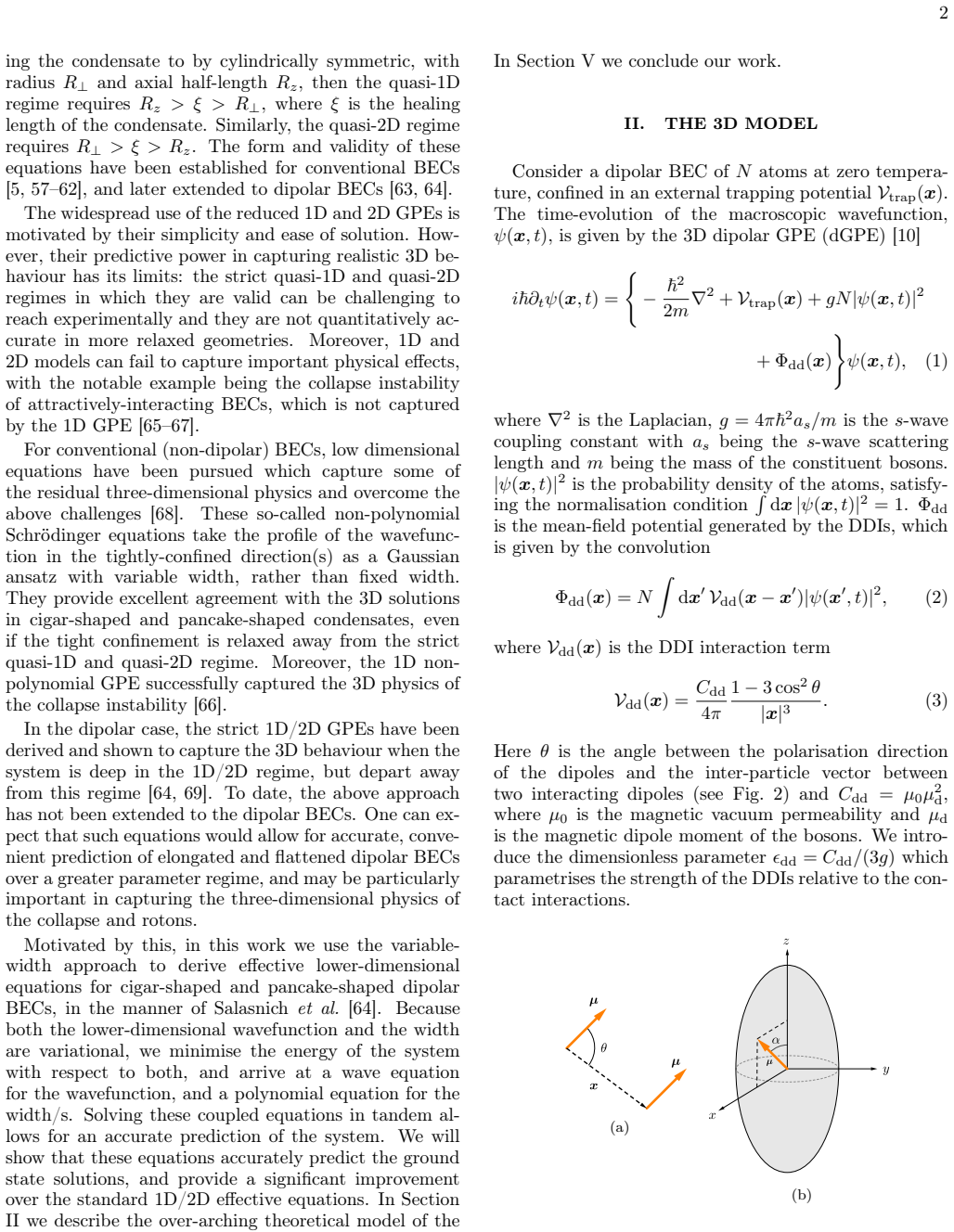
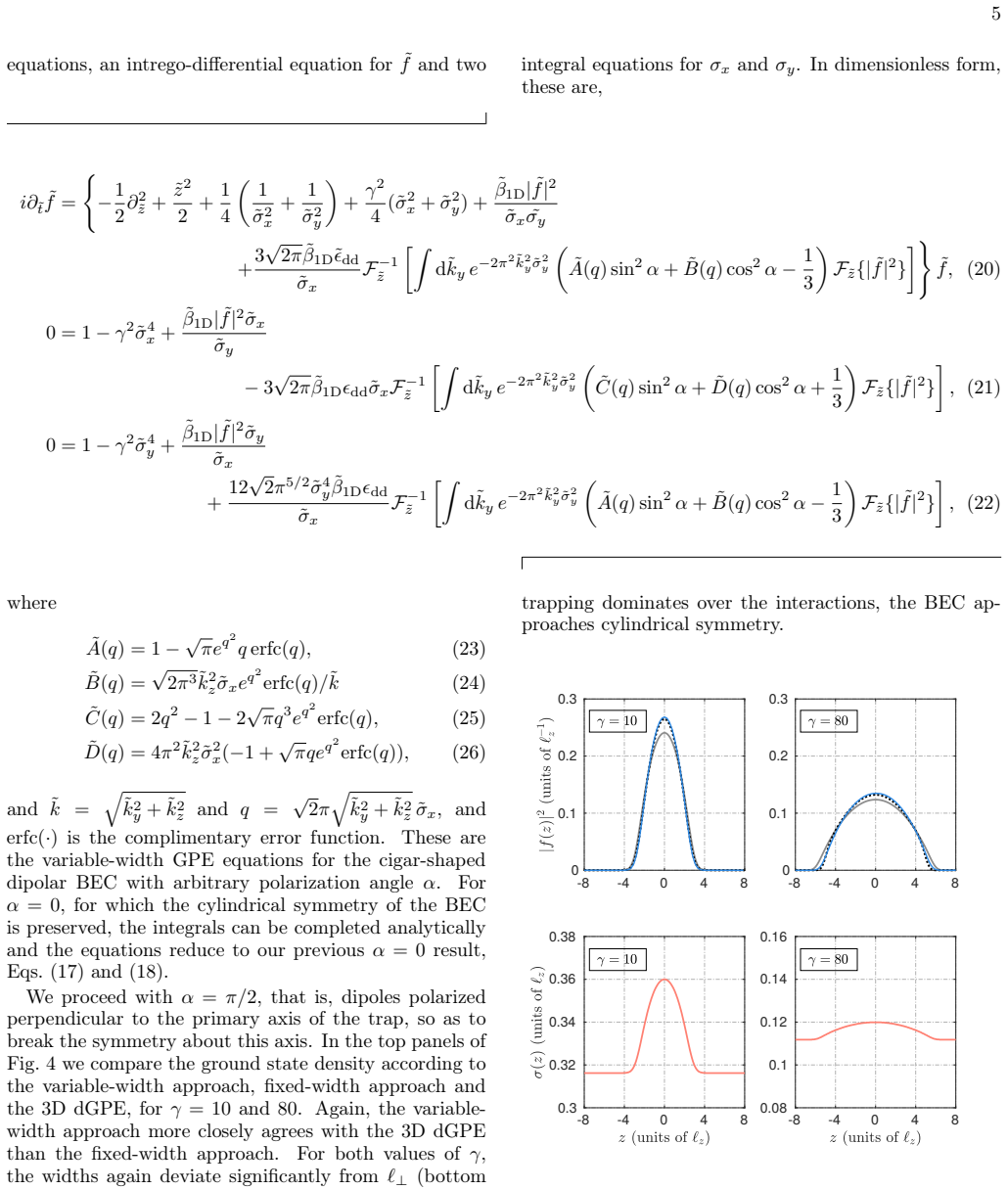
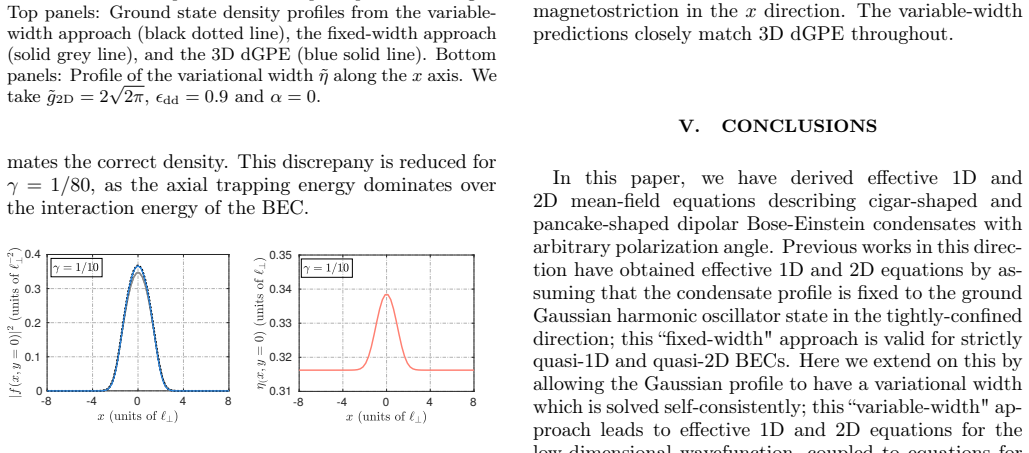
The central claim is that a variational-width Gaussian ansatz, $\psi = f(z,t)\phi(x,y;\sigma(z,t))$ for cigars and $\psi = f(x,y,t)\phi(z;\eta(x,y,t))$ for pancakes, yields effective 1D and 2D dipolar Gross-Pitaevskii equations that stay close to the full 3D solutions far outside the strict quasi-1D/quasi-2D limits. The reduced system is a coupled set: a partial differential equation for the low-dimensional wavefunction together with algebraic equations for the width(s), obtained by varying the action with respect to both. For cigar-shaped condensates with dipoles tilted away from the long axis, the transverse profile is allowed to be anisotropic with two widths $\sigma_x$ and $\sigma_y$, which lets the equations reproduce the dipole-induced magnetostriction; for pancakes the axial width $\eta(x,y,t)$ varies across the plane. In ground-state comparisons against full 3D numerical solutions, the variable-width equations match the density profiles and the transverse aspect ratio as a function of dipole strength for trap ratios $\gamma=80$ and $\gamma=10$ (cigars) and $\gamma=1/10$ and $\gamma=1/80$ (pancakes), with $\epsilon_{dd}=0.9$ and both $\alpha=0$ and $\alpha=\pi/2$ polarizations, and they substantially outperform the fixed-width reduction in the moderately trapped cases.
Load-bearing premise
The results rely on the condensate's profile in the tightly confined direction(s) remaining close to a Gaussian that changes only slowly along the free direction; if the true profile is strongly non-Gaussian or the width varies too rapidly, the reduced equations will not reproduce the 3D behaviour.
Editorial extensions
If this is right
- For cigar-shaped dipolar BECs with dipoles aligned along the long axis, the variable-width 1D equations match 3D ground-state densities closely at trap ratios $\gamma=80$ and $\gamma=10$, where the fixed-width equations visibly deviate.
- For dipoles polarized perpendicular to the long axis, allowing two anisotropic widths $\sigma_x$ and $\sigma_y$ reproduces the 3D transverse aspect ratio as a function of $\epsilon_{dd}$, something a fixed isotropic width cannot do.
- For pancake-shaped BECs, the variable-width 2D equations match 3D densities at $\gamma=1/10$ and $1/80$, correcting the fixed-width underestimate at the moderate ratio.
- Because the reduced equations are far cheaper to solve than the full 3D dGPE, they offer a practical route to studying rotons, solitons, and collapse in elongated or flattened dipolar gases while retaining key 3D effects.
Reading between the lines
- The same reduction, applied to time-dependent problems, could serve as a fast diagnostic for dipole-driven instabilities: the algebraic width equations should develop non-convex or multiple solutions at the onset of collapse or roton softening, signalling instability without a full 3D simulation.
- The two-width cigar equations are a natural candidate for resolving the known disagreement between 3D and standard 1D predictions for dark-soliton oscillations in dipolar gases; the authors flag this as future work, not a demonstrated result.
- Adding beyond-mean-field (Lee-Huang-Yang) corrections to the action before carrying out the variational reduction should yield low-dimensional supersolid models; the paper notes the need for quantum fluctuations but does not implement them.
- The transverse aspect-ratio curves the paper computes are directly measurable, so a focused experiment on in-situ aspect ratio versus dipole strength could test the reduced equations against 3D physics without resolving the full 3D profile.
Signed reviews
Editorial analysis
A structured set of objections, weighed in public.
Referee Report
Summary. This paper derives effective one-dimensional and two-dimensional Gross-Pitaevskii equations for cigar- and pancake-shaped dipolar Bose-Einstein condensates, extending the non-polynomial Schrödinger equation approach to dipolar systems. The authors start from the 3D dipolar GPE action, assume a separable wavefunction whose transverse (1D case) or axial (2D case) profile is a Gaussian with variational width, integrate out the tightly confined direction(s), and obtain a coupled PDE for the low-dimensional wavefunction and algebraic equations for the width(s). They treat the polarization angle generically, but validate numerically only for α=0 and α=π/2, comparing ground-state densities and aspect ratios with full 3D dGPE simulations at trap ratios γ=10,80 (cigar) and γ=1/10,1/80 (pancake), with interaction strength ϵ_dd=0.9 for densities. The central claim is that the variable-width equations agree with the 3D results significantly better than the fixed-width reductions, including in moderately relaxed geometries.
Significance. If the equations are correct and the approximations are under control, this is a genuinely useful contribution: it provides computationally cheaper reduced models for dipolar BECs that capture magnetostriction and variable confinement without fitting any parameters to the 3D benchmarks. The derivation is systematic, based on an action functional, and the comparison is made against independent 3D dGPE solutions. The approach could benefit studies of solitons, rotons, and dynamical phenomena in elongated and flattened dipolar condensates. However, the claimed regime of validity is broader than the presented evidence: the slow-variation approximation is not quantified, the validation is mostly visual and covers a narrow parameter set, and one of the central equations appears to contain a typo. These issues prevent acceptance in the current form.
major comments (4)
- [§III, Eq. (18)] The width equation as printed appears to have a load-bearing typo. For ϵ_dd=0 it reduces to 1−γ²σ̃²+β̃1D|f̃|²=0, i.e. σ̃²=(1+β̃1D|f̃|²)/γ²; with the Fig. 3 parameters (γ=10, β̃1D=2) and a typical |f̃|²≈0.2 this gives σ̃≈0.12, whereas the plotted σ(z) is approximately 0.3–0.38. The standard NPSE-type result is σ̃⁴=(1+...)/γ², and indeed the anisotropic width equations (21)–(22) contain σ̃_x⁴ and σ̃_y⁴. The α=0 limit of Eqs. (21)–(22) therefore cannot reproduce Eq. (18) as written. Please correct Eq. (18) and verify that the numerical code actually solves the corrected equation.
- [§III after Eq. (11); §IV after Eq. (28)] The reduction drops all derivatives of the variational width with respect to the free coordinate, including (∂_zσ)² and ∂_z²σ in the 1D case and the analogous in-plane terms for η in the 2D case. The abstract claims accuracy 'even as the trapping is relaxed away from the strict quasi-one- and quasi-two-dimensional regimes,' but no estimate of the omitted terms is given. At γ=10 the plotted σ(z) varies by roughly 10–20% across the cloud, so the slow-variation assumption is not obviously negligible. Please provide a quantitative estimate of the neglected kinetic-energy contributions over the claimed parameter range (e.g., the ratio of the omitted terms to the retained transverse kinetic energy), and ideally test additional trap ratios closer to γ=1.
- [§III and §IV, Figs. 3–8] The validation is qualitative and narrowly sampled. Density comparisons are shown only for ϵ_dd=0.9, α=0 and α=π/2, and two trap ratios per geometry; the conclusion states agreement 'over a range of trap ratios, polarization angles and interaction strengths,' but the interaction-strength dependence is demonstrated only for the aspect ratio, not for density profiles. The abstract's 'arbitrary polarization angle' is not tested (e.g., α=π/4 is absent). Please include quantitative error measures (relative L2 or H1 density differences, chemical potentials, or peak-density errors) and additional parameter points to substantiate the claims of 'strong agreement' and 'significant improvement' over the fixed-width models.
- [§II, Numerical methods] The reported grid parameters appear inconsistent with the physical sizes of the condensates shown in the figures. For pancake geometries, 256 points with ∆z=0.0008𝓁⊥ give a total z-extent of 0.205𝓁⊥, which is smaller than the axial width η≈0.31–0.35𝓁⊥ displayed in Fig. 6. For cigar geometries with γ=80, ∆z=0.04𝓁⊥ gives a z-extent of about 1.15𝓁z, which may be too small to contain the axial density shown in Fig. 3 if the axis is in units of 𝓁z. Please clarify the actual box sizes or correct the grid-spacing values; if the boxes are indeed that small, the 3D dGPE results used as benchmarks could be affected by truncation.
minor comments (5)
- [§III B] The word 'intrego-differential' should be 'integro-differential'.
- [Fig. 6 caption] The word 'discrepany' should be 'discrepancy'.
- [Eq. (29)] There appears to be a missing '+' sign between '-ℏ²/(4mη²)' and '1/(4mωz²η²)'; as printed, the second term is dimensionally inconsistent and should likely read '+(1/4)mωz²η²'.
- [Eq. (30)] The definition of Φ2D_dd contains a trailing 'f' that seems spurious: the Fourier bracket should act on |f|² only, as in Eq. (32).
- [References] References [22] and [72] are the same work (H.-Y. Lu et al., Phys. Rev. A 82, 023622 (2010)); please merge them.
Circularity Check
No significant circularity: the variable-width reductions are derived from the action functional and benchmarked against independent 3D dGPE simulations.
full rationale
The paper derives effective 1D and 2D dipolar GPEs by substituting a variational Gaussian ansatz into the 3D action functional, integrating out the tightly-confined directions, and applying Euler-Lagrange variation to both the low-dimensional wavefunction and the width parameters. The width equations (Eqs. 18, 21-22, 33) are algebraic consistency conditions from the same action, not fits to the 3D benchmark. The ground-state densities are then compared with separately computed solutions of the full 3D dGPE; no parameter is tuned to those 3D results. The only approximations are the separable Gaussian ansatz and the slow-variation assumption (e.g., ∇²φ ≈ ∇⊥²φ in Section III), which are stated modeling assumptions rather than circular reductions: the comparison to 3D simulation is an independent test. Some prior works by overlapping authors are cited, but they are not load-bearing for the central derivation. The claim that the method remains accurate as trapping is relaxed is a numerical-accuracy claim that could be strengthened by quantifying omitted terms or testing more parameters, but this is a correctness/robustness limitation, not circularity.
Assumptions & free parameters
assumptions (4)
- domain assumption The dipolar BEC is accurately described by the zero-temperature 3D Gross-Pitaevskii equation with contact plus dipole-dipole interactions.
- ad hoc to paper The wavefunction is separable into a low-dimensional part times a normalized Gaussian in the tightly confined direction, with slowly varying width.
- domain assumption The dipolar potential can be treated with a cylindrical real-space cutoff in numerical simulations, with a semi-analytic Fourier transform.
- standard math Euler-Lagrange variation of the reduced action with respect to the width parameters gives the correct effective dynamics.
Cite this review
Pith. "Pith review of Improved low-dimensional wave equations for cigar-shaped and disk-shaped dipolar Bose-Einstein condensates." pith.science (2026). https://pith.science/paper/PEE3IXXO
@misc{pith2026190802395,
  author       = {Pith},
  title        = {Pith review of: Improved low-dimensional wave equations for cigar-shaped and disk-shaped dipolar Bose-Einstein condensates},
  year         = {2026},
  howpublished = {\url{https://pith.science/paper/PEE3IXXO}},
  note         = {Machine review of arXiv:1908.02395}
}
read the original abstract
Within the formalism of the Gross-Pitaevskii equation, we derive effective one- and two-dimensional equations for cigar- and pancake-shaped dipolar Bose-Einstein condensates with arbitrary polarization angle. These are based on an ansatz for the condensate wavefunction whose width in the tightly-confined direction/s is treated variationally. The equations constitute a coupled partial differential for the low-dimensional wavefunction and algebraic equations for the width parameters. This approach accurately predicts the ground state densities of cigar-shaped and pancake-shaped dipolar Bose-Einstein condensates, and gives strong agreement with the three-dimensional results, even as the trapping is relaxed away from the strict quasi-one- and quasi-two-dimensional regimes. This approach offers a significant improvement over the standard one- and two-dimensional reduction.
Figures

Figures from the paper (4 more)


Reference graph
Works this paper leans on
-
[1]
M. H. Anderson, J. R. Ensher, M. R. Matthews, C. E. Wieman, and E. A. Cornell, Science269, 198 (1995)
1995
-
[2]
C. C. Bradley, C. A. Sackett, and R. G. Hulet, Phys. Rev. Lett. 78, 985 (1997)
work page 1997
-
[3]
K. B. Davis, M. O. Mewes, M. R. Andrews, N. J. van Druten, D. S. Durfee, D. M. Kurn, and W. Ketterle, Phys. Rev. Lett.75, 3969 (1995)
1995
-
[4]
G. Modugno, G. Ferrari, G. Roati, R. J. Brecha, A. Si- moni, and M. Inguscio, Science294, 1320 (2001)
work page 2001
-
[5]
L. P. Pitaevskii and S. S.,Bose-Einstein Condensation, 1st ed. (Clarendon Press, 2003)
work page 2003
-
[6]
Griesmaier, J
A. Griesmaier, J. Werner, S. Hensler, J. Stuhler, and T. Pfau, Phys. Rev. Lett.94, 160401 (2005)
2005
-
[7]
M. Lu, N. Q. Burdick, S. H. Youn, and B. L. Lev, Phys. Rev. Lett. 107, 190401 (2011)
2011
-
[8]
Aikawa, A
K. Aikawa, A. Frisch, M. Mark, S. Baier, A. Rietzler, R.Grimm, andF.Ferlaino,Phys.Rev.Lett. 108,210401 (2012)
2012
Show all 72 references
-
[9]
Chomaz, S
L. Chomaz, S. Baier, D. Petter, M. J. Mark, F. Wächtler, L. Santos, and F. Ferlaino, Phys. Rev. X 6, 041039 (2016)
2016
-
[10]
Lahaye, C
T. Lahaye, C. Menotti, L. Santos, M. Lewenstein, and T. Pfau, Reports on Progress in Physics 72, 126401 (2009)
2009
-
[11]
M. A. Baranov, M. Dalmonte, G. Pupillo, and P. Zoller, Chemical Reviews 112, 5012 (2012)
2012
-
[12]
Yi and L
S. Yi and L. You, Phys. Rev. A63, 053607 (2001)
2001
-
[13]
Santos, G
L. Santos, G. V. Shlyapnikov, P. Zoller, and M. Lewen- stein, Phys. Rev. Lett.85, 1791 (2000)
2000
-
[14]
Góral, K
K. Góral, K. Rza¸żewski, and T. Pfau, Phys. Rev. A61, 051601 (2000)
2000
-
[15]
U. R. Fischer, Phys. Rev. A73, 031602 (2006)
2006
-
[16]
Lahaye, T
T. Lahaye, T. Koch, B. Fröhlich, M. Fattori, J. Metz, A. Griesmaier, S. Giovanazzi, and T. Pfau, Nature448, 672 EP (2007)
2007
-
[17]
D. H. J. O’Dell, S. Giovanazzi, and G. Kurizki, Phys. Rev. Lett. 90, 110402 (2003)
2003
-
[18]
Santos, G
L. Santos, G. V. Shlyapnikov, and M. Lewenstein, Phys. Rev. Lett. 90, 250403 (2003)
2003
-
[19]
Chomaz, R
L. Chomaz, R. M. W. van Bijnen, D. Petter, G. Faraoni, S. Baier, J. H. Becher, M. J. Mark, F. Wächtler, L. San- tos, and F. Ferlaino, Nature Physics14, 442 (2018)
2018
-
[20]
Dutta and P
O. Dutta and P. Meystre, Phys. Rev. A 75, 053604 (2007)
2007
-
[21]
R. M. Wilson, S. Ronen, J. L. Bohn, and H. Pu, Phys. Rev. Lett. 100, 245302 (2008)
2008
-
[23]
Tanzi, E
L. Tanzi, E. Lucioni, F. Famà, J. Catani, A. Fioretti, C. Gabbanini, R. N. Bisset, L. Santos, and G. Modugno, Phys. Rev. Lett.122, 130405 (2019)
2019
-
[24]
Böttcher, J.-N
F. Böttcher, J.-N. Schmidt, M. Wenzel, J. Hertkorn, M. Guo, T. Langen, and T. Pfau, Phys. Rev. X9, 011051 (2019)
2019
-
[25]
Chomaz, D
L. Chomaz, D. Petter, P. Ilzhöfer, G. Natale, A. Traut- mann, C. Politi, G. Durastante, R. M. W. van Bijnen, A. Patscheider, M. Sohmen, M. J. Mark, and F. Fer- laino, Phys. Rev. X9, 021012 (2019)
2019
-
[26]
Cuevas, B
J. Cuevas, B. A. Malomed, P. G. Kevrekidis, and D. J. Frantzeskakis, Phys. Rev. A79, 053608 (2009)
2009
-
[27]
B. B. Baizakov, S. M. Al-Marzoug, and H. Bahlouli, Phys. Rev. A92, 033605 (2015)
2015
-
[28]
M. J. Edmonds, T. Bland, R. Doran, and N. G. Parker, New Journal of Physics19, 023019 (2017)
2017
-
[29]
Pedri and L
P. Pedri and L. Santos, Phys. Rev. Lett. 95, 200404 (2005)
2005
-
[30]
Jiang, Z
X. Jiang, Z. Fan, Z. Chen, W. Pang, Y. Li, and B. A. Malomed, Phys. Rev. A93, 023633 (2016)
2016
-
[31]
Huang, L
C. Huang, L. Lyu, H. Huang, Z. Chen, S. Fu, H. Tan, B. A. Malomed, and Y. Li, Phys. Rev. A 96, 053617 (2017)
2017
-
[32]
Tikhonenkov, B
I. Tikhonenkov, B. A. Malomed, and A. Vardi, Phys. Rev. Lett. 100, 090406 (2008)
2008
-
[33]
Raghunandan, C
M. Raghunandan, C. Mishra, K. Łakomy, P. Pedri, L. Santos, and R. Nath, Phys. Rev. A92, 013637 (2015)
2015
-
[34]
H. Chen, Y. Liu, Q. Zhang, Y. Shi, W. Pang, and Y. Li, Phys. Rev. A93, 053608 (2016)
2016
-
[35]
Pawłowski and K
K. Pawłowski and K. Rzążewski, New Journal of Physics 17, 105006 (2015)
2015
-
[36]
T.Bland, M.J.Edmonds, N.P.Proukakis, A.M.Martin, D. H. J. O’Dell, and N. G. Parker, Phys. Rev. A92, 063601 (2015)
2015
-
[37]
Bland, K
T. Bland, K. Pawłowski, M. J. Edmonds, K. Rzążewski, and N. G. Parker, Phys. Rev. A95, 063622 (2017)
2017
-
[38]
M. J. Edmonds, T. Bland, D. H. J. O’Dell, and N. G. Parker, Phys. Rev. A93, 063617 (2016)
2016
-
[39]
B. A. Umarov, N. A. B.Aklan, B.B. Baizakov, andF. K. Abdullaev, Journal of Physics B: Atomic, Molecular and Optical Physics 49, 125307 (2016)
2016
-
[40]
N. R. Cooper, E. H. Rezayi, and S. H. Simon, Phys. Rev. Lett. 95, 200402 (2005)
2005
-
[41]
95,200403(2005)
J.ZhangandH.Zhai,Phys.Rev.Lett. 95,200403(2005)
2005
-
[42]
Yi and H
S. Yi and H. Pu, Phys. Rev. A73, 061602 (2006)
2006
-
[43]
R. M. Wilson, S. Ronen, and J. L. Bohn, Phys. Rev. A 79, 013621 (2009)
2009
-
[44]
M. Abad, M. Guilleumas, R. Mayol, M. Pi, and D. M. Jezek, Phys. Rev. A79, 063622 (2009). 10
2009
-
[45]
Malet, T
F. Malet, T. Kristensen, S. M. Reimann, and G. M. Kavoulakis, Phys. Rev. A83, 033628 (2011)
2011
-
[46]
B. C. Mulkerin, R. M. W. van Bijnen, D. H. J. O’Dell, A. M. Martin, and N. G. Parker, Phys. Rev. Lett.111, 170402 (2013)
2013
-
[47]
Gautam, Journal of Physics B: Atomic, Molecular and Optical Physics 47, 165301 (2014)
S. Gautam, Journal of Physics B: Atomic, Molecular and Optical Physics 47, 165301 (2014)
2014
-
[48]
A. M. Martin, N. G. Marchant, D. H. J. O’Dell, and N. G. Parker, Journal of Physics: Condensed Matter29, 103004 (2017)
2017
-
[49]
R. K. Kumar, L. Tomio, B. A. Malomed, and A. Gam- mal, Phys. Rev. A96, 063624 (2017)
2017
-
[50]
Jia, A.-B
L. Jia, A.-B. Wang, and S. Yi, Phys. Rev. A97, 043614 (2018)
2018
-
[51]
Y. Cai, Y. Yuan, M. Rosenkranz, H. Pu, and W. Bao, Phys. Rev. A98, 023610 (2018)
2018
-
[52]
Prasad, T
S. Prasad, T. Bland, B. C. Mulkerin, N. G. Parker, and A. M. Martin, Phys. Rev. A accepted (2019)
2019
-
[53]
Y. Tang, W. Kao, K.-Y. Li, S. Seo, K. Mallayya, M. Rigol, S. Gopalakrishnan, and B. L. Lev, Phys. Rev. X 8, 021030 (2018)
2018
-
[54]
L. P. Pitaevskii, Journal of Experimental and Theoretical Physics 13, 646 (1961)
1961
-
[55]
E. P. Gross, Il Nuovo Cimento (1955-1965) 20, 454 (1961)
1961
-
[56]
C. J. Pethick and H. Smith,Bose-Einstein Condensation in Dilute Gases , 2nd ed. (Cambridge University Press, 2008)
2008
-
[57]
C. F. Barenghi and N. G. Parker,A Primer on Quantum FLuids (Springer, 2016)
2016
-
[58]
Olshanii, Phys
M. Olshanii, Phys. Rev. Lett.81, 938 (1998)
1998
-
[59]
D. S. Petrov, M. Holzmann, and G. V. Shlyapnikov, Phys. Rev. Lett.84, 2551 (2000)
2000
-
[60]
D. S. Petrov, G. V. Shlyapnikov, and J. T. M. Walraven, Phys. Rev. Lett.85, 3745 (2000)
2000
-
[61]
Menotti and S
C. Menotti and S. Stringari, Phys. Rev. A66, 043610 (2002)
2002
-
[62]
Muñoz Mateo and V
A. Muñoz Mateo and V. Delgado, Phys. Rev. A 74, 065602 (2006)
2006
-
[63]
N. G. Parker and D. H. J. O’Dell, Phys. Rev. A78, 041601 (2008)
2008
-
[64]
Y. Cai, M. Rosenkranz, Z. Lei, and W. Bao, Phys. Rev. A 82, 043623 (2010)
2010
-
[65]
V. M. Pérez-García, H. Michinel, J. I. Cirac, M. Lewen- stein, and P. Zoller, Phys. Rev. A56, 1424 (1997)
1997
-
[66]
Salasnich, A
L. Salasnich, A. Parola, and L. Reatto, Phys. Rev. A 66, 043603 (2002)
2002
-
[67]
N. G. Parker, S. L. Cornish, C. S. Adams, and A. M. Martin, Journal of Physics B: Atomic, Molecular and Op- tical Physics 40, 3127 (2007)
2007
-
[68]
Salasnich, A
L. Salasnich, A. Parola, and L. Reatto, Phys. Rev. A 65, 043614 (2002)
2002
-
[69]
Baillie and P
D. Baillie and P. B. Blakie, New Journal of Physics17, 033028 (2015)
2015
-
[70]
Fleck, J
J. Fleck, J. Morris, and M. Feit, Appl. Phys. 10, 129 (1976)
1976
-
[71]
Fleck, J
J. Fleck, J. Morris, and E. Bliss, IEEE J. Quantum Electron 14, 353 (1978)
1978
-
[72]
H.-Y. Lu, H. Lu, J.-N. Zhang, R.-Z. Qiu, H. Pu, and S. Yi, Phys. Rev. A82, 023622 (2010)
2010
-
[73]
Weller, J
A. Weller, J. P. Ronzheimer, C. Gross, J. Esteve, M. K. Oberthaler, D. J. Frantzeskakis, G. Theocharis, and P. G. Kevrekidis, Phys. Rev. Lett.101, 130401 (2008)
2008
Reviewed August 14, 2026 · model on record in the stance chip above.
Discussion (0). Continue with ORCID to comment.